化学学报 >

0 20251210 - 20251210

DOI: https://doi.org/10.6023/A25100334

研究论文

等离子体辅助合成ZnO:Er3+/Yb3+分级纳米棒及其上转换发光的三模态光学测温性能

  • 刘庆 ,
  • 陈双龙 ,
  • 王秋实 ,
  • 王雪娇 ,
  • 刘才龙
展开
  • a渤海大学 物理科学与技术学院 锦州 121013;
    b渤海大学 材料与环境工程学院 锦州 121013;
    c聊城大学 物理科学与信息工程学院 聊城 252000

网络出版日期: 2025-12-10

基金资助

国家重点研发计划项目(批准号:2023YFA1406200)、国家自然科学基金(批准号:11874174)、 兴辽英才青年拔尖人才(批准号:XLYC2403017)和辽宁省教育厅面上项目(批准号:JYTMS20231627)资助的课题.

Plasma-assisted synthesis of ZnO:Er3+/Yb3+ hierarchical nanorods and their upconversion luminescence-based trimodal optical thermometry properties

  • Liu Qing ,
  • Chen Shuanglong ,
  • Wang Qiushi ,
  • Wang Xuejiao ,
  • Liu Cailong
Expand
  • aBohai University, School of Physical Science and Technology, Jinzhou 121013;
    bBohai University, School of Materials and Environmental Engineering, Jinzhou 121013;
    cLiaocheng University, School of Physical Science and Information Engineering, Liaocheng 252000

Online published: 2025-12-10

Supported by

National Key Research and Development Program of China (Grant No. 2023YFA1406200), the National Natural Science Foundation of China (Grant Nos. 11874174), the Xing Liao Ying Cai Program for Young Top-notch Talents (Grant No. XLYC2403017) and the General Program of the Education Department of Liaoning Province (Grant No. JYTMS20231627).

摘要

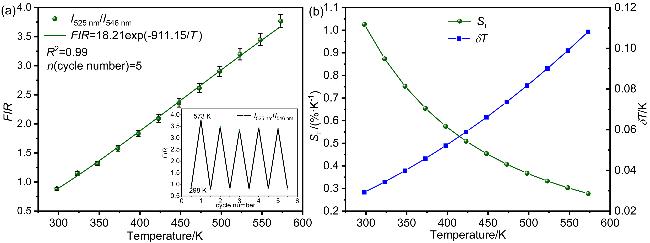
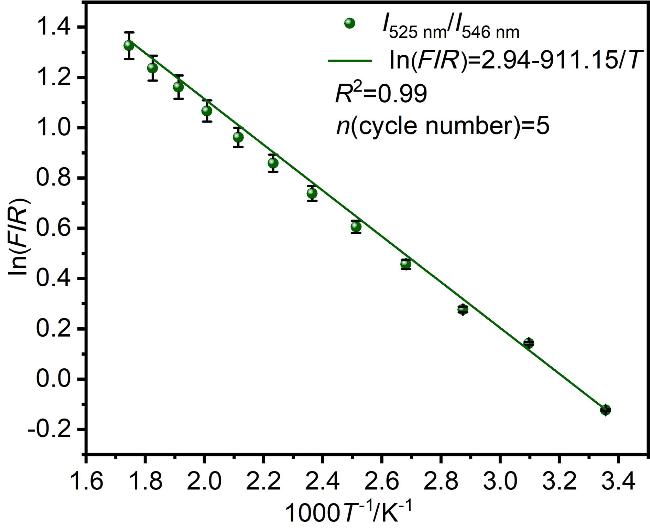
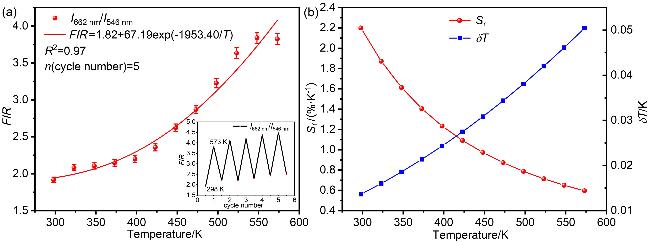
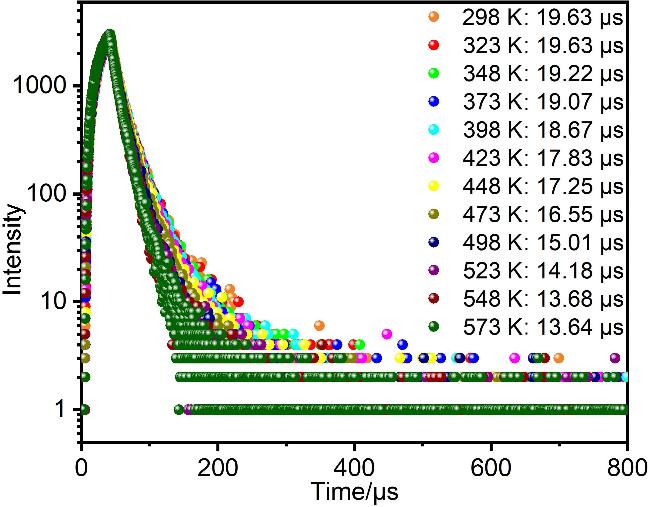
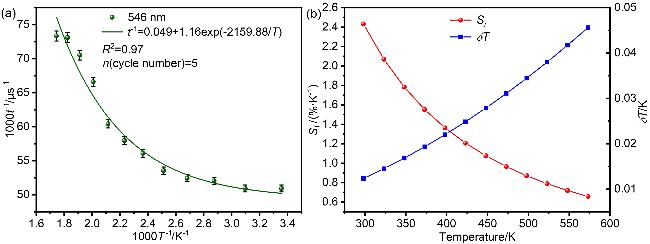
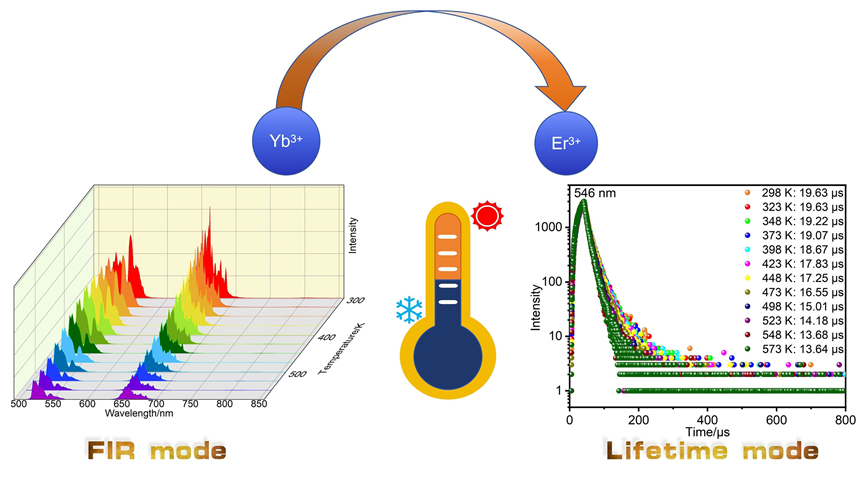
采用直流电弧等离子体法, 以Zn粉, Er2O3和Yb2O3粉末为反应原料, 在氧气环境中成功制备了ZnO:Er3+/Yb3+分级纳米棒. 通过多种表征手段(XRD、Raman、XPS、SEM、TEM和光致发光光谱), 系统分析了样品的晶体结构, 形貌和上转换发光性能. 在980 nm激光激发下, 样品在525 nm、546 nm以及662 nm呈现了发光峰. 变温发光(298 K~573 K)测试表明, 基于热耦合能级(2H11/24S3/2)和非热耦合能级(4S3/24F9/2)荧光强度比, 其最大相对灵敏度分别可达到1.03 %K-1和2.20 %K-1, 而基于4S3/2能级荧光寿命的最大相对灵敏度更是高达2.43 % K-1. 本研究利用单一发光中心实现了三模态光学测温, 证明该分级纳米棒在宽温度范围内具有优异的信号区分度和高灵敏度, 在光学测温领域展现出重要应用潜力.

本文引用格式

刘庆 , 陈双龙 , 王秋实 , 王雪娇 , 刘才龙 . 等离子体辅助合成ZnO:Er3+/Yb3+分级纳米棒及其上转换发光的三模态光学测温性能[J]. 化学学报, 0 : 20251210 -20251210 . DOI: 10.6023/A25100334

Abstract

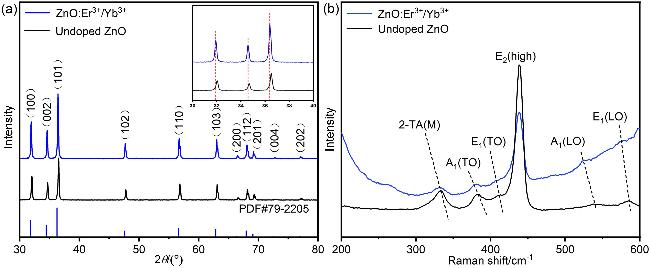
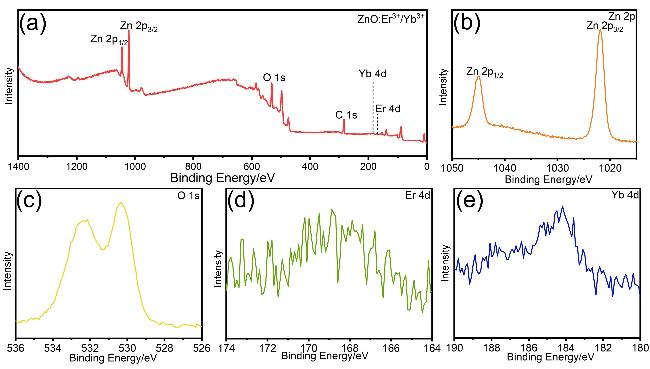
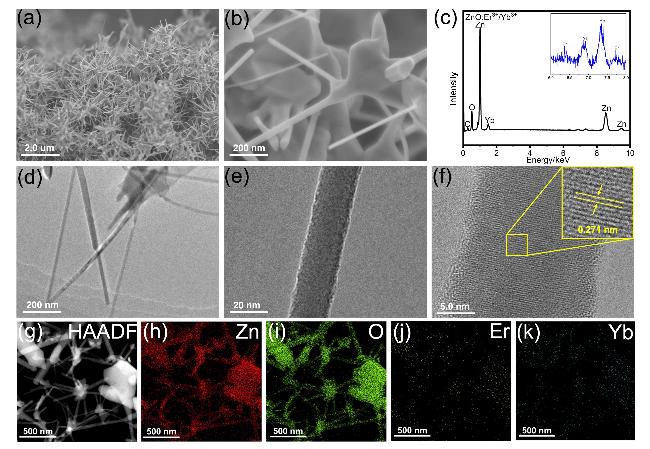
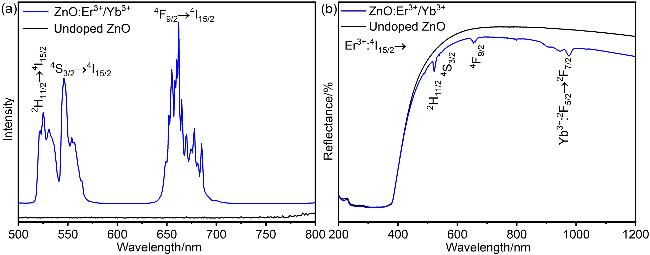
Through the DC arc discharge plasma method, ZnO:Er3+/Yb3+ hierarchical nanorod optical temperature-sensing materials were successfully prepared using ZnO powder, Er2O3 powder, and Yb2O3 powder as raw materials in an oxygen (O2) atmosphere. The crystal structure, morphological characteristics, and upconversion luminescence properties of the samples were systematically characterized through XRD, Raman, XPS, SEM, TEM, and photoluminescence analyses. Both XRD and Raman analyses indicated the absence of secondary phases in the samples, and the XRD and Raman spectra of ZnO:Er3+/Yb3+ exhibited a low-angle shift compared to undoped ZnO, confirming the substitution of Er or Yb ions at the main Zn lattice sites. XPS confirmed the coexistence of Zn, O, Er, and Yb elements, while EDS quantitative analysis revealed an atomic ratio of Zn:O:Er:Yb as 47.22:46.47:0.81:4.33. SEM results showed that the hierarchical nanorod structure consists of a robust main trunk and numerous radial branches grown from the main surface. Each nanorod maintained a uniform diameter along its entire length, with an average diameter ranging from 20 nm to 45 nm and a length of approximately 500 nm. HRTEM revealed that the adjacent lattice fringe spacing of the branched nanorods was about 0. 271 nm, corresponding to the (002) plane spacing of wurtzite-type ZnO, confirming their well-crystallized single-crystal structure. This result also indicated that the [001] crystal orientation is the primary growth direction of the ZnO nanorods. Photoluminescence studies identified characteristic emission peaks at 525 nm, 546 nm, and 662 nm in the visible region, attributed to the intra-4f electronic transitions of Er3+ ions. Through temperature-dependent luminescence tests from 298 K to 573 K, the maximum relative sensitivities of the fluorescence intensity ratios for the thermally coupled levels (2H11/2 and 4S3/2) and non-thermally coupled levels (4S3/2 and 4F9/2) were determined to be 1.03 % K-1 and 2.20 % K-1, respectively, while the maximum relative sensitivity of the 4S3/2 level fluorescence lifetime was 2.43 % K-1. In this study, a single luminescent center is used to achieve three-mode optical temperature measurement. The ZnO:Er3+/Yb3+ hierarchical nanorod optical temperature-sensing material demonstrated excellent signal discrimination and high sensitivity across a broad temperature range, highlighting its significant potential for applications in optical temperature sensing.

参考文献

[1] Xiang G.; Liu X.; Zhang J.; Liu Z.; Liu W.; Ma Y.; Jiang S.; Tang X.; Zhou X.; Li L.; Jin Y.Inorg. Chem. 2019, 58, 8245.
[2] Wei Z.; Liu G.; Dong X.; Wang J.; Yu W.Acta Chimica Sinica, 2014, 72, 257(in Chinese). (魏忠杰, 刘桂霞, 董相廷, 王进贤, 于文生. 化学学报, 2014, 72, 257.)
[3] Huang Q. Acta Chimica Sinica, 2020, 78, 968(in Chinese). (黄清明. 化学学报, 2020, 78, 968.)
[4] Hu X.; Shang X.; Huang P.; Zheng W.; Chen X.Acta Chimica Sinica, 2022, 80, 244(in Chinese). (胡晓柯, 商晓颖, 黄萍, 郑伟, 陈学元. 化学学报, 2022, 80, 244.)
[5] Sekulic M.; Dordevic V.; Ristic Z.; Medic M.; Dramicanin M. D.Adv. Opt. Mater. 2018, 6, 1800552.
[6] Wang C.; Jin Y.; Yuan L.; Wu H.; Ju G.; Li Z.; Liu D.; Lv Y.; Chen L.; Hu Y.Chem. Eng. J. 2019, 374, 992.
[7] Yang K.; Xu R.; Meng Q.; Chen L.; Zhao S.; Shen Y.; Xu S.J. Lumin. 2020, 222, 117145.
[8] Dogan A.; Erdem M.; Esmer K.; Eryurek G.J. Non-Cryst.Solids. 2021, 571, 121055.
[9] Cheng Y.; Gao Y.; Lin H.; Huang F.; Wang Y.J. Mater. Chem. C. 2018, 6, 7462.
[10] Wu M.; Deng D.; Ruan F.; Chen B.; Xu S. Chem. Eng. J. 2020, 396, 125178.
[11] Xu H.; Yu J.; Hu Q.; Han Q.; Wu W.J. Phys. Chem. Lett. 2022, 13, 962.
[12] Wang X.; Kong X.; Yu Y.; Sun Y.; Zhang H.J. Phys. Chem. C. 2007, 111, 15119.
[13] Hu J.; Zhang X.; Zheng H.; Lu F.; Peng X.; Wei R.; Hu F.; Guo H.Ceram. Int. 2022, 48, 3051.
[14] Cai Z.; Kang S.; Huang X.; Song X.; Xiao X.; Qiu J.; Dong G.J. Mater. Chem. C. 2018, 6, 9932.
[15] Feng M.; Li L.; Guo J.; Wang Q.; Pang T.; Guo H. J. Am. Ceram. Soc. 2024, 107, 4766.
[16] Jiang Y.; Tong Y.; Chen S.; Zhang W.; Hu F.; Wei R.; Guo H.Chem. Eng. J. 2021, 413, 127470.
[17] Cheng Z. L.; Meng M. Z.; Wang J. Y.; Li Z. Y.; He J.; Liang H.; Qiao X.; Liu Y. L.; Ou J.Nanoscale. 2023, 15, 11179.
[18] Liu S. Y.; Gao S.; Gao D.; Chen X.; Wang L.; Song W. B.; Zhu Y.; Yin H.; Tan J.Bull. Mater. Sci. 2025, 48, 76.
[19] Zhang H.; Liang Y.; Yang H.; Liu S.; Li H.; Gong Y.; Chen Y.; Li G.Inorg. Chem.2020, 59, 14337.
[20] Xue J. P.; Yu Z. K.; Noh H. M.; Lee B. R.; Choi B. C.; Park S. H.; Jeong J. H.; Du P.; Song M. J.Chem. Eng. J. 2021, 415, 128977.
[21] Chen D. Q.; Wan Z. Y.; Zhou Y.; Zhou X. Z.; Yu Y. L.; Zhong J. S.; Ding M. Y.; Ji Z. G.ACS Appl. Mater. Interfaces. 2015, 7, 19484.
[22] Tong Y.; Zhang W. N.; Wei R. F.; Chen L. P.; Guo H.Ceram. Int. 2021, 47, 2600.
[23] Gao Y.; Cheng Y.; Hu T.; Ji Z.; Lin H.; Xu J.; Wang Y. J.Mater. Chem. C. 2018, 6, 11178.
[24] Kumar V.; Pandey A.; Swami S. K.; Ntwaeaborwa O. M.; Swart H. C.; Dutta V.J. Alloys Compd. 2018, 766, 429.
[25] Li J.; Liu X.; Liu S.Mater. China 2024, 43, 1118(in Chinese). (李敬远, 刘欣, 刘胜杰, 中国材料进展, 2024, 43, 1118.)
[26] Meng X.; Liu C.; Wu F.; Li J.J. Colloid Interface Sci. 2011, 358, 334.
[27] Llusca M.;Lopez-Vidrier, J.; Antony, A.; Hernandez, S.; Garrido, B.; Bertomeu,[J].Thin Solid Films 2014, 562, 456.
[28] Tiwari S. P.; Mahata M. K.; Kumar K.; Rai V. K.Spectrochim. Acta, Part A 2015, 150, 623.
[29] Liu Y.; Yang Q.; Xu C. J. Appl. Phys. 2008, 104, 064701.
[30] Fuentes S.; Espinoza D.; Leon J.J. Nanosci. Nanotechnol. 2021, 21, 5714.
[31] Meng S.; Wang M.; Lü B.; Xue Q.; Yang Z.Acta Chimica Sinica, 2019, 77, 1184.(in Chinese). (孟双艳, 王明明, 吕柏霖, 薛群基, 杨志旺. 化学学报, 2019, 77, 1184.)
[32] Tong H.;D, Y.; L, L.;Tao, Z.; Shen, L.; Zhang, X.Acta Chimica Sinica, 2025, 83, 110(in Chinese). (佟浩, 邓玉雪, 李磊, 陶铮, 申来法, 张校刚. 化学学报, 2025, 83, 110.)
[33] Zhang X.; Zhang H.; Wei L.; Zhang Y.; Zhang B.J. Mater. Sci: Mater. Electron. 2018, 29, 15060.
[34] Cao B. S.; Rino L.; Wu J. L.; He Y. Y.; Zhang Z. Y.; Feng Z. Q.; Dong B. Sens.Actuators, A, 2017, 268, 110.
[35] Tabanli S.; Eryurek G.Sens. Actuators, A.2019, 285, 448.
[36] Anjana R.; Subha P. P.; Kurias M. K.; Jayaraj M. K.Methods Appl. Fluoresc. 2017, 6, 015005.
[37] Elleuch R.; Salhi R.; Deschanvres J. L.; Maalej R.J. Appl. Phys. 2015, 117, 053104.
[38] Jayachandraiah C.; Krishnaiah G.Adv. Mater. Lett. 2015, 6, 743.
[39] Zhang R.; Yin P. G.; Wang N.; Guo L.Solid State Sci. 2009, 11, 865.
[40] Jin Y.; Cui Q.; Wen G.; Wang Q.; Hao J.; Wang S.; Zhang J.J. Phys. D: Appl. Phys. 2009, 42, 215007.
[41] Ahmad I.Sep. Purif. Technol. 2019, 227, 115726.
[42] Senapati S.; Nanda K. K.J. Mater. Chem. C 2017, 5, 1074.
[43] Shi L.; Bao K.; Cao J.; Qian Y.CrystEngComm 2009, 11, 1762.
[44] Li Z.; Huang Y.; Wang X.; Wang D.; Wang X.; Han F.J. Mater. Sci. Technol. 2017, 33, 864.
[45] Wang S.; Yu Y.; Zuo Y.; Li C.; Yang J.; Lu C.Nanoscale 2012, 4, 5895.
[46] Mujtaba J.; Sun H.; Fang F.; Ahmad M.; Zhu J.RSC Adv. 2015, 5, 56232.
[47] Han H.; Wang J.; Xu C.; Wang Q.J. Alloys Compd. 2022, 907, 164461.
[48] Hu Q.; Tong G. Wu,W.; Liu, F.; Qian, H.; Hong, D.CrystEngComm 2013, 15, 1314
[49] Llusca M.;Lopez-Vidrier, J.; Lauzurica, S.; Sanchez-Aniorte, M. I.; Antony, A.; Molpeceres, C.; Hernandez, S.; Garrido, B.; Bertomeu,[J].J. Lumin. 2015, 167, 101.
[50] Sun Y.; Zou R.; Li W.; Tian Q.; Wu J.; Chen Z.; Hu J.CrystEngComm 2011, 13, 6107.
[51] Huang Q.; Yu H.; Zhang X.; Yu J.Acta Chimica Sinica, 2013, 71, 1071.(in Chinese). (黄清明, 俞瀚, 张新奇, 俞建长. 化学学报, 2013, 71, 1071.)
[52] Suo H.; Guo C.; Li T.J. Phys. Chem. C 2016, 120, 2914.
[53] Xiang G.; Liu X.; Xia Q.; Jiang S.; Zhou X.; Li L.; Jin Y.; Ma L.; Wang X.; Zhang J.Inorg. Chem. 2020, 59, 11054.
[54] Rai V. K.; Rai S. B.Spectrochim. Acta, Part A 2007, 68, 1406.
[55] Gorohova E.; Basyrova L.; Venevtsev I.; Alekseeva I.; Khubetsov A.; Dymshits O.; Baranov M.; Tsenter M.; Zhilin A.; Eron’ko S.; Oreschenko E.J. Phys. : Conf. Ser. 2020, 1695, 012041.
[56] Chen X.; Zhang Y.; Bu Y.; Chen Y.; Chen Y.; Fu J.; Li J.; Deng D.J. Lumin.2023, 261, 119907.
[57] Li Y.; Yang J.; Wang S.; Zheng J.; Zhao Y.; Zhou H.; Liu Y.J. Synth. Cryst. 2024, 53, 649(in Chinese). (李玉强, 杨健, 王帅, 郑基源, 赵炎, 周恒为, 刘玉学, 人工晶体学报, 2024, 53, 649. )
[58] Li L.; Guo C.; Jiang S.; Agrawal D. K.; Li T.RSC Adv. 2014, 4, 6391.
[59] Yu X.; Li H.; Gao B.; Jiang Y.; Li X.; Zheng R.; Wu H.; Song Z.; Fan J.; Zhao P.Mater. Rev. 2022, 36, 21050128(in Chinese). (于晓晨, 李华健, 高博扬, 蒋银林, 李小杰, 郑荣芳, 吴涵, 宋泽钰, 樊继斌, 赵鹏, 材料导报, 2022, 36, 21050128. )
[60] Zhang H.; Dong X.; Jiang L.; Yang Y.; Cheng X.; Zhao H.J. Mol. Struct. 2020, 1206, 127665.
[61] Cui Z.; Zhao L.; Wang T.; Cao J.; Qiao Y.; Pi C.; Fang Z.; Qiu J.; Xu X.; Yu X.CrystEngComm 2022, 24, 1764.
[62] Chen Y.; Bu Y.; Chen X.; Zhang Y.; Shen Y.; Zhou L.; Deng D. J. Lumin. 2022, 250, 119121.
[63] Guo J.; Shen Y.; Chen L.; Deng D.; Xu S.J. Lumin. 2024, 266, 120331.
[64] Zhang M.; Zhai X.; Lei P.; Yao S.; Xu X.; Dong L.; Du K.; Li C.; Feng J.; Zhang H. J. Lumin. 2019, 215, 116632.
[65] Chen D.; Wan Z.; Zhou Y.; Huang P.; Zhong J.; Ding M.; Xiang W.; Liang X.; Ji Z. J. Alloys Compd. 2015, 638, 21.
[66] He D.; Guo C.; Jiang S.; Zhang N.; Duan C.; Yin M.; Li T.RSC Adv. 2015, 5, 1385.
[67] Chen D.; Liu S.; Xu W.; Li X.J. Mater. Chem. C 2017, 5, 11769.
[68] Zhang J.; Li X.; Chen G.Mater. Chem. Phys. 2018, 206, 40.
[69] Zhang J.; Ji B.; Chen G.; Hua Z.Inorg. Chem. 2018, 57, 5038.
文章导航

/