研究论文

氮掺杂中空碳球负载钴纳米粒子催化氨硼烷制氢

  • 赵颖 ,
  • 李修刚 ,
  • 卢章辉
展开
  • a江西师范大学 化学与材料学院/江西省教育厅绿色催化重点实验室 南昌 330022
    b铜仁学院 材料与化学工程学院 铜仁 554300

收稿日期: 2025-09-28

  网络出版日期: 2026-01-12

基金资助

国家自然科学基金(22162014),江西省自然科学基金(20252BAC250037),贵州省自然科学基金(ZK[2023]466)和铜仁市博士人才项目([2023]7).

N-doped hollow carbon spheres supported Co nanoparticles for hydrogen production from ammonia borane

  • Ying Zhao ,
  • Xiugang Li ,
  • Zhang-Hui Lu
Expand
  • aCollege of Chemistry and Materials, Jiangxi Normal University, Nanchang 330022, China
    bCollege of Material and Chemical Engineering, Tongren University, Tongren 554300

Received date: 2025-09-28

  Online published: 2026-01-12

Supported by

National Natural Science Foundation of China (22162014), Jiangxi Provincial Natural Science Foundation (20252BAC250037), Natural Science Foundation of Guizhou Province (ZK[2023]466), and Doctoral Talents Project of Tongren City (No. [2023]7).

摘要

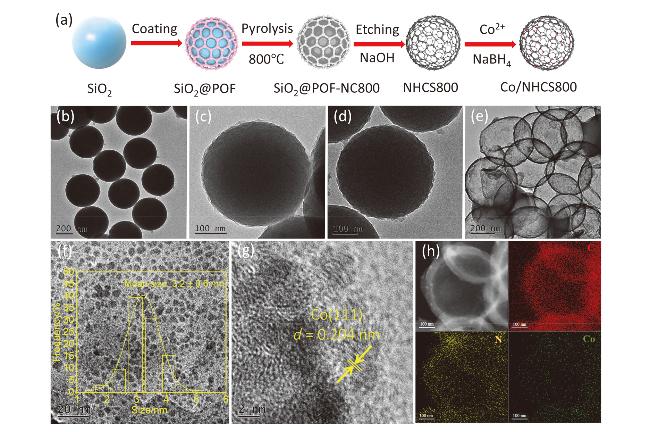
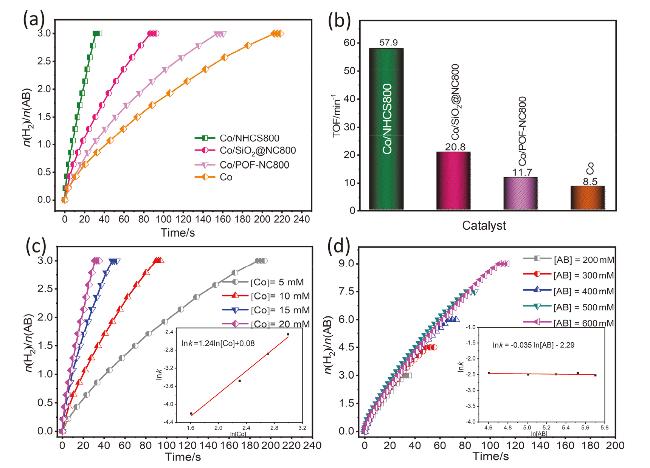
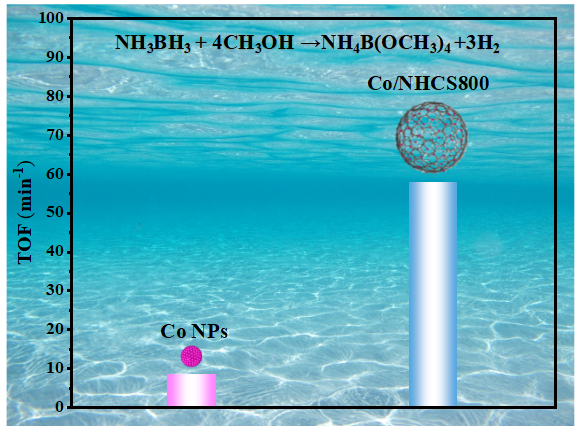
氮掺杂中空碳材料因其较低的密度、较高的比表面积、高效的传质性能以及丰富的氮物种等结构优势, 被认为是一种极具潜力的催化剂载体, 能够有效稳定并分散金属活性中心. 本研究以二氧化硅(SiO2)纳米球为硬模板, 首次采用溶剂热法在模板表面构建卟啉基有机框架(POFs)包覆层, 再通过高温热解结合碱刻蚀处理, 成功合成出具有中空结构的氮掺杂碳球(NHCS). 通过系统研究热解温度对材料物理和化学性质的影响, 发现800 °C热解所得NHCS800样品具有最优的结构稳定性以及最丰富的表面缺陷位点. 通过简单的浸渍还原法, 将Co纳米粒子均匀分散在载体表面, 制得Co/NHCS800催化剂. 表征结果显示, 催化剂中钴纳米粒子的平均尺寸约为2.5 nm, 显著小于无载体存在时形成的钴颗粒. 在催化氨硼烷醇解制氢反应中, Co/NHCS800表现出优异的催化性能, 其转换频率(TOF)值高达57.9 min-1. 该高催化性能可归因于载体较大的比表面积、金属纳米粒子的高度分散性以及氮物种与金属间存在的强电子转移效应.

本文引用格式

赵颖 , 李修刚 , 卢章辉 . 氮掺杂中空碳球负载钴纳米粒子催化氨硼烷制氢[J]. 化学学报, 2025 : 0 . DOI: 10.6023/A25090327

Abstract

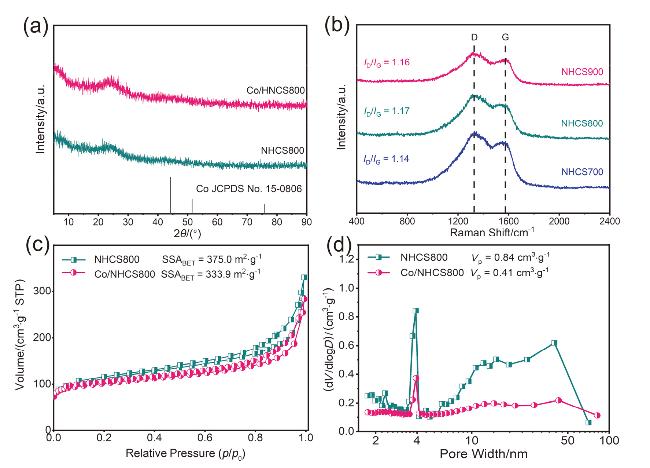
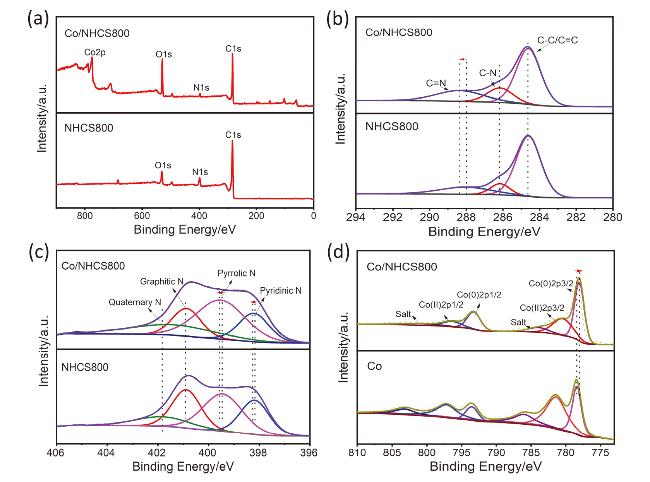
Nitrogen-doped hollow carbon materials are regarded as a highly promising catalyst support, owing to their structural advantages such as low density, high specific surface area, efficient mass transfer performance, and abundant nitrogen species, which collectively contribute to effectively stabilizing and dispersing metal active sites. In this work, for the first time, a nitrogen-doped hollow carbon spheres (NHCS) was synthesized by coating SiO2 nanospheres with a porphyrin-based organic frameworks (POFs) via a solvothermal method, followed by high-temperature pyrolysis and alkaline etching treatment. The influence of pyrolysis temperature on the physical and chemical properties of the material was systematically investigated. Results indicate that NHCS800, pyrolyzed at 800 °C, exhibited optimal structural stability and the most abundant surface defect sites. The Co/NHCS800 catalyst was prepared by uniformly dispersing cobalt nanoparticles on the support surface via a simple impregnation-reduction method. Characterization results revealed that the average size of the cobalt nanoparticles in the catalyst was approximately 2.5 nm, which was significantly smaller than that of cobalt particles formed in the absence of the support. For the catalytic dehydrogenation of ammonia borane (AB) via methanolysis, the Co/NHCS800 catalyst was ultrasonically dispersed in a single-neck round-bottom flask containing 5 mL of methanol. The flask was fixed in a constant-temperature water bath maintained at 25 °C. Once the temperature stabilized, 1.0 mmol of AB was rapidly added under vigorous stirring. The time required to generate every 5 mL of hydrogen gas was recorded until gas evolution ceased. The Co/NHCS800 catalyst demonstrated a remarkably high turnover frequency (TOF) value of 57.9 min⁻¹ for the methanolysis of ammonia borane. The catalysts were comprehensively characterized throughout the synthesis process using scanning electron microscopy (SEM), transmission electron microscopy (TEM), X-ray diffraction (XRD), Fourier transform infrared spectroscopy (FT-IR), Raman spectroscopy, and nitrogen adsorption-desorption measurements to monitor their morphological and structural evolution. The interaction between the metal and support was further investigated by X-ray photoelectron spectroscopy (XPS). The analysis indicates that the superior catalytic activity can be attributed to the large specific surface area of the support and the presence of ultrafine metal nanoparticles, as well as the strong electron transfer effect between nitrogen species and metal atoms.

参考文献

[1] Schlapbach L.; Züttel A.Nature 2001, 414, 8234.
[2] Demirci U. B.; Miele, P. Energy Environ. Sci.2009, 2, 627.
[3] Turner J. A.Science 2004, 305, 972.
[4] Yadav M.; Xu Q.Energy Environ. Sci.2012, 5, 9698.
[5] Sakintuna B.;Lamari-Darkrim, F.; Hirscher, M. Int. J. Hydrogen Energy 2007, 32, 1121.
[6] David E.J. Mater.Process Technol. 2005, 162, 169.
[7] Umegaki T.; Yan J. M.; Zhang X. B.; Shioyama H.; Kuriyama N.; Xu Q.Int. J. Hydrogen Energy 2009, 34, 2303.
[8] Zhang A.; Yao Q.; Lu, Z. Acta Chim. Sinica,2021, 79, 885(in Chinese). (张安琪, 姚淇露, 卢章辉, 化学学报, 2021, 79, 885.)
[9] Liu Y.; Guan H.; Zhang J.; Zhao Y.; Yang J. H.; Zhang B.Int. J.Hydrogen Energy 2018, 43, 2754.
[10] Shi Y.; Xiang Z.; Deng J.; Nan J.; Zhang B. Mater. Lett.2019, 237, 61.
[11] Jiang H. L.; Xu Q. Catal. Today2011, 170, 56
[12] Demirci U. B.; Garin F.J. Alloys Compd. 2008, 463, 107.
[13] Feng Y.; Zhou X.; Yang J. H.; Gao X.; Yin L.; Zhao Y.; Zhang B.ACS Sustain. Chem. Eng. 2020, 8, 2122.
[14] Sun Q.; Wang N.; Bai R.; Hui Y.; Zhang T.; David A. D.; Zhang P.; Song L.; Miao S.; Yu J.Adv. Sci. 2019, 6, 1802350.
[15] Luo W.; Cheng W.; Hu M.; Wang Q.; Cheng X.; Zhang Y.; Wang Y.; Gao D.; Bi J.; Fan G.ChemSusChem. 2019, 12, 535.
[16] Li J.; Cai T.; Feng Y.; Liu X.; Wang N.; Sun, Q. Sci. China Chem.2024, 67, 2911.
[17] Çalışkan S.; Zahmakıran M.; Özkar, S. Appl. Catal. B: Environ.2010, 93, 387.
[18] Sun J. K.; Zhan W. W.; Akita T.; Xu Q.J. Am. Chem. Soc. 2015, 137, 7063.
[19] Özhava D.; Özkar S.Appl. Catal. B: Environ. 2016, 181, 716.
[20] Sun Q.; Wang N.; Zhang T.; Bai R.; Mayoral A.; Zhang P.; Zhang Q.; Terasaki O.; Yu, J. Angew. Chem. Int. Ed.2019, 58, 18570.
[21] Wang N.; Sun Q.; Zhang T.; Mayoral A.; Li L.; Zhou X.; Xu J.; Zhang P.; Yu, J. J. Am. Chem. Soc.2021, 143, 6905.
[22] Fang Y.; Li J. L.; Togo T.; Jin F. Y.; Xiao Z. F.; Liu L. J.; Drake H.; Lian X. Z.; Zhou H. C. Chem.2018, 4, 555.
[23] Guan S.; Yuan Z.; Zhao S.; Zhuang Z.; Zhang H.; Shen R.; Fan Y.; Li B.; Wang D.; Liu, B. Angew. Chem. Int. Ed.2024, 136, e202408193.
[24] Onat E.; Celik F. A.; Şahin Ö.; Karabulut E.; İZGİ, M. S. Chem. Eng. J.2024, 497, 154593.
[25] Wan C.; Li R.; Wang J.; Cheng D. G.; Chen F.; Xu L.; Gao M.; Kang Y.; Eguchi M.; Yamauchi, Y. Angew. Chem. Int. Ed.2024, 63, e202404505.
[26] Zhou A.; Cao Y.; Zhao N.; Jin Y.; Li Y.; Yang L.; Zhang C.; Gao Y.; Zhang Z.; Zhang Y.; Xie W.J. Am. Chem. Soc. 2024, 146, 33002
[27] Li J.; Feng Y.; Li X.; Zhang T.; Liu X.; Wang N.; Sun Q.ACS Catal. 2024, 14, 14665.
[28] Long J.; Wu H.; Liu Y.; Ding Y.; Yao Q.; Metin O.; Lu Z. cMat.2024, 1, e10.
[29] Li X.; Yao L.; Yao Q.; Xia J.; Lu, Z. H. Inorg. Chem. Front.,2025, 12, 5222.
[30] Li Y.; Jiang Y.; Jiang P.; Du S.; Jiang J.; Leng, Y. Acta. Chim. Sinica 2019, 77, 66(in Chinese). (李月姜, 宇晨, 蒋平平, 杜盛郁, 姜就胜, 冷炎, 化学学报, 2019, 77, 66.)
[31] Xu B.; Wei X.; Sun J.; Liu J.; Ma, L. Acta. Chim. Sinica 2023, 81, 239(in Chinese). (徐斌, 韦秀芝, 孙江敏, 刘建国, 马隆龙, 化学学报, 2023, 81, 293.)
[32] Zhang K.; Wang N.; Meng Y.; Zhang T.; Zhao P.; Sun Q.; Yu J. Chem. Sci.,2024, 15, 379.
[33] Li C.; He G.; Qu Z.; Zhang K.; Guo L.; Zhang T.; Zhang J.; Sun Q.; Mei D.; Yu, J. Angew. Chem. Int. Ed.2024, 63, e202409001.
[34] Zhao M.; Wang X.; Xu J.; Li Y.; Wang X.; Chu X.; Wang K.; Wang Z.; Zhang L.; Feng J.; Song S.; Zhang H. Adv. Mater.2024, 36, 2313596.
[35] Yao, Q. L; He, M.; Kong Y. R.; Gui T.; Lu, Z. H. Rare Metals 2023, 42, 3410.
[36] Tian S.; Bai R.; Gao Z.; Chen Z.; Wang M.; Tang H.; Lin S.; Xu B.; Liu X.; Yu J.; Ma D. J. Am. Chem. Soc. 2025, 147, 30268.
[37] Jayaprakash N.; Shen J.; Moganty S. S.; Corona A. A.L. A.; Archer, L. A.Angew. Chem. Int. Ed. 2011, 50, 5904.
[38] Yuan C.; Guo Z.; Lou D. X.W.; Zhang, C.; Wu, H. B. Angew. Chem. Int. Ed. 2012, 51, 9592.
[39] He G.; Evers S.; Liang X.; Cuisinier M.; Garsuch A.; Nazar, L. F. ACS Nano.2013, 7, 10920.
[40] Zhang R. P.; Li W. C.; Hao G. P.; Lu, A. H. Nano. Res.2021, 14, 315.
[41] Zhou H.; Cui Q.; Hu X.; Yang W.; Tian X.; Wang S.Acta. Chim. Sinica 2024, 82, 503(in Chinese). (周何鑫, 崔青云, 胡雪敏, 杨文秀, 田肖, 王硕, 化学学报, 2024, 82, 503.
[42] Li X.Ph.D. Dissertation. Jiangxi Normal University, Nanchang, 2022 (in Chinese).(李修刚, 博士论文, 江西师范大学, 南昌, 2022.)
[43] Cui X.; Long Y.; Zhou X.; Yu G.; Yang J.; Yuan M.; Ma J.; Dong Z. Green Chem.2018, 20, 1121.
[44] Zhang R.; Gu X.; Liu Y.; Hua D.; Shao M.; Gu Z.; Wu J.; Zheng B.; Zhang W.; Li S.; Huo F.; Huang W. Appl. Surf. Sci. 2020, 512, 145740.
[45] Xie C.; Yan D.; Li H.; Du S.; Chen W.; Wang Y.; Zhou Y.; Chen R.; Wang S. ACS Catal,2020, 10, 11082.
[46] Fang X.; Liu S.; Zang J.; Xu C.; Zheng M. S.; Dong Q. F.; Sun D.; Zheng N.Nanoscale 2013, 5, 6908.
[47] Kuhn P.; Antonietti M.; Thomas A. Angew. Chem. Int. Ed. 2008, 47, 3450.
文章导航

/