


1 Introduction
Metal-organic frameworks (MOFs) are crystalline porous materials constructed from metal ions or clusters linked by organic ligands.[1-5] With high surface areas,[6-8] tunable pore sizes,[9-12] and accessible open metal sites,[13-15] they show immense promise for applications ranging from gas storage and separation,[16-23] to catalysis,[24-28] and sensing.[29-32] Notably, we previously reported UTSA-16 (K(H2O)2Co3(cit)(Hcit)),[33-34] a cost-effective MOF with exceptional CO2 capture performance, low adsorption enthalpy, and rapid adsorption/desorption kinetics. These attributes establish it as one of the most promising CO2 sorbents to date. The original hydrothermal synthesis of UTSA-16 from cobalt sources required 48 h at 120 ℃. Subsequently, Zn-based (UTSA-16(Zn)) and mixed-metal analogues were developed, exhibiting similarly high CO2 capture capabilities.[35-36] Efforts to scale up the production of the UTSA-16 have explored various methods, including large-scale hydrothermal,[37] microwave-assisted,[38-39] and continuous-flow synthetic methods.[40-41] While these approaches provide viable synthetic routes, they are often hampered by drawbacks such as high energy consumption, complex equipment, and large solvent waste.
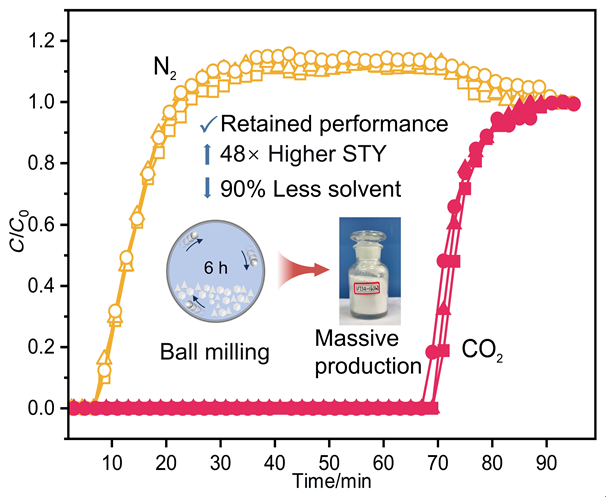
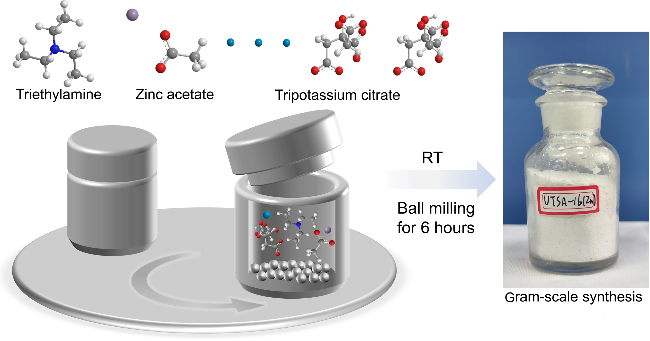
Herein, we report a rapid, green, and scalable mechanochemical strategy for the synthesis of UTSA-16(Zn), directly addressing the bottlenecks of energy and solvent consumption in conventional production (Figure 1). Crucially, we elucidate the pivotal role of acid-base chemistry, demonstrating that precise pH modulation via triethylamine (0.2 equiv.) is essential for suppressing defect formation and ensuring high crystallinity. This optimized protocol has brought surprising improvements: it achieves a remarkable 48-fold enhancement in space-time yield and a ca. 90% reduction in solvent usage compared to hydrothermal methods. Importantly, this efficiency does not come at the cost of quality; the mechanochemically derived product possesses a high BET surface area of 817 m2/g and exhibits exceptional CO2 capture capabilities with an uptake of 3.68 mmol/g (296 K, 0.1 MPa). Moreover, it achieves an ultra-high ideal adsorbed solution theory (IAST) selectivity of 388 for CO2/N2 mixtures, with dynamic breakthrough experiments confirming a robust dynamic CO2 capacity of 1.94 mmol/g under simulated flue gas conditions. These findings establish mechanochemistry as a powerful, environmentally benign route for the industrial-scale manufacturing of high-performance porous materials.
2 Results and Discussion
UTSA-16(Zn) is isostructural with UTSA-16(Co). As shown in Figure 2a, their ligand connections and metal coordination modes are identical, except for the substitution of Co by Zn. Due to the slightly smaller ionic radius of Zn(II) compared to Co(II), the window size of the diamondoid cage in UTSA-16(Zn) is slightly expanded to approximately 0.34 nm×0.58 nm (Figure 2b). The framework features interconnecting channels running along the a and b axes (Figure 2c). Grand Canonical Monte Carlo (GCMC) simulations reveal that the CO2 adsorption sites in UTSA-16(Zn) are consistent with those in UTSA-16(Co) as determined by our previous neutron diffraction studies: two pairs of CO2 molecules are captured within each cage, primarily driven by hydrogen bonding interactions between CO2 molecules and the coordinated water molecules on the potassium sites with an O(3W)—H…O72 distance of 0.298 nm (Figure 2d). These results confirm that the substitution of Co with Zn preserves both the structural integrity and the superior CO2 capture capability of the parent framework.
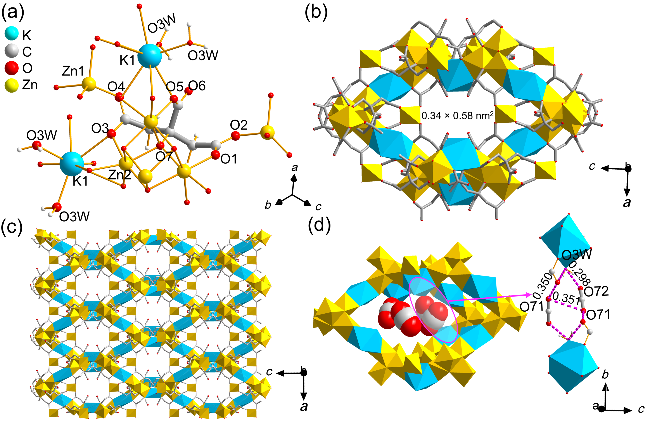
Figure 2 Crystal structure of UTSA-16(Zn). (a) Coordination mode of the citrate ligand. Each ligand links a cubane-like (Zn(2)4O4) cluster, two tetrahedral Zn(1) units, and two K+ ions. Each K+ ion is coordinated by two water molecules (O(3W)). (b) The diamondoid cage features a pore window of 0.34 nm×0.58 nm. All metal ions are depicted as polyhedra with color coding consistent with (a). (c) Packing structure viewed along the b-axis. (d) GCMC simulations reveal two pairs of CO2 dimers trapped within the cage |
Coupling the economic advantage of low-cost zinc with the pursuit of sustainable manufacturing, we are seeking to establish a rapid and green mechanochemical route for UTSA-16(Zn) production. Our investigation commenced by milling equimolar amounts of zinc acetate and potassium citrate monohydrate (10 mmol) in the presence of water and ethanol (2.5 mL each) for 6 h. This yielded a solid with a powder X-ray diffraction (PXRD) pattern consistent with the simulated structure of UTSA-16(Zn) (Supporting Information (SI), Figure S1). However, compared to the hydrothermally prepared analogue, the diffraction peaks were significantly broadened and exhibited diminished intensity, indicating poor crystallinity (SI, Figure S2). We attribute this low crystallinity to the in-situ accumulation of acidic byproducts (specifically acetic acid), which inhibits framework assembly. This hypothesis is substantiated by the observed pH drop of the reaction mixture from 6.81 to 5.98 after milling (SI, Table S1).
To mitigate the acidity-induced poor crystallinity, we introduced triethylamine (TEA) as a base modulator during the liquid-assisted grinding (LAG) process. As the TEA dosage increased, the PXRD patterns of the mechanochemically prepared samples exhibited improved agreement with the simulated pattern (Figure 3a). The impact of TEA was quantified by monitoring the full width at half maximum (FWHM) of the characteristic diffraction peak at 2θ=7.48°. As shown in Figure 3b, the addition of TEA significantly reduced the FWHM across all samples, indicative of enhanced crystallinity, crystallite growth, and structural ordering. Systematic screening revealed that 0.2 equiv. of TEA (relative to zinc acetate) yielded the highest crystallinity. Concurrently, the isolated yield increased with TEA dosage, peaking at 68% with 0.2 equiv. TEA. This corresponds to a 1.25-fold yield increase over the base-free synthesis. Furthermore, we monitored the pH evolution of the reaction system. Compared to the TEA-free counterpart (initial pH 6.81), the addition of 0.2 equiv. TEA raised the initial pH to 8.42. Although the pH gradually decreased as ball milling proceeded, it remained at 7.53 after 12 h, maintaining a weakly alkaline environment. These results confirm that 0.2 equiv. of TEA effectively buffers the reaction environment, thereby facilitating the rapid assembly of highly crystalline UTSA-16(Zn).
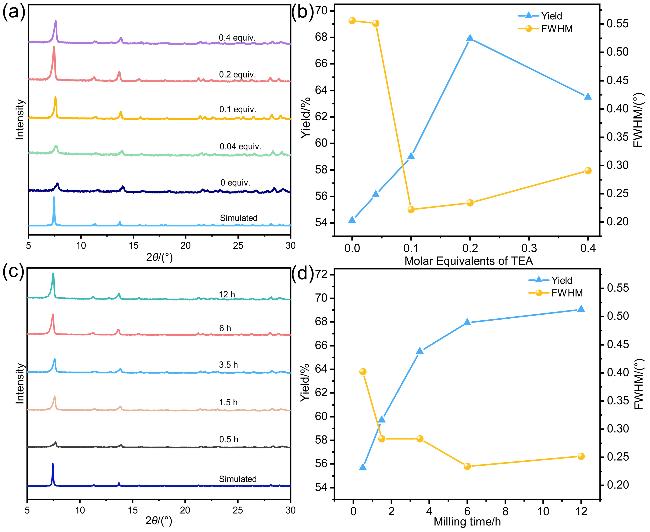
Figure 3 (a) PXRD patterns of UTSA-16(Zn) synthesized with varying molar equivalents of triethylamine (relative to zinc acetate). (b) Product yield and FWHM of the peak at 2θ=7.48° as a function of triethylamine dosage. (c) PXRD patterns of samples prepared with different milling times. (d) Product yield and FWHM (2θ=7.48°) plotted versus milling time |
Having established the optimal additive dosage, we subsequently investigated the synthesis kinetics. Time-dependent experiments conducted between 0.5 and 12 h revealed a gradual increase in crystallinity and improved agreement with the simulated PXRD pattern (Figure 3c). Specifically, extending the milling time from 0.5 to 6 h resulted in a steady intensification of the primary diffraction peak (2θ=7.48°) coupled with a continuous decrease in FWHM. Scanning electron microscopy (SEM) analysis indicated that the physical particle size remained substantially unchanged at approximately 3 μm throughout the process. This suggests that the observed peak narrowing is primarily attributed to improved crystallinity within the long-range ordered particles rather than physical grain growth (SI, Figure S3). However, while extending the time from 6 to 12 h slightly raised the yield from 67.9% to 69.1%, it compromised crystallinity, as evidenced by the increase in FWHM from 0.23° to 0.25° (Figure 3d). This structural degradation was further reflected in the gas adsorption performance. CO2 adsorption isotherms at 296 K revealed that the maximum uptake increased from 2.13 to 3.68 mmol/g as milling extended from 0.5 to 6 h, but declined to 3.39 mmol/g after 12 h (SI, Figure S4). Considering the trade-off between crystallinity, adsorption capacity, and space-time yield, we selected 6 h as the optimal condition.
The finalized protocol (milling with 0.2 equiv. TEA for 6 h) not only produces high-quality UTSA-16(Zn) but also achieves a remarkable 48-fold enhancement in space-time yield compared to the conventional hydrothermal method (SI, Figure S5). We utilized a standard laboratory planetary ball mill equipped with four 50 mL jars, successfully achieving a yield of approximately 48 g in a single batch. This capability for facile gram-scale preparation underscores the immense potential of our strategy for industrial mass production. Given its efficiency and scalability, this optimized mechanochemical route was adopted for all subsequent material preparations and property evaluations.
To further validate the structural fidelity of the mechanochemical product, we performed Fourier-transform infrared (FTIR) spectroscopy and thermogravimetric analysis (TGA). The FTIR spectrum of the mechanochemically synthesized UTSA-16(Zn) is virtually indistinguishable from that of the hydrothermally prepared analogue (SI, Figure S6). Characteristic bands at 1575 and 1395 cm−1 are as signed to the asymmetric and symmetric stretching vibrations of the carboxylate groups, respectively, while a broad absorption centered at ca. 3400 cm−1 is attributed to the O—H stretching of guest water molecules. The TGA profile displays a distinct two-step weight loss: an initial ca. 14% mass loss below 130 ℃, corresponding to the removal of guest water, followed by a stability plateau up to 290 ℃ (SI, Figure S7). Beyond this temperature, a sharp mass loss marks the decomposition of the framework. These results are in excellent agreement with literature data for conventionally synthesized UTSA-16(Zn),[40-41] corroborating that the mechanochemical route yields a phase-pure material with high structural integrity.
The permanent porosity of the mechanochemically synthesized UTSA-16(Zn) was assessed via N2 adsorption-desorption measurements at 77 K. This material exhibits a reversible Type-I isotherm with a maximum N2 adsorption capacity of up to 11.5 mmol/g (Figure 4a). The calculated Brunauer-Emmett-Teller (BET) surface area is determined to be 817 m2/g, which is in good agreement with other reported values.[35,41] Notably, a steep uptake is observed near the saturation pressure (pressure>90 kPa). This feature is attributed to the interparticle textural porosity arising from the loose packing of finer nanocrystallites generated by the high-energy milling process.[42] Pore size distribution analysis, derived using the non-local density functional theory (NLDFT) model, reveals a narrow distribution centered at 1 nm, which aligns well with the crystallographic pore diameter as well as others reported values (SI, Figure S8). These results demonstrate that the optimized mechanochemical protocol effectively preserves the intrinsic textural properties of the UTSA-16(Zn) framework.
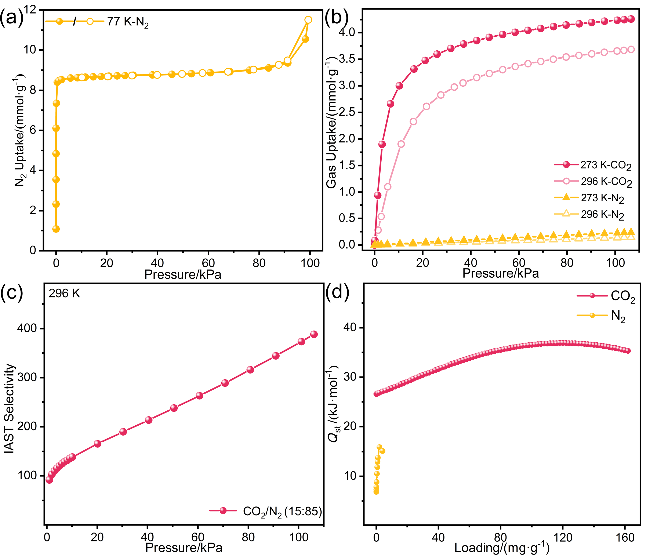
Figure 4 Gas adsorption performance of mechanochemically synthesized UTSA-16(Zn). (a) N2 adsorption-desorption isotherms at 77 K (solid and open symbols represent adsorption and desorption, respectively). (b) Single-component CO2 and N2 adsorption isotherms at 273 K and 296 K. (c) IAST selectivity for a CO2/N2 (15∶85, V/V) mixture at 296 K. (d) Coverage-dependent adsorption enthalpy of CO2 and N2 calculated by the virial fitting method |
To evaluate the CO2 capture potential of the mechanochemically synthesized UTSA-16(Zn), we collected single-component CO2 and N2 adsorption isotherms at 273 K and 296 K (Figure 4b). CO2 adsorption capacities as high as 4.26 mmol/g (at 273 K) and 3.68 mmol/g (at 296 K) were recorded under 0.1 MPa. These values mirror those of the hydrothermally prepared analogue, confirming the retention of exceptional adsorption capability. Conversely, N2 uptake under those conditions is negligible, reaching only 0.24 mmol/g at 273 K and 0.15 mmol/g at 296 K. This sharp disparity in uptake capacities highlights the high CO2/N2 selectivity of the material, a critical prerequisite for efficient post-combustion carbon capture. Furthermore, compared to other MOFs accessible via ball milling, our material balances a moderate CO2 adsorption capacity with the lowest raw material cost (SI, Table S3), suggesting promising prospects for practical application.
To predict the separation performance in mixed-gas environments, we employed the ideal adsorbed solution theory (IAST) (SI, Figure S9 and S10). For a simulated flue gas mixture (CO2/N2, 15∶85, V/V) at 296 K, the IAST selectivity was calculated to be 388 at 0.1 MPa (Figure 4c). This exceptionally high value firmly establishes the potential of mechanochemically synthesized UTSA-16(Zn) for effective CO2/N2 separation. To quantify the binding affinity between the adsorbate molecules and the framework, we calculated the isosteric heat of adsorption (Qst). The coverage-dependent Qₛₜ values for the CO2 and N2 were derived from their respective adsorption isotherms at 273 K and 296 K using the virial method (SI, Figure S11 and S12). At near zero-coverage, the Qst for CO2 is 35.3 kJ/mol, a moderate value that signifies appropriate physisorption strength while suggesting a relatively low energy penalty for regeneration. In stark contrast, the Qst for N2 is merely 15.0 kJ/mol, indicating much weaker interactions (Figure 4d). This significant difference in binding energies corroborates the pronounced selectivity observed in the single-component isotherms.
To validate the practical separation performance of our materials, we conducted fixed-bed breakthrough experiments under ambient conditions. A simulated flue gas mixture (CO2/N2, 15∶85, V/V) was flowed through a packed bed of the UTSA-16(Zn) at 4 mL/min. The resulting breakthrough curves exhibit a sharp separation front, providing clear evidence of efficient gas separation (Figure 5). The weakly interacting N2 broke through the column almost immediately, whereas CO2 was effectively retained, with its breakthrough point occurring at ca. 68 min. Integration of the CO2 breakthrough curve yields a dynamic CO2 capacity of 1.94 mmol/g (SI, Figure S13). This result is highly significant, as it demonstrates that a substantial fraction of the equilibrium capacity of material is readily accessible under dynamic conditions. Crucially, this separation performance is virtually identical to that reported for the solvothermal analogue, offering definitive evidence that our green mechanochemical synthesis yields a material with uncompromised performance for practical CO2/N2 separation.
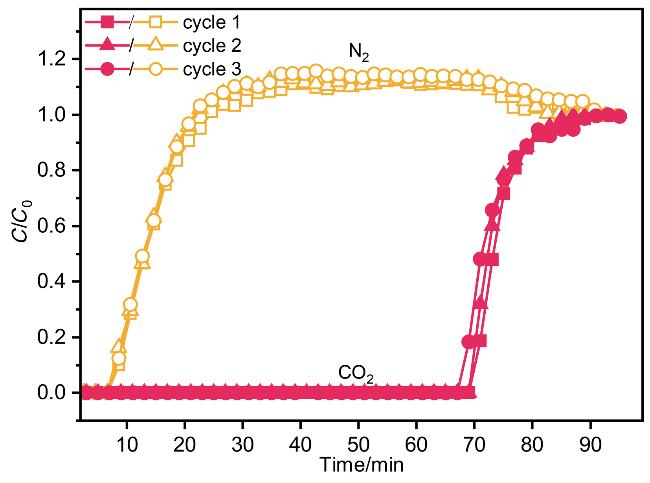


Figure 5 Dynamic CO2/N2 separation performance and cycling stability of mechanochemically synthesized UTSA-16(Zn). Three consecutive breakthrough cycles for a CO2/N2 mixture (15∶85, V/V) at 296 K and 0.1 MPa with a total flow rate of 4 mL/min. Red and gold symbols represent CO2 and N2, respectively. C/C0 denotes the normalized effluent concentration |
3 Conclusions
In conclusion, we have developed a rapid and green mechanochemical strategy for the synthesis of the CO2 adsorbent UTSA-16(Zn), addressing the challenges of energy consumption and solvent waste in conventional synthesis. Compared to the hydrothermal method, this optimized protocol increases the space-time yield by 48-fold, shortens the reaction time from 48 to 6 h, and reduces solvent consumption by approximately 90%. Mechanistic investigation indicates that controlling the reaction pH with triethylamine is critical for suppressing defect formation and ensuring high crystallinity. The mechanochemically derived material is structurally comparable to its hydrothermally prepared analogue. It retains a high BET surface area (817 m2/g) and demonstrates effective separation performance, with a CO2 uptake of 3.68 mmol/g at 296 K, and an IAST selectivity of 388. This work presents a scalable manufacturing route for UTSA-16(Zn) and demonstrates the importance of pH modulation in the mechanochemical synthesis of porous materials.
4 Experimental Section
4.1 Mechanochemical Synthesis of UTSA-16(Zn)
UTSA-16(Zn) was synthesized via an optimized ball milling procedure. In a typical synthesis, an agate milling jar (50 mL) was charged with zinc acetate (10 mmol), potassium citrate monohydrate (10 mmol), H2O (2.5 mL), ethanol (2.5 mL), triethylamine (2 mmol), and several zirconia milling balls (10 mm). The jar was sealed and placed in a planetary ball mill, operating at 516 r/min. The mixture was milled for 6 h at ambient temperature. Upon completion, the resulting viscous slurry was collected from the jar, using a minimal amount of methanol to aid in the transfer. The solid product was isolated by centrifugation (10000 r/min, 5 min), and the mother liquor was discarded. The precipitate was then washed sequentially with diethyl ether (15 mL×2) and methanol (15 mL×2). Subsequently, the solid was immersed in fresh methanol for 24 h, during which the solvent was exchanged five times. After a final centrifugation step, the purified product was dried in an oven at 50 ℃ for 12 h. Prior to gas adsorption analysis, the as-synthesized material was activated under dynamic vacuum at 85 ℃ for 24 h.
4.2 pH measurement
After ball milling using the reagent ratios described above, 10 mL of methanol was added to wash the viscous mixture from the milling jar. The suspension was centrifuged, and the supernatant was collected. The pH of the supernatant was measured using a Leici PHS-2F pH meter (Shanghai INESA Scientific Instrument Co., Ltd.).
4.3 Column Breakthrough Experiments
Breakthrough experiments of a CO2/N2 (15∶85, V/V) mixture were carried out at a flow rate of 4 mL/min. Activated UTSA-16(Zn) (1.01 g) crystals were packed into a stainless steel column (L=450 mm). The column was placed in a 296 K circulating water bath. The flow rates of all gas mixtures were regulated by mass flow controllers, and the effluent gas stream from the column was monitored by gas chromatography (thermal conductivity detector (TCD), detection limit: 0.1%). Prior to the breakthrough experiment, we flushed the activated sample in the adsorption bed with helium gas (10 mL/min) for 30 min to ensure the total removal of adsorbed gas. The outlet composition was continuously monitored by gas chromatograph until complete breakthrough was achieved.
(Cheng, B.)