


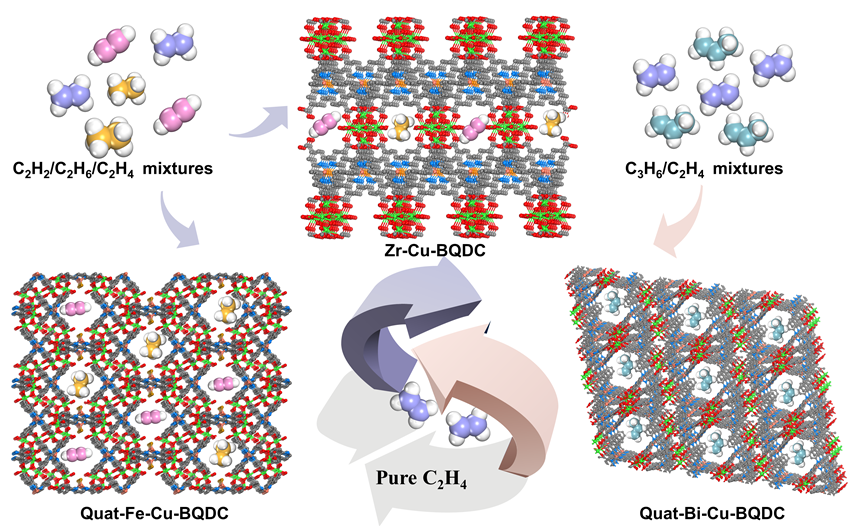
1 引言
2 结果与讨论
2.1 合成与晶体结构
2.1.1 Zr-Cu-BQDC
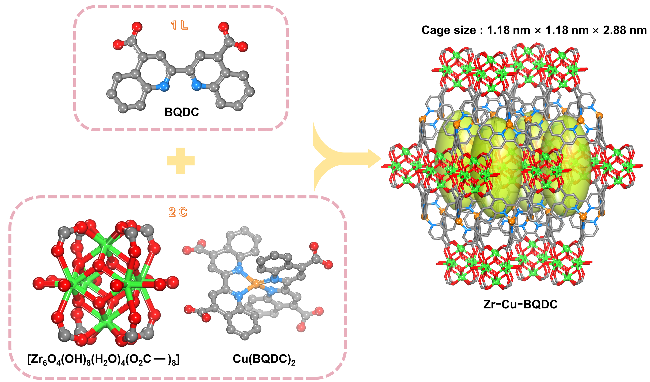
图1 Zr-Cu-BQDC由BQDC和两种金属节点组装流程及其对应笼尺寸的示意图. 碳: 灰色, 锆: 绿色, 铜: 橙色, 氧: 红色, 氮: 天蓝色. 为清晰起见省略氢原子Figure 1 Schematic diagram of the assembly process of Zr-Cu-BQDC from BQDC and two metal nodes, along with their corresponding cage sizes. C: gray, Zr: green, Cu: orange, O: red, N: sky blue. Hydrogen atoms are omitted for clarity |
2.1.2 Quat-Fe-Cu-BQDC
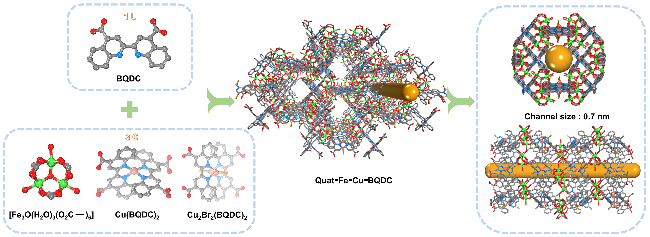
图2 Quat-Fe-Cu-BQDC由BQDC和三种金属节点组装流程及其一维通道尺寸示意图. 铁: 绿色, 铜: 橙色, 溴: 黄色. 为清晰起见省略了氢原子Figure 2 Schematic diagram of the assembly process of Quat-Fe-Cu-BQDC from BQDC and three metal nodes, together with the 1D channel dimensions. Fe: green, Cu: orange, Br: yellow. Hydrogen atoms are omitted for clarity |
2.1.3 Quat-Bi-Cu-BQDC
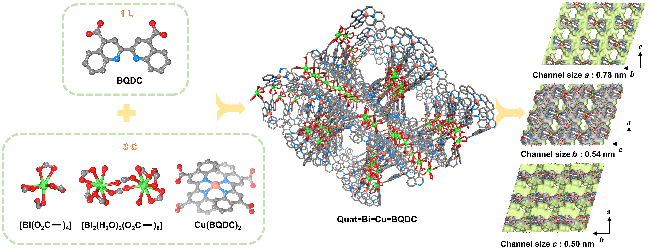
图3 Quat-Bi-Cu-BQDC由BQDC和三种金属节点组装流程及其3D通道尺寸示意图. 铋: 绿色, 铜: 橙色. 为清晰起见省略了氢原子Figure 3 Schematic diagram illustrating the assembly process of Quat-Bi-Cu-BQDC from BQDC and three metal nodes, along with its corresponding 3D channel dimensions. Bi: green, Cu: orange. Hydrogen atoms are omitted for clarity |
2.2 气体吸附与分离性能
2.2.1 Zr-Cu-BQDC
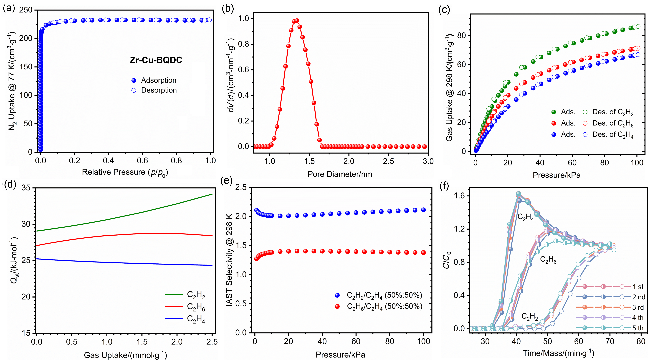
图4 Zr-Cu-BQDC的(a) 77 K下N2吸附等温线; (b)孔径分布图; (c)单组分气体吸附等温线; (d) C2气体的吸附焓; (e) 298 K下, C2H2/C2H4和C2H6/C2H4的吸附选择性; (f) C2混合气体穿透曲线Figure 4 For Zr-Cu-BQDC: (a) N2 adsorption isotherm at 77 K; (b) pore size distribution; (c) single-component gas adsorption isotherms; (d) Qst of C2 gases; (e) adsorption selectivity for C2H2/C2H4 and C2H6/C2H4 at 298 K; (f) breakthrough curves of C2 mixed gases |
2.2.2 Quat-Fe-Cu-BQDC
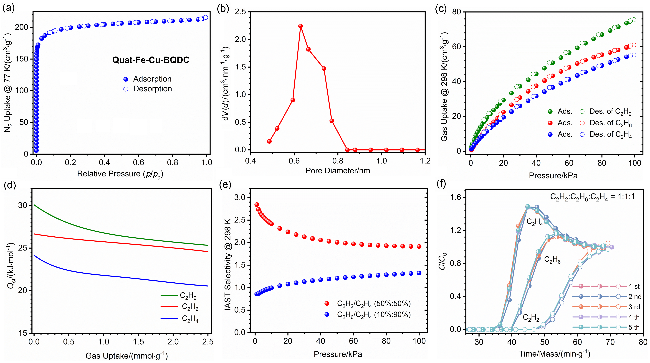
图5 Quat-Fe-Cu-BQDC的(a) 77 K下N2吸附等温线; (b)孔径分布图; (c)单组分气体吸附等温线; (d) C2气体的吸附焓; (e) 298 K下, C2H2/C2H4和C2H6/C2H4的吸附选择性; (f) C2混合气体穿透曲线Figure 5 For Quat-Fe-Cu-BQDC: (a) N2 adsorption isotherm at 77 K; (b) pore size distribution; (c) single-component gas adsorption isotherms; (d) Qst of C2 gases; (e) adsorption selectivity for C2H2/C2H4 and C2H6/C2H4 at 298 K; (f) breakthrough curves of C2 mixed gases |
2.2.3 Quat-Bi-Cu-BQDC
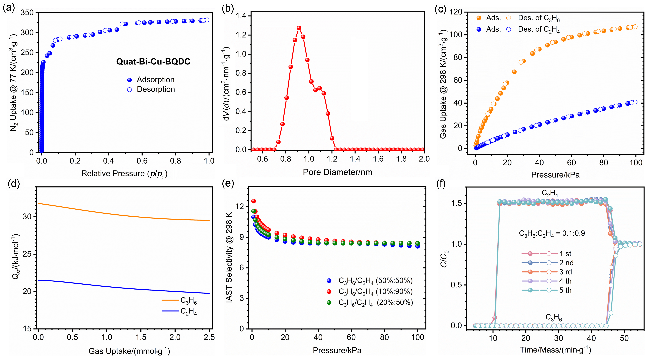


图6 Quat-Bi-Cu-BQDC的(a) 77 K下N2吸附等温线; (b)孔径分布图; (c)单组分气体吸附等温线; (d) C3H6/C2H4气体的吸附焓; (e) 298 K下, C3H6/C2H4的吸附选择性; (f) C3H6/C2H4混合气体穿透曲线Figure 6 For Quat-Bi-Cu-BQDC: (a) N2 adsorption isotherm at 77 K; (b) pore size distribution; (c) single-component gas adsorption isotherms; (d) Qst of C3H6/C2H4 gases; (e) adsorption selectivity for C3H6/C2H4 at 298 K; (f) breakthrough curves of C3H6/C2H4 mixed gases |