


1 Introduction
Acetylene (C2H2) has long been employed as one of the major raw chemical materials for organic synthesis and the chemical industry due to its high chemical reactivity. While its production is mainly derived from the partial combustion of methane or thermal cracking of hydrocarbons, which unavoidably produces CO2 as an impurity.[1] Whereas high purity of C2H2 are required in most of its applications, the process of removing CO2 from the mixture of CO2 and C2H2 is essential before practical use. However, it is also a challenging one because CO2 and C2H2 are extremely similar in molecular sizes (CO2: 0.318 nm×0.333 nm×0.536 nm, and C2H2: 0.332 nm×0.334 nm×0.570 nm) and physiochemical properties. In the current industry, energy-intensive and environmentally hazardous approaches such as cryogenic distillation or solvent extraction are mostly utilized to separate CO2/C2H2 mixture. It is urgent to explore efficient and environmentally friendly methods to solve this dilemma.
Gas separation based on selective sorption via porous materials have been considered as a promising alternative technology, in which the porous sorbents distinguish gas molecules with size, shape, or interaction between gas and their pore surfaces under mild conditions,[2-4] therefore the process is more energy-efficient. Adsorbents for CO2/C2H2 separation can be categorized based on their preferential adsorption into two types: C2H2-selective and CO2-selective. Most physical sorbents interact with C2H2 more strongly than CO2, and C2H2-selective materials are relatively familiar. These materials have been reported continually in recent years,[5-12] but employing this category of adsorbents, to obtain high-purity of C2H2, an extra desorption step is necessary, which consumes more energy (about 40%) than directly collecting C2H2,[13] in other words, separation based on CO2-selective sorbents is more energy-saving and economical.
Unfortunately, only a few of these inversely selective materials have been reported till now,[14-31] among these limited materials, overcoming the trade-off between selectivity and adsorption of CO2 should be sought after, and the performance for CO2/C2H2 separation need to promoted constantly. Porous coordination polymers (PCPs) have been intensively studied in gas separation owing to their adjustable pore sizes, functional sites, and surface areas.[32-33] Nevertheless, to employ PCPs for CO2/C2H2 separation in practice, besides the inversely CO2-selective feature, stability, economy and high separation efficiency are all key issues to be addressed.
With these in mind, we decide to explore CO2-selective PCPs following the premise in the beginning, including strong coordinated bonds, stable building blocks, low-cost and simple ligands, facilely scalable synthesis methods, and suitable pore structures with high CO2 uptake.
Cyanide ion, the simplest high-field ligand with strong basicity, has been used as robust linker in the coordination chemistry for hundreds of years. Due to its strong basicity, the tendency of hydrolysis for metal ions are blocked, therefore strong coordinated bonds are formed. Based on such strong bonds, a large amount of stable coordination polymers have been synthesized, such as famous Prussian blue (PB) and its analogs,[20,34-42] and Hofmann-type compounds.[43-47]
Among cyanide based building blocks, low-cost hexacyanoferrate (II, III) with high stability, acting as building block and connecting transition metal ions, generally afford robust frameworks. these assembly processes can be facilely to accomplish in water under mild condition. Resulting from the short length and high directionality of cyanide, narrow pore windows often be afforded in these frameworks, which could sieve the gas molecules in some extent. Moreover, resulting from the opposite quadrupole moment of CO2 and C2H2 (-13.4×10−40 C•m2 and +20.5×10−40 C•m2, respectively, Supporting Information (SI) Figure S1), the unique electronic structure along the framework of these PCPs especially when alkali metal ions existing in the cavity could influence the orientations of CO2 and C2H2 in the void space, which may be facilitate the separation of CO2/C2H2. Overall, by virtue of these advantages, it is very promising to find CO2-selective sorbents match the above premise in the platform of hexacyanoferrate (II, III) based PCPs.
Herein, two zeolite-like zinc hexacyanoferrate (II, III) frameworks with analogously cage-like structures, Zn3[(FeIII(CN)6]2 (ZnHCF) and K2Zn3[(FeII(CN)6]2 (KZnHCF), are employed as adsorbents to contrastively investigate CO2/C2H2 separation. These two PCPs all exhibit inverse CO2-selective adsorption behaviors due to their unique crystal structure and electronic structure. The exiting K ions within the cavities of KZnHCF play key roles in promoting the capacity of CO2 capture and CO2/C2H2 selectivity by effect of electrostatic orientation, the uptake of CO2 is increased from 36.9 cm3•g−1 (ZnHCF) to 111.5 cm3•g−1 (KZnHCF) and the selectivity is promoted from 1.8 (ZnHCF) to 23.4 (KZnHCF), respectively. Column breakthrough experimental results further prove that KZnHCF possess high separation performance for CO2/C2H2 mixture. It can efficiently separate CO2/C2H2 in a long temperature range (from 298 to 333 K), and giving 99.9% of high purity of C2H2 in one-step.
2 Results and Discussion
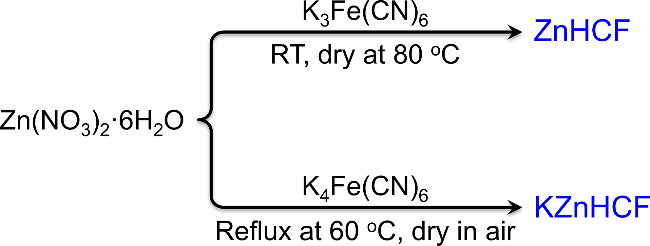
ZnHCF was obtained from the reaction of Zn(NO3)2 with K3Fe(CN)6 in H2O at room temperature, and dried at 80 ℃ under vacuum. Instead K3Fe(CN)6 with K4Fe(CN)6, and refluxed with Zn(NO3)2 in H2O at 60 ℃ overnight, followed by drying in air, KZnHCF was prepared (Scheme 1).
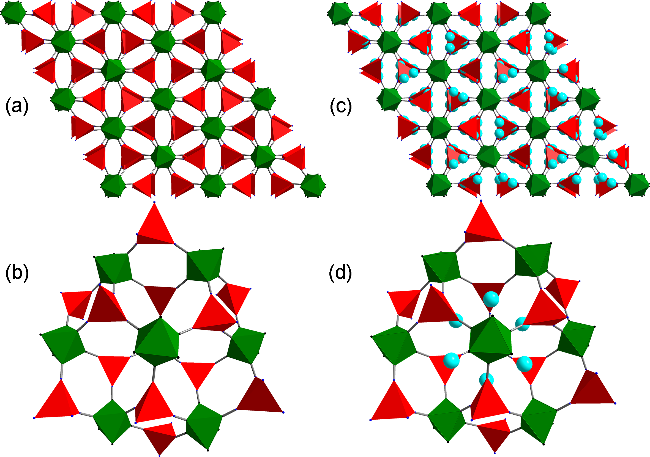
The structure of ZnHCF refined from X-ray powder diffraction pattern has been reported in 2007,[56] herein single crystal of ZnHCF was successfully obtained from dehydrating the single crystal of its cubic phase at 80 ℃. The X-ray single crystal diffraction revealed that ZnHCF crystallize in the hexagonal R-3c space group. Hexacyanoferrate(III) as an octahedral building block connects six tetrahedral Zn coordination sphere, each Zn is coordinated by four N atoms from four different hexacyanoferrate(III), and a 3D porous framework is generated (Figure 1a). In the structure, as shown in Figure 1b, the connection of eight octahedron of FeIIIC6 and twelve ZnN4 tetrahedron affords an ellipsoidal cavity with approximate 1.5 nm×0.9 nm×0.8 nm in volume, these cavities communicate with each other through six distortedly hexagonal windows.
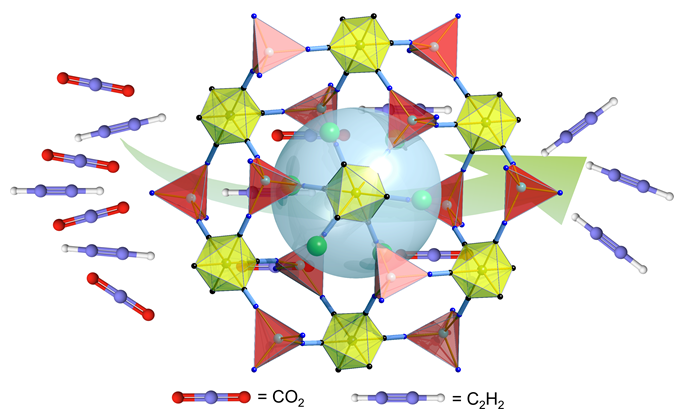
Interestingly, size of the window in this cage-like structure is about 0.390 nm×0.520 nm, which is larger than the diameters of CO2 (0.333 nm) and C2H2 (0.333 nm), but slightly narrower than the length of CO2 (0.536 nm) and C2H2 (0.570 nm). It means that these two linear gas molecules must be sloped or flat to enter the cavity of ZnHCF, in other words, the pore widow in ZnHCF could resist the two gases molecule slightly. Meanwhile, given the difference of length of CO2 (0.536 nm) and C2H2 (0.570 nm), the extent of these resistance could be different, which may contribute to separating CO2/C2H2 mixture. Furthermore, the most significant distinction of CO2 and C2H2 is their opposite quadrupole moment, in the theory, charge carrier can endow them with different space orientation through electrostatic interaction. Conceivably, when the interaction occurs in a limited aperture, the orientation of these two linear molecules become crucial, which determine their transmitting through the aperture to being favorably or not. In terms of the cage-like structure and unique window size of ZnHCF, if charged ions are introduced into the cavities to influence the orientation of CO2 and C2H2 when they entering the windows, the distinction of extent of resistance from windows should be strengthened, which could promote the separation performance for CO2/C2H2 mixture.
Therefore, we set our sight on another zeolite-like material: KZnHCF, which possess analogical cage-like structure along with K+ ions in the cavity.
The initial structure of KZnHCF was reported by Gravereau in 1979.[57] To completed understand the structural information of our prepared KZnHCF, we re-collected the X-ray single crystal diffraction data of KZnHCF. Structure analysis reveals KZnHCF possesses a similar connection mode with ZnHCF, as shown in Figure 1c, a negative and 3D porous framework is formed by combining FeIIC6 octahedron with ZnN4 tetrahedron, K+ as counter ions distribute in cavities of the framework and afford a zeolite-like structure. The generated ellipsoidal cavity is about 1.5 nm×1.0 nm×0.7 nm and the communication windows are 0.39 nm×0.52 nm in size (Figure 1d). Although the size of window is slightly deferred from that of ZnHCF, the effect of resistance for CO2 and C2H2 from the window as mentioned above is still maintained.
The bulk samples of ZnHCF and KZnHCF for gas adsorption and separation measurement were prepared by the modified methods according to the literature.[56-57] The aqueous solution of Zn(NO3)2 and K3Fe(CN)6 in the mole ratio of 2∶3 were mixed simultaneously and stirred for 12 h, the formed precipitate was aged in the solution and then filtered, after wash and dry under vacuum at 80 ℃, microcrystalline product of ZnHCF was obtained. The preparation for KZnHCF was similar, using K4Fe(CN)6 instead of K3Fe(CN)6, the mixed solution was stirred and aged at 60 ℃, and then the microcrystalline sample of KZnHCF was obtained in high yield.
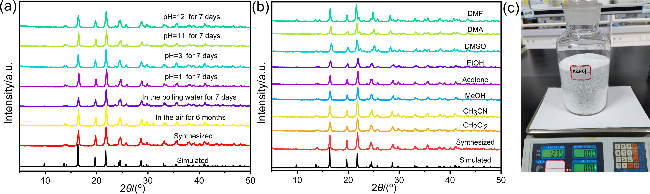
The experimental powder X-ray diffraction (PXRD) patterns of ZnHCF and KZnHCF match well with their simulated patterns (Figure 2a, 2b and SI Figure S3, S4), which verify the purity of obtained products. The results of inductively coupled plasma-optical emission spectroscopy (ICP-OES) further confirm the correct metal ratio in the products (K/Zn/Fe: 0/3/2 in ZnHCF and 2/3/2 in KZnHCF, respectively). The thermal stabilities of these two materials were examined by thermogravimetric analysis (TGA), TG curves indicate ZnHCF and KZnHCF exhibit high thermal stability at least up to 260 ℃ (SI Figure S5), which are quite satisfactory with the requirement for gas adsorption and separation process. Furthermore, to target the premise mentioned in the introduction for practical gas separation, chemical stability of KZnHCF were investigated in detail. As shown in Figure 2a and 2b, after exposing the sample in the air for 6 months, immersing the sample in boiling water, aqueous solution with pH 1—12 and diverse organic solution for 7 d, the PXRD pattern remain unchanged in comparison with the fresh sample. As expect, the robust nature of KZnHCF is confirmed. In addition, to verify the scalable preparation for KZnHCF and to further lower the cost, the synthesis method in the literature was further modified by increasing reaction concentration and using the cheapest Zinc salt, kilogram-scale of KZnHCF was prepared successfully (Figure 2c), and its phase purity was proved by PXRD. The highly chemical stability, low-cost and scalable preparation endow KZnHCF with broad adaptability both in store and in practical application.
To evaluate the permanent porosity of ZnHCF and KZnHCF, N2 adsorption tests were performed at 77 K based on the activated samples (SI Figure S6). Type-I isotherms exhibited by the recorded curves indicate the microporous nature of ZnHCF and KZnHCF. The calculated Brunauer-Emmett-Teller (BET) surface areas, the total pore volumes of ZnHCF and KZnHCF are 730 m2•g−1 and 466 m2•g−1, 0.34 cm3•g−1 and 0.21 cm3•g−1, respectively. Obviously, significant reduction in BET and pore volume of KZnHCF result from the introduction of K+ in the cavities.
Single-component gas adsorption experiments were firstly employed to identify CO2 and C2H2 uptake behavior of ZnHCF and KZnHCF, the low-pressure CO2 and C2H2 gas adsorption of ZnHCF and KZnHCF were measured at 298 K, respectively (Figure 3a). As expected, both ZnHCF and KZnHCF feature CO2-selective adsorption behavior. ZnHCF exhibits a saturated uptake of CO2 (36.9 cm3•g−1, 1.7 mmol•g−1) at 0.1 MPa and 298 K, which is higher than the uptake of C2H2 (21.5 cm3•g−1, 0.96 mmol•g−1) under the same conditions. It should attribute to the unique window sizes in the pore, as mentioned above, the resistance from the windows toward CO2 could be slightly lower than toward C2H2 due to the shorter molecule length of CO2. In comparison with ZnHCF under the same condition, although the BET surface area and the total pore volume are decreased, the adsorption capacity of CO2 and C2H2 on KZnHCF are increased to 111.5 cm3•g−1 (5.0 mmol•g−1) and 58.9 cm3•g−1 (2.6 mmol•g−1), respectively. These significant increases should owe to the strongly electrostatic interaction between K+ cation and CO2 or C2H2. The CO2 uptake of KZnHCF is much higher than its C2H2 uptake, leading to a relatively high CO2/C2H2 uptake ratio (1.89) at 298 K and 0.1 MPa, which is higher than those of some reported CO2-seletive materials, such as SIFSIX-3-Ni (0.8),[15] CD-MOF-1 (1.3), CD-MOF-2 (1.3),[58] PCP- NH2-ipa (1.66) and PCP-NH2-bdc (1.59).[27]
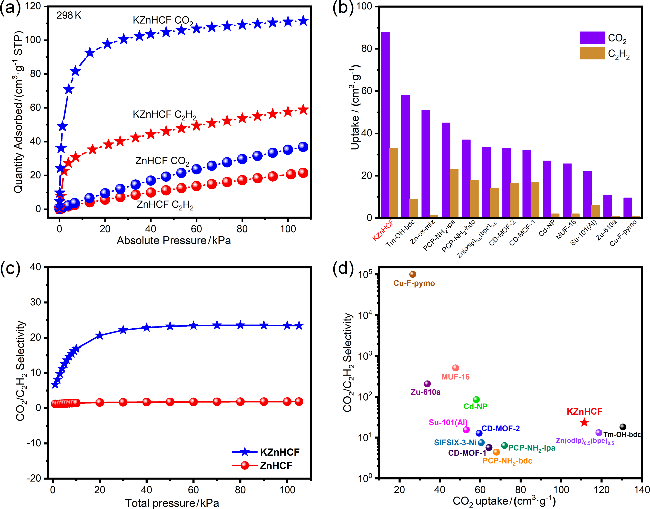
Figure 3 (a) CO2 and C2H2 adsorption isotherms for ZnHCF and KZnHCF at 298 K. (b) Comparison of CO2 and C2H2 uptakes among CO2-selective adsorbents at 298 K and 0.01 MPa. (c) IAST selectivity of ZnHCF and KZnHCF for CO2/C2H2 (V/V, 50/50) at 298 K and 0.1 MPa. (d) Separation performance of KZnHCF for equimolar CO2/C2H2 mixtures compared with other CO2-selective adsorbents at room temperature |
In actuality, the gas uptake behavior of porous material at low pressure could be more accurate to mirror the interaction between pore space and gas molecules, in which the intermolecular interaction of gases are maximally avoided. In terms of CO2 adsorption isotherms of KZnHCF at 298 K and low pressure, there is a steep increase and the uptake rapidly approach to the saturation, whereas the curve of C2H2 uptake rises slowly and gradually from 0 to 0.1 MPa. As a result, at 0.01 MPa and 298 K, the uptake of CO2 and C2H2 of KZnHCF are 88.2 cm3•g−1 and 32.5 cm3•g−1, respectively, giving a much higher CO2/C2H2 uptake ratio of 2.71, which indicates a far stronger affinity of the pore space toward CO2 than toward C2H2. Moreover, this uptake ratio is apparently higher than that of ZnHCF (1.67) under the same condition. It demonstrates that the ability of KZnHCF in distinguishing between CO2 and C2H2 is dramatically improved compared to ZnHCF.
It should be mentioned that the uptake of CO2 of KZnHCF at 298 K is much higher than that of the most reported CO2-selective materials at the same conditions, such as Zn-ox-mtz (68.8 cm3•g−1),[59] SIFSIX-3-Ni (60.5 cm3•g−1),[15] CD-MOF-1 (64.3 cm3•g−1), CD-MOF-2 (59.4 cm3•g−1),[58] MUF-16 (47.8 cm3•g−1),[25] Cd-NP (58.0 cm3•g−1),[20] PCP-NH2-ipa (72 cm3•g−1), PCP-NH2-bdc (68 cm3•g−1),[27] Cu-F-pymo (26.6 cm3•g−1),[23] SU-101(Al) (53.1 cm3•g−1),[60] and Zu-610a (33.8 cm3•g−1).[61] It only lower than Tm-OH-bdc (130.6 cm3•g−1)[16] and Zn(odip)0.5(ode)0.5 (118.7 cm3•g−1).[62] In addition, the purely inorganic composition and relatively low pore volume let KZnHCF present quite high density (1.59 g•cm−3) after activation, it means the work capacity of KZnHCF per unit volume could be high in practical use, which is a positive factor concerning volume and cost of equipment, as well as energy consume. At 298 K and 0.1 MPa, KZnHCF exhibits an outstanding volumetric adsorption capacity for CO2 (177.29 cm3•cm−3), which is almost higher than that of all the reported CO2-selective adsorbents. As mentioned above, the amount of CO2 captured at low pressure is more accurate to reflect the affinity toward CO2 as well as the preference of capture when CO2/C2H2 mixtures begin to enter the pore, which is a vital factor related to dynamic sieving CO2 from mixtures. At 0.01 MPa and 298 K, the uptake of CO2 of KZnHCF is rapidly up to 88.2 cm3•g−1, it is higher than those of all the reported CO2-selective materials till now under the same condition (Figure 3b). This high uptake of CO2 and the relatively low uptake of C2H2 at low pressure indicates that KZnHCF could efficiently capture CO2 from CO2/C2H2 mixture.
Additionally, the isosteric heat of adsorption (Qst) was calculated from the adsorption isotherms recorded at 273 and 298 K to precisely assess the interaction between adsorbent and CO2 or C2H2. As shown in SI Figure S17, the Qst values of CO2 and C2H2 under near-zero coverage of ZnHCF are 29.8 and 26.8 kJ•mol−1, respectively, it further demonstrates that the affinity of the pore surface for CO2 only slightly higher than that of C2H2. By contrast, KZnHCF possess a higher Qst of 41.2 kJ•mol−1 for CO2 and a lower Qst of 23.9 kJ•mol−1 for C2H2 (SI Figure S17), which undoubtedly demonstrate that the interaction between the pore space of KZnHCF and CO2 molecules is strengthened upon introducing K+ into the cavities, whereas the change for C2H2 is negligible. In fact, the Qst of 41.2 kJ•mol−1 for CO2 on KZnHCF is moderate among CO2-selective adsorbents, which is conducive to reducing regeneration energy consumption towards practical use in comparison with some materials, such as SIFSIX-3-Ni (50.9 kJ•mol−1),[15] CD-MOF-2 (67.2 kJ•mol−1),[58] and Tm-OH-bdc (45.2 kJ•mol−1)[16] (SI Table S2).
Using ideal adsorption solution theory (IAST), the adsorption capacity of binary mixtures can be estimated from the single component gas adsorption isotherms, and thus selectivity can be calculated. As shown in Figure 3c, the IAST selectivity of ZnHCF and KZnHCF for an equimolar mixture of CO2/C2H2 at 298 K was up to 1.8 and 23.2, respectively. It is worth noting that the selectivity of KZnHCF is relatively high and exceeds many CO2-selective MOFs under the same conditions, such as SIFSIX-3-Ni (7.5),[15] CD-MOF-1 (5.7),[58] CD-MOF-2 (12.8),[58] Tm-OH-bdc (18.2),[16] PCP-NH2-ipa (6.4), PCP-NH2-bdc (4.4),[27] SU-101(Al) (15.5).[60] But lower than Cu-F-pymo (>105),[23] MUF-16 (510),[25] Zu-610a (207),[61] Cd-NP (85)[20] and Zn-ox-mtz (1064.9)[59] (Figure 3d). Especially, among the three CO2-selective adsorbents with a high capacity of CO2 uptake (>100 cm3•g−1), KZnHCF possesses the highest IAST selectivity (Figure 3d). Over all, the high amount uptake of CO2, the large distinction in the isosteric heat of adsorption of CO2 and C2H2, together with the high IAST selectivity, enabling KZnHCF as a suitable adsorbent in the separation of CO2/C2H2.
In a structural view, the distribution of negative charge in the CO2 and C2H2 molecules are markedly distinct, one is in the ends and the other is in the middles (SI Figure S1). Which endow these two linear molecules with different orientation when they electrostatically interact with positive charges. In the structure of KZnHCF, K+ ions as positive charges are located in the cavities and could attract the ends of CO2 molecules when they approach the narrow pore windows, and then, CO2 molecules may be oriented to be flat, it should be the most favorable orientation to facilely enter the aperture for CO2 upon electrostatic interaction. This unique electrostatic orientation gives KZnHCF outstanding CO2 sorption capability and relatively high Qst. However, in virtue of electrostatic interaction between K+ and the middle of C2H2, C2H2 molecules are oriented and tend to be vertical when they approach the pore windows. Due to their slightly larger length according to the size of window, to enter the aperture, C2H2 molecules have to be sloped, which could produce more resistance especially when they are closer to K+. It should be the reason that KZnHCF possess relatively lower C2H2 uptake and low Qst toward C2H2. In brief, the combined effect of appropriate pore structure and electrostatic orientation could enable KZnHCF to distinguish between CO2 and C2H2 efficiently, and leading to an excellent CO2 capture performance as well as a high selectivity towards CO2/C2H2 mixture.
These results dramatically inspire our passion in investigation on separation of CO2/C2H2 mixture based on KZnHCF. The static CO2 and C2H2 uptakes from binary CO2/C2H2 mixtures (V/V=50/50), as well as the separation potential for KZnHCF were calculated by virtue of the methodology described by Krishna.[63] In which, separation potential as a metric combines adsorption capacity and selectivity to qualitatively evaluate the separation performance of KZnHCF. The calculated result indicates that 4.4 mole of pure C2H2 could be recovered from the equimolar CO2/C2H2 mixture on per kilogram of KZnHCF (SI Figure S22), which represent the most efficient performance among those of the reported reverse adsorbents.
The actual separation performance of ZnHCF and KZnHCF for CO2/C2H2 mixture were assessed by column breakthrough experiments, where CO2/C2H2 (V/V=50/50) mixtures were used to flow through the column filled with activated microcrystalline ZnHCF and KZnHCF at a flow rate of 2.0 mL•min−1 at 298 K. The effluent was continuously monitored by using a mass spectrometer. The results show that the two PCPs achieve remarkable one-step C2H2 purification performance. C2H2 is firstly eluted from the outlet with its low affinity for PCPs, while CO2 as the impurity is selectively retained in the column until the absorption capacity reaches saturation. The experimental breakthrough curves demonstrate that the interaction between the framework of ZnHCF and CO2 is weak, CO2 is detected quickly at about 5 min•g−1 after the C2H2 flow out (SI Figure S23). In contrast, for KZnHCF, K+ as counter ions in the cavities have a strong electrostatic interaction with the CO2 molecule. By virtue of the combined effects of appropriate pore structure and electrostatic orientation, the time to reach saturation of CO2 in comparison with ZnHCF is much promoted, as shown in Figure 4a, the breakthrough time intervals rise to about 52 min•g−1, and giving dynamic C2H2 productivity of 1915 mmol•kg−1 with high purity of more than 99.9% (SI Figure S25), which is only slightly lower than the newly reported record (2091 mmol•kg−1)[59] under the same condition.
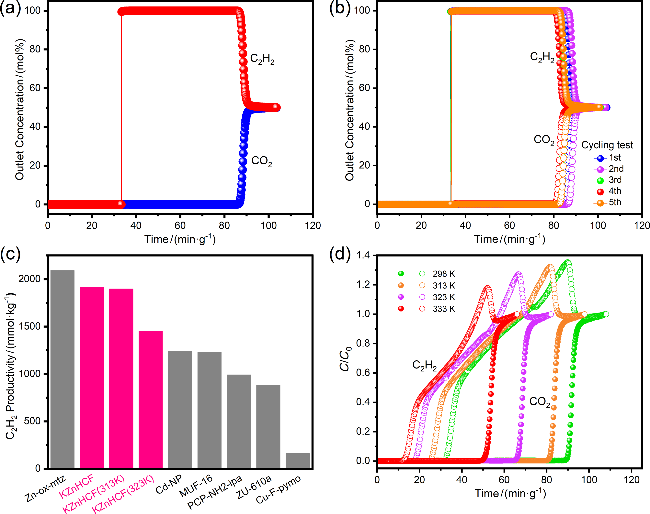


Figure 4 Experimental column breakthrough curves for (a) an equimolar CO2/C2H2 mixture and (b) cycling tests of the equimolar CO2/C2H2 mixture (solid symbols: C2H2, open symbols: CO2) in a column packed with KZnHCF at 298 K and 0.1 MPa. (c) Comparision of C2H2 productivity with the reported CO2-selective asorbents at 298 K and 0.1 MPa, including the producivity on KZnHCF at 313 K and 323 K. (d) Experimental column breakthrough curves for an equimolar CO2/C2H2 mixture under diverse temperature on KZnHCF |
To examine the recycling ability of KZnHCF, cycling breakthrough experiments were carried out under the same conditions, after five cycles of tests, the separation performance of KZnHCF does not decrease at all (Figure 4b, SI Figure S29), and the PXRD pattern prove that the framework of KZnHCF is still well maintained (SI Figure S4). In addition, considering the complicatedly environmental temperature in practical C2H2 production, the breakthrough experiments at diverse temperatures are also performed.
The results show that KZnHCF keep highly efficient CO2/C2H2 separation performance at long range of temperatures. As shown in Figure 4c and 4d, when the test temperature was raised to 313 K, astoundingly, the productivity only decreases a little to 1897 mmol•kg−1 (SI Figure S26). At 323 K, a high productivity of 1450 mmol•kg−1 can be provided (SI Figure S27), which is still higher than most of reported productivity at 298 K upon CO2-selective adsorbents. Even at 333 K, KZnHCF can still efficiently separate CO2/C2H2 (V/V=50/50) mixture without decrease of purity (productivity: 959 mmol•kg−1, SI Figure S28). Finally, a certain amount of sample from kilogram-scale preparation for KZnHCF is utilized to verify its actual separation capability, the result shows there is no significant distinction in the separation performance between gram-scale and kilogram-scale preparation (SI Figure S24). Obviously, KZnHCF can be considered as a promising adsorbent for actual CO2/C2H2 separation, based on this material, high-purity C2H2 can be produced in one-step without strict demand for temperature.
3 Conclusion
In summary, we have attempted to target the scientific challenge of inverse selective CO2/C2H2 adsorption and separation along with the obstacles of most of PCPs for the practical application in gas separation. Two low-cost hexacyanoferrate (II, III) based PCPs with high stability were employed as adsorbents to contrastively investigate CO2/C2H2 separation, the two zeolite-like POCs feature inverse CO2-selective separation behavior due to their suitable and cage-like pore structure and unique electronic structure. Especially for KZnHCF, K+ ions distributed in the cavities extremely enhance the electrostatic interaction between the cavities and CO2 molecules, and electrostatically orient CO2 featuring more appropriate position to enter the special pore windows, which make KZnHCF exhibit highly efficient CO2/C2H2 separation capacity, even at relatively high temperature. High stability, facile synthesis method, low-cost and large-scale preparation, recyclability, together with highly efficient separation perfor-mance endow KZnHCF with extremely high potential in practical CO2/C2H2 separation. This study could inspire researchers to put more attention to stability, economy, and actual separation efficiency of the adsorbents. Moreover, the combined effect of appropriate pore structure and electrostatic orientation discovered in this work could provide a new strategy in design or seeking of porous materials for application in special gas separation.
(Cheng, B.)