

化学学报 ›› 2026, Vol. 84 ›› Issue (5): 651-658.DOI: 10.6023/A26010036 上一篇 下一篇
所属专题: “框架材料化学”合集
研究论文
欧阳阳, 俱战锋*( ), 王文经, 杜顺福, 袁大强*()
投稿日期:2026-01-31
发布日期:2026-04-03
作者简介:★ “框架材料化学”专辑
基金资助:
Yangyang Ou, Zhanfeng Ju*(), Wenjing Wang, Shunfu Du, Daqiang Yuan*()
Received:2026-01-31
Published:2026-04-03
Contact:
* E-mail: juzf@fjirsm.ac.cn;ydq@fjirsm.ac.cn
About author:★ For the VSI “Chemistry of Framework Materials”.
Supported by:文章分享
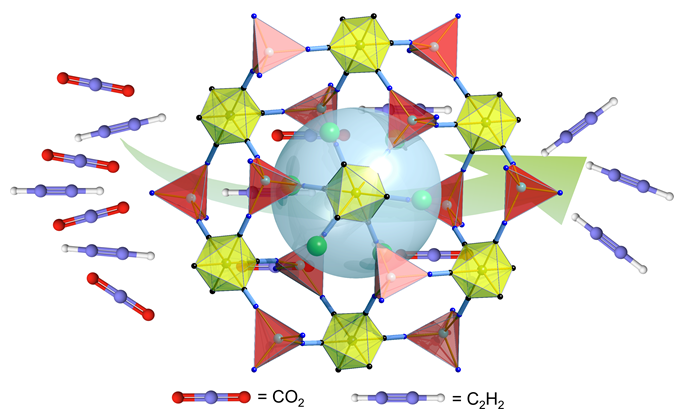
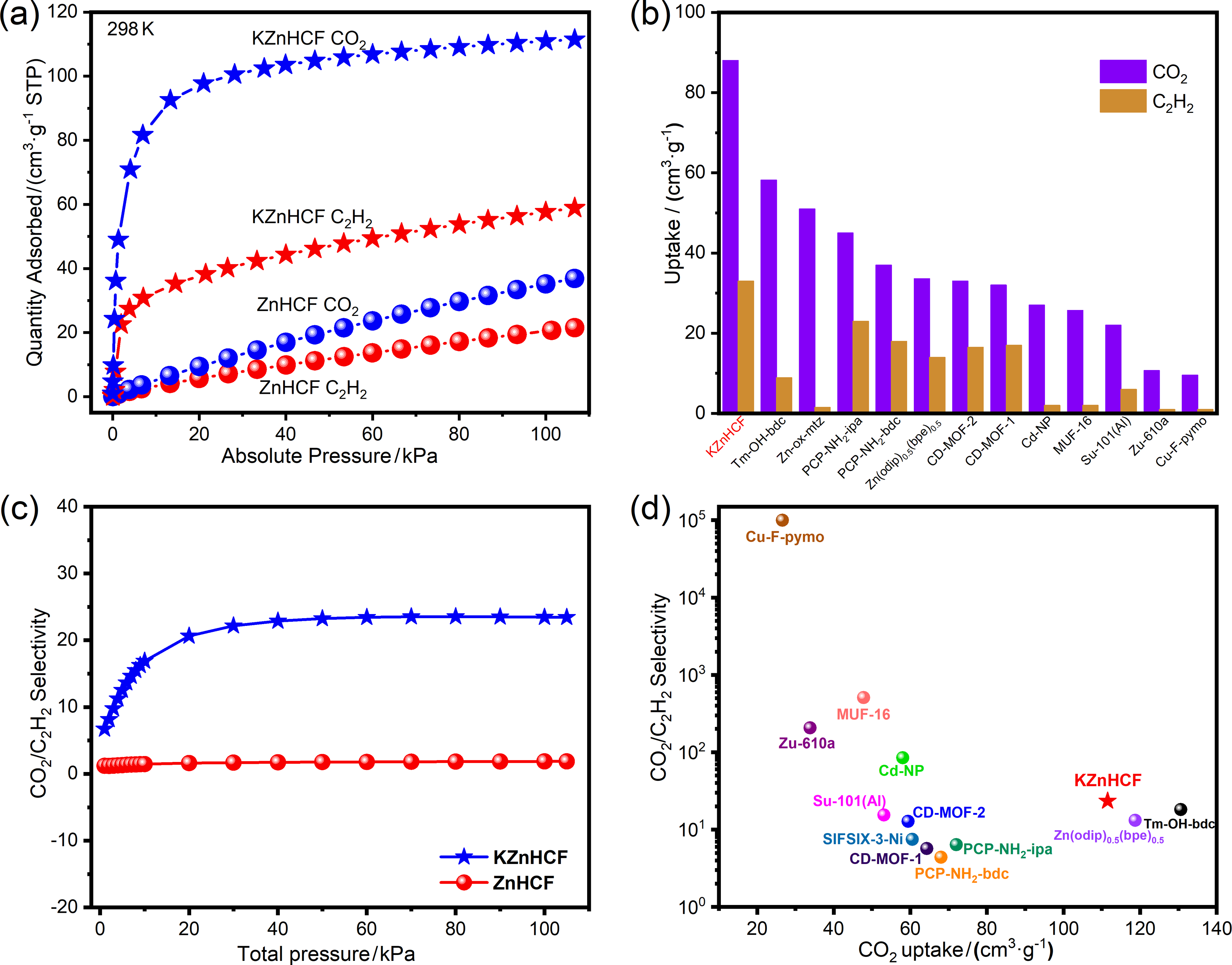
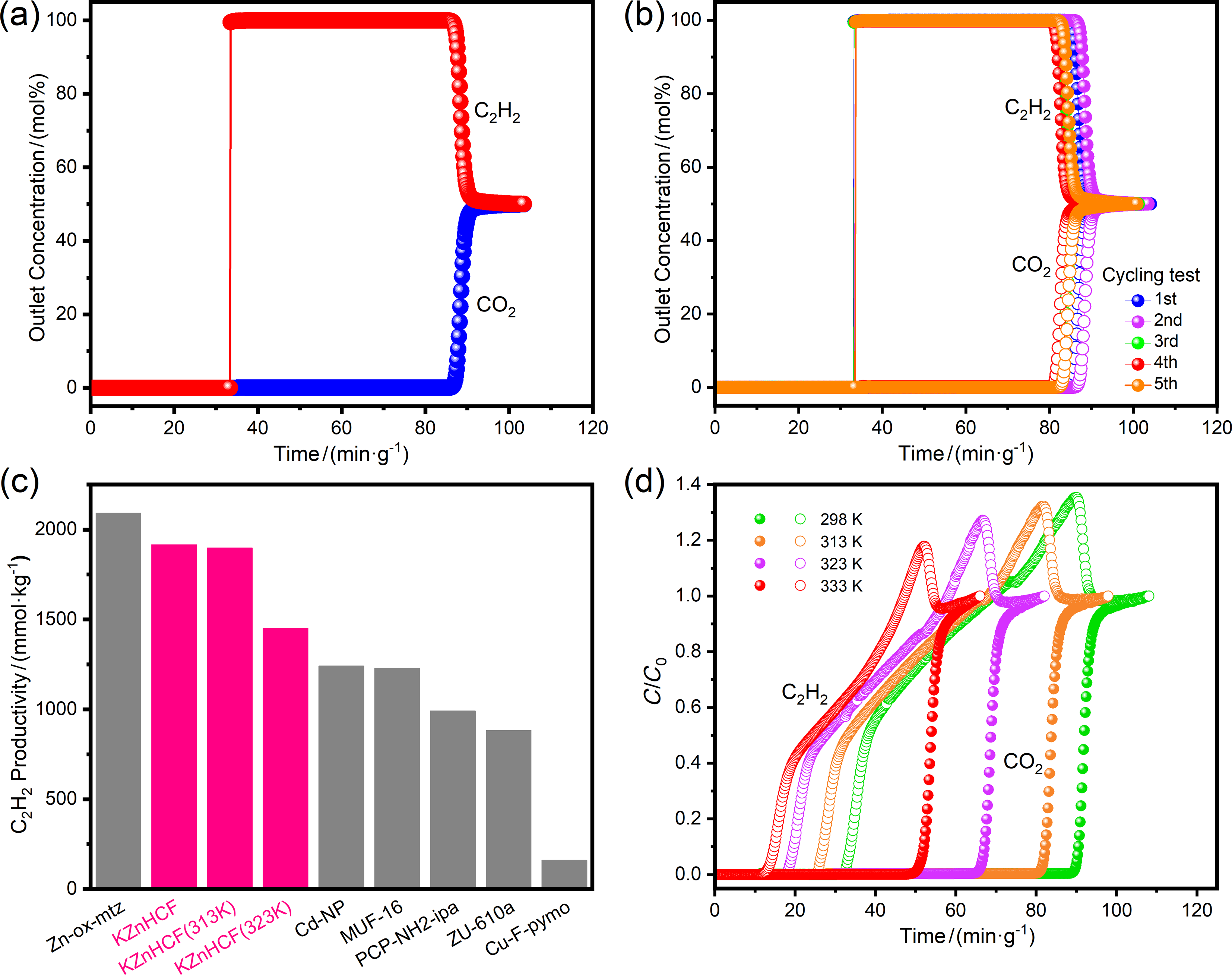
通过物理吸附分离法去除C2H2中的CO2杂质具有节能优势, 但由于这两种气体的分子尺寸和物理性质极为接近, 给分离带来很大挑战性. 其中具有CO2选择性的反向分离更为有效, 但是具有此性能的吸附剂十分稀缺. 另外, 吸附剂在分离过程中的稳定性、成本以及实际分离效率等问题均需考量. 本研究选用两种低成本、高稳定性的多孔配位框架材料Zn3[Fe3+(CN)6]2 (ZnHCF)和K2Zn3[Fe²+(CN)6]2 (KZnHCF)来解决上述问题. 这两例材料的笼状孔道结构具备适宜的窗口尺寸, 可实现对CO2的吸附性能优于C2H2. 在KZnHCF 中, 位于孔腔内部的 K+离子通过静电作用对进入孔道的CO2与C2H2分子产生差异化定向作用, 显著提升了CO2吸附量与分离选择性, 并在一定程度上缓解了吸附容量与选择性之间常见的此消彼长关系. 该材料在298 K条件下对CO2的吸附量达到111.5 cm3•g−1, 对等体积的CO2/C2H2混合气体具备出色的CO2选择性分离效果, 298 K、0.1 MPa条件下, 其理想吸附溶液理论(IAST)选择性为23.4. 更重要的是, 通过动态穿透实验发现, KZnHCF 可在较宽温度范围内保持高效的CO2/C2H2分离性能. 在298 K条件下处理体积比50∶50的CO2/C2H2混合气时, 该材料可一步法制备出纯度高于99.9%的C2H2, 动态吸附产率达1915 mmol•kg−1, 仅略低于最新报道的最高纪录. 在323 K, 其吸附产率(1450 mmol•kg−1)仍高于多数文献在298 K下报道的数值. KZnHCF 凭借优异的分离性能, 同时兼具高稳定性、可循环利用性、低成本及易规模化合成等优势, 成为潜在可应用于实际的高效CO2/C2H2分离材料.
欧阳阳, 俱战锋, 王文经, 杜顺福, 袁大强. 低成本高稳定性K2Zn3[Fe(CN)6]2框架用于高效CO2/C2H2分离★[J]. 化学学报, 2026, 84(5): 651-658.
Yangyang Ou, Zhanfeng Ju, Wenjing Wang, Shunfu Du, Daqiang Yuan. A Low-Cost and Highly Stable K2Zn3[Fe(CN)6]2 Framework for Efficient CO2/C2H2 Separation★[J]. Acta Chimica Sinica, 2026, 84(5): 651-658.
| [1] |
|
| [2] |
doi: 10.6023/A25040140 |
|
(吴子林, 张璐, 陈杨, 李晋平, 李立博, 化学学报, 2025, 83, 917.)
doi: 10.6023/A25040140 |
|
| [3] |
doi: 10.1002/cjoc.v43.9 |
| [4] |
doi: 10.1002/cjoc.v43.8 |
| [5] |
doi: 10.1002/anie.v61.43 |
| [6] |
doi: 10.1002/anie.v61.8 |
| [7] |
doi: 10.1002/anie.v65.12 |
| [8] |
doi: 10.1002/anie.v61.41 |
| [9] |
doi: 10.1021/jacs.2c05309 |
| [10] |
doi: 10.1016/j.cej.2022.135745 |
| [11] |
doi: 10.1038/s41467-021-27929-7 pmid: 35017555 |
| [12] |
doi: 10.1002/anie.v60.47 |
| [13] |
doi: 10.1002/(ISSN)1521-4125 |
| [14] |
doi: 10.1002/anie.v51.7 |
| [15] |
doi: 10.1016/j.chempr.2016.10.009 |
| [16] |
doi: 10.1039/D0TA03151H |
| [17] |
doi: 10.1021/jacs.5b10491 |
| [18] |
doi: 10.1016/j.seppur.2021.119608 |
| [19] |
doi: 10.1021/acsami.8b19590 |
| [20] |
doi: 10.1002/anie.202100584 pmid: 33524215 |
| [21] |
doi: 10.1002/anie.v60.31 |
| [22] |
doi: 10.1039/c2sc20443f |
| [23] |
|
| [24] |
doi: 10.1039/D1TA05869J |
| [25] |
doi: 10.1038/s41467-020-20489-2 pmid: 33420024 |
| [26] |
doi: 10.1016/j.cej.2018.11.113 |
| [27] |
doi: 10.1002/anie.v60.21 |
| [28] |
doi: 10.1002/anie.v60.33 |
| [29] |
doi: 10.1002/anie.v63.30 |
| [30] |
|
| [31] |
doi: 10.1002/anie.v65.3 |
| [32] |
doi: 10.1039/D2TA04835C |
| [33] |
doi: 10.1016/j.ccr.2021.213968 |
| [34] |
doi: 10.1016/j.ccr.2021.214274 |
| [35] |
doi: 10.1002/advs.v9.1 |
| [36] |
doi: 10.1021/ja051168t |
| [37] |
|
| [38] |
doi: 10.1016/j.micromeso.2012.06.019 |
| [39] |
doi: 10.1021/jp801955p |
| [40] |
doi: 10.1021/jp205104r |
| [41] |
doi: 10.1021/jp7117339 |
| [42] |
doi: 10.1016/j.apsusc.2010.10.003 |
| [43] |
doi: 10.1016/j.ccr.2017.03.022 |
| [44] |
doi: 10.1002/anie.v62.12 |
| [45] |
doi: 10.1038/s41467-022-33271-3 |
| [46] |
doi: 10.1021/jacs.1c12873 |
| [47] |
|
| [48] |
doi: 10.1038/ncomms8575 |
| [49] |
doi: 10.1002/anie.201409415 pmid: 25504739 |
| [50] |
doi: 10.1002/anie.v60.19 |
| [51] |
doi: 10.1039/C6TA10248D |
| [52] |
doi: 10.1039/C7TA11321H |
| [53] |
doi: 10.31635/ccschem.021.202101575 |
| [54] |
doi: 10.1021/jacs.0c11247 |
| [55] |
doi: 10.1038/s41467-021-25980-y |
| [56] |
doi: 10.1016/j.jpcs.2007.03.054 |
| [57] |
doi: 10.1107/S0567740879010797 |
| [58] |
doi: 10.1021/acsami.4c04760 |
| [59] |
doi: 10.1021/jacs.3c03265 |
| [60] |
doi: 10.1016/j.seppur.2022.120804 |
| [61] |
doi: 10.1002/anie.v61.39 |
| [62] |
doi: 10.1021/acsami.2c06744 |
| [63] |
doi: 10.1039/C7RA07363A |
| [1] | 王炙韬, 林雨珂, 万妍, 黄鑫伟, 李云斌, 吉定豪, 项生昌, 张章静. 快速、绿色机械化学合成UTSA-16(Zn)用于高效碳捕获★[J]. 化学学报, 2026, 84(5): 631-637. |
| [2] | 刘璐, 赵砚珑, 白薛峰, 张鑫, 李建荣. 可宏量制备的层叠配位聚合物用于CH4/N2分离★[J]. 化学学报, 2026, 84(5): 638-642. |
| [3] | 张伟宏, 马亚男, 方翰, 薛东旭. 面向乙烯一步纯化的多组分金属有机框架: 金属配体导向合成与C2混合气高效分离★[J]. 化学学报, 2026, 84(5): 659-666. |
| [4] | 冯超越, 薛波, 车国强, 刘大欢. 共价交联策略强化CO2/C2H2高效分离用IL@MOF复合材料的稳定性★[J]. 化学学报, 2026, 84(5): 673-681. |
| [5] | 宋玉朋, 华紫辉, 葛介超, 王春儒, 吴波. 具有强大内建电场的C60@TpPa共价有机框架材料高效光催化产氢[J]. 化学学报, 2026, 84(3): 370-376. |
| [6] | 叶舣, 黄正义, 赵兴雷, 赵娅俐, 刘龙杰, 吴武凤, 魏嫣莹. 垂直排列金属有机框架纳米片膜实现高效H2传输[J]. 化学学报, 2026, 84(1): 129-134. |
| [7] | 吴子林, 张璐, 陈杨, 李晋平, 李立博. 乙烷选择性金属有机框架材料的结构设计与分离应用★[J]. 化学学报, 2025, 83(8): 917-936. |
| [8] | 李帅, 刘亚婷, 仰大勇. 外泌体分离技术研究进展[J]. 化学学报, 2025, 83(4): 428-438. |
| [9] | 张蒙茜, 张玉莹, 秦家轩, 冯霄, 李雪艳, 畅通, 杨海英. 电聚合新型聚间苯二胺薄膜及H2/CO2分离性能研究[J]. 化学学报, 2025, 83(2): 132-138. |
| [10] | 王润泽, 储著银, 陈俊艺, 徐梦欣, 李献华, 刘志博. 跨界之桥: 铅放射性同位素驱动跨学科研究★[J]. 化学学报, 2025, 83(12): 1561-1575. |
| [11] | 何文, 王波, 冯晗俊, 孔祥如, 李桃, 肖睿. CO2捕集膜分离的Pebax基材料研究进展[J]. 化学学报, 2024, 82(2): 226-241. |
| [12] | 曾如馨, 陈鹏. RNA结合蛋白的组学解析与功能探索★[J]. 化学学报, 2024, 82(1): 53-61. |
| [13] | 王端达, 沈欣怡, 宋永杨, 王树涛. 新兴Janus颗粒在油水分离中的应用进展★[J]. 化学学报, 2023, 81(9): 1187-1195. |
| [14] | 曾少娟, 孙雪琦, 白银鸽, 白璐, 郑爽, 张香平, 张锁江. CO2捕集分离的功能离子液体及材料研究进展★[J]. 化学学报, 2023, 81(6): 627-645. |
| [15] | 钟越文, 钱希宁, 马超, 刘凯, 张洪杰. 稀土生物制造及其高附加值材料应用★[J]. 化学学报, 2023, 81(11): 1624-1632. |
| 阅读次数 | ||||||
|
全文 |
|
|||||
|
摘要 |
|
|||||
