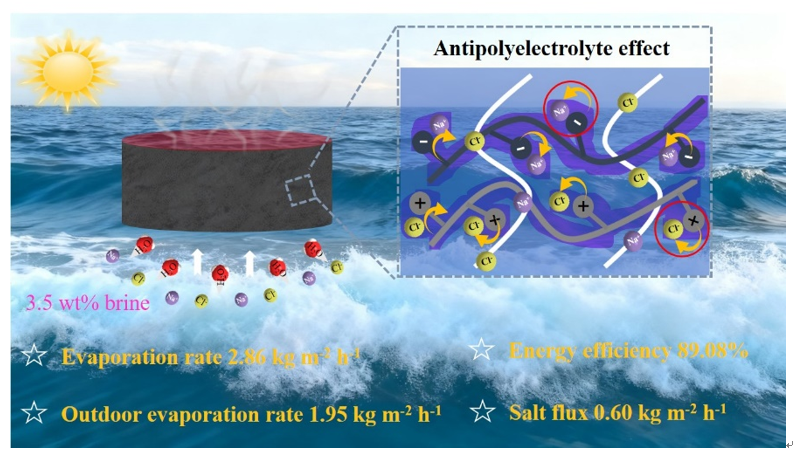
开发高效、耐盐的太阳能界面蒸发器,以实现海水的高效淡化和长期稳定运行,仍面临严峻挑战。本文构建了掺杂1-丁基-3-甲基咪唑氯盐的海藻酸盐复合凝胶蒸发器(BPS-Cl),该咪唑类离子液体改性凝胶具有各向异性层状多孔结构与优异水分传输性能。基于独特的抗聚电解质效应,该蒸发器在一个太阳照射下,在质量分数为3.5%的NaCl溶液中蒸发速率达2.86 kg·m⁻²·h⁻¹,较纯水条件下(2.54 kg·m⁻²·h⁻¹)提升12.59%,光热转换效率为89.25%;即使在w(NaCl)=10%高盐浓度下,蒸发速率仍可达2.32 kg·m⁻²·h⁻¹,显示出良好的高盐适应性。此外,BPS-Cl蒸发器表现出优异的自排盐性能,在w(NaCl)=3.5%的水溶液中连续运行36小时,平均蒸发速率稳定在2.84 kg·m⁻²·h⁻¹,且表面无盐分析出。户外实验进一步验证了其稳定的淡水生产能力。本研究为发展高效、抗盐的太阳能驱动海水淡化系统提供了新策略。
The development of highly efficient and salt-tolerant solar evaporators for sustainable seawater desalination remains a key challenge. Interfacial solar steam generation (ISSG) has emerged as a promising technology for harnessing solar energy to produce fresh water from saline sources. In this work, using polyethyleneimine (PEI) and sodium alginate (SA) as the gel network and reduced graphene oxide (RGO) as the photothermal material, we introduced 1-butyl-3-methylimidazolium chloride (BMIMCl) into the gel network, stirred the mixture uniformly, and finally obtained an alginate-based composite hydrogel evaporator doped with a hydrophilic imidazolium ionic liquid (denoted as BPS-Cl) via freeze-drying. The resulting evaporator possesses an anisotropic layered porous structure and favorable water transport capability. Owing to the unique anti-polyelectrolyte effect, the BPS-Cl evaporator achieved an evaporation rate of 2.86 kg·m⁻²·h⁻¹ in NaCl solution with a mass fraction of 3.5% under one-sun irradiation, which is 12.59% higher than that in pure water (2.54 kg·m⁻²·h⁻¹). Under dark evaporation conditions, the mass change of water per unit area per unit time for BPS-Cl was measured, and the corresponding photothermal conversion efficiency was calculated to be 89.25% according to the formula. Even under high-salinity conditions (w(NaCl)=10%), the evaporation rate can reach 2.32 kg·m⁻²·h⁻¹, demonstrating excellent salt tolerance. Moreover, during a 36-hour continuous desalination test in 3.5% NaCl solution (mass fraction), the evaporator exhibited stable performance with an average evaporation rate of 2.84 kg·m⁻²·h⁻¹ and no salt deposition on the surface, highlighting its excellent salt-rejection capability. In the outdoor evaporation experiment, the average evaporation rate of BPS-Cl was stable and reached 1.92 kg·m⁻²·h⁻¹. Meanwhile, the produced fresh water was collected and the ion concentrations of the freshwater were detected, which further validated its stable freshwater production performance. This study provides a novel strategy for the design of efficient and stable solar-driven desalination systems.
[1] N. E. UNITED; C. O. SCIENTIFIC.;The United Nations World Water Development Report 2024: Water for Prosperity and Peace. Paris: UNESCO 2024.
[2] Lewis. N. S.; Science2016, 351, aad1920.
[3] Shannon M. A.; Bohn P. W.; Elimelech M.; Georgiadis J. G.; Mariñas B. J.; Mayes A. M.; Nature2008 452, 301.
[4] Su Y.; Gu R.; Li Y.; Wu W.; Yu Z.; Cheng S.;Adv. Funct. Mater. 2025, 2420651.
[5] Chen Y.; Shen L.; Qi Z.; Luo Z.; Li X.; Bao H.; Nat. Sustain.2025, 8, 162-169.
[6] Chen Y., Bao H., Nat. Sustain.2025, 8, 123-124.
[7] Yang D.; Shi X.; Zhang J.; Bu X.; Acta Chim. Sinica2023, 81, 1052-1063 (in Chinese).(杨地, 史潇凡,张冀杰,卜显和,化学学报,2023, 81, 1052-1063.)
[8] Hu Y.; Ma H.; Wu M.; Lin T.; Yao H.; Liu F.; Cheng H.; Qu L.; Nat. Commun.2022, 13, 4335.
[9] Zhang H.; Shen X.; Kim E.; Wang M.; Lee J.; Chen H.; Zhang G.; Kim J.; Adv. Funct. Mater.2022, 32, 2111794.
[10] Chen X.; Ye Q.; Shi C.; Zhang L.; Zhou P.; Chen M.; Nano Res. Energy2025, 4(2), e9120152.
[11] Chen L.; Sun Y.; Ma C.; Sun Y.; Peng S.; Cao X.; Yang L.; Ma C.; Zhao H.; Wang H.; Zhang D.; Liu Q.; Liu Z.; Yuan Y.; Wang N.; Chem. Eng. J.2023, 475, 146177.
[12] Wang Z.; Gao J.; Zhou J.; Gong J.; Shang, L; Ye H.; He F.; Peng S.; Lin Z.; Li Y.; Caruso F.; Adv. Mater.2022, 35, 2209015.
[13] Wu X.; Wang Y.; Wu P.; Zhao J.; Lu Y.; Yang X.; Xu H.; Adv. Funct. Mater.2021, 31, 2102618.
[14] Zhang L.; Zhang Y.; Zou M.; Yu C.; Li C.; Gao C.; Dong Z.; Wu L.; Song Y.; Adv. Funct. Mater.2023, 33, 2300318.
[15] Wu L.; Dong Z.; Cai Z.; Ganapathy T.; Fang N.; Li C.; Yu C.; Zhang Y.; Song Y.; Nat. Commun.2020, 11, 521.
[16] Zhao W.; Gong H.; Song Y.; Li B.; Xu N.; Min X.; Lin G.; Zhu B.; Zhou L.; Zhang X.; Zhu J.; Adv. Funct. Mater.2021, 31, 100025.
[17] Gokturk P. A.; Sujanani R.; Qian J.; Wang Y.; Katz L. E.; Freeman B. D.; CrumLin E. J.; Nat. Commun.2022, 13, 5880.
[18] Zhang H.; Li X.; Liu X.; Du Y.; Xie W.; Zheng S.; Yang L.; Shi J.; Jing D.; Chem. Eng. J.2023, 473, 145484.
[19] Jiang H.; Liu X.; Wang H.; Wang D.; Guo Y.; Wang D.; Gao G.; Wang X.; Hu C.; Chin. Sci. Bull.2023, 68, 1640-1650.
[20] Li Z.; Zeng Q.; Yu G.; Li Z.; Ye C.; Liu Y.; Q J.; Macromol. Rapid Commun.2008, 29(2), 136—141.
[21] Qian J.; Guo J.; Li Y.; Yu X.; Desalination,2024, 575, 117292.
[22] Panja S. K.; Haddad B.; Debdab M.; Kiefer J.; Chaker Y.; Bresson S.; Paolone A.; ChemPhysChem,2019, 20(19), 2542-2548.
[23] Grenda K.; Idström A.; Evenäs L.; Persson M.; Holmberg K.; Bordes R.; J. Appl. Polym. Sci.2022, 139(7), e51657.
[24] Zhu S.; Wu Y.; Chen Q.; Yu Z.; Wang C.; Jin S.; Ding Y.; Wu G.; Green Chem.2006, 8(4), 325-327.
[25] Li Y.; Chen B.; Yao D.; Gao X.; Chen J.; Lu C.; Pang X.; Carbohydra. Poly.2025, 359, 123588.
[26] Jiang Y.; An N.; Sun Q.; Guo B.; Wang Z.; Zhou W.; Gao B.; Li Q.; Sci. Total Environ.2022, 837, 155757.
[27] Song C.; Jin Y.;International Journal of Biological Macromolecules 2025, 316, 144704.
[28] Li Y.; Liu X.; Wang Y.; Bi S.; Li J.; Wang J.; Duo Y.; Zhu Z.; Jin X.; Wang W.; Sci China Mater,2025, 68, 2850-2859 (in Chinese).(李叶燃,刘星,王一璠,毕圣洁,李静,王京博,朵永超,朱正涛,金欣,王闻宇,Sci China Mater, 2025, 68, 2850-2859.)
[29] Liu Wen.; Li Peng.; Li X.; He Y.; An L.; Qu D.; Wang X.; Sun Z.; Sci China Mater ,2023, 66, 1607-1614 (in Chinese).(刘文宁, 李鹏飞, 李湘勤, 何亚倩, 安丽, 曲丹, 汪夏燕, 孙再成, Sci China Mater, 2023, 66, 1607-1614.)
[30] Yang Z.; Cheng H.; Yang Y.; Liu H.; Du F.; Zhan Y.; Chem. J. Chinese Universities,2022, 43, 20220181 (in Chinese).(杨兆华,成鸿静,杨弋,刘辉,杜飞鹏,张云飞,Chem. J. Chinese Universities, 2022, 43, 20220181.)
[31] SEKINE Y.; IKEDA-FUKAZAWA T.; J. Chem. Phys.2009, 130(3), 034501.
[32] Lei C.; Guan W.; Guo Y.; Shi W.; Wang Y.; Johnston Prof. Keith P.; Yu G.; Angew. Chem. Int. Ed.2022, 134(36), e202208487.
[33] Zhu F.; Wang L.; DEMIR B.; An M.; Wu Z.; Yin J.; Xiao R.; Zheng Q.; Qian J.; Mater. Horiz.2020, 7(12), 3187-3195.
[34] Choi W.; Park S.; Kwon J.; Jang E.; Kim J.; Heo J.; Hwang Y.; Kim B.; Moon J.; Jung S.; Choi S.; Lee H.; Ahn H.; Hong J.; ACS Nano2021, 15, 6811-6828.
[35] Zhu Q.; Liu M.; Li Y.; Feng G.; Xu Z.; Geng L.; Yu X.; Sep. Purif. Technol.2025, 368, 133033.
[36] Chen L.; Sun Y.; Ma C.; Sun Y.; Peng S.; Cao X.; Yang L.; Ma C.; Zhao H.; Wang H.; Zhang D.; Liu Q.; Liu Z.; Yuan Y.; Wang N.; Chem. Eng. J.2023, 475, 146177.
[37] Geng L.; Zhang X.; Li Y.; Feng G.; Yu X.; Langmuir2024, 40(26), 13412—13421.
[38] Zhou H.; Han L.; Yang M.; Wu X.; Li J.; Ma H.; Zhang B.; Desalination2023, 556, 116567.
[39] Wang Z.; Jin R.; Zhang S.; Han X.; Guo P.; Jiang L.; Heng L.; Adv. Funct. Mater.2023, 33(47), 2306806.
[40] Yang H.; Sun Y.; Peng M.; Cai M.; Zhao B.; Li D.; Liang Z.; Jiang L.; ACS Nano2022, 16(2), 2511-2520.


