二维Janus纳米片的动态解组装到重组装为开发可循环再生的智能界面材料提供了新思路。然而,在保证纳米片构筑基元结构稳定性的同时,如何精确调控其动态重排行为与涂层宏观润湿性亟需解决。本研究以十八胺(ODA)双分子层为软模板,通过邻苯三酚(PG)氧化聚合及Fe3+配位交联,构筑了交联度可调的二维金属多酚Janus纳米片(Fe/PPG-ODA JNSs)。研究表明,Fe3+的引入显著增强纳米片的网络刚性与热稳定性,其在正己烷/乙醇混合溶剂中解组装生成的次级片状构筑单元尺寸随交联度增加而增大。溶剂蒸发诱导重组装过程中,交联度与溶剂极性协同调控构筑单元间氢键、π-π堆积及空间约束,从而获得花状、球形、螺旋纳米线及膜状结构。随着Fe3+交联程度增加,涂层水接触角由153.4°降至117.5°。结合SEM与XPS结果,该润湿性变化归因于表面多级粗糙结构减弱与Fe-多酚配位引起的表面化学组成/极性变化的协同作用,而非单一形貌因素,实现了涂层从超疏水低粘附向高粘附状态的有效转变。该金属多酚超粒子涂层在多种柔性及刚性基底上均表现出卓越的普适性,并能经历多次动态解组装-重组装循环而不丧失结构完整性与疏水性能。本工作深入阐明了金属配位网络对二维Janus材料动态组装行为的调控机制,为可再生、功能可调界面材料的设计提供了坚实的实验与理论依据。
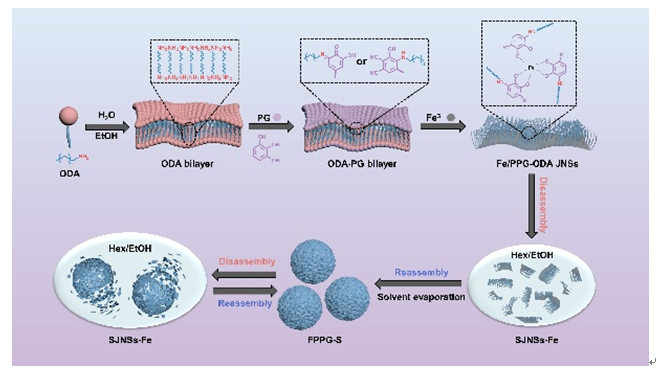
The development of recyclable and stimuli-regulated interfacial coatings with tunable wettability remains a significant challenge in surface and materials chemistry. Herein, we report a facile and controllable strategy for constructing two-dimensional (2D) metal-polyphenol Janus nanosheets (Fe/PPG-ODA JNSs) with tunable cross-linking degrees and demonstrate their application in dynamic assembly and reversible superhydrophobic coatings. The Janus nanosheets were fabricated using an octadecylamine (ODA) bilayer dispersed in the bulk EtOH/H2O medium as a soft template, where pyrogallol (PG) molecules were first adsorbed and subsequently underwent oxidative polymerization to form a poly(pyrogallol) (PPG) network. Fe3+ ions were then introduced to coordinate with phenolic hydroxyl groups, forming a metal-polyphenol cross-linked structure. By precisely regulating the FeCl3 concentration (0.05-0.25 mmol/L), a series of Fe/PPG-ODA JNSs with different cross-linking densities were obtained.
The chemical structure, morphology, and elemental composition of the nanosheets were systematically characterized by scanning electron microscopy (SEM), atomic force microscopy (AFM), Fourier transform infrared spectroscopy (FT-IR), and X-ray photoelectron spectroscopy (XPS). The spectroscopic results support covalent coupling between PG-derived quinone intermediates and ODA through Schiff-base and Michael-addition pathways, together with the formation of Fe3+-polyphenol coordination networks. AFM analysis reveals a gradual increase in nanosheet thickness with increasing Fe3+ content, indicating enhanced network rigidity. Thermogravimetric analysis (TGA) further demonstrates improved thermal stability with increasing cross-linking degree.
Upon ultrasonication in an n-hexane/ethanol mixed solvent, the Janus nanosheets undergo controllable disassembly into secondary nanosheet-like building units (SJNSs-Fe). The lateral size of these disassembled units increases with increasing cross-linking degree, indicating that metal coordination significantly enhances structural integrity against solvent-induced fragmentation. During solvent evaporation-induced self-assembly on solid substrates (including silicon wafers, glass, copper, stainless steel, and PTFE), these building units reassemble into hierarchical supraparticles. The assembly behavior is strongly dependent on multiple parameters, including Fe3+ cross-linking degree, solvent polarity (hexane/ethanol ratio from 6:1 to 1:1), particle concentration, and evaporation temperature (-20 to 50 °C). As a result, a variety of morphologies including flower-like aggregates, spherical supraparticles, helical nanowires, and dense films are obtained.
Small-angle X-ray scattering (SAXS) analysis reveals ordered hierarchical packing with characteristic lamellar spacing, supporting the formation of ordered supraparticle architectures. Importantly, the macroscopic wettability of the resulting coatings can be tuned by adjusting the cross-linking degree. The water contact angle decreases continuously from 153.4° to 117.5° with increasing Fe3+ content, accompanied by a transition from a superhydrophobic low-adhesion state displaying Cassie-Baxter-like composite wetting behavior to a hydrophobic high-adhesion state. The wettability variation is attributed to the combined effects of reduced hierarchical roughness and changes in surface chemical composition/polarity associated with Fe-polyphenol coordination.
Furthermore, the coatings exhibit excellent substrate universality and mechanical robustness. More importantly, they possess reversible disassembly-reassembly capability: the coatings can be disassembled into nanosheet building units under ultrasonic treatment in mixed solvent and subsequently reassembled into functional coatings upon solvent evaporation, with negligible loss in morphology or wettability after repeated cycles. This work demonstrates that metal coordination cross-linking provides an effective strategy to regulate the balance between structural stability and dynamic assembly in 2D Janus systems, offering a general platform for designing recyclable, adaptive, and functionally tunable interfacial materials.
[1] Ku K. H.; Lee Y. J.; Yi G.-R.; Jang S. G.; Schmidt B. V.; Liao K.; Klinger D.; Hawker C. J.; Kim B. J.,Shape-tunable biphasic Janus particles as pH-responsive switchable surfactants.Macromolecules 2017, 50 (23), 9276-9285.
[2] Liu F.; Li Y.; Huang Y.; Tsyrenova A.; Miller K.; Zhou L.; Qin H.; Jiang S.,Activation and assembly of plasmonic-magnetic nanosurfactants for encapsulation and triggered release.Nano Lett. 2020, 20 (12), 8773-8780.
[3] Kim J. W.; Lee D.; Shum H. C.; Weitz D. A.,Colloid surfactants for emulsion stabilization.Adv. Mater. 2008, 20 (17), 3239-3243.
[4] Yang J.; Wang J.; Liu Y.; Li H.; Lin Z.,Stimuli-responsive Janus mesoporous nanosheets towards robust interfacial emulsification and catalysis.Materials Horizons 2020, 7 (12), 3242-3249.
[5] Duan Y.; Zhao X.; Sun M.; Hao H.,Research advances in the synthesis, application, assembly, and calculation of Janus materials.Ind. Eng. Chem. Res. 2021, 60 (3), 1071-1095.
[6] Cao J.; Zhou T.; Xu Y.; Qi Y.; Jiang W.; Wang W.; Sun P.; Li A.; Zhang Q.,Oriented assembly of anisotropic nanosheets into ultrathin flowerlike superstructures for energy storage.ACS Nano 2021, 15 (2), 2707-2718.
[7] Zhang Y.; Li L.; Wang R.; Liu J.; Lin Z.; Li G.; Liu H.; Lei Y.; Xiong Y.; Zhao Y.; Xue L.Fish Skin‐Inspired Janus Hydrogel Coating for Drag Reduction Chin. J. Chem. 2024, 42, 867-872.
[8] Bravo L.,Polyphenols: chemistry, dietary sources, metabolism, and nutritional significance.Nutr. Rev. 1998, 56 (11), 317-333.
[9] Zhou J.; Lin Z.; Ju Y.; Rahim M. A.; Richardson J. J.; Caruso F.,Polyphenol-mediated assembly for particle engineering.Acc. Chem. Res. 2020, 53 (7), 1269-1278.
[10] Guan X.; Zhang B.; Wang Z.; Han Q.; An M.; Ueda M.; Ito Y.,Natural polyphenol tannin-immobilized composites: rational design and versatile applications. Journal of Materials Chemistry B 2023, 11 (21), 4619-4660.
[11] Shin M.; Park E.; Lee H.,Plant-inspired pyrogallol-containing functional materials.Adv. Funct. Mater. 2019, 29 (43), 1903022.
[12] Li D.; Xiong Y.; Liu Z.; Liu X.; Wang Y.; Sun M.; Zhao N.; Jia X.,Solvent-mediated biomimetic reversible assembly of supraparticles from polyphenol Janus nanosheets.Journal of Colloid and Interface Science 2026, 715, 140264.
[13] Jin B.; Shen J.; Gou X.; Peng R.; Chu S.; Dong H.,Synthesis, Characterization, thermal stability and sensitivity properties of new energetic polymers-PVTNP-g-GAPs crosslinked polymers.Polymers 2016, 8 (1), 10.
[14] Nair K. P.; Breedveld V.; Weck M.,Complementary hydrogen-bonded thermoreversible polymer networks with tunable properties.Macromolecules 2008, 41 (10), 3429-3438.
[15] Podsiadlo P.; Kaushik A. K.; Arruda E. M.; Waas A. M.; Shim B. S.; Xu J.; Nandivada H.; Pumplin B. G.; Lahann J.; Ramamoorthy A.,Ultrastrong and stiff layered polymer nanocomposites.Science 2007, 318 (5847), 80-83.
[16] Ritchie R. O.,The conflicts between strength and toughness.Nat. Mater. 2011, 10 (11), 817-822.
[17] Giesa T.; Buehler M. J.,Nanoconfinement and the Strength of Biopolymers.Annual Review of Biophysics 2013, 42 (1), 651-673.
[18] Wang H.-C.; Grolman J. M.; Rizvi A.; Hisao G. S.; Rienstra C. M.; Zimmerman S. C., pH-triggered release from polyamide microcapsules prepared by interfacial polymerization of a simple diester monomer.ACS macro letters 2017, 6 (3), 321-325.
[19] Sanchez-Ballester, N. M.; Soulairol, I.; Bataille, B.; Sharkawi, T., Flexible heteroionic calcium-magnesium alginate beads for controlled drug release.Carbohydr. Polym. 2019, 207, 224-229.
[20] Lobel B. T.; Baiocco D.; Al-Sharabi, M.; Routh, A. F.; Zhang, Z.; Cayre, O. J., Current challenges in microcapsule designs and microencapsulation processes: a review.ACS Appl. Mater. Interfaces 2024, 16 (31), 40326-40355.
[21] Yan G.; Chen G.; Peng Z.; Shen Z.; Tang X.; Sun Y.; Zeng X.; Lin L.,The Cross-Linking Mechanism and Applications of Catechol-Metal Polymer Materials.Advanced Materials Interfaces 2021, 8 (19), 2100239.
[22] Kim S.; Regitsky A. U.; Song J.; Ilavsky J.; McKinley, G. H.; Holten-Andersen, N., In situ mechanical reinforcement of polymer hydrogels via metal-coordinated crosslink mineralization.Nat. Commun. 2021, 12 (1), 667.
[23] Cheng Z.; Yan M.; Cao L.; Huang J.; Cao X.; Yuan D.; Chen Y.,Design of nitrile rubber with high strength and recycling ability based on Fe3+-catechol group coordination.Ind. Eng. Chem. Res. 2019, 58 (9), 3912-3920.
[24] Liu Y.; Li Z.; Zhang Z.; Wang J.; Sun L.; Xie T.,Thermal-driven self-healing waterborne polyurethane with robust mechanical properties based on reversible phenol-carbamate network and Fe3+-catechol coordination bond.Prog. Org. Coat. 2021, 153, 106153.
[25] Zhou Z.; Liu T.; Zhou W.; Chen H.; Bian Y.; Gong S.; Shi S. Q.; Li J.,A strong and biodegradable wood particles-based bioplastic modified by synergistically dynamic cross-linking with tannic acid and Fe3+.Composites Part B: Engineering 2022, 247, 110349.
[26] Li D.; Zhang S.; Sheng W.; Zhang Q.; Liu Z.; Li R.; Liu X.; Meng C.; Li C.; Li M.; Jia, X. ACS Appl. Nano Mater.2023, 6, 8290-8301.
[27] Soyekwo F.; Zhang Q.; Gao R.; Qu Y.; Lv R.; Chen M.; Zhu A.; Liu Q.,Metal in situ surface functionalization of polymer-grafted-carbon nanotube composite membranes for fast efficient nanofiltration.Journal of Materials Chemistry A 2017, 5 (2), 583-592.
[28] Deng Y.; Dong Y.; Wang G.; Sun K.; Shi X.; Zheng L.; Li X.; Liao S.,Well-defined ZIF-derived Fe-N codoped carbon nanoframes as efficient oxygen reduction catalysts.ACS Appl. Mater. Interfaces 2017, 9 (11), 9699-9709.
[29] Xu J.; Cao S.; Zhong M.; Ren S.; Chen X.; Li W.; Wang C.; Wang Z.; Lu X.; Lu X.,Rational design of bimetal phosphide embedded in carbon nanofibers for boosting oxygen evolution.J. Colloid Interface Sci. 2024, 657 (000), 8.
[30] Heeley E. L.; Hughes D. J.; El Aziz, Y.; Taylor, P. G.; Bassindale, A. R., Linear long alkyl chain substituted POSS cages: the effect of alkyl chain length on the self-assembled packing morphology.Macromolecules 2013, 46 (12), 4944-4954.
[31] Man T.; Wang Z.; Xing Y.; Ma K.; Nong Z.; Lu S.Multifunctional Integrated Composite Coatings Based on both Grafted-ZnO and Single-walled Carbon Nanotubes. Acta Chim. Sinica 2024, 82, 1142-1149.
[32] Yang Q.-M.; Liu Y.-C.; Chen L.-X.; Yang P.,Study on the Amyloid-like Fibrinogen-based Nanofilm. Acta Polym. Sin. 2020, 51(8), 890-900.
[33] Yang F.; Li M.; Xiong J.; Lv X.; Ma X.; Chen W.; Yang P.,Amyloid-Like Protein Coating as a Barrier Against Plasticizer Leaching. CCS Chem. 2025, 7(2), 493-506.
[34] Bai J.-W.; Liu W.; Wen B.; Lei Z.-L.; Li C.; Ren H.; Yang P.,Synergistic Functional Group Interactions for Stable Interfacial Adhesion: Insights from Amyloid-inspired Polymers. Chinese J. Polym. Sci. 2025, 43(7), 1096-1104.