

Acta Chimica Sinica ›› 2026, Vol. 84 ›› Issue (3): 370-376.DOI: 10.6023/A25100352 Previous Articles Next Articles
Article
宋玉朋a,c, 华紫辉b,c, 葛介超a,c, 王春儒b,c, 吴波b,c,d,*( )
)
投稿日期:2025-10-23
发布日期:2026-02-03
基金资助:
Song Yupenga,c, Hua Zihuib,c, Ge Jiechaoa,c, Wang Chunrub,c, Wu Bob,c,d,*()
Received:2025-10-23
Published:2026-02-03
Contact:
*E-mail: zkywubo@iccas.ac.cn
Supported by:Share
Song Yupeng, Hua Zihui, Ge Jiechao, Wang Chunru, Wu Bo. C60@TpPa Covalent Organic Framework with Strong Built-In Electric Field Enables Efficient Photocatalytic Hydrogen Production[J]. Acta Chimica Sinica, 2026, 84(3): 370-376.
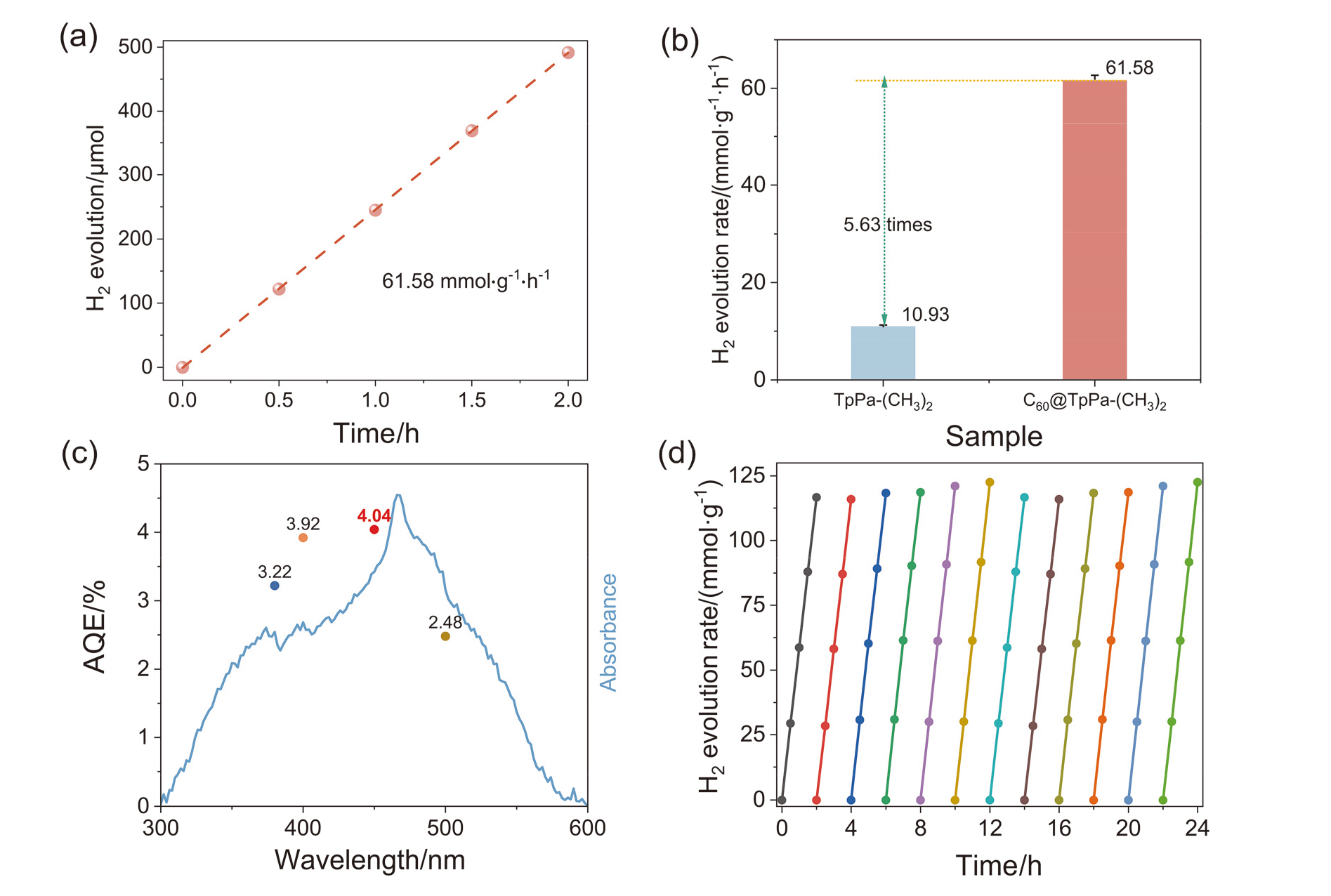
| [1] |
doi: 10.1016/j.chempr.2020.06.010 |
| [2] |
doi: 10.1038/s41560-019-0456-5 |
| [3] |
doi: 10.1038/s41578-020-00254-z |
| [4] |
doi: 10.6023/A24090266 |
|
(陈铭晖, 张博心, 魏滔, 孙兆雪, 冯亚青, 张宝, 化学学报, 2025, 83, 93.)
doi: 10.6023/A24090266 |
|
| [5] |
doi: 10.1039/C7EE00751E |
| [6] |
doi: 10.1039/C9QI00964G |
| [7] |
doi: 10.1038/s41557-018-0141-5 |
| [8] |
doi: 10.1038/s41929-023-00972-x |
| [9] |
doi: 10.6023/A25030077 |
|
(闫生荣, 刘文浩, 段芳, 陈明清, 东为富, 陆双龙, 杜明亮, 化学学报, 2025, 83, 685.)
doi: 10.6023/A25030077 |
|
| [10] |
doi: 10.1002/aenm.v11.29 |
| [11] |
doi: 10.1002/cnl2.v2.6 |
| [12] |
doi: 10.1002/adma.v37.52 |
| [13] |
doi: 10.1002/cjoc.v43.10 |
| [14] |
doi: 10.1002/cjoc.v42.21 |
| [15] |
doi: 10.1002/cnl2.v3.4 |
| [16] |
doi: 10.59717/j.xinn-mater.2024.100087 |
| [17] |
doi: 10.1002/adfm.v34.25 |
| [18] |
|
| [19] |
|
| [20] |
doi: 10.1002/anie.v59.16 |
| [21] |
doi: 10.1002/advs.v12.28 |
| [22] |
|
| [23] |
doi: 10.1021/accountsmr.3c00247 |
| [24] |
|
| [25] |
doi: 10.3390/nano14030256 |
| [26] |
doi: 10.1016/j.cej.2025.166299 |
| [27] |
|
| [28] |
|
| [29] |
doi: 10.1016/j.apcata.2023.119320 |
| [30] |
doi: 10.1021/ja308278w pmid: 23153356 |
| [31] |
doi: 10.1016/j.cej.2021.129984 |
| [32] |
doi: 10.1002/adfm.v33.3 |
| [33] |
|
| [34] |
doi: 10.1002/adfm.v32.17 |
| [35] |
doi: 10.1038/s41467-022-29826-z |
| [36] |
doi: 10.1002/adma.v33.7 |
| [1] | Shengrong Yan, Wenhao Liu, Fang Duan, Mingqing Chen, Weifu Dong, Shuanglong Lu, Mingliang Du. Constructing of sp2-Carbon Linked Covalent Organic Frameworks with D-A Structure and Evaluating Their Photocatalytic Performance towards Hydrogen Peroxide Production [J]. Acta Chimica Sinica, 2025, 83(7): 685-693. |
| [2] | Jiayu Wang, Wenjuan Zhao, Hongyu Jia, Yongbo Liu, Min Zhang, Longlong Dong, Anjie Zhang, Rui Wang. Enhancing Electrocatalytic Nitrate Reduction to Ammonia via Copper-Coordinated Three-Dimensional Covalent Organic Frameworks [J]. Acta Chimica Sinica, 2025, 83(12): 1507-1513. |
| [3] | Ban Miaohan, Shuang Yazhou, Yang Anping, Zheng Changyong, Zhang Wei, Xu Fei. Advances in Covalent Organic Frameworks Design for Proton Conduction [J]. Acta Chimica Sinica, 2025, 83(11): 1435-1540. |
| [4] | Shenglin Jin, Changzhi Han, Chong Zhang, Daodao Hu, Ben Yang, Jia-Xing Jiang. Synthesis and Photocatalytic Hydrogen Production Performance of Furan based D-π-A type Linear Conjugated Polymer [J]. Acta Chimica Sinica, 2025, 83(10): 1150-1156. |
| [5] | Chengqiu Li, Jiajun Yu, Xiao Feng. Research Progress of Covalent Organic Frameworks as Proton Conductors★ [J]. Acta Chimica Sinica, 2025, 83(10): 1223-1236. |
| [6] | Jianchuan Liu, Cuiyan Li, Yaozu Liu, Yujie Wang, Qianrong Fang. Highly-Stable Two-Dimensional Bicarbazole-based sp2-Carbon-conjugated Covalent Organic Framework for Efficient Electrocatalytic Oxygen Reduction★ [J]. Acta Chimica Sinica, 2023, 81(8): 884-890. |
| [7] | Rongjie Yang, Lin Zhou, Bin Su. Selective Detection of Vitamins A and C based on Covalent Organic Framework Modified Electrodes★ [J]. Acta Chimica Sinica, 2023, 81(8): 920-927. |
| [8] | Xuefeng Liang, Jian Jing, Xin Feng, Yongze Zhao, Xinyuan Tang, Yan He, Lisheng Zhang, Huifang Li. Electronic Structure of Covalent Organic Frameworks COF66 and COF366: from Monomers to Two-Dimensional Framework [J]. Acta Chimica Sinica, 2023, 81(7): 717-724. |
| [9] | Minghui He, Ziqiu Ye, Guiqing Lin, Sheng Yin, Xinyi Huang, Xu Zhou, Ying Yin, Bo Gui, Cheng Wang. Research Progress of Porphyrin-Based Covalent Organic Frameworks in Photocatalysis★ [J]. Acta Chimica Sinica, 2023, 81(7): 784-792. |
| [10] | Junchang Chen, Mingxing Zhang, Shuao Wang. Research Progress of Synthesis Methods for Crystalline Porous Materials [J]. Acta Chimica Sinica, 2023, 81(2): 146-157. |
| [11] | Ling Qiu, Jiayi Liang, Zhuxia Zhang, Taishan Wang. Synthesis and Characterizations of 15N Isotope Labeling Metal Nitride Clusterfullerene [J]. Acta Chimica Sinica, 2022, 80(7): 874-878. |
| [12] | Xiaohan Yu, Wei Huang, Yanguang Li. Controllable Synthesis and Photocatalytic Applications of Two-dimensional Covalent Organic Frameworks [J]. Acta Chimica Sinica, 2022, 80(11): 1494-1506. |
| [13] | Ruilin Haotian, Ziyu Zhu, Yanhui Cai, Wei Wang, Zhen Wang, Axin Liang, Aiqin Luo. Application of Covalent Organic Framework-Based Electrochemical Biosensors in Biological Sample Detection [J]. Acta Chimica Sinica, 2022, 80(11): 1524-1535. |
| [14] | Zitao Wang, Yaozu Liu, Yujie Wang, Qianrong Fang. A New Covalent Organic Framework Modified with Sulfonic Acid for CO2 Uptake and Selective Dye Adsorption [J]. Acta Chimica Sinica, 2022, 80(1): 37-43. |
| [15] | Tao Wang, Lu Zhao, Kewei Wang, Yunfeng Bai, Feng Feng. Research Progress on the Synthesis of Covalent Organic Frameworks and Their Applications in Tumor Therapy [J]. Acta Chimica Sinica, 2021, 79(5): 600-613. |
| Viewed | ||||||
|
Full text |
|
|||||
|
Abstract |
|
|||||
