

Acta Chimica Sinica ›› 2026, Vol. 84 ›› Issue (3): 425-447.DOI: 10.6023/A25110360 Previous Articles Next Articles
Review
周铭宇a,c, 刘乐彬a,c, 梅雷a, 刘雅兰a,*( ), 石伟群b,*()
投稿日期:2025-11-06
发布日期:2025-12-31
作者简介: |
周铭宇, 中国科学院高能物理研究所博士研究生, 主要 从事金属锆的熔盐电化学研究. |
 |
刘乐彬, 中国科学院高能物理研究所硕士研究生, 主要 从事干法后处理研究. |
 |
梅雷, 中国科学院高能物理研究所, 研究员. 主要研究方向为锕系元素化学与分离材料, 致力于将超分子识别与组装的理念和方法应用于锕系固体化学和放射性核素分离化学研究, 在锕系超分子配合物及其配位化学基础、基于协同识别的放射性核素分离新方法、新型锕系固相材料开发等方面开展了系列原创性工作, 为解决乏燃料后处理、环境放射性污染控制与资源回用研究等领域中的关键问题提供了新思路. 以通讯/第一作者身份在Nature Commun., J. Am. Chem. Soc., Angew. Chem. Int. Ed., Adv. Funct. Mater.等国际知名期刊发表研究论文130余篇. 目前担任中国化学会青年化学工作者委员会委员, 中科院青促会化学与材料分会委员, 中国核学会锕系化学与物理分会理事, 并担任《核化学与放射化学》期刊编委, SmartMat、Materials Research Letters、《结构化学》等学术期刊青年编委. |
 |
刘雅兰, 副研究员, 中国科学院高能物理研究所. 多年来致力于氧化物乏燃料干法后处理领域, 聚焦于锕-镧分离研究. 首先开展了锕、镧系氧化物在熔盐中的溶解及其电化学行为研究, 随后在固态活性铝阴极上进行了锕-镧的电化学分离, 并采用原位光谱技术监测了分离过程中锕、镧元素的化学种态变化, 发现了铀的循环电解并将其消除, 提高了电流效率. 最终成功实现了锕-镧元素的有效分离, 与传统的液态Cd阴极相比将分离因子提高了两个数量级. 在此基础上, 进一步总结了锕、镧氧化物在氯化物熔盐中的溶解规律, 提出了利用其溶解性差异实现一步分离的新方法. 基于相关工作, 在电化学领域与核能领域著名期刊Electrochim. Acta, J. Electrochem. Soc., Electrochem. Commun.和 J. Nucl. Mater.等上共发表论文40余篇, 其中第一作者及通讯作者论文20篇. |
 石伟群, 上海交通大学特聘教授, 核燃料循环与核材料研究所所长, 国家杰出青年科学基金获得者. 2007年1月在清华大学化学系获博士学位. 长期致力于核燃料循环化学相关基础研究, 在JACS、Angew. Chem、Chem.、CCS Chem.、Nat. Commun、Adv. Mater.等国际知名期刊发表SCI论文400余篇, 成果被国内外同行广泛关注和引用, 文章总引两万余次, H因子71 (Google Scholar), 2020~2024年连续入选Elsevier中国高被引学者榜单(核科学技术). 分别担任期刊《Supramolecular Materials》副主编, 《Industrial Chemistry & Materials》、《Chinese Chemical Letters》、《Journal of Nuclear Fuel Cycle and Waste Technology》、《International Journal of Advanced Nuclear Reactor Design and Technology》和《Journal of Nuclear Science and Technology》的编委与国际顾问编委, 中文期刊《化学学报》、《高等学校化学学报》、《核化学与放射化学》、《核动力》编委. 现为中国核工业教育学会副理事长、中国核学会锕系物理与化学分会副理事长、中国有色金属学会熔盐化学与技术专业委员会副主任委员、中国化学会核化学与放射化学专业委员会委员、中国核学会核化工分会常务理事兼副秘书长.
Zhou Mingyua,c, Liu Lebina,c, Mei Leia, Liu Yalana,*(), Shi Weiqunb,*()
Received:2025-11-06
Published:2025-12-31
Contact:
*E-mail: liuyalan@ihep.ac.cn;
shiwq@ihep.ac.cn
Share
Zhou Mingyu, Liu Lebin, Mei Lei, Liu Yalan, Shi Weiqun. Research Progress on the Preparation and Recovery of Nuclear-Grade Zirconium Using Molten Salts[J]. Acta Chimica Sinica, 2026, 84(3): 425-447.
| Methods | Advantage | Challenges |
|---|---|---|
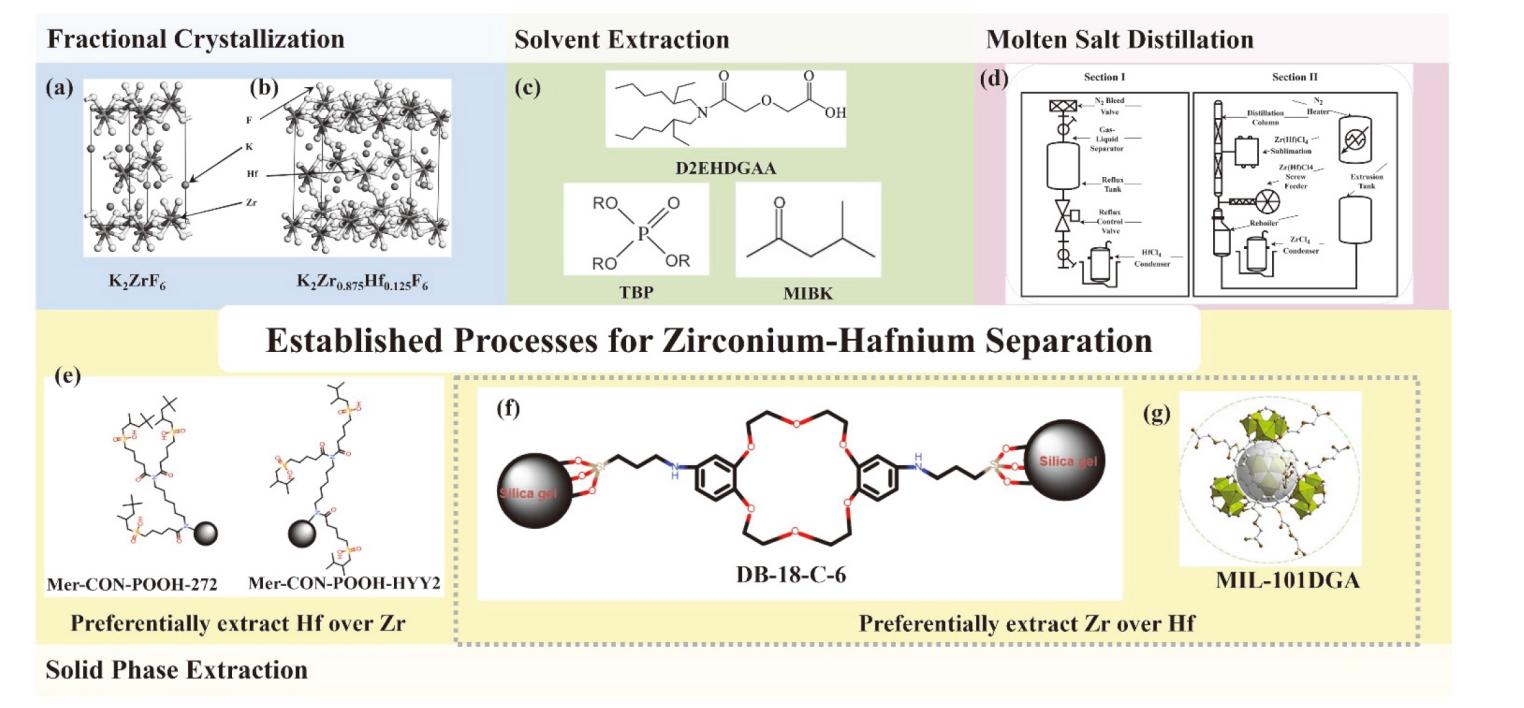
| Fractional Crystallization | Simplicity principle; Mild operating conditions | Low separation factor; Low productivity; Intermittent operation |
| Solvent Extraction | Large-scale production; Mature process; Separation efficiency | High consumption; High waste generation; Process complexity |
| Solid-phase Extraction | Eco-Friendly; Highly efficient | Adsorbent cost; Low stability |
| Molten Salt Distillation | Process simplicity; Simplifies downstream; Waste minimization | High temperature; Corrosivity; High energy consumption |
| Methods | Advantage | Challenges |
|---|---|---|
| Fractional Crystallization | Simplicity principle; Mild operating conditions | Low separation factor; Low productivity; Intermittent operation |
| Solvent Extraction | Large-scale production; Mature process; Separation efficiency | High consumption; High waste generation; Process complexity |
| Solid-phase Extraction | Eco-Friendly; Highly efficient | Adsorbent cost; Low stability |
| Molten Salt Distillation | Process simplicity; Simplifies downstream; Waste minimization | High temperature; Corrosivity; High energy consumption |
| Components | Melting/Eutectic Temp. (℃) | Characteristics/Properties | Primary Applications in Zr Industry |
|---|---|---|---|
| NaCl | 801 |  Wide electrochemical window; Wide electrochemical window; High Zr-salt solubility; High Zr-salt solubility; Low cost; Low cost; Formation of dense, adherent Zr deposits. Formation of dense, adherent Zr deposits. | Molten Salt Distillation; Molten Salt Electrolysis for Zr/Hf Separation; Electrowinning for Zirconium Production. |
| MgCl2 | 714 | Denser Kroll byproduct than molten Mg; Electrolytically regeneratable. Electrolytically regeneratable. | Kroll Process for Zirconium Production. |
| CaCl2 | 772 | High O2− affinity/solubility; Efficient O2− transport. Efficient O2− transport. | FFC Process for Zirconium Production. |
| NaCl-KCl | 657 | Powdery, non-adherent zirconium deposits; Favorable solubility for ZrCxOy anodes. Favorable solubility for ZrCxOy anodes. | Molten Salt Distillation; Molten Salt Extraction for Zr/Hf Separation; Molten Salt Electrolysis for Zr/Hf Separation; Electrowinning for Zirconium Production; USTB Process for Zirconium Production. |
| LiCl-KCl | 352 |  Multi-metallic processing capability; Highly purifiable; Multi-metallic processing capability; Highly purifiable; Wide/stable electrochemical window. Wide/stable electrochemical window. | Molten Salt Electrolysis for Zr/Hf Separation; Electrowinning for Zirconium Production; Electrorefining for Zirconium Recovery. |
| LiF-KF | 492 |  High Zr(IV) reduction efficiency; High Zr(IV) reduction efficiency; Dense Zr deposition; Fluoride-induced anode passivation; Dense Zr deposition; Fluoride-induced anode passivation; High viscosity and corrosivity. High viscosity and corrosivity. | Electrorefining for Zirconium Recovery. |
| LiF-NaF | 649 | ||
| LiF-NaF-KF | 460 |
| Components | Melting/Eutectic Temp. (℃) | Characteristics/Properties | Primary Applications in Zr Industry |
|---|---|---|---|
| NaCl | 801 | Wide electrochemical window; High Zr-salt solubility; Low cost; Formation of dense, adherent Zr deposits. | Molten Salt Distillation; Molten Salt Electrolysis for Zr/Hf Separation; Electrowinning for Zirconium Production. |
| MgCl2 | 714 | Denser Kroll byproduct than molten Mg; Electrolytically regeneratable. | Kroll Process for Zirconium Production. |
| CaCl2 | 772 | High O2− affinity/solubility; Efficient O2− transport. | FFC Process for Zirconium Production. |
| NaCl-KCl | 657 | Powdery, non-adherent zirconium deposits; Favorable solubility for ZrCxOy anodes. | Molten Salt Distillation; Molten Salt Extraction for Zr/Hf Separation; Molten Salt Electrolysis for Zr/Hf Separation; Electrowinning for Zirconium Production; USTB Process for Zirconium Production. |
| LiCl-KCl | 352 | Multi-metallic processing capability; Highly purifiable; Wide/stable electrochemical window. | Molten Salt Electrolysis for Zr/Hf Separation; Electrowinning for Zirconium Production; Electrorefining for Zirconium Recovery. |
| LiF-KF | 492 | High Zr(IV) reduction efficiency; Dense Zr deposition; Fluoride-induced anode passivation; High viscosity and corrosivity. | Electrorefining for Zirconium Recovery. |
| LiF-NaF | 649 | ||
| LiF-NaF-KF | 460 |
| Technique | Description/Formula Name | Equation | Applicable System & Notes |
|---|---|---|---|
| EFMa | Nernst Equation | | Ecell: Measured potential (V) C: Concentration of the electroactive species (mol/L) |
| LSV/CV | Reversible System Half-Wave Potential | | Reversible System: Fast electron transfer. EP/2: Half-wave potential (V) EP: Peak potential (V) Constant 2.2 is characteristic of a reversible process. |
| Irreversible System Half-Wave Potential | | Totally Irreversible System: Slow electron transfer. Constant 1.85 is characteristic of an irreversible process. | |
| SWV | Peak Width at Half Height | | W1/2: Peak width at half height (V) Applicable when electron transfer is sufficiently fast. |
| CP | Sand's Equation | | Used to calculate the diffusion coefficient D or n. i: Applied constant current (A) A: Electrode area (cm2) C: Bulk concentration (mol/cm3) |
| Calculation | Randles-Sevcik Equation | | Primarily used in LSV/CV to calculate the diffusion coefficient D from the peak current ip. ip: Peak current (A) ν: Scan rate (V/s) |
| Technique | Description/Formula Name | Equation | Applicable System & Notes |
|---|---|---|---|
| EFMa | Nernst Equation | | Ecell: Measured potential (V) C: Concentration of the electroactive species (mol/L) |
| LSV/CV | Reversible System Half-Wave Potential | | Reversible System: Fast electron transfer. EP/2: Half-wave potential (V) EP: Peak potential (V) Constant 2.2 is characteristic of a reversible process. |
| Irreversible System Half-Wave Potential | | Totally Irreversible System: Slow electron transfer. Constant 1.85 is characteristic of an irreversible process. | |
| SWV | Peak Width at Half Height | | W1/2: Peak width at half height (V) Applicable when electron transfer is sufficiently fast. |
| CP | Sand's Equation | | Used to calculate the diffusion coefficient D or n. i: Applied constant current (A) A: Electrode area (cm2) C: Bulk concentration (mol/cm3) |
| Calculation | Randles-Sevcik Equation | | Primarily used in LSV/CV to calculate the diffusion coefficient D from the peak current ip. ip: Peak current (A) ν: Scan rate (V/s) |
| FLiNaK (LiF:NaF:KF) | |||||
|---|---|---|---|---|---|
| Author | Time | Zr(IV) Ion Source | Electrode | Electroreduction behavior of Zr(IV) | D(Zr4+)/(cm2•s−1) |
| Mellors[ | 1966 | ZrF4 & K2ZrF6 | Mo | Zr(IV)→Zr | — |
| Li[ | 2023 | K2ZrF6 | Cu | | — |
| Zuo[ | 2025 | ZrF4 | W | | 3.85×10⁻⁶ (600 ℃) |
| LiF-CaF2 | |||||
| Gibilaro[ | 2013 | ZrF4 | Ta, Cu, Ni | Zr(IV)→Zr | 9.96×10⁻⁶ (840 ℃) |
| Fabian[ | 2022 | ZrF4 | Mo, Ni | Zr(IV)→Zr0(sol)→Zr | 2.6×10⁻⁵ (840 ℃) |
| LiF-KF | |||||
| Mellors[ | 1966 | ZrF4 & K2ZrF6 | Mo | Zr(IV)→Zr | — |
| Park[ | 2013 | ZrF4 | Mo | Zr(IV)→Zr | — |
| Xu[ | 2016 | ZrF4 | Mo | Step 1: Zr4+→Zr2+ Step 2: Zr4+, Zr2+→Zr+ Step 3: Zr+, Zr2+, Zr4+→Zr | 1.32×10⁻⁶~1.53×10⁻⁵ (600 ℃) |
| LiF-NaF | |||||
| Groult[ | 2007 | ZrF4 | W, Mo, C, Ni | Zr(IV)→Zr | 1.19×10⁻⁵ (694 ℃) 2.59×10⁻⁵ (730 ℃) 3.19×10⁻⁵ (762 ℃) |
| Groult[ | 2011 | n(LiF):n(KF):n(ZrF4)= (26:37:37) | C | Zr(IV)→ZrC | — |
| Xu[ | 2017 | K2ZrF6 | Mo | Zr(IV)→Zr(II) Zr(IV)/Zr(II)→Zr | 8.14×10⁻⁶~1.91×10⁻⁵ (750 ℃) |
| Quaranta[ | 2018 | ZrF4 | Ag | Zr(IV)→Zr | 1.21×10⁻⁵~1.35×10⁻⁵ (750 ℃) |
| FLiNaK (LiF:NaF:KF) | |||||
|---|---|---|---|---|---|
| Author | Time | Zr(IV) Ion Source | Electrode | Electroreduction behavior of Zr(IV) | D(Zr4+)/(cm2•s−1) |
| Mellors[ | 1966 | ZrF4 & K2ZrF6 | Mo | Zr(IV)→Zr | — |
| Li[ | 2023 | K2ZrF6 | Cu | | — |
| Zuo[ | 2025 | ZrF4 | W | | 3.85×10⁻⁶ (600 ℃) |
| LiF-CaF2 | |||||
| Gibilaro[ | 2013 | ZrF4 | Ta, Cu, Ni | Zr(IV)→Zr | 9.96×10⁻⁶ (840 ℃) |
| Fabian[ | 2022 | ZrF4 | Mo, Ni | Zr(IV)→Zr0(sol)→Zr | 2.6×10⁻⁵ (840 ℃) |
| LiF-KF | |||||
| Mellors[ | 1966 | ZrF4 & K2ZrF6 | Mo | Zr(IV)→Zr | — |
| Park[ | 2013 | ZrF4 | Mo | Zr(IV)→Zr | — |
| Xu[ | 2016 | ZrF4 | Mo | Step 1: Zr4+→Zr2+ Step 2: Zr4+, Zr2+→Zr+ Step 3: Zr+, Zr2+, Zr4+→Zr | 1.32×10⁻⁶~1.53×10⁻⁵ (600 ℃) |
| LiF-NaF | |||||
| Groult[ | 2007 | ZrF4 | W, Mo, C, Ni | Zr(IV)→Zr | 1.19×10⁻⁵ (694 ℃) 2.59×10⁻⁵ (730 ℃) 3.19×10⁻⁵ (762 ℃) |
| Groult[ | 2011 | n(LiF):n(KF):n(ZrF4)= (26:37:37) | C | Zr(IV)→ZrC | — |
| Xu[ | 2017 | K2ZrF6 | Mo | Zr(IV)→Zr(II) Zr(IV)/Zr(II)→Zr | 8.14×10⁻⁶~1.91×10⁻⁵ (750 ℃) |
| Quaranta[ | 2018 | ZrF4 | Ag | Zr(IV)→Zr | 1.21×10⁻⁵~1.35×10⁻⁵ (750 ℃) |
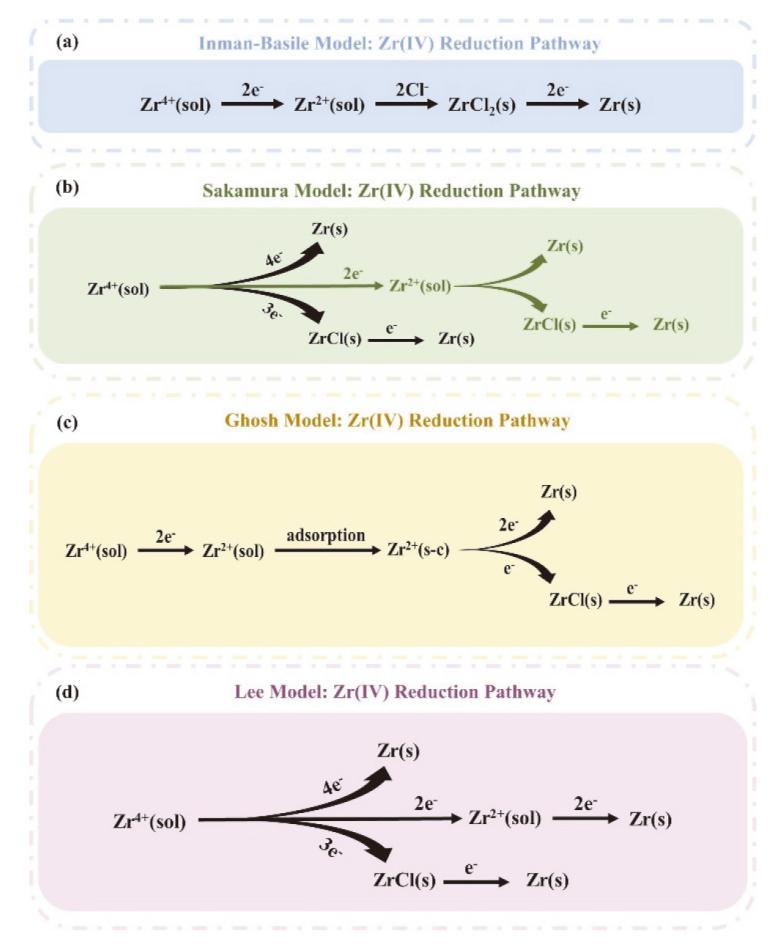
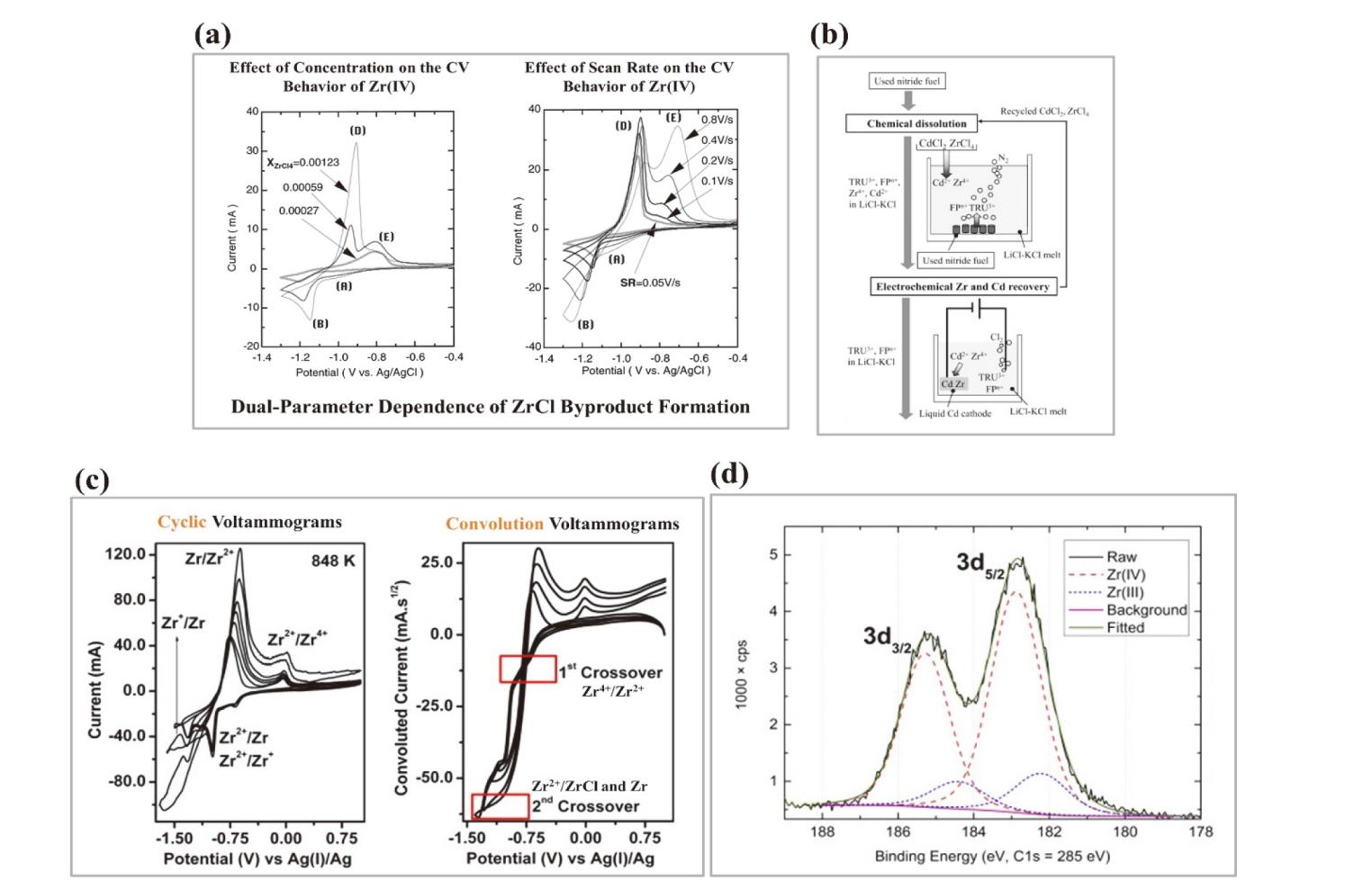
| Author | Year | Technique/Method | Electrolyte | Electroreduction behavior of Zr(IV) | Temp.a/℃ |
|---|---|---|---|---|---|
| Mellors[ | 1966 | ED b | NaCl-KCl-ZrCl4 NaCl-KCl-K2ZrF6 | ZrCl2 forms in electroreduction | 600~900 |
| Swaroop[ | 1966 | EFM | NaCl-KCl-ZrCl2 NaCl-KCl-ZrCl2-ZrCl3 NaCl-KCl-ZrCl3-ZrCl4 | Zr(IV)→Zr(III)→Zr(II)→Zr(0) | 670~740 |
| Sakakura[ | 1976 | CP | NaCl-KCl-ZrCl2 NaCl-KCl-ZrCl4 | Zr(IV)→Low Valency→Zr(0) | 700~900 |
| Polyakova[ | 1982 | LSV | NaCl-KCl-ZrCl4 | Zr(IV)→Zr(II)→Zr(0) | 735 |
| NaCl-KCl-K2ZrF6 | | 805 | |||
| Guang-Sen[ | 1990 | LSV and CV | NaCl-KCl-ZrCl4 | | 760 |
| Wu[ | 2011 | CV and SWV | NaCl-KCl-K2ZrF6 | Zr(IV)→Zr(II)→Zr(0) | 750 |
| Ueda[ | 2015 | CV | AlCl3-NaCl-KCl-ZrCl4 | Zr(IV)→Zr(II)→Zr(0) | 175 |
| Wang[ | 2016 | CV, CP and ED b | NaCl-KCl-K2ZrF6 | Pathway 1: Zr(IV)→Zr(III)→Zr(II)→Zr(0) Pathway 2: Zr(IV)→Zr(0) | 750 |
| Tekeda[ | 2018 | CV and SWV | NaCl-KCl-ZrCl4 | Pathway 1: Zr(IV)→Zr(II)→Zr(0) Pathway 2: Zr(IV)→Zr(0) | 800 |
| NaCl-KCl-K2ZrF6 | | ||||
| Zhang[ | 2022 | CV | NaCl-KCl-K2ZrF6 | Zr(IV)→Zr(II)→Zr(0) | 750 |
| Wang[ | 2023 | CV | NaCl-KCl-K2ZrF6 | Pathway 1: Zr(IV)→Zr(III)→Zr(II)→Zr(0) Pathway 2: Zr(IV)→Zr(0) | 750 |
| Author | Year | Technique/Method | Electrolyte | Electroreduction behavior of Zr(IV) | Temp.a/℃ |
|---|---|---|---|---|---|
| Mellors[ | 1966 | ED b | NaCl-KCl-ZrCl4 NaCl-KCl-K2ZrF6 | ZrCl2 forms in electroreduction | 600~900 |
| Swaroop[ | 1966 | EFM | NaCl-KCl-ZrCl2 NaCl-KCl-ZrCl2-ZrCl3 NaCl-KCl-ZrCl3-ZrCl4 | Zr(IV)→Zr(III)→Zr(II)→Zr(0) | 670~740 |
| Sakakura[ | 1976 | CP | NaCl-KCl-ZrCl2 NaCl-KCl-ZrCl4 | Zr(IV)→Low Valency→Zr(0) | 700~900 |
| Polyakova[ | 1982 | LSV | NaCl-KCl-ZrCl4 | Zr(IV)→Zr(II)→Zr(0) | 735 |
| NaCl-KCl-K2ZrF6 | | 805 | |||
| Guang-Sen[ | 1990 | LSV and CV | NaCl-KCl-ZrCl4 | | 760 |
| Wu[ | 2011 | CV and SWV | NaCl-KCl-K2ZrF6 | Zr(IV)→Zr(II)→Zr(0) | 750 |
| Ueda[ | 2015 | CV | AlCl3-NaCl-KCl-ZrCl4 | Zr(IV)→Zr(II)→Zr(0) | 175 |
| Wang[ | 2016 | CV, CP and ED b | NaCl-KCl-K2ZrF6 | Pathway 1: Zr(IV)→Zr(III)→Zr(II)→Zr(0) Pathway 2: Zr(IV)→Zr(0) | 750 |
| Tekeda[ | 2018 | CV and SWV | NaCl-KCl-ZrCl4 | Pathway 1: Zr(IV)→Zr(II)→Zr(0) Pathway 2: Zr(IV)→Zr(0) | 800 |
| NaCl-KCl-K2ZrF6 | | ||||
| Zhang[ | 2022 | CV | NaCl-KCl-K2ZrF6 | Zr(IV)→Zr(II)→Zr(0) | 750 |
| Wang[ | 2023 | CV | NaCl-KCl-K2ZrF6 | Pathway 1: Zr(IV)→Zr(III)→Zr(II)→Zr(0) Pathway 2: Zr(IV)→Zr(0) | 750 |
| [1] |
doi: 10.1007/BF02843474 |
| [2] |
|
|
(熊炳昆, 冶金工业出版社, 锆铪冶金, 北京, 2002, pp. 15-38.)
|
|
| [3] |
|
| [4] |
doi: 10.1016/0261-3069(85)90165-7 |
| [5] |
|
| [6] |
doi: 10.1016/j.jnucmat.2017.12.043 |
| [7] |
|
| [8] |
|
| [9] |
|
| [10] |
doi: 10.1179/cmq.1985.24.3.273 |
| [11] |
|
| [12] |
doi: 10.1016/j.jnucmat.2008.10.016 |
| [13] |
|
| [14] |
doi: 10.1016/j.nucengdes.2005.09.024 |
| [15] |
doi: 10.1039/D2EE02010F |
| [16] |
|
|
(王挺, 恽迪, 杜沛南, 伍晓勇, 材料导报, 2026, 40, 25040205.)
|
|
| [17] |
doi: 10.1007/s11669-013-0270-x |
| [18] |
doi: 10.1016/0022-3115(88)90127-4 |
| [19] |
doi: 10.1016/j.jnucmat.2022.153523 |
| [20] |
doi: 10.1007/BF02745341 |
| [21] |
doi: 10.1016/j.jnucmat.2009.03.007 |
| [22] |
doi: 10.1016/j.jnucmat.2012.03.045 |
| [23] |
doi: 10.1080/00295450.2017.1323535 |
| [24] |
doi: 10.13182/NT99-A2975 |
| [25] |
doi: 10.1016/j.pnucene.2021.104037 |
| [26] |
|
| [27] |
doi: 10.1080/00295450.2019.1623617 |
| [28] |
doi: 10.1007/BF02647233 |
| [29] |
doi: 10.1007/s10512-009-9092-7 |
| [30] |
doi: 10.1016/j.resconrec.2025.108708 |
| [31] |
|
| [32] |
doi: 10.1016/j.jnucmat.2015.07.010 |
| [33] |
|
| [34] |
|
| [35] |
doi: 10.1149/1945-7111/ac0996 |
| [36] |
|
| [37] |
|
|
(刘辉, 王化军, 许文, 徐国栋, 刘璐, 王俊莲, 中国材料进展, 2023, 42, 335.)
|
|
| [38] |
|
| [39] |
|
| [40] |
doi: 10.1021/cr60005a001 |
| [41] |
|
| [42] |
doi: 10.1002/qua.v111.3 |
| [43] |
doi: 10.1002/zaac.v255:1/3 |
| [44] |
|
| [45] |
doi: 10.1007/BF02345549 |
| [46] |
doi: 10.1021/ja01589a010 |
| [47] |
doi: 10.1080/15422119.2014.920876 |
| [48] |
doi: 10.1016/j.seppur.2021.119779 |
| [49] |
doi: 10.1016/j.seppur.2024.128539 |
| [50] |
doi: 10.1016/j.cej.2013.03.127 |
| [51] |
doi: 10.1021/acsami.5c02082 |
| [52] |
doi: 10.1016/j.seppur.2025.132620 |
| [53] |
|
| [54] |
doi: 10.3390/en80910354 |
| [55] |
doi: 10.1134/S003602952470160X |
| [56] |
|
| [57] |
doi: 10.1515/HTMP.1999.18.4.213 |
| [58] |
doi: 10.1021/je00020a019 |
| [59] |
|
| [60] |
doi: 10.1021/je800299y |
| [61] |
doi: 10.1080/01496395.2016.1170852 |
| [62] |
|
| [63] |
doi: 10.1007/BF02652514 |
| [64] |
|
| [65] |
|
| [66] |
|
| [67] |
|
| [68] |
doi: 10.1007/BF01012474 |
| [69] |
doi: 10.1002/zaac.v148:1 |
| [70] |
doi: 10.1149/1.3071683 |
| [71] |
doi: 10.1016/0016-0032(55)90727-4 |
| [72] |
doi: 10.1149/1.2773819 |
| [73] |
doi: 10.1007/BF03398172 |
| [74] |
|
| [75] |
|
|
(吴延科, 陈松, 徐志高, 王力军, 稀有金属, 2009, 33, 62.)
|
|
| [76] |
|
| [77] |
doi: 10.1149/1.2423865 |
| [78] |
doi: 10.1149/1.2781210 |
| [79] |
doi: 10.1149/1.2430009 |
| [80] |
doi: 10.1016/0013-4686(82)80092-3 |
| [81] |
doi: 10.1007/s12598-011-0187-7 |
| [82] |
|
| [83] |
doi: 10.1016/j.ijhydene.2021.12.038 |
| [84] |
doi: 10.1007/BF02642064 |
| [85] |
doi: 10.1149/1.2114020 |
| [86] |
doi: 10.1016/j.jmst.2019.10.043 |
| [87] |
doi: 10.1016/j.electacta.2018.01.213 |
| [88] |
doi: 10.1007/s10008-015-2861-4 |
| [89] |
doi: 10.1149/1945-7111/ad02c3 |
| [90] |
|
| [91] |
|
| [92] |
doi: 10.1007/s11663-004-0024-6 |
| [93] |
doi: 10.20964/2018.05.23 |
| [94] |
|
| [95] |
|
|
(李晴宇, 杜继红, 奚正平, 稀有金属材料与工程, 2007, 36, 390.)
|
|
| [96] |
doi: 10.1021/cr200305x pmid: 23339568 |
| [97] |
doi: 10.1016/S0364-5916(02)00027-5 |
| [98] |
doi: 10.1179/026708304225012242 |
| [99] |
doi: 10.1007/s11663-006-9016-z |
| [100] |
doi: 10.1021/cm802237v |
| [101] |
doi: 10.1021/cm902073g |
| [102] |
|
| [103] |
doi: 10.1007/s10800-010-0242-3 |
| [104] |
|
| [105] |
doi: 10.1134/S0031918X1413016X |
| [106] |
doi: 10.1149/07515.0391ecst |
| [107] |
doi: 10.1149/1945-7111/acf8fc |
| [108] |
doi: 10.3390/met13020408 |
| [109] |
doi: 10.1557/jmr.2006.0268 |
| [110] |
|
| [111] |
doi: 10.1007/s40831-018-0199-8 |
| [112] |
doi: 10.1007/s11663-021-02255-x |
| [113] |
doi: 10.1016/j.molliq.2024.126831 |
| [114] |
doi: 10.1016/j.seppur.2021.118803 |
| [115] |
doi: 10.3390/ma18112634 |
| [116] |
|
| [117] |
doi: 10.1016/j.seppur.2020.118096 |
| [118] |
doi: 10.1016/j.proche.2012.10.013 |
| [119] |
doi: 10.1016/j.pnucene.2023.105026 |
| [120] |
|
| [121] |
|
| [122] |
|
| [123] |
doi: 10.1080/00295450.2020.1757961 |
| [124] |
doi: 10.1016/j.jnucmat.2023.154339 |
| [125] |
|
| [126] |
doi: 10.1016/j.radphyschem.2022.110732 |
| [127] |
doi: 10.1016/j.nucengdes.2014.04.035 |
| [128] |
doi: 10.1002/er.v45.8 |
| [129] |
|
| [130] |
|
| [131] |
doi: 10.1016/0022-3115(92)90515-M |
| [132] |
doi: 10.1007/s11426-016-0321-x |
| [133] |
|
| [134] |
doi: 10.1016/j.electacta.2013.02.022 |
| [135] |
doi: 10.1007/s11595-023-2804-3 |
| [136] |
doi: 10.1016/j.jnucmat.2013.01.310 |
| [137] |
doi: 10.1016/j.jnucmat.2020.152219 |
| [138] |
doi: 10.1021/jp411781n |
| [139] |
doi: 10.1149/1945-7111/ac4b1a |
| [140] |
doi: 10.1149/1945-7111/add41f |
| [141] |
|
| [142] |
doi: 10.1016/j.jnucmat.2016.04.037 |
| [143] |
|
| [144] |
doi: 10.1149/1.2423405 |
| [145] |
doi: 10.5796/kogyobutsurikagaku.39.864 |
| [146] |
|
| [147] |
doi: 10.13182/NT01-A3162 |
| [148] |
doi: 10.1016/j.anucene.2021.108924 |
| [149] |
doi: 10.1016/j.jpcs.2004.06.049 |
| [150] |
doi: 10.1524/zpch.2006.220.10.1247 |
| [151] |
|
| [152] |
doi: 10.1039/C6RA17102H |
| [153] |
|
| [154] |
doi: 10.1016/j.jfluchem.2011.06.040 |
| [155] |
doi: 10.1016/j.jnucmat.2017.03.028 |
| [156] |
|
| [157] |
doi: 10.1007/BF00616685 |
| [158] |
|
| [159] |
|
| [160] |
doi: 10.1016/j.jallcom.2007.05.008 |
| [161] |
doi: 10.1016/j.jallcom.2010.10.048 |
| [162] |
doi: 10.1016/j.seppur.2019.115965 |
| [163] |
doi: 10.1021/acssuschemeng.1c06931 |
| [164] |
doi: 10.1016/j.seppur.2021.119683 |
| [165] |
|
| [166] |
doi: 10.1016/j.jelechem.2008.12.011 |
| [167] |
|
| [168] |
doi: 10.1016/j.electacta.2015.02.078 |
| [169] |
doi: 10.1016/j.jnucmat.2021.153330 |
| [170] |
|
|
(肖益群, 王有群, 林如山, 贾艳虹, 何辉, 核化学与放射化学, 2018, 40, 100.)
doi: 10.7538/hhx.2018.YX.2017034 |
|
| [171] |
|
| [172] |
doi: 10.1016/j.elecom.2017.10.010 |
| [173] |
doi: 10.1149/1945-7111/ab69f3 |
| [174] |
doi: 10.1016/0013-4686(62)80035-8 |
| [175] |
doi: 10.1139/v65-410 |
| [176] |
doi: 10.1139/v66-031 |
| [177] |
doi: 10.5796/jesj.35.2.75 |
| [178] |
doi: 10.1149/06404.0609ecst |
| [179] |
|
| [180] |
|
| [181] |
doi: 10.1007/BF00615261 |
| [182] |
doi: 10.1021/j100630a014 |
| [183] |
|
| [184] |
doi: 10.1016/j.molliq.2025.127254 |
| [185] |
doi: 10.3103/S1067821209050101 |
| [186] |
|
| No related articles found! |
| Viewed | ||||||
|
Full text |
|
|||||
|
Abstract |
|
|||||
