

Acta Chimica Sinica ›› 2026, Vol. 84 ›› Issue (9): 1464-1474.DOI: 10.6023/A26040110 Previous Articles Next Articles
Article
张宇明, 孙世涛, 周诗嘉, 李珺卿, 贺雷*( ), 王东琪*()
投稿日期:2026-04-06
发布日期:2026-06-18
通讯作者:
贺雷, 王东琪
基金资助:
Yuming Zhang, Shitao Sun, Shijia Zhou, Junqing Li, Lei He*(), Dongqi Wang*()
Received:2026-04-06
Published:2026-06-18
Contact:
Lei He, Dongqi Wang
Supported by:Share
Yuming Zhang, Shitao Sun, Shijia Zhou, Junqing Li, Lei He, Dongqi Wang. Value-added Transformation of Ethanol to n-Butanol: a Machine Learning Study[J]. Acta Chimica Sinica, 2026, 84(9): 1464-1474.
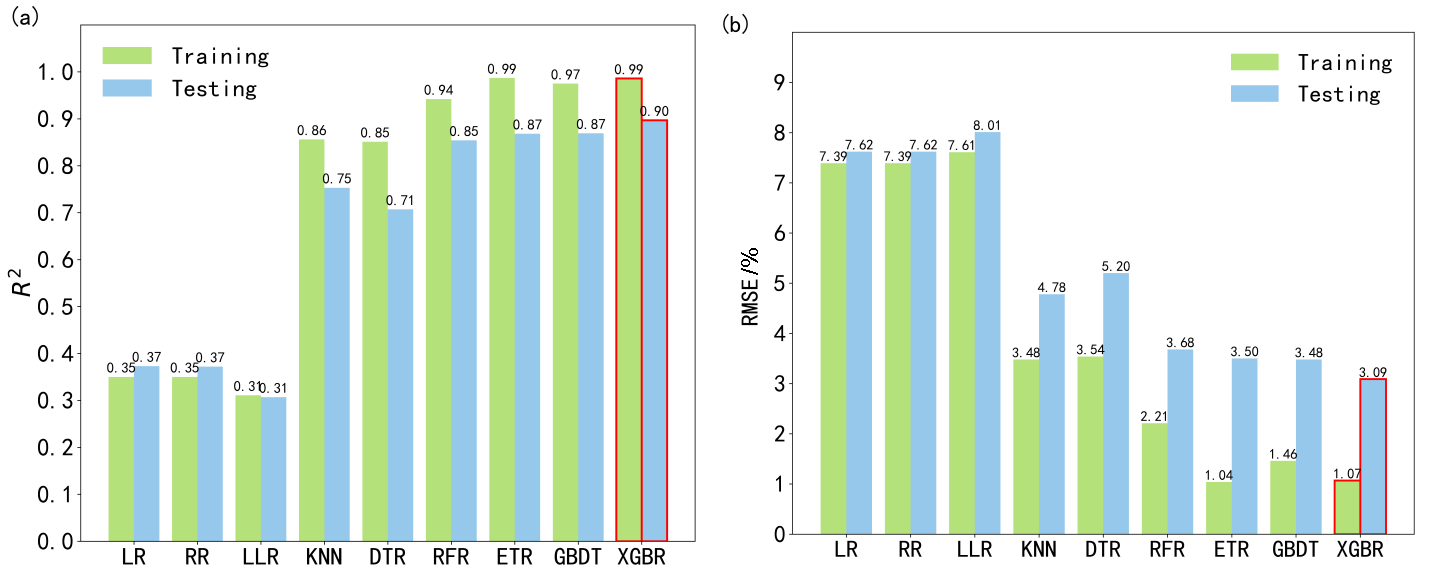
| ML model | R2-train | R2-test | RMSE(%)-train | RMSE(%)-test |
|---|---|---|---|---|
| LR | 0.350 | 0.373 | 7.39 | 7.62 |
| RR | 0.350 | 0.372 | 7.39 | 7.62 |
| LLR | 0.311 | 0.307 | 7.61 | 8.01 |
| KNN | 0.856 | 0.753 | 3.48 | 4.78 |
| DTR | 0.851 | 0.707 | 3.54 | 5.20 |
| RFR | 0.942 | 0.854 | 2.21 | 3.68 |
| ETR | 0.987 | 0.868 | 1.04 | 3.50 |
| GBDT | 0.975 | 0.869 | 1.46 | 3.48 |
| XGBR | 0.986 | 0.897 | 1.07 | 3.09 |
| ML model | R2-train | R2-test | RMSE(%)-train | RMSE(%)-test |
|---|---|---|---|---|
| LR | 0.350 | 0.373 | 7.39 | 7.62 |
| RR | 0.350 | 0.372 | 7.39 | 7.62 |
| LLR | 0.311 | 0.307 | 7.61 | 8.01 |
| KNN | 0.856 | 0.753 | 3.48 | 4.78 |
| DTR | 0.851 | 0.707 | 3.54 | 5.20 |
| RFR | 0.942 | 0.854 | 2.21 | 3.68 |
| ETR | 0.987 | 0.868 | 1.04 | 3.50 |
| GBDT | 0.975 | 0.869 | 1.46 | 3.48 |
| XGBR | 0.986 | 0.897 | 1.07 | 3.09 |
| No. | Metal | Support | Reaction temperature/℃ | Butanol yield/% |
|---|---|---|---|---|
| 1 | Au | MgAlOx | 334 | 57.1 |
| 2 | Ag | NaX | 322 | 53.9 |
| 3 | Cu | NC | 344 | 51.1 |
| 4 | Ca | NC | 332 | 48.7 |
| 5 | Be | NC | 327 | 46.9 |
| No. | Metal | Support | Reaction temperature/℃ | Butanol yield/% |
|---|---|---|---|---|
| 1 | Au | MgAlOx | 334 | 57.1 |
| 2 | Ag | NaX | 322 | 53.9 |
| 3 | Cu | NC | 344 | 51.1 |
| 4 | Ca | NC | 332 | 48.7 |
| 5 | Be | NC | 327 | 46.9 |
| [1] |
|
|
(李洪言, 郑一鸣, 季银利, 于淼, 沈奕天, 张胜然, 刘永煜, 王海洋, 陈子文, 代晓东, 天然气与石油, 2025, 43, 129.)
|
|
| [2] |
doi: 10.1021/ie50493a017 |
|
(王敬, 孔令凯, 吴亚冉, 顾明龙, 陈翔宇, 化学工业, 2025, 43, 33.)
|
|
| [3] |
doi: 10.1021/acssuschemeng.8b03622 |
| [4] |
|
|
(杨铮, 刘思明, 邢磊, 化学工业, 2025, 43, 1.)
|
|
| [5] |
doi: 10.1021/acscatal.3c01481 |
| [6] |
doi: 10.1016/j.rser.2023.114240 |
| [7] |
doi: 10.1038/s41570-019-0084-4 |
| [8] |
doi: 10.1016/j.seppur.2022.120655 |
| [9] |
doi: 10.1002/ese3.v13.6 |
| [10] |
doi: 10.1016/j.jclepro.2020.124902 |
| [11] |
|
| [12] |
doi: 10.1021/jacs.3c13092 |
| [13] |
|
| [14] |
doi: 10.1021/acs.inorgchem.3c04142 |
| [15] |
doi: 10.1021/jacs.5b10257 pmid: 26526779 |
| [16] |
doi: 10.1246/cl.2009.838 |
| [17] |
doi: 10.1002/anie.v52.34 |
| [18] |
doi: 10.1021/acscatal.5b01327 |
| [19] |
doi: 10.1021/jacs.7b05939 |
| [20] |
doi: 10.1021/jacs.9b08968 |
| [21] |
doi: 10.1021/acscatal.7b03653 |
| [22] |
doi: 10.1006/jcat.1999.2734 |
| [23] |
|
| [24] |
doi: 10.1039/C9CC05454E |
| [25] |
doi: 10.1016/j.jcat.2008.08.005 |
| [26] |
|
| [27] |
doi: 10.3390/catal2010068 |
| [28] |
doi: 10.1021/acs.iecr.9b06778 |
| [29] |
doi: 10.1016/j.jcat.2016.08.024 |
| [30] |
doi: 10.1021/acssuschemeng.1c04305 |
| [31] |
doi: 10.1039/D3GC00078H |
| [32] |
doi: 10.1016/j.jechem.2022.04.049 |
| [33] |
doi: 10.1002/cctc.v10.16 |
| [34] |
doi: 10.1021/acscatal.2c02440 |
| [35] |
doi: 10.1021/acs.iecr.5b02409 |
| [36] |
doi: 10.1016/j.renene.2014.08.052 |
| [37] |
doi: 10.1039/D2CY01554D |
| [38] |
doi: 10.1039/C4GC00219A |
| [39] |
doi: 10.1021/acs.iecr.0c04649 |
| [40] |
|
| [41] |
doi: 10.1021/acscatal.2c06213 |
| [42] |
doi: 10.1039/C0CC03038D |
| [43] |
doi: 10.1021/acscatal.8b04014 |
| [44] |
doi: 10.1039/D1SE01002F |
| [45] |
doi: 10.1016/j.catcom.2017.06.016 |
| [46] |
doi: 10.1039/C6CC05860D |
| [47] |
doi: 10.1360/SSC-2025-0066 |
|
(胡建钰, 杨峻毅, 胡素磊, 刘进勋, 李微雪, 中国科学(化学), 2025, 55, 1704.)
|
|
| [48] |
doi: 10.6023/A23100473 |
|
(李珺卿, 宋千禧, 刘子义, 王东琪, 化学学报, 2024, 82, 387.)
doi: 10.6023/A23100473 |
|
| [49] |
doi: 10.1021/acsestengg.3c00617 |
| [50] |
doi: 10.1021/acscatal.9b04186 |
| [51] |
doi: 10.1039/D2CC05938J |
| [52] |
|
| [53] |
doi: 10.1016/j.apcata.2023.119427 |
| [54] |
doi: 10.1002/adsu.v7.3 |
| [55] |
doi: 10.1021/acs.jpclett.0c00665 |
| [56] |
doi: 10.1039/D1TA06772A |
| [57] |
|
| [58] |
doi: 10.1016/j.jechem.2024.12.056 |
| [59] |
doi: 10.1038/s42256-019-0138-9 pmid: 32607472 |
| [60] |
doi: 10.1016/j.jclepro.2018.08.207 |
| [1] | Shibo Sun, Sheng Wang, Hanyang Wang, Chenkuo Lan, Jing Ma, Qizhao Wang, Zhenli Sun, Xiangke Wang. Machine Learning-Assisted Elucidation of the Adsorption Structure-Mechanism Relationship of Uranyl on Covalent Organic Frameworks★ [J]. Acta Chimica Sinica, 2026, 84(9): 1418-1427. |
| [2] | Huiqiong Weng, He Huang, Wenfei Wang, Heguo Li, Xiaopeng Li, Shouxin Zhang, Shuhua Li, Yue Zhao, Yufang Wu, Zhiwei Qiao. AI Big-Data Mining Empowered by MOFid for High-Performance Chemical Warfare Agent Adsorbents [J]. Acta Chimica Sinica, 2026, 84(1): 8-19. |
| [3] | Yunhe Mo, Weigang Cao, Lequan Zhao, Zhenqiang Tang, Long Zheng, Zongying Cai. Screening Vanadium-Based Electrode Materials for Lithium-Ion Batteries Based on Machine Learning and First-Principles [J]. Acta Chimica Sinica, 2025, 83(5): 518-526. |
| [4] | Junqing Li, Qianxi Song, Ziyi Liu, Dongqi Wang. Machine Learning for Predicting Band Gap in Boron-containing Materials [J]. Acta Chimica Sinica, 2024, 82(4): 387-395. |
| [5] | Xingyi Qi, Yaofeng Hu, Ruoyu Wang, Yaqing Yang, Yufei Zhao. Recent Advance of Machine Learning in Selecting New Materials [J]. Acta Chimica Sinica, 2023, 81(2): 158-174. |
| [6] | Yizhi Han, Jianhui Lan, Xue Liu, Weiqun Shi. Advances in Molecular Dynamics Studies of Molten Salts Based on Machine Learning [J]. Acta Chimica Sinica, 2023, 81(11): 1663-1672. |
| [7] | Min Cheng, Shihui Wang, Lei Luo, Li Zhou, Kexin Bi, Yiyang Dai, Xu Ji. Large-Scale Computational Screening of Metal-Organic Framework Membranes for Ethane/Ethylene Separation [J]. Acta Chimica Sinica, 2022, 80(9): 1277-1288. |
| [8] | Yuze Liu, Kunhua Li, Jiaxing Huang, Xi Yu, Wenping Hu. Accurate Prediction of the Boiling Point of Organic Molecules by Multi-Component Heterogeneous Learning Model [J]. Acta Chimica Sinica, 2022, 80(6): 714-723. |
| [9] | Shihui Wang, Xiaoyu Xue, Min Cheng, Shaochen Chen, Chong Liu, Li Zhou, Kexin Bi, Xu Ji. High-Throughput Computational Screening of Metal-Organic Frameworks for CH4/H2 Separation by Synergizing Machine Learning and Molecular Simulation [J]. Acta Chimica Sinica, 2022, 80(5): 614-624. |
| [10] | Cai Chengzhi, Li Lifeng, Deng Xiaomei, Li Shuhua, Liang Hong, Qiao Zhiwei. Machine Learning and High-throughput Computational Screening of Metal-organic Framework for Separation of Methane/ethane/propane [J]. Acta Chimica Sinica, 2020, 78(5): 427-436. |
| [11] | Zhu Boyang, Wu Ruilong, Yu Xi. Artificial Intelligence for Contemporary Chemistry Research [J]. Acta Chimica Sinica, 2020, 78(12): 1366-1382. |
| [12] | Liu Zhilu, Li Wei, Liu Hao, Zhuang Xudong, Li Song. Research Progress of High-throughput Computational Screening of Metal-Organic Frameworks [J]. Acta Chim. Sinica, 2019, 77(4): 323-339. |
| [13] | PENG Xu-Hong, FANG Jian, WANG Hong-Kui, ZHAO Ji-Hua, SHEN Wei-Guo. Study on the Microstructural Characteristics of Water in Water/Triton X-100/n-Butanol/Cyclohexane Microemulsion by FT-IR Spectroscopy [J]. Acta Chimica Sinica, 2011, 69(19): 2253-2258. |
| [14] | XU Jin-Guang*,1, TENG Fei2, TIAN Zhi-Jian2, QU Xiu-Hua, ZHANG Pei-Qing, XU Yun-Peng2, XIONG Guo-Xing3, LIN Li-Wu2,3. Novel Reverse Microemulsion and Its Application to Synthesis of Nanostructured La0.95Ba0.05MnAl11O19-α Catalyst for Methane Combustion [J]. Acta Chimica Sinica, 2005, 63(24): 2205-2210. |
| Viewed | ||||||
|
Full text |
|
|||||
|
Abstract |
|
|||||
