

Acta Chimica Sinica ›› 2026, Vol. 84 ›› Issue (9): 1475-1486.DOI: 10.6023/A26040128 Previous Articles Next Articles
Article
万浩波a, 谢文斌a, 杨磊a,*( ), 冉雪琴b,*(), 冯全友a,*(), 解令海a,*()
投稿日期:2026-04-20
发布日期:2026-06-23
通讯作者:
杨磊, 冉雪琴, 冯全友, 解令海
基金资助:
Haobo Wana, Wenbin Xiea, Lei Yanga,*(), Xueqin Ranb,*(), Quanyou Fenga,*(), Linghai Xiea,*()
Received:2026-04-20
Published:2026-06-23
Contact:
Lei Yang, Xueqin Ran, Quanyou Feng, Linghai Xie
Supported by:Share
Haobo Wan, Wenbin Xie, Lei Yang, Xueqin Ran, Quanyou Feng, Linghai Xie. Theoretical Study on the Performance of Through-Space Charge-Transfer Thermally Activated Delayed Fluorescence[J]. Acta Chimica Sinica, 2026, 84(9): 1475-1486.
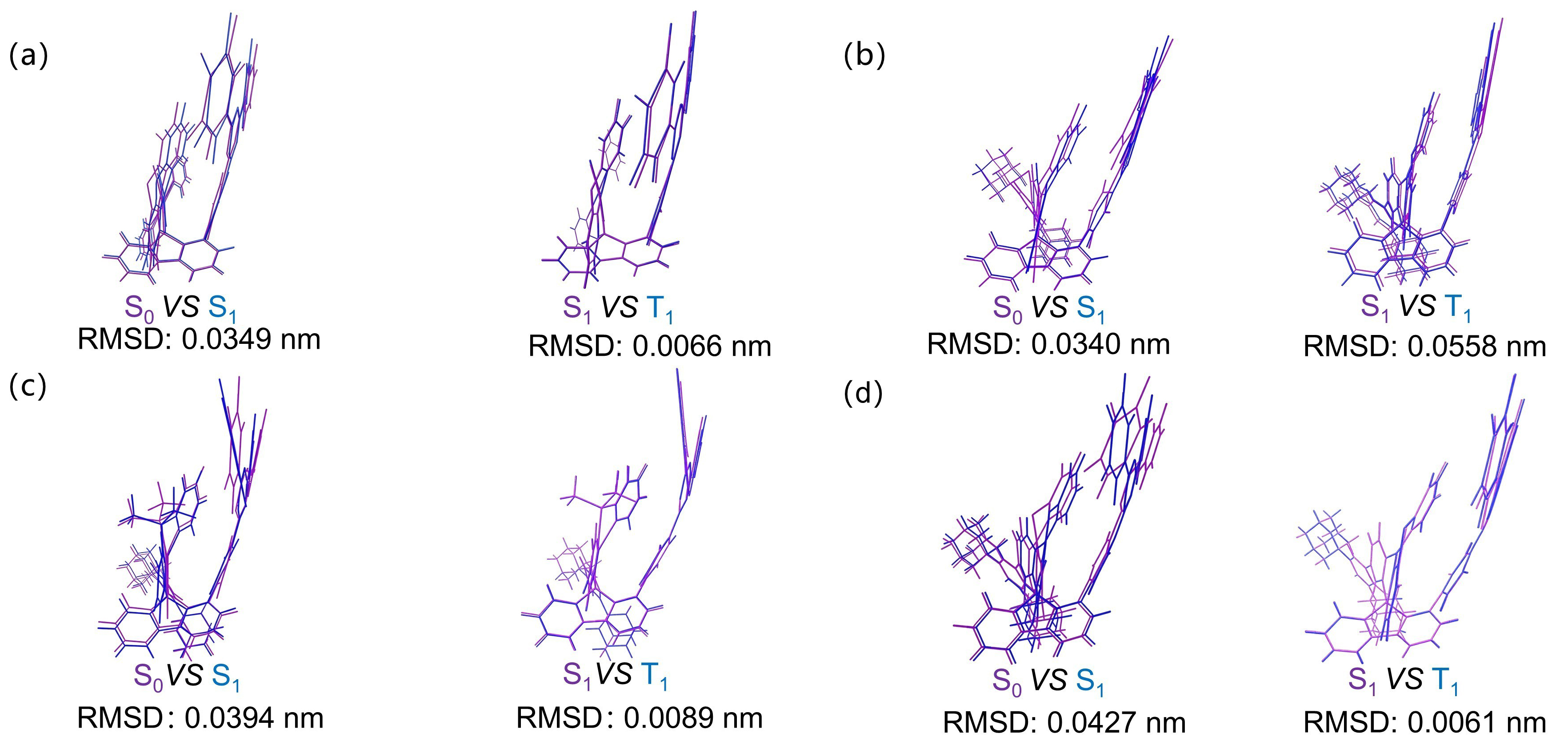
| S0/S1 | ||||
|---|---|---|---|---|
| 3Ph-SPT | Ph2Ad-SPT | Ph2Ad-SDT | Ph2Ad-SST | |
| ϕ1 | -60.3/-60.2 | -60.6/-66.3 | -61.6/-69.5 | -61.1/-68.8 |
| ϕ2 | -99.7/-103.0 | -101.2/-105.5 | -105.3/-122.4 | -109.9/-114.3 |
| |ϕ1-ϕ2| | 39.4/42.8 | 40.6/39.2 | 43.7/52.9 | 48.8/45.5 |
| MPPD | 0.035/0.033 | 0.035/0.034 | 0.067/0.061 | 0.052/0.045 |
| MPPA | 0.016/0.016 | 0.016/0.017 | 0.016/0.027 | 0.020/0.022 |
| l | 0.530/0.525 | 0.532/0.527 | 0.510/0.515 | 0.544/0.523 |
| S0/S1 | ||||
|---|---|---|---|---|
| 3Ph-SPT | Ph2Ad-SPT | Ph2Ad-SDT | Ph2Ad-SST | |
| ϕ1 | -60.3/-60.2 | -60.6/-66.3 | -61.6/-69.5 | -61.1/-68.8 |
| ϕ2 | -99.7/-103.0 | -101.2/-105.5 | -105.3/-122.4 | -109.9/-114.3 |
| |ϕ1-ϕ2| | 39.4/42.8 | 40.6/39.2 | 43.7/52.9 | 48.8/45.5 |
| MPPD | 0.035/0.033 | 0.035/0.034 | 0.067/0.061 | 0.052/0.045 |
| MPPA | 0.016/0.016 | 0.016/0.017 | 0.016/0.027 | 0.020/0.022 |
| l | 0.530/0.525 | 0.532/0.527 | 0.510/0.515 | 0.544/0.523 |
| S0-S1 | S1-S0 | ||||||||||
|---|---|---|---|---|---|---|---|---|---|---|---|
| λabs/nm | ΔE/eV | Main transition | λem/nm | ΔE/eV | Main transition | ||||||
| 3Ph-SPT | 338 | 3.67 | HOMO→L+2 (74%) | 523 | 2.37 | HOMO→LUMO (98%) | |||||
| Ph2Ad-SPT | 335 | 3.69 | HOMO→L+3 (91%) | 530 | 2.34 | HOMO→LUMO (98%) | |||||
| Ph2Ad-SDT | 284 | 4.35 | H-3→L+1 (54%) | 488 | 2.54 | HOMO→LUMO (97%) | |||||
| Ph2Ad-SST | 283 | 4.38 | HOMO→LUMO (29%) | 512 | 2.42 | HOMO→LUMO (98%) | |||||
| S0-S1 | S1-S0 | ||||||||||
|---|---|---|---|---|---|---|---|---|---|---|---|
| λabs/nm | ΔE/eV | Main transition | λem/nm | ΔE/eV | Main transition | ||||||
| 3Ph-SPT | 338 | 3.67 | HOMO→L+2 (74%) | 523 | 2.37 | HOMO→LUMO (98%) | |||||
| Ph2Ad-SPT | 335 | 3.69 | HOMO→L+3 (91%) | 530 | 2.34 | HOMO→LUMO (98%) | |||||
| Ph2Ad-SDT | 284 | 4.35 | H-3→L+1 (54%) | 488 | 2.54 | HOMO→LUMO (97%) | |||||
| Ph2Ad-SST | 283 | 4.38 | HOMO→LUMO (29%) | 512 | 2.42 | HOMO→LUMO (98%) | |||||
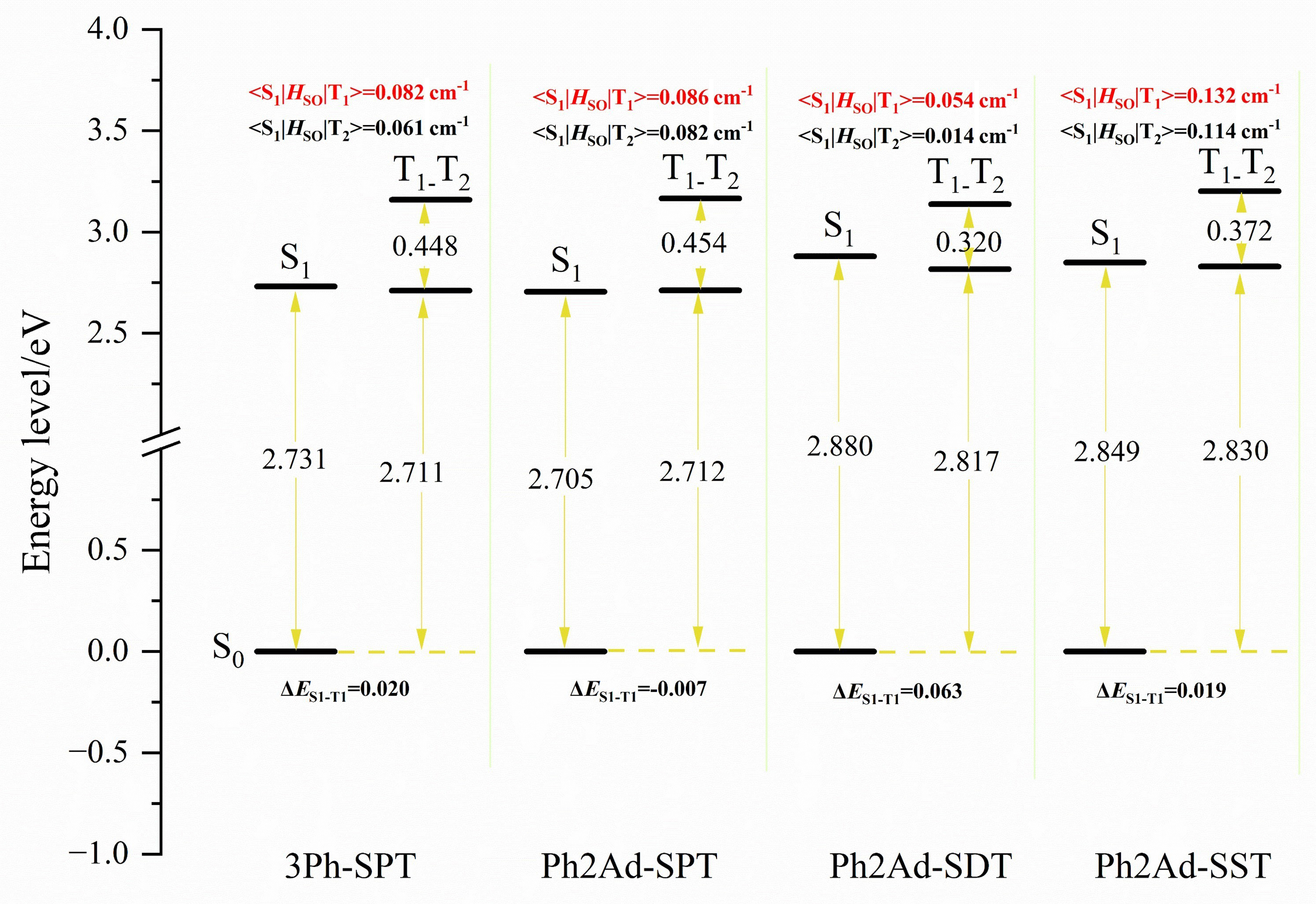
| λISC | λRISC | λS0-S1 | E(S1)* | E(T1)* | ΔEST* | f | SOC | |
|---|---|---|---|---|---|---|---|---|
| 3Ph-SPT | 0.009 | 0.004 | 34.803 | 2.731 | 2.711 | 0.020 | 0.0055 | 0.082 |
| Ph2Ad-SPT | 0.035 | 0.060 | 33.388 | 2.705 | 2.712 | -0.007 | 0.0056 | 0.086 |
| Ph2Ad-SDT | 0.018 | 0.007 | 32.953 | 2.880 | 2.817 | 0.063 | 0.0051 | 0.054 |
| Ph2Ad-SST | 0.015 | 0.007 | 41.489 | 2.849 | 2.830 | 0.019 | 0.0051 | 0.132 |
| λISC | λRISC | λS0-S1 | E(S1)* | E(T1)* | ΔEST* | f | SOC | |
|---|---|---|---|---|---|---|---|---|
| 3Ph-SPT | 0.009 | 0.004 | 34.803 | 2.731 | 2.711 | 0.020 | 0.0055 | 0.082 |
| Ph2Ad-SPT | 0.035 | 0.060 | 33.388 | 2.705 | 2.712 | -0.007 | 0.0056 | 0.086 |
| Ph2Ad-SDT | 0.018 | 0.007 | 32.953 | 2.880 | 2.817 | 0.063 | 0.0051 | 0.054 |
| Ph2Ad-SST | 0.015 | 0.007 | 41.489 | 2.849 | 2.830 | 0.019 | 0.0051 | 0.132 |
| kISC/s⁻1 | kRISC/s⁻1 | kr/s⁻1 | |
|---|---|---|---|
| 3Ph-SPT | 7.39×10⁶ | 6.79×10⁶ | 1.35×10⁶ |
| Ph2Ad-SPT | 6.27×10⁶ | 4.95×10⁶ | 1.33×10⁶ |
| Ph2Ad-SDT | 1.63×10⁵ | 1.00×10⁴ | 1.43×10⁶ |
| Ph2Ad-SST | 1.74×10⁷ | 2.10×10⁷ | 1.30×10⁶ |
| kISC/s⁻1 | kRISC/s⁻1 | kr/s⁻1 | |
|---|---|---|---|
| 3Ph-SPT | 7.39×10⁶ | 6.79×10⁶ | 1.35×10⁶ |
| Ph2Ad-SPT | 6.27×10⁶ | 4.95×10⁶ | 1.33×10⁶ |
| Ph2Ad-SDT | 1.63×10⁵ | 1.00×10⁴ | 1.43×10⁶ |
| Ph2Ad-SST | 1.74×10⁷ | 2.10×10⁷ | 1.30×10⁶ |
| [1] |
(a)
|
|
(b)
|
|
|
(c)
|
|
|
(d)
doi: 10.6023/A24100296 |
|
|
(张妞, 韩书冉, 马宏伟, 陈磅宽, 化学学报, 2025, 83, 10.)
doi: 10.6023/A24100296 |
|
| [2] |
(a)
doi: 10.1038/nature11687 |
|
(b)
doi: 10.1039/c3tc30699b |
|
|
(c)
doi: 10.1021/jacs.7b10257 |
|
|
(d)
doi: 10.6023/A25010010 |
|
|
(方素琴, 童恺宁, 陈思浛, 张千峰, 童碧海, 冯敏强, 孔辉, 化学学报, 2025, 83, 471.)
doi: 10.6023/A25010010 |
|
|
(e)
doi: 10.6023/A24100310 |
|
|
(马金珠, 李阳, 高珊, 赵越, 丁磊, 周东营, 樊健, 化学学报, 2025, 83, 17.)
doi: 10.6023/A24100310 |
|
|
(f)
doi: 10.6023/A24040148 |
|
|
(张登朝, 贾吉慧, 梁栋, 蔡显宝, 赵雨晴, 胡祥龙, 江钰冰, 卢灿忠, 化学学报, 2024, 82, 887.)
doi: 10.6023/A24040148 |
|
| [3] |
(a)
doi: 10.1021/acs.macromol.0c02235 |
|
(b)
doi: 10.1039/D2TC05402G |
|
|
(c)
doi: 10.1080/15980316.2020.1788657 |
|
| [4] |
(a)
doi: 10.1002/adom.v10.22 |
|
(b)
doi: 10.6023/A23040186 |
|
|
(王一诺, 邵世洋, 王利祥, 化学学报, 2023, 81, 1202.)
doi: 10.6023/A23040186 |
|
|
(c)
doi: 10.1002/adfm.v33.12 |
|
| [5] |
doi: 10.1021/acs.orglett.7b01281 |
| [6] |
doi: 10.1021/jacs.7b00873 pmid: 28345346 |
| [7] |
(a)
doi: 10.1002/anie.v56.47 |
|
(b)
doi: 10.1016/j.dyepig.2016.08.023 |
|
| [8] |
(a)
doi: 10.1039/C8CC04594A |
|
(b)
doi: 10.1039/C8SC04991B |
|
| [9] |
|
| [10] |
doi: 10.1039/D5SC02235E |
| [11] |
doi: 10.1016/j.cej.2025.169199 |
| [12] |
(a)
doi: 10.1016/j.cej.2020.127418 |
|
(b)
doi: 10.1002/adom.v9.16 |
|
|
(c)
doi: 10.1016/j.cej.2024.153511 |
|
| [13] |
doi: 10.1039/D1TC03345J |
| [14] |
doi: 10.1016/j.comptc.2023.114277 |
| [15] |
(a)
doi: 10.1063/1.1480445 |
|
(b)
doi: 10.1016/0009-2614(96)00349-1 |
|
| [16] |
doi: 10.1021/ct700248k pmid: 26620661 |
| [17] |
doi: 10.1063/1.478522 |
| [18] |
doi: 10.1021/ar700111a |
| [19] |
doi: 10.1021/ct800308k pmid: 26620472 |
| [20] |
|
| [21] |
doi: 10.1016/j.cplett.2004.06.011 |
| [22] |
|
| [23] |
(a)
doi: 10.1002/adfm.v28.34 |
|
(b)
doi: 10.1038/s41566-020-0668-z |
|
| [24] |
doi: 10.1063/1.1677816 |
| [25] |
(a)
|
|
(b)
doi: 10.1002/wcms.v2.1 |
|
|
(c)
|
|
| [26] |
doi: 10.1021/ja00237a007 |
| [27] |
doi: 10.1119/1.12937 |
| [28] |
doi: 10.1016/j.carbon.2020.05.023 |
| [29] |
(a)
doi: 10.1002/jcc.v33.5 |
|
(b)
doi: 10.1016/j.jmgm.2012.07.004 |
|
| [30] |
|
| [31] |
|
| [32] |
doi: 10.1021/acs.jpca.4c00010 |
| [33] |
|
| [34] |
doi: 10.1007/s40843-023-2563-2 |
| [35] |
(a)
doi: 10.1016/j.cej.2023.146659 |
|
(b)
doi: 10.1002/adfm.v29.20 |
|
|
(c)
doi: 10.1039/D1TC00592H |
|
| [36] |
doi: 10.1038/s41563-020-0710-z |
| [37] |
doi: 10.1038/s41598-017-05339-4 |
| [1] | Junfei Tao, Shipan Xu, Xuyang Du, He Yin, An Yan, Huaiteng Hang, Liang Chen, Guijiang Zhou, Yuanhui Sun, Xiaolong Yang. Synthesis and Electroluminescence Performance of Thermally Activated Delayed Fluorescence Materials Based on 4-Cyanopyrimidine Acceptor [J]. Acta Chimica Sinica, 2026, 84(7): 1040-1048. |
| [2] | Qinghui Wang, Zheng Ren, Kai Zhang, Dongying Zhou, Jian Fan. Multiple Resonance Thermally Activated Delayed Fluorescence Molecule Based on 3,6-Diphenylselenylcarbazole [J]. Acta Chimica Sinica, 2026, 84(2): 248-256. |
| [3] | Zhihao Yao, Wei Zhang, Zhaoyi Zhou, Dancong Li, Kaikai Zhang, Tao Liu, Wenkai Hu, Shouan Cheng, Mingxuan Hu, Yujia Liu. Study on Synergistic Modulation of LaMnO3 Electronic Structure and CO Selective Catalytic Reduction Reaction Mechanism via Sr/Fe [J]. Acta Chimica Sinica, 2026, 84(1): 30-42. |
| [4] | Yichun Lou, Chengli He, Linrui Wang, Xiaoli Cui. Mechanochemical Urea Synthesis Using Nitrogen, Water and Carbon Dioxide with TiO2 under Mild Conditions: An Experimental and Theoretical Study [J]. Acta Chimica Sinica, 2026, 84(1): 73-85. |
| [5] | Shoufei Cheng, Jing Li, Lin Ling, Yuxue Li, Long Lu. Density Functional Theory Research on Decomposition Mechanisms of Nitroglycerin [J]. Acta Chimica Sinica, 2025, 83(8): 833-843. |
| [6] | Xin Wang, Yiwei Shi, Ruijie Yang, Zhiguo Song, Min Wang. Solvent-Free “One-Pot” Biginelli Reaction Catalyzed by Mononuclear Cd(II) Complex Containing Benzenesulfonic Acid Ligands [J]. Acta Chimica Sinica, 2025, 83(7): 674-684. |
| [7] | Suqin Fang, Kaining Tong, Sihan Chen, Qianfeng Zhang, Bihai Tong, Mankeung Fung, Hui Kong. Xanthone Based Thermally Activated Delayed Fluorescence Enantiomers for Efficient Circularly Polarized Electroluminescence [J]. Acta Chimica Sinica, 2025, 83(5): 471-478. |
| [8] | Yi-Lin Lu, Shengjie Dong, Fangchao Cui, Tingting Bo, Zhuo Mao. Theoretical Construction of Hittorf’s Violet Phosphorene/SnS2 van der Waals Heterojunction as Direct Photocatalyst for Overall Water Splitting [J]. Acta Chimica Sinica, 2025, 83(4): 377-389. |
| [9] | Minghui Chen, Boxin Zhang, Tao Wei, Zhaoxue Sun, Yaqing Feng, Bao Zhang. Theoretical Calculation Studies on Interlayer Displacement Behavior and Photogenerated Carrier Dynamics of Covalent Triazine Frameworks [J]. Acta Chimica Sinica, 2025, 83(2): 93-100. |
| [10] | Naixin Zhang, Weiqun Shi, Congzhi Wang. Theoretical Studies of Divalent Actinide Complexes AnB8 [J]. Acta Chimica Sinica, 2025, 83(12): 1523-1529. |
| [11] | Ying Ma, Weixi Chen, Yuchen Liu, Ziyi Liu, Tao Wu, An-Hui Lu, Dongqi Wang. Density Functional Theory Study of Hexagonal Boron Nitride Oxidation Mode [J]. Acta Chimica Sinica, 2025, 83(1): 52-59. |
| [12] | Jinzhu Ma, Yang Li, Shan Gao, Yue Zhao, Lei Ding, Dongying Zhou, Jian Fan. High-efficiency Near Infrared Thermally Activated Delayed Fluorescence Based on Phenazine Acceptor [J]. Acta Chimica Sinica, 2025, 83(1): 17-24. |
| [13] | Dengchao Zhang, Jihui Jia, Dong Liang, Xianbao Cai, Yuqing Zhao, Xianglong Hu, Yubing Jiang, Canzhong Lu. Design, Synthesis and Properties of Cu(I) Complexes with a Nitrogen-containing Spirocycle Ligand for Delayed Fluorescence Materials [J]. Acta Chimica Sinica, 2024, 82(8): 887-893. |
| [14] | Yuqing Zhao, Dong Liang, Jihui Jia, Rongmin Yu, Can-Zhong Lu. Synthesis and Characterization of an Emissive Ag(I) Complex with a D-A Type Ligand Containing Two Electron-withdrawing Groups [J]. Acta Chimica Sinica, 2024, 82(5): 486-492. |
| [15] | Yu-Qiang Zhao, Xia Zhang, Yunru Yang, Liping Zhu, Ying Zhou. Design and Synthesis of Aggregation-Induced Emission Photocage Molecules for In Situ Photoactivation Imaging Studies [J]. Acta Chimica Sinica, 2024, 82(3): 265-273. |
| Viewed | ||||||
|
Full text |
|
|||||
|
Abstract |
|
|||||
