

Acta Chimica Sinica ›› 2026, Vol. 84 ›› Issue (10): 1591-1600.DOI: 10.6023/A26050151 Previous Articles Next Articles
Article
刘佳冬, 刘研博, 张照胜*( )
投稿日期:2026-05-06
发布日期:2026-06-23
基金资助:
Jiadong Liu, Yanbo Liu, Zhaosheng Zhang*()
Received:2026-05-06
Published:2026-06-23
Contact:
*E-mail: misaraty@163.com; Tel.: 0312-5079359
Supported by:Share
Jiadong Liu, Yanbo Liu, Zhaosheng Zhang. Mechanism of Modulating the Photovoltaic Properties of Two-Dimensional Perovskites via A-Site Cations[J]. Acta Chimica Sinica, 2026, 84(10): 1591-1600.
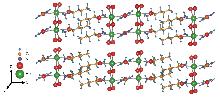
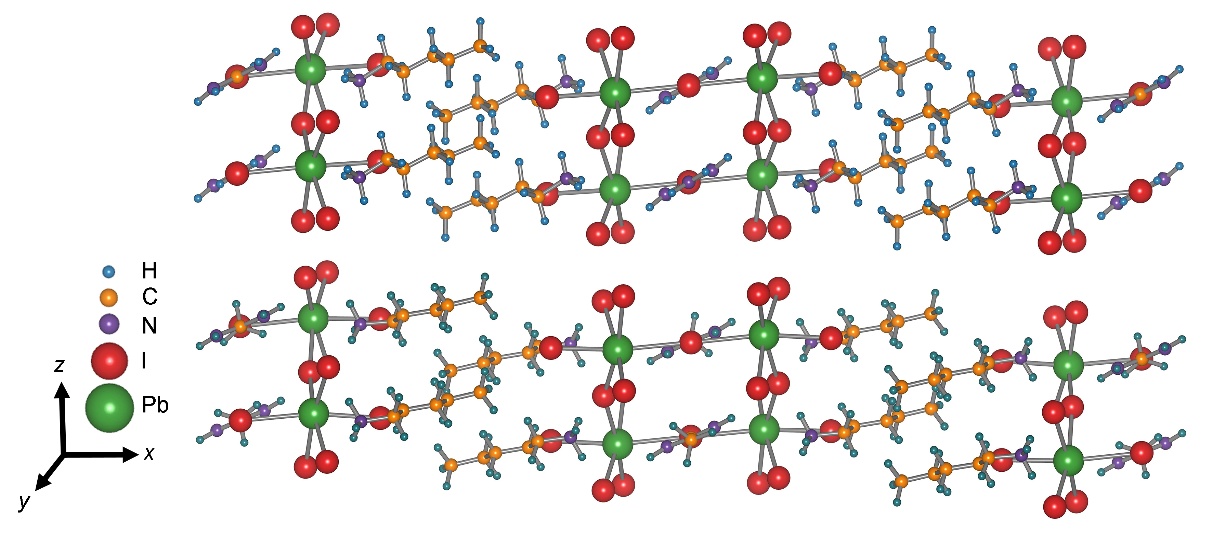
| Lattice constant/nm | V/nm3 | α=γ/(°) | β/(°) | dPb-I/nm | |||||
|---|---|---|---|---|---|---|---|---|---|
| a | b | c | axial | equatorial | average | ||||
| (PA)2GuaPb2I7 | 4.124* | 0.911* | 0.898* | 3.363* | 90* | 93.79* | 0.321* | 0.322* | 0.321* |
| 3.986 | 0.909 | 0.844 | 3.059 | 90 | 91.09 | 0.318 | 0.317 | 0.318 | |
| (PA)2AcePb2I7 | 4.159* | 0.914* | 0.895* | 3.392* | 90* | 94.83* | 0.323* | 0.322* | 0.322* |
| 4.071 | 0.911 | 0.843 | 3.126 | 90 | 92.03 | 0.321 | 0.316 | 0.317 | |
| Bonds | ICOHP | Angles/(°) | dN—H…I/nm | |
|---|---|---|---|---|
| (PA)2GuaPb2I7 | H(12)—I(1) | -0.35 | 153.3 | 0.268 |
| H(10)—I(1) | -0.35 | 153.3 | 0.268 | |
| H(2)—I(13) | -0.26 | 152.8 | 0.276 | |
| H(18)—I(13) | -0.28 | 154.7 | 0.275 | |
| (PA)2AcePb2I7 | H(1)—I(25) | -0.41 | 152.2 | 0.263 |
| H(36)—I(25) | -0.39 | 151.0 | 0.265 | |
| H(37)—I(13) | -0.24 | 155.8 | 0.283 |
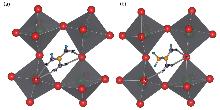
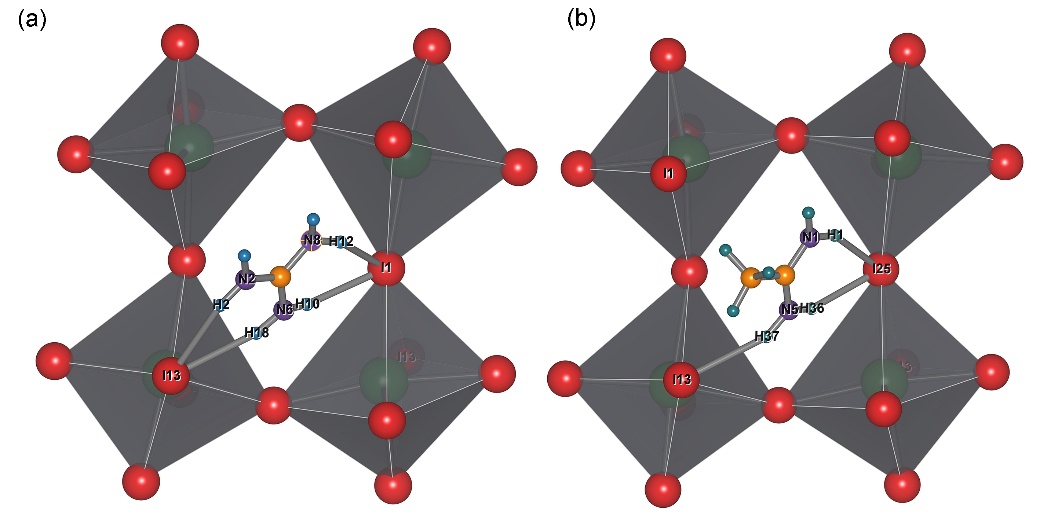
| [1] |
|
|
(彭亚晶, 赵雨新, 杨金辉, 仉昕昕, 程佳玲, 化学学报, 2024, 82, 879.)
|
|
| [2] |
|
|
(刘雪朋, 李博桐, 韩明远, 张先付, 陈建林, 戴松元, 化学学报, 2024, 82, 348.)
|
|
| [3] |
|
|
(肖圣宗, 许雄文, 化学学报, 2024, 82, 1031.)
|
|
| [4] |
|
| [5] |
|
| [6] |
|
|
(陈宇波, 郑德旭, 王楠, 刘吉双, 于凤阳, 吴飒建, 刘生忠, 李智鹏, 化学学报, 2024, 82, 987.)
|
|
| [7] |
|
| [8] |
|
| [9] |
|
|
(汪佳艳, 郭焕焕, 殷逍遥, 张昀照, 王威, 赵晨瑞, 陈洁, 文洁, 孙伟海, 化学学报, 2026, 84, 231.)
|
|
| [10] |
|
|
(高林, 江东彬, 徐源, 姚青, 刘冯立, 孙伟海, 杜振波, 孙留学, 吴季怀, 兰章, 化学学报, 2026, 84, 223.)
|
|
| [11] |
|
|
(朱文昊, 汪玉杰, 李浩, 汪杨, 郑松志, 王则远, 陈劭添, 孙伟海, 赵小敏, 化学学报, 2025, 83, 616.)
|
|
| [12] |
|
|
(郭镇域, 周欢萍, 化学学报, 2021, 79, 223.)
|
|
| [13] |
|
| [14] |
|
| [15] |
|
|
(李庆宇, 刘铭, 应用物理, 2021, 11, 461.)
|
|
| [16] |
|
| [17] |
|
|
(张林, 张慧, 朱从潭, 郭学益, 杨英, 化学学报, 2024, 82, 971.)
|
|
| [18] |
|
| [19] |
|
|
(吴海峰, 陈佳叶, 柴小菲, 甘雅瑄, 蒋琼琼, 马涛, 徐超, 洁净煤技术, 2025, 31, 132.)
|
|
| [20] |
|
| [21] |
|
| [22] |
|
| [23] |
|
| [24] |
|
| [25] |
|
| [26] |
|
| [27] |
|
| [28] |
|
| [29] |
|
| [30] |
|
| [31] |
|
| [32] |
|
| [33] |
|
| [34] |
|
| [35] |
|
| [36] |
|
| [37] |
|
| [38] |
|
| [39] |
|
| [40] |
|
| [41] |
|
| [42] |
|
| [43] |
|
| [44] |
|
| [45] |
|
| [46] |
|
| [47] |
|
|
(赵梓, 牛玉, 赵阳, 宋琦, 辛璐, 陆熙, 化学学报, 2016, 74, 689.)
|
|
| [48] |
|
| [49] |
|
| [50] |
|
| [51] |
|
| [52] |
|
| [53] |
|
| [54] |
|
| [55] |
|
| [56] |
|
| [57] |
|
| [58] |
|
| [59] |
|
| [60] |
|
| [61] |
|
| [62] |
|
| [63] |
|
| [64] |
|
| [65] |
|
| [66] |
|
| [67] |
|
| [68] |
|
|
(毕富珍, 郑晓, 任志勇, 物理化学学报, 2019, 35, 69.)
|
|
| [69] |
|
| [70] |
|
| [71] |
|
| [72] |
|
| [73] |
|
| [74] |
|
| [75] |
|
| [1] | Haifeng Lv, Xingxing Li. First-Principles Design of Low-Dimensional Organometallic Magnets with Novel Functions★ [J]. Acta Chimica Sinica, 2025, 83(9): 1035-1045. |
| [2] | Ye Tian, Boyao Zhang, Junyu Chen, Mengxin Ji, Hao Ren, Yuhua Chi. Research on Adjusting Electronic Transport with MoSi2N4/ZrS2(HfS2) II-Type Heterojunction for Photocatalytic Hydrogen Production [J]. Acta Chimica Sinica, 2025, 83(5): 498-509. |
| [3] | Yunhe Mo, Weigang Cao, Lequan Zhao, Zhenqiang Tang, Long Zheng, Zongying Cai. Screening Vanadium-Based Electrode Materials for Lithium-Ion Batteries Based on Machine Learning and First-Principles [J]. Acta Chimica Sinica, 2025, 83(5): 518-526. |
| [4] | Guowei Hu, Xiaohuan Wang, Zhipeng Yuan, Yaer Xinba, Hexige Wuliji. Effect of Ag Doping on the Photocatalytic Performance of Bismuth Ferrite-based Compounds [J]. Acta Chimica Sinica, 2025, 83(3): 229-236. |
| [5] | Jihong Liu, Jiapeng Zhu, Xu Zhang, Jiyang Zhang, Chaoyang Huang, Guixiao Jia, Shengli An. Strain Mechanism Study on Li-rich Layered Cathode Materials Li-Ni-Mn-O for Li-ion Batteries [J]. Acta Chimica Sinica, 2025, 83(2): 101-109. |
| [6] | Zhang Zhiqiang, Dong Derui, Cao Liuyue, Zhang Binwei. Application and Perspectives of 3D Carbon-based Current Collectors for High Specific Energy Sodium Metal Batteries★ [J]. Acta Chimica Sinica, 2025, 83(11): 1386-1396. |
| [7] | Kai Zhang, Xiaojun Wu. Room-Temperature Ferromagnetism in Two-Dimensional Janus Titanium Chalcogenides★ [J]. Acta Chimica Sinica, 2023, 81(9): 1142-1147. |
| [8] | Xuefeng Liang, Jian Jing, Xin Feng, Yongze Zhao, Xinyuan Tang, Yan He, Lisheng Zhang, Huifang Li. Electronic Structure of Covalent Organic Frameworks COF66 and COF366: from Monomers to Two-Dimensional Framework [J]. Acta Chimica Sinica, 2023, 81(7): 717-724. |
| [9] | Zhengjia Zhao, Kang Liu, Yan Guo, Jipan Yu, Weiqun Shi. Research Progress of Transuranic Organometallic Chemistry [J]. Acta Chimica Sinica, 2023, 81(11): 1633-1641. |
| [10] | Bing Zheng, Zhe Wang, Jing He, Jiao Zhang, Wenbo Qi, Mengyuan Zhang, Haitao Yu. Structure and Work Function of Alkaline (Earth) Metal-Bilayer α-Borophene Nanocomposite: A Theoretical Study [J]. Acta Chimica Sinica, 2023, 81(10): 1357-1370. |
| [11] | Hairu Li, Ceng Zhang, Sidian Li. Study on the Regulation of Alkali-earth Metal Ben (n=1~3) on the Structure of B12 Clusters [J]. Acta Chimica Sinica, 2022, 80(7): 888-895. |
| [12] | Bin Yan, Ding-Jiang Xue, Jin-Song Hu. Recent Progress in GeSe Thin-Film Solar Cells※ [J]. Acta Chimica Sinica, 2022, 80(6): 797-804. |
| [13] | Xue Gong, Xinguo Ma, Fengda Wan, Wangyang Duan, Xiaoling Yang, Jinrong Zhu. Study on the Electronic Structure and Optical Properties of Two-dimensional Monolayer MoSi2X4 (X=N, P, As) [J]. Acta Chimica Sinica, 2022, 80(4): 510-516. |
| [14] | Rui Guo, Xing Wei, Moyun Cao, Yan Zhang, Yun Yang, Jibin Fan, Jian Liu, Ye Tian, Zekun Zhao, Li Duan. Optical and Tunable Electronic Properties of AlAs/InSe Van Der Waals Heterostructures [J]. Acta Chimica Sinica, 2022, 80(4): 526-534. |
| [15] | Kang Liu, Bin Li, Jipan Yu, Weiqun Shi. Carbone Derivatives of Group 14: A Class of Important Reactive Intermediates [J]. Acta Chimica Sinica, 2022, 80(3): 373-385. |
| Viewed | ||||||
|
Full text |
|
|||||
|
Abstract |
|
|||||
