

Acta Chimica Sinica ›› 2026, Vol. 84 ›› Issue (9): 1442-1451.DOI: 10.6023/A26040099 Previous Articles Next Articles
Article
张恩泽, 田济华, 沈一诺, 曾绍红, 王叶梅*( ), 郑芬芬*()
投稿日期:2026-07-10
发布日期:2026-08-17
通讯作者:
王叶梅, 郑芬芬
基金资助:
Enze Zhang, Jihua Tian, Yinuo Shen, Shaohong Zeng, Yemei Wang*(), Fenfen Zheng*()
Received:2026-07-10
Published:2026-08-17
Contact:
Yemei Wang, Fenfen Zheng
Supported by:Share
Enze Zhang, Jihua Tian, Yinuo Shen, Shaohong Zeng, Yemei Wang, Fenfen Zheng. Design and Synthesis of Mixed Halogenated Subphthalocyanines for Lysosome-Targeted Photodynamic Therapy[J]. Acta Chimica Sinica, 2026, 84(9): 1442-1451.
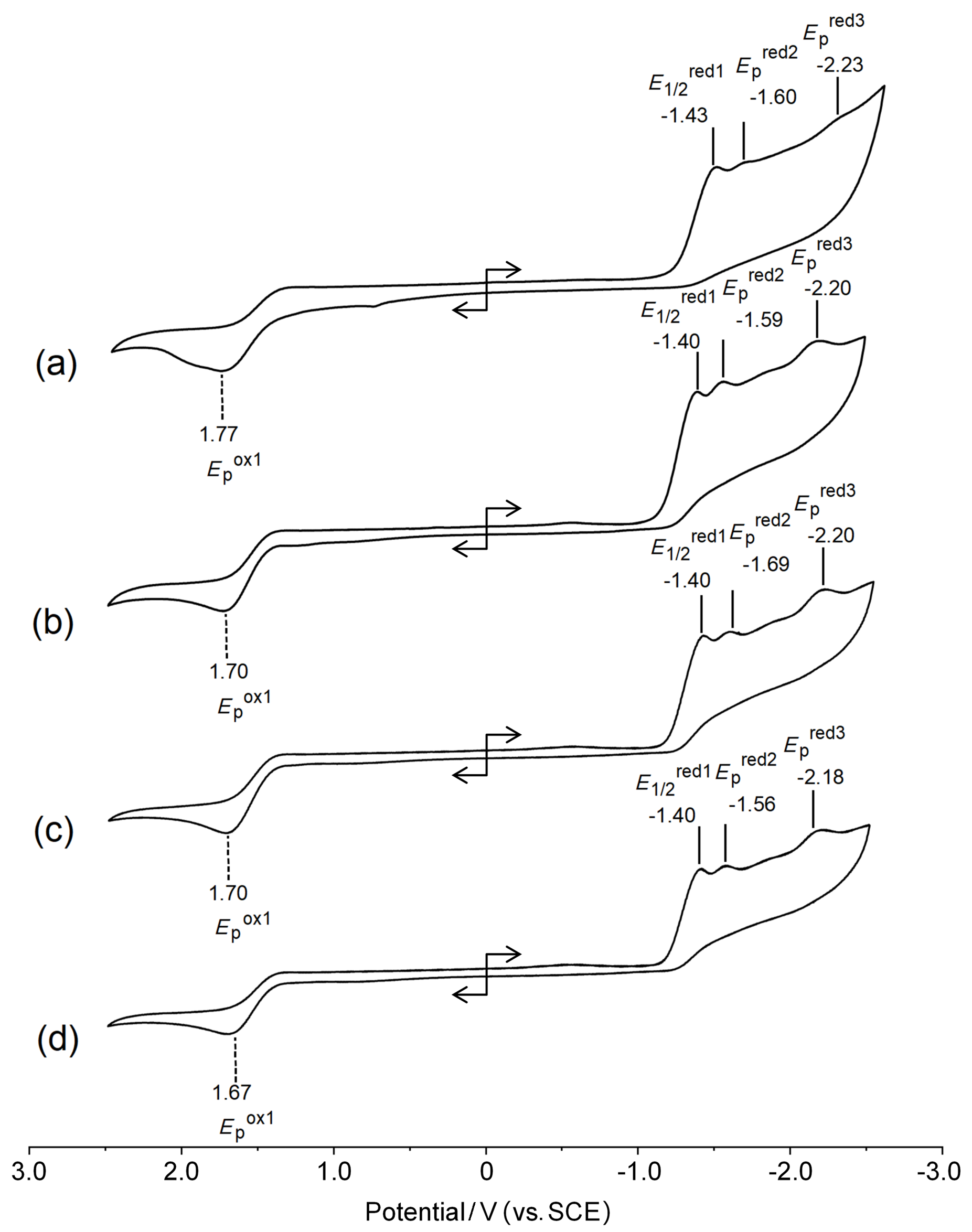
| Eox/V | Ered/V | ERa | H-L (V)b | |||
|---|---|---|---|---|---|---|
| 1st | 2nd | 3rd | ||||
| 4 | 1.77 | -1.43 | -1.60 | -2.23 | 0.17 | 3.20 |
| 5 | 1.70 | -1.40 | -1.59 | -2.20 | 0.19 | 3.10 |
| 6 | 1.70 | -1.40 | -1.69 | -2.20 | 0.29 | 3.10 |
| 7 | 1.67 | -1.40 | -1.56 | -2.18 | 0.16 | 3.07 |
| Eox/V | Ered/V | ERa | H-L (V)b | |||
|---|---|---|---|---|---|---|
| 1st | 2nd | 3rd | ||||
| 4 | 1.77 | -1.43 | -1.60 | -2.23 | 0.17 | 3.20 |
| 5 | 1.70 | -1.40 | -1.59 | -2.20 | 0.19 | 3.10 |
| 6 | 1.70 | -1.40 | -1.69 | -2.20 | 0.29 | 3.10 |
| 7 | 1.67 | -1.40 | -1.56 | -2.18 | 0.16 | 3.07 |
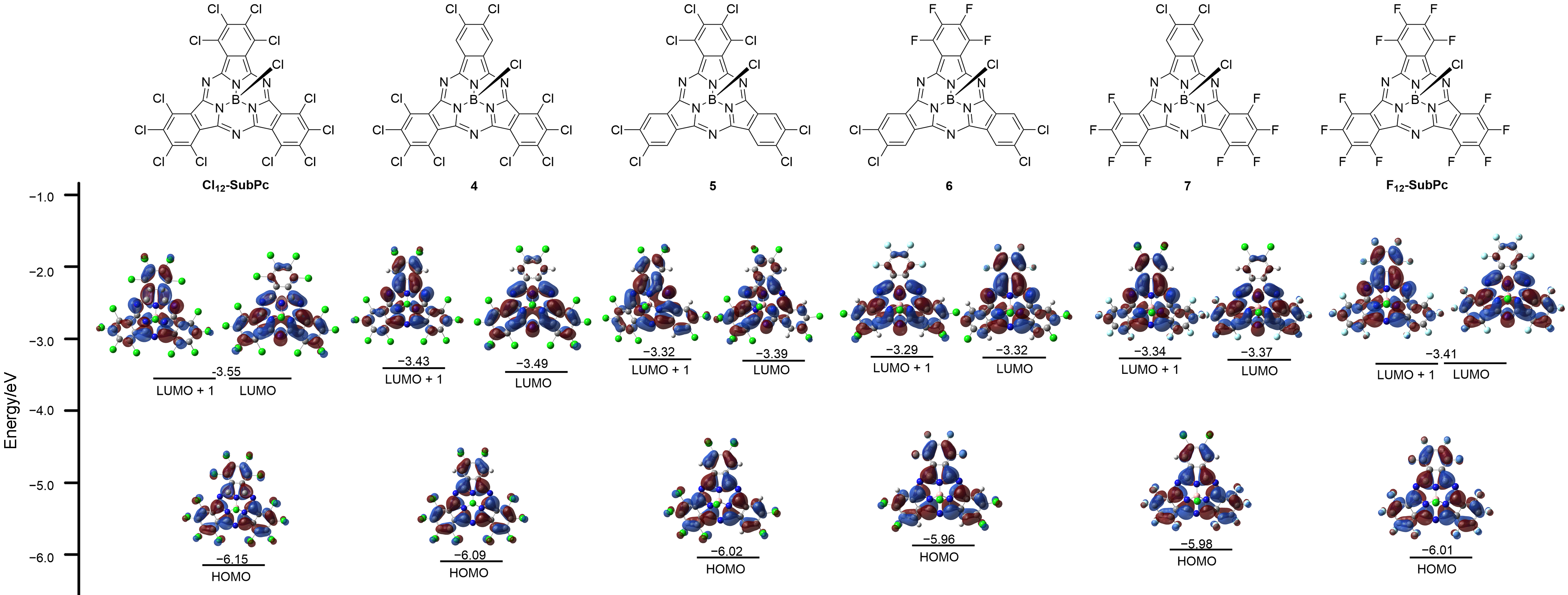
| 氟原子数 | 氯原子数 | Φ△/% | ΦF/% | ||
|---|---|---|---|---|---|
| 4 | Cl10SubPc | — | 10 | 59.29 | 17.25 |
| 5 | Cl8SubPc | — | 8 | 41.56 | 19.99 |
| 6 | F4Cl4SubPc | 4 | 4 | 35.81 | 28.45 |
| 7 | F8Cl2SubPc | 8 | 2 | 19.73 | 32.59 |
| 氟原子数 | 氯原子数 | Φ△/% | ΦF/% | ||
|---|---|---|---|---|---|
| 4 | Cl10SubPc | — | 10 | 59.29 | 17.25 |
| 5 | Cl8SubPc | — | 8 | 41.56 | 19.99 |
| 6 | F4Cl4SubPc | 4 | 4 | 35.81 | 28.45 |
| 7 | F8Cl2SubPc | 8 | 2 | 19.73 | 32.59 |

| [1] |
|
| [2] |
doi: 10.1038/s41392-025-02140-y |
| [3] |
|
| [4] |
doi: 10.1001/archderm.1960.01580040026005 |
| [5] |
doi: 10.1002/adma.v26.31 |
| [6] |
doi: 10.6023/A24120380 |
|
(于千水, 戚聪, 顾顺心, 杨欣达, 姜琴, 魏荣斌, 施鹏飞, 化学学报, 2025, 83, 579.)
doi: 10.6023/A24120380 |
|
| [7] |
doi: 10.6023/A25050141 |
|
(李佳启, 黄艳琴, 丁桂第, 张瑞, 刘兴奋, 范曲立, 黄维, 化学学报, 2025, 83, 1324.)
doi: 10.6023/A25050141 |
|
| [8] |
doi: 10.6023/A24090286 |
|
(张雨琦, 占辰, 贡祎, 陆峰, 范曲立, 化学学报, 2024, 82, 1226.)
doi: 10.6023/A24090286 |
|
| [9] |
doi: 10.6023/A23100472 |
|
(黄艳琴, 罗集文, 李佳启, 张瑞, 刘兴奋, 范曲立, 黄维, 化学学报, 2024, 82, 1.)
|
|
| [10] |
doi: 10.6023/A24010035 |
|
(李燕, 王玮, 张毓婷, 肖述章, 兰海闯, 耿鹏, 化学学报, 2024, 82, 443.)
doi: 10.6023/A24010035 |
|
| [11] |
|
| [12] |
doi: 10.1021/jacs.4c16907 |
| [13] |
doi: 10.3390/ph15020156 |
| [14] |
doi: 10.1016/j.cclet.2023.108974 |
| [15] |
doi: 10.1016/j.trechm.2023.02.003 |
| [16] |
doi: 10.1039/d2cs00280a pmid: 36354343 |
| [17] |
doi: 10.1021/acs.jmedchem.1c01584 pmid: 34813305 |
| [18] |
doi: 10.1039/D3CP05476D |
| [19] |
doi: 10.1039/D1CC05977G |
| [20] |
doi: 10.1039/D5TC03743C |
| [21] |
doi: 10.1021/jacs.2c13353 |
| [22] |
doi: 10.1002/anie.v58.8 |
| [23] |
doi: 10.1016/j.dyepig.2022.110282 |
| [24] |
|
| [25] |
doi: 10.1142/S1088424623500542 |
| [26] |
doi: 10.3390/molecules28020725 |
| [27] |
doi: 10.1039/D1TC02600C |
| [28] |
|
| [29] |
|
| [30] |
|
| [31] |
doi: 10.1016/j.dyepig.2016.03.001 |
| [1] | Hui Zhang, Yuzhen Chen. PtCu/PCN-224 Heterojunction for Photothermal-Driven Selective Oxidation of Benzyl Alcohol [J]. Acta Chimica Sinica, 2026, 84(7): 1096-1104. |
| [2] | Yueke Yuan, Xiangyu Dong, Tong Mu, Zekun Gao, Xiuli Zheng, Huan Cong, Weimin Liu, Pengfei Wang. Near-Infrared Supramolecular Photosensitizers Based on Conjugated Macrocycle for Hypoxic Photodynamic Therapy [J]. Acta Chimica Sinica, 2026, 84(6): 820-827. |
| [3] | Li Jiaqi, Huang Yanqin, Ding Guice, Zhang Rui, Liu Xingfen, Fan Quli, Huang Wei. Photoacoustic/Near-infrared Ⅱ Fluorescence Dual-mode Imaging and Photo/Chemodynamic Synergistic Therapy Effects of DPP-PEG/BSA-MnO2 [J]. Acta Chimica Sinica, 2025, 83(11): 1324-1334. |
| [4] | Yan Li, Wei Wang, Yuting Zhang, Shuzhang Xiao, Haichuang Lan, Peng Geng. Design and Synthesis of Nanoscale Zr-Porphyrin IX Framework for Synergistic Photodynamic and Sonodynamic Therapy of Tumors [J]. Acta Chimica Sinica, 2024, 82(4): 443-448. |
| [5] | Yuan Zhang, Beining Zheng, Meichun Fu, Shouhua Feng. Research Progress in the Application of Spinel Oxides in Tumor Therapy★ [J]. Acta Chimica Sinica, 2023, 81(8): 949-954. |
| [6] | Xin Lv, Yi Wu, Boran Zhang, Wei Guo. Design, Synthesis and Photodynamic Therapy of a H2O2-Activatable Near Infrared Borondipyrromethene (BODIPY) Photosensitizer [J]. Acta Chimica Sinica, 2023, 81(4): 359-370. |
| [7] | Yinghong Yan, Pingzhao Liang, Yang Zou, Lin Yuan, Xiaojun Peng, Jiangli Fan, Xiaobing Zhang. Structure and Properties Regulation of Organic Photosensitizers and Application in Photodiagnosis and Treatment★ [J]. Acta Chimica Sinica, 2023, 81(11): 1642-1662. |
| [8] | Xiaojuan Li, Ziyu Ye, Shuhan Xie, Yongjing Wang, Yonghao Wang, Yuancai Lv, Chunxiang Lin. Study on Performance and Mechanism of Phenol Degradation through Peroxymonosulfate Activation by Nitrogen/Chlorine Co-doped Porous Carbon Materials [J]. Acta Chimica Sinica, 2022, 80(9): 1238-1249. |
| [9] | Badi Liu, Chengjun Wang, Ying Qian. Synthesis, Two-photon Fluorescence Imaging and Photodynamic Therapy of Near Infrared Thienyl-BODIPY Photosensitizer [J]. Acta Chimica Sinica, 2022, 80(8): 1071-1083. |
| [10] | Yanran Li, Zigui Wang, Zhaohui Tang. Water Soluble IR-780 Polymer for Mitochondria-Targeted Photodynamic Therapy※ [J]. Acta Chimica Sinica, 2022, 80(3): 291-296. |
| [11] | Qi Wang, Hui Xia, Yanwei Xiong, Xinmin Zhang, Jie Cai, Chong Chen, Yicong Gao, Feng Lu, Quli Fan. Simple Preparation of Near-infrared-II Organic Small Molecule-based Phototheranostics by Manipulation of the Electron-donating Unit [J]. Acta Chimica Sinica, 2022, 80(11): 1485-1493. |
| [12] | Lixiang Pan, Yanqin Huang, Kuang Sheng, Rui Zhang, Quli Fan, Wei Huang. Applications of Hyaluronic Acid Nanomaterials in Fluorescence/Photoacoustic Imaging and Phototherapy [J]. Acta Chimica Sinica, 2021, 79(9): 1097-1106. |
| [13] | Ju Huang, Zhen Li, Zhihong Liu. Functionalized Upconversion Nanoparticles for Disassembly of β‑Amyloid Aggregation with Near-Infrared Excitation [J]. Acta Chimica Sinica, 2021, 79(8): 1049-1057. |
| [14] | Yan Tao, Liu Zhenhua, Song Xinyue, Zhang Shusheng. Construction and Development of Tumor Microenvironment Stimulus-Responsive Upconversion Photodynamic Diagnosis and Treatment System [J]. Acta Chimica Sinica, 2020, 78(7): 657-669. |
| [15] | Li Mingle, Peng Xiaojun. Research Progress on the Phthalocyanine Based Targeting Photosensitizers in Photodynamic Therapy [J]. Acta Chim. Sinica, 2016, 74(12): 959-968. |
| Viewed | ||||||
|
Full text |
|
|||||
|
Abstract |
|
|||||
