综述与进展
梁鹏宇, 王陈辰, 姚小军*
收稿日期:2026-07-14
修回日期:2026-08-24
基金资助:Liang, Pengyu, Wang, Chenchen, Yao, Xiaojun*
Received:2026-07-14
Revised:2026-08-24
Contact:
*E-mail: xjyao@mpu.edu.mo
Supported by:文章分享
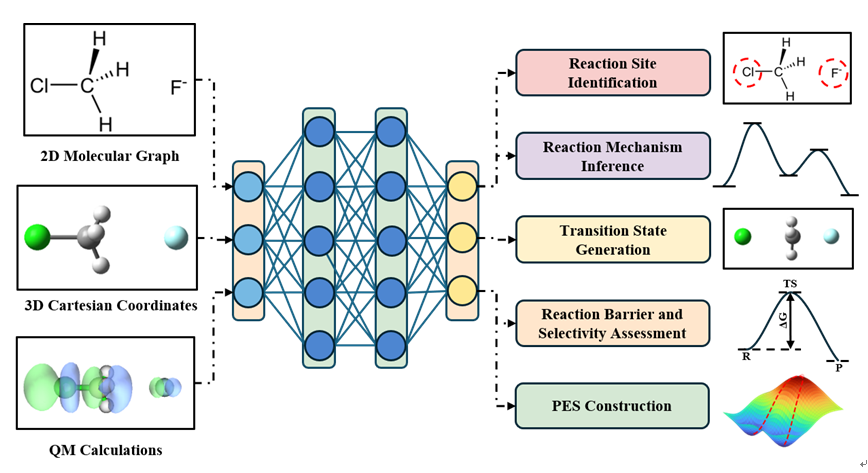
化学反应机理是明确反应过程、解释反应规律并指导反应设计的重要基础。传统反应机理研究通常利用实验表征捕获反应中间体、获取动力学和产物分布等信息,并结合理论计算评估候选反应路径、过渡态结构和反应能垒。然而,面对多构象、多组分等复杂反应体系,机理假设的提出和验证仍依赖人工经验,同时受到计算成本和搜索空间规模的限制。人工智能能够从分子结构、反应数据和量子化学计算结果中学习化学规律,在复杂反应空间的高效探索和机理研究的自动化中展现出巨大潜力。本文首先概述了化学结构的主要表征方法及其适用模型。在此基础上,围绕化学反应机理研究的关键环节,系统综述了人工智能在反应位点识别、反应机理推断、过渡态生成、反应能垒与选择性评价,以及机器学习势与反应势能面构建中的研究进展。最后,本文总结了现有方法在数据质量、物理化学约束、模型泛化能力和可解释性等方面面临的问题,并讨论了其与实验表征和理论计算协同发展的可能方向。
梁鹏宇, 王陈辰, 姚小军. 人工智能驱动的化学反应机理研究进展[J]. 有机化学, doi: 10.6023/cjoc202607012.
Liang, Pengyu, Wang, Chenchen, Yao, Xiaojun. Advances in AI-driven Chemical Reaction Mechanism Research[J]. Chinese Journal of Organic Chemistry, doi: 10.6023/cjoc202607012.
| [1] Jorner K.; Tomberg A.; Bauer C.; Sköld C.; Norrby, P.-O. Nat. Rev. Chem. 2021, 5(4), 240-255. [2] Keith J. A.;Vassilev-Galindo, V.; Cheng, B.; Chmiela, S.; Gastegger, M.; Müller, K.-R.; Tkatchenko, A. Chem. Rev. 2021, 121(16), 9816-9872. [3] Unsleber J. P.; Reiher M. Annu. Rev. Phys. Chem. 2020, 71(1), 121-142. [4] Steiner M.; Reiher M. Nat.Commun. 2024, 15(1), 3680. [5] Bensberg M.; Reiher M. J. Phys. Chem. A 2024, 128(22), 4532-4547. [6] Wen M.;Spotte-Smith, E. W. C.; Blau, S. M.; McDermott, M. J.; Krishnapriyan, A. S.; Persson, K. A. Nat. Comput. Sci. 2023, 3(1), 12-24. [7] Margraf J. T.; Jung H.; Scheurer C.; Reuter K. Nat.Catal. 2023, 6(2), 112-121. [8] Meuwly, M. Chem.Rev. 2021, 121(16), 10218-10239. [9] Li G.; Li Z.; Gao L.; Chen S.; Wang G.; Li S. Phys. Chem. Chem. Phys. 2023, 25(35), 23696-23707. [10] Atz K.; Grisoni F.; Schneider G. Nat. Mach. Intell. 2021, 3(12), 1023-1032. [11] Wigh D. S.; Goodman J. M.; Lapkin A. A. WIREs Comput Mol Sci 2022, 12(5), e1603. [12] Segler M. H.; Preuss M.; Waller M. P. Nature 2018, 555(7698), 604-610. [13] Tetko I. V.; Karpov P.; Van Deursen, R.; Godin, G. Nat. Commun. 2020, 11(1), 5575. [14] Mikulak-Klucznik, B.; Gołębiowska, P.; Bayly, A. A.; Popik, O.; Klucznik, T.; Szymkuć, S.; Gajewska, E. P.; Dittwald, P.; Staszewska-Krajewska, O.; Beker, W. Nature 2020, 588(7836), 83-88. [15] Wang X.; Li Y.; Qiu J.; Chen G.; Liu H.; Liao B.; Hsieh C.-Y.; Yao X. Chem. Eng. J. 2021, 420, 129845. [16] Deng Y.; Zhao X.; Sun H.; Chen Y.; Wang X.; Xue X.; Li L.; Song J.; Hsieh C.-Y.; Hou T. Nat.Commun. 2025, 16(1), 7012. [17] Xu L.-C.; Tang M.-J.; An J.; Cao F.; Qi Y. Nat. Mach. Intell. 2025, 7(9), 1561-1571. [18] Wang X.; Yin X.; Zhang X.; Zhao H.; Gu S.; Wu Z.; Zhang O.; Qian W.; Huang Y.; Li Y. Nat.Commun. 2025, 16(1), 10929. [19] Shields B. J.; Stevens J.; Li J.; Parasram M.; Damani F.; Alvarado J. I.M.; Janey, J. M.; Adams, R. P.; Doyle, A. G. Nature 2021, 590(7844), 89-96. [20] Wang X.; Hsieh C.-Y.; Yin X.; Wang J.; Li Y.; Deng Y.; Jiang D.; Wu Z.; Du H.; Chen H.; Li Y.; Liu H.; Wang Y.; Luo P.; Hou T.; Yao X. Research 2023, 6, 0231. [21] Wang J. Y.; Stevens J. M.; Kariofillis S. K.; Tom M.-J.; Golden D. L.; Li J.; Tabora J. E.; Parasram M.; Shields B. J.; Primer D. N. Nature 2024, 626(8001), 1025-1033. [22] Sin J. W.; Chau S. L.; Burwood R. P.; Püntener K.; Bigler R.; Schwaller P. Nat.Commun. 2025, 16(1), 6464. [23] Ahneman D. T.; Estrada J. G.; Lin S.; Dreher S. D.; Doyle A. G. Science 2018, 360(6385), 186-190. [24] Yin X.; Hsieh C.-Y.; Wang X.; Wu Z.; Ye Q.; Bao H.; Deng Y.; Chen H.; Luo P.; Liu H.; Hou T.; Yao X. Research 2024, 7, 0292. [25] Szymkuć S.; Wołos A.; Roszak R.; Grzybowski B. A. Nat. Commun. 2024, 15(1), 10286. [26] Boser F.; Spies J. C.; Glorius F. J. Am. Chem. Soc. 2026, 148(14), 15066-15075. [27] Boiko D. A.;MacKnight, R.; Kline, B.; Gomes, G. Nature 2023, 624(7992), 570-578. [28] Chawla N. V.;González-Montiel, G. A.; Guo, K.; Guo, T.; Hua, T.; Huang, X.; Inae, E.; Jiang, M.; Le, K.; Liu, G.; Maier, J. C.; Moniz, N.; Nogueira, B.; Pan, D.; Piguave, B. V.; Savoie, B. M.; Schofield, A. B.; Shen, Y.; Taylor, A.; Zhang, X.; Zhu, Y.; Wiest, O. Chem. Rev. 2026, 126(13), 7587-7635. [29] Parr R. G.; Yang W. J. Am. Chem. Soc. 1984, 106(14), 4049-4050. [30] Morell C.; Grand A.; Toro-Labbé, A. J. Phys. Chem. A 2005, 109(1), 205-212. [31] Durant J. L.; Leland B. A.; Henry D. R.; Nourse J. G.J. Chem. Inf. Comput. Sci. 2002, 42(6), 1273-1280. [32] Rogers D.; Hahn M. J. Chem. Inf. Model. 2010, 50(5), 742-754. [33] Weininger, D. J. Chem. Inf. Comput.Sci. 1988, 28(1), 31-36. [34] Schwaller P.; Laino T.; Gaudin T.; Bolgar P.; Hunter C. A.; Bekas C.; Lee A. A. ACS Cent. Sci. 2019, 5(9), 1572-1583. [35] Weininger D.; Weininger A.; Weininger J. L.J. Chem. Inf. Comput. Sci. 1989, 29(2), 97-101. [36] Heller S.;McNaught, A.; Stein, S.; Tchekhovskoi, D.; Pletnev, I. J. Cheminform. 2013, 5(1), 7. [37] Unke O. T.; Chmiela S.; Sauceda H. E.; Gastegger M.; Poltavsky I.; Schütt K. T.; Tkatchenko A.; Müller K.-R. Chem. Rev. 2021, 121(16), 10142-10186. [38] Batzner S.; Musaelian A.; Sun L.; Geiger M.; Mailoa J. P.; Kornbluth M.; Molinari N.; Smidt T. E.; Kozinsky B. Nat.Commun. 2022, 13(1), 2453. [39] Gallegos L. C.; Luchini G.; St. John,P. C.; Kim, S.; Paton, R. S. Acc. Chem. Res. 2021, 54(4), 827-836. [40] Grambow C. A.; Pattanaik L.; Green W. H.J. Phys. Chem. Lett. 2020, 11(8), 2992-2997. [41] Gallarati S.; Bucci E. M.; Doyle A. G.; Sigman M. S. Nature 2026, 651(8106), 637-646. [42] Sigmund L. M.; Assante M.; Johansson M. J.; Norrby P.-O.; Jorner K.; Kabeshov M. Chem.Sci. 2025, 16(13), 5383-5412. [43] Klucznik T.; Syntrivanis L.-D.; Baś S.; Mikulak-Klucznik, B.; Moskal, M.; Szymkuć, S.; Mlynarski, J.; Gadina, L.; Beker, W.; Burke, M. D. Nature 2024, 625(7995), 508-515. [44] Wang X.; Mao Y.; Wang Z. Chem.Catal. 2025, 5(8), 101458. [45] Morell C.; Ayers P. W.; Grand A.; Gutiérrez-Oliva, S.; Toro-Labbé, A. Phys. Chem. Chem. Phys. 2008, 10(48), 7239-7246. [46] Scales S.; Johnson S.; Hu Q.; Do Q.-Q.; Richardson P.; Wang F.; Braganza J.; Ren S.; Wan Y.; Zheng B.; Faizi D.; McAlpine, I. Org. Lett. 2013, 15(9), 2156-2159. [47] Brinck T.; Carlqvist P.; Stenlid J. H.J. Phys. Chem. A 2016, 120(50), 10023-10032. [48] Parr R. G.Density Functional Theory of Atoms and Molecules. In Horizons of Quantum Chemistry; Fukui, K., Pullman, B., Eds.; Springer Netherlands: Dordrecht, 1980, pp. 5~15. [49] Geerlings P.;De Proft, F.; Langenaeker, W. Chem. Rev. 2003, 103(5), 1793-1874. [50] Liu S.Conceptual Density Functional Theory: Towards a New Chemical Reactivity Theory; John Wiley & Sons, 2022. [51] Liu S.Density-Based Reactivity Theory; John Wiley & Sons, 2026. [52] Elrod D. W.; Maggiora G. M.; Trenary R. G.J. Chem. Inf. Comput. Sci. 1990, 30(4), 477-484. [53] Kvasnicka V.; Pospichal J. Journal of Molecular Structure: THEOCHEM 1991, 235(3-4), 227-242. [54] Tomberg A.; Johansson M. J.; Norrby P.-O.J. Org. Chem. 2019, 84(8), 4695-4703. [55] Li X.; Zhang S.-Q.; Xu L.-C.; Hong X. Angew. Chem. Int. Ed. 2020, 59, 13253-13259. [56] Yang L.-C.; Li X.; Zhang S.-Q.; Hong X. Org. Chem. Front. 2021, 8(22), 6187-6195. [57] Nippa D. F.; Atz K.; Hohler R.; Müller A. T.; Marx A.; Bartelmus C.; Wuitschik G.; Marzuoli I.; Jost V.; Wolfard J.; Binder M.; Stepan A. F.; Konrad D. B.; Grether U.; Martin R. E.; Schneider G. Nat.Chem. 2024, 16(2), 239-248. [58] Schleinitz J.;Carretero-Cerdán, A.; Gurajapu, A.; Harnik, Y.; Lee, G.; Pandey, A.; Milo, A.; Reisman, S. E. J. Am. Chem. Soc. 2025, 147(9), 7476-7484. [59] Zhang Z.; Qiu J.; Zheng J.; Yu Z.; Su L.; Lin Q.; Zhang C.; Liao K. J. Chem. Inf. Model. 2025, 65(7), 3420-3430. [60] Borup R. M.; Ree N.; Jensen J. H.Beilstein J. Org. Chem. 2024, 20(1), 1614-1622. [61] Li B.; Liu Y.; Sun H.; Zhang R.; Xie Y.; Foo K.; Mak F. S.; Zhang R.; Yu T.; Lin S.; Wang P.; Wang X. Digit.Discov. 2024, 3(10), 2019-2031. [62] Guan Y.; Lee T.; Wang K.; Yu S.; McWilliams, J. C. J. Chem. Inf. Model. 2023, 63(12), 3751-3760. [63] Borghini A.; Crotti P.; Pietra D.; Favero L.; Bianucci A. M.J. Comput. Chem. 2010, 31(14), 2612-2619. [64] Keto A.; Guo T.; Underdue M.; Stuyver T.; Coley C. W.; Zhang X.; Krenske E. H.; Wiest O. J. Am. Chem. Soc. 2024, 146(23), 16052-16061. [65] Wang L.; Zhang C.; Bai R.; Li J.; Duan H. Chem.Commun. 2020, 56(65), 9368-9371. [66] Maeda S.; Harabuchi Y.; Takagi M.; Taketsugu T.; Morokuma K. Chem.Rec. 2016, 16(5), 2232-2248. [67] Li G.; Ling H.; Su C.; Liu Z.; Wang G.; Yang M.; Li S. CCS Chem. 2026, DOI: 10.31635/ccschem.026.202607339. [68] Bradshaw J.; Kusner M. J.; Paige B.; Segler M. H.S.; Hernández-Lobato, J. M. arXiv March 20, 2019. S.; Hernández-Lobato, J. M. arXiv March 20, 2019. http://arxiv.org/abs/1805.10970. [69] Tavakoli M.; Chiu Y. T.T.; Carlton, A. M.; Van Vranken, D.; Baldi, P. J. Chem. Inf. Model. 2025, 65(3), 1228-1242. [70] Miller R. J.; Dashuta A. E.; Rudisill B.; Van Vranken, D.; Baldi, P. J. Am. Chem. Soc. 2025, 147(44), 41168-41176. [71] Liang P.; Liu B.; Lu R.; Li J.; Tan Y.; Liu H.; Yao X. Chin. Chem. Lett. 2025, 112168. [72] Neukomm T. A.; Jončev Z.; Schwaller, P. arXiv April 17, 2026. Schwaller, P. arXiv April 17, 2026. http://arxiv.org/abs/2512.05722. [73] Joung J. F.; Fong M. H.; Casetti N.; Liles J. P.; Dassanayake N. S.; Coley C. W. Nature 2025, 645(8079), 115-123. [74] Bran A. M.; Neukomm T. A.; Armstrong D.; Jončev Z.; Schwaller P. Matter 2026, 9(5), 102812. [75] Tavakoli M.; Miller R. J.; Angel M. C.; Pfeiffer M. A.; Gutman E. S.; Mood A. D.; Van Vranken, D.; Baldi, P. J. Chem. Inf. Model. 2024, 64(6), 1975-1983. [76] Joung J. F.; Fong M. H.; Roh J.; Tu Z.; Bradshaw J.; Coley C. W. Angew. Chem. Int.Ed. 2024, 63(43), e202411296. [77] Chen S.; Babazade R.; Kim T.; Han S.; Jung Y. Sci. Data 2024, 11(1), 863. [78] Tavakoli M.; Chiu Y. T.T.; Baldi, P.; Carlton, A. M.; Van Vranken, D. J. Chem. Inf. Model. 2023, 63(4), 1114-1123. [79] Bradshaw J.; Zhang A.; Mahjour B.; Graff D. E.; Segler M. H.S.; Coley, C. W. ACS Cent. Sci. 2025, 11(4), 539-549. [80] E W.; Ren, W.; Vanden-Eijnden, E. Phys. Rev. B 2002, 66(5), 052301. [81] Ren W.;Vanden-Eijnden, E. J. Chem. Phys. 2007, 126(16), 164103. [82] Henkelman G.; Jónsson, H. J. Chem. Phys. 2000, 113(22), 9978-9985. [83] Henkelman G.; Uberuaga B. P.; Jónsson, H. J. Chem. Phys. 2000, 113(22), 9901-9904. [84] Peters B.; Heyden A.; Bell A. T.; Chakraborty A. J. Chem. Phys. 2004, 120(17), 7877-7886. [85] Zimmerman P. M.J. Chem. Phys. 2013, 138(18), 184102. [86] Zimmerman, P. J. Chem. Theory Comput. 2013, 9(7), 3043-3050. [87] Zimmerman P. M.J. Comput. Chem. 2015, 36(9), 601-611. [88] Grambow C. A.; Pattanaik L.; Green W. H.Sci. Data 2020, 7(1), 137. [89] Schreiner M.; Bhowmik A.; Vegge T.; Busk J.; Winther O. Sci. Data 2022, 9(1), 779. [90] Li J.-Q.; Zhang S.-Q.; Zhao Q.; Liu D.-G.; Lu X.; Wang Y.-F.; Fu Y.; Hong X. Digit.Discov. 2026, DOI: 10.1039/D6DD00330C. [91] Pattanaik L.; Ingraham J. B.; Grambow C. A.; Green W. H. Phys. Chem. Chem.Phys. 2020, 22(41), 23618-23626. [92] Jackson R.; Zhang W.; Pearson J. Chem.Sci. 2021, 12(29), 10022-10040. [93] Choi, S. Nat.Commun. 2023, 14(1), 1168. [94] Kim S.; Woo J.; Kim W. Y. Nat. Commun. 2024, 15(1), 341. [95] Duan C.; Du Y.; Jia H.; Kulik H. J. Nat. Comput. Sci. 2023, 3(12), 1045-1055. [96] Duan C.; Liu G.-H.; Du Y.; Chen T.; Zhao Q.; Jia H.; Gomes C. P.; Theodorou E. A.; Kulik H. J. Nat. Mach. Intell. 2025, 7(4), 615-626. [97] Luo Y.; Gu X.; Sun J. Nat.Commun. 2026, 17, 7497. [98] Heid E.; Green W. H.J. Chem. Inf. Model. 2022, 62(9), 2101-2110. [99] Heinen S.; von Rudorff, G. F.; von Lilienfeld, O. A. J. Chem. Phys. 2021, 155(6), 064105. [100] Spiekermann K. A.; Pattanaik L.; Green W. H.J. Phys. Chem. A 2022, 126(25), 3976-3986. [101] Zhao Q.; Anstine D. M.; Isayev O.; Savoie B. M. Chem. Sci. 2023, 14(46), 13392-13401. [102] Vijay S.; Venetos M. C.; Spotte-Smith, E. W. C.; Kaplan, A. D.; Wen, M.; Persson, K. A. Chem. Sci. 2024, 15(8), 2923-2936. [103] Van Gerwen, P.; Briling, K. R.; Bunne, C.; Somnath, V. R.; Laplaza, R.; Krause, A.; Corminboeuf, C. J. Chem. Inf. Model. 2024, 64(15), 5771-5785. [104] Caldeweyher E.; Elkin M.; Gheibi G.; Johansson M.; Sköld C.; Norrby P.-O.; Hartwig J. F.J. Am. Chem. Soc. 2023, 145(31), 17367-17376. [105] Xu L.-C.; Frey J.; Hou X.; Zhang S.-Q.; Li Y.-Y.; Oliveira J. C.; Li S.-W.; Ackermann L.; Hong X. Nat.Synth. 2023, 2(4), 321-330. [106] Cuomo A. E.; Ibarraran S.; Sreekumar S.; Li H.; Eun J.; Menzel J. P.; Zhang P.; Buono F.; Song J. J.; Crabtree R. H.; Batista V. S.; Newhouse T. R. ACS Cent. Sci. 2023, 9(9), 1768-1774. [107] Ismail I.; Robertson C.; Habershon S. J. Chem. Phys. 2022, 157(1), 014109. [108] Harabuchi Y.; Staub R.; Gao M.; Tsuji N.; List B.; Varnek A.; Maeda S. ACS Cent. Sci. 2026, 12(4), 524-531. [109] Doba T.; Harabuchi Y.; Nagata Y.; Maeda S. J. Am. Chem. Soc. 2026, 148(25), 26150-26160. [110] Xu X.-Y.; Liu L.-G.; Xu L.-C.; Zhang S.-Q.; Hong X. J. Am. Chem. Soc. 2025, 147(18), 15318-15328. [111] Behler J.; Parrinello M. Phys. Rev. Lett. 2007, 98(14), 146401. [112] Behler, J. Chem.Rev. 2021, 121(16), 10037-10072. [113] Behler, J. Angew. Chem. Int. Ed. 2017, 56(42), 12828-12840. [114] Zhang L.; Han J.; Wang H.; Car R.; E, W. Phys. Rev. Lett. 2018, 120(14), 143001. [115] Wu G.; Zhao Y.; Zhang L.; Du J.; Meng Q.; Liu Q.AIChE J. 2025, 71(5), e18741. [116] Tang K.; Zhao Y.; Zhang L.; Du J.; Meng Q.; Liu Q. J. Chem. Theory Comput. 2025, 21(18), 8933-8949. [117] Kim J.; Cho H.; Jeon H.; Jung J.; Han S. Chem.Rev. 2026, 126(8), 4467-4510. [118] Brezina K.; Beck H.; Marsalek O. J. Chem. Theory Comput. 2023, 19(19), 6589-6604. [119] Kulichenko M.; Nebgen B.; Lubbers N.; Smith J. S.; Barros K.; Allen A. E.A.; Habib, A.; Shinkle, E.; Fedik, N.; Li, Y. W.; Messerly, R. A.; Tretiak, S. Chem. Rev. 2024, 124(24), 13681-13714. [120] Zhang Y.; Wang H.; Chen W.; Zeng J.; Zhang L.; Wang H. Comput. Phys. Commun. 2020, 253, 107206. [121] Kulichenko M.; Barros K.; Lubbers N.; Li Y. W.; Messerly R.; Tretiak S.; Smith J. S.; Nebgen B. Nat. Comput. Sci. 2023, 3(3), 230-239. [122] Heinen S.; von Rudorff, G. F.; von Lilienfeld, O. A. J. Chem. Phys. 2022, 157(22), 221102. [123] Yuan E. C.-Y.; Kumar, A.; Guan, X.; Hermes, E. D.; Rosen, A. S.; Zádor, J.; Head-Gordon, T.; Blau, S. M. Nat. Commun. 2024, 15(1), 8865. [124] Hermes E. D.; Sargsyan K.; Najm H. N.; Zádor, J. J. Chem. Theory Comput. 2022, 18(11), 6974-6988. [125] Ren K.; Tang K.; Zhao Y.; Zhang L.; Du J.; Meng Q.; Liu Q. Nat.Commun. 2026, 17, 6253. [126] Young T. A.;Johnston-Wood, T.; Zhang, H.; Duarte, F. Phys. Chem. Chem. Phys. 2022, 24(35), 20820-20827. [127] Zhang H.; Juraskova V.; Duarte F. Nat.Commun. 2024, 15(1), 6114. [128] Ma J.; Fu X.; Xie W.; Hu P. J. Chem. Theory Comput. 2026, 22(4), 1920-1930. [129] Gallegos M.;Vassilev-Galindo, V.; Poltavsky, I.; Martín Pendás, Á.; Tkatchenko, A. Nat. Commun. 2024, 15(1), 4345. [130] Kearnes S. M.; Maser M. R.; Wleklinski M.; Kast A.; Doyle A. G.; Dreher S. D.; Hawkins J. M.; Jensen K. F.; Coley C. W.J. Am. Chem. Soc. 2021, 143(45), 18820-18826. [131] Wigh D. S.; Arrowsmith J.; Pomberger A.; Felton K. C.; Lapkin A. A.J. Chem. Inf. Model. 2024, 64(9), 3790-3798. [132] Strieth‐Kalthoff, F.; Sandfort, F.; Kühnemund, M.; Schäfer, F. R.; Kuchen, H.; Glorius, F. Angew. Chem. Int. Ed. 2022, 61(29), e202204647. [133] Schrader M. L.; Schäfer F. R.; Schäfers F.; Glorius F. Nat.Chem. 2024, 16(4), 491-498. [134] Raissi M.; Perdikaris P.; Karniadakis G. E.J. Comput. Phys. 2019, 378, 686-707. [135] Ji W.; Qiu W.; Shi Z.; Pan S.; Deng S. J. Phys. Chem. A 2021, 125(36), 8098-8106. [136] Weng Y.; Zhou D. J. Phys. Chem. A 2022, 126(45), 8534-8543. [137] Hirschfeld L.; Swanson K.; Yang K.; Barzilay R.; Coley C. W.J. Chem. Inf. Model. 2020, 60(8), 3770-3780. |
| [1] | 张凯瑞, 王亚亚, 朱宏丹, 彭谦. 有机反应机制的准经典分子动态学研究进展[J]. 有机化学, 2021, 41(10): 3995-4006. |
| [2] | 吴江, 李嘉雯, 李昊, 朱纯银. 可见光催化促进的金属有机基元反应[J]. 有机化学, 2017, 37(9): 2203-2210. |
| [3] | 杨思娅,孙成科,林雪飞. 取代基对手性唑噁唑硼烷催化还原苯基乙基酮对映体选择性影响的理论研究[J]. 有机化学, 2003, 23(12): 1400-1406. |
| [4] | 聂小平,叶秀林. 若干有机合成反应的构象效应[J]. 有机化学, 1999, 19(2): 109-120. |
| [5] | 荣国斌,王Bing,马汝建. N-三甲基硅基对甲苯磺酰胺与对甲苯磺酸酯的反应[J]. 有机化学, 1998, 18(5): 478-480. |
| [6] | 谭波,赵玉芬. 磷酰氨基酸的酯交换反应研究[J]. 有机化学, 1995, 15(1): 30-34. |
| [7] | 密爱巧,陈元伟,肖勋,蒋耀忠. 手性蒎烯酮亚胺用于立体选择性合成[J]. 有机化学, 1993, 13(2): 199-201. |
| [8] | 胡昌玉,许禄. 一个用于含C, H, O的有机化合物结构解析专家系统[J]. 有机化学, 1993, 13(2): 129-135. |
| [9] | 吴国生,葛明娟,林光灿,李尊良,舒菊坪. 水杨叉间溴缩苯胺的光发色和热消色反应过渡态[J]. 有机化学, 1990, 10(4): 360-365. |
| [10] | 黄素秋,张克凌,陈敏东,郑穹,夏淑贞,李宝睿. 卟啉化合物的研究 XV: 双卟啉的合成及其与钴离子的络合反应[J]. 有机化学, 1989, 9(4): 321-324. |
| [11] | 陈庆华,谢孟峡,贾西贝,王学良. 分子内1,3-偶极环加成反应的研究 IV: 某些硝酮偶极体系的热及光化学反应及区域选择性[J]. 有机化学, 1989, 9(2): 156-162. |
| [12] | 徐建华,吴国生. ZIMMERMAN光重排的理论研究进展[J]. 有机化学, 1985, 5(2): 113-119. |
| 阅读次数 | ||||||
|
全文 |
|
|||||
|
摘要 |
|
|||||


