有机化学 ›› 2025, Vol. 45 ›› Issue (4): 1261-1267.DOI: 10.6023/cjoc202409005 上一篇 下一篇
研究论文
高玉兰a, 龙江琴b, 王秋生b,*( )
)
收稿日期:2024-09-03
修回日期:2024-10-21
发布日期:2024-11-27
基金资助:
Yulan Gaoa, Jiangqin Longb, Qiusheng Wangb()
Received:2024-09-03
Revised:2024-10-21
Published:2024-11-27
Contact:
* E-mail: Supported by:文章分享
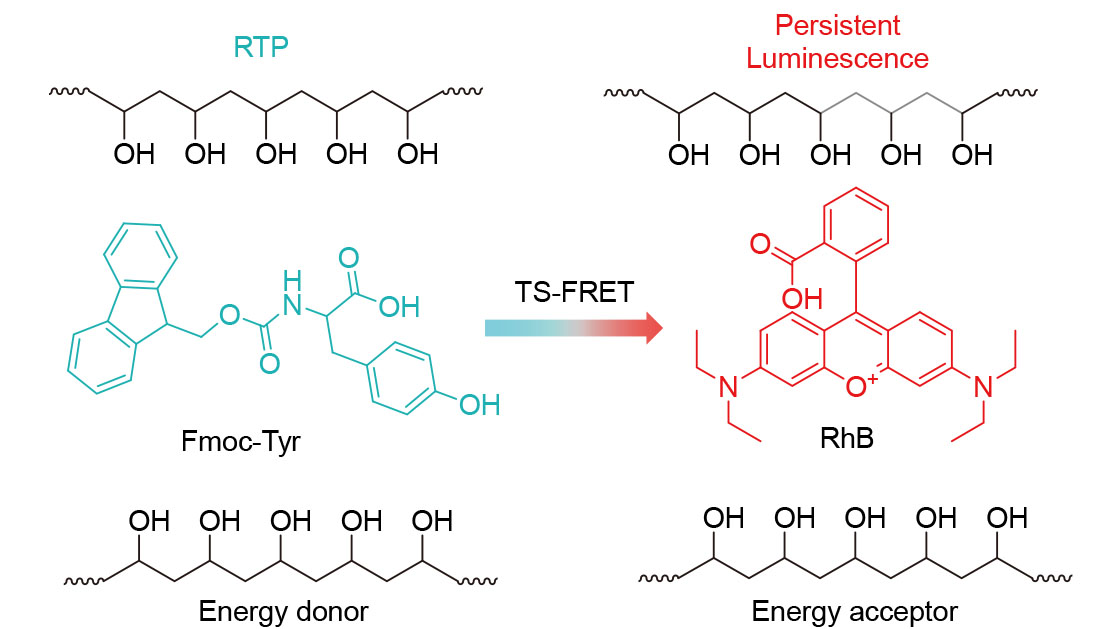
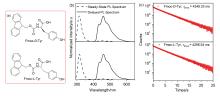
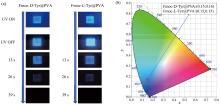
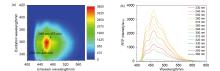
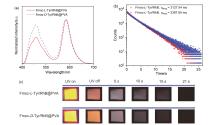
室温磷光(Room Temperature Phosphorescence, RTP)材料在信息加密、光学传感、生物成像、信息存储等方面具有十分广阔的应用前景, 然而有机材料在室温条件下实现长寿命、高效率的磷光一直面临诸多挑战性, 这主要是由于环境条件下有机分子的磷光发射经常会被强烈的非辐射跃迁、低效的系间穿越、氧气等因素的淬灭所阻碍. 本研究主要使用掺杂聚合物基质这一策略实现了长寿命室温磷光发射, 所制备的两种9-芴基甲氧基羰基(Fmoc)-酪氨酸@PVA薄膜在275 nm的紫外光源照射后产生寿命大于4000 ms的磷光发射和持续时间长达41 s的蓝色余辉. 进一步在体系中掺杂染料分子罗丹明B, 通过Förster共振能量转移(Förster-resonance energy-transfer, FRET)过程实现对薄膜余辉发光颜色的调节.
高玉兰, 龙江琴, 王秋生. 9-芴基甲氧基羰基-酪氨酸掺杂聚乙烯醇室温磷光薄膜性质研究[J]. 有机化学, 2025, 45(4): 1261-1267.
Yulan Gao, Jiangqin Long, Qiusheng Wang. Properties Research of Poly(vinyl alcohol) Phosphorescent Films Doped with 9-Fluorenyl Methoxycarbonyl-Tyrosine at Room Temperature[J]. Chinese Journal of Organic Chemistry, 2025, 45(4): 1261-1267.

| Compound | Fluorescence | Phosphorescence | |||||
|---|---|---|---|---|---|---|---|
| λex/nm | λem/nm | ФFluo/% | λem/nm | τ/ms | ФPhos/% | ||
| Fmoc-D-Tyr | 275 | 314 | 2.98 | 460 | 4248.33 | 15.37 | |
| Fmoc-L-Tyr | 275 | 318 | 6.24 | 460 | 4256.54 | 16.89 | |
| Fmoc-D-Tyr/RhB | 275 | 314/592 | 1.68 | 461/589 | 3387.85 | 18.56 | |
| Fmoc-L-Tyr/RhB | 275 | 318/592 | 2.88 | 461/589 | 3127.54 | 22.66 | |
| Compound | Fluorescence | Phosphorescence | |||||
|---|---|---|---|---|---|---|---|
| λex/nm | λem/nm | ФFluo/% | λem/nm | τ/ms | ФPhos/% | ||
| Fmoc-D-Tyr | 275 | 314 | 2.98 | 460 | 4248.33 | 15.37 | |
| Fmoc-L-Tyr | 275 | 318 | 6.24 | 460 | 4256.54 | 16.89 | |
| Fmoc-D-Tyr/RhB | 275 | 314/592 | 1.68 | 461/589 | 3387.85 | 18.56 | |
| Fmoc-L-Tyr/RhB | 275 | 318/592 | 2.88 | 461/589 | 3127.54 | 22.66 | |






| [1] |
Becquerel, E. C. R. Acad. Sci. 1866, 62, 999.
|
| [2] |
(a) Hirata, S.; Totani, K.; Kaji, H.; Vacha, M.; Watanabe, T.; Adachi, C. Adv. Opt. Mater. 2013, 1, 438.
|
|
(b) Jian, M. Y.; Song, Z. C.; Chen, X. J.; Zhao, J. C.; Xu, B. J.; Chi, Z. G. Chem. Eng. J. 2022, 429, 132346.
|
|
| [3] |
Jiang, X; Wu, M. L.; Zhang, L; Wang, J. Y.; Cui, M. Y.; Wang, J. H.; Pang, X. K.; Song, B.; He, Y. Anal. Chem. 2022, 94, 7264.
doi: 10.1021/acs.analchem.2c00510 pmid: 35427126 |
| [4] |
(a) Yang, J.; Zhen, X.; Wang, B.; Gao, X. M.; Ren, Z. A.; Wang, J. Q.; Xie, Y. J.; Li, J. R.; Peng, Q.; Pu, K. Y.; Li, Z. Nat. Commun. 2018, 9, 840.
doi: 10.1038/s41467-018-03236-6 pmid: 29483501 |
|
(b) Zhang, Y. H.; Li, H. R.; Yang, M. D.; Dai, W. B.; Shi, J. B.; Tong, B.; Cai, Z. X.; Wang, Z. Y.; Dong, W. P.; Yu, X. Q. Chem. Commun. 2023, 59, 5329.
pmid: 29483501 |
|
| [5] |
Li, F. Y.; Du, Y.; Liu, J. A.; Sun, H.; Wang, J.; Li, R. Q.; Kim, D.; Hyeon, T.; Ling, D. S. Adv. Mater. 2018, 30, 1802808.
|
| [6] |
(a) Su, Y.; Phua, S. Z. F.; Li, Y. B.; Zhou, X. J.; Jana, D.; Li, G. F.; Lim, W. Q.; Ong, W. K.; Yang, C. L. Sci. Adv. 2018, 4, eaas9732.
|
|
(b) Gao, L.; Huang, J. Y.; Qu, L. J.; Chen, X. H.; Zhu, Y.; Li, C.; Tian, Q. C.; Zhao, Y. L.; Yang, C. L. Nat. Commun. 2023, 14, 7252.
|
|
| [7] |
(a) Zhao, W. J.; He, Z. K.; Tang, B. Z. Nat. Rev. Mater. 2020, 5, 869.
|
|
(b) Ma, X.; Wang, J.; Tian, H. Acc. Chem. Res. 2019, 52, 738.
|
|
|
(c) Ma, X. K.; Liu, Y. Acc. Chem. Res. 2021, 54, 3403.
|
|
|
(d) Guo, J. J.; Yang, C. L.; Zhao, Y. L. Acc. Chem. Res. 2022, 55, 1160.
|
|
| [8] |
Liang, Y. H.; Xu, C.; Zhang, H. Q.; Wu, S. Y.; Li, J. A.; Yang, Y. F.; Mao, Z.; Luo, S. L.; Liu, C.; Shi, G.; Sun, F. Q.; Chi, Z. G.; Xu, B. L. Angew. Chem., Int. Ed. 2023, 135, e202217616.
|
| [9] |
(a) Chen, X. F.; Xu, C.; Wang, T.; Zhou, C.; Du, J. J.; Wang, Z. P.; Xu, H. X.; Xie, T. Q.; Bi, G. Q.; Jiang, J.; Zhang, X. P.; Demas, J. N.; Trindle, C.; Luo, Y.; Zhang, G. Q. Angew. Chem., Int. Ed. 2016, 55, 9872.
pmid: 21336325 |
|
(b) Shi, H. F.; Song, L. L.; Ma, H. L.; Sun, C.; Huang, K. Y.; Lv, A. Q.; Ye, Y. P.; Wang, H.; Cai, S. Z.; Yao, W.; Zhang, Y. J.; Zheng, R. L.; An, Z. F.; Huang, W. J. Phys. Chem. Lett. 2019, 10, 595.
pmid: 21336325 |
|
|
(c) Mu, Y.; Wang, J. Q.; Han, S. D.; Pan, J.; Li, J. H.; Wang, G. M. Inorg. Chem. 2020, 59, 972.
pmid: 21336325 |
|
|
(d) Bolton, O.; Lee, K.; Kim, H. J.; Lin, K. Y.; Kim, J. Nat. Chem. 2011, 3, 205.
doi: 10.1038/nchem.984 pmid: 21336325 |
|
| [10] |
An, Z. F.; Zheng, C.; Tao, Y.; Chen, R. F.; Shi, H. F.; Chen, T.; Wang, Z. F.; Li, H. H.; Deng, R. R.; Liu, X. G.; Huang, W. Nat. Mater. 2015, 14, 685.
|
| [11] |
(a) Yang, Z.; Xu, C.; Li, W.; Mao, Z.; Ge, X. Y.; Huang, Q. Y.; Deng, H. J.; Zhao, J.; Gu, F.; Zhang, Y.; Chi, Z. G. Angew. Chem., Int. Ed. 2020, 59, 17451.
pmid: 38020368 |
|
(b) Kongasseri, A. A.; Garain, S.; Ansari, S. N.; Garain, B. C.; Wagalgave, S. M.; Singh, U.; Pati, S. K.; George, S. J. Chem. Mater. 2023, 35, 7781.
pmid: 38020368 |
|
|
(c) Kongasseri, A. A.; Ansari, S. N.; Garain, S.; Wagalgave, S. M.; George, S. J. Chem. Sci. 2023, 14, 12548.
doi: 10.1039/d3sc04001a pmid: 38020368 |
|
|
(d) Song, J.; Ma, R. Chin. J. Org. Chem. 2021, 41, 4519 (in Chinese).
pmid: 38020368 |
|
|
(宋金明, 马骧, 有机化学, 2021, 41, 4519.)
doi: 10.6023/cjoc202100082 pmid: 38020368 |
|
|
(e) Yuan, W. Z.; Shen, X. Y.; Zhao, H.; Lam, J. W.; Tang, L.; Lu, P.; Wang, C.; Liu, Y.; Wang, Z.; Zheng, Q.; Sun, J. Z.; Ma, Y.; Tang, B. Z. J. Phys. Chem. C 2010, 114, 6090.
pmid: 38020368 |
|
| [12] |
(a) Mieno, H.; Kabe, R.; Notsuka, N.; Allendorf, M. D.; Adachi, C. Adv. Opt. Mater. 2016, 4, 1015.
|
|
(b) Lu, Y. L.; Wang, Y. J.; Zhu, L. L.; Yue, B. B. Chin. J. Org. Chem. 2022, 42, 3549 (in Chinese).
|
|
|
(路云乐, 王彦杰, 朱亮亮, 岳兵兵, 有机化学, 2022, 42, 3549.)
doi: 10.6023/cjoc202204063 |
|
| [13] |
(a) Xu, L. T.; Li, G. P.; Xu, T.; Zhang, W. D.; Zhang, S. K.; Yin, S. W.; An, Z. F.; He, G. Chem. Commun. 2018, 54, 9226.
|
|
(b) Yang, Z. Y.; Mao, Z.; Zhang, X. P.; Ou, D. P.; Mu, Y. X.; Zhang, Y.; Zhao, C. Y.; Liu, S. W.; Chi, Z. G.; Xu, J. R.; Wu, Y. C.; Lu, P. Y.; Lien, A.; Bryce, M. R. Angew. Chem., Int. Ed. 2016, 55, 2181.
|
|
| [14] |
(a) Feng, R. C.; Wang, M. X.; Zhang, Z. Y.; Hu, P. T.; Wu, Z. Q.; Shi, G. Y.; Xu, B. J.; Li, H.; Ma, L. J. ACS Appl. Mater. 2023, 15, 30717.
|
|
(b) Wan, K. L.; Zhai, Y. X.; Liu, S. X.; Li, J.; Li, S. J.; Strehmel, B.; Chen, Z. J.; James, T. D. Angew. Chem., Int. Ed. 2022, 61, e202202760.
|
|
|
(c) Zhou, Q.; Yang, C. L.; Zhao, Y. L. Chem 2023, 9, 2446.
|
|
| [15] |
Dai, X. Y.; Huo, M.; Liu, Y. Nat. Rev. Chem. 2023, 7, 854.
|
| [16] |
Ma, X.; Xu, C.; Wang, J.; Tian, H. Angew. Chem., Int. Ed. 2018, 57, 10854.
|
| [17] |
Zhang, Y. F.; Su, Y.; Wu, H. W.; Wang, Z. H.; Wang, C.; Zheng, Y.; Zheng, X.; Gao L.; Zhou, Q.; Yang, Y.; Chen, X. H.; Yang, C. L.; Zhao, Y. L. J. Am. Chem. Soc. 2021, 143, 13675.
|
| [18] |
Lin, F. X.; Wang, H. Y.; Cao, Y. F.; Yu, R. J.; Liang, G. D.; Huang, H. H.; Mu, Y. X.; Yang, Z. Y.; Chi, Z. G. Adv. Mater. 2022, 34, 2108333.
|
| [19] |
Peng, H.; Xie, G. Z.; Cao, Y.; Zhang, L. Y.; Yan, X.; Zhang, X.; Miao, S. H.; Tao, Y.; Li, H. H.; Zheng, C.; Huang, W.; Chen, R. F. Sci. Adv. 2022, 8, eabk2925.
|
| [20] |
Zhang, Y. F.; Zhang, S. G.; Liu, G. Y.; Sun, Q. K.; Xue, S. F.; Yang, W. J. Chem. Sci. 2023, 14, 5177.
|
| [21] |
Liang, Y. H.; Hu, P.; Zhang, H. Q.; Yang, Q. C.; Wei, H. S.; Chen, R. T.; Yu, J. H.; Liu, C.; Wang, Y. H.; Luo, S. L.; Shi, G.; Chi, Z. G.; Xu, B. G. Angew. Chem., Int. Ed. 2024, 136, e202318516.
|
| [22] |
Zhen, J. S.; Long, J. Q.; Guo, X.; Wang, Q. S.; Zeng, X. Chem.-Eur. J. 2024, 30, e202304137.
|
| [1] | 李楠, 王雲生, 李振. 三苯胺-吩噻嗪衍生物掺杂聚合物的光诱导室温磷光[J]. 有机化学, 2024, 44(8): 2487-2494. |
| [2] | 张惟, 李庚辰, 苏昊, 戴文博, 孙鹏, 石建兵, 佟斌, 蔡政旭, 董宇平. 基于主客体掺杂室温磷光材料的氧气传感材料[J]. 有机化学, 2024, 44(8): 2523-2529. |
| [3] | 崔怡静, 朱天文, 张强, 袁望章. 共晶提升纯有机材料室温磷光余辉性能[J]. 有机化学, 2024, 44(8): 2588-2594. |
| [4] | 于丽杰, 冯勃, 王智佳, 高立信, 张纯, Rajendran Satheeshkumar, 李佳, 周宇波, 王文龙. 5-苯基-1,3,4-噻二唑衍生物的合成及含SH2结构域蛋白酪氨酸磷酸酶1 (SHP1)抑制活性研究[J]. 有机化学, 2021, 41(8): 3097-3105. |
| [5] | 李英俊, 林乐弟, 靳焜, 高立信, 盛丽, 刘季红, 李佳. 新型含咔唑环芳氨基乙酰腙衍生物的合成及其蛋白酪氨酸磷酸酶1B (PTP1B)抑制活性评价[J]. 有机化学, 2021, 41(8): 3157-3170. |
| [6] | 林芷晴, 夏婉铃, 刘仁义, 姜少华, 马志强. 肉桂酸-香豆素酯类似物的合成及抑制酪氨酸酶活性研究[J]. 有机化学, 2020, 40(9): 2980-2987. |
| [7] | 严子昂, 邹雷, 马骧. 纯有机超分子发光材料的研究进展[J]. 有机化学, 2020, 40(7): 1814-1822. |
| [8] | 张亮, 李猛, 高庆宇, 陈传峰. 基于卤素取代邻苯二甲酰亚胺新型有机发光材料的合成及其性能研究[J]. 有机化学, 2020, 40(2): 516-520. |
| [9] | 李英俊, 赵月, 靳焜, 高立信, 盛丽, 刘雪洁, 杨鸿境, 林乐弟, 李佳. 含咔唑/苯并咪唑环的2,5-二取代-1,3,4-噻二唑酰胺衍生物的合成及对PTP1B/TCPTP抑制活性的评价[J]. 有机化学, 2019, 39(9): 2599-2608. |
| [10] | 杨滋琦, 刘兴坤, 姜鲁南, 王美. 基于荧光共振能量转移效应的比例计量型水合肼荧光探针的设计、合成及其应用研究[J]. 有机化学, 2019, 39(5): 1483-1488. |
| [11] | 侯桂革, 江成世, 刘红椿, 童林江, 彭霞, 季寅淳, 耿美玉, 肖伟, 龚景旭, 郭跃伟. 新颖3,4-二氢-苯并[b]氧杂(艹卓)-5(2H)-酮类化合物的合成以及蛋白酪氨酸激酶抑制活性研究[J]. 有机化学, 2017, 37(6): 1463-1472. |
| [12] | 沈宝星, 钱鹰. 新型萘酰亚胺-氟硼二吡咯荧光分子的合成、荧光共振能量转移及细胞成像[J]. 有机化学, 2016, 36(4): 774-781. |
| [13] | 周晓伟, 唐延婷, 桑锋, 张秀利, 李立新, 周红刚, 刘伟, 戴玉洁. 一种磷酸酪氨酸拟似物类蛋白酪氨酸磷酸酶1B 抑制剂的合成及体外活性评价[J]. 有机化学, 2015, 35(6): 1363-1369. |
| [14] | 周丽梅, 郎文成, 蒋晓慧, 黄强, 尹梦云. L-酪氨酸修饰的石墨烯铜催化含氮杂环化合物的N-芳基化反应[J]. 有机化学, 2015, 35(11): 2340-2346. |
| [15] | 张鹏, 张有明, 林奇, 姚虹, 魏太保. 金属离子响应型荧光传感分子的设计原理及研究进展[J]. 有机化学, 2014, 34(7): 1300-1321. |
| 阅读次数 | ||||||
|
全文 |
|
|||||
|
摘要 |
|
|||||


