研究简报

氯化亚铜催化3-氯-1-丁烯异构为1-氯-2-丁烯研究

  • 董建勋 ,
  • 阎智峰 ,
  • 石玉坤 ,
  • 胡晓静 ,
  • 丁真贞 ,
  • 赵伟玲 ,
  • 宋娟娟 ,
  • 黄唯平
展开
  • a 南开大学化学系 天津 300071;
    b 河南省伟华安全科技有限公司 郑州 450000

收稿日期: 2011-09-21

  修回日期: 2011-11-12

  网络出版日期: 2012-04-24

基金资助

国家自然科学基金(No. 21071086)资助项目.

Cuprous Chloride Catalyzed Isomerization of 3-Chloro-1-butene to Crotyl Chloride

  • Dong Jianxun ,
  • Yan Zhifeng ,
  • Shi Yukun ,
  • Hu Xiaojing ,
  • Ding Zhenzhen ,
  • Zhao Weiling ,
  • Song Juanjuan ,
  • Huang Weiping
Expand
  • a College of Chemistry, Nankai University, Tianjin 300071;
    b Henan Weihua Safety Assessment Company Limited, Zhengzhou 450000

Received date: 2011-09-21

  Revised date: 2011-11-12

  Online published: 2012-04-24

Supported by

Project supported by the National Natural Science Foundation of China (No. 21071086).

摘要

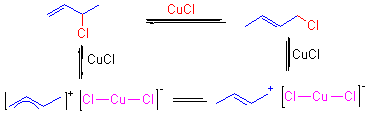
采用一价铜盐为催化剂、二甲基甲酰胺为溶剂, 在均相体系中催化3-氯-1-丁烯异构化生成1-氯-2-丁烯. 考察了溶剂、反应温度、催化剂种类和加入量对反应的影响, 研究发现反应温度和催化剂的加入量对异构化反应有较大影响.在最优条件3-氯-1-丁烯1 mL, 二甲基甲酰胺 9 mL, CuCl 0.10 g, 60 ℃反应5 h, 产物和原料的浓度比为3.88 mmol·L-1. 采用在线红外光谱对反应过程进行监测, 检测到有红外吸收峰在反应过程中先增加后减少的变化过程, 提出了可能的反应机理.

本文引用格式

董建勋 , 阎智峰 , 石玉坤 , 胡晓静 , 丁真贞 , 赵伟玲 , 宋娟娟 , 黄唯平 . 氯化亚铜催化3-氯-1-丁烯异构为1-氯-2-丁烯研究[J]. 有机化学, 2012 , 32(04) : 794 -798 . DOI: 10.6023/cjoc1109212

Abstract

The isomerization of 3-chloro-1-butene to crotyl chloride was carried out in the homogeneous catalytic system containing cuprous salt and dimethylformamide. Factors such as solvent, temperature, and content of catalyst that influence the reaction were investigated. The type of solvent and content of catalyst had great effect on the isomerization. Equilibrium constant of the title reaction reached 3.88, which was kept for 5 h at 60 ℃ under the optimal condition. The process of isomerization was monitored with in-situ FTIR-ATR and the possible reaction mechanism was suggested in this paper.

参考文献

[1] Xu, K.-X. Handbook of Organic Chemical Materials and Intermediates, Liaoning Petrochemical Engineering Technical Information Master Station, Shenyang, 1989, p. 60 (in Chinese). (徐克勋, 有机化工原料及中间体便览, 辽宁省石油化工技术情 报总站, 沈阳, 1989, p. 60.)  

[2] Kharasch, M. S.; Margolis, E. T.; Mayo, F. R. J. Org. Chem. 1936, 1, 393.  

[3] Mascavage, L. M.; Dalton, D. R. Tetrahedron Lett. 1991, 32, 3461.  

[4] DeWolfe, R. H.; Young, W. G. Chem. Rev. 1956, 56, 753.  

[5] Hemmingson, J. A. J. Chem. Soc. B 1971, 1347.

[6] Dittmer, D. C.; Marcantonio, A. F. J. Org. Chem. 1964, 29, 3473.  

[7] Winstein, S.; Young, W. G. J. Am. Chem. Soc. 1936, 58, 104.  

[8] Kharasch, M. S.; Kritchevsky, J.; Mayo, F. R. J. Org. Chem. 1937, 2, 489.  

[9] Lane, J. F.; Fentress, J.; Sherwood Jr, L. T. J. Am. Chem. Soc. 1944, 66, 545.  

[10] Yang, L.; Houser, R. P. Inorg. Chem. 2006, 45, 9416.  

[11] Chadha, S.; Nelson, W. H.; Emrich, R.; Lindesmith, E. Appl. Spectrosc. 1993, 47, 475.  

[12] Lu, M.; Wang, S.-W.; Li, J. J. Nanjing Univ. Sci. Technol. 2007, 31, 533 (in Chinese). (陆明, 汪水旺, 李剑, 南京理工大学学报, 2007, 31, 533.)

[13] Braude, E. A. Quart. Rev. 1950, 4, 419.

[14] Young, W. G.; Winstein, S.; Goering, H. L. J. Am. Chem. Soc. 1951, 73, 1958.  

[15] Puentes, E.; Mamalis, I.; Noels, A. F. J. Catal. 1983, 82, 365.  

[16] Mamalis, I.; Grandjean, J.; Noels, A. F. Catal. Today 1987, 1, 59.  

[17] Cristol, S. J.; Lee, G. A. J. Am. Chem. Soc. 1969, 91, 7554.  

[18] Schei, S. H.; Klaeboe, P. Acta Chem. Scand. A 1983, 37, 315.

[19] Schei, S. H. J. Mol. Struct. 1984, 118, 319.  

[20] Crowder, G. A.; Smyrl, N. J. Mol. Struct. 1971, 10, 373.  

[21] Klemperer, W.; Rice, S. A.; Berry, R. S. J. Am. Chem. Soc. 1957, 79, 1810.  
文章导航

/