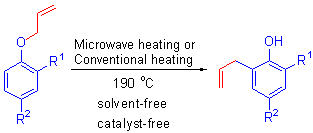
[1] Liu, Z. H.; Qu, H. C.; Gu, X. Y.; Lee, K. S.; Bryan, G.; Kumirov, V. K.; Hruby, V. J. Tetrahedron Lett. 2010, 51(27), 3518.
[2] Bruder, M.; Smith, S. J.; Blake, A. J.; Moody, C. J. Org. Biomol. Chem. 2009, 7(10), 2127.

[3] Camp, J. E.; Craig, D. Tetrahedron Lett. 2009, 50(26), 3503.
[4] Biswas, S.; Maiti, S.; Jana, U. Eur. J. Org. Chem. 2010, 41(39), 2861.
[5] Ollevier, T.; Mwene-Mbeja, T. M. Tetrahedron Lett. 2006, 47(24), 4051.
[6] Hiersemann, M.; Abraham, L. Eur. J. Org. Chem. 2002, 2002(9), 1461.
[7] Wang, S. L.; Cheng, C.; Gong, F.; Wu, F. Y.; Jiang, B.; Zhou, J. F.; Tu, S. J. Chin. J. Chem. 2011, 29, 2101.
[8] Andrade, M. M. J. Comb. Chem. 2010, 12(2), 245.
[9] Ye, P.; Sargent, K.; Stewart, E.; Liu, J. F.; Yohannes, D.; Yu, L. B. J. Org. Chem. 2006, 71(8), 3137.
[10] Gao, R.; Canney, D. J. J. Org. Chem. 2010, 75(21), 7451.
[11] Chai, H. S.; Lam, Y. L. J. Comb. Chem. 2010, 12(2), 286.
[12] Chebanov, V. A.; Muravyova, E. A.; Desenko, S. M.; Musatov, V. I.; Knyazeva, I. V.; Shishkina, S. V.; Shishkin, O. V.; Kappe, C. O. J. Comb. Chem. 2006, 8(3), 427.
[13] Yamashitaa, H.; Mitsukuraa, Y.; Kobashia, H.; Hirokia, K.; Sugiyamaa, J. I.; Onishib, K.; Sakamotoc, T. Appl. Catal., A 2010, 381(1~2), 145.
[14] Yamamoto, T.; Enokida, H.; Fujimoto, M. Green Chem. 2003, 5(6), 690.
[15] Schobert, R.; Gordon, G. J.; Mullen, G.; Stehle, R. Tetrahedron Lett. 2004, 45(6), 1121.
[16] Chen, X. X.; Xu, P.; Xia, Z. N. Chemistry 2009, (8), 674 (in Chinese). (陈新秀, 徐盼, 夏之宁, 化学通报, 2009, (8), 674.)
[17] Pincock, A. L.; Pincock, J. A.; Stefanova, R. J. Am. Chem. Soc. 2002, 124(33), 9768.
[18] Willem, A. L. V. O.; Garreth, L. M.; Lee, G. M.; Samuel, K.; Simon, S. M.; Natalie, T.; Charles, B. D. K. Tetrahedron 2005, 61(32), 7746.