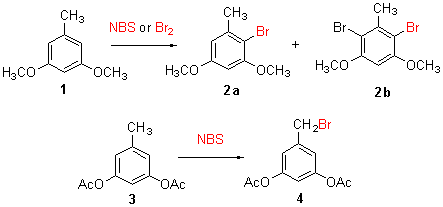
3,5-二甲氧基甲苯在偶氮二异丁腈的存在下与N-溴代丁二酰亚胺(NBS)反应, 产物不是3,5-二甲氧基苄溴, 而是2-溴-3,5-二甲氧基甲苯和2,6-二溴-3,5-二甲氧基甲苯. 同样条件下, 3,5-二乙酰氧基甲苯与NBS 反应则生成3,5-二乙酰氧基苄溴. GAUSSIAN 03 计算的结果表明, 3,5-二甲氧基甲苯中苯环碳原子上的电荷密度高于侧链上碳原子上的电荷密度, 因此溴自由基更容易取代苯环上的氢, 而3,5-二乙酰氧基甲苯的情况恰好相反, 故产物是3,5-二乙酰氧基苄溴.
顾烨
,
石洪卫
,
陈丽媛
,
沈永嘉
. 3,5-二烷氧基甲苯的溴化反应研究[J]. 有机化学, 2012
, 32(01)
: 174
-177
.
DOI: 10.6023/cjoc1106221
When 3,5-dimethoxy-toluene reacted with N-bromosuccinimide (NBS) in the presence of azobisisobutyronitrile, the product was not 3,5-dimethoxy benzylbromide, but a mixture of 2-bromo-3,5-dimethoxy-toluene and 2,6-dibromo-3,5- dimethoxy-toluene. Under the same conditions, 3,5-diacetoxy-toluene reacted with NBS to generate 3,5-diacetoxy-benzyl bromide. The charge density distributions calculated by GAUSSIAN 03 indicated that the charge density of carbon atom of benzene ring in 3,5-dimethoxy-toluene was higher than the one of the carbon atom of the side chain. Thus, bromine radical was easy to replace the hydrogen in the ring. While the charge density distributions of 3,5-diacetoxy toluene was quite the opposite, hence, the product was 3,5-diacetoxy-benzyl bromide.