研究论文

铜绿假单胞菌PAO1III型分泌系统新型抑制剂的合成和生物活性研究

  • 张成芳 ,
  • 吴小刚 ,
  • 李燕 ,
  • 梁翠荣 ,
  • 车亦舟 ,
  • 顾玲玲 ,
  • 任杰 ,
  • 胡昆 ,
  • 孙小强 ,
  • Ching-Hong Yang ,
  • 陈新
展开
  • a 常州大学制药与生命科学学院 常州 213164;
    b Department of Biological Sciences, University of Wisconsin-Milwaukee, Wisconsin 53211, USA;
    c 中国农业大学植物病理系 北京 100193;
    d 常州大学石油化工学院 常州 213164

收稿日期: 2013-02-26

  修回日期: 2013-04-01

  网络出版日期: 2013-04-08

基金资助

国家自然科学基金(No.21272029)和江苏省“333高层次人才培养工程”资助项目.

Synthesis and Bioactivity of Novel Inhibitors for Type III Secretion System of Pseudomonas aeruginosa PAO1

  • Zhang Chengfang ,
  • Wu Xiaogang ,
  • Li Yan ,
  • Liang Cuirong ,
  • Che Yizhou ,
  • Gu Lingling ,
  • Ren Jie ,
  • Hu Kun ,
  • Sun Xiaoqiang ,
  • Yang Ching-Hong ,
  • Chen Xin
Expand
  • a School of Pharmaceutical and Life Science, Changzhou University, Changzhou 213164;
    b Department of Biological Sciences, University of Wisconsin-Milwaukee, Wisconsin 53211, USA;
    c Department of Plant Disease, China Agricultural University, Beijing 100193;
    d School of Petrochemical Engineering, Changzhou University, Changzhou 213164

Received date: 2013-02-26

  Revised date: 2013-04-01

  Online published: 2013-04-08

Supported by

Project supported by the National Natural Science Foundation of China (No.21272029) and the "333 High-level talent training program" of Jiangsu Province.

摘要

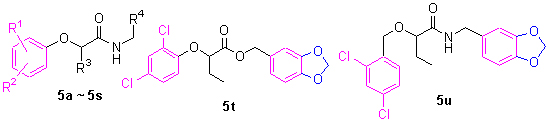
铜绿假单胞菌PAO1是一种革兰氏阴性机会性人类病原菌, 易感染免疫受损的人群.III型分泌系统(Type three secretion system, T3SS)是其主要的致病因子.T3SS抑制剂的策略是抑制铜绿假单胞菌表达及分泌毒力蛋白, 阻止其对宿主细胞的侵染.在一种已知T3SS抑制剂的结构基础上, 设计和合成了20种α-苯氧基酰胺新衍生物, 系统研究了它们的构效关系, 研究表明有5种新衍生物对铜绿假单胞菌的一个效应子编码基因exoS的表达具有明显抑制作用.其中N-(2-吡啶基甲基)-2-(2,4-二氯苯氧)-丁酰胺(5r)的活性强于已知的抑制剂MBX1641, 并具有很好的水溶性.
本文引用格式

张成芳 , 吴小刚 , 李燕 , 梁翠荣 , 车亦舟 , 顾玲玲 , 任杰 , 胡昆 , 孙小强 , Ching-Hong Yang , 陈新 . 铜绿假单胞菌PAO1III型分泌系统新型抑制剂的合成和生物活性研究[J]. 有机化学, 2013 , 33(06) : 1309 -1318 . DOI: 10.6023/cjoc201302021

Abstract

Pseudomonas aeruginosa PAO1 is a Gram-negative, opportunistic bacterial human pathogen which infects immunocompromised individuals.The bacterium carries a type III secretion system (T3SS) as a major virulence determinant.The strategy of T3SS inhibitors is to prevent the bacterium from injecting effector proteins into the host, and causing a change in the pathophysiology of the host cells.Based on the structure of a known T3SS inhibitor of P.aeruginosa, 20 new α-phenoxyacetamide derivatives have been designed and synthesized, and the structure-activity relationship results for these new derivatives have been discussed.Five derivatives have shown strong inhibitory effect against exoS gene expression of P.aeruginosa, and among them, N-(2-pyridylmethyl)-2-(2,4-dichlorophenoxy)-butanamide (5r) has not only exhibited stronger potency than the known T3SS inhibitor, but also better solubility in aqueous solution.

参考文献

[1] Gould, I.M.Int. J. Antimicrob. Agents 2009, 34(Suppl.3), S2.
[2] Keyser, P.; Elofsson, M.; Rosell, S.; Wolf-Watz, H.J.Intern.Med. 2008, 264, 17.
[3] Ghosh, P.Microbiol.Mol.Biol.Rev.2004, 68, 771.
[4] Engel, J.; Balachandran, P.Curr.Opin.Microbiol.2009, 12, 61.
[5] Izore, T.; Job, V.; Dessen, A. Structure 2011, 19, 603.
[6] Hung, D.T.; Shakhnovich, E.A.; Pierson, E.; Mekalanos, J.J.Science 2005, 310, 670.
[7] Muschiol, S.; Bailey, L.; Gylfe, A.; Sundin, C.; Hultenby, K.; Bergstom, S.; Elofsson, M.; Wolf-Wate, H.; Normark, S.; Henriques-Normark, B.Proc.Natl.Acad.Sci.U.S.A.2006, 103, 14566.
[8] Hudson, D.L.; Layton, A.N.; Field, T.R.; Bowen, A.J.; Wolf-Watz, H.; Elofsson, M.; Stevens, M.P.; Galyov, E.E.An.Agents Chemother. 2007, 51, 2631.
[9] Poole, K.Clin.Microbiol.Infect. 2004, 10, 12.
[10] Hauser, A.R.Nat.Rev.Microbiol.2009, 7, 654.
[11] Engel, J.; Balachandran, P.Curr.Opin.Microbiol. 2009, 12, 61.
[12] Aiello, A.; Williams, J.D.; Majgier-Baranowska, H.; Patel, I.; Peet, N.P.; Huang, J.; Lory, S.; Bowlin, T.L.; Moir, D.T.Antimicrob. Agents Chemother.2010, 54, 1988.
[13] Pu, Y.J.; Vaid, R.K.; Boini, S.K.; Towsley, R.W.; Doecke, C.W.; Mitchell, D.Org.Proc.Res.Dev.2009, 13, 310.
[14] Moir, D.T.; Aiello, D.; Peet, N.P.; Williams, J.D.; Torham, M.WO 2013010089, 2013[Chem.Abstr.2013, 158, 205450].
[15] Grabouska, E.; Arct, J.; Eckstein, Z.Rocz.Chem.1969, 43, 715.
[16] Winternitz, P.DE 2635327, 1977[Chem.Abstr.1977, 87, 67967].
[17] Akhtar, T.; Hameed, S.; Al-Masoudi, N.A.; Loddo, R.; La Colla, P.Acta Pharm. 2008, 58, 135.
[18] Duintijer, E.; Jonsson, A.Acta Chem.Scand. 1954, 8, 1493.
[19] Tarasiuk, B.Chemia 2006, 61, 171.
[20] Rao, V.R.; Reddy, G.V.; Yadla, R.; Narsaiah, B.; Rao, P.S.ARKIVOC 2005, 3, 211.
[21] Hayashi, K.; Tan, X.; Zheng, N.; Hatate, T.; Kimura, Y.; Kepinski, S.; Nozaki, H.Proc.Natl.Acad.Sci.U.S.A.2008, 105, 5632.
[22] Moir, D.T.; Aiello, D.; Peet, N.P.; Williams, J.D.; Torham, M.WO 2013010082, 2013[Chem.Abstr.2013, 158, 205446].
[23] Yamazaki, A.; Li, J.; Zeng, Q.; Khokhani, D.; Hutchins, W.; Yost, A.; Biddle, E.; Toone, E T.; Chen, X.; Yang, C.H.Antimiciob.Agents Chemother. 2012, 56, 36.
文章导航

/