2-芳氨基-3-羟乙基喹唑啉-4(3H)-酮衍生物的合成及生物活性
收稿日期: 2013-11-29
修回日期: 2013-12-19
网络出版日期: 2014-01-03
基金资助
贵州省自然科学联合基金(No. LKK[2013]03)资助项目.
Synthesis and Biological Properties of 3-(2-Hydroxyethyl)-2-(phenylamino)quinazolin-4(3H)-ones
Received date: 2013-11-29
Revised date: 2013-12-19
Online published: 2014-01-03
Supported by
Project supported by the Natural Science Mutual Funds of Guizhou Province (No. LKK[2013]03).
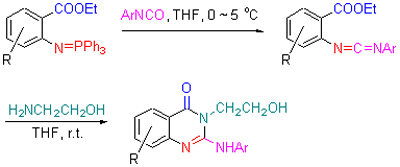
以取代2-氨基苯甲酸(1)为原料,经系列反应合成关键中间体β-乙氧酰基膦亚胺(4),再与芳基异氰酸酯、乙醇胺进行三组份串联的氮杂-Wittig反应,合成了一系列2-芳氨基-3-羟乙基-4(3H)-喹唑啉酮衍生物6. 目标分子的结构通过IR,1H NMR,MS和元素分析确证,并进一步测试了目标化合物对烟草青枯菌的室内抑菌活性. 结果表明,虽然所有化合物的抗菌活性抑制率均低于参照药物噻菌铜,但若喹唑啉酮母环附加有取代基时,化合物的抑菌活性得到显著的提高. 由此可见,对喹唑啉酮母环进行修饰也不乏是一种改进其生物活性的有效途径.
关键词: 喹唑啉-4(3H)-酮; 氮杂-Wittig反应; 合成; 杀菌活性
杨绪红 , 王翔 , 吴鸣虎 . 2-芳氨基-3-羟乙基喹唑啉-4(3H)-酮衍生物的合成及生物活性[J]. 有机化学, 2014 , 34(5) : 1015 -1020 . DOI: 10.6023/cjoc201311046
Key intermediate β-ethoxycarbonyl iminophosphorance (4), which was prepared from starting material substituted 2-aminobenzoic acid (1), was reacted with aryl isocyanates, ethanolamine by a three-component tandem aza-Wittig reaction to obtain a series of 2-arylamino-3-hydroxyethyl-4(3H)-quinazolinone derivatives 6. The structures of the target products were confirmed by IR, 1H NMR, MS and elemental analysis. The antibacterial activities of compounds 6 in vitro against tobacco bacterial wilt were further tested. The bioassay of the compounds 6 showed that the inhibitory activities of all the compounds were lower than the reference drug thiediazole copper. However, the antibacterial activity was significantly enhanced when the parent quinazolinone rings of the compounds 6 are substituted. Thus it can be seen that decoration of the parent quinazolinone ring of the compounds 6 can be regard as a kind of effective way of improving their biological property.
[1] Kumar, V.; Kumar Tewary, D.; Desikachar Ravindranath, S.; Shanker, A. Food Chem. Toxicol. 2004, 42, 423.
[2] Berg, G. L. Farm Chemicals Handbook, Meister Publishing Company, Willoughby OH, 1986.
[3] Russell, P.; Percival, A.; Coltman, P.; Green, D. In Brighton Crop Protection Conference, Pests and Diseases, Vol. 1, Farnham, UK, 1992, p. 411.
[4] Huapaya, L. V. Am. J. Psychiatry 1979, 136, 985.
[5] Liang, Y.; Ding, M.-W.; Liu, Z.-J.; Liu, X.-P. Synth. Commun. 2003, 33, 2843.
[6] Ding, M. W.; Yang, S. J.; Chen, Y. F. Chin. J. Org. Chem. 2004, 24, 923 (Chinese).
(丁明武, 杨尚君, 陈云峰, 有机化学, 2004, 24, 923.)
[7] Yang, X.; Wu, M.; Ding, M. Chin. J. Org. Chem. 2010, 30, 1032 (in Chinese).
(杨绪红, 吴鸣虎, 丁明武, 有机化学, 2010, 30, 1032.)
[8] Gao, X. W.; Cai, X. J.; Yan, K.; Gao, L. L.; Wang, H. Y.; Chen, Z.; Song, B. A. Chin. J. Org. Chem. 2008, 28, 1785 (Chinese)
(高兴文, 蔡学建, 严凯, 高丽丽, 王和英, 陈卓, 宋宝安, 有机化学, 2008, 28, 1785.)
[9] Wang, X.; Li, P.; Li, Z.; Yin, J.; He, M.; Xue, W.; Chen, Z.; Song, B. J. Agric. Food Chem. 2013, 61, 9575.
[10] Yang, X. H.; Wu, M. H.; Sun, S. F.; Ding, M. W.; Xie, J. L.; Xia, Q. H. J. Heterocycl. Chem. 2008, 45, 1365.
[11] Vlasenko, A. F.; Mandrichenko, B. E.; Rogul'chenko, G. K.; Sinyak, R. S.; Mazur, I. A.; M., K. P. Khim. Geterotsikl. Soedin. 1976, 12, 834.
[12] Ding, M.-W.; Zeng, G.-P.; Wu, T.-J. Synth. Commun. 2000, 30, 1599.
/
| 〈 |
|
〉 |