
一种可视化检测硫化氢的苯并噻唑类荧光增强型探针
收稿日期: 2014-04-09
修回日期: 2014-05-05
网络出版日期: 2014-06-03
基金资助
国家自然科学基金(No. 51173060)资助项目.
A Benzothiazole-Derived Fluorescence Enhancement Probe for Visual Detection of H2S
Received date: 2014-04-09
Revised date: 2014-05-05
Online published: 2014-06-03
Supported by
Project supported by the National Natural Science Foundation of China (No. 51173060).
范方禄 , 靖金球 , 陈雪梅 . 一种可视化检测硫化氢的苯并噻唑类荧光增强型探针[J]. 有机化学, 2014 , 34(10) : 2178 -2183 . DOI: 10.6023/cjoc201404015
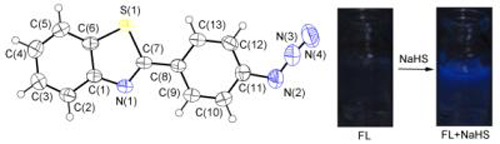
A benzothiazole-derived fluorescence enhancement probe (FL) for the detection of H2S was synthesized and characterized by employing azide group as the recognition unit, and its spectral properties had been researched. The results showed that FL exhibited relatively good sensitivity and selectivity to H2S as well as fast response, it also had strong anti-interference ability and low cytotoxicity, the detection limit of H2S was estimated to be 8.78×10⁻⁷ mol·L-1, and the detection of H2S in living HeLa cells and various water samples indicated that it had potential application value.
Key words: H2S; fluorescent probe; azide group; visualization
[1] Li, L.; Rose, P.; Moore, P. K. Annu. Rev. Pharmacol. Toxicol. 2011, 51, 169.
[2] Kabil, O.; Banerjee, R. J. Biol. Chem. 2010, 285, 21903.
[3] Lefer, D. J. Proc. Natl. Acad. Sci. U. S. A. 2007, 104, 17907.
[4] Blackstone, E.; Morrison, M.; Roth, M. B. Science 2005, 308, 587.
[5] Huang, B.; Chen, Y.-C.; Guo, Z.-J.; He, W.-J. Chin. J. Inorg. Chem. 2013, 29, 2283 (in Chinese).
(黄彬, 陈韵聪, 郭子建, 何卫江, 无机化学学报, 2013, 29, 2283.)
[6] Liu, J.; Sun, Y.; Zhang, J.; Yang, T.; Cao, J.; Zhang, L.; Guo, W. Chem. Eur. J. 2013, 19, 4717.
[7] Kumar, N.; Bhalla, V.; Kumar, M. Coord. Chem. Rev. 2013, 257, 2335.
[8] Jiang, Y.; Wu, Q.; Chang, X. Talanta 2014, 121, 122.
[9] Zhang, J.; Guo, W. Chem. Commun. 2014, 50, 4214.
[10] Mao, G.; Wei, T.; Wang, X.; Huan, S.; Lu, D.; Zhang, J.; Zhang, X.; Tan, W.; Shen, G.; Yu, R. Anal. Chem. 2013, 85, 7875.
[11] Chen Y.; Zhu, C.; Yang, Z.; Chen, J.; He, Y.; Jiao, Y.; He, W.; Qiu, L.; Cen, J.; Guo, Z. Angew. Chem., Int. Ed. 2013, 52, 1688.
[12] Wang, X.; Sun, J.; Zhang, W.; Ma, X.; Lv, J.; Tang, B. Chem. Sci. 2013, 4, 2551.
[13] Lippert, A. R.; New, E. J.; Chang, C. J. J. Am. Chem. Soc. 2011, 133, 10078.
[14] Peng, H.; Cheng, Y.; Dai, C.; King, A. L.; Predmore, B. L.; Lefer, D. J.; Wang, B. Angew Chem., Int. Ed. 2011, 50, 9672.
[15] Montoya, L. A.; Pluth, M. D. Chem. Commun. 2012, 48, 4767.
[16] Zhou, G.; Wang, H.; Ma, Y.; Chen, X. Tetrahedron 2013, 69, 867.
[17] Li, W.; Sun, W.; Yu, X.; Du, L.; Li M. J. Fluoresc. 2013, 23, 181.
[18] Wan, Q.; Song, Y.; Li, Z.; Gao, X.; Ma, H. Chem. Commun. 2013, 49, 502.
[19] Hartman, M. C. T.; Dcona. M. M. Analyst 2012, 137, 4910.
[20] Yu, F.; Li, P.; Song, P.; Wang, B.; Zhao, J.; Han, K. Chem. Commun. 2012, 48, 2852.
[21] Huang, Q.; Yang, X.; Li, H. Dyes Pigm. 2013, 99, 871.
[22] Yang, Y.; Li, B.; Zhang, L.; Guan, Y. J. Lumin. 2014, 145, 895.
[23] Shortreed M, Kopelman R, Kuhn M, Hoyland, B. Anal. Chem. 1996, 68, 1414.
[24] Shi, D. F.; Bradshaw, T. D.; Wrigley, S.; McCall, C. J.; Lelieveld, P.; Fichtner, I.; Stevens, M. F. G. J. Med. Chem. 1996, 39, 3375.
[25] Sheldrick, G. M. SHELXS-97, Program for the Solution of Crystal Structures, University of Göttingen, Germany, 1997.
[26] Sheldrick, G. M. SHELXL-97, Program for the Refinement of Crystal Structures, University of Göttingen, Germany, 1997.
[27] Liu, Y.; Fei, Q.; Shan, H.; Cui, M.; Liu, Q.; Feng, G.; Huan, Y. Analyst 2014, 139, 1868.
/
| 〈 |
|
〉 |

