
四丁基碘化铵催化的氧化脱氢反应选择性合成Z-β-酰胺基烯酮
收稿日期: 2016-01-27
修回日期: 2016-02-26
网络出版日期: 2016-03-18
基金资助
山西省科技攻关(No.20130313015-2)资助项目.
Tetra-butyl Ammonium Iodide-Catalyzed Oxidative Dehydrogenation for the Selective Synthesis of Z-β-Acylamino Enones
Received date: 2016-01-27
Revised date: 2016-02-26
Online published: 2016-03-18
Supported by
Project supported by the Science and Technology Key Project of Shanxi Province (No. 20130313015-2).
赵玉英 , 王二兵 , 王颖莉 . 四丁基碘化铵催化的氧化脱氢反应选择性合成Z-β-酰胺基烯酮[J]. 有机化学, 2016 , 36(7) : 1681 -1685 . DOI: 10.6023/cjoc201601034
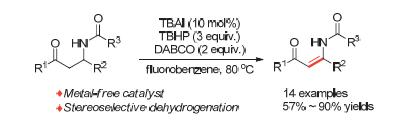
A tetra-butyl ammonium iodide (TBAI)-catalyzed oxidative dehydrogenation of β-acylamino ketones for the synthesis of Z-β-acylamino enones has been developed. The present method has some distinct advantages such as mild conditions, high selectivity, readily available starting materials, and broad substrate scope. This method is also the first example of oxidative dehydrogenation with the use of TBAI/TBHP (tert-butyl hydroperoxide) oxidation system.
Key words: iodide; catalytic dehydrogenation; β-acylamino enones; stereoselectivity
[1] Yet, L. Chem. Rev. 2003, 103, 4283.
[2] (a) Moore, R. E.; Bartolini, G. J. Am. Chem. Soc. 1981, 103, 2491. (b) Kagamizono, T.; Sakai, N.; Arai, K.; Kobinata, K.; Osada, H. Tetrahedron Lett. 1997, 38, 1223.
(c) Toske, S. G.; Jensen, P. R.; Kauffman, C. A.; Fencial, W. Tetrahedron 1998, 54, 13459.
(d) Davyt, D.; Entz, W.; Fernandez, R.; Mariezcurrena, R.; Mombru, A. W.; Saldana, J.; Dominguez, L.; Coll, J.; Manta, E. J. Nat. Prod. 1998, 61, 1560.
[3] Salama, N. N.; Eddington, N. D.; Payne, T. L.; Wilson, K. R.; Scott, K. R. Curr. Med. Chem. 2004, 11, 2093.
[4] (a) Xiao, D.; Zhang, Z.; Zhang, X. Org. Lett. 1999, 1, 1679.
(b) Burk, M. J. Acc. Chem. Res. 2000, 33, 363.
(c) Sibi, M. P.; Asano, Y. J. Am. Chem. Soc. 2001, 123, 9708.
(d) Blaser, H.-U.; Malan, C.; Pugin, B.; Spindler, F.; Steiner, H.; Studer, M. Adv. Synth. Catal. 2003, 345, 103.
[5] (a) Huang, K.; Zhang, X.; Geng, H.; Li, S.-K.; Zhang, X. ACS Catal. 2012, 2, 1343.
(b) Geng, H.; Huang, K.; Sun, T.; Li, W.; Zhang, X.; Zhou, L.; Wu, W.; Zhang, X. J. Org. Chem. 2011, 76, 332.
[6] (a) Hommes, P.; Berlin, S.; Reissig, H.-U. Synthesis 2013, 3288.
(b) Shabana, R.; Rasmussen, J. B.; Lawesson, S.-O. Tetrahedron 1981, 37, 1819.
[7] (a) Gao, D.; Back, T. G. Chem. Eur. J. 2012, 18, 14828.
(b) Li, X.; Huang, L.; Chen, H.; Wu, W.; Huang, H.; Jiang, H. Chem. Sci. 2012, 3, 3463.
[8] Gayon, E.; Szymczyk, M.; Gérard, H.; Vrancken, E.; Campagne, J.-M. J. Org. Chem. 2012, 77, 9205.
[9] (a) Panda, N.; Jena, A. K.; Raghavender, M. ACS Catal. 2012, 2, 539.
(b) Lee, J. M.; Ahn, D.-S.; Jung, D. Y.; Lee, J.; Do, Y.; Kim, S. K.; Chang, S. J. Am. Chem. Soc. 2006, 128, 12954.
(c) Gogoi, J.; Gogoi, P.; Boruah, R. C. Eur. J. Org. Chem. 2014, 3483.
(d) Panda, N.; Mothkuri, R. J. Org. Chem. 2012, 77, 9407.
(e) Ding, R.; Zhang, Q.-C.; Xu, Y.-H.; Loh, T.-P. Chem. Commun. 2014, 50, 11661.
[10] (a) Liu, D.; Lei, A. Chem. Asian J. 2015, 10, 806.
(b) Wu, X.; Gong, J.; Qi, X. Org. Biomol. Chem. 2014, 12, 5807. (c) Finkbeiner, P.; Nachtsheim, B. J. Synthesis 2013, 45, 979.
[11] (a) Ma, L.; Wang, X.; Yu, W.; Han, B. Chem. Commun. 2011, 47, 11333.
(b) Chen, J.; Shao, Y.; Zheng, H.; Cheng, J.; Wan, X. J. Org. Chem. 2015, 80, 10734.
(c) Xie, J.; Jiang, H.; Cheng, Y.; Zhu, C. Chem. Commun. 2012, 48, 979.
[12] Gao, W.-C.; Hu, F.; Huo, Y.-M.; Chang, H.-H.; Li, X.; Wei, W.-L. Org. Lett. 2015, 17, 3914.
[13] The Z-isomer of products are confirmed by two evidences: (1) in H NMR spectrum, due to the intramolecular hydrogen bond formed between the amide group and the carbonyl group, the chemical shift of amide protons moves to the downfield relative to free N—H of amide, and in our reported products, the chemical shifts of N—H are all at about δ 10, different from normal chemical shifts of amide bond (δ 5~7); (2) According to Ref. [9e], the known structure of Z-isomer in 1a is consistent with our NMR data.
[14] Nicolaou, K. C.; Mathison, C. J. N. Angew. Chem., Int. Ed. 2005, 44, 5992.
[15] http://www.chem.wisc.edu/areas/reich/pkatable/index.htm
[16] Baidya, M.; Mayr, H. Chem. Commun. 2008, 1792.
[17] Sugiura, M.; Kumahara, M.; Nakajima, M. Chem. Commun. 2009, 3585.
/
| 〈 |
|
〉 |

