
环苯基六炔烃的制备:脱Ph2P(O)/分子内Eglington偶联环化反应
收稿日期: 2017-08-07
修回日期: 2017-09-28
网络出版日期: 2017-10-20
基金资助
湖南省教育厅一般项目(No.17C0629)、湖南科技大学博士启动基金(No.E51693)、湖南科技大学理论有机化学与功能分子教育部重点实验室开放基金(No.E21630)和国家自然科学基金(No.21402048)资助项目.
Synthesis of Cyclic Phenyl Polyynes: Ph2P-Deprotection/Intramolecular Eglington Coupling Cyclization
Received date: 2017-08-07
Revised date: 2017-09-28
Online published: 2017-10-20
Supported by
Project supported by the General Project of Hunan Education Department (No. 17C0629), the Doctoral Foundation of Hunan University of Science and Technology (No. E51693), the Open Foundation of Key Laboratory of Theoretical Organic Chemistry and Functional Molecule of Ministry of Education, Hunan University of Science and Technology (No. E21630) and the National Natural Science Foundation of China (No. 21402048).
彭丽芬 , 张思维 , 王丙昊 , 寻梦硕 , 唐子龙 , 焦银春 , 许新华 . 环苯基六炔烃的制备:脱Ph2P(O)/分子内Eglington偶联环化反应[J]. 有机化学, 2018 , 38(2) : 519 -525 . DOI: 10.6023/cjoc201708011
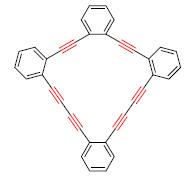
Ph2P (O)-deprotection/intramolecular Eglington coupling cyclization, proceeding in one-pot manner, can be applied to synthesize cyclic phenyl polyynes. Compared to Micheal M. Haley's stepwise desilylation/Eglington coupling reaction, the polar Ph2P (O) protecting group enabled facile seperation of product from remaining starting compound for their different polarity, and it also led to easy separation of target compound because the amont of by-products which showed similar Rf to target compound decreased. Furthermore, our one-pot reaction, avoiding the workup after Ph2P (O)-deprotection and reducing losses of materials, increased the yield of cyclic aromatic polyynes. This method showed some other outstanding features including easy synthesis of intermediates and mild reaction conditions.
[1] Diederich, F.; Stang, P. J.; Tykwinski, R. R. Acetylene Chemistry, Willey-VCH Verlag GmbH & CO. KgaA, Weinheim, 2005.
[2] Fischer, M.; Lieser, G.; Rapp, A.; Schnell, I.; Mamdouh, W.; Feyter, S. D.; Schryver, F. C.; Höger, S. J. Am. Chem. Soc. 2004, 126, 214.
[3] Wan, W. B.; Brand, S. C.; Pak, J. J.; Haley, M. M. Chem. -Eur. J. 2005, 6, 2044.
[4] Zhou, Q.; Carroll, P. J.; Swager, T. M. J. Org. Chem. 1994, 59, 1294.
[5] (a) Glaser, C. Chem. Ber. 1869, 2, 422.
(b) Hay, A. S. J. Org. Chem. 1962, 27, 3320.
(c) Eglinton, G.; McRae, W. Adv. Org. Chem. 1963, 4, 225.
(d) Vögtle, F.; Berscheid, R. Synthesis 1992, 58.
[6] Haley, M. M.; Bell, M. L.; English, J. J.; Johnson, C. A.; Weakley, T. J. R. J. Am. Chem. Soc. 1997, 119, 2956.
[7] Orita, A.; Taniguchi, H.; Otera, J. Chem. -Asian J. 2006, 1, 430.
[8] Peng, L. -F.; Xu, F.; Suzuma, Y.; Orita, A.; Otera, J. J. Org. Chem. 2013, 78, 12802.
[9] (a) Eglinton, G.; Galbraith, A. R. Chem. Ind. 1956, 737.
(b) Behr, O. M.; Eglinton, G.; Galbraith, A. R.; Raphael. R. A. J. Chem. Soc. 1960, 3614.
(c) Altmann, M.; Friedrich, J.; Beer, F.; Reuter, R.; Enkelmann, V.; Bunz, U. H. F. J. Am. Chem. Soc. 1997, 119, 1472.
[10] Orita, A.; Miyamoto, K.; Nakashima, M.; Ye, F. -G.; Otera, J. Adv. Synth. Catal. 2004, 346, 767.
[11] Peng, L. -F.; Xu, F.; Shinohara, K.; Orita, A.; Otera, J. Chem. Lett. 2014, 43, 1610.
/
| 〈 |
|
〉 |

