
2-芳基-3,4-二氢异喹啉类植物源抑菌剂的设计合成及构效关系研究
收稿日期: 2019-05-10
修回日期: 2019-06-02
网络出版日期: 2019-06-24
基金资助
国家自然科学基金(No.21702173)、中央高校基本科研业务费(No.2682016CX104)和四川省科技创新苗子工程(No.2682017QY04)资助项目.
Design, Synthesis and Structure-Activity Relationships of Plant-Based 2-Aryl-3,4-dihydroisoquinolin-2-iums as Potential Antifungal Agents
Received date: 2019-05-10
Revised date: 2019-06-02
Online published: 2019-06-24
Supported by
Project supported by the National Natural Science Foundation of China (No. 21702173), the Fundamental Research Funds for the Central Universities (No. 2682016CX104) and the Miaozi Project of Scientific and Technological Innovation of Sichuan Province (No. 2018090).
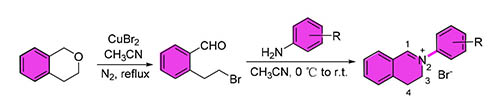
植物病原菌严重危及农作物的生产安全.为了寻找新型的抑菌剂,通过合理的分子拼接,将苯甲酸类和苯酚类药效团引入异喹啉的2-位,设计并合成了15个2-芳基-3,4-二氢异喹啉衍生物,利用核磁共振和高分辨质谱鉴定了化合物结构.初步离体抑菌结果显示,大部分化合物对11种受试植物病原菌都具有中等到显著的抑制活性,与阳性对照样(百菌清、多菌灵)相当.2-(3-乙氧羰基苯基)-3,4-二氢异喹啉溴化盐(4j)对水稻纹枯病菌的EC50为3.8495 mg·mL-1,优于对照样百菌清(4.6328 mg·mL-1).其中有5个化合物对小麦纹枯病菌的EC50(7.4583~15.4495 mg·mL-1)都优于百菌清(16.0137 mg·mL-1),其中2-(4-甲氧羰基苯基)-3,4-二氢异喹啉溴化盐(4f)最为显著,为植物源抑菌剂的开发提高了理论基础.
关键词: 2-芳基-3,4-二氢异喹啉; 植物源; 抑菌剂; 构效关系
陈伟 , 左怀龙 , 李玉新 , 刘江 , 周先礼 . 2-芳基-3,4-二氢异喹啉类植物源抑菌剂的设计合成及构效关系研究[J]. 有机化学, 2019 , 39(8) : 2317 -2322 . DOI: 10.6023/cjoc201905020
In order to discover more potent antifungal, a series of 2-aryl-3,4-dihydroisoquinolin-2-iums were reasonable designed and productive synthesized by introducing benzoic acid and phenol pharmacophores into the 2-position of isoquinoline. Their structures were identified by NMR and HRMS. The preliminary in vitro antifungal results showed that most of the title compounds exhibited moderate to significant inhibitory activities against various phytopathogenic fungi at 50 mg·mL-1, and were equal to controls (chlorothalonil, carbendazim). The concentration of 50% inhibition rate (EC50) of 2-(3-ethoxycarbonyl-phenyl)-3,4-dihydroisoquinolin-2-ium (4j) against R. solani was 3.8495 mg·mL-1, which was significantly superior to chlorothalonil (4.6328 mg·mL-1). All the EC50 values of 5 compounds (7.4583~15.4495 mg·mL-1) against R. cerealis were better than chlorothalonil (16.0137 mg·mL-1), and 2-(4-methoxycarbonylphenyl)-3,4-dihydroisoquinolin-2-ium (4f) is the best one. The present results provide valuable information for development of plant-based antifungal agents.
[1] Chen, W.; Li, Y. X.; Zhou, Y. Y.; Ma, Y.; Li, Z. M. Chin. Chem. Lett. 2019, DOI:10.1016/j.cclet.2019.04.072.
[2] Liang, R.; Li, X.; Yuan, W.; Jin, S.; Hou, S.; Wang, M.; Wang, H. J. Agric. Food Chem. 2018, 66, 9907.
[3] Hou, Z.; Zhu, L. F.; Yu, X. C.; Sun, M. Q.; Miao, F.; Zhou, L. J. Agric. Food Chem. 2016, 64, 2847.
[4] Eskola, M.; Altieri, A.; Galobart, J. World Mycotoxin J. 2018, 11, 277.
[5] Wu, Y. L.; Wang, D. L.; Guo, E. H.; Song, S.; Feng, J. T.; Zhang, X. Bioorg. Med. Chem. Lett. 2017, 27, 1284.
[6] Moss, S.; Ulber, L.; den Hoed, I. Crop Prot. 2019, 115, 13.
[7] Velioglu, Y. S.; Fikirdesici-Ergen, S.; Aksu, P.; Altindag, A. Tarim Bilim. Derg. 2018, 24, 245.
[8] Wei, Y. X.; Xu, X. Y.; Song, X. Curr. Org. Chem. 2017, 21, 1907.
[9] Mehta, S.; Sharma, K. Int. J. Pharma Sci. Res. 2016, 7, 4327.
[10] Ping, G.; Wang, Y.; Shen, L.; Wang, Y.; Hu, X.; Chen, J.; Hu, B.; Cui, L.; Meng, Q.; Li, C. Chem. Commun. 2017, 53, 7381.
[11] Ling, F.; Wu, Z. Q.; Jiang, C.; Liu, L.; Wang, G. X. J. Fish Dis. 2016, 39, 993.
[12] Lei, P.; Xu, Y.; Du, J.; Yang, X. L.; Yuan, H. Z.; Xu, G. F.; Ling, Y. Bioorg. Med. Chem. Lett. 2016, 26, 2544.
[13] Yang, R.; Gao, Z. F.; Zhao, J. Y.; Li, W. B.; Zhou, L.; Miao, F. J. Agric. Food Chem. 2015, 63, 1906.
[14] Thebault, M.; Mueller, U.; Kandelbauer, A.; Zikulnig-Rusch, E.; Lammer, H. Eur. J. Wood Wood Prod. 2017, 75, 853.
[15] Liu, C. L.; Yang, J. C. Handbook of Modern Pesticide, Chemical Industry Press, Beijing, 2017 (in Chinese). (刘长令,杨吉春,现代农药手册,化学工业出版社,北京, 2017.)
[16] Zhou, M. Y.; Kong, S. S.; Zhang, L. Q.; Zhao, M.; Duan, J. A.; Ou-yang, Z.; Wang, M. Tetrahedron Lett. 2013, 54, 3962.
[17] Ma, Y. N.; Yang, X. J.; Pan, L.; Hou, Z.; Geng, H. L.; Song, X. P.; Miao, F.; Zhou, L. Chem. Pharm. Bull. 2013, 61, 204.
/
| 〈 |
|
〉 |

