基于硝基还原机理的一氧化碳荧光探针的开发及细胞成像研究
收稿日期: 2020-09-07
修回日期: 2020-10-06
网络出版日期: 2020-10-28
基金资助
国家自然科学基金(21672083); 国家自然科学基金(21877048); 国家自然科学基金(22077048); 广西大学启动基金(A3040051003); 广西省自然科学基金(2019GXNSFBA245068)
Development of a New Carbon Monoxide Fluorescent Probe Based on Nitro Reduction and Its Bioimaging Research in Living Cells
Received date: 2020-09-07
Revised date: 2020-10-06
Online published: 2020-10-28
Supported by
National Natural Science Foundation of China(21672083); National Natural Science Foundation of China(21877048); National Natural Science Foundation of China(22077048); Startup Fund of Guangxi University(A3040051003); Natural Science Foundation of Guangxi Province(2019GXNSFBA245068)
陈恩庆 , 唐永和 , 王蕾 , 任江波 , 林伟英 . 基于硝基还原机理的一氧化碳荧光探针的开发及细胞成像研究[J]. 有机化学, 2021 , 41(3) : 1200 -1206 . DOI: 10.6023/cjoc202009016
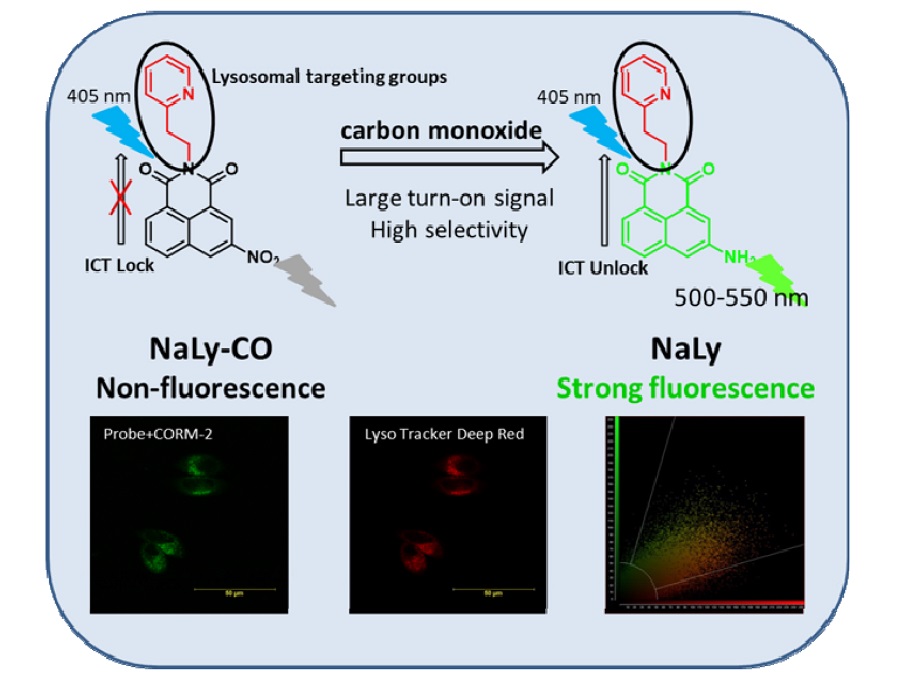
Carbon monoxide (CO), as an important cell signaling molecule, is involved in important physiological and pathological functions in organism. A new fluorescence enhanced CO fluorescent probe NaLy-CO was developed by using naphthalimide dye as fluorescence platform and nitro group as the recognition site. The results of spectrum test in solution showed that the fluorescent probe NaLy-CO had good selectivity and sensitivity to CO. The fluorescent probe NaLy-CO was successfully used to detect exogenous and endogenous CO in living HeLa cells by using confocal fluorescence imaging technology. In addition, the colocation imaging experiments showed that the fluorescent probe NaLy-CO could detect CO in the lysosome of living cells.
Key words: carbon monoxide; fluorescent probe; bioimaging; nitro; naphthalimide
| [1] | Prockop, L. D.; Chichkova, R. I. J. Neurol. Sci. 2007, 262, 122. |
| [2] | Sjostrand, T. J. Clin. Invest. 1949, 28, 201. |
| [3] | Brune, B.; Ullrich, V. Mol. Pharmacol. 1987, 32, 497. |
| [4] | Prabhakar, N. R.; Dinerman, J. L.; Agani, F. H.; Snyder, S. H. Proc. Natl. Acad. Sci. U. S. A. 1995, 92, 1994. |
| [5] | Paro, F. M.; Steiner, A. A.; Branco, L. G. S. J. Therm. Biol. 2001, 26, 339. |
| [6] | Sato, K.; Balla, J.; Otterbein, L.; Smith, R. N.; Brouard, S.; Lin, Y.; Csizmadia, E.; Sevigny, J.; Robson, S. C.; Vercellotti, G.; Choi, A. M.; Bach, F. H.; Soares, M. P. J. Immunol. 2001, 166, 4185. |
| [7] | Foresti, R.; Motterlini, R. Free Radical Res. 1999, 31, 459. |
| [8] | Heinemann, S. H.; Hoshi, T.; Westerhausen, M.; Schiller, A. Chem. Commun. 2014, 50, 3644. |
| [9] | Lee, I. T.; Luo, S.-F.; Lee, C.-W.; Wang, S.-W.; Lin, C.-C.; Chang, C.-C.; Chen, Y.-L.; Chau, L.-Y.; Yang, C.-M. Am. J. Pathol. 2009, 175, 519. |
| [10] | Ryter, S. W.; Choi, A. M. K. Transl. Res. 2016, 167, 7. |
| [11] | Wu, L.; Wang, R. Pharmacol. Rev. 2005, 57, 585. |
| [12] | Schroeder, R. A.; Ewing, C. A.; Sitzmann, J. V.; Kuo, P. C. Dig. Dis. Sci. 2000, 45, 2405. |
| [13] | Watts, C. Biochim. Biophys. Acta, Proteins Proteomics 2012, 1824, 14. |
| [14] | Zhao, H. Traffic 2012, 13, 1307. |
| [15] | Li, M.; Wang, Y.; Liu, G.; Lü, H.; Xing, G. Chin. J. Org. Chem., 2017, 37, 356. (in Chinese) |
| [15] | (李美含, 王宇童, 刘广建, 吕海娟, 邢国文, 有机化学, 2017, 37, 356.) |
| [16] | Dell'Angelica, E. C. FASEB J. 2000, 14, 1265. |
| [17] | Benito-Garagorri, D.; Puchberger, M.; Mereiter, K.; Kirchner, K. Angew. Chem., Int. Ed. 2008, 47, 9142. |
| [18] | Kitagishi, H.; Minegishi, S.; Yumura, A.; Negi, S.; Taketani, S.; Amagase, Y.; Mizukawa, Y.; Urushidani, T.; Sugiura, Y.; Kano, K. J. Am. Chem. Soc. 2016, 138, 5417. |
| [19] | Park, S. S.; Kim, J.; Lee, Y. Anal. Chem. 2012, 84, 1792. |
| [20] | Lv, B.; Xu, X.; Huang, D.; Wu, P.; Sheng, Z.; Liu, W.; Li, D.; Alharbi, N. S.; Zhang, K.; Wang, S. Chin. J. Org. Chem. 2018, 38, 3165. (in Chinese) |
| [20] | (吕卉, 徐学涛, 黄丹颖, 吴盼盼, 盛钊君, 刘文锋, 李冬利, Alharbi, N. S., 张焜, 王少华, 有机化学, 2018, 38, 3165.) |
| [21] | Li, Y.; Lü, Z.; Liu, M.; Xing, G. Chin. J. Org. Chem. 2016, 36, 962. (in Chinese) |
| [21] | (李杨洁, 吕子奇, 刘敏, 邢国文, 有机化学, 2016, 36, 962.) |
| [22] | Luo, X.; Chen, M.; Yang, Q. Acta Chim. Sinica 2020, 78, 373. (in Chinese) |
| [22] | (罗兴蕊, 陈敏文, 杨晴来, 化学学报, 2020, 78, 373.) |
| [23] | Wei, C.; Zhang, P.; Li, X. Chin. J. Org. Chem. 2019, 39, 3375. (in Chinese) |
| [23] | (魏超, 张平竹, 李小六, 有机化学, 2019, 39, 3375.) |
| [24] | Tafesh, A. M.; Weiguny, J. Chem. Rev. 1996, 96, 2035. |
| [25] | Wang, K.-R.; Qian, F.; Wang, X.-M.; Tan, G.-H.; Rong, R.-X.; Cao, Z.-R.; Chen, H.; Zhang, P.-Z.; Li, X.-L. Chin. Chem. Lett. 2014, 25, 1087. |
| [26] | Ma, C.; Wei, C.; Li, X.; Zheng, X.; Chen, B.; Wang, M.; Zhang, P.; Li, X. Dyes Pigm. 2019, 162, 624. |
/
| 〈 |
|
〉 |