一种荧光增强型甲醛荧光探针的合成及其性能研究
收稿日期: 2021-10-10
修回日期: 2021-12-06
网络出版日期: 2021-12-22
基金资助
国家自然科学基金(21672083); 国家自然科学基金(21877048); 国家自然科学基金(22077048); 国家自然科学基金(22104019); 广西省自然科学基金(2021GXNSFDA075003); 广西省自然科学基金(2019GXNSFBA245068); 广西省自然科学基金(AD21220061); 广西大学启动基金(A3040051003)
Synthesis and Study of Performance for An Enhanced Formaldehyde Fluorescent Probe
Received date: 2021-10-10
Revised date: 2021-12-06
Online published: 2021-12-22
Supported by
National Natural Science Foundation of China(21672083); National Natural Science Foundation of China(21877048); National Natural Science Foundation of China(22077048); National Natural Science Foundation of China(22104019); Natural Science Foundation of Guangxi Province(2021GXNSFDA075003); Natural Science Foundation of Guangxi Province(2019GXNSFBA245068); Natural Science Foundation of Guangxi Province(AD21220061); Startup Fund of Guangxi University(A3040051003)
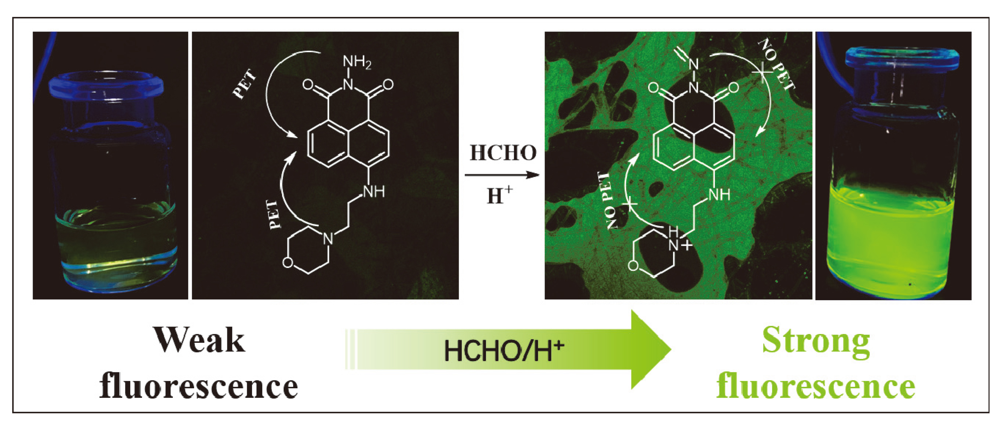
甲醛(FA)对环境和人们的身体健康息息相关, 例如曝露在环境中的FA被人体吸收后, 轻则会引起头痛、喉咙发炎等不适, 重则会损害人体重要器官进而引发诸如白血病、阿尔兹海默症等疾病. 针对环境中FA的快速检测, 开发了一个荧光增强性的FA探针HSU-FA. 该探针选用萘酰亚胺染料作为荧光平台, 以肼基基团作为识别FA的位点, 通过肼基基团与羰基缩合成腙的反应达到识别FA的效果. 通过测试条件优化得出, 在乙酸含量为30%测试条件下探针HSU-FA对FA的识别效果最佳. 通过紫外-可见吸收光谱可知, 在FA的作用下探针的吸收光谱发生显著增强现象. 通过荧光光谱测试得出, 该探针对FA具有突出的识别能力和响应速度. 此外, 该探针具有较强的抗光漂白能力, 能够在溶液状态下稳定存在. 在溶液中该探针与FA相互作用可以展示出不同的荧光强度, 显示出了较强的浓度依赖性. 更重要的是, 利用无纺布制备的FA检测卡实现了环境中FA的快速检测.
卢辉旭 , 唐永和 , 周红梅 , 林伟英 . 一种荧光增强型甲醛荧光探针的合成及其性能研究[J]. 有机化学, 2022 , 42(4) : 1163 -1169 . DOI: 10.6023/cjoc202110012
Formaldehyde (FA) is closely related to the environment and people’s health. For example, when FA is absorbed by the human body after exposure to the environment, it will cause discomfort such as headache and throat inflammation, or damage the vital organs of the human body and then cause diseases such as leukemia and Alzheimer's disease. For the rapid detection of FA in the environment, a fluorescent enhanced FA probe HSU-FA was developed. The probe uses naphthalimide dye as the fluorescent platform and hydrazine group as the site of FA recognition. The FA recognition effect is achieved by the condensation reaction between hydrazine group and carbonyl group condensation to form hydrazone. According to the optimization of test conditions, under the test condition of 30% acetic acid content, the probe HSU-FA has the best identification effect on FA. According to the UV-vis absorption spectrum, the absorption spectrum of the probe was significantly enhanced under the action of FA. The fluorescence spectrum test shows that the probe has outstanding recognition ability and response speed to FA. In addition, the probe has a strong resistance to photobleaching and can be stable in solution. The interaction between the probe and FA in solution showed different fluorescence intensities, showing a strong concentration dependence. More importantly, the rapid detection of FA in the environment by using the FA detection card prepared from non-woven fabrics was realized.
| [1] | Manoj, K.; Joseph, S. J. Phys. Chem. A 2015, 119, 9821. |
| [2] | Yang, Z.; Yan, J; Zhang, N.; Li, D.; Xiao, S.; Zheng, K. Sens. Actuators, B 2018, 114, 162 |
| [3] | He, R.; Tong, Z. Q.; Zhang, J. L.; Luo, W. H.; Li, H.; Luo, H. J.; Wang, W. S.; Liu, Y. Biophys. J. 2009, 96, 89. |
| [4] | Kim, K. H.; Jahan, S. A.; Lee, J. T. J. Environ. Sci. Health, Part C: Environ. Carcinog. Ecotoxicol. Rev. 2011, 9, 4. |
| [5] | Kim, J.; Han, Y.; Ahn, J. H.; Kim, S. W.; Lee, S. I.; Lee, K. H.; Ahn, K. Br. J. Dermatol. 2016, 175, 357. |
| [6] | Bruemmer, K. J.; Walvoord, R. R.; Brewer, T. F.; Burgos-Barragan, G.; Wit, N.; Pontel, L. B.; Patel, K. J.; Chang, C. J. J. Am. Chem. Soc. 2017, 139, 5338. |
| [7] | He, L.; Yang, X.; Ren, M.; Kong, X.; Liu, Y.; Lin, W. Chem. Commun. 2016, 52, 9582. |
| [8] | Yu, W.; Jin, H.; Tang, C.; Du, J.; Zhang, Z. Br. J. Pharmacol. 2018, 175, 1114. |
| [9] | Tong, Z.; Wang, W.; Luo, W.; Lv, J.; Li, H.; Luo, H.; Jia, J.; He, R. J. Alzheimer’s Dis. 2017, 55, 1031. |
| [10] | Pisoschi, A. M.; Pop, A.; Gajaila, I.; Iordache, F.; Serban, A. I. Microchem. J. 2020, 155, 104681. |
| [11] | Xie, W. Q.; Chai, X. S. J. Chromatogr. A 2016, 1468, 241. |
| [12] | Sun, Q.; Yang, S. H.; Wu, L.; Dong, Q. J.; Yang, W. C.; Yang, G. F. Anal. Chem. 2016, 88, 6084. |
| [13] | Wahed, P.; Razzaq, M. A.; Dharmapuri, S.; Corrales, M. Food Chem. 2016, 202, 476. |
| [14] | Tian, Y.; Xin, F.; Gao, C.; Jing, J.; Zhang, X. J. Mater. Chem. B 2017, 5, 6890. |
| [15] | Tang, Y.; Ma, Y.; Yin, J.; Lin, W. Chem. Soc. Rev. 2019, 48, 4036. |
| [16] | Tang, L.; Tian, M.; Chen, H.; Yan, X.; Zhong, K.; Bian, Y. Dyes Pigm. 2018, 158, 482. |
| [17] | Bi, A.; Liu, M.; Huang, S.; Zheng, F.; Ding, J.; Wu, J.; Tang, G.; Zeng, W. Chem. Commun. 2021, 57, 3496. |
| [18] | Zhou, Y.; Yan, J.; Zhang, N.; Li, D.; Xiao, S.; Zheng, K. Sens. Actuators, B 2018, 258, 156. |
| [19] | Bi, A.; Gao, T.; Cao, X.; Dong, J.; Liu, M.; Ding, N.; Liao, W.; Zeng, W. Sens. Actuators, B 2018, 255, 3292. |
| [20] | Hao, Y.; Zhang, Y.; Zhang, A.; Sun, Q.; Zhu, J.; Qu, P.; Chen, S.; Xu, M. Spectrochim. Acta, Part A 2020, 229, 117988. |
| [21] | Wu, S.-Z.; Zeng, F.; Lin, M.-G.; Wang, C.; Huang, J. Acta Chim. Sinica 2021, 79, 331. (in Chinese) |
| [21] | ( 吴水珠, 曾钫, 林敏刚, 王超, 黄靖, 化学学报, 2021, 79, 331.) |
| [22] | Chen, D.-G.; Li, J.-B.; Chen, L. Chin J. Org. Chem. 2021, 41, 611. (in Chinese) |
| [22] | ( 陈杜刚, 黎俊波, 陈莉, 有机化学, 2021, 41, 611.) |
| [23] | Tang, B.; Zhang, J.; Xie, X.-L; Wang, X.; Li, Y. Chin J. Org. Chem. 2021, 79, 36. (in Chinese) |
| [23] | ( 唐波, 张建, 解希雷, 王栩, 李勇, 有机化学, 2021, 79, 36.) |
| [24] | Yu, Z.; Xiang, L.; Yang, S.; Qu, S.; Zeng, X.; Zhou, Y.; Yang, R. Spectrochim. Acta, Part A 2021, 245, 118887. |
| [25] | Sabina, K.; Shayeri, B.; Anupama, B.; Arup, P.; Nandita, M. J. Photochem. Photobiol., B 2020, 209, 111943. |
| [26] | Koji, N.; Kenjiro, H.; Takayuki, I.; Honami, E.; Tomoe, I.; Masakazu, M.; Toru, K.; Tasuku, U.; Yuji, I.; Tetsuo, N.; Yasuteru, U. Analyst 2020, 145, 7736. |
| [27] | Sebastian, R.; Eva, M. B.; Stephan, D.; Carmen, S.; Martin, Z.; Antonio, S.; Luiz, H. C. Mater. Sci. Eng., C 2021, 129, 112409. |
| [28] | Liu, X.; Li, N.; Li, M.; Chen, H.; Zhang, N.; Wang, Y.; Zheng, K. Coord. Chem. Rev. 2020, 404, 213109. |
| [29] | Bi, A.; Yang, S.; Liu, M.; Wang, X.; Liao, W.; Zeng, W. RSC Adv. 2017, 7, 36421. |
| [30] | Cai, S.; Liu, C.; Jiao, X.; Zhao, L.; Zeng, X. Tetrahedron 2020, 76, 131617. |
| [31] | Jana, A.; Baruah, M.; Munan, S.; Samanta, A. Chem. Commun. 2021, 57, 6380. |
| [32] | Nasirian, A.; Tikum, A. F.; Fortibui, M. M.; Lee, S.; Kim, J. Dyes Pigm. 2021, 188, 109156. |
| [33] | Xu, Q.-S.; Guo, Z.-Q. East China Uni. Sci. Technol. 2019, 364, 4357. (in Chinese) |
| [33] | ( 徐清爽, 郭志前, 华东理工大学学报, 2019, 364, 4357.) |
| [34] | Yin, J.; Huang, L.; Wu, L.; Li, J.; James, T. D.; Lin, W. Chem. Soc. Rev. 2021, 50, 12098. |
| [35] | Kucheryavy, P.; Li, G.; Vyas, S.; Hadad, C.; Glusac, K. D. J. Phys. Chem. A 2009, 113, 6453. |
| [36] | Brana, M.; Ramos, A. Curr. Med. Chem.: Anti-Cancer Agents 2001, 13, 1. |
| [37] | Mcadam, C. J.; Morgan, J. L.; Robinson, B. H.; Simpson, J.; Rieger, P. H.; Rieger, A. L. Organometallics 2003, 22, 5126. |
| [38] | Ma, C.; Wei, C.; Li, X.; Zheng, X.; Chen, B.; Wang, M.; Zhang, P.; Li, X. Dyes Pigm. 2019, 162, 624. |
| [39] | Qu, D.; Zhang, F.; Gao, H.; Wang, Q.; Bai, Y.; Liu, H. Chem. Res. Chin. Univ. 2019, 35, 345. |
| [40] | Ye, Z.; Zhang, R.; Song, B.; Dai, Z.; Jin, D.; Goldys, E. M.; Yuan, J. Dalton Trans. 2014, 43, 8414. |
| [41] | Zakharko, M. A.; Panchenko, P. A.; Ignatov, P. A.; Fedorov, Y. V.; Fedorova, O. A. Mendeleev Commun. 2020, 30, 332. |
/
| 〈 |
|
〉 |