
金核霉素生物合成途径的体内研究和关键代谢物鉴定
收稿日期: 2022-11-11
修回日期: 2023-02-24
网络出版日期: 2023-03-17
基金资助
国家自然科学基金(32070065)
In vivo Studies on the Biosynthetic Pathway of Aureonuclemycin and Identification of Key Metabolites
Received date: 2022-11-11
Revised date: 2023-02-24
Online published: 2023-03-17
Supported by
National Natural Science Foundation of China(32070065)
王飞 , 金文兵 , 侯现锋 , 唐功利 , 潘海学 . 金核霉素生物合成途径的体内研究和关键代谢物鉴定[J]. 有机化学, 2023 , 43(7) : 2561 -2566 . DOI: 10.6023/cjoc202301012
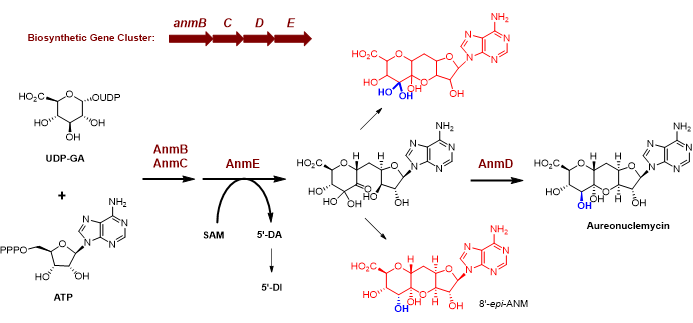
On the basis of aureonuclemycin biosynthetic gene cluster obtained in the previous work, in-frame markerless deletion mutants of all genes were constructed, and the key genes that play a role in the biosynthesis of aureonuclemycin were identified. Two key aureonuclemycin-like compounds were successfully obtained from mutant and wild-type strains. According to the results of in vivo experiments, metabolite analysis and identification of key compounds, the possible biosynthetic pathway of aureonuclemycin was proposed.
Key words: nucleoside antibiotic; biosynthesis; aureonuclemycin
| [1] | Dai, X.; Li, G.; Wu, Z.; Lu, D.; Wang, H.; Li, Z.; Zhou, L.; Chen, X.; Chen, W. CN 87100250, 1988. |
| [2] | (a) Terahara, A.; Haneishi, T.; Arai, M.; Hata, T.; Kuwano, H.; Tamura, C. J. Antibiot. 1982, 35, 1711. |
| [2] | (b) Takiguchi, Y.; Yoshikawa, H.; Terahara, A.; Torikata, A.; Terao, M. J. Antibiot. 1979, 32, 862. |
| [2] | (c) Takiguchi, Y.; Yoshikawa, H.; Terahara, A.; Torikata, A.; Terao, M. J. Antibiot. 1979, 32, 857. |
| [2] | (d) Haneishi, T.; Terahara, A.; Kayamori, H.; Yabe, J.; Arai, M. J. Antibiot. 1976, 29, 870. |
| [2] | (e) Arai, M.; Haneishi, T.; Kitahara, N.; Enokita, R.; Kawakubo, K. I. J. Antibiot. 1976, 29, 863. |
| [3] | Lin, G. M.; Romo, A. J.; Liem, P. H.; Chen, Z.; Liu, H. W. J. Am. Chem. Soc. 2017, 139, 16450. |
| [4] | Pan, H. X.; Chen, Z.; Zeng, T.; Jin, W. B.; Geng, Y.; Lin, G. M.; Zhao, J.; Li, W. T.; Xiong, Z.; Huang, S. X.; Zhai, X.; Liu, H. W.; Tang, G. L. Org. Lett. 2019, 21, 1374. |
| [5] | Chen, Z.; Sato, S.; Geng, Y.; Zhang, J.; Liu, H. W. J. Am. Chem. Soc. 2022, 144, 15653 |
| [6] | Ji, Z. Y.; Nie, Q. Y.; Yin, Y.; Zhang, M.; Pan, H. X.; Hou, X. F.; Tang, G. L. Angew. Chem., Int. Ed. 2019, 58, 18046. |
/
| 〈 |
|
〉 |

