
基于主客体掺杂室温磷光材料的氧气传感材料
收稿日期: 2024-04-01
修回日期: 2024-05-31
网络出版日期: 2024-07-02
基金资助
国家自然科学基金(22222501); 国家自然科学基金(22175023); 北京市自然科学基金(2232022); 北京市自然科学基金(2242060); 北京理工大学研究生科研水平和创新能力提升计划(2023YCXZ016)
Detection of Oxygen Based on Host-Guest Doped Room-Temperature Phosphorescence Material
Received date: 2024-04-01
Revised date: 2024-05-31
Online published: 2024-07-02
Supported by
National Natural Science Foundation of China(22222501); National Natural Science Foundation of China(22175023); Natural Science Foundation of Beijing(2232022); Natural Science Foundation of Beijing(2242060); Beijing Institute of Technology Research and Innovation Promoting Project(2023YCXZ016)
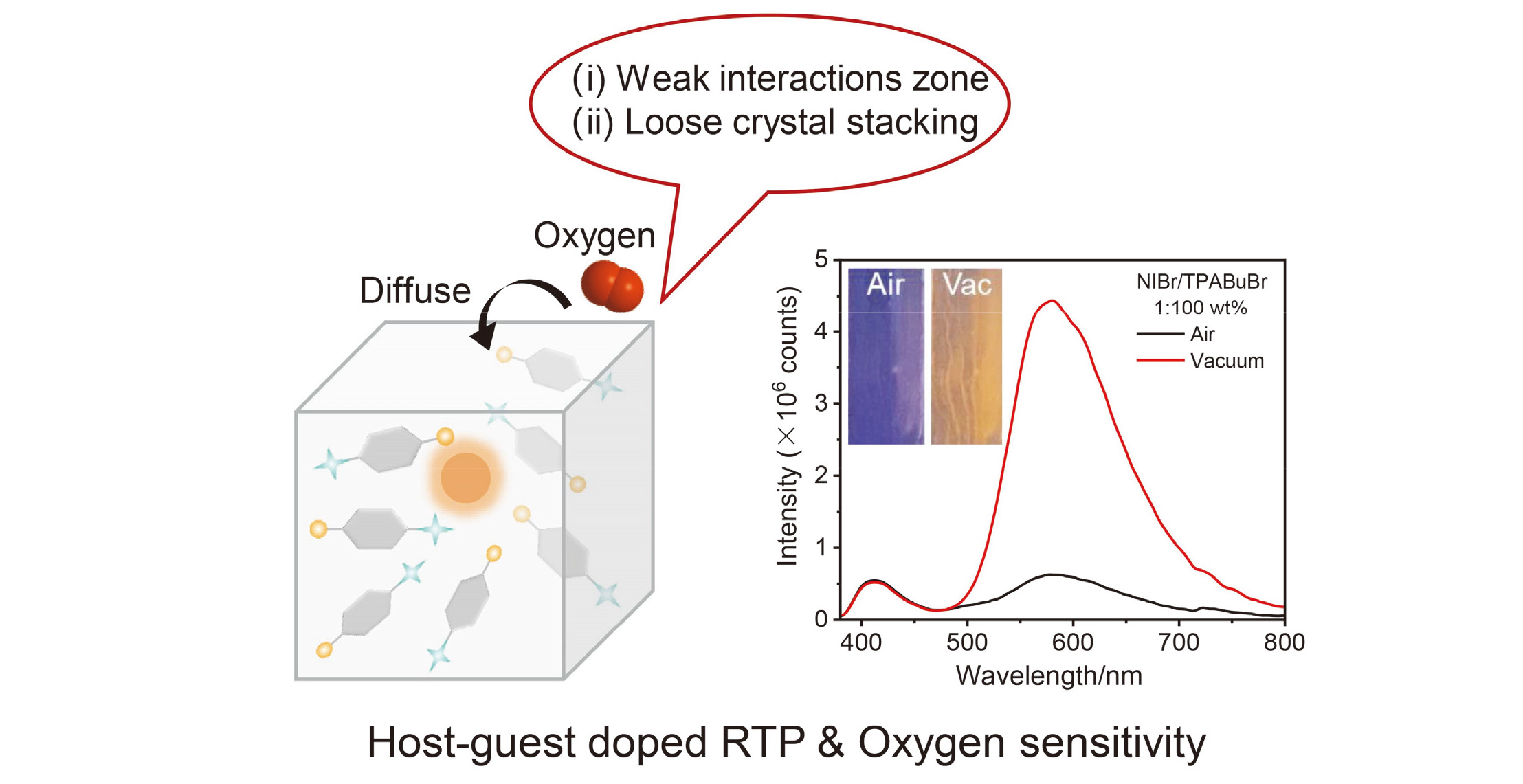
定量氧气检测, 特别是在低浓度下的检测, 在生物、复杂环境和化学过程工程中具有重要意义. 由于磷光的三线态激子对氧气的高灵敏度和快速响应, 纯有机室温磷光用于氧气检测近年来引起了人们的广泛关注. 然而, 在室温下纯有机主客体掺杂材料同时实现超长磷光和定量氧气检测仍然面临挑战. 为实现磷光需要限制发光基元的非辐射弛豫需要的主体分子间紧密堆积, 致使氧气不容易进材料体系中, 进而难以实现对氧气的响应. 本研究探讨了由4',4'-二叔丁基-4-溴三苯胺(TPABuBr)和4-溴代正丁基萘酰亚胺(NIBr)组成的主客体掺杂室温磷光材料在低氧环境下的氧敏感性. 该掺杂材料在室温下展现出荧光和磷光双发射特性. 主体TPABuBr中的叔丁基基团使晶体结构中存在适当的分子间距, 赋予了掺杂材料氧透过性. 掺杂材料的磷光发射强度与氧体积分数之间的线性关系符合Stern-Volmer方程, 可用于定量分析氧浓度, 且具有快速响应和优异的光稳定性, 展示了其作为氧传感器的潜力. 总的来说, 本研究阐述了NIBr/TPABuBr掺杂材料的设计和特性, 展示了其在氧浓度检测方面的潜力, 为设计氧传感系统提供了新思路.
张惟 , 李庚辰 , 苏昊 , 戴文博 , 孙鹏 , 石建兵 , 佟斌 , 蔡政旭 , 董宇平 . 基于主客体掺杂室温磷光材料的氧气传感材料[J]. 有机化学, 2024 , 44(8) : 2523 -2529 . DOI: 10.6023/cjoc202404003
Quantitative oxygen detection, especially at low concentrations, holds significant importance in the realms of biology, complex environments, and chemical process engineering. Due to the high sensitivity and rapid response of the triplet excitons of phosphorescence to oxygen, pure organic room-temperature phosphorescence (RTP) materials have garnered widespread attention in recent years for oxygen detection. However, simultaneously achieving ultralong phosphorescence at room temperature and quantitative oxygen detection from pure organic host-guest doped materials poses challenges. The densely packed materials may decrease non-radiative decay to increase the phosphorescence, but are unsuitable for oxygen diffusion in oxygen detection. Herein, the oxygen sensitivity of host-guest doped RTP materials using 4-bromo-N,N-bis(4-(tert- butyl)phenyl)aniline (TPABuBr) as the host and 6-bromo-2-butyl-1H-benzo[de]isoquinoline-1,3(2H)-dione (NIBr) as the guest was developed. The doped material exhibits fluorescence-phosphorescence dual-emission behavior at room temperature. The tert-butyl groups in TPABuBr facilitate appropriate intermolecular spacing in the crystal state, enhancing oxygen permeability. Therefore, oxygen penetration can quench the phosphorescence emission. The observed linear relationship between the phosphorescence intensity of the doped material and the oxygen volume fraction conforms to the Stern-Volmer equation, suggesting its potential for quantitative analysis of oxygen concentration. The calculated limit of detection is 0.015% (φ), enabling the analysis of oxygen with a volume fraction of less than 2.5% (φ). Moreover, the doped materials demonstrate rapid response and excellent photostability, indicating their potential utility as oxygen sensors. This study elucidates the design and characteristics of NIBr/TPABuBr doped materials, highlighting their potential application in oxygen concentration detection and offering insights for the design of oxygen sensors.
| [1] | O’Riordan, T. C.; Voraberger, H.; Kerry, J. P.; Papkovsky, D. B. Anal. Chim. Act. 2005, 530, 135. |
| [2] | (a) Wu, C.; Bull, B.; Christensen, K.; McNeill, J. Angew. Chem., Int. Ed. 2009, 48, 2741. |
| [2] | (b) Wang, S.; Gu, K.; Guo, Z.; Yan, C.; Yang, T.; Chen, Z.; Tian, H.; Zhu, W.-H. Adv. Mater. 2019, 31, 1805735. |
| [2] | (c) Feng, G.; Zhang, G.-Q.; Ding, D. Chem. Soc. Rev. 2020, 49, 8179. |
| [2] | (d) Zhang, G.; Palmer, G. M.; Dewhirst, M. W.; Fraser, C. L. Nat. Mater. 2009, 8, 747. |
| [2] | (e) Godet, I.; Doctorman, S.; Wu, F.; Gilkes, D. M. Cell. 2022, 11, 686. |
| [3] | Seife, C. Scienc. 2003, 299, 1971. |
| [4] | (a) Jin, H.; Jiang, X.; Sun, Z.; Gui, R. Coord. Chem. Rev. 2021, 431, 213694. |
| [4] | (b) Ju, Y.; Wu, X. g.; Huang, S.; Dai, G.; Song, T.; Zhong, H. Adv. Funct. Mater. 2021, 32, 2108296. |
| [4] | (c) Liu, H.; Pan, G.; Yang, Z.; Wen, Y.; Zhang, X.; Zhang, S. T.; Li, W.; Yang, B. Adv. Opt. Mater. 2022, 10, 2102814. |
| [5] | (a) Liu, X. Q.; Zhang, K.; Gao, J. F.; Chen, Y. Z.; Tung, C. H.; Wu, L. Z. Angew. Chem., Int. Ed. 2020, 59, 23456. |
| [5] | (b) Zeng, Y.; Nguyen, V. P.; Li, Y.; Kang, D. H.; Paulus, Y. M.; Kim, J. ACS Appl. Mater. Interface. 2022, 14, 18182. |
| [5] | (c) Kou, M.; Qin, F.; Wang, Y.; Zhang, X.; Hu, Z.; Zhao, H.; Zhang, Z. J. Phys. Chem. Lett. 2023, 14, 7193. |
| [6] | (a) Dai, W.; Bianconi, T.; Ferraguzzi, E.; Wu, X.; Lei, Y.; Shi, J.; Tong, B.; Carlotti, B.; Cai, Z.; Dong, Y. ACS Mater. Lett. 2021, 3, 1767. |
| [6] | (b) Cao, Y.; Wang, D.; Zhang, Y.; Li, G.; Gao, C.; Li, W.; Chen, X.; Chen, X.; Sun, P.; Dong, Y.; Cai, Z.; He, Z. Angew. Chem., Int. Ed. 2024, e202401331. |
| [6] | (c) Zhang, Y.; Zhang, W.; Xia, J.; Xiong, C.; Li, G.; Li, X.; Sun, P.; Shi, J.; Tong, B.; Cai, Z.; Dong, Y. Angew. Chem., Int. Ed. 2023, 62, e202314273. |
| [6] | (d) Zhao, Y.; Yang, J.; Liang, C.; Wang, Z.; Zhang, Y.; Li, G.; Qu, J.; Wang, X.; Zhang, Y.; Sun, P.; Shi, J.; Tong, B.; Xie, H.-Y.; Cai, Z.; Dong, Y. Angew. Chem., Int. Ed. 2024, 63, e202317431. |
| [6] | (e) Dai, W.; Jiang, Y.; Lei, Y.; Huang, X.; Sun, P.; Shi, J.; Tong, B.; Yan, D.; Cai, Z.; Dong, Y. Chem. Sci. 2024, 15, 4222. |
| [7] | He, T.; Guo, W. J.; Chen, Y. Z.; Yang, X. F.; Tung, C. H.; Wu, L. Z. Aggregat. 2023, 4, e250. |
| [8] | (a) Han, X.; Chen, K.; Lei, Y.; Huang, J.; Wei, S.; Cai, Z.; Wu, H.-Y.; Liu, M.-C.; Huang, X.-B.; Dong, Y. ACS Mater. Lett. 2022, 4, 1764. |
| [8] | (b) Dai, W.; Li, G.; Zhang, Y.; Ren, Y.; Lei, Y.; Shi, J.; Tong, B.; Cai, Z.; Dong, Y. Adv. Funct. Mater. 2023, 33, 2210102. |
| [8] | (c) Dai, W.; Niu, X.; Wu, X.; Ren, Y.; Zhang, Y.; Li, G.; Su, H.; Lei, Y.; Xiao, J.; Shi, J.; Tong, B.; Cai, Z.; Dong, Y. Angew. Chem., Int. Ed. 2022, 61, e202200236. |
| [8] | (d) Lei, Y.; Dai, W.; Guan, J.; Guo, S.; Ren, F.; Zhou, Y.; Shi, J.; Tong, B.; Cai, Z.; Zheng, J.; Dong, Y. Angew. Chem., Int. Ed. 2020, 59, 16054. |
| [8] | (e) Dai, W.; Zhang, Y.; Wu, X.; Guo, S.; Ma, J.; Shi, J.; Tong, B.; Cai, Z.; Xie, H.; Dong, Y. CCS Chem. 2022, 4, 2550. |
| [8] | (f) Ding, B.; Ma, L.; Huang, Z.; Ma, X.; Tian, H. Sci. Adv. 2021, 7, eabf9668. |
| [8] | (g) Song, J.; Ma, X. Chin. J. Org. Chem. 2021, 41, 4519 (in Chinese). |
| [8] | (宋金明, 马骧, 有机化学, 2021, 41, 4519.) |
| [8] | (h) Han, P.; Qin, A. Chin. J. Org. Chem. 2023, 43, 2254 (in Chinese). |
| [8] | (韩鹏博, 秦安军, 有机化学, 2023, 43, 2254.) |
| [9] | (a) Lei, Y.; Yang, J.; Dai, W.; Lan, Y.; Yang, J.; Zheng, X.; Shi, J.; Tong, B.; Cai, Z.; Dong, Y. Chem. Sci. 2021, 12, 6518. |
| [9] | (b) Li, G.; Dai, W.; Lei, Y.; Shi, J.; Tong, B.; Cai, Z.; Dong, Y. ChemPhotoChe. 2022, 7, e202200198. |
| [9] | (c) Guo, Y.; Chen, K.; Hu, Z.; Lei, Y.; Liu, X.; Liu, M.; Cai, Z.; Xiao, J.; Wu, H.; Huang, X. J. Phys. Chem. Lett. 2022, 13, 7607. |
| [9] | (d) Lei, Y.; Dai, W.; Li, G.; Zhang, Y.; Huang, X.; Cai, Z.; Dong, Y. J. Phys. Chem. Lett. 2023, 14, 1794. |
| [9] | (e) Ren, Y.; Dai, W.; Guo, S.; Dong, L.; Huang, S.; Shi, J.; Tong, B.; Hao, N.; Li, L.; Cai, Z.; Dong, Y. J. Am. Chem. Soc. 2022, 144, 1361. |
| [9] | (f) Xiao, F.; Gao, H.; Lei, Y.; Dai, W.; Liu, M.; Zheng, X.; Cai, Z.; Huang, X.; Wu, H.; Ding, D. Nat. Commun. 2022, 13, 186. |
| [9] | (g) Zhang, Y.; Xiong, C.; Wang, W.; Dai, W.; Ren, Y.; Xia, J.; Li, G.; Shi, J.; Tong, B.; Zheng, X.; Shao, X.; Cai, Z.; Dong, Y. Aggregat. 2023, 4, e310. |
| [10] | Guo, S.; Dai, W.; Chen, X.; Lei, Y.; Shi, J.; Tong, B.; Cai, Z.; Dong, Y. ACS Mater. Lett. 2021, 3, 379. |
| [11] | Gu, F.; Jiang, T.; Ma, X. ACS Appl. Mater. Interface. 2021, 13, 43473. |
| [12] | Zhou, Y.; Qin, W.; Du, C.; Gao, H.; Zhu, F.; Liang, G. Angew. Chem., Int. Ed. 2019, 58, 12102. |
| [13] | Guo, W.-J.; Chen, Y.-Z.; Tung, C.-H.; Wu, L.-Z. CCS Chem. 2021, 3, 1384. |
| [14] | (a) Cai, Y.; Guo, Z.; Chen, J.; Li, W.; Zhong, L.; Gao, Y.; Jiang, L.; Chi, L.; Tian, H.; Zhu, W.-H. J. Am. Chem. Soc. 2016, 138, 2219. |
| [14] | (b) Lumpi, D.; Holzer, B.; Bintinger, J.; Horkel, E.; Waid, S.; Wanzenb?ck, H. D.; Marchetti-Deschmann, M.; Hametner, C.; Bertagnolli, E.; Kymissis, I.; Fr?hlich, J. New J. Chem. 2015, 39, 1840. |
| [15] | Chen, X.; Xu, C.; Wang, T.; Zhou, C.; Du, J.; Wang, Z.; Xu, H.; Xie, T.; Bi, G.; Jiang, J.; Zhang, X.; Demas, J. N.; Trindle, C. O.; Luo, Y.; Zhang, G. Angew. Chem., Int. Ed. 2016, 55, 9872. |
| [16] | (a) Wang, Y.; Yang, J.; Gong, Y.; Fang, M.; Li, Z.; Tang, B. Z. SmartMa. 2020, 1, 1006. |
| [16] | (b) Xu, Z.; He, Y.; Shi, H.; An, Z. SmartMa. 2023, 4, e1139. |
| [16] | (c) Cai, S.; Yao, X.; Ma, H.; Shi, H.; An, Z. Aggregat. 2023, 4, e320. |
| [16] | (d) Zhang, Y.; Li, J.; Zhao, J.; Li, X.; Wang, Z.; Huang, Y.; Zhang, H.; Liu, Q.; Lei, Y.; Ding, D. Angew. Chem., Int. Ed. 2024, 63, e202313890. |
| [17] | (a) Huang, R. W.; Wei, Y. S.; Dong, X. Y.; Wu, X. H.; Du, C. X.; Zang, S. Q.; Mak, T. C. W. Nat. Chem. 2017, 9, 689. |
| [17] | (b) Xie, Z.; Ma, L.; deKrafft, K. E.; Jin, A.; Lin, W. J. Am. Chem. Soc. 2010, 132, 922. |
| [17] | (c) Wang, X.-D.; Wolfbeis, O. S. Chem. Soc. Rev. 2014, 43, 3666. |
/
| 〈 |
|
〉 |

