



1 Introduction
Gold homogeneous catalysis represents an ingenious and ingenious tactic for the assembly of functionalized molecules from readily accessible precursors, benefiting from its intrinsic characteristics including high catalytic performance, high selectivity, high functional group compatibility, and oxygen and moisture tolerance.[1] Mechanistically, gold(I) species exhibit the innate preference of protodeauration over β-hydride elimination, which demonstrates unusual catalytic capabilities to construct intricate molecular frameworks not available by other transition metals.[2] Generally, gold catalysts have a dual character, functioning simultaneously with strong π-Lewis acidity as well as soft σ-Lewis acidity,[3] where the former could activate alkynes to enhance the electron-deficient properties, enabling nucleophilic attack, whereas the latter can activate carbonyls, imines and other heteroatom groups for addition or/and substitution reactions.[4] If these two Lewis acidities are governed simultaneously, gold catalysts will drive two or more distinct elementary steps to proceed in turn under the same reaction conditions, which provides a large chemical space for exploiting gold self-relay catalysis to enhance catalytic efficiency.[5] Despite several groups have reported a few elegant gold self-relay catalysis reactions for the construction of cyclic structures,[6] the types of these reactions are still limited. As a consequence, the development of a new type of gold self-relay catalysis is highly desirable, given the enormous applications of this reaction in pharmaceutical science, medicinal chemistry and functional materials.
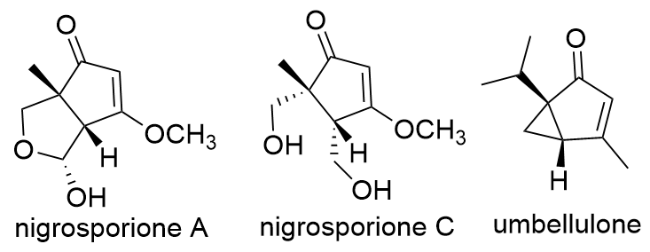
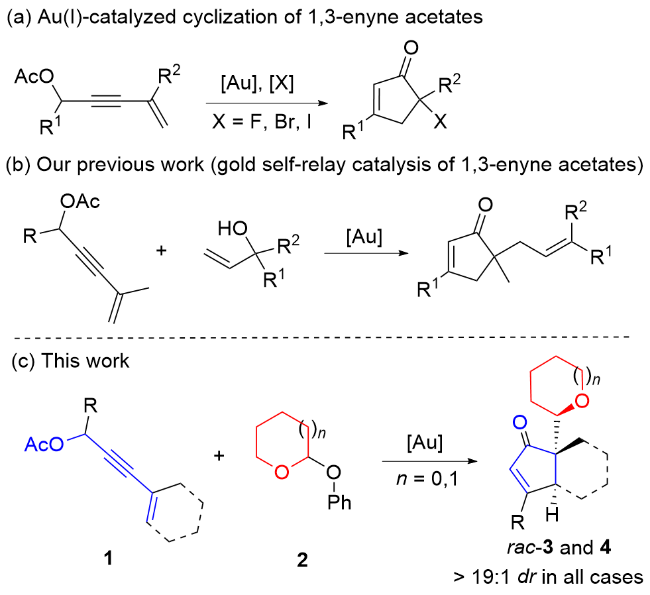
Cyclopentenones endowed with cyclic all-carbon quaternary stereocenters are an important class of privileged carbocyclic motifs that commonly exist in nature,[7] represented by nigrosporiones A and C[8] and umbellulone[9] (Figure 1). Moreover, cyclopentenone skeletons often serve as key precursors for the total synthesis of some natural products and pharmaceuticals.[10] These contributions have been observed in cyclopentenones, which has intensified interest in their synthetic accessibility. Along these lines, Au-catalyzed intramolecular annulations of 1,3-enyne acetates have become one of the most prevalent methods for constructing functionalized cyclopentenones[11] (Scheme 1a). Very recently, we[12] exploited gold self-relay catalysis of 1,3-enyne acetates with different electrophiles to provide a direct pathway for synthesizing cyclopentenones with cyclic all-carbon quaternary stereocenters. For example, merging gold-catalyzed sequential cycloisomerization and allylic reactions of 1,3-enyne acetates with allylic alcohols produces allyl cyclopentenones with an all-carbon quaternary stereocenter[12a] (Scheme 1b). To continue our interest in developing gold self-relay catalysis to construct a cyclopentenone skeleton,[12] we wondered whether gold self-relay catalysis of 1,3-enyne acetates 1 and cyclic ether acetals 2 proceeded to generate cyclic ether-containing cyclopentenones, which would offer a new opportunity to exploit new transformations of cyclic ether acetals, because cyclic ether acetals, such as tetrahydropyranyl (THP)[13] and tetrahydrofuranyl (THF)[14] ethers, are commonly used as protecting groups in traditional multistep organic syntheses, rather than electrophilic cyclic ether surrogates. To our delight, the reaction proceeded readily through a gold-catalyzed 3,3-rear-rangement, Nazarov cyclization and a nucleophilic substitution cascade to furnish the target cyclopentenone products with excellent diastereoselectivities (Scheme 1c). Notably, such a catalytic strategy allows us to achieve new use for an old reagent: cyclic ether acetals as electrophilic cyclic ether surrogates, leading to the diastereoselective synthesis of cyclic etherified cyclopentenones in a single step. Herein, we report this gold self-relay catalysis.
2 Results and discussion
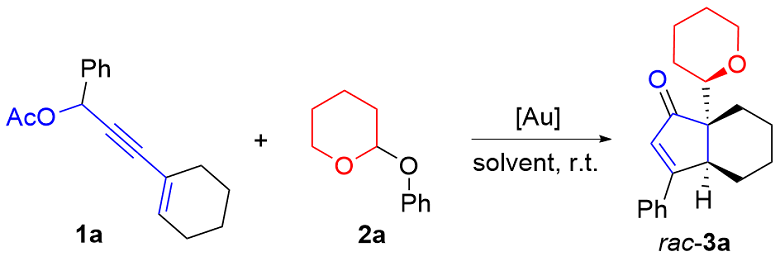
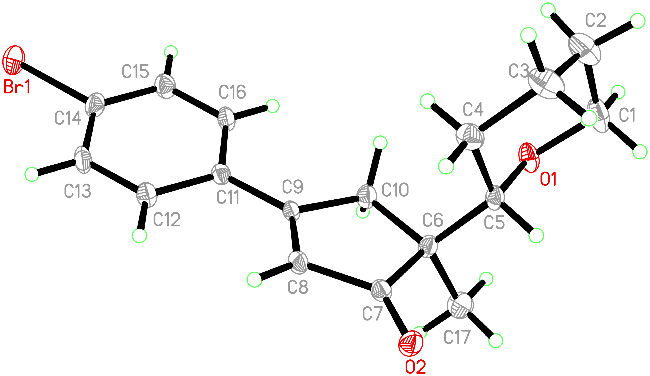
At the outset, we used 1,3-enyne acetate 1a and tetrahydropyranyl ether 2a as model substrates to establish the optimal reaction conditions (Table 1). The reaction of 1a with 2a at a 1∶1 molar ratio worked readily in dichloromethane (DCM) at room temperature by using JohnPhos-Au(MeCN)SbF6 (2.0 mol%) as a catalyst, and the desired cyclopentenone product 3a with >19∶1 dr was afforded, albeit with 33% yield (Entry 1). The relative stereochemi-stry of this compound was determined by analogy with that of product 4g, which was assigned by X-ray diffraction analysis. This preliminary result prompted us to further investigate other reaction parameters, including the substrate ratio, solvent and catalyst, to improve the efficiency of this transformation (Table 1). An increase in the molar ratio of 1a to 2a to 1∶1.5 made this reaction more efficient, delivering product 3a in 58% yield (Entry 2). Further increasing the molar ratio of 1a∶2a to 1∶2 resulted in a slightly decreased yield (52%, Entry 3). Taking JohnPhos-Au(MeCN)SbF6 as the gold catalyst, the effect of the solvent was then examined by screening several other solvents, namely, toluene, CH3CN, 1,4-dioxane and tetrahydrofuran (THF). The results revealed that the former two could drive this transformation to work more efficiently, providing higher yields of 3a (Entries 4~5), compared with DCM, and toluene proved to be the better choice for this process between these solvents (Entry 4), whereas the latter two completely suppressed the formation of 3a (Entries 6~7). The screening of several other gold catalysts often used in catalytic transformations, such as PPh3AuCl, AuCl, AuCl3 and IPrAuNTf2, indicated that none of these attempts could increase the yield of 3a; in fact, all these cases dramatically inhibited the reaction process (Entries 8~11). Without gold catalyst, the reaction did not proceed (Entry 12).
Table 1 Condition optimization for product 3aa
|
| Entry | n(1a)∶ n(2a) | [Au] | Solvent | Yield/ % |
|---|---|---|---|---|
| 1 | 1∶1 | JohnPhosAu(MeCN)SbF6 | DCM | 33 |
| 2 | 1∶1.5 | JohnPhosAu(MeCN)SbF6 | DCM | 58 |
| 3 | 1∶2 | JohnPhosAu(MeCN)SbF6 | DCM | 52 |
| 4 | 1∶1.5 | JohnPhosAu(MeCN)SbF6 | Toluene | 71 |
| 5 | 1∶1.5 | JohnPhosAu(MeCN)SbF6 | CH3CN | 69 |
| 6 | 1∶1.5 | JohnPhosAu(MeCN)SbF6 | 1,4-Dioxane | Trace |
| 7 | 1∶1.5 | JohnPhosAu(MeCN)SbF6 | THF | Trace |
| 8 | 1∶1.5 | PPh3AuCl | Toluene | 40 |
| 9 | 1∶1.5 | AuCl | Toluene | 16 |
| 10 | 1∶1.5 | AuCl3 | Toluene | N.D. |
| 11 | 1∶1.5 | IPrAuNTf2 | Toluene | N.R. |
| 12 | 1∶1.5 | — | Toluene | N.R. |
a Reaction conditions: 1a (0.1 mmol), 2a (x equiv.), Au catalyst (2 mol%), solvent (2.0 mL), r.t. for 48 h. b Isolated yield based on 1a. |
With the optimized conditions, we set out to investigate the scope of this self-relay catalytic process with a range of 1,3-enyne acetates 1 and cyclic ether acetals 2 (Scheme 2). Initially, the electronic nature and positions of the substituents on the phenyl ring of substrate 1 were probed by repeating the reactions with tetrahydropyranyl ether 2a as a representative component. The reaction is effective in the presence of different substituents, such as methyl (ortho, 1b; meta, 1c; para, 1d), and chloro (ortho, 1e; meta, 1f; para, 1g), on the phenyl ring of substrate 1, enabling the highly diastereoselective synthesis of tetrahydropyranylated 1-indenones 3b~3g as the sole diastereoisomers in 50%~87% yields. Among these functional groups, both the sterically crowded ortho-tolyl (1b) and ortho-chloro-phenyl (1e) counterparts seem reluctant to undergo this process, as moderate yields of desired products 3b and 3e were isolated, respectively. Subsequently, tetrahydrofuranyl ether 2b was subjected with substrates 1 bearing different substituents linked by the propargyl moiety, delivering corresponding tetrahydrofuranylated 1-indenones 3h~3l with good yields and excellent diastereoselectivity (>19∶1 dr). Both electronically neutral (H), rich (methyl) and poor (chloro) groups in the phenyl ring tethered by the propargyl moiety were well tolerated with this transformation, enabling highly diastereoselective access to the corresponding products 3h~3j with acceptable yields. In addition to the phenyl substrate 1, this approach is also amenable to both cycloalkyl [e.g., cyclohexyl (Cy) 1h] and alkyl (tert-butyl, 1i) counterparts, giving products 3k and 3l in 70% and 87% yields and >19∶1 dr, respectively.
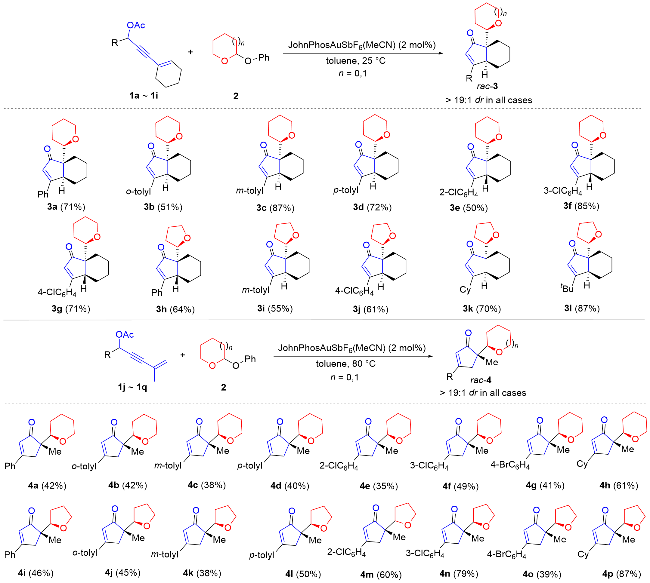
To further expand the application of this protocol, acyclic phenyl-substituted 1,3-enyne acetate 1j was reacted with tetrahydropyranyl ether 2a under the optimized conditions. The reaction gave only a 20% yield of product 4a, and most of the starting materials were not consumed. After brief screening, the yield of product 4a was improved to 42% by fine-tuning the reaction temperature to 80 ℃. Under these acceptable reaction conditions, a series of cyclic etherified cyclopentenones were synthesized in moderate to good yields (Scheme 2). Similar to the synthesis of product 3, the reaction proceeded readily with the use of both electron-donating (ortho-, meta- and para-methyl, 1k/1l/1m) and electron-withdrawing (ortho-and meta- chloro 1n and 1o, para-bromo 1p) groups at different positions in the phenol ring, delivering targets 4b~4g in moderate yields with >19∶1 dr. Swapping the aryl group with a cyclohexyl (1q) group resulted in product 4h as the sole diastereoisomer in 61% yield. Alternatively, tetrahydrofuranyl ether 2b was found to show good reactivity under the present catalytic conditions, accessing products 4i~4p with 38%~87% yields and >19∶1 dr, which proved the functional group compatibility of this catalytic transformation. The resulting cyclopentenones were indisputably characterized by NMR spectroscopy and HRMS. Furthermore, the stereo-structure of 4g was further confirmed by X-ray diffraction analysis (Figure 2, CCDC 2379071).
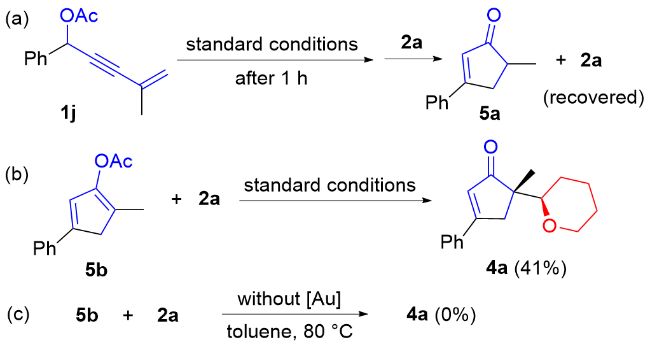
To gain mechanistic insight into this gold-catalysis, several control experiments were carried out as described in Scheme 4. After subjecting 1j to a gold-catalyzed reaction under standard conditions for 1 h, 2a was subsequently added to the reaction system. Instead of the expected product 4a, cyclopentenone 5a was detected, along with the recovery of 2a, which ruled out the possible intermediate of cyclopentenone 5a (Scheme 3a). Owing to the gold-catalyzed cyclization of 1,3-enyne acetates generated two products, namely, cyclopentenone 5a and cyclopentadiene 5b,[11-12] the reaction of preformed cyclopentadiene 5b with 2a under standard conditions afforded 41% yield of 4a (Scheme 3b), indicating that cyclopentadiene 5 should be an intermediate for this transformation. Next, the reaction of 5b with 2a in the absence of a gold catalyst did not proceed (Scheme 3c), implying that the gold catalyst could act as a Lewis acid for the nucleophilic substitution process. In the overall process, the gold catalyst has dual characteri-stics, namely, π-Lewis acid-type activation of the triple bond for Nazarov cyclization as well as σ-Lewis acid-type activation of cyclic ether acetals for nucleophilic substitution, which indicates a gold self-relay catalysis process.
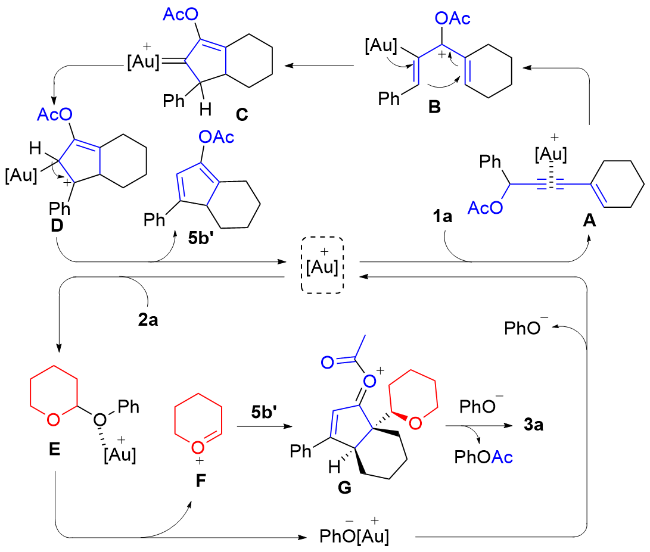
Drawing upon the experimental results as well as the literature precedents,[8-9] a reasonable mechanism for this gold(I) self-relay catalysis is proposed in Scheme 4. With 1,3-enyne acetate 1a as a representative example, this might initially involve an AuI-catalyzed [3,3]-rearrange-ment to give the cationic pentadienylic gold species B through self-π-acidity to activate the triple bond, which undergoes an electrocyclic Nazarov cyclization to yield the gold carbenoid complex C. Subsequent 1,2-hydride migration and protodeauration furnish cyclopentadiene 5b'. Next, the gold catalyst governs self-σ-acidity to activate the C—O bond of tetrahydropyranyl ether 2a, giving tetrahydropyrylium F and a phenol-gold complex. The former is intercepted by cyclopentadiene 5b', providing intermediate G, which is converted to product 3a in the presence of a phenol anion from the phenol-gold complex, and the latter regenerates the gold catalyst for the next catalytic cycle.


3 Conclusions
In summary, a new gold(I) self-relay catalysis composed of [3,3]-rearrangement, Nazarov cyclization and a nucleophilic substitution process by using readily available 1,3-enyne acetates and cyclic ether acetals as electrophilic cyclic ether surrogates has been developed. The overall process was governed by the π-and σ-Lewis acid capability of the gold complexes, providing a direct and diastereoselective pathway for the synthesis of cyclic etherified cyclopentenone derivatives with a cyclic all-carbon quaternary stereocenter in moderate to good yields. This catalytic strategy features effective control of diastereoselectivity and good functional group tolerance of substrates, together with low loading of the gold catalyst. Furthermore, the reaction proceeded readily without any inert atmosphere protection, thus demonstrating good oxygen resistance and making the operation simple and convenient. Ongoing efforts are being made to apply gold(I) self-relay catalysis for building functionalized molecules with important biological interest.
4 Experimental section
4.1 Materials and Methods
1H NMR (13C NMR) spectra were measured on a Bruker DPX 400 MHz spectrometer in CDCl3 with chemical shift (δ) given relative to TMS as internal standard. HRMS (APCI and ESI) was determined by using a microTOF-QII HRMS/MS instrument (BRUKER). Compounds 1[12] and 2[13-14] were prepared according to the reported procedures. Other chemicals and solvents were purchased from commercial suppliers without further purification unless otherwise specified. Gold catalysts purchased from Laajoo were used in this paper.
4.2 General procedure for the synthesis of products 3 and 4
4.2.1 Synthesis of 3
To a 10 mL tube under air conditions, 1,3-enyne acetate (1a, 0.1 mmol, 25.4 mg, 1 equiv.), tetrahydropyranyl ether (2a, 0.15 mmol, 26.7 mg, 1.5 equiv.), JohnPhosAu(Me-CN)SbF6 (2 mol%, 1.6 mg) and toluene (2.0 mL) were successively added. Then, the tube was stirred at room temperature for 48 h until complete consumption of 1a, as monitored by TLC analysis. After the reaction was completed, the reaction mixture was concentrated in vacuo and the resulting residue was purified by column chromatography on silica gel [eluent, V(petroleum ether)∶V(ethyl acetate)=20∶1] to afford the desired product 3a as a yellow oil. 3b~3l were synthesized using the same method as 3a.
3-Phenyl-7a-(tetrahydro-2H-pyran-2-yl)-3a,4,5,6,7,7a-hexahydro-1H-inden-1-one (3a): Yellow oil, 21.0 mg, 71% yield. 1H NMR (400 MHz, CDCl3) δ: 7.64~7.62 (m, 2H), 7.46~7.45 (m, 3H), 6.45 (s, 1H), 3.99 (d, J=7.6 Hz, 1H), 3.68~3.66 (m, 1H), 3.43~3.31 (m, 2H), 2.02~1.86 (m, 2H), 1.79~1.76 (m, 2H), 1.63~1.57 (m, 1H), 1.54~1.50 (m, 1H), 1.48~1.38 (m, 2H), 1.34~1.25 (m, 5H), 1.19~1.13 (m, 1H); 13C NMR (100 MHz, CDCl3) δ: 212.5, 178.9, 133.8, 130.8, 128.9, 128.8, 127.4, 83.0, 69.3, 56.1, 43.2, 26.7, 26.1, 25.8, 24.1, 23.5, 17.5, 17.0; IR (KBr) ν: 2940, 2831,1694, 1603, 1365, 1069, 775 cm-1; HRMS (ESI) calcd for C20H24O2Na [M+Na]+ 319.1674, found 319.1681.
7a-(Tetrahydro-2H-pyran-2-yl)-3-(o-tolyl)-3a,4,5,6,7,7a-hexahydro-1H-inden-1-one (3b): Yellow oil, 15.8 mg, 51% yield. 1H NMR (400 MHz, CDCl3) δ: 7.33~7.25 (m, 4H), 6.21 (s, 1H), 4.02~3.99 (m, 1H), 3.62 (s, 1H), 3.44~3.38 (m, 2H), 2.40 (s, 3H), 1.98~1.90 (m, 1H), 1.84~1.79 (m, 1H), 1.78~1.73 (m, 2H), 1.55~1.38 (m, 9H), 1.25~1.17 (m, 1H); 13C NMR (100 MHz, CDCl3) δ: 213.0, 180.7, 135.8, 135.0, 132.8, 131.3, 129.2, 127.4, 126.0, 82.9, 69.3, 55.1, 46.3, 27.3, 26.2, 25.7, 23.6, 22.9, 21.0, 17.4; IR (KBr) ν: 2938, 2831, 1695, 1601, 1363, 1086, 774 cm-1; HRMS calcd for C21H26O2Na [M+Na]+ 333.1830, found 333.1837.
7a-(Tetrahydro-2H-pyran-2-yl)-3-(m-tolyl)-3a,4,5,6,7,7a-hexahydro-1H-inden-1-one (3c): Yellow oil, 27.1 mg, 87% yield. 1H NMR (400 MHz, CDCl3) δ: 7.43 (s, 2H), 7.36~7.33 (m, 1H), 7.28 (s, 1H), 6.43 (s, 1H), 4.00 (d, J=10.4 Hz, 1H), 3.66 (s, 1H), 3.44~3.31 (m, 2H), 2.42 (s, 3H), 2.03~1.88 (m, 2H), 1.77 (d, J=12.0 Hz, 2H), 1.64~1.60 (m, 2H), 1.53~1.49 (m, 3H), 1.42~1.30 (m, 4H), 1.22~1.15 (m, 1H); 13C NMR (100 MHz, CDCl3) δ: 212.6, 179.2, 138.6, 133.7, 131.6, 128.8, 128.7, 128.0, 124.5, 83.0, 69.3, 56.1, 43.1, 26.8, 26.1, 25.8, 24.2, 23.5, 21.5, 17.5, 17.0; IR (KBr) ν: 2964, 2831, 1713, 1686, 1600, 1367, 1220, 1070, 775 cm-1; HRMS calcd for C21-H26O2Na [M+Na]+ 333.1830, found 333.1834.
7a-(Tetrahydro-2H-pyran-2-yl)-3-(p-tolyl)-3a,4,5,6,7,7a-hexahydro-1H-inden-1-one (3d): Yellow oil, 22.3 mg, 72% yield. 1H NMR (400 MHz, CDCl3) δ: 7.53 (d, J=7.6 Hz, 2H), 7.26~7.25 (m, 2H), 6.41 (s, 1H), 3.98 (d, J=10.0 Hz, 1H), 3.64 (s, 1H), 3.42~3.30 (m, 2H), 2.40 (s, 3H), 1.98~1.91 (m, 2H), 1.77~1.75 (m, 2H), 1.51~1.42 (m, 4H), 1.33~1.25 (m, 6H); 13C NMR (100 MHz, CDCl3) δ: 212.6, 179.0, 141.4, 131.0, 129.7, 128.0, 127.5, 83.0, 69.4, 56.2, 43.1, 26.8, 26.2, 25.9, 24.4, 23.6, 21.6, 17.6, 17.1; IR (KBr) ν: 2920, 2850, 2826, 1692, 1611, 1470, 1368, 1084, 775 cm-1; HRMS (ESI) calcd for C21H26O2Na [M+Na]+ 333.1830, found 333.1826.
3-(2-Chlorophenyl)-7a-(tetrahydro-2H-pyran-2-yl)-3a,4,5,6,7,7a-hexahydro-1H-inden-1-one (3e): Yellowish oil, 18.3 mg, 50% yield. 1H NMR (400 MHz, CDCl3) δ: 7.49~7.47 (m, 1H), 7.36~7.32 (m, 3H), 6.40 (s, 1H), 4.00 (d, J=10.0 Hz, 1H), 3.78 (s, 1H), 3.44~3.39 (m, 2H), 2.01~1.93 (m, 1H), 1.84~1.82 (m, 1H), 1.76~1.72 (m, 2H), 1.57~1.35 (m, 9H), 1.29~1.23 (m, 1H); 13C NMR (100 MHz, CDCl3) δ: 212.9, 177.7, 134.4, 134.0, 132.4, 130.7, 130.4, 129.2, 127.0, 82.8, 69.4, 55.4, 45.7, 27.5, 26.2, 25.8, 23.6, 22.8, 17.4, 17.3; IR (KBr) ν: 2947, 2830, 1606, 1362, 1085, 775 cm-1; HRMS (ESI) calcd for C20H23O2ClNa [M+Na]+ 353.1284, found 353.1289.
3-(3-Chlorophenyl)-7a-(tetrahydro-2H-pyran-2-yl)-3a,4,5,6,7,7a-hexahydro-1H-inden-1-one (3f): Yellowish oil, 31.3 mg, 85% yield. 1H NMR (400 MHz, CDCl3) δ: 7.58 (s, 1H), 7.49 (d, J=7.6 Hz, 1H), 7.42~7.37 (m, 2H), 6.43 (s, 1H), 3.98 (d, J=10.8 Hz, 1H), 3.61 (s, 1H), 3.42~3.32 (m, 2H), 1.99~1.87 (m, 2H), 1.79~1.76 (m, 2H), 1.56~1.32 (m, 9H), 1.20~1.14 (m, 1H); 13C NMR (100 MHz, CDCl3) δ: 212.6, 177.5, 135.7, 135.1, 130.7, 130.3, 129.6, 127.3, 125.6, 83.0, 69.4, 56.3, 43.5, 26.8, 26.1, 25.8, 24.0, 23.6, 17.5, 17.1; IR (KBr) ν: 2938, 2832, 1694, 1603, 1364, 1289, 1086, 775 cm-1; HRMS (ESI) calcd for C20-H23O2ClNa [M+Na]+ 353.1284, found 353.1292.
3-(4-Chlorophenyl)-7a-(tetrahydro-2H-pyran-2-yl)-3a,4,5,6,7,7a-hexahydro-1H-inden-1-one (3g): White oil, 26.1 mg, 71% yield. 1H NMR (400 MHz, CDCl3) δ: 7.55 (d, J=8.0 Hz, 2H), 7.41 (d, J=8.0 Hz, 2H), 6.41 (s, 1H), 3.97 (d, J=10.4 Hz, 1H), 3.60 (s, 1H), 3.38~3.30 (m, 2H), 1.96~1.86 (m, 2H), 1.78~1.75 (m, 2H), 1.52~1.32 (m, 9H), 1.19~1.12 (m, 1H); 13C NMR (100 MHz, CDCl3) δ: 212.2, 177.3, 136.7, 132.2, 129.2, 129.0, 128.7, 82.9, 69.3, 56.2, 43.3, 26.7, 26.1, 25.8, 24.0, 23.5, 17.5, 17.0; IR (KBr) ν: 2938, 2831, 1693, 1631, 1600, 1364, 1086, 775 cm-1; HRMS calcd for C20H23O2ClNa [M+Na]+ 353.1284, found 353.1279.
3-Phenyl-7a-(tetrahydrofuran-2-yl)-3a,4,5,6,7,7a-hexa-hydro-1H-inden-1-one (3h): Yellowish oil, 18.1 mg, 64% yield. 1H NMR (400 MHz, CDCl3) δ: 7.62~7.61 (m, 2H), 7.45 (s, 3H), 6.46 (s, 1H), 3.91~3.87 (m, 1H), 3.80~3.70 (m, 2H), 3.51~3.48 (m, 1H), 2.00~1.80 (m, 5H), 1.76~1.70 (m, 2H), 1.59~1.54 (m, 2H), 1.41~1.32 (m, 2H), 1.28~1.22 (m, 1H); 13C NMR (100 MHz, CDCl3) δ: 212.0, 178.6, 133.7, 130.9, 129.0, 128.3, 127.4, 84.5, 68.3, 55.0, 43.7, 27.4, 26.0, 26.0, 24.7, 18.1, 17.8; IR (KBr) ν: 2993, 2831, 2717, 1689, 1605, 1364, 1068, 775 cm-1; HRMS calcd for C19H22O2Na [M+Na]+ 305.1517, found 305.1516.
7a-(Tetrahydrofuran-2-yl)-3-(m-tolyl)-3a,4,5,6,7,7a-hexahydro-1H-inden-1-one (3i): Yellow oil, 14.9 mg, 55% yield. 1H NMR (400 MHz, CDCl3) δ: 7.43~7.42 (m, 2H), 7.36~7.32 (m, 1H), 7.28 (s, 1H), 6.44 (s, 1H), 3.9~3.87 (m, 1H), 3.82~3.70 (m, 2H), 3.49~3.47 (m, 1H), 2.42 (s, 3H), 1.92~1.80 (m, 5H), 1.75~1.69 (m, 2H), 1.61~1.54 (m, 2H), 1.41~1.32 (m, 2H), 1.29~1.23 (m, 1H); 13C NMR (100 MHz, CDCl3) δ: 212.0, 178.9, 138.7, 133.7, 131.6, 128.8, 128.1, 127.9, 124.5, 84.5, 68.2, 55.0, 43.6, 27.4, 26.0, 24.7, 21.5, 18.1, 17.7; IR (KBr) ν: 2943, 2831, 1688, 1594, 1363, 1068, 775 cm-1; HRMS calcd for C20-H24O2Na [M+Na]+ 319.1674, found 319.1679.
3-(4-Chlorophenyl)-7a-(tetrahydrofuran-2-yl)-3a,4,5,6,7,7a-hexahydro-1H-inden-1-one (3j): Yellowish oil, 19.3 mg, 61% yield. 1H NMR (400 MHz, CDCl3) δ: 7.55 (d, J=8.0 Hz, 2H), 7.43 (d, J=8.0 Hz, 2H), 6.43 (s, 1H), 3.88 (t, J=7.2 Hz, 1H), 3.76~3.70 (m, 2H), 3.46~3.44 (m, 1H), 1.92~1.75 (m, 6H), 1.56~1.54 (m, 1H), 1.50~1.26 (m, 5H); 13C NMR (100 MHz, CDCl3) δ: 211.7, 177.0, 136.9, 132.2, 129.3, 128.7, 128.5, 84.6, 68.3, 55.1, 44.0, 27.4, 26.0, 24.7, 18.1, 17.8; IR (KBr) ν: 2904, 2689, 1602, 1490, 1380, 1366, 1266, 1039, 748 cm-1; HRMS calcd for C19H21O2ClNa [M+Na]+ 339.1128, found 339.1124.
3-Cyclohexyl-7a-(tetrahydrofuran-2-yl)-3a,4,5,6,7,7a-hexahydro-1H-inden-1-one (3k): Yellow oil, 20.2 mg, 70% yield. 1H NMR (400 MHz, CDCl3) δ: 5.91 (s, 1H), 3.85~3.81 (m, 1H), 3.74~3.67 (m, 2H), 2.92 (s, 1H), 2.27~2.22 (m, 1H), 1.98 (d, J=12.8 Hz, 1H), 1.83~1.68 (m, 10H), 1.61~1.44 (m, 4H), 1.40~1.25 (m, 6H), 1.14~1.0 8(m, 1H); 13C NMR (100 MHz, CDCl3) δ: 213.1, 190.9, 127.8, 84.9, 68.2, 54.1, 44.4, 39.4, 32.3, 30.9, 27.9, 26.6, 26.2, 26.01, 25.96, 25.9, 23.4, 18.1, 18.0; IR (KBr) ν: 2928, 2853, 1696, 1605, 1448, 1367, 1349, 1271, 1165, 1064, 753 cm-1; HRMS calcd for C19H28O2Na [M+Na]+ 311.1987, found 311.1991.
3-(tert-Butyl)-7a-(tetrahydrofuran-2-yl)-3a,4,5,6,7,7a-hexahydro-1H-inden-1-one (3l): Yellow oil, 22.8 mg, 87% yield. 1H NMR (400 MHz, CDCl3) δ: 5.97 (s, 1H), 3.80~3.76 (m, 1H), 3.68 ~3.65 (m, 2H), 3.00~2.95 (m, 1H), 2.03~1.99 (m, 1H), 1.92~1.87 (m, 1H), 1.80~1.77 (m, 2H), 1.70~1.58 (m, 5H), 1.50~1.45 (m, 1H), 1.42~1.37 (m, 2H), 1.24 (s, 9H); 13C NMR (100 MHz, CDCl3) δ: 212.4, 194.3, 128.2, 84.7, 68.2, 55.9, 45.7, 35.7, 29.8, 27.3, 26.0, 26.0, 19.7, 19.2; IR (KBr) ν: 2938, 2894, 2261, 1579, 1456, 1381, 1368, 1053, 750 cm-1; HRMS calcd for C17H26O2Na [M+Na]+ 285.1830, found 285.1727.
4.2.2 Synthesis of 4
To a 10 mL tube under air conditions, 1,3-enyne acetate (1j, 0.3 mmol, 64.2 mg, 1.0 equiv.), tetrahydropyranyl ether (2a, 0.45 mmol, 80.1 mg 1.5 equiv.), JohnPhosAu(MeCN)SbF6 (2 mol%, 4.8 mg) and toluene (2.0 mL) were successively added. Then, the tube was stirred at 80 ℃ for 24 h until complete consumption of 1j, as monitored by TLC analysis. After the reaction was completed, the reaction mixture was concentrated in vacuum and the resulting residue was purified by column chromatography on silica gel [eluent, V(petroleum ether)∶V(ethyl ace-tate)=20∶1] to afford the desired product 4a as a white solid. 4b~4p were synthesized using the same method as 4a.
5-Methyl-3-phenyl-5-(tetrahydro-2H-pyran-2-yl)cyclo-pent-2-en-1-one (4a): White solid, 32.3 mg, 42% yield. m.p. 99~101 ℃; 1H NMR (400 MHz, CDCl3) δ: 7.68 (d, J=7.6 Hz, 2H), 7.46 (d, J=6.4 Hz, 3H), 6.49 (s, 1H), 4.08~3.95 (m, 1H), 3.49~3.39 (m, 2H), 3.32 (d, J=18.4 Hz, 1H), 2.67 (d, J=18.4 Hz, 1H), 1.77 (d, J=10.4 Hz, 1H), 1.62 (s, 1H), 1.51~1.44 (m, 2H), 1.40 (d, J=13.6 Hz, 1H), 1.31 (s, 3H), 1.24~1.16 (m, 1H); 13C NMR (100 MHz, CDCl3) δ: 211.9, 171.1, 132.8, 132.2, 128.4, 126.5, 125.8, 82.1, 69.3, 52.2, 39.7, 26.2, 26.0, 23.3, 22.5; IR (KBr) ν: 3061, 1693, 1601, 1572, 1494, 1448, 1372, 1043, 766, 688 cm-1; HRMS calcd for C17H21O2 [M+H]+ 257.1542, found 257.1554.
5-Methyl-5-(tetrahydro-2H-pyran-2-yl)-3-(o-tolyl)cyclo-pent-2-en-1-one (4b): Colorless oil, 34.1 mg, 42% yield. 1H NMR (400 MHz, CDCl3) δ: 7.41 (d, J=7.6 Hz, 1H), 7.34~7.25 (m, 3H), 6.23 (s, 1H), 4.00 (d, J=11.2 Hz, 1H), 3.49~3.36 (m, 2H), 3.27 (d, J=18.8 Hz, 1H), 2.64 (d, J=18.8 Hz, 1H), 2.42 (s, 3H), 1.80 (d, J=9.2 Hz, 1H), 1.53~1.40 (m, 4H), 1.31 (s, 3H), 1.26 (d, J=11.2 Hz, 1H); 13C NMR (100 MHz, CDCl3) δ: 212.5, 174.5, 136.3, 135.2, 131.5, 131.0, 129.8, 127.5, 126.2, 82.1, 69.3, 51.7, 43.2, 26.2, 26.1, 23.4, 22.4, 21.9; IR (KBr) ν: 3061, 1697, 1607, 1589, 1488, 1456, 1439, 1372, 1053, 762 cm-1; HRMS calcd for C18H23O2 [M+H]+ 271.1698, found 271.1689.
5-Methyl-5-(tetrahydro-2H-pyran-2-yl)-3-(m-tolyl)-cyclopent-2-en-1-one (4c): Colorless oil, 30.8 mg, 38% yield. 1H NMR (400 MHz, CDCl3) δ: 7.49 (s, 2H), 7.39~7.31 (m, 1H), 7.28 (d, J=8.0 Hz, 1H), 6.47 (s, 1H), 4.01 (d, J=11.6 Hz, 1H), 3.50~3.37 (m, 2H), 3.31 (d, J=18.8 Hz, 1H), 2.65 (d, J=18.8 Hz, 1H), 2.40 (s, 3H), 1.76 (d, J=10.4 Hz, 1H), 1.56~1.42 (m, 3H), 1.39 (d, J=14.0 Hz, 1H), 1.30 (s, 3H), 1.27~1.17 (m, 1H); 13C NMR (100 MHz, CDCl3) δ: 212.3, 173.1, 138.7, 133.9, 132.2, 128.9, 127.7, 126.0, 124.3, 82.2, 69.3, 52.2, 39.8, 26.3, 26.1, 23.4, 22.6, 21.5; IR (KBr) ν: 2934, 1694, 1597, 1582, 1485, 1439, 1372, 1054, 867, 787, 688 cm-1; HRMS calcd for C18H23O2 [M+H]+ 271.1698, found 271.1689.
5-Methyl-5-(tetrahydro-2H-pyran-2-yl)-3-(p-tolyl)-cyclopent-2-en-1-one (4d): White solid, 32.4 mg, 40% yield. m.p. 65~67 ℃; 1H NMR (400 MHz, CDCl3) δ: 7.57 (d, J=7.2 Hz, 2H), 7.26~7.20 (m, 2H), 6.44 (s, 1H), 4.01 (d, J=12.4 Hz, 1H), 3.45 (d, J=10.4 Hz, 1H), 3.41 (d, J=11.2 Hz, 1H), 3.29 (d, J=18.4 Hz, 1H), 2.64 (d, J=18.4 Hz, 1H), 2.40 (s, 3H), 1.76 (d, J=9.6 Hz, 1H), 1.55~1.42 (m, 3H), 1.39 (d, J=13.6 Hz, 1H), 1.30 (s, 3H), 1.20 (d, J=12.4 Hz, 1H); 13C NMR (100 MHz, CDCl3) δ: 212.2, 172.8, 142.0, 131.2, 129.6, 127.0, 125.3, 82.2, 69.3, 52.1, 39.6, 26.2, 26.1, 23.3, 22.6, 21.6; IR (KBr) ν: 2927, 1692, 1596, 1564, 1510, 1439, 1372, 1042, 815 cm-1; HRMS calcd for C18H23O2 [M+H]+ 271.1698, found 271.1700.
3-(2-Chlorophenyl)-5-methyl-5-(tetrahydro-2H-pyran-2-yl)cyclopent-2-en-1-one (4e): Colorless oil, 30.5 mg, 35% yield. 1H NMR (400 MHz, CDCl3) δ: 7.52~7.40 (m, 2H), 7.38~7.29 (m, 2H), 6.55 (s, 1H), 4.00 (d, J=11.2 Hz, 1H), 3.49~3.38 (m, 2H), 3.35 (d, J=18.8 Hz, 1H), 2.68 (d, J=18.8 Hz, 1H), 1.87~1.75 (m, 1H), 1.56~1.39 (m, 4H), 1.31 (s, 3H), 1.26 (d, J=9.2 Hz, 1H); 13C NMR (100 MHz, CDCl3) δ: 212.5, 171.6, 132.2, 131.0, 130.8, 129.2, 127.1, 82.1, 69.3, 52.0, 42.7, 26.3, 26.1, 23.4, 22.4; IR (KBr) ν: 2935, 1698, 1596, 1561, 1472, 1438, 1373, 1042, 759 cm-1; HRMS calcd for C17H20ClO2 [M+H]+ 291.1152, found 291.1152.
3-(3-Chlorophenyl)-5-methyl-5-(tetrahydro-2H-pyran-2-yl)cyclopent-2-en-1-one(4f): Colorless oil, 42.6 mg, 49% yield. 1H NMR (400 MHz, CDCl3) δ: 7.64 (s, 1H), 7.56 (d, J=7.6 Hz, 1H), 7.47~7.34 (m, 2H), 6.48 (s, 1H), 4.00 (d, J=10.8 Hz, 1H), 3.48~3.36 (m, 2H), 3.28 (d, J=18.4 Hz, 1H), 2.63 (d, J=18.4 Hz, 1H), 1.78 (d, J=9.6 Hz, 1H), 1.65 (s, 1H), 1.50~1.44 (m, 2H), 1.40 (d, J=12.8 Hz, 1H), 1.30 (s, 3H), 1.24~1.16 (m, 1H); 13C NMR (100 MHz, CDCl3) δ: 211.9, 171.0, 135.8, 135.1, 131.1, 130.2, 127.2, 127.1, 125.1, 82.2, 69.3, 52.3, 39.9, 26.2, 26.1, 23.3, 22.5; IR (KBr) ν: 3068, 1697, 1602, 1591, 1564, 1454, 1439, 1373, 1053, 867, 787, 718 cm-1; HRMS calcd for C17H20ClO2 [M+H]+ 291.1152, found 291.1153.
3-(4-Bromophenyl)-5-methyl-5-(tetrahydro-2H-pyran-2-yl)cyclopent-2-en-1-one (4g): White solid, 41.0 mg, 41% yield. m.p. 111~114 ℃; 1H NMR (400 MHz, CDCl3) δ: 7.62~7.47 (m, 4H), 6.47 (s, 1H), 4.00 (d, J=11.6 Hz, 1H), 3.49~3.36 (m, 2H), 3.28 (d, J=18.4 Hz, 1H), 2.62 (d, J=18.4 Hz, 1H), 1.77 (d, J=10.4 Hz, 1H), 1.56~1.43 (m, 3H), 1.39 (d, J=13.2 Hz, 1H), 1.30 (s, 3H), 1.24~1.15 (m, 1H); 13C NMR (100 MHz, CDCl3) δ: 212.2, 172.7, 133.9, 131.4, 128.9, 127.0, 126.1, 82.2, 69.3, 52.2, 39.7, 26.2, 26.1, 23.3, 22.6; IR (KBr) ν: 2934, 1694, 1599, 1560, 1486, 1439, 1401, 1372, 1043, 822 cm-1; HRMS calcd for C17H20BrO2 [M+H]+ 335.0647, found 335.0648.
3-Cyclohexyl-5-methyl-5-(tetrahydro-2H-pyran-2-yl)-cyclopent-2-en-1-one (4h): Colorless oil, 47.9 mg, 61% yield. 1H NMR (400 MHz, CDCl3) δ: 5.82 (s, 1H), 3.98 (d, J=10.8 Hz, 1H), 3.46~3.35 (m, 1H), 3.31 (d, J=11.2 Hz, 1H), 2.87 (d, J=18.8 Hz, 1H), 2.38~2.26 (m, 1H), 2.18 (d, J=18.8 Hz, 1H), 1.95~1.85 (m, 2H), 1.85~1.67 (m, 4H), 1.54~1.41 (m, 3H), 1.35~1.24 (m, 5H), 1.19 (s, 3H), 1.14~1.04 (m, 1H); 13C NMR (100 MHz, CDCl3) δ: 213.0, 186.8, 126.7, 81.9, 69.2, 51.6, 41.9, 40.5, 31.3, 31.2, 26.1, 26.1, 26.1, 26.0, 23.3, 22.3; IR (KBr) ν: 2928, 1698, 1610, 1449, 1372, 1055 cm-1; HRMS calcd for C17H27O2 [M+H]+ 263.2011, found 263.2020.
5-Methyl-3-phenyl-5-(tetrahydrofuran-2-yl)cyclopent-2-en-1-one (4i): Colorless oil, 33.4 mg, 46% yield. 1H NMR (400 MHz, CDCl3) δ: 7.68 (d, J=6.0 Hz, 2H), 7.46 (d, J=6.0 Hz, 3H), 6.51 (d, J=2.4 Hz, 1H), 3.99~3.90 (m, 1H), 3.90~3.80 (m, 1H), 3.80~3.71 (m, 1H), 3.15 (d, J=18.4 Hz, 1H), 2.74 (d, J=18.4 Hz, 1H), 1.92~1.75 (m, 3H), 1.57~1.48 (m, 1H), 1.35 (s, 3H); 13C NMR (100 MHz, CDCl3) δ: 211.9, 172.3, 133.9, 131.4, 129.0, 127.1, 126.2, 83.9, 68.4, 51.0, 39.8, 26.6, 26.2, 22.9; IR (KBr) ν: 3061, 1693, 1601, 1572, 1495, 1448, 1431, 1373, 1062, 768, 689 cm-1; HRMS calcd for C16H19O2 [M+H]+ 243.1385, found 243.1385.
5-Methyl-5-(tetrahydrofuran-2-yl)-3-(o-tolyl)cyclopent-2-en-1-one (4j): Colorless oil, 34.6 mg, 45% yield. 1H NMR (400 MHz, CDCl3) δ: 7.40 (d, J=7.6 Hz, 1H), 7.35~7.26 (m, 3H), 6.25 (s, 1H), 3.97~3.89 (m, 1H), 3.87~3.79 (m, 1H), 3.79~3.70 (m, 1H), 3.11 (d, J=18.4 Hz, 1H), 2.71 (d, J=18.8 Hz, 1H), 2.43 (s, 3H), 1.93~1.79 (m, 3H), 1.60~1.51 (m, 1H), 1.35 (s, 3H); 13C NMR (100 MHz, CDCl3) δ: 212.1, 174.0, 136.4, 135.1, 131.5, 130.9, 129.8, 127.4, 126.2, 83.7, 68.3, 50.5, 43.3, 26.6, 26.2, 22.6, 21.9; IR (KBr) ν: 2961, 1697, 1606, 1589, 1566, 1488, 1456, 1373, 1062,763 cm-1; HRMS calcd for C17H21O2 [M+H]+ 257.1542, found 257.1537.
5-Methyl-5-(tetrahydrofuran-2-yl)-3-(m-tolyl)cyclopent-2-en-1-one (4k): Colorless oil, 29.2 mg, 38% yield. 1H NMR (400 MHz, CDCl3) δ: 7.47 (s, 2H), 7.38~7.31 (m, 1H), 7.28 (d, J=7.6 Hz, 1H), 6.49 (s, 1H), 3.98~3.89 (m, 1H), 3.88~3.79 (m, 1H), 3.79~3.70 (m, 1H), 3.12 (d, J=18.4 Hz, 1H), 2.72 (d, J=18.4 Hz, 1H), 2.40 (s, 3H), 1.92~1.75 (m, 3H), 1.56~1.43 (m, 1H), 1.35 (s, 3H); 13C NMR (100 MHz, CDCl3) δ: 211.9, 172.7, 138.7, 133.9, 132.2, 128.9, 127.7, 126.0, 124.2, 83.8, 68.4, 51.0, 39.8, 26.6, 26.1, 22.9, 21.5; IR (KBr) ν: 2963, 1693, 1597, 1582, 1484, 1456, 1431, 1373, 1062, 867, 787, 689 cm-1; HRMS calcd for C17H21O2 [M+H]+ 257.1542, found 257.1569.
5-Methyl-5-(tetrahydrofuran-2-yl)-3-(p-tolyl)cyclopent-2-en-1-one (4l): Yellow solid, 38.4 mg, 50% yield. m.p. 75~76 ℃; 1H NMR (400 MHz, CDCl3) δ: 7.57 (d, J=6.4 Hz, 2H), 7.25 (d, J=7.6 Hz, 2H), 6.46 (s, 1H), 3.97~3.90 (m, 1H), 3.87~3.79 (m, 1H), 3.78~3.70 (m, 1H), 3.11 (d, J=18.4 Hz, 1H), 2.71 (d, J=18.8 Hz, 1H), 2.40 (s, 3H), 1.89~1.82 (m, 2H), 1.82~1.74 (m, 1H), 1.56~1.42 (m, 1H), 1.34 (s, 3H); 13C NMR (100 MHz, CDCl3) δ: 211.9, 172.4, 142.1, 131.2, 129.7, 127.1, 125.3, 83.9, 68.4, 50.9, 39.7, 26.6, 26.2, 22.9, 21.6; IR (KBr) ν: 2962, 1691, 1599, 1564, 1512, 1455, 1431, 1372, 1062, 815 cm-1; HRMS calcd for C17H21O2 [M+H]+ 257.1542, found 257.1548.
3-(2-Chlorophenyl)-5-methyl-5-(tetrahydrofuran-2-yl)-cyclopent-2-en-1-one (4m): Colorless oil, 49.7 mg, 60% yield. 1H NMR (400 MHz, CDCl3) δ: 7.51~7.45 (m, 1H), 7.45~7.40 (m, 1H), 7.37~7.31 (m, 2H), 6.54 (d, J=2.0 Hz, 1H), 3.97~3.90 (m, 1H), 3.87~3.79 (m, 1H), 3.79~3.71 (m, 1H), 3.17 (d, J=18.8 Hz, 1H), 2.75 (d, J=18.8 Hz, 1H), 1.94~1.78 (m, 3H), 1.64~1.53 (m, 1H), 1.36 (s, 3H); 13C NMR (100 MHz, CDCl3) δ: 212.0, 171.3, 134.4, 132.8, 132.1, 131.0, 130.8, 129.2, 127.1, 83.7, 68.4, 50.9, 42.7, 26.6, 26.2, 22.6; IR (KBr) ν: 3067, 1689, 1597, 1561, 1512, 1472, 1431, 1373, 1063, 760 cm-1; HRMS calcd for C16H18ClO2 [M+H]+ 277.0995, found 277.1007.
3-(3-Chlorophenyl)-5-methyl-5-(tetrahydrofuran-2-yl)-cyclopent-2-en-1-one (4n): White solid, 65.4 mg, 79% yield. m.p. 88~89 ℃; 1H NMR (400 MHz, CDCl3) δ: 7.61 (s, 1H), 7.54 (d, J=7.6 Hz, 1H), 7.46~7.33 (m, 2H), 6.49 (s, 1H), 3.97~3.88 (m, 1H), 3.86~3.78 (m, 1H), 3.77~3.66 (m, 1H), 3.11 (d, J=18.4 Hz, 1H), 2.69 (d, J=18.4 Hz, 1H), 1.91~1.82 (m, 2H), 1.81~1.74 (m, 1H), 1.61~1.49 (m, 1H), 1.33 (s, 3H); 13C NMR (100 MHz, CDCl3) δ: 211.5, 170.5, 135.7, 135.1, 131.1, 130.2, 127.2, 127.1, 125.1, 83.8, 68.4, 51.0, 40.0, 26.5, 26.1, 22.7; IR (KBr) ν: 3067, 1694, 1602, 1563, 1591, 1456, 1427, 1373, 1061, 866, 786, 717 cm-1; HRMS calcd for C16H18ClO2 [M+H]+ 277.0995, found 277.0999.
3-(4-Bromophenyl)-5-methyl-5-(tetrahydrofuran-2-yl)-cyclopent-2-en-1-one (4o): White solid, 37.4 mg, 39% yield. m.p. 129~130 ℃; 1H NMR (400 MHz, CDCl3) δ: 7.62~7.49 (m, 4H), 6.48 (s, 1H), 3.96~3.89 (m, 1H), 3.86~3.78 (m, 1H), 3.77~3.69 (m, 1H), 3.11 (d, J=18.4 Hz, 1H), 2.69 (d, J=18.4 Hz, 1H), 1.91~1.82 (m, 2H), 1.82~1.75 (m, 1H), 1.61~1.48 (m, 1H), 1.33 (s, 3H); 13C NMR (100 MHz, CDCl3) δ: 211.6, 170.7, 132.8, 132.3, 128.5, 126.6, 125.9, 83.9, 68.4, 51.0, 40.0, 26.5, 26.1, 22.8; IR (KBr) ν: 2963, 1694, 1599, 1560, 1485, 1456, 1431, 1372, 1036, 827 cm-1; HRMS calcd for C16H18BrO2 [M+H]+ 321.0490, found 321.0498.
3-Cyclohexyl-5-methyl-5-(tetrahydrofuran-2-yl)cyclo-pent-2-en-1-one (4p): Colorless oil, 64.7 mg, 87% yield. 1H NMR (400 MHz, CDCl3) δ: 5.83 (s, 1H), 3.87~3.75 (m, 2H), 3.75~3.67 (m, 1H), 2.68 (d, J=18.8 Hz, 1H), 2.25 (d, J=18.8 Hz, 1H), 1.93~1.83 (m, 3H), 1.83~1.78 (m, 3H), 1.77~1.67 (m, 3H), 1.44~1.33 (m, 2H), 1.32~1.27 (m, 2H), 1.23 (s, 3H); 13C NMR (100 MHz, CDCl3) δ: 212.6, 186.3, 126.7, 83.6, 68.3, 50.5, 41.9, 40.6, 31.3, 31.3, 26.5, 26.2, 26.1, 26.0, 22.6; IR (KBr) ν: 2927, 1698, 1610, 1449, 1371, 1063 cm-1; HRMS calcd for C16H25O2 [M+H]+ 249.1855, found 249.1868.
Supporting Information 1H NMR and 13C NMR spectra of products 3a~3l and 4a~4p. The Supporting Information is available free of charge via the Internet at http:// sioc-journal.cn/.
(Cheng, F.)