


1 Introduction
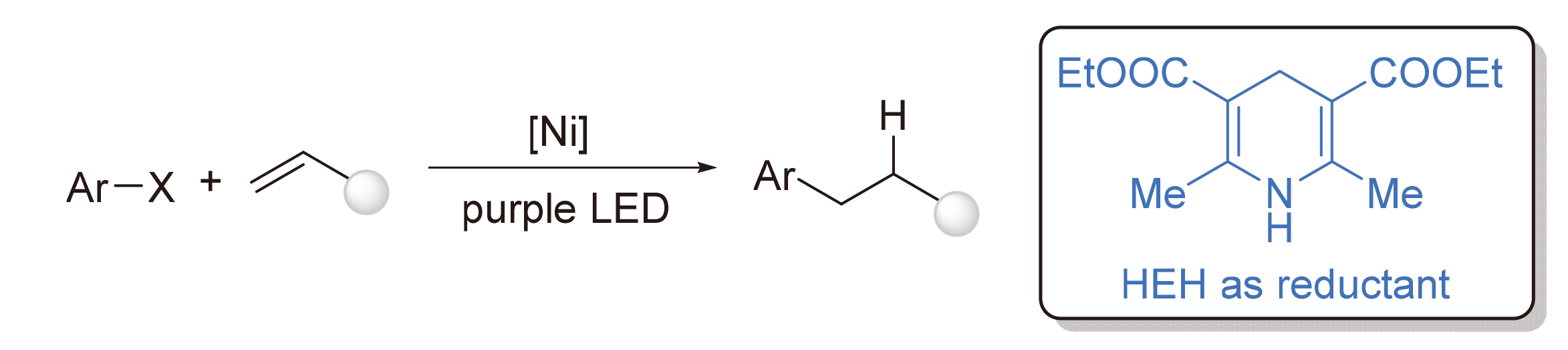
Reductive Heck reactions have emerged as a powerful tool for efficient construction of saturated C—C bonds,[1] which enable cross-coupling between aryl (pseudo)halides and alkenes followed by protonation or coupling with a hydride, while avoiding the use of highly reactive and air- sensitive organometallics. To this end, palladium-catalyzed reductive Heck reactions including asymmetric versions have been widely developed.[2] Unlike palladium, nickel is an earth-abundant, extremely cheap transition metal, which is more electropositive than palladium. In Heck reactions, the migration insertion of NiII species to alkenes is more favorable than Pd, while β-hydride elimination of alkyl nickel species is calculated to have higher barriers than Pd.[3] Thus, nickel has also been viewed as an efficient catalyst for reductive Heck reaction.[4] Recent progress has been achieved in the field of nickel-catalyzed reductive Heck cyclization.[5] And very recently, Zhou and co- workers[6] reported the first example of asymmetric intermolecular reductive Heck reaction by nickel catalysis. Despite of a progress achieved, the reductive Heck reactions require elevated temperatures and stoichiometric amounts of metal reductant such as Mn or Zn (Scheme 1, a), which results in a large disposal of metal waste and a high risk in practical synthesis. Therefore, further exploration of reductive Heck reaction under mild conditions without requirement of metallic reductants is highly desirable.
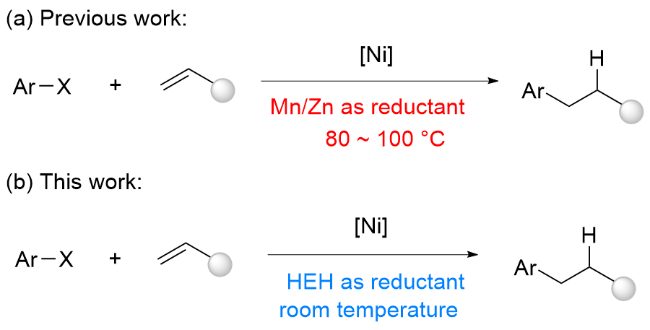
Compared to metal reductants, organic reductants are mild, cheap, and user environmentally friendly.[7] Taking advantage of photoexcited chemistry, a sort of organic reductants could be applied in metal-catalyzed reductive cross-coupling reactions to replace traditional metal reductants,[8] while the application in reductive Heck reaction remains underdeveloped. In this regard, our group has developed several examples of photo-assisted nickel-cataly- zed reductive cross-coupling in the aid of organic reductant, such as tertiary amine or Hantzsch ester (HEH).[9] Previously, we reported a photo-induced nickel-catalyzed reductive acyl-coupling without photoredox catalyst by using HEH as a potent organic reductant.[9c] Recently, Yang and co-workers[10] reported a photoexcited NiII-aryl complex- mediated Giese addition of aryl radicals to alkenes enabled by nickel/photoredox dual catalysis, in which HEH was used as reductant. Inspired by these works, we envisioned that the excited-state of HEH* [Eox(HEH•+/HEH*)=-2.28 V vs. SCE][11] could potentially reduce Ni(II) [Ered(NiII/Ni0)=-1.2 V vs. SCE][12] back to Ni(0) to furnish the catalytic cycle, meanwhile the protons releasing from HEH during the reductive process could protonate alkyl Ni(II) species to afford hydroarylation products. Herein, we reported the first photo-induced nickel-cataly- zed reductive Heck arylation of alkenes in the presence of HEH as organic reductant under extremely mild conditions (Scheme 1, b). HEH was identified as a unique bifunctional reagent which serves as a reductant and proton source. This method obviates the use of metal-based reductants and provides a complementary approach for reductive Heck reaction.
2 Results and discussion
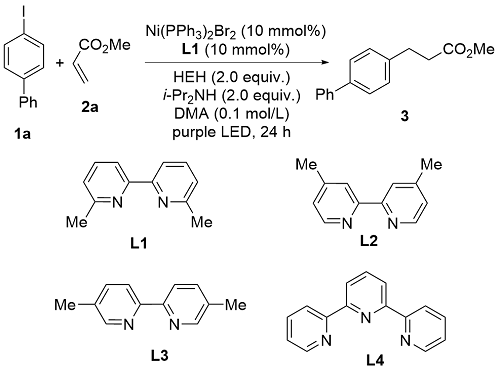
4-Iodo-1,1'-biphenyl (1a) and methyl acrylate (2a) were chosen as model substrate to test the hypothesis. To our delight, after a detailed survey of reaction conditions, the reductive Heck product 3 could be detected in 78% GC yield when performing the reaction in the presence of Ni(PPh3)2Br2 as catalyst, 6,6'-dmbpy (L1) as ligand, Hantzsch ester (HEH) as organic reductant, i-Pr2NH as base, in dimethyl adipate (DMA) under 1.5 W purple LED irradiation for 24 h (Table 1, Entry 1). Nickel catalyst has an important effect on the reactivity. Replacing Ni(PPh3)2- Br2 to other nickel sources led to decreased yields (Entries 2, 3). Interestingly, the direct use of Ni0 precatalyst such as Ni(cod)2 could also give 65% yield (Entry 3). Ligand screening showed that the bipyridyl ligand bearing di-ortho-methyl substituents is critical to the reaction as moving methyl group to para or meta position resulted in very low efficiency (Entries 4, 5). The use of terpyridyl ligand L4 largely decreased the reactivity (Entry 6). The survey of different solvents indicated that N,N-dimethyl- formamide (DMF), dimethyl sulfoxide (DMSO), and tetrahydrofuran (THF) were all inferior to the reaction (Entries 7~9). The purple light was important for the reaction process as using 456 nm blue LED irradiation led to no reaction (Entry 10). Control experiments suggested that nickel, ligand, purple light, and base were all indispensable for the reductive Heck reaction (Entry 11).
With the optimized reaction conditions in hand, we started to examine the substrate scope. First, the substrate scope of electron-deficient alkenes was investigated (Table 2). Acrylates bearing methyl (3), ethyl (4), isopropyl (5), tert-butyl (6), benzyl (7), isobutyl (8) and cyclohexyl (9) substituent reacted smoothly, affording the corresponding products in good yields (66%~80% isolated yields). Besides, phenyl acrylate (10), allyl acrylate (11), and 2- methoxyethyl acrylate (12) were all valid substrates. Gratifyingly, methyl methacrylate reacted as well (13). Moreover, acrylonitrile (14) was also proven to be a valid substrate for the nickel-catalyzed reductive Heck reaction. While acrylamides reacted with largely decreased yields. Unfortunately, acrolein, α,β-unsaturated ketones, β-sub- stituted or α,β-disubstituted acrylates were incompatible to the standard conditions.
Table 1 Optimization of the reaction conditionsa |
| Entry | Deviation from the standard condition | Yieldb/% |
|---|---|---|
| 1 | None | 78 |
| 2 | NiBr2 | 22 |
| 3 | Ni(cod)2 | 65 |
| 4 | L2 | Trace |
| 5 | L3 | 16 |
| 6 | L4 | 30 |
| 7 | DMF | 57 |
| 8 | DMSO | 24 |
| 9 | THF | Trace |
| 10 | 456 nm blue LED | 0 |
| 11 | No Ni, ligand, HEH, base, or light | 0 |
a Unless otherwise noted, the reaction was carried out at 0.1 mmol scale with 1a (0.1 mmol), 2a (0.2 mmol); b Yields were determined by GC with n-tride- cane as an internal standard. |
Table 2 Substrate scope of alkenesa |

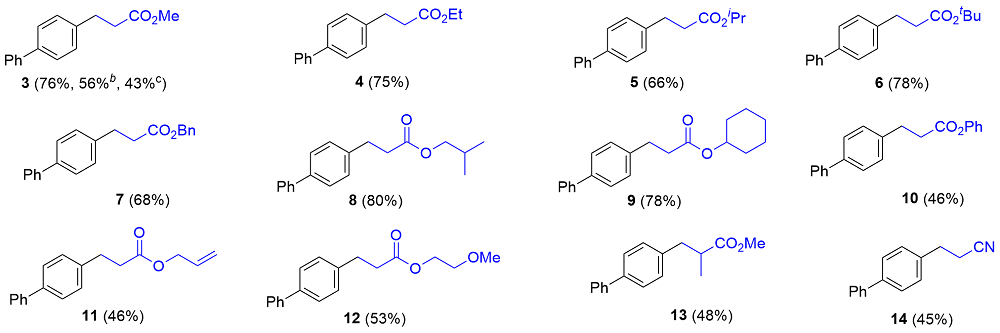 |
a All reactions were carried out at 0.2 mmol scale with 1a (0.2 mmol), 2 (0.4 mmol, 2.0 equiv). Isolated yields were provided. b Aryl bromide was used. c Aryl triflate was used. |
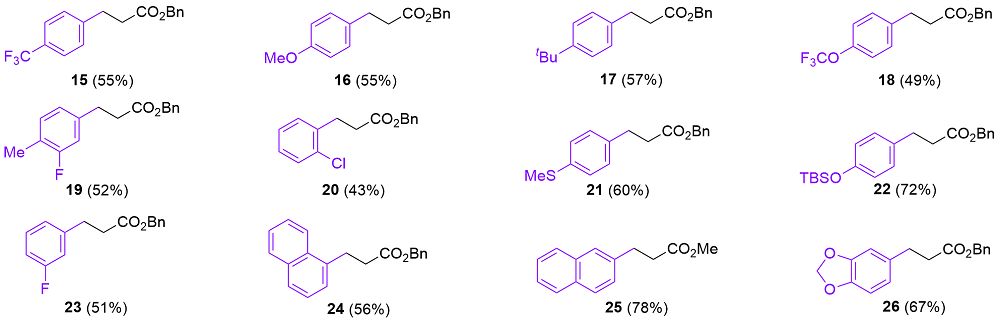
Next, the scope generality of aryl halides was investigated (Table 3). Aryl iodides with different electronic and steric natures of substituents have no significant influence on the reactivity. Aryl iodides irrespective of para, meta, or ortho substituents all successfully engaged in the reaction. Not only electron-withdrawing groups but also electron-donating groups were reacted smoothly, affording desired products in moderate to good yields (15~23). The reaction tolerated a variety of functional groups, such as CF3 (15), OCF3 (18), fluoride (19, 23), chloride (20), thioether (21), and tert-butyldimethylsilyl ether (OTBS) (22).
Table 3 Substrate scope of aryl halidesa |

 |
a All reactions were carried out at 0.2 mmol scale with 1 (0.2 mmol), 2 (0.4 mmol, 2.0 equiv). Isolated yields were provided. |
Besides of phenyl iodides, 1-iodonaphthalene and 2-iodo- naphthalene were proven to be suitable substrates (24, 25). Presumably due to the steric hindrance effect, ortho-sub- stituted aryl iodides provided generally lower reactivity (20 and 24). Gratifyingly, heteroaryl halide, such as 5-iodo- benzo[d][1,3]dioxole (26) was also successfully participated in the reaction to give the expected product in good yield. Besides of aryl iodides, aryl bromides and aryl triflates were valid substrates.
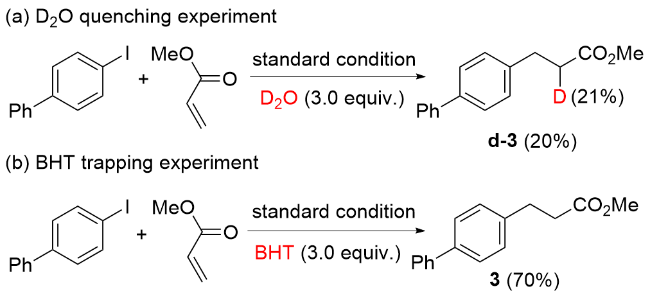
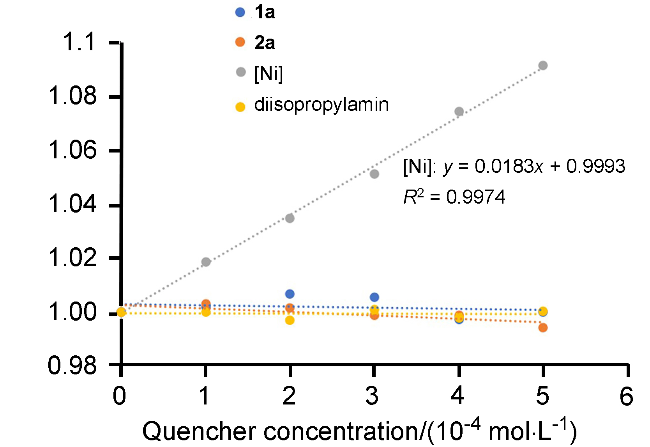
In order to give an insight into the mechanism, the related mechanistic experiments were carried out. when D2O was added, 20% yield of deuterated reductive Heck product d-3 was isolated with 21% deuterium incorporation (Scheme 2). The low deuterium incorporation might be contributed to the competitive protonation by HE. This result indicated the formation of C—Ni bond adjacent to the ester group by reductive Heck reaction of 1a and 2a. Moreover, the radical-trapping experiment was performed with butylated hydroxytoluene (BHT) as a radical inhibitor, while the reaction still proceeded smoothly without detection of aryl radical-trapped adducts by HRMS (Scheme 2), suggesting that the radical pathway was most unlikely involved. The Stern-Volmer quenching experiments were performed and the results revealed that the oxidative quenching of the excited state of HEH* by nickel catalyst was existed in the reaction system, suggesting a single electron-transfer (SET) between HEH* and NiII (Figure 1).
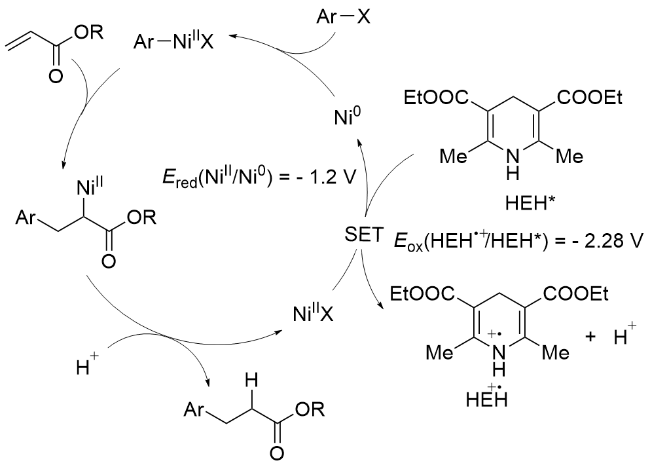
Based on the experimental results, a plausible mechanism was proposed in Scheme 3. The ground-state of HEH was irradiated by purple light to reach its excited state HEH*, which is a strong reductant that can potentially reduce NiII to Ni0. Then Ni0 undergoes oxidative addition with aryl halide to get aryl-NiII species, followed by migration insertion of alkenes to form α-carbonyl NiII species. Final single electron reduction of the resulting NiII by HEH* regenerates Ni0 to complete the catalytic cycle.


3 Conclusions
In summary, a photo-induced nickel-catalyzed reductive Heck reaction of aryl halides with electron-deficient alkenes under very mild conditions was developed. Hantzsch ester (HEH) was disclosed as a mild organic reductant to replace traditionally used metal reductants for reductive Heck reaction. The photoexcited state of HEH* possessing strong reductive potential can reduce NiII back to Ni0 to furnish the catalytic cycle. The reaction shows relatively broad scope of aryl halides and tolerates a variety of functional groups.
4 Experimental section
4.1 General Information
The HRMS analyses were performed on a BRUKER FT-ICR-MS SolariX 7T instrument with ESI mode. GC analyses were performed on a Shimadzu GC 2010 Pro instrument with n-tridecane as an internal standard to calculate GC yields. 1H NMR and 13C NMR spectra were recorded in CDCl3 on Bruker AV600 and Bruker AV400 instruments, respectively. Thin layer chromatography (TLC) employed glass 0.25 mm silica gel plates. Flash chromatography columns were packed with 200~300 mesh silica gels using the indicated solvents.
4.2 Experimental method
The reactions were set up in an N2 filled glovebox. An oven-dried vial equipped with a stir-bar was added aryl halides (0.20 mmol, 1.0 equiv.), Hantzsch ester (0.40 mmol, 2.0 equiv.), 6,6'-dmbpy (20 µmol, 0.10 equiv.) and Ni(PPh3)2Br2 (20 µmol, 0.10 equiv.). Then, DMA (0.10 mol/L, 2.0 mL), i-Pr2NH (0.40 mmol, 2.0 equiv.) and alkenes (0.40 mmol, 2.0 equiv.) were added. The vial was sealed and removed from the glovebox, then irradiated with a 1.5 W purple LED lamp (at approximately 1.0 cm away from the light source) with cooling from a fan for 24 h. The reaction was quenched by H2O, and extracted with ethyl acetate (20 mL×3). The combined organic layers were washed with brine, dried with Na2SO4, filtered, and concentrated in vacuo. Then the residue was purified by flash chromatography (petroleum ether/ethyl acetate, V∶V=100∶1~50∶1) to give the corresponding product.
Methyl 3-([1'-biphenyl]-4-yl)propanoate (3): 36.5 mg, 76% yield, colorless oil. 1H NMR (600 MHz, Chloroform- d) δ: 7.60~7.59 (m, 2H), 7.55~7.54 (m, 2H), 7.46~7.43 (m, 2H), 7.36~7.34 (m, 1H), 7.30~7.29 (m, 2H), 3.71 (s, 3H), 3.02 (t, J=8.0 Hz, 2H), 2.70 (t, J=8.0 Hz, 2H); 13C NMR (151 MHz, Chloroform-d) δ: 173.44, 141.03, 139.72, 139.37, 128.85, 128.82, 127.36, 127.24, 127.11, 51.76, 35.74, 30.67; HRMS (ESI) calcd for C16H17O2 (M+H)+ 241.1223, found 241.1225.
Ethyl 3-([1'-biphenyl]-4-yl)propanoate (4): 38.1 mg, 75% yield, colorless oil. 1H NMR (400 MHz, Chloroform-d) δ: 7.65~7.63 (m, 2H), 7.60~7.58 (m, 2H), 7.51~7.47 (m, 2H), 7.41~7.37 (m, 1H), 7.35~7.33 (m, 2H), 4.21 (q, J=7.2 Hz, 2H), 3.06 (t, J=8.0 Hz, 2H), 2.72 (t, J=8.0 Hz, 2H), 1.31 (t, J=7.2 Hz, 3H); 13C NMR (101 MHz, Chloroform-d) δ: 172.95, 141.02, 139.76, 139.28, 128.81 (2C), 127.28, 127.19, 127.06, 60.52, 35.94, 30.67, 14.30; HRMS (ESI) calcd for C17H18O2Na (M+Na)+ 277.1199, found 277.1208.
Isopropyl 3-([1'-biphenyl]-4-yl)propanoate (5): 35.4 mg, 66% yield, colorless oil. 1H NMR (600 MHz, Chloroform-d) δ: 7.64~7.63 (m, 2H), 7.59~7.57 (m, 2H), 7.49~7.47 (m, 2H), 7.38~7.37 (m, 1H), 7.34~7.33 (m, 2H), 5.10~5.06 (m, 1H), 3.05 (t, J=8.0 Hz, 2H), 2.69 (t, J=8.0 Hz, 2H), 1.28~1.27 (m, 6H); 13C NMR (151 MHz, Chloroform-d) δ: 172.51, 141.05, 139.81, 139.25, 128.85, 128.82, 127.26, 127.19, 127.08, 67.84, 36.26, 30.75, 21.92; HRMS (ESI) calcd for C18H20O2Na (M+Na)+ 291.1356, found 291.1355.
tert-Butyl 3-([1'-biphenyl]-4-yl)propanoate (6): 44.0 mg, 78% yield, colorless oil. 1H NMR (600 MHz, Chloroform-d) δ: 7.63~7.61 (m, 2H), 7.57~7.56 (m, 2H), 7.49~7.45 (m, 2H), 7.39~7.36 (m, 1H), 7.33~7.31 (m, 2H), 3.00 (t, J=8.0 Hz, 2H), 2.62 (t, J=8.0 Hz, 2H), 1.48 (s, 9H); 13C NMR (151 MHz, Chloroform-d) δ: 172.38, 141.12 140.02, 139.20, 128.88, 128.84, 127.24, 127.20, 127.11, 80.52, 37.14, 30.87, 28.21; HRMS (ESI) calcd for C19H23O2 (M+H)+ 283.1693, found 283.1687.
Benzyl 3-([1'-biphenyl]-4-yl)propanoate (7): 43.0 mg, 68% yield, colorless oil. 1H NMR (600 MHz, Chloroform-d) δ: 7.64~7.62 (m, 2H), 7.58~7.56 (m, 2H), 7.50~7.46 (m, 2H), 7.42~7.35 (m, 6H), 7.32~7.30 (m, 2H), 5.18 (s, 2H), 3.07 (t, J=8.0 Hz, 2H), 2.78 (t, J=8.0 Hz, 2H); 13C NMR (151 MHz, Chloroform-d) δ: 172.77, 141.01, 139.58, 139.32, 136.00, 128.83 (2C), 128.64, 128.32 (2C), 127.31, 127.22, 127.08, 66.40, 35.91, 30.67; HRMS (ESI) calcd for C22H21O2 (M+H)+ 317.1356, found 317.1345.
Isobutyl 3-([1'-biphenyl]-4-yl)propanoate (8): 45.1 mg, 80% yield, colorless oil. 1H NMR (600 MHz, Chloroform-d) δ: 7.64~7.63 (m, 2H), 7.59~7.58 (m, 2H), 7.50~7.47 (m, 2H), 7.40~7.38 (m, 1H), 7.35~7.34 (m, 2H), 3.93 (d, J=6.5 Hz, 2H), 3.07 (t, J=8.0 Hz, 2H), 2.74 (t, J=8.0 Hz, 2H), 2.01~1.94 (m, 1H), 0.98 (d, J=6.5 Hz, 6H); 13C NMR (151 MHz, Chloroform-d) δ: 173.04, 141.05, 139.74, 139.30, 128.82, 128.80, 127.30, 127.19, 127.08, 70.71, 35.93, 30.74, 27.79, 19.15; HRMS (ESI) calcd for C19H22O2Na (M+Na)+305.1512, found 305.1522.
Cyclohexyl 3-([1'-biphenyl]-4-yl)propanoate (9): 48.1 mg, 78% yield, colorless oil. 1H NMR (600 MHz, Chloroform-d) δ: 7.65~7.63 (m, 2H), 7.59~7.58 (m, 2H), 7.50~7.47 (m, 2H), 7.40~7.37 (m, 1H), 7.35~7.34 (m, 2H), 4.86~4.84 (m, 1H), 3.06 (t, J=8.0 Hz, 2H), 2.71 (t, J=8.0 Hz, 2H), 1.88~1.87 (m, 2H), 1.77~1.76 (m, 2H), 1.60~1.58 (m, 1H), 1.47~1.40 (m, 4H), 1.34~1.30 (m, 1H); 13C NMR (151 MHz, Chloroform-d) δ: 172.42, 141.04, 139.80, 139.22, 128.81, 128.79, 127.23, 127.15, 127.05, 72.76, 36.25, 31.68, 30.77, 25.45, 23.79; HRMS (ESI) calcd for C21H25O2 (M+H)+309.1849, found 309.1850.
Phenyl 3-([1'-biphenyl]-4-yl)propanoate (10): 27.8 mg, 46% yield, colorless oil. 1H NMR (600 MHz, Chloroform-d) δ: 7.64~7.63 (m, 2H), 7.61~7.59 (m, 2H), 7.49~7.47 (m, 2H), 7.42~7.38 (m, 5H), 7.27~7.25 (m, 1H), 7.08~7.06 (m, 2H), 3.16 (t, J=8.0 Hz, 2H), 2.97 (t, J=8.0 Hz, 2H); 13C NMR (151 MHz, Chloroform-d) δ: 171.54, 150.78, 141.03, 139.56, 139.35, 129.55, 128.99, 128.90, 127.46, 127.31, 127.16, 125.96, 121.67, 36.08, 30.71; HRMS (ESI) calcd for C21H19O2 (M+H)+ 303.1380, found 303.1395.
Allyl 3-([1'-biphenyl]-4-yl)propanoate (11): 24.5 mg, 46% yield, colorless oil. 1H NMR (600 MHz, Chloroform-d) δ: 7.61~7.60 (m, 2H), 7.56~7.55 (m, 2H), 7.47~7.45 (m, 2H), 7.37~7.35 (m, 1H), 7.32~7.29 (m, 2H), 5.96~5.91 (m, 1H), 5.34~5.25 (m, 2H), 4.63~4.62 (m, 2H), 3.04 (t, J=8.0 Hz, 2H), 2.74 (t, J=8.0 Hz, 2H); 13C NMR (151 MHz, Chloroform-d) δ: 172.69, 141.08, 139.69, 139.41, 132.28, 128.88 (2C), 127.39, 127.27, 127.15, 118.42, 65.34, 35.93, 30.70; HRMS (ESI) calcd for C18H18O2Na (M+Na)+ 289.1199, found 289.1187.
2-Methoxyethyl 3-([1'-biphenyl]-4-yl)propanoate (12): 30.1 mg, 53% yield, colorless oil. 1H NMR (600 MHz, Chloroform-d) δ: 7.63~7.61 (m, 2H), 7.57~7.56 (m, 2H), 7.48~7.46 (m, 2H), 7.38~7.36 (m, 1H), 7.33~7.32 (m, 2H), 4.30~4.24 (m, 2H), 3.62~3.61 (m, 2H), 3.41 (s, 3 H), 3.05 (t, J=8.0 Hz, 2H), 2.77 (t, J=8.0 Hz, 2H); 13C NMR (151 MHz, Chloroform-d) δ: 172.95, 141.00, 139.64, 139.29, 128.83, 128.81, 127.29, 127.19, 127.06, 70.53, 63.61, 59.04, 35.73, 30.59; HRMS (ESI) calcd for C18H21O3 (M+H)+ 285.1485, found 285.1496.
Methyl 3-([1'-biphenyl]-4-yl)-2-methylpropanoate (13): 24.4 mg, 48% yield, colorless oil. 1H NMR (600 MHz, Chloroform-d) δ: 7.62~7.61 (m, 2H), 7.56~7.55 (m, 2H), 7.48~7.45 (m, 2H), 7.38~7.35 (m, 1H), 7.28~7.27 (m, 2H), 3.70 (s, 3H), 3.13~3.09 (m, 1H), 2.85~2.79 (m, 1H), 2.77~2.74 (m, 1H), 1.24~1.23 (m, 3H); 13C NMR (151 MHz, Chloroform-d) δ: 176.67, 141.05, 139.36, 138.59, 129.50, 128.86, 127.24, 127.21, 127.11, 51.75, 41.52, 39.45, 16.96; HRMS (ESI) calcd for C17H18O2Na (M+Na)+ 277.1199, found 277.1209.
3-([1'-Biphenyl]-4-yl)propanenitrile (14): 18.6 mg, 45% yield, colorless oil. 1H NMR (600 MHz, Chloroform-d) δ: 7.57~7.53 (m, 4H), 7.44~7.40 (m, 2H), 7.34~7.31 (m, 1H), 7.28~7.26 (m, 2H), 2.94 (t, J=8.0 Hz, 2H), 2.59 (t, J=8.0 Hz, 2H); 13C NMR (151 MHz, Chloroform-d) δ: 140.61, 140.16, 137.12, 128.84, 128.75, 127.56, 127.40, 127.04, 119.22, 31.17, 19.28; HRMS (ESI) calcd for C15H13NNa (M+Na)+ 230.0940, found 230.0943.
Benzyl 3-(4-(trifluoromethyl)phenyl)propanoate (15): 33.9 mg, 55% yield, colorless oil. 1H NMR (600 MHz, Chloroform-d) δ: 7.56~7.35 (m, 2H), 7.39~7.36 (m, 3H), 7.33~7.32 (m, 4H), 5.15 (s, 2H), 3.06 (t, J=8.0 Hz, 2H), 2.74 (t, J=8.0 Hz, 2H); 13C NMR (151 MHz, Chloroform-d) δ: 172.37, 144.57, 135.86, 128.80, 128.69, 128.67 (q, JC-F=33.2 Hz), 128.44, 128.40, 125.54 (q, JC-F=4.5 Hz), 124.38 (q, JC-F=271.8 Hz), 66.56, 35.50, 30.79; 19F NMR (565 MHz, Chloroform-d)) δ: -62.35 ; HRMS (ESI) calcd for C17H15F3O2Na (M+Na)+ 331.0916, found 331.0933.
Benzyl 3-(4-methoxyphenyl)propanoate (16): 29.7 mg, 55% yield, colorless oil. 1H NMR (600 MHz, Chloroform-d) δ: 7.40~7.34 (m, 5H), 7.15~7.14 (m, 2H), 6.86~6.85 (m, 2H), 5.15 (s, 2H), 3.82 (s, 3H), 2.96 (t, J=8.0 Hz, 2H), 2.70 (t, J=8.0 Hz, 2H); 13C NMR (151 MHz, Chloroform-d) δ: 172.89, 158.18, 136.06, 132.56, 129.36, 128.63, 128.31, 128.29, 114.00, 66.33, 55.33, 36.30, 30.21; HRMS (ESI) calcd for C17H19O3 (M+H)+ 271.1329, found 271.1333.
Benzyl 3-(4-(tert-butyl)phenyl)propanoate (17): 33.8 mg, 57% yield, colorless oil. 1H NMR (600 MHz, Chloroform-d) δ: 7.44~7.39 (m, 7H), 7.23~7.21 (m, 2H), 5.21 (s, 2H), 3.05 (t, J=8.0 Hz, 2H), 2.77 (t, J=8.0 Hz, 2H), 1.41 (s, 9H); 13C NMR (151 MHz, Chloroform-d) δ: 172.91, 149.12, 137.41, 136.06, 128.61, 128.30, 128.26, 128.04, 125.46, 66.32, 35.94, 34.44, 31.47, 30.48; HRMS (ESI) calcd for C20H25O2 (M+H)+ 297.1849, found 297.1858.
Benzyl 3-(4-(trifluoromethoxy)phenyl)propanoate (18): 31.8 mg, 49% yield, colorless oil. 1H NMR (600 MHz, Chloroform-d) δ: 7.39~7.33 (m, 5H), 7.24~7.22 (m, 2H), 7.15~7.14 (m, 2H), 5.15 (s, 2H), 3.01 (t, J=8.0 Hz, 2H), 2.72 (t, J=8.0 Hz, 2H); 13C NMR (151 MHz, Chloroform-d) δ: 172.52, 147.84, 139.23, 135.92, 129.76, 128.69, 128.42, 128.40, 121.16, 120.62 (q, JC-F=256.7 Hz), 66.52, 35.80, 30.32; 19F NMR (565 MHz, Chloroform-d) δ: -57.89; HRMS (ESI) calcd for C17H16F3O3 (M+H)+ 325.1049, found 325.1065.
Benzyl 3-(3-fluoro-4-methylphenyl)propanoate (19): 28.3 mg, 52% yield, colorless oil. 1H NMR (600 MHz, Chloroform-d) δ: 7.41~7.36 (m, 5H), 7.13~7.11 (m, 1H), 6.91~6.89 (m, 2H), 5.17 (s, 2H), 2.98 (t, J=8.0 Hz, 2H), 2.72 (t, J=8.0 Hz, 2H), 2.29 (s, 3H); 13C NMR (151 MHz, Chloroform-d) δ: 172.55, 161.33 (d, JC-F=244.6 Hz), 140.10 (d, JC-F=6.0 Hz), 135.96, 131.45 (d, JC-F=5.4 Hz), 128.62, 128.32, 128.25, 123.71 (d, JC-F=3.0 Hz), 122.58 (d, JC-F=18.1 Hz), 114.99 (d, JC-F=22.6Hz), 66.40, 35.74, 30.37, 14.22 (d, JC-F=3.0 Hz); 19F NMR (565 MHz, Chloroform-d) δ: -117.63; HRMS (ESI) calcd for C17H17- FO2Na (M+Na)+ 295.1105, found 295.1101.
Benzyl 3-(2-chlorophenyl)propanoate (20): 23.6 mg, 43% yield, colorless oil. 1H NMR (600 MHz, Chloroform-d) δ: 7.40~7.35 (m, 6H), 7.26 ~7.25 (m, 1H), 7.20~7.19 (m, 2H), 5.16 (s, 2H), 3.13 (t, J=8.0 Hz, 2H), 2.75 (t, J=8.0 Hz, 2H); 13C NMR (151 MHz, Chloroform-d) δ: 172.63, 138.06, 136.00, 134.07, 130.60, 129.68, 128.67, 128.34 (2C), 127.98, 127.02, 66.45, 34.06, 29.05; HRMS (ESI) calcd for C16H16ClO2 (M+H)+ 275.0833, found 275.0833.
Benzyl 3-(4-(methylthio)phenyl)propanoate (21): 34.3 mg, 60% yield, colorless oil. 1H NMR (600 MHz, Chloroform-d) δ: 7.41~7.33 (m, 5H), 7.23~7.21 (m, 2H), 7.16~7.14 (m, 2H), 5.15 (s, 2H), 2.97 (t, J=8.0 Hz, 2H), 2.70 (t, J=8.0 Hz, 2H), 2.50 (s, 3H); 13C NMR (151 MHz, Chloroform-d) δ: 172.69, 137.48, 136.07, 135.96, 128.94, 128.63, 128.30 (2C), 127.16, 66.37, 35.92, 30.48, 16.22; HRMS (ESI) calcd for C17H19O2S (M+H)+ 287.1100, found 287.1124.
Benzyl 3-(4-((tert-butyldimethylsilyl)oxy)phenyl)pro-panoate (22): 53.3 mg, 72% yield, colorless oil. 1H NMR (600 MHz, Chloroform-d) δ: 7.39~7.34 (m, 5H), 7.07~7.05 (m, 2H), 6.78~6.76 (m, 2H), 5.14 (s, 2H), 2.93 (t, J=8.0 Hz, 2H), 2.68 (t, J=8.0 Hz, 2H), 1.01 (s, 9H), 0.21 (s, 6H); 13C NMR (151 MHz, Chloroform-d) δ: 172.99, 154.15, 136.09, 133.20, 139.31, 128.68, 128.34 (2C), 120.14, 66.37, 36.31, 30.32, 25.82, 18.32, -4.30; HRMS (ESI) calcd for C22H31O3Si (M+H)+ 371.2037, found 371.2016.
Benzyl 3-(3-fluorophenyl)propanoate (23): 26.3 mg, 51% yield, colorless oil. 1H NMR (600 MHz, Chloroform- d) δ: 7.40~7.35 (m, 5H), 7.29~7.25 (m, 1H), 7.01~7.00 (m, 1H), 6.95~6.93 (m, 2H), 5.16 (s, 2H), 3.01 (t, J=8.0 Hz, 2H), 2.73 (t, J=8.0 Hz, 2H); 13C NMR (151 MHz, Chloroform-d) δ: 172.48, 162.99 (d, JC-F=246.1 Hz), 143.02 (d, JC-F=8.5 Hz), 135.91, 120.3 (d, JC-F=8.5 Hz), 128.66, 128.36, 128.34, 124.05 (d, JC-F=3.0 Hz), 115.32 (d, JC-F=21.4 Hz), 113.28 (d, JC-F=21.4 Hz), 66.48, 35.60, 30.69; 19F NMR (565 MHz, Chloroform-d) δ: -113.34; HRMS (ESI) calcd for C16H15FO2Na (M+Na)+ 281.0948, found 281.0955.
Benzyl 3-(naphthalen-1-yl)propanoate (24): 32.5 mg, 56% yield, colorless oil. 1H NMR (600 MHz, Chloroform-d) δ: 8.14~8.12 (m, 1H), 7.96~7.95 (m, 1H), 7.83~7.82 (m, 1H), 7.63~7.56 (m, 2H), 7.49~7.41 (m, 7H), 5.25 (s, 2H), 3.55 (t, J=8.0 Hz, 2H), 2.92 (t, J=8.0 Hz, 2H); 13C NMR (151 MHz, Chloroform-d) δ: 172.85, 136.43, 135.97, 133.93, 131.65, 128.93, 128.60, 128.27 (2 C), 127.20, 126.13, 126.01, 125.65, 125.62, 123.43, 66.38, 35.20, 28.13; HRMS (ESI) calcd for C20H18O2Na (M+ Na)+ 313.1199, found 313.1208.
Methyl 3-(naphthalen-2-yl)propanoate (25): 33.4 mg, 78% yield, colorless oil. 1H NMR (600 MHz, Chloroform-d) δ: 7.87~7.83 (m, 3H), 7.70~7.70 (m, 1H), 7.53~7.47 (m, 2H), 7.40~7.38 (m, 1H), 3.73 (s, 3H), 3.18 (t, J=8.0 Hz, 2H), 2.78 (t, J=8.0 Hz, 2H); 13C NMR (151 MHz, Chloroform-d) δ: 173.39, 138.08, 133.67, 132.24, 128.21, 127.70, 127.59, 127.03, 126.53, 126.10, 125.47, 51.71, 35.68, 31.16; HRMS (ESI) calcd for C14H15O2 (M+H)+ 215.1067, found 215.1070.
Benzyl 3-(benzo[d][1,3]dioxol-5-yl)propanoate (26): 38.1 mg, 67% yield, colorless oil. 1H NMR (600 MHz, Chloroform-d) δ: 7.40~7.35 (m, 5H), 6.76~6.67 (m, 3H), 5.94 (s, 2H), 5.16 (s, 2H), 2.93 (t, J=8.0 Hz, 2H), 2.68 (t, J=8.0 Hz, 2H); 13C NMR (151 MHz, Chloroform-d) δ: 172.68, 147.70, 146.02, 135.99, 134.25, 128.60, 128.28 (2C), 121.19, 108.86, 108.30, 100.88, 66.32, 36.25, 30.76; HRMS (ESI) calcd for C17H16O4Na (M+Na)+ 307.0941, found 307.0943.
Supporting Information Tables of condition optimization, procedure for control experiments, UV-Vis absorption spectroscopic measurements, 1H NMR, 13C NMR and 19F NMR spectra of all products. The Supporting Information is available free of charge via the Internet at http://sioc-journal.cn.
(Zhao, C.)