



1 Introduction
Chronic obstructive pulmonary disease (COPD) is a prevalent condition marked by chronic inflammation of the respiratory system.[1] It results from inhaling harmful particles, particularly tobacco smoke and pollutants, along with genetic, developmental, and social factors.[2] COPD is characterized by chronic respiratory symptoms[3] and airflow limitations[4] that are not fully reversible and tend to progress over time. Exposure to harmful particles or gases leads to abnormalities in the airways or alveoli, resulting in respiratory discomfort and restricted airflow.[5] The primary clinical symptoms include dyspnea, persistent cough, and sputum production.[6] Globally, COPD is the leading cause of death and disability.[7]
Research indicates that the pathogenesis of COPD is closely linked to oxidative stress and nitrification stress.[8] This is evidenced by decreased plasma antioxidant capacity, diminished anti-nitrification ability, and a reduction in the number of sulfhydryl groups in proteins.[9] Fudosteine enhances intracellular thiol levels, effectively scavenging reactive oxygen species and neutralizing oxidants,[10] which subsequently inhibits the expression of inflammatory genes. It has been shown to be effective in treating both stable COPD and acute exacerbations with minimal side effects.[11] Since the early 1980s, new medications have emerged with generic drugs initially used as phlegm regulators for cough and bronchitis associated with mucus obstruction.[12] Recent studies have suggested that steins may also be beneficial in treating chronic respiratory conditions, such as emphysema, tuberculosis, and bronchiectasis.[13] Stein medications typically consist of one or two blocked sulfhydryl groups, except for mecysteine hydrochloride, which contains one unblocked group.[14] In the liver, these medications interact with disulfide bonds in mucin, processed by liver microsomal enzymes, leading to the formation of three active free sulfhydryl groups.[15] This process disrupts the molecular structure of mucus, facilitating its dissolution.[16]
Fudosteine has a beneficial effect on the treatment of both stable and acute exacerbations of COPD with minimal side effects.[17] It primarily reduces phlegm by enhancing the breakdown of disulfide bonds in mucin found in sputum and other secretions, while also lowering the expression of the epithelial mucin gene (MUC5AC).[18] The expression of MUC5AC is considered a rate-limiting factor in the development of goblet cells;[19] thus, inhibiting its expression can effectively prevent excessive goblet cell proliferation in the respiratory tract.[20] In studies conducted by Komatsu et al.,[21] an animal model of airway inflammation induced by endotoxin and antigen was used to evaluate the role of Fudosteine. The results indicated that Fudosteine significantly reduced the counts of neutrophils, goblet cells, and eosinophils in bronchoalveolar lavage fluid, which are all contributors to inflammation.[22] Given Fudosteine favorable pharmacological profile, including strong efficacy, low side effects, and broad indications, this study aims to design and develop new COPD drugs with enhanced anti-inflammatory activity and improved free radical scavenging capabilities.
2 Results and discussion
2.1 Design strategy of compounds
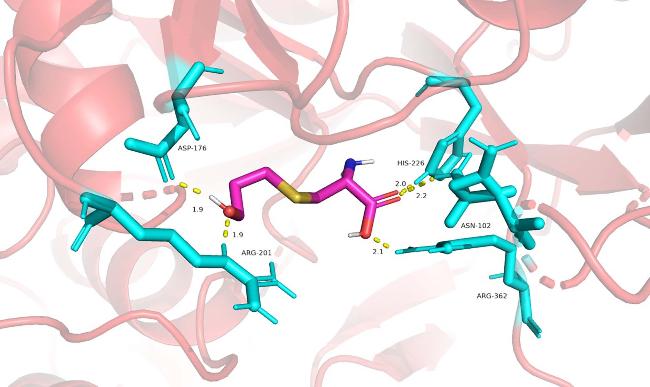
The literature indicates that sulfonamide structures are widely utilized in pharmaceutical development and metal complex research.[23] Drug compounds containing sulfonamide fragments exhibit promising biological activities, including anti-tumor,[24] anti-inflammatory,[25] and anti- tuberculosis effects.[26] Cysteine (Cys), though not classified as an essential amino acid, benefits from the addition of amines to its N-terminus, which enhances its antioxidant and anti-inflammatory properties. Research by Rubio et al.[27] demonstrated that acetylcysteine effectively reduces elastase-induced emphysema in rat models. Additionally, Hu et al. synthesized several cysteine diamine analogues, some of which showed significant efficacy. Molecular docking studies of Fudosteine with MUC5AC (PDB code: 5ajo) revealed (Figure 1) that Fudosteine forms five hydrogen bonds with amino acids ASP-176, ARG-201, ASN- 106, ARG-362, and HIS-226. Its terminal hydroxyl group further establishes two additional hydrogen bonds with ASP-176A and ARG-201A. These findings suggest that Fudosteine may be an effective treatment option for COPD.
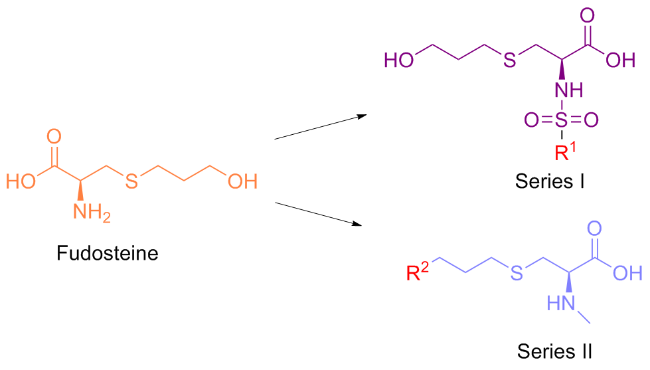
In this study, Fudosteine served as the lead compound for structural modifications. The derivatives with substituents R1 and R2 were further explored to identify candidates with enhanced free radical scavenging and anti-inflam- matory properties. As shown in Scheme 1, sulfonamide derivatives (Series I) and amine derivatives were synthesized (Series II) by combining various sulfonamide and amine fragments with the lead compound.
2.2 Chemistry
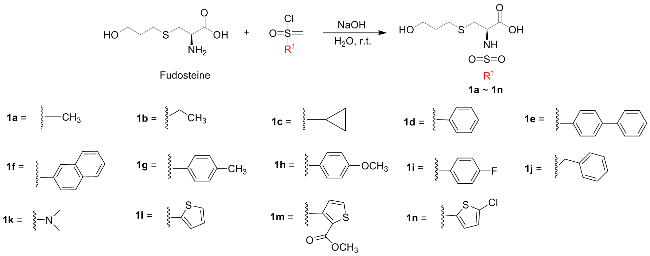
The general synthesis stages for Series I of Fudosteine derivatives are outlined in Scheme 2. The sulfonamide derivatives (1a~1n) were synthesized through a substitution reaction between Fudosteine and various sulfonyl chlorides in the presence of an acid binding agent. Given that Fudosteine contains hydroxyl groups, the chemical process can easily produce sulfonic acid esters as byproducts. To minimize this issue, sodium hydroxide is used as the alkali and water serves as the solvent, since sulfonates are prone to hydrolysis under strong alkaline conditions and Fudosteine is highly water-soluble.
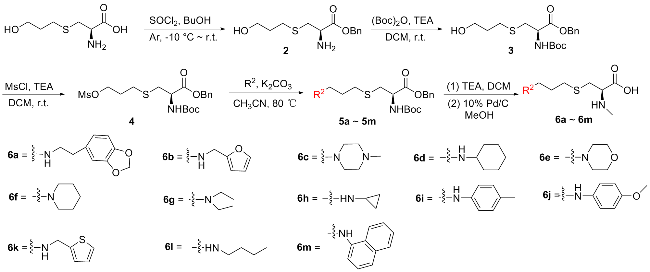
Fudosteine was utilized as the lead compound in the reaction with benzyl alcohol to produce compound 2. This product underwent protection using di-tert-butyl dicarbonate to yield compound 3. Subsequently, the terminal hydroxyl group was sulfonated with methyl sulfonyl chloride to obtain compound 4. Compound 4 generated through this three-step process served as a common intermediate for the terminal hydroxyl derivative of Fudosteine. It was then subjected to aminolysis reactions with various amines, resulting in a series of corresponding Fudosteine amine derivatives, as illustrated in Scheme 3, through a two-step removal process.
2.3 Structure-activity relationships of the compound
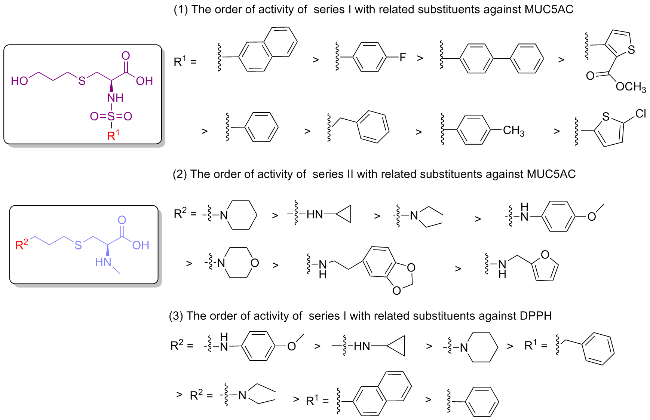
The results indicated that the various substituents in Fudosteine derivatives significantly influenced their activity with the activity order summarized in Scheme 4. The structure-activity relationships against MUC5AC and 2,2-diphenyl-1-picrylhydrazyl (DPPH) are as follows: (1) Generally, Series II amine compounds exhibit stronger MUC5AC protein inhibition and greater DPPH free radical scavenging activity compared to Series I sulfonamide derivatives. (2) Aliphatic amines showed superior activity compared to aromatic amines. (3) In contrast, sulfonamide derivatives displayed no activity. Notably, compound 1f demonstrated the highest overall activity. (4) Compound 6f exhibited exceptional anti-inflammatory and antioxidant properties, and all compounds displayed similar dual activity. However, compound 1f proved to be the most effective, with minimal impact on DPPH.
2.4 Biological
2.4.1 Inhibitory activity of Fudosteine derivatives against MUC5AC
The anti-secretory activity of MUC5AC protein in a tumour necrosis factor-α (TNF-α) induced human lung cancer cell line (NCI-H292) cell model was evaluated using synthetic derivatives 1a~1n and 6a~6m through enzyme linked immunosorbent assay (ELISA). The results are summarized in Table 1. Among the Fudosteine sulfona-mide derivatives, compounds 1f and 1i demonstrated significantly higher inhibition of MUC5AC protein compared to Fudosteine itself. In contrast, derivatives 1d, 1e, 1g, 1j, and 1m exhibited minimal activity. The half maximal inhibitory concentration (IC50) values for Fudosteine derivatives 6a~6m indicated that compounds 6e, 6f, 6g, 6h, and 6j had superior inhibitory effects on MUC5AC protein compared to the lead compound, Fudosteine (IC50=8.43 mmol/L), in the TNF-α-induced NCI-H292 cell model.
Table 1 Results of Fudosteine derivatives inhibiting MU5AC |
| Compd. | IC50/(mmol•L-1) | Compd. | IC50/(mmol•L-1) |
|---|---|---|---|
| 1a | >70 | 6a | 18.97 |
| 1b | >70 | 6b | 39.51 |
| 1c | >70 | 6c | >70 |
| 1d | 7.11 | 6d | >70 |
| 1e | 5.34 | 6e | 1.71 |
| 1f | 1.05 | 6f | 1.08 |
| 1g | 11.34 | 6g | 1.53 |
| 1h | >70 | 6h | 1.38 |
| 1i | 2.04 | 6i | >70 |
| 1j | 8.07 | 6j | 1.58 |
| 1k | >70 | 6k | >70 |
| 1l | >70 | 6l | >70 |
| 1m | 7.02 | 6m | >70 |
| 1n | 110.50 | Fudosteine | 8.43 |
2.4.2 Antioxidant capacity of Fudosteine derivatives
The IC50 values of DPPH test for Fudosteine derivatives indicate the free radical scavenging activity, with lower values reflecting greater antioxidant capability. The DPPH free radical scavenging abilities of each derivative alongside Fudosteine are presented in Table 2. The results reveal that all derivatives exhibited higher antioxidant capacity than Fudosteine. Among the Series I sulfonamides, compound 1g demonstrated the strongest DPPH scavenging activity, while compound 6j showed the highest antioxidant capacity in Series II.
Table 2 DPPH-scavenging action of Fudosteine and its analogues |
| Compd. | IC50/(mg•mL-1) | Compd. | IC50/(mg•mL-1) |
|---|---|---|---|
| 1a | 8.157 | 6a | 2.692 |
| 1b | 5.160 | 6c | 3.473 |
| 1c | 2.176 | 6d | 4.314 |
| 1d | 1.689 | 6e | 1.910 |
| 1e | 2.960 | 6f | 0.4976 |
| 1f | 1.439 | 6g | 1.009 |
| 1g | 0.320 | 6h | 0.01264 |
| 1h | 15.85 | 6i | 0.2314 |
| 1i | 3.889 | 6j | 0.003697 |
| 1j | 0.9764 | 6k | 1.138 |
| 1k | 2.137 | 6l | 0.9286 |
| 1l | 37.2 | 6m | 0.5969 |
| 1m | 6.212 | Fudosteine | 52.32 |
2.4.3 Inhibition of phosphodiesterase 4A (PDE4A1) enzyme by Fudosteine sulfonamide derivatives
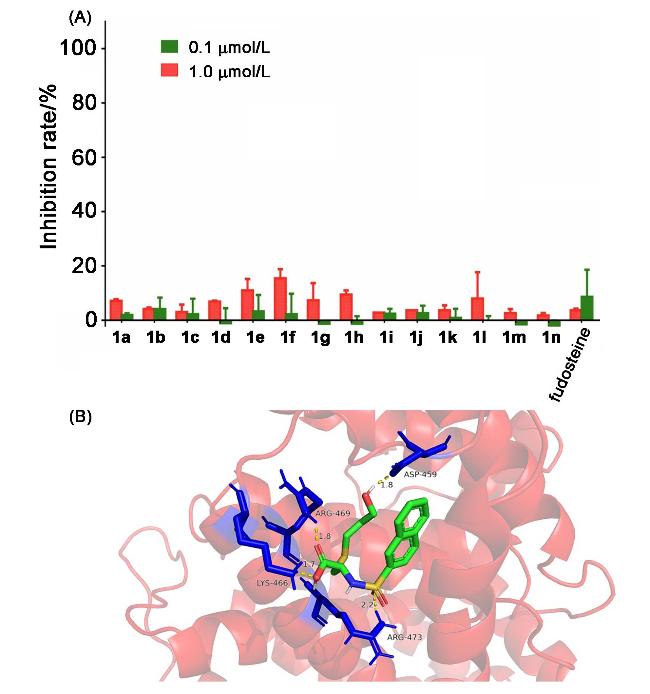
The inhibitory and antioxidant activities of Fudosteine sulfonamide derivatives on MUC5AC protein were generally limited, possibly because the anti-inflammatory effects of Series I derivatives may be mediated through alternative mechanisms. To further explore the anti-inflammatory potential of these derivatives, synthetic Fudosteine derivatives 1a~1n were tested for their inhibitory effects on the PDE4A enzyme. Phosphodiesterase (PDE) is encoded by 21 genes and generates over 100 distinct isomers with PDE4 specifically degrading cyclic 3',5'-adenosine monophosphate (cAMP).[28] Research has indicated that PDE4 nhibitors can effectively reduce inflammation in COPD.[29] The compounds were evaluated at doses of 1 and 0.1 μmol•L-1 using Fudosteine as a control. The experimental results are presented in Table 3 and Figure 2. At a concentration of 0.1 μmol•L-1, Fudosteine inhibited the PDE4A1 enzyme more effectively than its derivatives. Among the derivatives, 1l exhibited no significant inhibitory effect, while 1d, 1g, 1h, 1m, and 1n demonstrated negative inhi- bitory effects. At a concentration of 1 μmol•L-1, deriva- tives 2a, 2b, 1d, 2e, 1f, 1g, 1h, and 1l inhibited the PDE4A1 enzyme significantly better than the lead compound, Fudosteine. Derivatives 1c, 1j, and 1k showed comparable inhibition rates to Fudosteine. Notably, derivatives 1a, 1d, 1g, 1h, and 1l inhibited the enzyme at double the rate of Fudosteine with derivative 1e achieving three times the inhibition. The most potent inhibitor was derivative 1f, which exhibited five times the potency of Fudosteine. Molecular docking studies indicated that the binding free energy of 1f with PDE4A1 ProteinData Bank (PDB) (PDB code: 2QYK) is lower than that of Fudosteine with the same target. The interaction between 1f and PDE4A1 involves four hydrogen bonds: the carbonyl oxygen and amino hydrogen of 1f form hydrogen bonds with Gly315A and Glu606, respectively. Additionally, the naphthalene ring of 1f engages in hydrophobic interactions with Gln- 454A and Leu453A, while its alkyl side chain effectively binds to Arg469A and Phe461A.
Table 3 Inhibitory rate of Fudosteine series derivatives on PDE4A1 enzyme |
| Compd. | Inhibitory rate/% | |
|---|---|---|
| 1 μmol•L-1 | 0.1 μmol•L-1 | |
| 1a | 7.08 | 1.93 |
| 1b | 4.08 | 4.08 |
| 1c | 3.00 | 2.15 |
| 1d | 6.86 | -1.07 |
| 1e | 10.94 | 3.22 |
| 1f | 15.44 | 2.15 |
| 1g | 7.29 | -1.29 |
| 1h | 9.44 | -1.29 |
| 1i | 2.79 | 2.36 |
| 1j | 3.65 | 2.57 |
| 1k | 3.65 | 0.86 |
| 1l | 7.94 | 0 |
| 1m | 2.57 | -1.50 |
| Fudosteine | 3.65 | 8.58 |


3 Conclusions
Currently, there are significant gaps in the management of COPD. To develop therapeutic agents with low toxicity and high efficacy, two series of sulfonamide derivatives and Fudosteine amines were synthesized, enhancing their anti-inflammatory and antioxidant properties. Notably, compound 1f demonstrated superior PDE4 inhibitory and antioxidant activities compared to Fudosteine, while compound 6f exhibited a significantly greater inhibitory effect on MUC5AC protein than the lead compound. Additionally, 6f showed enhanced free radical scavenging ability. Molecular docking studies reveal that compounds 1f and 6f form bidentate hydrogen bonds and engage in hydrophobic interactions with various amino acid residues, which may contribute to their free radical scavenging capabilities. These findings offer new insights and highlight the potential of compound 6f for future COPD treatment development. However, its biological mechanisms remain to be fully elucidated. This article lays a theoretical foundation for ongoing research and development of medications for chronic obstructive pulmonary disease and serves as a valuable reference.
4 Experimental section
4.1 Biological activity detection
4.1.1 PDE4A1 enzyme inhibition rate
To prepare the carboxyfluorescein-cyclic adenosine mo- nophosphate phosphodiesterase IV (FAM-cAMP PDE IV) substrate working solution, 20 μL of FAM-adenosine cyclophosphatase was added to 1980 μL of PDE buffer. 25 μL of this mixture was dispensed into each well. The compound was dissolved in dimethyl sulfoxide (DMSO-d) to create a 10 mmol/L stock solution, which was then diluted with DMSO-d to obtain 100 and 10 μmol/L solutions. For the working solutions, 5 μL of each diluent was mixed with 45 μL of PDE buffer to achieve final concentrations of 10 and 1 μmol/L. Each experimental well received 5 μL of the compound solution, while the control wells received 5 μL of 10% DMSO-d in PDE buffer. The PDE4A1 recombinant enzyme stock solution was diluted to 0.0125 mg/L using PDE buffer, and 20 μL of this solution was added to all compound and vehicle control wells. For the blank control wells, 20 μL of PDE buffer was used. The reaction was conducted at room temperature for 1 h. Subsequently, 80 μL of glue was mixed with 7920 μL of adhesive diluent. After thorough mixing, 100 μL of this solution was added to each well and allowed to react at room temperature for another hour. Finally, the carboxyfluorescein-cyclic adenosine monophosphate phospho- diesterase IV (FP) is read from Envision. The original data computation formula is:
Inhibition rate (%)=(FPV-FPS)/(FPV-FPB)×100%
where FPS is sample FP, FPV is vehicle control FP, and FPB is blank control FP.
4.1.2 Inhibitory action of MUC5AC protein
NCI-H292 cells were fed and planted into 96-well plates with a density of 2×10⁴ cells per well. After the cells had adhered stably, the medications to be evaluated were introduced to each cell hole according to the experimental protocol and incubated for 2 h. TNF-α was spotted into each cell well at a final concentration of 20 g/L. The cell culture plate was placed in the cell incubator and incubated for 24 h. MUC5AC content in cell supernatant was determined using the MUC5AC kit.
MUC5AC in cell supernatant was identified using ELISA. The mother liquor solution of the compound was prepared using ultra-pure DMSO-d. The concentration of the first-stage mother liquor was 10 g/L, while that of the second-stage mother liquor was 1 g/L. The compound's concentration was determined to be 0.5, 1.0, 3.0, 9.0, and 20.0 g/L, with the final concentration of DMSO-d being 0.5%, 1.0%, 3.0%, 0.9%, and 2.0%. In the ELISA plate, 100 μL of supernatant from each cell culture plate was spotted and 10 μL of a 10×sample dilution was added to each well. The plate was then incubated at 4 ℃ for 24 h. The washing solution was used to clean the microplate five times. Each well received horseradish peroxidase (HRP)-conjugated secondary antibody, which was incubated for 30 min at room temperature. The washing solution was used to clean the microplate five times. The ELISA developer was added and 5~15 min was allowed to develop. Then, the termination liquid was added, and the absorbance was measured using a microplate reader.
Because of the considerable disparity in coating between ELISA plates, a blank control (3 replicates) was created for each. The statistical analysis began by comparing the statistical difference between the group with a drug concentration of 0 (BLANK group) and the lowest dose group (0.5 mg/mL), followed by the statistical difference between the lowest dose group (0.5 mg/mL) and the highest dose group (20 mg/mL). If the lowest dose group (0.5 mg/mL) was significantly lower than the BLANK group, it meant that the molecule must be active if there was no significant change in the lowest dose group (0.5 mg/mL) compared to the BLANK group. There was a significant difference between the highest dose group (20 mg/mL) and the lowest dose group (0.5 mg/mL), and the substance was still declared active. If there is no significant difference between the highest dose group (20 mg/mL) and the lowest dose group (0.5 mg/mL), the substance is termed inert.
The statistical analysis was carried out using GraphPad Prism (PRISM 5.0) and Origin 8.5 software. Results were presented as mean±standard deviation. The studentʼs t- test was used for statistical analysis of two sets of data, whereas the one-way analysis of variance (ANOVA) was employed for statistical analysis of multiple sets.
4.1.3 Assessment of DPPH free radical scavenging
The DPPH free radical solution was prepared in methanol to a final concentration of 3×10⁻³ mol/L.[28] Fudosteine served as the positive control for DPPH scavenging. Samples of 200 μL at various concentrations were added to 200 μL of the DPPH solution (3×10⁻³ mol/L) in methanol. The mixture was then incubated in the dark at 37 ℃ for 30 min, after which the absorbance was measured at 517 nm. Each experiment was conducted in triplicate.
The formula for calculating DPPH scavenging rate is:
DPPH scavenging rate (%)=[(Acont-Atest)/Acont]×100%
where Acont represents the absorbance of the control reaction and Atest is the absorbance of the test sample.
4.2 Chemistry
4.2.1 Materials and methods
Unless otherwise stated, all reagents and solvents are commercially available and can be used without additional treatment. 1H NMR and 13C NMR spectra were recorded on a Varian Unity Inova 400 MHz instrument at 400 MHz and 100 MHz, respectively. The chemical shift was determined using tetramethylsilane as an internal standard. HRMS spectra were acquired using a Bruker Daltonics ESI-BioTOF Q instrument. Column chromatography was carried out using silica gel (200~300 mesh). Thin layer chromatography was used to observe the reaction on a glass slide that had been covered with GF-254 silica gel. The apparatus and reagents used for biological activity determination are listed below: Thermo Scientific cell incubator; SpectraMax M5, Molecular Devices microplate reader; nCI-H292 cells from Shanghai Xinyu Biotechnology Co., Ltd.
4.2.2 Synthesis of compounds 1a~1c, 1i~1k and 1m
Fudosteine (1.00 g, 0.006 mol) was dissolved in 30 mL of water, sodium hydroxide (0.6 g, 0.015 mol) was added to dissolve, and methanesulfonyl chloride (0.64 g, 0.006 mol) was added in an ice bath. After the addition was done, the reaction was brought to room temperature. Thin-layer chromatography (TLC) monitoring indicated that the reaction was complete. The reaction solution was acidified with 2 mol/L hydrochloric acid to pH 2. After extraction with ethyl acetate, drying with anhydrous sodium sulfate, filtration, vacuum distillation and drying, white solid 1a was obtained with a yield of 38%. Compounds 1a~1c, 1i~1k and 1m were produced using a process identical to that used for 1a.
N-(Ethylsulfonyl)-S-(3-hydroxypropyl)-L-cysteine (1a): White solid, yield 38%. 1H NMR (400 MHz, DMSO-d6) δ: 4.01~3.96 (m, 1H), 3.44 (t, J=6.2 Hz, 2H), 3.01 (s, 4.5 Hz, 3H), 2.87~2.82 (m, 1H), 2.75~2.7 (m, 1H), 2.59 (t, J=7.4 Hz, 2H), 1.68~1.61 (m, 2H); 13C NMR (101 MHz, DMSO-d6) δ: 172.01, 59.32, 56.01, 41.21, 33.98, 32.36, 28.35. HRMS (ESI) calcd for C7H15NO5S2Na [M+Na]+ 280.0289, found 280.0294.
S-(3-Hydroxypropyl)-N-(propylsulfonyl)-L-cysteine (1b): White solid, yield 37%. 1H NMR (400 MHz, DMSO- d6) δ: 7.61 (d, J=6.5 Hz, 1H), 3.91 (d, J=5.5 Hz, 1H), 3.44 (t, J=6.2 Hz, 2H), 3.05~2.91 (m, 2H), 2.83 (dd, J=13.7, 5.7 Hz, 1H), 2.70 (dd, J=13.6, 7.9 Hz, 1H), 2.58 (t, J=7.3 Hz, 2H), 1.76~1.59 (m, 4H), 0.95 (t, J=7.4 Hz, 3H); 13C NMR (101 MHz, DMSO-d6) δ: 172.23, 59.41, 56.12, 54.39, 34.17, 32.44, 28.41, 16.97, 12.75. HRMS (ESI) calcd for C9H19NO5S2Na [M+Na]+ 308.0602, found 308.0598.
N-(Cyclopropylsulfonyl)-S-(3-hydroxypropyl)-L-cystei-ne (1c): White solid, yield 42%. 1H NMR (400 MHz, DMSO-d6) δ: 12.98 (s, 1H), 7.70 (d, J=9.0 Hz, 1H), 4.48 (s, 1H), 3.93 (dd, J=15.3, 7.4 Hz, 1H), 3.45 (t, J=6.2 Hz, 2H), 2.83 (dd, J=13.7, 6.3 Hz, 1H), 2.74 (dd, J=13.7, 7.5 Hz, 1H), 2.59 (t, J=7.3 Hz, 2H), 2.56~2.50 (m, 1H), 1.70~1.61 (m, 2H), 0.91 (dd, J=6.9, 4.3 Hz, 4H); 13C NMR (101 MHz, DMSO-d6) δ: 172.35, 59.49, 56.37, 34.13, 32.49, 30.80, 28.45, 5.29, 5.11. HRMS (ESI) calcd for C9H17NO5S2Na [M+Na]+ 306.0446, found 306.0462.
N-((4-Fluorophenyl)sulfonyl)-S-(3-hydroxypropyl)-L-cysteine (1i): White solid, yield 66%. 1H NMR (400 MHz, DMSO-d6) δ: 12.86 (s, 1H), 8.37 (d, J=8.7 Hz, 1H), 7.85 (dd, J=8.9, 5.2 Hz, 2H), 7.40 (t, J=8.9 Hz, 2H), 4.46 (s, 1H), 3.81 (dd, J=15.1, 7.5 Hz, 1H), 3.39 (t, J=6.2 Hz, 2H), 2.74 (dd, J=13.8, 6.3 Hz, 1H), 2.58 (dd, J=13.7, 7.5 Hz, 1H), 2.48~2.38 (m, 2H), 1.58~1.50 (m, 2H); 13C NMR (101 MHz, DMSO-d6) δ: 171.36, 162.97, 137.59, 129.77, 116.30, 59.37, 56.08, 33.71, 32.28, 28.25. HRMS (ESI) calcd for C12H16FNO5S2Na [M+Na]+ 360.0352, found 360.0408.
N-(Benzylsulfonyl)-S-(3-hydroxypropyl)-L-cysteine (1j): White solid, yield 52%. 1H NMR (400 MHz, DMSO-d6) δ: 13.02 (s, 1H), 7.68 (d, J=8.4 Hz, 1H), 7.39 (d, J=1.9 Hz, 2H), 7.36 (d, J=5.4 Hz, 2H), 7.35 (s, 1H), 4.49 (s, 1H), 4.41~4.31 (m, 2H), 3.95 (dd, J=15.0, 6.8 Hz, 1H), 3.45 (t, J=6.2 Hz, 2H), 2.80 (dd, J=13.7, 6.3 Hz, 1H), 2.69 (dd, J=13.7, 7.1 Hz, 1H), 2.57 (t, J=7.3 Hz, 2H), 1.64 (dt, J=13.1, 6.5 Hz, 2H); 13C NMR (101 MHz, DMSO-d6) δ: 172.17, 131.03, 130.25, 128.37, 128.13, 59.44, 58.78, 56.22, 34.01, 32.45, 28.46. HRMS (ESI) calcd for C13H19NO5S2Na [M+Na]+ 356.0602, found 356.0561.
N-(N,N-Dimethylsulfamoyl)-S-(3-hydroxypropyl)-L-cy-steine (1k): White solid, yield 36%. 1H NMR (400 MHz, DMSO-d6) δ: 7.77 (d, J=9.1 Hz, 1H), 3.86 (dd, J=14.9, 8.0 Hz, 1H), 3.50 (t, J=6.2 Hz, 2H), 2.85 (dd, J=13.6, 6.1 Hz, 1H), 2.76 (dd, J=13.6, 7.9 Hz, 1H), 2.71 (s, 6H), 2.62 (dd, J=13.7, 6.3 Hz, 2H), 1.74~1.66 (m, 2H); 13C NMR (101 MHz, DMSO-d6) δ: 172.39, 59.41, 56.76, 37.71, 33.81, 32.38, 28.40. HRMS (ESI) calcd for C8H18N2O5-S2Na [M+Na]+ 309.0555, found 309.0583.
S-(3-Hydroxypropyl)-N-((5-(methoxycarbonyl)thioph-en-3-yl)sulfonyl)-L-cysteine (1m): 1H NMR (400 MHz, DMSO-d6)) δ: 13.05 (s, 1H), 7.97 (d, J=5.2 Hz, 1H), 7.63 (d, J=8.3 Hz, 1H), 7.47 (d, J=5.2 Hz, 1H), 4.46 (s, 1H), 4.05 (dd, J=13.6, 6.8 Hz, 1H), 3.87 (s, 3H), 3.40 (t, J=6.2 Hz, 2H), 2.86~2.75 (m, 2H), 2.46 (d, J=7.8 Hz, 2H), 1.61~1.53 (m, 2H); 13C NMR (101 MHz, DMSO-d6) δ: 171.26, 160.36, 144.20, 132.00, 131.63, 130.18, 59.40, 56.12, 53.28, 34.19, 32.36, 28.37. HRMS (ESI) calcd for C12H17NO7S3Na [M+Na]+ 406.0065, found 406.0070.
4.2.3 Synthesis of compounds 1d~1h, 1l and 1n
Fudosteine (1.01 g, 0.006 mol) was dissolved in 30 mL water, sodium hydroxide (0.60 g, 0.015 mol) was added to dissolve, and benzenesulfonyl chloride (1.00 g, 0.006 mol) was added under ice bath conditions. After the addition was completed, the reaction was transferred to room temperature. After the reaction was completed, the reaction solution was acidified with 2 mol/L hydrochloric acid to pH=2 to precipitate white solids. The white solids were collected by filtration and collected, and then the white solids were beaten with ethyl acetate, filtered and dried to obtain white solids for 1d with a yield of 36%. Compounds 1d~1h, 1l and 1n were produced using a process identical to that used for 1d.
S-(3-Hydroxypropyl)-N-(phenylsulfonyl)-L-cysteine (1d): White solid, yield 36%. 1H NMR (400 MHz, DMSO- d6) δ: 12.82 (s, 1H), 8.29 (d, J=8.4 Hz, 1H), 7.80 (d, J=7.1 Hz, 2H), 7.62 (t, J=7.3 Hz, 1H), 7.56 (t, J=7.3 Hz, 2H), 4.46 (s, 1H), 3.80 (d, J=7.6 Hz, 1H), 3.38 (t, J=6.2 Hz, 2H), 2.72 (dd, J=13.7, 6.6 Hz, 1H), 2.60~2.51 (m, 1H), 2.47~2.35 (m, 2H), 1.59~1.47 (m, 2H); 13C NMR (101 MHz, DMSO-d6) δ: 171.43, 141.17, 132.55, 129.12, 126.65, 59.40, 56.10, 33.68, 32.29, 28.25. HRMS (ESI) calcd for C12H17NO5S2Na [M+Na]+ 342.0446, found 342.0438.
N-([1'-Biphenyl]-4-ylsulfonyl)-S-(3-hydroxypropyl)- L-cysteine (1e): White solid, yield 58%. 1H NMR (400 MHz, DMSO-d6) δ: 8.36 (d, J=8.5 Hz, 1H), 7.88 (d, J=9.1 Hz, 4H), 7.74 (d, J=7.2 Hz, 2H), 7.51 (t, J=7.5 Hz, 2H), 7.44 (t, J=7.3 Hz, 1H), 3.85 (dd, J=14.9, 7.1 Hz, 1H), 3.37 (t, J=6.2 Hz, 2H), 2.75 (dd, J=13.8, 6.5 Hz, 1H), 2.58 (dd, J=13.7, 7.3 Hz, 1H), 2.48~2.38 (m, 2H), 1.59~1.45 (m, 2H); 13C NMR (101 MHz, DMSO-d6) δ: 171.45, 143.94, 139.93, 138.63, 129.25, 128.60, 127.38, 127.23, 127.15, 59.37, 56.08, 33.66, 32.26, 28.25. HRMS (ESI) calcd for C18H21NO5S2Na [M+Na]+ 418.0759, found 418.0735.
S-(3-Hydroxypropyl)-N-(naphthalen-2-ylsulfonyl)-L-cy-steine (1f): Rice white solid, yield 50%. 1H NMR (400 MHz, DMSO-d6) δ: 12.82 (s, 1H), 8.42 (d, J=9.1 Hz, 2H), 8.12 (dd, J=18.1, 8.3 Hz, 2H), 8.03 (d, J=8.0 Hz, 1H), 7.83 (dd, J=8.7, 1.9 Hz, 1H), 7.75~7.60 (m, 2H), 4.42 (s, 1H), 3.87 (dd, J=15.5, 7.1 Hz, 1H), 3.33 (s, 2H), 2.73 (dd, J=13.7, 6.5 Hz, 1H), 2.55 (dd, J=13.7, 7.4 Hz, 1H), 2.38 (t, J=11.2 Hz, 2H), 1.53~1.35 (m, 2H); 13C NMR (101 MHz, DMSO-d6) δ: 171.41, 138.16, 134.29, 131.72, 129.34, 129.22, 128.78, 127.90, 127.59, 127.32, 122.66, 59.30, 56.11, 33.68, 32.19, 28.21. HRMS (ESI) calcd for C16H19NO5S2Na [M+Na]+ 392.0602, found 392.0577.
S-(3-Hydroxypropyl)-N-tosyl-L-cysteine (1g): White solid, yield 46%. 1H NMR (400 MHz, DMSO-d6) δ: 12.81 (s, 1H), 8.19 (d, J=8.6 Hz, 1H), 7.68 (d, J=8.3 Hz, 2H), 7.36 (d, J=8.0 Hz, 2H), 4.46 (s, 1H), 3.77 (dd, J=15.3, 7.0 Hz, 1H), 3.38 (t, J=6.2 Hz, 2H), 2.71 (dd, J=13.7, 6.7 Hz, 1H), 2.56~2.51 (m, 1H), 2.48~2.38 (m, 2H), 2.38 (s, 3H), 1.56~1.47 (m, 2H); 13C NMR (101 MHz, DMSO-d6) δ: 171.45, 142.78, 138.30, 129.55, 126.74, 59.42, 56.03, 33.63, 32.29, 28.24, 21.13. HRMS (ESI) calcd for C13H19- NO5S2Na [M+Na]+ 356.0602, found 356.0601.
S-(3-Hydroxypropyl)-N-((4-methoxyphenyl)sulfonyl)-L-cysteine (1h): White solid, yield 48%. 1H NMR (400 MHz, DMSO-d6) δ: 12.82 (s, 1H), 8.11 (d, J=8.6 Hz, 1H), 7.72 (d, J=8.9 Hz, 2H), 7.07 (d, J=9.0 Hz, 2H), 4.46 (s, 1H), 3.82 (s, 3H), 3.78~3.71 (m, 1H), 3.38 (t, J=5.9 Hz, 2H), 2.70 (dd, J=13.7, 6.8 Hz, 1H), 2.56~2.51 (m, 1H), 2.47~2.35 (m, 2H), 1.57~1.48 (m, 2H); 13C NMR (101 MHz, DMSO-d6) δ: 171.50, 162.27, 132.78, 128.91, 114.23, 59.41, 56.01, 55.75, 33.62, 32.30, 28.25. HRMS (ESI) calcd for C13H19NO6S2Na [M+Na]+ 372.0551, found 372.0571.
S-(3-Hydroxypropyl)-N-(thiophen-2-ylsulfonyl)-L-cys- teine (1l): White solid, yield 50%. 1H NMR (400 MHz, DMSO-d6) δ: 12.92 (s, 1H), 8.51 (d, J=8.4 Hz, 1H), 7.90 (dd, J=5.0, 1.4 Hz, 1H), 7.58 (dd, J=3.7, 1.4 Hz, 1H), 7.15 (dd, J=5.0, 3.7 Hz, 1H), 4.47 (s, 1H), 3.85 (q, J=7.3 Hz, 1H), 3.40 (t, J=6.2 Hz, 2H), 2.75 (dd, J=13.8, 6.5 Hz, 1H), 2.57 (dd, J=13.7, 7.4 Hz, 1H), 2.45 (td, J=7.1, 2.8 Hz, 2H), 1.60~1.52 (m, 2H); 13C NMR (101 MHz, DMSO-d6) δ: 171.32, 141.96, 132.70, 131.88, 127.60, 59.39, 56.23, 33.51, 32.29, 28.28. HRMS (ESI) calcd for C10H15NO5S3Na [M+Na]+ 348.0010, found 348.0062.
N-((5-Chlorothiophen-2-yl)sulfonyl)-S-(3-hydroxypro-pyl)-L-cysteine (1n): 1H NMR (400 MHz, DMSO-d6) δ: 13.00 (s, 1H), 8.71 (d, J=8.4 Hz, 1H), 7.47 (d, J=4.0 Hz, 1H), 7.22 (d, J=4.0 Hz, 1H), 4.47 (s, 1H), 3.87 (dd, J=14.0, 7.7 Hz, 1H), 3.41 (t, J=5.9 Hz, 2H), 2.79 (dd, J=13.8, 5.9 Hz, 1H), 2.62 (dd, J=13.8, 7.9 Hz, 1H), 2.49~2.43 (m, 2H), 1.63~1.52 (m, 2H); 13C NMR (101 MHz, DMSO-d6) δ: 171.25, 140.49, 134.57, 131.74, 127.81, 59.41, 56.27, 33.64, 32.31, 28.36. HRMS (ESI) calcd for C10H14ClNO5S3Na [M+Na]+ 381.9620, found 381.9627.
4.2.4 Synthesis of compound 2
Under argon protection, benzyl alcohol (43.00 mL, 413 mmol, 15 equiv.) was added to a three-necked round-bottom flask and cooled to -10 ℃. Subsequently, thionyl chloride (6.00 mL, 82.60 mmol, 3 equiv.) was slowly added drop by drop to the reaction system at -10 ℃. The temperature of the reaction system was controlled not to exceed 0 ℃. After the addition of Fudosteine (5.00 g, 27.90 mmol, 1 equiv.), the reaction was slowly heated to 60 ℃ and refluxed for 2 h. The excess thionyl chloride was removed by vacuum distillation to obtain a yellow oily liquid. The yellow oily liquid was separated and purified by column chromatography (dichloromethane/methanol, V∶V=100∶1) to obtain yellow oily substance benzyl S- (3-hydroxypropyl)-L-cysteinate (2) with a yield of 51%. 1H NMR (400 MHz, CDCl3) δ: 7.39~7.30 (m, 5H), 5.16 (d, J=4.1 Hz, 2H), 3.70 (d, J=7.1 Hz, 1H), 3.53 (t, J=6.1 Hz, 2H), 2.87 (ddd, J=20.6, 13.4, 5.8 Hz, 2H), 2.62 (t, J=7.2 Hz, 2H), 1.86 (s, 2H); 13C NMR (101 MHz, CDCl3) δ: 173.4, 135.3, 128.7, 67.1, 54.7, 36.3, 32.6, 29.8.
4.2.5 Synthesis of compound 3
Compound 2 (5.00 g, 18.6 mmol, 1 equiv.) was dissolved in dichloromethane and added to a three-necked round-bottom flask below 0 ℃, and triethylamine (5.15 mL, 372 mmol, 2 equiv.) was slowly added. After dropping, Boc anhydride (6.49 g, 29.7 mmol) was added. The ice bath was then removed and the reaction mixture was stirred at room temperature for 10 h until the TLC detection reaction is complete. The reaction solution was washed three times with saturated sodium carbonate solution and saturated sodium chloride, respectively, dried with anhydrous sodium sulfate, concentrated under reduced pressure, and purified by silica gel column (petroleum ether/ethyl acetate, V∶V=5∶1) to obtain yellow oil benzyl N-(tert-butoxycarbonyl)-S-(3-hydroxypropyl)-L-cy- steinate (3) with a yield of 50%. 1H NMR (400 MHz, CDCl3) δ: 7.61~7.06 (m, 5H), 5.17 (q, J=12.2 Hz, 2H), 4.56 (dd, J=13.2, 5.5 Hz, 1H), 3.74~3.55 (m, 2H), 2.93 (ddd, J=19.8, 13.9, 5.4 Hz, 2H), 2.68~2.50 (m, 2H), 1.74 (tq, J=14.2, 7.2 Hz, 2H), 1.42 (s, 9H); 13C NMR (101 MHz, CD3OD) δ: 171.28, 156.31, 135.67, 128.17, 127.92, 79.46, 59.98, 53.89, 33.11, 27.26. HRMS (ESI) calcd for C18H27NO5S [M+Na]+ 392.1610, found 392.1548.
4.2.6 Synthesis of compound 4
Under the protection of argon, compound 3 (6.00 g, 16.30 mmol, 1 equiv.) was dissolved in dichloromethane and added to a three-necked round-bottom flask at 0 ℃, and then triethylamine (11.33 mL, 81 mmol, 5 equiv.) was slowly added. After dropping, methylsulfonyl chloride (5.00 mL, 65 mmol, 4 equiv.) was slowly added. The ice bath was removed, and the reaction mixture was stirred at 25 ℃ for 2.5 h. The reaction was completely detected by TLC. The sulfonate was filtered out, dissolved in dichloromethane, washed with saturated sodium chloride, dried with anhydrous sodium sulfate, and finally separated and purified by silica gel column (petroleum ether/ethyl acetate, V∶V=5∶1) to obtain yellow oil benzyl N-(tert- butoxycarbonyl)-S-(3-((methylsulfonyl)oxy)propyl)-L-cy-steinate (4) with a yield of 99%. 1H NMR (400 MHz, CDCl3) δ: 7.45~7.27 (m, 5H), 5.26~5.11 (m, 2H), 4.54 (t, J=16.7 Hz, 1H), 4.34~4.15 (m, 2H), 3.08~2.85 (m, 5H), 2.70~2.48 (m, 2H), 2.03~1.85 (m, 2H), 1.43 (s, 9H); 13C NMR (101 MHz, CDCl3) δ: 170.65, 155.09, 135.13, 128.60, 128.32, 80.09, 68.01, 67.39, 53.51, 37.22, 34.33, 28.65, 28.17. HRMS (ESI) calcd for C19H29NO7S2 [M+Na]+ 470.1385, found 470.1274.
4.2.7 Synthesis of compounds 5d~5m
Compound 4 (0.50 g, 1.10 mmol, 1 equiv.), potassium carbonate (0.36 g, 2.60 mmol, 3 equiv.), KI (0.56 g, 3.40 mmol, 0.1 equiv.), and piperonylamine (0.25 mL, 2.2 mmol, 1.2 equiv.) were dissolved in acetonitrile and added to a three-necked round-bottom flask. The reaction mixture was refluxed at 80 ℃ until the TLC detection reaction was complete. The compound was isolated and purified by silica gel column chromatography (petroleum ether/ethyl acetate, V∶V=3∶1) to obtain yellow oil 5a with a yield of 94%. Similarly, compounds 5b~5m were prepared.
Benzyl S-(3-((2-(benzo[d][1,3]dioxol-5-yl)ethyl)amino)- propyl)-N-(tert-butoxycarbonyl)-D-cysteinate (5a): 1H NMR (400 MHz, CDCl3) δ: 7.45~7.25 (m, 5H), 6.73~6.62 (m, 3H), 5.90 (d, J=5.6 Hz, 3H), 5.22~5.06 (m, 2H), 3.73~3.58 (m, 1H), 2.97~2.38 (m, 12H), 1.70 (td, J=14.5, 7.3 Hz, 2H); 13C NMR (101 MHz, CDCl3) δ: 173.4, 147.9, 146.6, 135.3, 130.4, 128.7, 128.3, 121.7, 109.0, 108.5, 101.0, 67.1, 54.7, 49.6, 46.4, 36.3, 32.6, 29.8, 25.9.
Benzyl N-(tert-butoxycarbonyl)-S-(3-((furan-2-ylmeth- yl)amino)propyl)-L-cysteinate (5b): Yellow oil, yield 67%. 1H NMR (400 MHz, CDCl3) δ: 7.47~7.18 (m, 6H), 6.33~6.25 (m, 1H), 6.14 (d, J=3.0 Hz, 1H), 5.16 (d, J=8.7 Hz, 2H), 4.65~4.47 (m, 1H), 3.73 (s, 2H), 2.94 (d, J=4.8 Hz, 2H), 2.63 (t, J=6.1 Hz, 2H), 2.52 (t, J=7.2 Hz, 2H), 1.68 (dt, J=14.4, 7.2 Hz, 2H), 1.42 (s, 9H); 13C NMR (101 MHz, CDCl3) δ: 171.1, 155.3, 153.8, 141.8, 135.2, 128.7, 110.2, 106.9, 80.1, 67.4, 53.6, 47.4, 46.0, 34.5, 30.5, 29.5, 28.4.
Benzyl N-(tert-butoxycarbonyl)-S-(3-(4-methylpipera- zin-1-yl)propyl)-L-cysteinate (5c): Yellow oily substance, yield 71%. 1H NMR (400 MHz, CDCl3) δ: 7.43~7.17 (m, 5H), 5.14 (q, J=12.3 Hz, 2H), 4.53 (d, J=6.4 Hz, 1H), 2.90 (d, J=17.7 Hz, 2H), 2.66~2.07 (m, 15H), 1.71~1.61 (m, 2H), 1.40 (s, 9H); 13C NMR (101 MHz, CDCl3) δ: 171.0, 155.2, 135.2, 128.8, 80.1, 67.4, 57.1, 55.1, 53.5, 53.2, 46.1, 34.6, 30.6, 28.4, 26.8.
Benzyl N-(tert-butoxycarbonyl)-S-(3-(cyclohexylami- no)propyl)-L-cysteinate (5d): Yellow oil, yield 75%. 1H NMR (400 MHz, CDCl3) δ: 7.57~7.12 (m, 5H), 5.17 (q, J=12.3 Hz, 2H), 4.55 (s, 1H), 2.95 (s, 2H), 2.58 (dt, J=48.9, 7.0 Hz, 4H), 2.37 (t, J=10.3 Hz, 1H), 1.84 (d, J=11.5 Hz, 2H), 1.78~1.62 (m, 4H), 1.57~1.31 (m, 9H), 1.29~0.92 (m, 6H); 13C NMR (101 MHz, CDCl3) δ: 171.1, 135.3, 128.8, 67.5, 56.9, 53.6, 45.7, 34.64, 33.1, 30.8, 30.3, 28.4, 26.3, 25.2.
Benzyl N-(tert-butoxycarbonyl)-S-(3-morpholinopro- pyl)-L-cysteinate (5e): Yellow oily substance, yield 58%. 1H NMR (400 MHz, CDCl3) δ: 7.42~7.20 (m, 5H), 5.15 (q, J=12.3 Hz, 2H), 4.52 (s, 1H), 3.75 (s, 4H), 2.94 (s, 2H), 2.65~2.32 (m, 8H), 1.84~1.71 (m, 2H), 1.41 (s, 9H); 13C NMR (151 MHz, CDCl3) δ: 170.99, 155.16, 135.11, 128.60, 128.49, 128.37, 80.17, 67.28, 66.84, 57.29, 53.65, 53.52, 34.59, 30.50, 28.32, 26.37.
Benzyl N-(tert-butoxycarbonyl)-S-(3-(piperidin-1-yl)- propyl)-L-cysteinate (5f): Yellow oil, yield 66%. 1H NMR (400 MHz, CDCl3) δ: 7.45~7.23 (m, 5H), 5.26~5.07 (m, 2H), 4.55 (d, J=6.1 Hz, 1H), 2.97 (t, J=15.9 Hz, 2H), 2.56~2.18 (m, 8H), 1.74~1.64 (m, 2H), 1.59~1.35 (m, 15H); 13C NMR (151 MHz, CDCl3) δ: 171.02, 155.18, 135.24, 128.59, 128.46, 128.37, 80.06, 67.14, 57.79, 54.58, 53.50, 34.42, 30.83, 28.26, 26.82, 25.91, 24.30.
Benzyl N-(tert-butoxycarbonyl)-S-(3-(dimethylamino)- propyl)-L-cysteinate (5g): Yellow oil, yield 88%. 1H NMR (400 MHz, CDCl3) δ: 7.30 (d, J=32.7 Hz, 5H), 5.17 (q, J=12.4 Hz, 2H), 4.56 (s, 1H), 2.96 (s, 2H), 2.60~2.20 (m, 8H), 1.63 (t, J=14.1 Hz, 2H), 1.52~1.28 (m, 9H), 1.11~0.68 (m, 6H); 13C NMR (101 MHz, CDCl3) δ: 170.82, 155.20, 135.19, 128.18, 79.94, 66.80, 53.65, 50.95, 46.21, 34.06, 30.99, 28.28, 26.62, 12.23.
Benzyl N-(tert-butoxycarbonyl)-S-(3-(cyclopropylami- no)propyl)-L-cysteinate (5h): Yellow oil, yield 53%. 1H NMR (400 MHz, CDCl3) δ: 7.52~7.21 (m, 5H), 5.16 (q, J=12.3 Hz, 2H), 4.54 (s, 1H), 2.91 (t, J=16.4 Hz, 2H), 2.70 (t, J=6.9 Hz, 2H), 2.53 (dot, J=14.3, 6.9 Hz, 2H), 2.06 (dd, J=6.1, 2.5 Hz, 1H), 1.68 (dt, J=14.0, 7.0 Hz, 2H), 1.46 (d, J=30.4 Hz, 9H), 0.55~0.22 (m, 4H); 13C NMR (101 MHz, CDCl3) δ: 155.23, 135.17, 128.46, 128.34, 112.14, 79.83, 66.93, 54.21, 53.13, 36.13, 34.44, 30.76, 28.19, 26.67, 6.62.
Benzyl N-(tert-butoxycarbonyl)-S-(3-(p-tolylamino)pro- pyl)-L-cysteinate (5i): Yellow solid, yield 73%. 1H NMR (400 MHz, CDCl3) δ: 7.31 (d, J=38.5 Hz, 5H), 6.99 (d, J=8.0 Hz, 2H), 6.54 (d, J=8.0 Hz, 2H), 5.19 (q, J=12.2 Hz, 2H), 4.58 (s, 1H), 3.19 (dt, J=13.3, 6.8 Hz, 2H), 3.04~2.88 (m, 2H), 2.67~2.48 (m, 2H), 2.24 (s, 3H), 1.90~1.74 (m, 2H), 1.45 (s, 9H); 13C NMR (101 MHz, CDCl3) δ: 171.06, 155.29, 155.04, 145.71, 135.09, 129.67, 128.57, 128.53, 128.43, 126.68, 112.97, 80.05, 67.22, 53.34, 42.76, 34.58, 29.96, 28.72, 28.06, 20.39.
Benzyl N-(tert-butoxycarbonyl)-S-(3-((4-methoxyphen- yl)amino)propyl)-L-cysteinate (5j): Yellow oil, yield 68%. 1H NMR (400 MHz, CDCl3) δ: 7.31 (d, J=36.7 Hz, 5H), 6.84~6.48 (m, 4H), 5.18 (q, J=12.3 Hz, 2H), 4.58 (s, 1H), 3.74 (s, 3H), 3.14 (dd, J=16.9, 10.3 Hz, 2H), 3.04~2.89 (m, 2H), 2.68~2.50 (m, 2H), 1.89~1.74 (m, 2H), 1.36 (d, J=63.6 Hz, 9H); 13C NMR (101 MHz, CDCl3) δ: 170.85, 152.11, 142.08, 135.00, 128.61, 128.52, 128.37, 115.04, 114.21, 112.05, 79.83, 67.57, 55.67, 53.39, 43.41, 34.32, 29.90, 28.78, 28.14.
Benzyl N-(tert-butoxycarbonyl)-S-(3-((thiophen-2-yl- methyl)amino)propyl)-L-cysteinate (5k): Light yellow oily substance, yield 77%. 1H NMR (400 MHz, CDCl3) δ: 7.30 (d, J=35.3 Hz, 5H), 7.19 (d, J=4.2 Hz, 1H), 6.91 (dd, J=18.6, 11.4 Hz, 2H), 5.18 (q, J=12.2 Hz, 2H), 4.63~4.48 (m, 1H), 3.95 (s, 2H), 2.96 (s, 2H), 2.76~2.47 (m, 4H), 1.77~1.64 (m, 2H), 1.44 (s, 9H); 13C NMR (101 MHz, CDCl3) δ: 170.94, 155.02, 143.87, 135.10, 128.46, 128.38, 128.34, 126.67, 124.66, 124.32, 79.73, 67.34, 53.27, 47.78, 47.07, 34.64, 30.26, 29.33, 28.03.
Benzyl N-(tert-butoxycarbonyl)-S-(3-(butylamino)prop- yl)-L-cysteinate (5l): Light yellow oily substance, yield 74%. 1H NMR (400 MHz, CDCl3) δ: 7.30 (d, J=34.2 Hz, 4H), 5.17 (q, J=12.3 Hz, 2H), 4.56 (s, 1H), 2.95 (s, 2H), 2.70~2.44 (m, 6H), 1.70 (dd, J=13.8, 6.8 Hz, 2H), 1.43 (s, 9H), 1.34~1.22 (m, 2H), 0.99~0.77 (m, 3H); 13C NMR (101 MHz, CDCl3) δ: 170.61, 156.07, 151.43, 134.71, 128.32, 67.14, 53.45, 49.29, 47.67, 34.36, 31.47, 30.52, 28.98, 28.11, 20.53, 13.70.
Benzyl N-(tert-butoxycarbonyl)-S-(3-(naphthalen-1-yl- amino)propyl)-L-cysteinate(5m): Light yellow oily substance, yield 66%. 1H NMR (400 MHz, CDCl3) δ: 7.83 (dd, J=18.3, 7.9 Hz, 3H), 7.52~7.21 (m, 8H), 6.60 (d, J=7.4 Hz, 1H), 5.19 (dd, J=24.6, 12.2 Hz, 2H), 4.64 (s, 1H), 3.38 (dd, J=17.4, 11.2 Hz, 2H), 3.01 (dt, J=13.3, 7.6 Hz, 2H), 2.76~2.58 (m, 2H), 1.98 (dd, J=12.9, 6.4 Hz, 2H), 1.54 (d, J=62.3 Hz, 9H); 13C NMR (101 MHz, CDCl3) δ: 143.25, 142.14, 135.08, 134.40, 128.56, 126.36, 125.74, 124.89, 123.66, 120.90, 120.01, 119.00, 117.30, 117.16, 109.69, 104.22, 80.34, 67.41, 53.22, 42.63, 34.69, 30.35, 28.59, 28.34.
4.2.8 Synthesis of compounds 6a~6m
Compound 5a (0.61 g, 1.20 mmol, 1 equiv.) was dissolved in dichloromethane and added to a three-necked round bottom flask. Stirring at 0 ℃, trifluoroacetic acid (5.00 mL, 488 mmol, 41 equiv.) was added to the reaction system. The reaction mixture reacted at room temperature until the TLC detection reaction was complete. The reaction solution was concentrated under reduced pressure, added ethyl acetate (30 mL) to dissolve, washed with saturated sodium bicarbonate (15 mL×3). The organic layer was dried with anhydrous sodium sulfate, and concentrated under reduced pressure to obtain a yellow oily substance. 10% palladium-carbon (0.66 g) was added to the three- necked round bottom flask, and the air in the reaction flask was replaced with a double-row tube. The system was placed in an argon atmosphere, and then replaced with hydrogen for three times. Methanol was added to the hydrogen balloon and stirred at 35 ℃. The reaction system reacted in a hydrogen environment for 72 h, and the reaction was completely detected by TLC. The palladium- carbon was removed by filtration, and the filtrate was distilled in vacuo to obtain a yellow oil. Compound 6a was isolated and purified by silica gel column (dichloromethane/methanol, V∶V=20∶1) with a yield of 66%. Similarly, compounds 6b~6m were prepared.
S-(3-((2-(Benzo[d][1,3]dioxol-5-yl)ethyl)amino)propyl)-N-methyl-D-cysteine (6a): 1H NMR (400 MHz, DMSO-d6) δ: 6.78 (d, J=4.8 Hz, 2H), 6.63 (d, J=7.8 Hz, 1H), 5.93 (s, 2H), 3.55 (d, J=42.6 Hz, 4H), 3.05~2.53 (m, 12H), 1.67~1.52 (m, 2H); 13C NMR (101 MHz, DMSO-d6) δ: 174.6, 147.2, 145.4, 133.9, 121.4, 109.0, 108.1, 100.6, 54.5, 51.6, 50.9, 47.7, 36.34, 35.15, 29.54, 29.12. HRMS (ESI) calcd for C16H24N2O4S [M+H]+ 341.1530, found 341.1589.
S-(3-(Furan-2-ylmethyl)amino)propyl)-N-methyl-D-cys-teine (6b): Yellow oil, yield 49%. 1H NMR (400 MHz, DMSO-d6) δ: 7.52 (s, 1H), 6.28 (d, J=55.4 Hz, 2H), 3.82~3.55 (m, 4H), 3.61 (s, 2H),2.72 (td, J=13.2, 6.7 Hz, 6H), 1.60 (dt, J=13.6, 6.7 Hz, 2H); 13C NMR (101 MHz, DMSO-d6) δ: 173.97, 153.84, 141.80, 110.13, 106.91, 66.98, 54.36, 47.73, 46.13, 37.27, 30.44, 29.77. HRMS (ESI) calcd for C12H21N2O3S [M+H]+ 273.1267, found 273.1251.
N-Methyl-S-(3-(4-methylpiperazin-1-yl)propyl)-D-cys-teine (6c): Yellow oil, yield 52%. 1H NMR (400 MHz, CD3OD) δ: 3.74 (s, 3H), 3.69 (t, J=6.0 Hz, 1H), 2.97~2.43 (m, 12H), 2.37 (s, 3H), 1.83~1.75 (m, 2H); 13C NMR (101 MHz, CD3OD) δ: 175.29, 57.81, 55.31, 54.89, 53.25, 52.76, 45.60, 37.23, 30.99, 27.34. HRMS (ESI) calcd for C12H26N3O2S [M+H]+ 276.1740, found 276.1738.
S-(3-(Cyclohexylamino)propyl)-N-methyl-D-cysteine (6d): Yellow oil, yield 55%. 1H NMR (400 MHz, CD3OD) δ: 3.73 (dd, J=10.6, 3.0 Hz, 4H), 3.16~2.79 (m, 5H), 2.67 (t, J=6.8 Hz, 2H), 2.12 (s, 2H), 1.93 (dd, J=23.8, 16.4 Hz, 4H), 1.30 (ddd, J=33.0, 20.5, 10.8 Hz, 6H); 13C NMR (101 MHz, CD3OD) δ: 57.06, 54.31, 53.55, 43.09, 39.17, 35.44, 33.35, 29.00, 28.76, 28.62, 26.02, 25.78, 24.84, 24.69, 24.29, 24.06. HRMS (ESI) calcd for C13H27- N2O2S [M+H]+ 275.1788, found 275.1786.
N-Methyl-S-(3-morpholinopropyl)-D-cysteine (6e): Yel- low solid, yield 75%. m.p. 80~81 ℃; 1H NMR (400 MHz, CDCl3) δ: 3.74 (s, 3H), 3.65 (t, J=6.0 Hz, 1H) 3.55 (s, 4H), 2.94 (s, 2H), 2.65~2.32 (m, 8H), 1.84~1.71 (m, 2H); 13C NMR (101 MHz, CDCl3) δ: 170.98, 70.19, 67.43, 66.15, 60.19, 34.58, 30.31, 28.36, 25.55. HRMS (ESI) calcd for C11H23N2O3S [M+H]+ 263.1424, found 263.1420.
N-Methyl-S-(3-(piperidin-1-yl)propyl)-D-cysteine (6f): Yellow oil, yield 47%. 1H NMR (400 MHz, CDCl3) δ: 3.69 (s, 3H), 3.60 (dd, J=7.3, 4.7 Hz, 1H), 2.87 (dd, J=13.5, 4.6 Hz, 1H), 2.71 (dd, J=13.5, 7.5 Hz, 1H), 2.51 (t, J=7.3 Hz, 2H), 2.31 (t, J=7.2 Hz, 6H), 1.77~1.67 (m, 2H), 1.57~1.47 (m, 4H), 1.37 (s, 2H); 13C NMR (101 MHz, CDCl3) δ: 174.56, 58.03, 54.61, 54.19, 52.24, 37.36, 30.66, 26.95, 25.95, 24.43. HRMS (ESI) calcd for C11H23N2O3S [M+H]+ 261.1631, found 261.1634.
S-(3-(Dimethylamino)propyl)-N-methyl-D-cysteine (6g): Yellow oil, yield 67%. 1H NMR (400 MHz, CD3OD) δ: 3.83~3.58 (m, 4H), 2.87 (ddd, J=20.1, 13.6, 6.0 Hz, 2H), 2.64 (dq, J=27.7, 7.0 Hz, 8H), 1.79 (dt, J=14.7, 7.2 Hz, 2H), 1.11 (t, J=7.2 Hz, 6H); 13C NMR (101 MHz, CD3OD) δ: 175.44, 54.98, 52.65, 52.29, 47.93, 37.47, 31.09, 26.73, 10.97. HRMS (ESI) calcd for C11H25N2O2S [M+H]+ 249.1631, found 249.1634.
S-(3-(Cyclopropylamino)propyl)-N-methyl-D-cysteine (6h): Yellow oil, yield 54%. 1H NMR (400 MHz, CD3OD) δ: 3.74 (s, 3H), 3.65 (t, J=6.0 Hz, 1H), 2.95~2.49 (m, 6H), 2.15 (ddd, J=10.4, 6.9, 3.7 Hz, 1H), 1.83~1.73 (m, 2H), 0.58~0.27 (m, 4H); 13C NMR (101 MHz, CD3OD) δ: 175.4, 54.9, 52.6, 37.4, 31.1, 30.1, 5.9. HRMS (ESI) calcd for C10H21N2O2S [M+H]+ 233.1318, found 233.1316.
N-Methyl-S-(3-(p-tolylamino)propyl)-D-cysteine (6i): Yellow solid, yield 69%. m.p. 57~59 ℃; 1H NMR (400 MHz, CDCl3) δ: 6.98 (d, J=8.2 Hz, 2H), 6.54 (d, J=8.2 Hz, 2H), 3.88~3.50 (m, 4H), 3.31~3.11 (m, 2H), 3.01~2.56 (m, 4H), 2.23 (s, 3H), 1.94~1.80 (m, 2H); 13C NMR (101 MHz, CDCl3) δ: 174.5, 145.8, 129.7, 126.6, 113.0, 54.2, 52.3, 42.9, 37.3, 30.2, 29.1, 20.4. HRMS (ESI) calcd for C14H23N2O2S [M+H]+ 283.1475, found 283.1473.
S-(3-((4-Methoxyphenyl)amino)propyl)-N-methyl-D-cy-steine (6j): Yellow solid, yield 70%. m.p. 59~61 ℃; 1H NMR (400 MHz, CDCl3) δ: 6.67 (dd, J=77.4, 8.7 Hz, 4H), 3.79~3.56 (m, 7H), 3.26~3.06 (m, 2H), 3.01~2.69 (m, 2H), 2.73~2.55 (m, 2H), 2.32 (s, 3H), 1.86 (p, J=6.8 Hz, 2H); 13C NMR (101 MHz, CDCl3) δ: 174.5, 152.1, 142.3, 114.9, 114.1, 55.8, 54.2, 52.3, 43.6, 37.2, 30.2, 29.2. HRMS (ESI) calcd for C14H23N2O3S [M+H]+ 299.1424, found 299.1425.
N-Methyl-S-(3-((thiophen-2-ylmethyl)amino)propyl)-D-cysteine (6k): Yellow oil, yield 72%. 1H NMR (400 MHz, CDCl3) δ: 7.19 (d, J=4.8 Hz, 1H), 6.98~6.85 (m, 2H), 3.97 (s, 2H), 3.82~3.55 (m, 4H), 2.82 (ddd, J=23.4, 13.4, 5.3 Hz, 4H), 2.60 (t, J=7.1 Hz, 2H), 1.76 (dd, J=13.8, 6.8 Hz, 2H); 13C NMR (101 MHz, CDCl3) δ: 174.5, 143.8, 126.6, 124.9, 124.3, 109.9, 54.1, 52.2, 48.2, 47.6, 37.2, 30.3, 29.7. HRMS (ESI) calcd for C12H21N2O2S2 [M+H]+ 289.1039, found 289.1039.
S-(3-(Butylamino)propyl)-N-methyl-D-cysteine (6l): Yellow oil, yield 65%. 1H NMR (400 MHz, CDCl3) δ: 3.72 (s, 4H), 3.19~2.43 (m, 8H), 2.09~1.88 (m, 2H), 1.64 (dd, J=14.7, 7.3 Hz, 2H), 1.36 (dd, J=14.6, 7.3 Hz, 2H), 0.90 (t, J=7.2 Hz, 3H); 13C NMR (101 MHz, CDCl3) δ: 173.8, 172.3, 162.3, 145.8, 118.1, 115.5, 115.2, 113.1, 54.3, 52.4, 47.8, 46.3, 36.1, 29.6, 27.9, 25.4, 19.9, 13.5. HRMS (ESI) calcd for C11H25N2O2S [M+H]+ 249.1631, found 249.1629.
N-Methyl-S-(3-(naphthalen-1-ylamino)propyl)-D-cys-teine (6m): Yellow oil, yield 59%. 1H NMR (400 MHz, CDCl3) δ: 7.80 (t, J=9.0 Hz, 2H), 7.54~7.14 (m, 4H), 6.61 (d, J=7.4 Hz, 1H), 3.85~3.56 (m, 4H), 3.40 (t, J=6.2 Hz, 2H), 3.05~2.62 (m, 4H), 2.04 (dd, J=12.6, 6.6 Hz, 2H); 13C NMR (101 MHz, CDCl3) δ: 174.4, 143.2, 134.3, 128.6, 126.6, 125.7, 124.7, 123.4, 119.9, 117.3, 104.2, 54.2, 52.3, 42.9, 37.2, 30.4, 29.7, 28.8. HRMS (ESI) calcd for C17H23N2O2S [M+H]+ 319.1475, found 319.1473.
Supporting Information The 1H NMR and 13C NMR spectra of compounds 1a~1n, 5a~5m, and 6a~6n. The Supporting Information is available free of charge via the Internet at http://sioc-journal.cn.
(Lu, Y.)