



1 Introduction
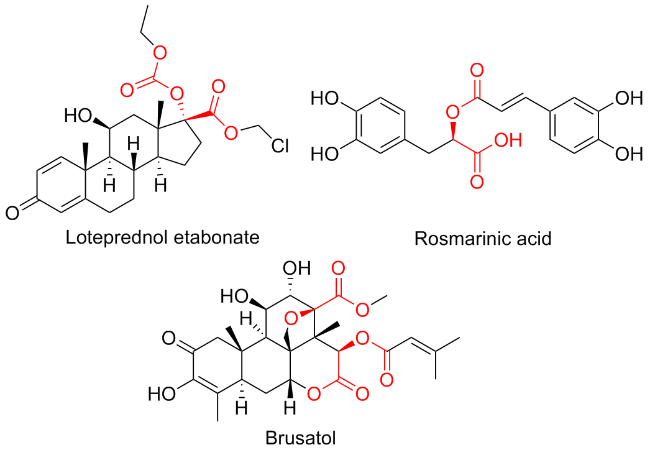
Diazocarbonyl compounds are important synthetic buil- ding blocks, which can react with various types of compounds via C—H bond functionalization and X—H insertion (e.g., X=O, N, Si).[1] α-Acyloxy esters are privileged synthetic intermediates, which constitute the core of many biologically active natural products and synthetic pharmaceutical agents (Figure 1).[2]
Because of the importance of α-acyloxy ester motifs, much attention has been paid to their synthesis in the past few decades. One of the most straightforward approaches to access α-acyloxy esters is O—H insertion reaction of α-aryl diazoesters with carboxylic acids.[3] The transition- metal-catalyzed metal-carbene O—H insertion has found widespread use in organic synthesis (Scheme 1a).[2a,4] Feng and co-workers[5] disclosed a Rh-catalyzed enantioselective insertion of α-diazoesters or α-diazo ketones into O—H bonds of carboxylic acids. On the other hand, the palladium-catalyzed coupling of aromatic and benzylic acid derivatives with α-diazocarbonyl compounds to prepare aromatic and benzylic ester derivatives with an O-sub- stituted quaternary carbon center has also been developed as an elegant protocol for the synthesis of α-acyloxy esters.[6] Due to the relatively high cost and high toxicity of transition metal catalysts, transition-metal-free methods have attracted much attention.[3b,3d,3f,3g,7] Metal-free strategies could be accessible using photochemical conditions (Scheme 1b).[3a,8] Davies’ group[9] reported that aryl diazoacetates could undergo photolysis under blue light irradiation (460~490 nm) in the presence of a variety of partners to afford products of cyclopropanation, O—H, N—H, and C—H insertions, thus providing a straightforward and general platform for their mild functionalization. In addition, except for photocatalysis, Lewis acid catalysis is another approach to be considered in metal-free strategies.[10] In 2018, the Tang group[11] demonstrated B(C6F5)3•nH2O catalyzed O—H bond insertion of α-diazoesters in water. In 2021, the Koenigs group[12] discovered tropylium-cata- lyzed O—H functionalization of carboxylic acids with diazo compounds (Scheme 1c). Among these methods, harsh reaction conditions (anhydrous conditions) or the use of air-sensitive reagents are generally required. As a result, the development of simple and convenient methods for the O—H insertion reaction of α-aryl diazoesters with carboxylic acids is highly desirable.
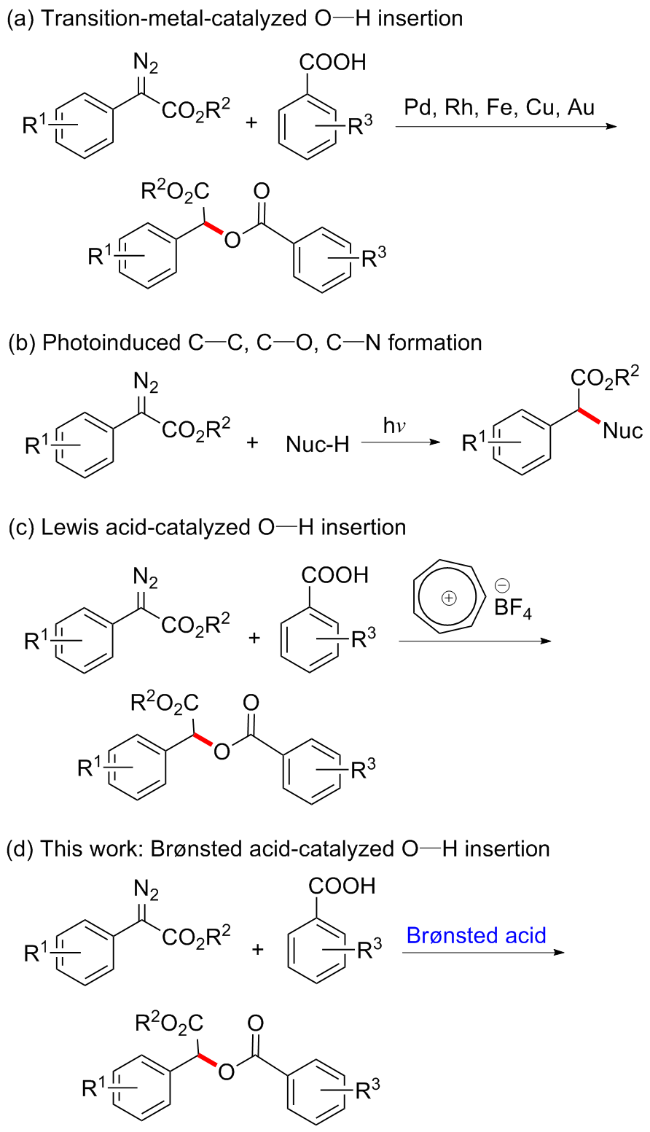
Compared to Lewis acids or transition metal catalysts, Brønsted acids are generally inexpensive and environmentally benign. Recent studies have indicated the potential of Brønsted acids in catalyzing O—H and C—H insertion involving diazo compounds.[13] To our knowledge, the use of Brønsted acid as catalysts for O—H insertion of α-diazoesters with carboxylic acids has not been reported. Herein, we are glad to report a Brønsted acid-catalyzed O—H insertion of carboxylic acids with diazo compounds (Scheme 1d).
2 Results and discussion
α-Aryl diazoacetates 1a and p-methylbenzoic acid 2b were used as the model substrates. When various Brønsted acid catalysts were screened, the product 3ab was obtained in good yield using TfOH as the acid catalyst, but weaker Brønsted acids were not effective, such as triflimide (Tf2NH), p-toluenesulfonic acid monohydrate (TsOH• H2O), and trifluoroacetic acid (TFA) (Table 1, Entries 1~4). These results indicated that the acidity of Brønsted acids was crucial for this transformation. The effect of solvents was also investigated, among many solvents [e.g., THF, 1,2-dichloroethane (DCE), MeCN, and dioxane], dichloroethane was the best solvent (Table 1, Entries 2, 5~9). Unfortunately, expanding to 0.20 mmol, the yield dropped markedly (Table 1, Entry 10). However, the desired product was in moderate yield using 1.0 mL of DCE (Table 1, Entry 11). Sequentially, aiming to increase the performance and eliminate by-products of the reaction, the amount of 1a required was examined, and 4.0 equiv. of 1a gave the best result (Table 1, Entries 12). It should be noted that decreased loading of TfOH (5 mol%) led to a reduced yield (Table 1, Entry 13). Additionally, higher or lower temperature gave no chemical yield improvement (Table 1, Entry 14). Moreover, all reactions were carried out in the open air with reagent-grade solvents, which indicated this transformation was robust.
Table 1 Optimization of the reaction conditionsa |
| Entry | Catalyst | Solvent | Yieldb/% |
|---|---|---|---|
| 1 | Tf2NH | CH2Cl2 | — |
| 2 | TfOH | CH2Cl2 | 60 |
| 3 | TsOH•H2O | CH2Cl2 | — |
| 4 | TFA | CH2Cl2 | — |
| 5 | TfOH | DCE | 64 |
| 6 | TfOH | CHCl3 | 50 |
| 7 | TfOH | THF | — |
| 8 | TfOH | MeCN | 13 |
| 9 | TfOH | Dioxane | 32 |
| 10c | TfOH | DCE | 29 |
| 11c,d | TfOH | DCE | 45 |
| 12c,d | TfOH | DCE | 59e/69g/80h/76i |
| 13c,d | TfOH | DCE | 50e,f |
| 14c,d | TfOH | DCE | 45j/63k |
a Reactions performed on a 0.10 mmol scale using 1.2 equiv. of 2b in the solvent (0.5 mol/L) at 25 ℃ with 10 mol% Brønsted acid for 16 h. b Isolated yields. c 0.20 mmol scale. d 1.0 mL DCE. e With 2.0 equiv. of 2a. f With 5 mol% TfOH. g With 3.0 equiv. of 1a. h With 4.0 equiv. of 1a. i With 5.0 equiv. of 1a. j Reaction carried out at 10 ℃. k Reaction carried out at 40 ℃. |
Using the optimized conditions, the scope of carboxylic acids 2 was investigated (Table 2). Benzoic acid worked smoothly and gave the desired product in high yield (3aa). Para-, meta-, and ortho-substituted benzoic acids were all suitable substrates, and good yields were obtained (3ab~3ad). Furthermore, the formation of 3ab on a 1.0 mmol scale was repeated, and the corresponding product 3ab was obtained in a comparable yield. Para- methoxy-substituted benzoic acid gave a slightly reduced chemical yield (3ae). Moreover, ortho-F, para-F, ortho-Cl, and para-F benzoic acids worked well (3af~3ai), and the steric hindrance had little influence on the efficiency of reactions. 1-Naphthyl and 2-naphthyl carboxylic acids also gave good yields (3aj, 3ak). Notably, this protocol was also successfully extended to heteroaryl carboxylic acids (3al). Gratifyingly, although alkyl carboxylic acids were less reactive than aromatic carboxylic acids, various aliphatic carboxylic acids were also applicable. Acetic acid, pivalic acid, cyclohexane-carboxylic acid, and heptanoic acid gave the desired products in moderate to good yields (3am~3ap).
Table 2 Scope of carboxylic acids 2a |
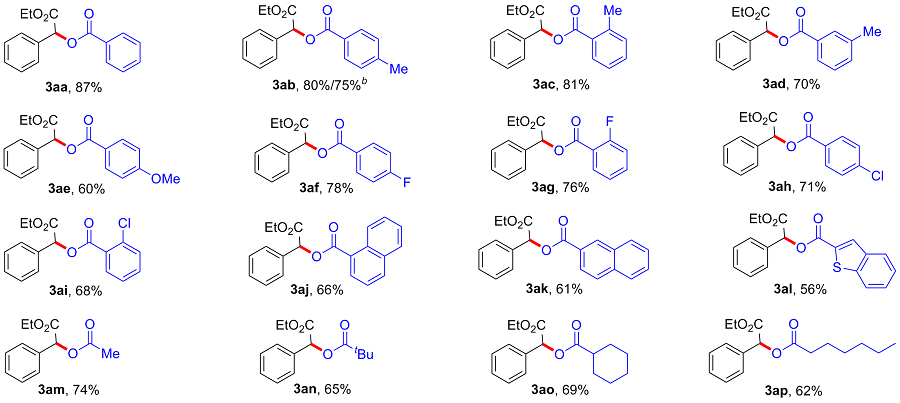 |
a Reaction conditions: 1a (0.80 mmol), 2 (0.20 mmol), TfOH (10 mol%) in DCE (1.0 mL), 16 h, r.t.; all yields are isolated yields. b 1.0 mmol scale. |
Next, the substrate scope with respect to the diazoesters 1 was examined (Table 3). Para-, meta-, and ortho-sub- stituted α-aryl diazoacetates were well tolerated, affording the corresponding products in moderate to good yields (3ba~3da, 3fa~3ma). 2-Naphthyl diazoacetate also gave a moderate yield (3ea). In general, aryl diazoacetates with the weak electron-donating groups gave higher chemical yields, such as F, Cl, and Br (65%~91%, 3fa~3ma). Additionally, good yields were obtained for insertion reaction with diazo compounds containing different ester group, such as isopropyl and methyl esters (3na, 3oa).
Table 3 Scope of diazoesters 1a |
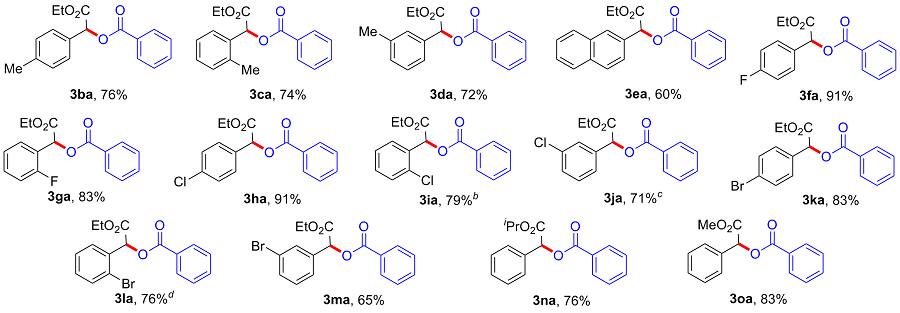 |
a Reaction conditions: 1a (0.80 mmol), 2 (0.20 mmol), TfOH (10 mol%) in DCE (1.0 mL), 16 h, r.t.; all yields are isolated yields. b 60 h. c 4 h. d 40 h. |
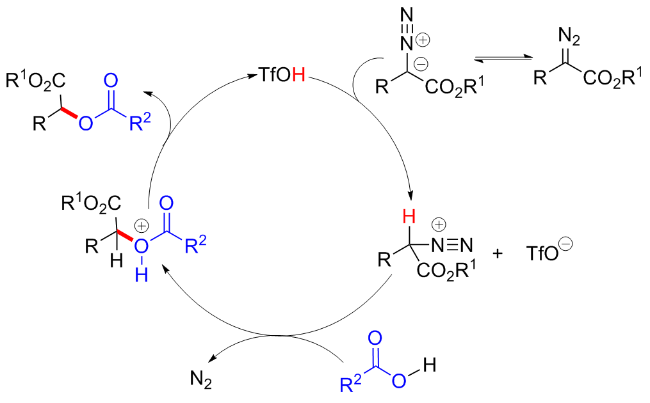
A plausible and summarized mechanism based on literature[1k,14] precedence for O—H insertion of carboxylic acids with α-aryl diazoesters is depicted in Scheme 2. Initially, the diazo compound was protonated by TfOH, driving to the formation of the diazonium intermediate. Sequentially, the nucleophilic attack of the oxygen atom dislocated nitrogen molecular, followed by hydrogen abstraction by the conjugate base of the acid catalyst to give the final product. The acid catalyst was regenerated at the same time.


3 Conclusions
In summary, a simple Brønsted acid-promoted O—H bond insertion of α-aryl α-diazoacetates with carboxylic acids has been developed. This protocol enabled the facile preparation of α-acyloxy esters in moderate to high yields. This methodology displays excellent functional group tolerance, employs easily accessible starting materials and catalysts. The reactions are simple, and the reactions can be conducted in the open air. In contrast to many literature reports of α-aryl α-diazoacetates, no transition metal was needed.
4 Experimental section
4.1 General information
All reactions were carried out under an ambient atmosphere without protection. All the α-diazoesters were prepared according to the known literature, and the corresponding spectrum data matches that were reported in the literature.[15] Commercial reagents and solvents were obtained from commercial providers and used without further purification. 1H NMR (400 MHz or 600 MHz), 13C NMR (100 MHz or 150 MHz), and 19F NMR (376 MHz or 565 MHz) spectra were recorded on a Bruker NMR apparatus. The chemical shifts (δ) for 1H and 13C are given in relative to residual signals of the solvents (CHCl3, δ 7.26 in 1H NMR, δ 77.16 in 13C NMR). Alternatively, 1H NMR chemical shifts were referenced to the tetramethylsilane signal (δ 0). High-resolution mass spectra (HRMS) were measured on a Thermo Scientific Q Exactive HF Orbitrap-FTMS. For thin layer chromatography (TLC) analysis throughout this work, Merck precoated TLC plates (silica gel 60 GF254, 0.25 mm) were used, and Silica gel 60H (200~300 mesh) manufactured by Qingdao Huanghai Chemical Group Co. (China) was used for general chromatography, using UV light as the visualizing agent.
4.2 General procedure for the synthesis of α-acyloxy esters
To an 8 mL vial equipped with a magnetic stir-bar were added carboxylic acid 2 (1.0 equiv., 0.2 mmol), diazoester 1 (4.0 equiv., 0.8 mmol) and dissolved in ClCH2CH2Cl (1.0 mL, 0.5 mol/L of concentration of 2) at 25 ℃. After pre-stirring, TfOH (10 mol%) was added. Sequentially, the reaction mixture was stirred at 25 ℃for 16 h. The reaction mixture was then purified by chromatography on silica gel [V(petroleum ether)∶V(EtOAc)=50∶1~5∶1] to afford the desired product 3.
4.3 Characterization data
2-Ethoxy-2-oxo-1-phenylethyl benzoate (3aa): Colorless oil, 87% yield [49 mg, V(petroleum ether)∶V(EtOAc)=10∶1]. 1H NMR (400 MHz, CDCl3) δ: 8.15~8.12 (m, 2H), 7.61~7.57 (m, 3H), 7.48~7.41 (m, 5H), 6.15 (s, 1H), 4.29~4.16 (m, 2H), 1.24 (t, J=7.2 Hz, 3H); 13C NMR (100 MHz, CDCl3) δ: 168.9, 166.0, 134.2, 133.6, 130.1, 129.4, 129.3, 128.9, 128.6, 127.7, 75.1, 61.9, 14.1; HRMS (ESI) calcd for C17H16NaO4 [M+Na]+ 307.0941, found 307.0941.
2-Ethoxy-2-oxo-1-phenylethyl 4-methylbenzoate (3ab): colorless oil, 80% yield [48 mg, V(petroleum ether)∶V(EtOAc)=10∶1]. 1H NMR (400 MHz, CDCl3) δ: 8.01 (d, J=8.0 Hz, 2H), 7.60~7.57 (m, 2H), 7.44~7.37 (m, 3H), 7.23 (d, J=8.4 Hz, 2H), 6.13 (s, 1H), 4.26~4.13 (m, 2H), 2.39 (s, 3H), 1.21 (t, J=7.2 Hz, 3H); 13C NMR (100 MHz, CDCl3) δ: 168.9, 166.0, 144.3, 134.3, 130.1, 129.2, 128.9, 128.4, 127.7, 126.6, 74.9, 61.7, 21.8, 14.1; HRMS (ESI) calcd for C18H18NaO4 [M+Na]+ 321.1097, found 321.1099.
2-Ethoxy-2-oxo-1-phenylethyl 2-methylbenzoate (3ac): Colorless oil, 81% yield [48 mg, V(petroleum ether)∶V(EtOAc)=10∶1]. 1H NMR (400 MHz, CDCl3) δ: 7.95~7.92 (m, 2H), 7.62~7.58 (m, 2H), 7.44~7.40 (m, 3H), 7.40~7.32 (m, 2H), 6.14 (s, 1H), 4.28~4.16 (m, 2H), 2.41 (s, 3H), 1.24 (t, J=7.2 Hz, 3H); 13C NMR (100 MHz, CDCl3) δ: 169.0, 166.2, 138.4, 134.4, 134.3, 130.6, 129.3, 129.3, 128.9, 128.5, 127.8, 127.3, 75.1, 61.9, 21.4, 14.1; HRMS (ESI) calcd for C18H18NaO4 [M+Na]+ 321.1097, found 321.1095.
2-Ethoxy-2-oxo-1-phenylethyl 3-methylbenzoate (3ad): Colorless oil, 70% yield [42 mg, V(petroleum ether)∶V(EtOAc)=10∶1]. 1H NMR (400 MHz, CDCl3) δ: 7.94~7.93 (m, 2H), 7.61~7.58 (m, 2H), 7.46~7.39 (m, 4H), 7.36~7.32 (m, 1H), 6.14 (s, 1H), 4.28~4.16 (m, 2H), 2.41 (s, 3H), 1.24 (t, J=7.2 Hz, 3H); 13C NMR (100 MHz, CDCl3) δ: 169.0, 166.2, 138.4, 134.4, 134.3, 130.6, 129.3, 129.3, 128.9, 128.5, 127.8, 127.3, 75.1, 61.9, 21.4, 14.2; HRMS (ESI) calcd for C18H18NaO4 [M+Na]+ 321.1097, found 321.1095.
2-Ethoxy-2-oxo-1-phenylethyl 4-methoxybenzoate (3ae): Colorless oil, 60% yield [38 mg, V(petroleum ether)∶V(EtOAc)=10∶1]. 1H NMR (400 MHz, CDCl3) δ: 8.10~8.07 (m, 2H), 7.60~7.57 (m, 2H), 7.45~7.39 (m, 3H), 6.94~6.92 (m, 2H), 6.12 (s, 1H), 4.26~4.16 (m, 2H), 3.86 (s, 3H), 1.23 (t, J=7.2 Hz, 3H); 13C NMR (100 MHz, CDCl3) δ: 169.1, 165.7, 163.9, 134.4, 132.2, 129.3, 128.9, 127.7, 121.8, 113.8, 74.9, 61.8, 55.6, 14.2; HRMS (ESI) calcd for C18H18NaO5 [M+Na]+ 337.1046, found 337.1043.
2-Ethoxy-2-oxo-1-phenylethyl 4-fluorobenzoate (3af): Colorless oil, 78% yield [47 mg, V(petroleum ether)∶V(EtOAc)=10∶1]. 1H NMR (400 MHz, CDCl3) δ: 8.17~8.12 (m, 2H), 7.59~7.55 (m, 2H), 7.46~7.41 (m, 3H), 7.15~7.10 (m, 2H), 6.13 (s, 1H), 4.28~4.16 (m, 2H), 1.23 (t, J=7.2 Hz, 3H); 13C NMR (100 MHz, CDCl3) δ: 168.9, 166.22 (d, JCF=253.4 Hz), 165.1, 134.1, 132.7 (d, JCF=9.5 Hz), 129.4, 129.0, 127.8, 125.7 (d, JCF=3.1 Hz), 115.8 (d, JCF=22.0 Hz), 75.2, 62.0, 14.1; 19F NMR (376 MHz, CDCl3) δ: -104.60 (s); HRMS (ESI) calcd for C17H15FNaO4 [M+Na]+ 325.0847, found 325.0843.
2-Ethoxy-2-oxo-1-phenylethyl 2-fluorobenzoate (3ag): Colorless oil, 76% yield [46 mg, V(petroleum ether)∶V(EtOAc)=10∶1]. 1H NMR (400 MHz, CDCl3) δ: 8.05 (td, J=7.6, 2.0 Hz, 1H), 7.61~7.59 (m, 2H), 7.58~7.52 (m, 1H), 7.45~7.32 (m, 4H), 7.24~7.14 (m, 2H), 6.16 (s, 1H), 4.28~4.16 (m, 2H), 1.24 (t, J=7.2 Hz, 3H); 13C NMR (100 MHz, CDCl3) δ: 168.7, 163.6 (d, JCF=3.8 Hz), 162.4 (d, JCF=260.1 Hz), 135.2 (d, JCF=9.1 Hz), 133.2 (d, JCF=136.9 Hz), 129.3, 128.9, 128.4 (d, JCF=20.4 Hz), 127.6, 124.2 (d, JCF=4.1 Hz), 117.9 (d, JCF=9.4 Hz), 117.2 (d, JCF=22.0 Hz), 75.3, 61.9, 14.1; 19F NMR (376 MHz, CDCl3) δ: -108.33 (s); HRMS (ESI) calcd for C17H15FNaO4 [M+Na]+ 325.0847, found 325.0849.
2-Ethoxy-2-oxo-1-phenylethyl 4-chlorobenzoate (3ah): Colorless oil, 71% yield [45 mg, V(petroleum ether)∶V(EtOAc)=10∶1]. 1H NMR (400 MHz, CDCl3) δ: 8.06 (d, J=8.4 Hz, 2H), 7.58~7.56 (m, 2H), 7.44~7.42 (m, 5H), 6.12 (s, 1H), 4.28~4.15 (m, 2H), 1.23 (t, J=7.2 Hz, 3H); 13C NMR (100 MHz, CDCl3) δ: 168.8, 165.2, 140.1, 134.0, 131.5, 129.5, 129.0, 129.0, 127.9, 127.8, 75.3, 62.0, 14.2; HRMS (ESI) calcd for C17H15ClNaO4 [M+Na]+ 341.0551, found 341.0550.
2-Ethoxy-2-oxo-1-phenylethyl 2-chlorobenzoate (3ai): Colorless oil, 68% yield [43 mg, V(petroleum ether)∶V(EtOAc)=10∶1]. 1H NMR (400 MHz, CDCl3) δ: 8.02~8.00 (m, 1H), 7.59~7.57 (m, 2H), 7.49~7.40 (m, 5H), 7.36~7.32 (m, 1H), 6.16 (s, 1H), 4.29~4.17 (m, 2H), 1.24 (t, J=7.2 Hz, 3H); 13C NMR (100 MHz, CDCl3) δ: 168.7, 164.9, 134.4, 133.8, 133.2, 132.1, 131.3, 129.4, 129.1, 128.9, 127.8, 126.8, 75.6, 62.0, 14.1; HRMS (ESI) calcd for C17H15ClNaO4 [M+Na]+ 341.0551, found 341.0547.
2-Ethoxy-2-oxo-1-phenylethyl 1-naphthoate (3aj): Colorless oil, 66% yield [44 mg, V(petroleum ether)∶V(EtOAc)=10∶1]. 1H NMR (400 MHz, CDCl3) δ: 8.99~8.95 (m, 1H), 8.35 (dd, J=7.2, 1.2 Hz, 1H), 8.05 (d, J=8.0 Hz, 1H), 7.91~7.89 (m, 1H), 7.65~7.61 (m, 3H), 7.57~7.50 (m, 2H), 7.47~7.41 (m, 3H), 6.27 (s, 1H), 4.32~4.21 (m, 2H), 1.27 (t, J=7.2 Hz, 3H); 13C NMR (100 MHz, CDCl3) δ: 169.1, 166.9, 134.2, 134.0, 133.9, 131.6, 131.0, 129.4, 129.0, 128.7, 128.1, 127.8, 126.5, 126.4, 125.9, 124.7, 75.3, 62.0, 14.2; HRMS (ESI) calcd for C21H18NaO4 [M+Na]+ 357.1097, found 357.1100.
2-Ethoxy-2-oxo-1-phenylethyl 2-naphthoate (3ak): Colorless oil, 61% yield [41 mg, V(petroleum ether)∶V(EtOAc)=10∶1]. 1H NMR (400 MHz, CDCl3) δ: 8.71 (s, 1H), 8.15~8.12 (m, 1H), 7.97 (d, J=8.0 Hz, 1H), 7.91~7.88 (m, 2H), 7.66~7.53 (m, 4H), 7.48~7.43 (m, 3H), 6.22 (s, 1H), 4.31~4.18 (m, 2H), 1.25 (t, J=7.1 Hz, 3H); 13C NMR (100 MHz, CDCl3) δ: 169.0, 166.2, 135.9, 134.3, 132.6, 131.8, 129.6, 129.4, 129.0, 128.6, 128.4, 127.9, 127.9, 126.9, 126.7, 125.5, 75.3, 61.9, 14.2; HRMS (ESI) calcd for C21H18NaO4 [M+Na]+ 357.1097, found 357.1100.
2-Ethoxy-2-oxo-1-phenylethyl benzo[b]thiophene-2- carboxylate (3al): Colorless oil, 56% yield [38 mg, V(petroleum ether)∶V(EtOAc)=5∶1]. 1H NMR (400 MHz, CDCl3) δ: 8.62 (d, J=8.0 Hz, 1H), 8.54 (s, 1H), 7.88 (d, J=8.0 Hz, 1H), 7.62~7.60 (m, 2H), 7.51~7.40 (m, 5H), 6.21 (s, 1H), 4.30~4.19 (m, 2H), 1.25 (t, J=7.2 Hz, 3H); 13C NMR (100 MHz, CDCl3) δ: 169.0, 161.9, 140.1, 138.0, 136.8, 134.3, 129.4, 129.0, 127.9, 126.3, 125.7, 125.3, 124.8, 122.6, 74.9, 62.0, 14.2; HRMS (ESI) calcd for C19H16NaO4S [M+Na]+ 363.0662, found 363.0652.
Ethyl 2-acetoxy-2-phenylacetate (3am): Colorless oil, 74% yield [33 mg, V(petroleum ether)∶V(EtOAc)=20∶1]. 1H NMR (400 MHz, CDCl3) δ: 7.48~7.46 (m, 2H), 7.40~7.37 (m, 3H), 5.91 (s, 1H), 4.25~4.12 (m, 2H), 2.20 (s, 3H), 1.21 (t, J=7.2 Hz, 3H); 13C NMR (100 MHz, CDCl3) δ: 170.5, 169.0, 134.0, 129.3, 128.9, 127.7, 74.7, 61.8, 20.9, 14.1; HRMS (ESI) calcd for C12H14NaO4 [M+Na]+ 245.0784, found 245.0778.
2-Ethoxy-2-oxo-1-phenylethyl pivalate (3an): Colorless oil, 65% yield [34 mg, V(petroleum ether)∶V(EtOAc)=20∶1]. 1H NMR (400 MHz, CDCl3) δ: 7.50~7.47 (m, 2H), 7.42~7.37 (m, 3H), 5.86 (s, 1H), 4.21~4.13 (m, 2H), 1.29 (s, 9H), 1.21 (t, J=7.2 Hz, 3H); 13C NMR (100 MHz, CDCl3) δ: 178.0, 169.1, 134.3, 129.1, 128.8, 127.5, 74.5, 61.7, 38.9, 27.2, 14.1; HRMS (ESI) calcd for C15H20NaO4 [M+Na]+ 287.1254, found 287.1251.
2-Ethoxy-2-oxo-1-phenylethyl cyclohexanecarboxylate (3ao): Colorless oil, 69% yield [40 mg, V(petroleum ether)∶V(EtOAc)=20∶1]. 1H NMR (400 MHz, CDCl3) δ: 7.49~7.46 (m, 2H), 7.41~7.36 (m, 3H), 5.89 (s, 1H), 4.22~4.12 (m, 2H), 2.51~2.43 (m, 1H), 2.07~2.03 (m, 1H), 1.95~1.92 (m, 1H), 1.81~1.74 (m, 2H), 1.66~1.65 (m, 1H), 1.56~1.47 (m, 2H), 1.34~1.25 (m, 3H), 1.21 (t, J=7.2 Hz, 3H); 13C NMR (100 MHz, CDCl3) δ: 175.5, 169.1, 134.3, 129.2, 128.8, 127.6, 74.3, 61.7, 42.9, 29.1, 28.9, 25.8, 25.5, 25.4, 14.1; HRMS (ESI) calcd for C17H12NaO4 [M+Na]+ 313.1410, found 313.1406.
2-Ethoxy-2-oxo-1-phenylethyl heptanoate (3ap): Colorless oil, 62% yield [36 mg, V(petroleum ether)∶V(EtOAc)=20∶1]. 1H NMR (400 MHz, CDCl3) δ: 7.48~7.46 (m, 2H), 7.40~7.36 (m, 3H), 5.91 (s, 1H), 4.24~4.12 (m, 2H), 2.53~2.38 (m, 2H), 1.72~1.65 (m, 2H), 1.37~1.27 (m, 6H), 1.21 (t, J=7.2 Hz, 3H), 0.88 (t, J=6.8 Hz, 3H); 13C NMR (100 MHz, CDCl3) δ: 173.3, 169.1, 134.2, 129.2, 128.9, 127.7, 74.5, 61.8, 34.1, 31.6, 28.8, 24.9, 22.6, 14.2, 14.1; HRMS (ESI) calcd for C17H24NaO4 [M+Na]+ 315.1567, found 315.1566.
2-Ethoxy-2-oxo-1-(p-tolyl)ethyl benzoate (3ba): Colorless oil, 76% yield [45 mg, V(petroleum ether)∶V(EtOAc)=10∶1]. 1H NMR (400 MHz, CDCl3) δ: 8.13~8.11 (m, 2H), 7.59~7.55 (m, 1H), 7.48~7.42 (m, 4H), 7.25~7.22 (m, 2H), 6.11 (s, 1H), 4.27~4.14 (m, 2H), 2.37 (s, 3H), 1.23 (t, J=7.2 Hz, 3H); 13C NMR (100 MHz, CDCl3) δ: 169.1, 166.1, 139.3, 133.5, 131.3, 130.1, 129.6, 129.5, 128.5, 127.7, 75.0, 61.8, 21.4, 14.1; HRMS (ESI) calcd for C18H18NaO4 [M+Na]+ 321.1097, found 321.1095.
2-Ethoxy-2-oxo-1-(o-tolyl)ethyl benzoate (3ca): Colorless oil, 74% yield [44 mg, V(petroleum ether)∶V(EtOAc)=10∶1]. 1H NMR (400 MHz, CDCl3) δ: 8.13~8.10 (m, 2H), 7.59~7.53 (m, 2H), 7.47~7.43 (m, 2H), 7.32~7.23 (m, 3H), 6.43 (s, 1H), 4.29~4.16 (m, 2H), 2.52 (s, 3H), 1.23 (t, J=7.2 Hz, 3H); 13C NMR (100 MHz, CDCl3) δ: 169.2, 166.2, 137.2, 133.5, 132.9, 131.0, 130.1, 129.5, 129.3, 128.6, 128.1, 126.5, 72.3, 61.8, 19.6, 14.2; HRMS (ESI) calcd for C18H18NaO4 [M+Na]+ 321.1097, found 321.1089.
2-Ethoxy-2-oxo-1-(m-tolyl)ethyl benzoate (3da): Colorless oil, 72% yield [43 mg, V(petroleum ether)∶V(EtOAc)=10∶1]. 1H NMR (400 MHz, CDCl3) δ: 8.15~8.12 (m, 2H), 7.61~7.57 (m, 1H), 7.48~7.44 (m, 2H), 7.40~7.38 (m, 2H), 7.34~7.30 (m, 1H), 7.24~7.21 (m, 1H), 6.11 (s, 1H), 4.29~4.16 (m, 2H), 2.40 (s, 3H), 1.24 (t, J=7.2 Hz, 3H); 13C NMR (100 MHz, CDCl3) δ: 169.0, 166.1, 138.7, 134.1, 133.5, 130.1, 130.1, 129.5, 128.8, 128.6, 128.4, 124.9, 75.2, 61.9, 21.6, 14.2; HRMS (ESI) calcd for C18H18NaO4 [M+Na]+ 321.1097, found 321.1090.
2-Ethoxy-1-(naphthalen-2-yl)-2-oxoethyl benzoate (3ea): Colorless oil, 60% yield [40 mg, V(petroleum ether)∶V(EtOAc)=10∶1]. 1H NMR (400 MHz, CDCl3) δ: 8.17~8.15 (m, 2H), 8.06 (s, 1H), 7.93~7.86 (m, 3H), 7.70~7.68 (m, 1H), 7.62~7.57 (m, 1H), 7.56~7.52 (m, 2H), 7.49~7.45 (m, 2H), 6.31 (s, 1H), 4.30~4.16 (m, 2H), 1.23 (t, J=7.2 Hz, 3H); 13C NMR (100 MHz, CDCl3) δ: 169.0, 166.1, 133.7, 133.6, 133.3, 131.6, 130.1, 129.5, 128.9, 128.6, 128.4, 127.9, 127.6, 126.9, 126.7, 124.9, 75.3, 62.0, 14.2; HRMS (ESI) calcd for C21H18NaO4 [M+Na]+ 357.1097, found 357.1090.
2-Ethoxy-1-(4-fluorophenyl)-2-oxoethyl benzoate (3fa): Colorless oil, 91% yield [55 mg, V(petroleum ether)∶V(EtOAc)=10∶1]. 1H NMR (400 MHz, CDCl3) δ: 8.13~8.11 (m, 2H), 7.61~7.56 (m, 3H), 7.46 (t, J=7.6 Hz, 2H), 7.14~7.09 (m, 2H), 6.13 (s, 1H), 4.28~4.16 (m, 2H), 1.23 (t, J=7.2 Hz, 3H); 13C NMR (100 MHz, CDCl3) δ: 168.8, 165.9, 163.3 (d, JCF=247.1 Hz), 133.7, 130.1 (d, JCF=3.4 Hz), 130.1, 129.6 (d, JCF=8.4 Hz), 129.3, 128.6, 116.0 (d, JCF=21.7 Hz), 74.4, 62.0, 14.1; 19F NMR (376 MHz, CDCl3) δ: -111.95 (s); HRMS (ESI) calcd for C17H15FNaO4 [M+Na]+ 325.0847, found 325.0845.
2-Ethoxy-1-(2-fluorophenyl)-2-oxoethyl benzoate (3ga): Colorless oil, 83% yield [50 mg, V(petroleum ether)∶V(EtOAc)=10∶1]. 1H NMR (400 MHz, CDCl3) δ: 8.13~8.09 (m, 2H), 7.60~7.56 (m, 2H), 7.47~7.42 (m, 2H), 7.42~7.37 (m, 1H), 7.24~7.12 (m, 2H), 6.53 (s, 1H), 4.30~4.19 (m, 2H), 1.24 (t, J=7.1 Hz, 4H); 13C NMR (100 MHz, CDCl3) δ: 168.4 (d, JCF=1.5 Hz), 165.8, 160.70 (d, JCF=249.0 Hz), 133.6, 131.3 (d, JCF=8.3 Hz), 130.1, 129.7 (d, JCF=3.1 Hz), 129.3, 128.6, 124.7 (d, JCF=3.8 Hz), 122.0 (d, JCF=14.0 Hz), 116.1 (d, JCF=21.3 Hz), 68.7 (d, JCF=5.4 Hz), 62.1, 14.1; 19F NMR (376 MHz, CDCl3) δ: -116.61 (dd, J=17.6, 8.6 Hz); HRMS (ESI) calcd for C17H15FNaO4 [M+Na]+ 325.0847, found 325.0846.
1-(4-Chlorophenyl)-2-ethoxy-2-oxoethyl benzoate (3ha): Colorless oil, 91% yield [58 mg, V(petroleum ether)∶V(EtOAc)=10∶1]. 1H NMR (400 MHz, CDCl3) δ: 8.13~8.10 (m, 2H), 7.61~7.58 (m, 1H), 7.56~7.52 (m, 2H), 7.48~7.44 (m, 2H), 7.42~7.39 (m, 2H), 6.12 (s, 1H), 4.28~4.16 (m, 2H), 1.23 (t, J=7.2 Hz, 3H); 13C NMR (100 MHz, CDCl3) δ: 168.5, 165.8, 135.4, 133.7, 132.7, 130.1, 129.2, 129.2, 129.1, 128.6, 74.4, 62.1, 14.1; HRMS (ESI) calcd for C17H15ClNaO4 [M+Na]+ 341.0551, found 341.0545.
1-(2-Chlorophenyl)-2-ethoxy-2-oxoethyl benzoate (3ia): Colorless oil, 79% yield [50 mg, V(petroleum ether)∶V(EtOAc)=10∶1]. 1H NMR (400 MHz, CDCl3) δ: 8.12~8.10 (m, 2H), 7.61~7.56 (m, 2H), 7.45 (t, J=7.6 Hz, 3H), 7.35~7.33 (m, 2H), 6.68 (s, 1H), 4.31~4.20 (m, 2H), 1.25 (t, J=7.2 Hz, 3H); 13C NMR (100 MHz, CDCl3) δ: 168.5, 165.8, 134.4, 133.6, 132.5, 130.6, 130.2, 130.1, 129.7, 129.3, 128.6, 127.4, 71.8, 62.1, 14.1; HRMS (ESI) calcd for C17H15ClNaO4 [M+Na]+ 341.0551, found 341.0548.
1-(3-Chlorophenyl)-2-ethoxy-2-oxoethyl benzoate (3ja): Colorless oil, 71% yield [44 mg, V(petroleum ether)∶V(EtOAc)=10∶1]. 1H NMR (400 MHz, CDCl3) δ: 8.14~8.12 (m, 2H), 7.62~7.58 (m, 2H), 7.49~7.46 (m, 3H), 7.40~7.36 (m, 2H), 6.11 (s, 1H), 4.29~4.17 (m, 2H), 1.25 (t, J=7.2 Hz, 3H); 13C NMR (100 MHz, CDCl3) δ: 168.4, 165.8, 136.1, 134.9, 133.8, 130.2, 130.1, 129.6, 129.2, 128.7, 127.8, 125.9, 74.4, 62.2, 14.2; HRMS (ESI) calcd for C17H15ClNaO4 [M+Na]+ 341.0551, found 341.0547.
1-(4-Bromophenyl)-2-ethoxy-2-oxoethyl benzoate (3ka): Colorless oil, 83% yield [60 mg, V(petroleum ether)∶V(EtOAc)=10∶1]. 1H NMR (400 MHz, CDCl3) δ: 8.13~8.11 (m, 2H), 7.62~7.55 (m, 3H), 7.48~7.44 (m, 4H), 6.10 (s, 1H), 4.28~4.16 (m, 2H), 1.23 (t, J=7.2 Hz, 3H); 13C NMR (100 MHz, CDCl3) δ: 168.5, 165.8, 133.7, 133.3, 132.1, 130.1, 129.4, 129.2, 128.6, 123.6, 74.4, 62.1, 14.1; HRMS (ESI) calcd for C17H15BrNaO4 [M+Na]+ 385.0046, found 385.0042.
1-(2-Bromophenyl)-2-ethoxy-2-oxoethyl benzoate (3la): Colorless oil, 76% yield [55 mg, V(petroleum ether)∶V(EtOAc)=10∶1]. 1H NMR (400 MHz, CDCl3) δ: 8.12~8.10 (m, 2H), 7.65 (dd, J=8.0, 1.2 Hz, 1H), 7.60~7.56 (m, 2H), 7.50~7.43 (m, 2H), 7.47~7.36 (m, 1H), 7.29~7.27 (m, 1H), 6.66 (s, 1H), 4.31~4.20 (m, 2H), 1.26 (t, J=7.2 Hz, 3H); 13C NMR (100 MHz, CDCl3) δ: 168.5, 165.8, 134.3, 133.6, 133.5, 130.8, 130.2, 129.8, 129.3, 128.6, 128.0, 124.4, 74.0, 62.1, 14.2; HRMS (ESI) calcd for C17H15BrNaO4 [M+Na]+ 385.0046, found 385.0040.
1-(3-Bromophenyl)-2-ethoxy-2-oxoethyl benzoate (3ma): Colorless oil, 65% yield [47 mg, V(petroleum ether)∶V(EtOAc)=10∶1]. 1H NMR (400 MHz, CDCl3) δ: 8.13~8.11 (m, 2H), 7.75~7.74 (m, 1H), 7.62~7.59 (m, 1H), 7.55~7.51 (m, 2H), 7.49~7.46 (m, 2H), 7.32~7.28 (m, 1H), 6.10 (s, 1H), 4.29~4.17 (m, 2H), 1.25 (t, J=7.2 Hz, 3H); 13C NMR (100 MHz, CDCl3) δ: 168.4, 165.8, 136.3, 133.8, 132.5, 130.7, 130.5, 130.1, 129.2, 128.7, 126.4, 123.0, 74.3, 62.2, 14.2; HRMS (ESI) calcd for C17H15BrNaO4 [M+Na]+ 385.0046, found 385.0040.
2-Isopropoxy-2-oxo-1-phenylethyl benzoate (3na): Colorless oil, 76% yield [45 mg, V(petroleum ether)∶V(EtOAc)=10∶1]. 1H NMR (400 MHz, CDCl3) δ: 8.15~8.12 (m, 2H), 7.61~7.57 (m, 3H), 7.48~7.40 (m, 5H), 6.11 (s, 1H), 5.08 (hept, J=6.4 Hz, 1H), 1.29 (d, J=6.0 Hz, 3H), 1.13 (d, J=6.4 Hz, 3H); 13C NMR (100 MHz, CDCl3) δ: 168.4, 166.0, 134.3, 133.5, 130.1, 129.5, 129.3, 128.9, 128.6, 127.7, 75.3, 69.6, 21.8, 21.6. HRMS (ESI) calcd for C18H18NaO4 [M+Na]+ 321.1097, found 321.1095.
2-Methoxy-2-oxo-1-phenylethyl benzoate (3oa): Colorless oil, 83% yield [45 mg, V(petroleum ether)∶V(EtOAc)=10∶1]. 1H NMR (600 MHz, CDCl3) δ: 8.14 (d, J=7.8 Hz, 1H), 7.59 (t, J=7.2 Hz, 1H), 7.48~7.41 (m, 2H), 6.18 (s, 1H), 3.76 (s, 1H); 13C NMR (150 MHz, CDCl3) δ: 169.4, 166.0, 134.0, 133.6, 130.1, 129.4, 129.3, 129.0, 128.6, 127.8, 75.0, 52.8; HRMS (ESI) calcd for C16H14NaO4 [M+Na]+ 293.0784, found 293.0787.
4.4 1 mmol scale reaction for 3ab
A solution of TfOH (8.8 μL, 0.1 mmol, 10 mol%), diazoester 1a (4 mmol, 760 mg) and p-tolenic acid 2b (1 mmol, 136 mg) in ClCH2CH2Cl (4.0 mL) was stirred at room temperature for 16 h. The mixture was purified by column chromatography [V(petroleum ether)∶V(EtO- Ac)=50∶1] to afford the desired product 3ab (223 mg, 75%).
Supporting Information Copies of NMR spectra of α-aryl diazoacetates 3. The Supporting Information is available free of charge via the Internet at http://sioc-journal.cn.
(Cheng, F.)