



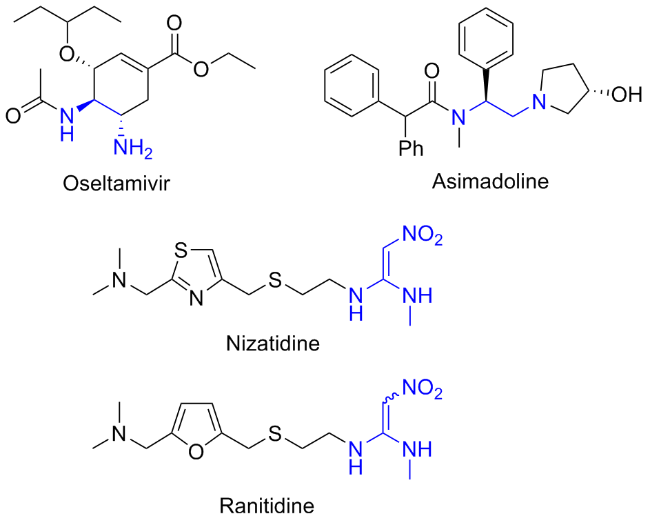
β-Amino nitroalkenes are important structural motifs present in a wide range of biologically active compounds including nizatidine and ranitidine, which are H2-receptor antagonists that work by blocking histamine to decrease stomach acid production (Figure 1).[1-3] As a push-pull alkene, β-amino nitroalkenes are commonly used as building blocks in organic synthetic chemistry to construct indoles, pyridines, pyrroles and other heterocyclic compounds.[4-7] Furthermore, the enantioselective hydrogenation of β-acyl- amino nitroalkenes is able to furnish the valuable chiral β-amino nitroalkanes that could be efficiently converted into α-amino acids by the Meyer or Nef reactions,[8-9] or 1,2- diamino compounds upon reduction.[10-11] Such chiral amines are key structural elements in chiral diamine ligands and can also be found in pharmaceuticals such as Oseltamivir,[12,13] which is used to treat influenza, Asimadoline,[14] a potent κ opioid receptor agonist and other biologically active molecules (Figure 1).[15]
Because of the utility of β-amino nitroalkenes in organic chemistry, many methods have been developed for their simple and efficient synthesis. To date, the preparation of β-amino nitroalkenes mainly relies on two conceptually different methods: the direct nucleophilic addition of nitromethane to aldehydes (Henry reaction) followed by amination of the resulting nitroalkene[16] (Scheme 1a) and the same Henry reaction followed by the sequential oxidation and titanium-catalyzed enamination using different Amines[17-18](Scheme 1b). Recently, Yoshimatsu’s group[19] reported an efficient and straightforward strategy for the synthesis of β-amino nitroalkenes through the aza-Henry reaction of nitriles with nitroalkanes (Scheme 1c). Although several methods have been developed, all presented strategies revolve around Henry reaction, which may consist of multistep syntheses or need an equivalent amount of transition metals. Thus, the development of a facile and convenient approach to β-amino nitroalkenes is still desirable.
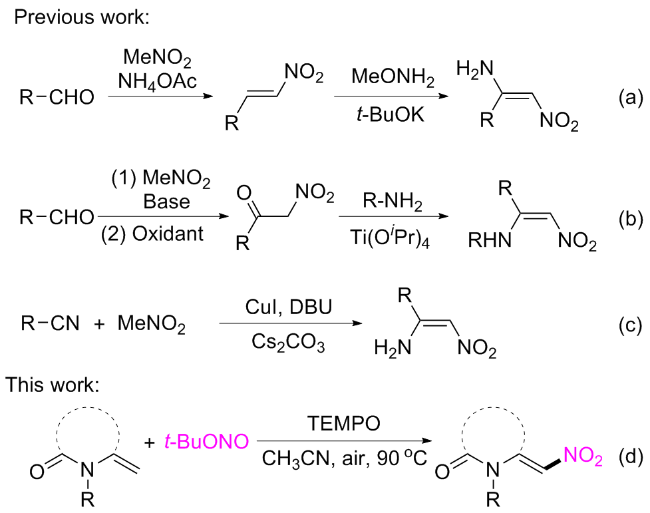
As a variant of enamine, enamide exists in a mass of pharmaceuticals and biologically active natural products as core structural elements,[20,21] and is also a kind of versatile and valuable organic synthon widely used for the construction of diverse nitrogen-containing compounds.[22-24] Therefore, lots of facile methods to synthesize functionalized enamides have been established, of which the most effective and straightforward is direct C—H functionalization of the β-C(sp2)—H bond of enamides. Based on this strategy, β-functionalized enamides bearing various functional groups have been successfully prepared, such as alkylation,[25-27] olefination,[28-29] alkynylation,[30-32] arylation,[33-37] carbonylation,]38-40] trifluoromethylation,[41-43] amidation,[44-45] phosphorylation,[46-47] and so on.[48-50] To the best of our konwledge, the direct nitration of enamide has not been systematically explored yet. If this reaction was possible, it would be a powerful and atom-economical route for the synthesis of β-amino nitroalkenes. Herein, we report the first case of direct nitration of enamide with tert-butyl nitrite under metal-free conditions (Scheme 1d).
2 Results and discussion
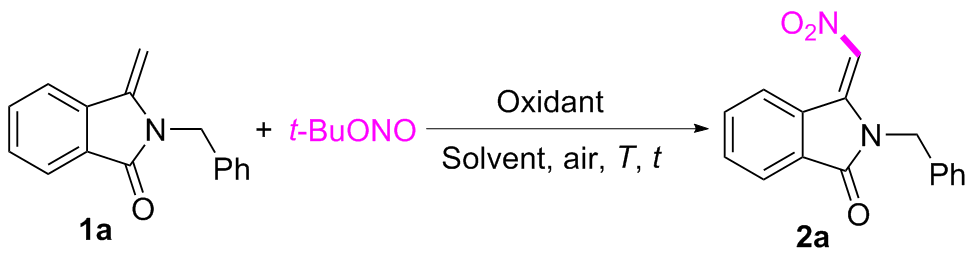
After extensive literature research and preliminary scree- ning experiments, we selected the shelf-stable and easy to operate tert-butyl nitrite (tBuONO) as nonmetallic nitrating agent.[51-53] Our study was commenced with the examination of the model nitration of tertiary enamide 1a to establish the optimal conditions. The screening results are shown in Table 1. All tested oxidants could promote the direct nitration of enamide at 90 ℃ in 1,4-dioxane (Table 1, Entries 1~6), but 2,2,6,6-tetramethylpiperidine-1-oxyl (TEMPO) was the most effective and the desired β-acyl- amino nitroalkene 2a was afforded in 74% yield (Table 1, Entry 5). To improve the productivity of 2a, an array of solvents were scrutinized including tetrahydrafuran, 1,2-dichloroethane, toluene and acetonitrile (Table 1, Entries 7~10), which proved that acetonitrile is an ideal sol-vent and the chemical yield of 2a was significantly raised to 88% (Table 1, Entry 10). Subsequent investigation of the reaction temperature showed that neither increasing nor decreasing the temperature promoted the nitration more efficiently (Table 1, Entries 11~13). Further conditions screening indicated that when the dosage of tBuONO and TEMPO was decreased, the direct nitration still underwent smoothly, but the yield of target product would be reduced (Table 1, Entries 14~16). Moreover, it was important to note that air is crucial for this direct nitration of enamide, because the replacement of air with nitrogen would damage the yield of product and even trace target product was observed when the reaction was performed under N2 atmosphere with degassed solvent using nitrogen (Table 1, Entries 17~18). From the above results, the optimal reaction conditions were confirmed as shown in Table 1 Entry 10.
Table 1 Reaction condition optimizationa |
| Entry | Oxidant | Solventb | T/℃ | t/h | Yieldc/% | |
|---|---|---|---|---|---|---|
| 1 | K2S2O8 | 1,4-Dioxane | 90 | 13 | 63 | |
| 2 | TBHP | 1,4-Dioxane | 90 | 13 | 60 | |
| 3 | DTBP | 1,4-Dioxane | 90 | 13 | 70 | |
| 4 | DCP | 1,4-Dioxane | 90 | 13 | 56 | |
| 5 | TEMPO | 1,4-Dioxane | 90 | 13 | 74 | |
| 6 | BPO | 1,4-Dioxane | 90 | 13 | 58 | |
| 7 | TEMPO | THF | 90 | 14 | 72 | |
| 8 | TEMPO | DCE | 90 | 12 | 62 | |
| 9 | TEMPO | Toluene | 90 | 14 | 61 | |
| 10 | TEMPO | CH3CN | 90 | 8 | 88 | |
| 11 | TEMPO | CH3CN | 80 | 9 | 73 | |
| 12 | TEMPO | CH3CN | 100 | 8 | 78 | |
| 13 | TEMPO | CH3CN | 110 | 8 | 75 | |
| 14d | TEMPO | CH3CN | 90 | 12 | 66 | |
| 15e | TEMPO | CH3CN | 90 | 12 | 77 | |
| 16f | TEMPO | CH3CN | 90 | 16 | 64 | |
| 17g | TEMPO | CH3CN | 90 | 16 | 41 | |
| 18h | TEMPO | CH3CN | 90 | 16 | 8 | |
a Reaction conditions: enamide 1a (0.5 mmol), tBuONO (1.0 mmol, 2.0 equiv.), oxidant (0.2 mmol, 0.4 equiv.) and solvent were added and the mixture was reacted at the corresponding temperature (see the appropriate column). b Commercially purchased solvent. c Yield of isolated product. d tBuONO (0.5 mmol, 1.0 equiv.). e TEMPO (0.1 mmol, 0.2 equiv.). f TEMPO (0.05 mmol, 0.1 equiv.). g Performed under N2. h Performed under N2 with degassed N2 purged solvent. |
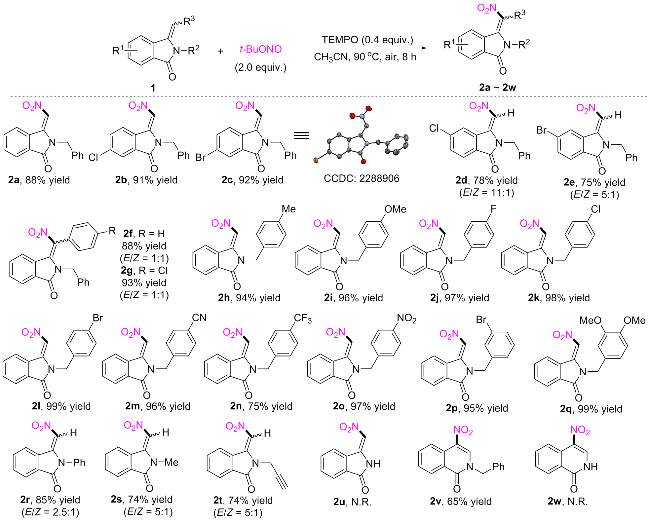
With the optimized reaction conditions in hand, we set out to explore the substrate scope of this direct nitration reaction (Scheme 2). The nitration of cyclic enamides with tert-butyl nitrite was firstly examined. The results are summarized in Scheme 2. Under the standard reaction conditions, the desired products 2a~2g were obtained in 75%~93% yields using enamides 1a~1g as substrate, which derived from different substituted 2-acylbenzoic acids and benzylamine. When substituents (Cl and Br) are in opposition to nitrovinyl, only the E isomer was observed in the reaction and proved by X-ray single crystal structure of compound 2c (see the ESI). On the other hand, the direct nitration of tertiary enamides bearing substituents at meta-position of nitrovinyl or β-position of alkenyl provided an inseparable mixture of E/Z isomers (2d~2g) probably owing to the steric effect. Tertiary enamides 1h~1q, which were prepared from different substituted benzylamines, underwent the reaction smoothly to afford target products 2h~2q in excellent yields. The results indicated that the electronic nature and position of substituents on the benzene ring of the benzyl moiety had virtually no impact on reac- tion outcome. When benzyl group was replaced with phenyl, methyl or propargyl, substrates 1r~1t also showed good reactivity and were successfully transformed into the corresponding β-acylamino nitroalkenes 2r~2t as a mixture of isomers in high efficency. In addition, the reaction worked well with 2-benzylisoquinolin-1(2H)-one 1v as a substrate and furnished the desired products 2v in 65% yields. However, the secondary enamides 1s and 1w that contain hydrogen atom instead of benzyl group on the nitrogen atom was not suitable to this direct nitration reaction.
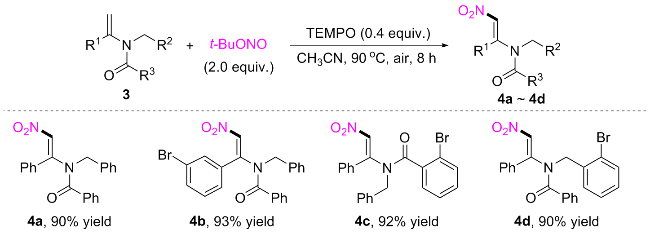
Subsequently, we further assessed the reactivity of acyclic tertiary enamides with tert-butyl nitrite and the results showed that this direct nitration reaction was also compatible with acyclic enamides as listed in Scheme 3. All tested acyclic tertiary enamides underwent the nitration smoothly under the standard conditions to generate the corresponding products 4a~4d in a single E configuration with excellent yields.
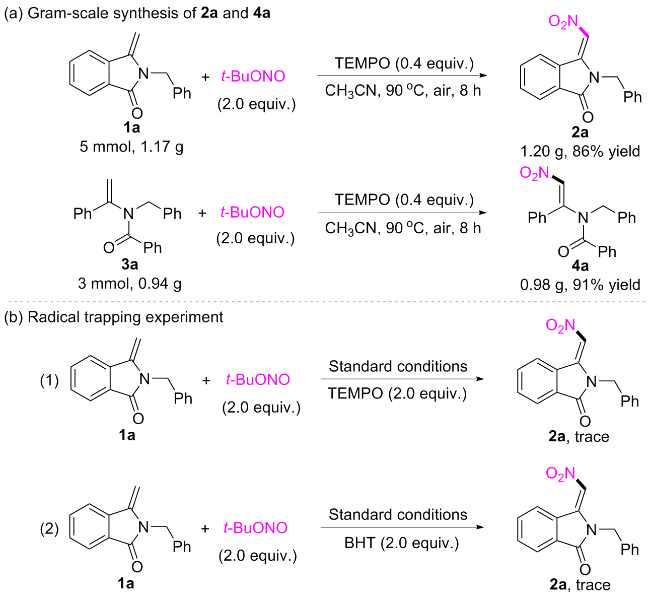
To demonstrate the utility of this reaction, the gram-scale β-nitration reaction of tertiary enamide 1a (5.0 mmol) and 3a (3.0 mmol) with tert-butyl nitrite (2.0 equiv.) was performed, which produced the corresponding β-acylamino nitroalkenes 2a and 4a in 86% and 91% yields, respectively (Scheme 4a). To gain insight into the mechanism of the direct nitration reaction, several preliminary controlled experiments were carried out (Scheme 4b). When 2.0 equiv. of radical scavenger 2,2,6,6-tetramethylpiperidine oxide (TEMPO) or 2,6-di-tert-butyl-4-methylphenol (BHT) was added in the standard reaction, only trace amount of product 2a was detected. This result indicated that the direct nitra- tion reaction presumably carried out through a radical process.
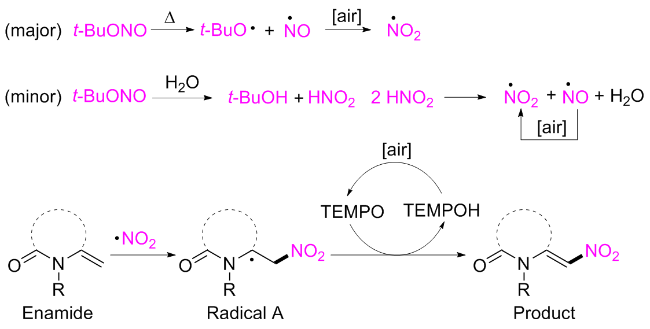
Based on above experimental results and previous literatures,[54-56] we proposed a possible reaction pathway for this direct nitration reaction as delineated in Scheme 5. A homolytic cleavage of the N—O bond of t-BuONO might take place to generate NO2 radical with the assistance of heating or H2O under aerobic conditions. Then nitro radical attacks the electron-rich β-position of tertiary enamide to generate a nitroalkane radical A. Subsequently, 2,2,6,6-tetramethylpiperidine oxide (TEMPO) is responsible for the radical abstraction of hydrogen from intermediate A to produce the desired product β-acylamino nitroalkene. Under aerobic conditions, TEMPOH could be oxidized back to TEMPO to continue the cycle.


3 Conclusions
In conclusion, we have develped the first case of direct nitration of tertiary enamide with tert-butyl nitrite (tBuONO) under metal-free conditions. The reaction showed high E-selectivity, broad substrate scope and good functional group compatibility. A wide array of cyclic and acyclic enamides was nitrated in excellent yields with shelf-stable, commercially available nonmetallic reagents, which provides a concise method for the synthesis of diverse valuable β-acylamino nitroalkenes. In addition, the method is simple to operate and can also be performed under aerobic conditions. Therefore, this approach will be very promising in organic synthesis and exhibits the versatility of stable enamides.
4 Experimental section
4.1 General experimental information
All chemicals were commercially available for direct use unless otherwise stated. Flash column chromatography was performed on silica gel (100~200). Reactions were monitored using pre-coated, glass-backed silica gel plates and visualized by means of UV irridation (254 nm) or KMnO4. 1H NMR and 13C NMR spectra were recorded on a Bruker AV500 spectrometer at ambient temperature. Chemical shifts are reported with either tetramethylsilane or the residual solvent resonance used as an internal standard. High- resolution mass spectra (HRMS) was measured on a quad- rupole time-of-flight mass spectrometer (Q-TOF-MS) using electrospray ionization (ESI) as an ionization method. Cry- stallographic data were collected on a Rigaku XtaLAB Synergy (Cu) X-ray single crystal diffractometer. All yields reported were isolated yields. All tertiary enamides are known compounds and prepared according to the reported literature procedures and tert-butyl nitrite (tBuONO) is commercially available.
4.2 Experimental method
To a 10 mL Schlenk tube equipped with a magnetic stirrer was added tertiary enamides 1 or 3 (0.5 mmol, 1.0 equiv.), t-BuONO (1.0 mmol, 2.0 equiv.), TEMPO (0.2 mmol, 0.4 equiv.) and CH3CN (3.0 mL). Then, the Schlenk tube was capped with septa and allowed to stir at 90 ℃ in a pre-heated oil bath for 8 h. After being cooled to room temperature, the solvent was evaporated in vacuo and the residue was purified by column chromatography eluted with a mixture of petroleum ether and ethyl acetate (V∶V=8∶1) to give the pure target product 2 or 4.
4.3 Characterization of the products
(E)-2-Benzyl-3-(nitromethylene)isoindolin-1-one (2a): Light yellow solid (123.2 mg, 88% yield). m.p. 102~104 ℃; 1H NMR (500 MHz, Chloroform-d) δ: 8.74~8.67 (m, 1H), 7.98 (dt, J=6.7, 2.0 Hz, 1H), 7.77~7.67 (m, 2H), 7.38~7.33 (m, 2H), 7.33~7.28 (m, 1H), 7.23 (dd, J=7.0, 1.8 Hz, 2H), 7.13 (s, 1H), 5.00 (s, 2H); 13C NMR (126 MHz, Chloroform-d) δ: 166.8, 144.6, 134.4, 134.3, 133.0, 131.7, 129.7, 129.3, 128.8, 128.3, 126.9, 124.4, 121.3, 44.0. HRMS (ESI) calcd for C16H13N2O3 [M+H]+ 281.0921, found 281.0913.
(E)-2-Benzyl-6-chloro-3-(nitromethylene)isoindolin-1-one (2b): Light yellow solid (143.1 mg, 91% yield). m.p. 139~141 ℃; 1H NMR (500 MHz, Chloroform-d) δ: 8.66 (d, J=8.5 Hz, 1H), 7.95 (d, J=2.1 Hz, 1H), 7.70 (dd, J=8.5, 2.1 Hz, 1H), 7.40~7.35 (m, 2H), 7.34~7.30 (m, 1H), 7.24~7.19 (m, 2H), 7.12 (s, 1H), 5.00 (s, 2H); 13C NMR (126 MHz, Chloroform-d) δ: 165.7, 143.8, 139.8, 134.22, 134.16, 131.6, 130.2, 129.9, 129.5, 128.5, 126.9, 124.7, 121.7, 44.3. HRMS (ESI) calcd for C16H12ClN2O3 [M+ H]+ 315.0531, 317.0501, found 315.0524, 317.0495
(E)-2-Benzyl-6-bromo-3-(nitromethylene)isoindolin-1- one (2c): Light yellow solid (164.6 mg, 92% yield). m.p. 149~151 ℃; 1H NMR (500 MHz, Chloroform-d) δ: 8.58 (dd, J=8.5, 2.4 Hz, 1H), 8.11 (t, J=2.3 Hz, 1H), 7.86 (dt, J=8.6, 2.2 Hz, 1H), 7.40~7.35 (m, 2H), 7.34~7.29 (m, 1H), 7.24~7.20 (m, 2H), 7.13 (s, 1H), 4.99 (s, 2H); 13C NMR (126 MHz, Chloroform-d) δ: 165.6, 143.9, 137.2, 134.1, 131.6, 130.3, 130.2, 129.4, 128.5, 128.0, 127.7, 126.9, 121.8, 44.3. HRMS (ESI) calcd for C16H12BrN2O3 [M+H]+ 359.0026, 361.0005, found 359.0034, 361.0012.
2-Benzyl-5-chloro-3-(nitromethylene)isoindolin-1-one (2d): A mixture of the (E) and (Z) isomers, E/Z=11∶1. Light yellow solid (122.5 mg, 78% yield). m.p. 140~142 ℃; 1H NMR (500 MHz, Chloroform-d) δ: 8.73 (d, J=1.7 Hz, 1H), 7.93~7.89 (m, 1+0.09H), 7.70 (dd, J=8.1, 1.7 Hz, 1H), 7.65 (dd, J=8.1, 1.7 Hz, 0.09H), 7.59 (s, 0.09H), 7.36 (dd, J=8.0, 6.3 Hz, 2H), 7.32 (t, J=7.2 Hz, 1H), 7.24 (d, J=5.0 Hz, 0.2H), 7.23~7.19 (m, 2H), 7.12 (s, 1H), 7.08 (s, 0.09H), 7.06~7.03 (m, 0.18H), 5.42 (s, 0.18H), 4.99 (s, 2H); 13C NMR (126 MHz, Chloroform-d) δ: 165.9, 143.4, 141.0, 134.1, 133.2, 133.1, 129.4, 129.2, 128.5, 128.0, 126.9, 125.4, 121.9, 44.3. HRMS (ESI) calcd for [M+H]+ C16H12ClN2O3 315.0531, 317.0501, found 315.0522, 317.0492.
2-Benzyl-5-bromo-3-(nitromethylene)isoindolin-1-one (2e): A mixture of the (E) and (Z) isomers, E/Z=5∶1. Light yellow solid (134.1 mg, 75% yield). m.p. 139~142 ℃; 1H NMR (500 MHz, Chloroform-d) δ: 8.89 (d, J=1.5 Hz, 1H), 7.90~7.80 (m, 2+0.4H), 7.75 (d, J=5.0 Hz, 0.2H), 7.40~7.34 (m, 2H), 7.34~7.30 (m, 1H), 7.24 (t, J=1.5 Hz, 0.38H), 7.23~7.19 (m, 2H), 7.11 (s, 1H), 7.07 (s, 0.2H), 7.06~7.03 (m, 0.39H), 5.42 (s, 0.4H), 4.99 (s, 2H); 13C NMR (126 MHz, Chloroform-d) δ: 166.0, 143.4, 136.2, (135.7), (135.6), 134.1, 133.3, 132.0, 129.5, 129.0, 128.55, (128.47), (128.0), 127.2, 126.9, (126.3), 125.5, (124.0), 121.9, (46.3), 44.3. HRMS (ESI) calcd for C16H12BrN2O3 [M+H]+ 359.0026, 361.0005, found 359.0034, 361.0012.
2-Benzyl-3-(nitro(phenyl)methylene)isoindolin-1-one (2f): A mixture of the (E) and (Z) isomers, E/Z=1∶1. Yellow solid (156.6 mg, 88% yield). m.p. 131~134 ℃; 1H NMR (500 MHz, Chloroform-d) δ: 8.02~7.97 (m, 1H), 7.95 (d, J=7.5 Hz, 1.17H), 7.68~7.62 (m, 3H), 7.56~7.48 (m, 2.47H), 7.47~7.41 (m, 3.43H), 7.31~7.20 (m, 9H), 7.19~7.09 (m, 7.34H), 6.53 (d, J=7.1 Hz, 2H), 6.11 (d, J=8.0 Hz, 1.15H), 5.24 (s, 2.20H), 4.68 (s, 2H); 13C NMR (126 MHz, Chloroform-d) δ: 168.8, 167.9, 137.0, 136.5, 135.68, 135.67, 135.1, 134.2, 133.7, 133.5, 133.4, 133.0, 132.1, 131.41, 131.39, 131.3, 131.1, 130.9, 130.8, 129.9, 129.7, 128.9, 128.7, 128.6, 128.53, 128.48, 128.1, 127.3, 125.8, 125.0, 124.6, 124.3, 123.4, 46.0, 45.3. HRMS (ESI) calcd for C22H17N2O3 [M+H]+ 357.1234, found 357.1244.
2-Benzyl-3-((4-chlorophenyl)(nitro)methylene)isoin-dolin-1-one (2g): A mixture of the (E) and (Z) isomers, E/Z=1∶1. Yellow solid (181.3 mg, 93% yield). m.p. 123~126 ℃; 1H NMR (500 MHz, Chloroform-d) δ: 8.02~7.98 (m, 0.83H), 7.96 (d, J=7.5 Hz, 1H), 7.69~7.61 (m, 2.6H), 7.53 (t, J=7.5 Hz, 1H), 7.44~7.39 (m, 2H), 7.33~7.24 (m, 2+1.66H), 7.24~7.19 (m, 2H), 7.19~7.12 (m, 2+1.66+0.86H), 7.11~7.05 (m, 2+1.67H), 6.56 (d, J=6.9 Hz, 1.66H), 6.22 (d, J=8.0 Hz, 1H), 5.23 (s, 2H), 4.69 (s, 1.66H); 13C NMR (126 MHz, Chloroform-d) δ: 168.7, 167.9, 137.4, 137.3, 137.2, 136.8, 135.5, 135.4, 135.1, 133.8, 133.7, 133.4, 133.2, 132.9, 132.2, 132.0, 131.6, 131.5, 130.5, 130.1, 128.9, 128.8, 128.61, 128.59, 128.5, 128.20, 128.15, 127.5, 127.3, 125.6, 124.9, 124.8, 124.4, 123.5, 46.1, 45.4. HRMS (ESI) calcd for C22H16ClN2O3 [M+H]+ 391.0844, 393.0814, found 391.0851, 393.0822.
(E)-2-(4-Methylbenzyl)-3-(nitromethylene)isoindolin-1-one (2h). Light yellow solid (138.2 mg, 94% yield). m.p. 137~139 ℃; 1H NMR (500 MHz, Chloroform-d) δ: 8.71 (dd, J=7.2, 1.2 Hz, 1H), 8.02~7.96 (m, 1H), 7.77~7.69 (m, 2H), 7.18~7.10 (m, 5H), 4.96 (s, 2H), 2.33 (s, 3H); 13C NMR (126 MHz, Chloroform-d) δ: 166.9, 144.7, 138.2, 134.3, 133.0, 132.4, 131.8, 131.4, 130.0, 129.9, 128.9, 127.0, 124.5, 121.4, 43.9, 21.2. HRMS (ESI) calcd for C17H15N2O3 [M+H]+ 295.1077, found 295.1086.
(E)-2-(4-Methoxybenzyl)-3-(nitromethylene)isoindolin-1-one (2i): Light yellow solid (148.5 mg, 96% yield). m.p. 148~149 ℃; 1H NMR (500 MHz, Chloroform-d) δ: 8.71 (d, J=7.8 Hz, 1H), 7.98 (dd, J=7.4, 1.4 Hz, 1H), 7.77~7.68 (m, 2H), 7.20~7.14 (m, 3H), 6.91~6.85 (m, 2H), 4.94 (s, 2H), 3.79 (s, 3H); 13C NMR (126 MHz, Chloroform-d) δ: 166.9, 159.6, 144.7, 134.3, 133.0, 131.8, 129.9, 128.9, 128.4, 126.4, 124.4, 121.4, 114.7, 55.5, 43.6. HRMS (ESI) calcd for C17H15N2O4 [M+H]+ 311.1026, found 311.1018.
(E)-2-(4-Fluorobenzyl)-3-(nitromethylene)isoindolin-1-one (2j): Light yellow solid (144.5 mg, 97% yield). m.p. 169~171 ℃; 1H NMR (500 MHz, Chloroform-d) δ: 8.71 (dd, J=7.4, 1.2 Hz, 1H), 7.99 (dd, J=7.0, 1.5 Hz, 1H), 7.79~7.70 (m, 2H), 7.26~7.19 (m, 2H), 7.10 (s, 1H), 7.09~7.01 (m, 2H), 4.97 (s, 2H); 13C NMR (126 MHz, Chloroform-d) δ: 166.8, 162.6 (d, JC-F=248.2 Hz), 144.5, 134.4, 133.1, 131.7, 130.3 (d, JC-F=2.5 Hz), 129.7, 128.9, 128.8 (d, JC-F=8.8 Hz), 124.5, 121.3, 116.4 (d, JC-F=21.4 Hz), 43.4. HRMS (ESI) calcd for C16H11FN2O3Na [M+Na]+ 321.0646, found 321.0638.
(E)-2-(4-Chlorobenzyl)-3-(nitromethylene)isoindolin-1-one (2k): Light yellow solid (153.6 mg, 98% yield). m.p. 145~147 ℃; 1H NMR (500 MHz, Chloroform-d) δ: 8.74~8.68 (m, 1H), 7.99 (dd, J=7.5, 1.3 Hz, 1H), 7.79~7.70 (m, 2H), 7.36~7.30 (m, 2H), 7.20~7.15 (m, 2H), 7.07 (s, 1H), 4.96 (s, 2H); 13C NMR (126 MHz, Chloroform-d) δ: 166.8, 144.5, 134.5, 134.4, 133.2, 133.0, 131.7, 129.7, 129.6, 128.9, 128.3, 124.6, 121.3, 43.4. HRMS (ESI) calcd for C16H11ClN2O3Na [M+Na]+ 337.0350, 339.0321, found 337.0341, 339.0313.
(E)-2-(4-Bromobenzyl)-3-(nitromethylene)isoindolin-1-one (2l): Light yellow solid (177.2 mg, 99% yield). m.p. 134~135 ℃; 1H NMR (500 MHz, DMSO-d6) δ: 8.50 (d, J=7.9 Hz, 1H), 8.01~7.95 (m, 1H), 7.90~7.80 (m, 2H), 7.62 (s, 1H), 7.55 (dd, J=8.1, 2.4 Hz, 2H), 7.27 (d, J=8.1 Hz, 2H), 5.04 (s, 2H); 13C NMR (126 MHz, DMSO-d6) δ: 166.1, 143.9, 134.9, 134.3, 133.3, 131.7, 131.1, 129.3, 129.2, 127.7, 124.1, 121.5, 120.8, 42.1. HRMS (ESI) calcd for C16H11BrN2O3Na [M+Na]+ 380.9845, 382.9825, found 380.9837, 382.9817.
(E)-4-((1-(Nitromethylene)-3-oxoisoindolin-2-yl)meth- yl)benzonitrile (2m): Light yellow solid (146.4 mg, 96% yield). m.p. 186~188 ℃; 1H NMR (500 MHz, DMSO-d6) δ: 8.53~8.49 (m, 1H), 8.00~7.96 (m, 1H), 7.91~7.80 (m, 4H), 7.63 (s, 1H), 7.49 (d, J=8.1 Hz, 2H), 5.17 (s, 2H); 13C NMR (126 MHz, DMSO-d6) δ: 166.2, 144.0, 141.2, 134.3, 133.3, 132.7, 131.2, 129.3, 127.80, 127.77, 124.1, 121.6, 118.6, 110.4, 42.5. HRMS (ESI) calcd for [M+H]+ C17H12N3O3 306.0873, found 306.0863.
(E)-3-(Nitromethylene)-2-(4-(trifluoromethyl)benzyl)-isoindolin-1-one (2n): Light yellow solid (130.5 mg, 75% yield). m.p. 115~117 ℃; 1H NMR (500 MHz, Chloroform-d) δ: 8.73 (d, J=7.8 Hz, 1H), 8.01 (dd, J=7.3, 1.4 Hz, 1H), 7.81~7.72 (m, 2H), 7.63 (d, J=8.0 Hz, 2H), 7.36 (d, J=8.0 Hz, 2H), 7.05 (s, 1H), 5.06 (s, 2H); 13C NMR (126 MHz, Chloroform-d) δ: 166.8, 144.4, 138.5, 134.6, 133.3, 131.7, 130.8 (q, JC-F=32.8 Hz), 129.6, 129.0, 127.3, 126.4 (q, JC-F=3.8 Hz), 126.2 (q, JC-F=270.2 Hz), 124.7, 121.3, 43.6. HRMS (ESI) calcd for C17H12F3N2O3
[M+H]+ 349.0795, found 349.0802.(E)-2-(4-Nitrobenzyl)-3-(nitromethylene)isoindolin-1-one (2o): Yellow solid (157.6 mg, 97% yield). m.p. 181~183 ℃; 1H NMR (500 MHz, Chloroform-d) δ: 8.74 (dd, J=7.5, 1.2 Hz, 1H), 8.27~8.21 (m, 2H), 8.05~8.00 (m, 1H), 7.83~7.73 (m, 2H), 7.42 (d, J=8.7 Hz, 2H), 7.01 (s, 1H), 5.11 (s, 2H); 13C NMR (126 MHz, Chloroform-d) δ: 166.7, 148.0, 144.3, 141.7, 134.7, 133.4, 131.6, 129.4, 129.1, 127.7, 124.75, 124.66, 121.2, 43.4. HRMS (ESI) calcd for C16H12N3O5 [M+H]+ 326.0771, found 326.0760.
(E)-2-(3-Bromobenzyl)-3-(nitromethylene)isoindolin-1-one (2p): Light yellow solid (170.0 mg, 95% yield). m.p. 117~119 ℃; 1H NMR (500 MHz, Chloroform-d) δ: 8.73 (dd, J=7.5, 1.2 Hz, 1H), 8.03~7.97 (m, 1H), 7.80~7.71 (m, 2H), 7.45 (dt, J=8.0, 1.4 Hz, 1H), 7.37 (t, J=1.8 Hz, 1H), 7.27~7.21 (m, 1H), 7.17 (dt, J=7.8, 1.3 Hz, 1H), 7.07 (s, 1H), 4.97 (s, 2H); 13C NMR (126 MHz, Chloroform-d) δ: 166.8, 144.5, 136.8, 134.5, 133.2, 131.70, 131.67, 130.9, 129.9, 129.6, 129.0, 125.5, 124.6, 123.6, 121.3, 43.4. HRMS (ESI) calcd for C16H12BrN2O3 [M+H]+ 359.0026, 361.005, found 359.0034, 361.0014.
(E)-2-(3,4-Dimethoxybenzyl)-3-(nitromethylene)isoin-dolin-1-one (2q): Yellow solid (168.3 mg, 99% yield). m.p. 148~150 ℃; 1H NMR (500 MHz, Chloroform-d) δ: 8.75~8.69 (m, 1H), 8.02~7.97 (m, 1H), 7.79~7.69 (m, 2H), 7.20 (s, 1H), 6.85~6.78 (m, 2H), 6.76 (d, J=2.0 Hz, 1H), 4.93 (s, 2H), 3.87 (s, 3H), 3.84 (s, 3H); 13C NMR (126 MHz, Chloroform-d) δ: 167.0, 149.8, 149.2, 144.7, 134.4, 133.1, 131.8, 129.8, 128.9, 126.9, 124.5, 121.5, 119.6, 111.6, 110.3, 56.14, 56.09, 44.0. HRMS (ESI) calcd for C18H17N2O5 [M+H]+ 341.1132, found 341.1140.
3-(Nitromethylene)-2-phenylisoindolin-1-one (2r): A mixture of the (E) and (Z) isomers, E/Z=2.5∶1. Light yellow solid (113.0 mg, 85% yield). m.p. 133~135 ℃; 1H NMR (500 MHz, Chloroform-d) δ: 8.82 (d, J=7.8 Hz, 1H), 8.04~7.98 (m, 1+0.4H), 7.85~7.70 (m, 2+3×0.4H), 7.62~7.52 (m, 2+3×0.4H), 7.47 (t, J=7.6 Hz, 0.76H), 7.40 (t, J=7.5 Hz, 0.4H), 7.32 (dd, J=7.2, 1.8 Hz, 2H), 7.27 (t, J=3.7 Hz, 1H), 6.94 (s, 1H); 13C NMR (126 MHz, Chloroform-d) δ: (167.8), 166.4, 146.9, (139.5), (136.1), (135.6), 134.4, (134.0), 133.4, (133.0), (132.8), 131.6, 130.4, 130.1, (129.9), 129.3, 128.9, 128.64, (128.58), (127.5), 126.0, (125.3), 124.6, 122.2, (120.6), (115.1). HRMS (ESI) calcd for C15H11N2O3 [M+H]+ 267.0764, found 267.0757.
2-Methyl-3-(nitromethylene)isoindolin-1-one (2s): A mixture of the (E) and (Z) isomers, E/Z=5∶1. Light yellow solid (75.5 mg, 74% yield). m.p. 167~169 ℃; 1H NMR (500 MHz, Chloroform-d) δ: 8.74 (d, J=7.9 Hz, 1H), 7.95~7.88 (m, 1+0.19H), 7.74 (td, J=7.7, 1.4 Hz, 1H), 7.71~7.62 (m, 1+0.2×3H), 7.25 (s, 0.19H), 7.21 (s, 1H), 3.53 (s, 0.6H), 3.29 (s, 3H); 13C NMR (126 MHz, Chloro- form-d) δ: (168.7), 166.6, 146.2, (140.7), (136.2), 134.2, (133.6), 133.0, (132.4), 131.6, 130.2, 128.8, (127.7), (124.8), 124.2, 120.42, (120.39), (115.0), (31.0), 27.0. HRMS (ESI) calcd for [M+H]+ C10H9N2O3 205.0608, found 205.0616.
3-(Nitromethylene)-2-(prop-2-yn-1-yl)isoindolin-1-one (2t): A mixture of the (E) and (Z) isomers, E/Z=5∶1. Yellow solid (84.4 mg, 74% yield). m.p. 138~140 ℃; 1H NMR (500 MHz, Chloroform-d) δ: 8.75 (d, J=7.9 Hz, 1H), 7.98~7.92 (m, 1H), 7.77 (td, J=7.7, 1.4 Hz, 1H), 7.74~7.66 (m, 1+3×0.2H), 7.46 (s, 1H), 7.36 (s, 0.18H), 5.03 (d, J=2.5 Hz, 0.39H), 4.60 (d, J=2.5 Hz, 2H), 2.39 (t, J=2.5 Hz, 1H), 2.26 (t, J=2.5 Hz, 0.16H); 13C NMR (126 MHz, Chloroform-d) δ: 165.5, 143.8, (138.0), (136.5), 134.5, (134.0), 133.1, (132.6), 131.7, 129.6, 129.0, (127.1), (125.2), 124.6, 121.5, (120.7), (116.3), 75.7, 74.4, (73.8), (32.9), 29.7. HRMS (ESI) calcd for C12H9N2O3 [M+H]+ 229.0608, found 229.0600.
2-Benzyl-4-nitroisoquinolin-1(2H)-one (2v): Light yellow solid (91.0 mg, 65% yield). m.p. 139~141 ℃; 1H NMR (500 MHz, Chloroform-d) δ: 8.69 (d, J=8.4 Hz, 1H), 8.63 (s, 1H), 8.52 (d, J=8.1 Hz, 1H), 7.87~7.82 (m, 1H), 7.63 (t, J=7.6 Hz, 1H), 7.41~7.31 (m, 5H), 5.29 (s, 2H); 13C NMR (126 MHz, Chloroform-d) δ: 161.7, 136.9, 135.1, 134.5, 129.6, 129.4, 129.2, 129.1, 128.9, 128.8, 128.5, 124.6, 123.9, 53.0. HRMS (ESI) calcd for [M+H]+ C16H13N2O3 281.0921, found 281.0912.
(E)-N-Benzyl-N-(2-nitro-1-phenylvinyl)benzamide (4a): Light yellow solid (161.2 mg, 90% yield). m.p. 179~181 ℃; 1H NMR (500 MHz, DMSO-d6) δ: 7.69~7.63 (m, 2H), 7.59 (t, J=7.4 Hz, 1H), 7.52~7.46 (m, 4H), 7.44~7.38 (m, 2H), 7.32 (t, J=7.6 Hz, 2H), 7.28~7.23 (m, 3H), 7.18 (dd, J=7.1, 2.5 Hz, 2H), 4.93 (d, J=137.2 Hz, 2H); 13C NMR (126 MHz, DMSO-d6) δ: 170.5, 148.5, 135.8, 134.4, 132.3, 131.9, 131.4, 131.1, 129.4, 129.2, 128.9, 128.2, 128.0, 127.7, 127.6, 51.5. HRMS (ESI) calcd forC22H19N2O3 [M+H]+ 359.1390, found 359.1382.
(E)-N-Benzyl-N-(1-(3-bromophenyl)-2-nitrovinyl)ben-zamide (4b): Light yellow solid (102.7 mg, 93% yield). m.p. 120~122 ℃; 1H NMR (500 MHz, Chloroform-d) δ: 7.58 (dt, J=7.8, 1.5 Hz, 1H), 7.48~7.43 (m, 2H), 7.38~7.34 (m, 1H), 7.32 (t, J=1.9 Hz, 1H), 7.30~7.19 (m, 8H), 7.16 (dt, J=7.8, 1.4 Hz, 1H), 6.85 (s, 1H), 4.97 (s, 2H); 13C NMR (126 MHz, Chloroform-d) δ: 171.3, 147.8, 135.6, 135.5, 135.0, 134.8, 131.6, 131.4, 130.9, 129.7, 128.7, 128.5, 128.3, 127.9, 127.2, 123.5, 52.1. HRMS (ESI) calcd for C22H18BrN2O3 [M+H]+ 437.0495, 439.0475, found 437.0504, 439.0484.
(E)-N-Benzyl-2-bromo-N-(2-nitro-1-phenylvinyl)ben-zamide (4c): Light yellow solid (200.5 mg, 92% yield). m.p. 118~120 ℃; 1H NMR (500 MHz, DMSO-d6) δ: 7.69 (s, 1H), 7.50 (dd, J=7.9, 1.2 Hz, 1H), 7.43~7.38 (m, 4H), 7.37~7.33 (m, 3H), 7.32~7.25 (m, 2H), 7.25~7.18 (m, 3H), 6.89 (d, J=7.4 Hz, 2H), 4.99 (s, 2H); 13C NMR (126 MHz, DMSO-d6) δ: 168.9, 148.9, 137.1, 136.1, 134.7, 132.8, 132.1, 131.4, 130.6, 128.8, 128.6, 128.5, 128.4, 128.2, 128.0, 127.7, 119.2, 51.9. HRMS (ESI) calcd for C22H18BrN2O3 [M+H]+ 437.0495, 439.0475, found 437.0504, 439.0483.
(E)-N-(2-Bromobenzyl)-N-(2-nitro-1-phenylvinyl)ben-zamide (4d): Light yellow solid (196.2 mg, 90% yield). m.p. 119~121 ℃; 1H NMR (500 MHz, DMSO-d6) δ: 7.75~7.68 (m, 3H), 7.58 (t, J=7.4 Hz, 1H), 7.55~7.51 (m, 2H), 7.51~7.47 (m, 3H), 7.47~7.41 (m, 2H), 7.36 (q, J=8.3 Hz, 3H), 7.19 (t, J=7.7 Hz, 1H), 4.97 (s, 2H); 13C NMR (126 MHz, DMSO-d6) δ: 170.8, 148.7, 135.2, 134.0, 132.40, 132.37, 131.7, 131.6, 131.3, 130.9, 129.6, 129.33, 129.25, 128.1, 127.8, 127.7, 122.7, 51.7. HRMS (ESI) calcd for C22H18BrN2O3 [M+H]+ 437.0495, 439.0475; found 437.0503, 439.0482.
Supporting Information The 1H NMR, 13C NMR, and 19F NMR spectra of products 2a~2w and 4a~4d. The Supporting Information is available free of charge via the Internet at http://sioc-journal.cn.
(Lu, Y.)