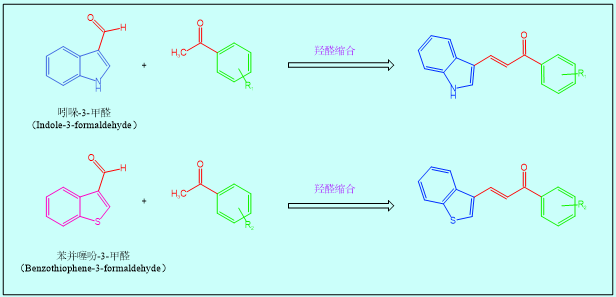
本论文设计合成了31个含有吲哚环和苯并噻吩环的查尔酮衍生物(1a-1ae),并考察了其对胆碱酯酶(ChE)和单胺氧化酶(MAO)的抑制活性。胆碱酯酶实验的结果显示,所有化合物对乙酰胆碱酯酶(AChE)的抑制作用较弱。部分化合物对丁酰胆碱酯酶(BuChE)的抑制效果较为显著,其中化合物1a和1h对BuChE的抑制效果最好(抑制率分别为85.55%和76.43%)。单胺氧化酶实验结果表明,部分化合物对单胺氧化酶具有一定的抑制作用。抑制活性超过50%的化合物(1c, 1f, 1g, 1v, 1aa)的MAO-A和MAO-B酶活性被评估,发现化合物(1c, 1f, 1aa)对MAO-A和MAO-B都表现出较好的抑制活性。细胞毒性实验结果显示,抑制活性较好的化合物对L929细胞无细胞毒性。此外,化合物1a、1c和1f的分子对接结果表明,化合物1a和1f与BuChE以及化合物1c和1f与MAO-A和MAO-B之间存在显著的相互作用。
汤敏
,
张斌
,
王秋实
,
方超华
,
胡立威
,
关丽萍
. 基于包含吲哚环、苯并噻吩环的MAO和ChE抑制活性的查尔酮衍生物设计、合成及生物活性研究[J]. 有机化学, 0
: 202412042
-202412024
.
DOI: 10.6023/cjoc202412042
In this thesis, 31 chalcone derivatives (1a-1ae) containing indole and benzothiophene rings were designed and synthesized. Their biological activities in inhibiting cholinesterase (ChE) and monoamine oxidase (MAO) were subsequently investigated. The cholinesterase test results indicated that all compounds exhibited minimal inhibitory effects on acetylcholinesterase (AChE). However, certain compounds demonstrated notable inhibitory effects on butyrylcholinesterase (BuChE), with compounds 1a and 1h showing the strongest inhibition rates of 85.55% and 76.43%, respectively.The findings from the monoamine oxidase experiments indicated that some of the compounds exhibited specific inhibitory effects on monoamine oxidase. Compounds exhibiting inhibitory activity exceeding 50%—specifically, 1c, 1f, 1g, 1v, and 1aa—were further evaluated for their effects on MAO-A and MAO-B enzymatic activities. It was observed that compounds 1c, 1f, and 1aa displayed comparatively superior inhibitory activity against both MAO-A and MAO-B.Results from cytotoxicity assays indicated that the compounds demonstrating enhanced inhibitory activity did not exhibit cytotoxic effects on L929 cells. Additionally, the results of molecular docking of compounds 1a, 1c and 1f showed significant interaction between compounds 1a and 1f with BuChE and between compounds 1c and 1f with MAO-A and MAO-B.
[1] Ramirez S.; Koerich S.; Astudillo N.; Gregorio N. D.; Lahham R.A.; Allison T.; Rocha N.P.; Wang F.; Soto C. Int. J. Mol. Sci. 2023, 24, 17087.
[2] Hua K.Y.; Zhao W.J.Folia Neuropathol. 2023, 61, 15-18.
[3] Saleem L.; Zubbair M.M.; Debnath P. Heliyon. 2021, 7, e08502.
[4] Li X.T.Metab Brain Dis. 2022, 37, 581-587.
[5] Arianna P.; Manuela G.; Pierpaolo S.; Francesca J.; Maria D.A.; Giuseppe S. Cell. Mol. Neurobiol. 2018, 38, 817-826.
[6] Tabet N.Age Agein. 2006, 35, 336-338.
[7] Lina H.; Grant S.; Katrin B.; Sonja M.; Simon Y.; Klaus H.; Jürgen E.; Gerald M. Pharmacol.Ther. 2007, 113, 154-164.
[8] Saleh L.Y.; Özdemir S.; Sağlık B.N.; Döndaş H.A.; Altug C. J. Mol. Struct. 2024, 1313, 138667.
[9] Annette M.; Klaus H.; Marlene K.; Matt S.; Ralph M.; Jürgen E.; David C.; Gerald M. Adv.Drug Deliv. 2008, 60, 1463-1470.
[10] Kim C.R.; Choi S.J.; Kwon Y.K.; Kim J.K.; Kim Y.J.; Park, G.G. Biol. Pharm. Bull. 2016, 39, 1130-1136.
[11] Mirjana B.L.; ŠGoran H.P.R. Prog Brain Res. 2021, 261, 379-421.
[12] Wang Q.J.; Ren H.H.; Liu T.Q.; Zhang X.Y. J. Affect. 2024, 351, 8-14.
[13] Salwierz P.; Thapa S.; Taghdiri F.; Vasilevskaya A.; Anastassiadis C.; Wai D.F.T.A.; Golas, C.Tartaglia, M.C. GeroSci. 2024, 46, 783-793.
[14] Mayeli M.; Shafie M.; Shiravi M.; Parvar T. A.; Mirsepassi Z.; Rahiminejad F.; Sattarpour R.; Aghamollaii V.Health Rep. 2024, 7, e2106.
[15] Zhao Y.; Qin Y.; Hu X.; Chen X.; Jiang Y.P.; Jin X.J.; Li G.; Li Z.H.; Yang J.H.; Cui S.Y.; Zhang Y. H.Front. Pharmacol. 2024, 15, 1406127.
[16] Mesa R.R.; Barquera J.A.O.S.D.L.D.; Medellin, G.; Garza, L.A.D.L.; Torres, G.S.; Velazquez, J.O.M.; Aviles, F.S.S.; Martinez, J. Am J Geria Psychiat. 2024, 32, S102-S103.
[17] Fakih N.; Fakhoury M. J Psychiatr Pract. 2024, 30, 181-191.
[18] Oliveira V.M.D.; Rocha, M.N.D.; Roberto, C.H.A.; Lucio, F.N.M.; Marinho, M.M.; Marinho, E.S.; Morais, S.M.D. J. Mol. Struct. 2024, 1302, 137453.
[19] Meghan P.; Zhi L.; Bing Q.; Grace T.; Matthew U.; Reed O.; Rebecca D.; Julia V.; Sheyum S.; Nissim I.; María D.L.P.F.; Mimi, S. H.Sci. Rep. 2023, 13, 10411.
[20] Flavia R.; Claudio C.; Andrea S.; Niccolò S.; Alessandro V.; Nicolas Z.; Michele F.; Ken G.; Ignazio C.C.; Vincent V.D.E.; Stephen, S.; Felice, L.; Andrea, D.B. Eur. Neuropsychopharmacol. 2023, 72, 60-78.
[21] Ji Y.; Yang C.Y.; Pang X.R.; Yan Y.B.; Wu Y.; Geng Z.; Hu W.J.; Hu P.P.; Wu X.Q.; Wang K. NRR. 2024, 20, 326-342.
[22] Lana K.;H, Y.M. Cell. 2023, 12, 763.
[23] Min P.S.; Hyun L.S.; Yan Z.H.; Jeongtae K.; Young J.J.; Jin C.Y.; Soyeon J.; Soyeong S.; Kyungsook J.; Hee J.J.Front Neurosci- Switz. 2023, 17, 1108371.
[24] Daniela M.; Sara M.; Benjamin M.; Joseph B.J.; František D. Front.Pharmacol. 2023, 14, 1196413.
[25] Sang Z.P.; Wang K.R.; Wang H.F.; Wang H.J.; Ma Q.W.; Han X.; Ye M.Y.; Yu L.T.; Liu W.M.Bioorganic Med. Chem. Lett. 2017, 27, 5046-5052.
[26] Asif H.; Al B.K.; Jawaid A.M.; Alam K.Shah. J. Mol. Struct. 2021.
[27] Macklin J.L.; Schwans P.J.Bioorganic Med. Chem. Lett. 2020, 30, 127213.
[28] Singh A.; Sharma S.; Arora S.; Attri S.; Kaur P.; Gulati H.K.; Bhagat K.; Kumar Nitish.; Singh H.; Singh J.V.; Bedi P.M.S. Bioorganic Med. Chem. Lett. 2020, 30, 127477.
[29] Rialette H.;P, P.J.; Anél, P. Bioorg Med Chem Lett. 2022, 77, 129038.
[30] Jawed A.M.; Amena A.; Abuzer A.; Arunkumar T.; A, B.M.; Mohammad, Y.; Salahuddin, A. AcsOmega. 2022, 7, 38207-38245.
[31] Munir S.; Shahid A.; Aslam B.; Ashfaq U.A.; Akash M.S.H.; Ali, M.A.; Almatroudi, A.; Allemailem, K.S.; Rajoka, M.S.R.; Khurshid, M.; Baloch, Z. Evid-based Compl Alt. 2020, 2020, 8836983.
[32] Funahashi R.; Matsuura F.; Ninomiya M.; Okabe S.; Takashima S.; Tanaka K.; Nishina A.; Koketsu M.Bioorg.Chem. 2024, 145, 107229.
[33] Liu W. H.; Zhao D. H.; He Z. W.; Hu Y. M.; Zhu Y. X.; Zhang L. J.; Jin L. H.; Guan L. P.; Wang S. H.Molecules. 2022, 27, 9062.
[34] Tan Q. W.; He L. Y.; Zhang S. S.; He Z. W.; Liu W. H.; Zhang L.; Guan L. P.; Wang S.H. Chem. Biodivers. 2022, 19, e202100610.
[35] Guan L. P.; He Z. W.; Jiang K. L.; Sun X. H.; Tang M.; Liu Y.W.; Wu D. Chem.Biodivers. 2023, 20, e202301271.


