



1 Introduction
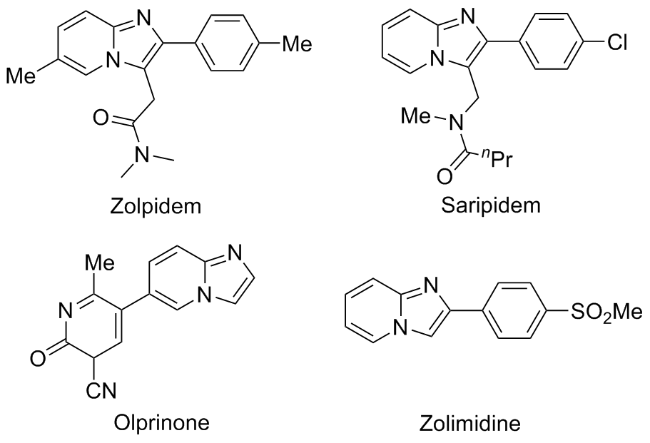
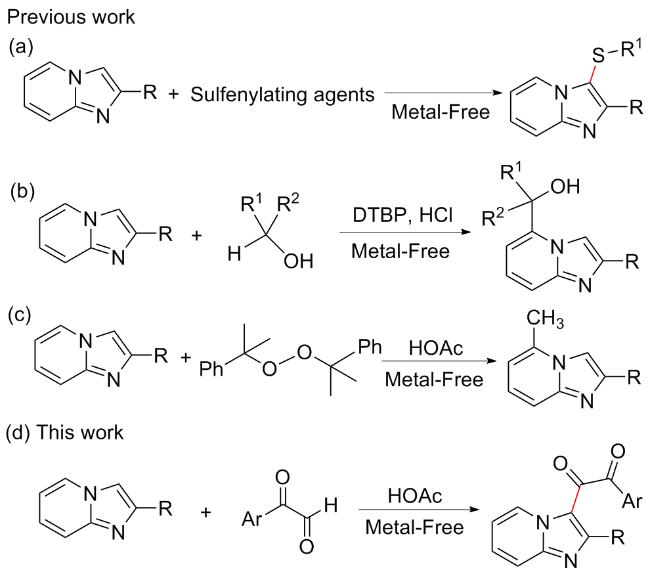
Imidazopyridines are versatile and important privileged scaffolds in many natural products and drugs including zolpidem, zolimidine, saripidem and olprinone due to their wide range of biological activities (Figure 1).[1] Therefore, the functionalization of imidazo[1,2-a]pyridine derivatives has emerged as a powerful tool in organic synthesis, such as arylation,[2] alkylation,[3] amination,[4] alkoxylation,[5] chlorination[6] and formylation[7]. Although significant advances have been achieved, many reactions were carried out using transition metal catalysts. In recent years, the development of transition-metal-free direct C—H bond functionalization is a highly significant research area in organic synthesis from the economic and environmental point of view.[8] Several representative metal-free C—H functionalizations of imidazo[1,2-a]pyridine have been reported. Initially, various regioselective C-3 sulfenylations of imidazo[1,5-a]quinolines using disulfides, thiophenols or thiols as sulfenylating agents were developed under metal-free reaction conditions (Figure 2a).[9] Subsequently, regioselective C-5 hydroxyalkylation of imidazo- [1,2-a]pyridine with alcohols promoted by di-tert-butyl peroxide was also described without any metal catalyst by Lin and Yan’s group[10] (Figure 2b). Very recently, similar study on C-5 methylation of imidazo[1,2-a]pyridine using peroxides as methyl sources was also reported under metal-free conditions by their group (Figure 2c).[11] In addition, we found that the C-3 dicarbonylation of imidazopyridine and oxoaldehyde was also reported under metal-free conditions by Guo and Ma’s group[12]. Therefore, as a continuation of our interest in exploring C—H functionalization of nitrogen-containing heterocycles,[13] we report herein an efficient protocol for the acetic acid mediated metal-free oxidative C—H cross coupling of imidazo- [1,2-a]pyridine with oxoaldehydes under an air atmosphere to afford dicarbonyl imidazo[1,2-a]pyridines in moderate to good yields.
2 Results and discussion
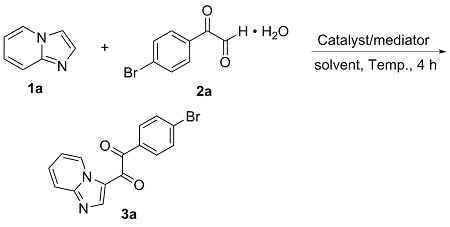
The study was initiated by investigating the reaction of imidazo[1,2-a]pyridine (1a) and 2-(4-bromophenyl)-2-oxo- acetaldehyde hydrate (2a) in the presence of 20 mol% of PdCl2 and Pd(OAc)2 in toluene at 100 ℃ under air atmosphere. Gratifyingly, the target product 1,2-dicarbonyl imidazo[1,2-a]pyridine (3a) was obtained in 19% and 24% yield, respectively (Table 1, Entries 1 and 2). Based on the above results, several copper catalysts were also examined. The use of Cu(OAc)2•H2O, CuBr and CuI did not improve the reaction yield (Table 1, Entries 3~5). Surprisingly, the yield increased to 60% when the reaction was conducted in the absence of any catalyst (Table 1, Entry 6). Subsequently, various solvents such as benzene, dioxane, dimethyl sulfoxide (DMSO), MeCN and EtOH were investigated. These were found to be less effective for this transformation (Table 1, Entries 7~11). To our delight, the yield of 3a was enhanced to 65% when HOAc (0.2 mL) was added into the above reaction system (Table 1, Entry 12). A higher amount of HOAc loading (0.5 mL) increased the yield to 75% (Table 1, Entry 13), but increasing the amount of HOAc, the yield was decreased (Table 1, Entry 14). Several organic acids and bases such as HCOOH, p-toluenesulfonic acid (PTSA), piperidine and pyrrolidine were not so effective for this transformation (Table 1, Entries 15~18). The yield of the reaction was decreased on decreasing as well as increasing the reaction temperature (Table 1, Entries 19 and 20). Furthermore, when the reaction was conducted under N2 or O2 atmosphere, the yield of the product 3a was also decreased. The result indicated that air atmosphere played an important role in this transformation (Table 1, Entries 21 and 22). Finally, the optimized reaction conditions were achieved using 0.5 mL of HOAc in toluene at 100 ℃ for 4 h under air atmosphere (Table 1, Entry 13).
Table 1 Optimization of reaction conditionsa,b |
| Entry | Catalyst/mediator | Solvent | Yield/% |
|---|---|---|---|
| 1 | PdCl2 (20 mol%) | Toluene | 19 |
| 2 | Pd(OAc)2 (20 mol%) | Toluene | 24 |
| 3 | Cu(OAc)2•H2O (20 mol%) | Toluene | 23 |
| 4 | CuBr (20 mol%) | Toluene | 15 |
| 5 | CuI (20 mol%) | Toluene | 10 |
| 6 | — | Toluene | 60 |
| 7 | — | Benzene | 46 |
| 8 | — | Dioxane | 28 |
| 9 | — | DMSO | 25 |
| 10 | — | MeCN | 29 |
| 11 | — | EtOH | 34 |
| 12 | HOAc (0.2 mL) | Toluene | 65 |
| 13 | HOAc (0.5 mL) | Toluene | 75 |
| 14 | HOAc (1.0 mL) | Toluene | 69 |
| 15 | HCOOH (0.5 mL) | Toluene | 43 |
| 16 | PTSA (0.5 mL) | Toluene | 28 |
| 17 | Piperidine (0.5 mL) | Toluene | 30 |
| 18 | Pyrrolidine (0.5 mL) | Toluene | 55 |
| 19c | HOAc (0.5 mL) | Toluene | 65 |
| 20d | HOAc (0.5 mL) | Toluene | 68 |
| 21e | HOAc (0.5 mL) | Toluene | 70 |
| 22f | HOAc (0.5 mL) | Toluene | 53 |
a Reaction conditions: 1a (0.5 mmol), 2a (0.6 mmol), catalyst/mediator, solvent (3 mL), 100 ℃, 4 h, under air atmosphere. b Isolated yields. c The reaction was conducted at 80 ℃. d The reaction was conducted at 120 ℃. e The reaction was conducted under O2 atmosphere. f The reaction was conducted under N2 atmosphere. |
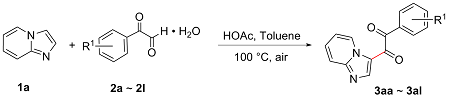
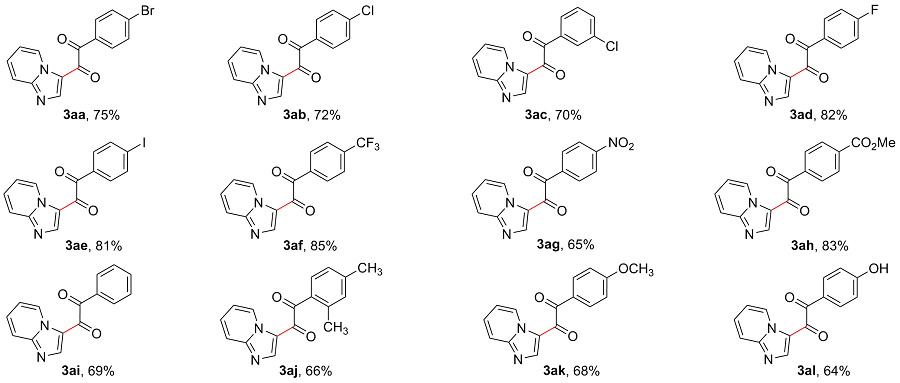
With the optimized reaction conditions in hand, the scope of glyoxal hydrates was investigated using imidazo[1,2-a]pyridine (1a) as the substrate. As shown in Table 2, glyoxal hydrates with both electron-deficient substituents and electron-rich substituents worked well to afford 1,2-dicarbonyl imidazo[1,2-a]pyridine 3aa~3al in good yields. Substituents such as Br, Cl, F, I, CF3, NO2, COOCH3 (2a~2h) on the phenyl ring of the glyoxal hydrates had a beneficial effect on the reaction outcome and delivered the desired products 3aa~3ah in relatively high yields. Glyoxal hydrates with electron-rich groups, such as CH3, OCH3 and OH, were also effective coupling partners, and the desired products 3aj~3al was obtained in good yields. Notably, halogen, nitro group, ester group and hydroxyl group were well tolerated, which provided more options for further functionalization.
Table 2 Scope of the glyoxal hydratesa,b |
 |
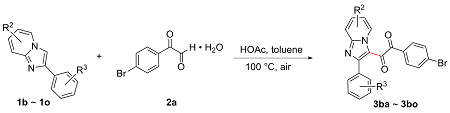
Subsequently, various 2-aryl-substituted imidazo[1,2-a]- pyridines were also tested under the standard reaction conditions, and the results are summarized in Table 3. Imidazo[1,2-a]pyridines with electron-withdrawing substituents on the phenyl ring like Br, Cl, F and NO2 afforded the corresponding products 3ba~3be in good yields. Furthermore, 5-methyl and 6-methyl substituted imidazo[1,2-a]- pyridines efficiently reacted with 2-(4-bromophenyl)-2- oxoacetaldehyde hydrate (2a) to produce the corresponding 1,2-dicarbonyl imidazo[1,2-a]pyridine products 3bf~3bo in good yields.
Table 3 Scope of the imidazo[1,2-a]pyridinesa,b |
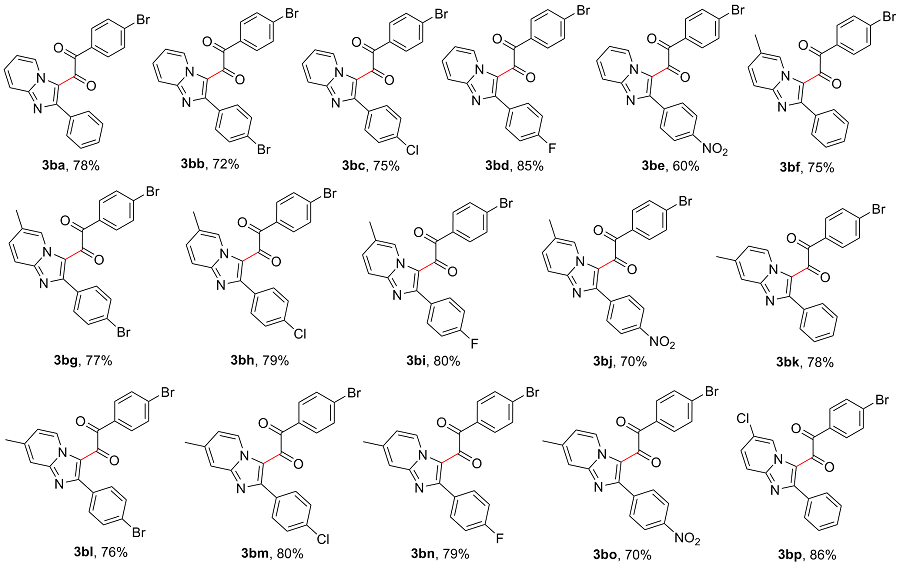 |
a Reaction conditions: 1a (0.5 mmol), 2 (0.6 mmol), HOAc (0.5 mL), toluene (3 mL), 100 ℃, under air atmosphere. b Isolated yields are given. |
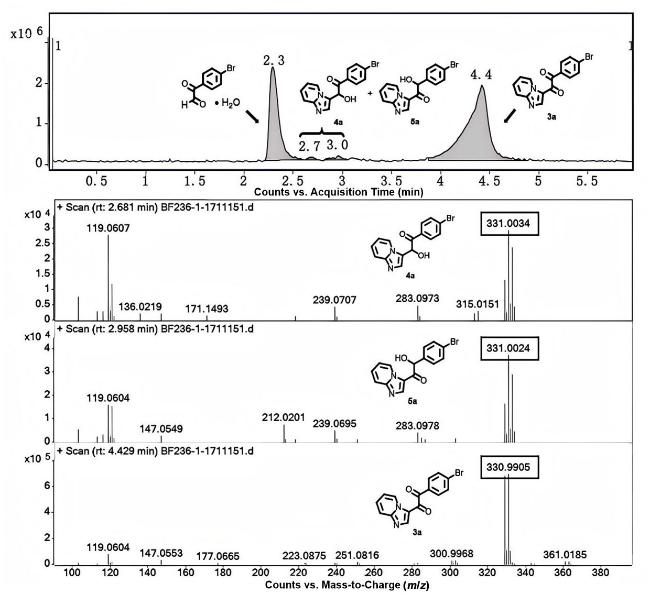
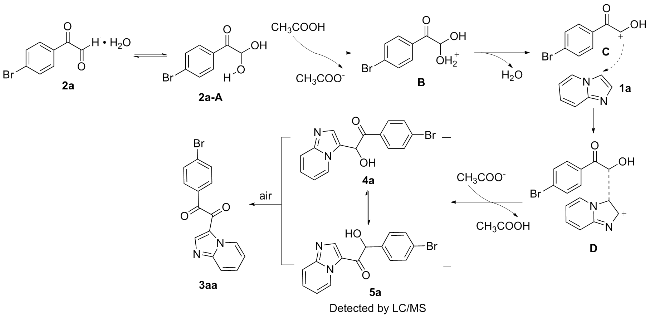
To define the possible reaction mechanism, LC-MS analysis for the reaction was shown in Figure 3. Interestingly, two isomeric intermediates 4a and 5a were detected by LC-MS. It is worth noting that 4a can be isomerized to 5a, as described in Reference.[15] This finding was slightly different from the research result of Guo and Ma’s group[12], providing further evidence for exploring the actual reaction mechanism. In addition, the intermediates 4a and 5a were observed to be relatively unstable and were not isolated successfully because of their easy oxidation to the desired product 3a. Based on the above experimental results and related research reports,[14] a plausible pathway was proposed as shown in Scheme 1. The reaction may be carried out by the reaction of arylglyoxal hydrate with acetic acid (CH3COOH) to form the hydrated cation B and release the acetoxy anion (CH3COO-). The hydrated cation B underwent a dehydration reaction to form the carbocation C. Subsequently, the carbocation C attacked the C—H bond of 2-phenylimidazo[1,2-a]pyridine at C-3 position by the nucleophilic substitution to form the transition state D, which underwent the deprotonative rearomatization reaction in the presence of CH3COO- to form the intermediates 4a and 5a. Finally, the intermediates 4a and 5a were oxidated to obtain the target product 3a in the air.


3 Conclusions
In conclusion, an acetic acid mediated metal-free oxidative C—H cross coupling of imidazo[1,2-a]pyridines with glyoxal hydrates under air atmosphere has been successfully established. This reaction has a broad scope of substrate and good functional group compatibility, providing an efficient process for the synthesis of 1,2-dicarbonyl imidazo[1,2-a]pyridines. Further studies on metal-free catalyzed functionalization of nitrogen-containing heterocycles are currently under investigation in our laboratory.
4 Experimental section
4.1 General informations
All reactions were performed in dried two-neck round bottom flask. Cu and Pd catalysts, imidazo[1,2-a]pyridine, SeO2, methyl ketones and solvents were purchased from commercial sources and used without further purification.
Thin layer chromatography (TLC) employed glass 0.25 mm silica gel plates. Flash chromatography columns were packed with 300~400 mesh silica gel in petroleum ether. All melting points were determined on a WRS-2A microprocessor melting-point apparatus and uncorrected. 1H NMR and 13C NMR spectra were recorded on a Bruker Advance NMR spectrometer (500 MHz) in DMSO-d6 as solvent. Chemical shifts (δ) were reported using tetramethylsilane (TMS) as the internal standard. HRMS (ESI) analysis of the product was obtained from a Micromass UPLC/Q-TOF Micro Mass Spectrometer. HRMS (APCI) analysis of the reaction mechanism was obtained from an Agilent 6530 Accurate-Mass Q-TOF LC/MS. Arylglyoxal hydrates were prepared from oxidation of corresponding methyl ketones with SeO2 according to the reported procedure.[16]
4.2 General procedure for acetic acid mediated imidazo[1,2-a]pyridines with glyoxal hydrates
A dried 25 mL two-neck round bottom flask was charged with imidazo[1,2-a]pyridine (0.5 mmol, 1.0 equiv), 2-oxoacetaldehyde hydrate (0.6 mmol, 1.2 equiv.), HOAc (0.5 mL) and toluene (4 mL) under an air atmosphere. The reaction mixture was stirred at 100 ℃ until the complete consumption of starting material as monitored by TLC or HPLC. After completion of the reaction, the reaction mixture was cooled to room temperature and diluted with ethyl acetate and water. The aqueous phase was extracted with ethyl acetate. The combined organic extracts were washed with saturated brine, dried with anhydrous Na2SO4 and evaporated under reduced pressure. The crude products were purified by flash column chromatography on silica gel (petroleum ether (PE) and ethyl acetate) to afford the desired products 3.
4.3 Characterization data for products 3aa~3al and 3ba~3bp
1-(4-Bromophenyl)-2-(imidazo[1,2-a]pyridin-3-yl)-ethane-1,2-dione (3aa): Purified by flash column chromatography [V(PE)∶V(EtOAc)=4∶1, Rf=0.3]. Yellow solid, m.p. 215.8~217.2 ℃; 1H NMR (500 MHz, DMSO-d6) δ: 9.62 (d, J=6.5 Hz, 1H), 8.48 (d, J=1.5 Hz, 1H), 7.99 (dd, J=9.0, 2.0 Hz, 3H), 7.85~7.83 (m, 3H), 7.48 (dd, J=7.0, 6.5 Hz, 1H); 13C NMR (125 MHz, DMSO-d6) δ: 190.58, 180.12, 149.33, 147.33, 132.05, 131.86, 131.57, 131.50, 129.18, 128.85, 120.86, 117.55, 116.62; HRMS (ESI) calcd for C15H9N2O2NaBr [M+Na]+ 350.9745, 352.9725, found 350.9738, 352.9710.
1-(4-Chlorophenyl)-2-(imidazo[1,2-a]pyridin-3-yl)-ethane-1,2-dione (3ab): Purified by flash column chroma- tography [V(PE)∶V(EtOAc)=4∶1, Rf=0.3]. Yellow solid, m.p. 182.8~183.6 ℃; 1H NMR (500 MHz, DMSO-d6) δ: 9.62 (dd, J=5.5, 1.0 Hz, 1H), 8.48 (d, J=2.0 Hz, 1H), 8.09~8.07 (m, 2H), 7.99 (d, J=8.5 Hz, 1H), 7.84 (dd, J=8.5, 7.0 Hz, 1H), 7.71~7.69 (m, 2H), 7.49~7.47 (m, 1H); 13C NMR (125 MHz, DMSO-d6) δ: 190.36, 180.15, 149.33, 147.32, 139.82, 131.85, 131.56, 131.18, 129.09, 128.85, 120.86, 117.55, 116.61; HRMS (ESI) calcd for C15H9N2O2NaCl [M+Na]+ 307.0250, 309.0221, found 307.0241, 309.0214.
1-(3-Chlorophenyl)-2-(imidazo[1,2-a]pyridin-3-yl)-ethane-1,2-dione (3ac):[17] Purified by flash column chromatography [V(PE)∶V(EtOAc)=4∶1, Rf=0.3]. Yellow solid, m.p. 110.6~112.1 ℃; 1H NMR (500 MHz, DMSO-d6) δ: 9.61 (d, J=6.5 Hz, 1H), 8.50 (s, 1H), 8.08 (s, 1H), 8.02~7.98 (m, 2H), 7.86~7.82 (m, 2H), 7.65 (dd, J=5.5, 7.5 Hz, 1H), 7.47 (dd, J=7.0, 6.5 Hz, 1H); 13C NMR (125 MHz, DMSO-d6) δ: 190.10, 179.65, 149.35, 147.43, 134.41, 134.33, 133.68, 131.58, 130.89, 129.39, 128.98, 128.70, 120.88, 117.51, 116.57; HRMS (ESI) calcd for C15H9N2O2NaCl [M+Na]+ 307.0250, 309.0221, found 307.0241, 309.0214.
1-(4-Fluorophenyl)-2-(imidazo[1,2-a]pyridin-3-yl)-ethane-1,2-dione (3ad):[17] Purified by flash column chromatography [V(PE)∶V(EtOAc)=4∶1, Rf=0.3]. Yellow solid, m.p. 167.3~167.6 ℃; 1H NMR (500 MHz, DMSO-d6) δ: 9.62 (d, J=6.5 Hz, 1H), 8.46 (s, 1H), 8.17~8.14 (m, 2H), 7.97 (d, J=9.0 Hz, 1H), 7.85~7.82 (m, 1H), 7.49~7.44 (m, 3H); 13C NMR (125 MHz, DMSO-d6) δ: 190.06, 180.49, 165.83 (d, J=252.5 Hz), 149.30, 147.21, 133.22 (d, J=8.75 Hz), 131.51, 129.22 (d, J=2.5 Hz), 128.84, 120.89, 117.54, 116.57, 116.17 (d, J=22.5 Hz); HRMS (ESI) calcd for C15H9N2O2NaF [M+Na]+ 291.0546, found 291.0523.
1-(Imidazo[1,2-a]pyridin-3-yl)-2-(4-iodophenyl)ethane-1,2-dione (3ae):[17] Purified by flash column chroma- tography [V(PE)∶V(EtOAc)=4∶1, Rf=0.3]. Yellow solid, m.p. 138.4~138.8 ℃; 1H NMR (500 MHz, DMSO-d6) δ: 9.61 (d, J=7.0 Hz, 1H), 8.46 (s, 1H), 8.02 (d, J=8.0 Hz, 3H), 7.80 (d, J=7.5 Hz, 2H), 7.70 (d, J=8.0 Hz, 1H), 7.47 (d, J=7.0, 7.0 Hz, 1H); 13C NMR (125 MHz, DMSO-d6) δ: 191.00, 180.23, 149.31, 147.28, 131.74, 131.56, 131.41, 130.73, 128.84, 120.85, 117.55, 116.62, 104.22; HRMS (ESI) calcd for C15H9N2O2NaI [M+Na]+ 398.9606, found 398.9615.
1-(Imidazo[1,2-a]pyridin-3-yl)-2-(4-(trifluoromethyl)-phenyl)ethane-1,2-dione (3af): Purified by flash column chromatography [V(PE)∶V(EtOAc)=4∶1, Rf=0.3]. Yellow solid, m.p. 142.7~144.1 ℃; 1H NMR (500 MHz, DMSO-d6) δ: 9.63 (d, J=6.5 Hz, 1H), 8.55 (s, 1H), 8.26 (d, J=7.5 Hz, 2H), 8.01~7.98 (m, 3H), 7.85 (d, J=8.5, 8.0 Hz, 1H), 7.49 (d, J=7.0, 6.5 Hz, 1H); 13C NMR (125 MHz, DMSO-d6) δ: 190.36, 179.40, 149.38, 147.58, 135.80, 133.58 (d, J=3.25 Hz), 131.67, 130.84, 130.00, 129.92, 128.89, 125.77 (q, J=3.75 Hz), 120.84, 117.34 (d, J=111.25 Hz); HRMS (ESI) calcd for C16H9N2O2NaF3 [M+Na]+ 341.0514, found 341.0528.
1-(Imidazo[1,2-a]pyridin-3-yl)-2-(4-nitrophenyl)ethane-1,2-dione (3ag): Purified by flash column chromatography [V(PE)∶V(EtOAc)=4∶1, Rf=0.2]. Yellow solid, m.p. 219.4~212.0 ℃; 1H NMR (500 MHz, DMSO-d6) δ: 9.62 (d, J=7.0 Hz, 1H), 8.48 (d, J=2.5 Hz, 1H), 7.99 (dd, J=8.0, 2.5 Hz, 3H), 7.86~7.82 (m, 3H), 7.48 (d, J=7.0, 6.5 Hz, 1H); 13C NMR (125 MHz, DMSO-d6) δ: 190.58, 180.11, 149.33, 147.33, 132.05, 131.86, 131.57, 131.50, 129.18, 128.85, 120.85, 117.55, 116.62; HRMS (ESI) calcd for C15H9N3O4Na [M+Na]+ 318.0491, found 318.0498.
Methyl 4-(2-(imidazo[1,2-a]pyridin-3-yl)-2-oxoacetyl)- benzoate (3ah):[17] Purified by flash column chroma- tography [V(PE)∶V(EtOAc)=4∶1, Rf=0.2]. Yellow solid, m.p. 168.8~167.9 ℃; 1H NMR (500 MHz, DMSO- d6) δ: 9.63 (dd, J=7.0, 1.5 Hz, 1H), 8.52 (d, J=1.5 Hz, 1H), 8.18 (d, J=7.5 Hz, 2H), 8.15 (d, J=8.5 Hz, 2H), 7.80 (d, J=8.5 Hz, 1H), 7.85 (dd, J=8.5, 7.0 Hz, 1H), 7.48 (dd, J=7.0, 6.5 Hz, 1H), 3.89 (s, 3H); 13C NMR (125 MHz, DMSO-d6) δ: 190.83, 179.84, 165.44, 149.38, 147.48, 135.89, 132.98, 130.29, 129.40, 129.15, 128.87, 120.83, 117.58, 116.68, 52.27; HRMS (ESI) calcd for C17H12N2O4Na [M+Na]+ 331.0695, found 331.0687.
1-(Imidazo[1,2-a]pyridin-3-yl)-2-phenylethane-1,2-dione (3ai):[17] Purified by flash column chromatography [V(PE)∶V(EtOAc)=4∶1, Rf=0.3]. Yellow solid, m.p. 154.9~156.7 ℃; 1H NMR (500 MHz, DMSO-d6) δ: 9.63 (d, J=7.0 Hz, 1H), 8.44 (s, 1H), 8.05 (d, J=7.0 Hz, 2H), 7.98 (d, J=9.0 Hz, 1H), 7.85~7.82 (m, 1H), 7.78 (dd, J=7.5, 7.0 Hz, 1H), 7.62 (dd, J=7.5, 7.5 Hz, 2H), 7.47 (dd, J=6.5, 6.5 Hz, 1H); 13C NMR (125 MHz, DMSO-d6) δ: 191.65, 181.00, 149.28, 147.10, 134.85, 132.42, 131.46, 129.96, 128.93, 128.81, 120.89, 117.54, 116.57; HRMS (ESI) calcd for C15H10N2O2Na [M+Na]+ 273.0640, found 273.0658.
1-(2,4-Dimethylphenyl)-2-(imidazo[1,2-a]pyridin-3-yl)-ethane-1,2-dione (3aj): Purified by flash column chromatography [V(PE)∶V(EtOAc)=4∶1, Rf=0.3]. Yellow solid, m.p. 110.5~112.3 ℃; 1H NMR (500 MHz, DMSO-d6) δ: 9.59 (d, J=6.5 Hz, 1H), 8.41 (s, 1H), 7.97 (d, J=9.0 Hz, 1H), 7.81 (dd, J=7.5, 7.5 Hz, 1H), 7.68 (d, J=7.5 Hz, 1H), 7.44 (dd, J=7.0, 6.0 Hz, 1H), 7.27 (s, 1H), 7.16 (d, J=8.0 Hz, 1H), 2.59 (s, 3H), 2.36 (s, 3H); 13C NMR (125 MHz, DMSO-d6) δ: 193.60, 182.03, 149.11, 146.79, 144.31, 140.45, 132.79, 131.25, 128.67, 126.50, 120.89, 117.51, 116.48, 20.99; HRMS (ESI) calcd for C17H14N2O2Na [M+Na]+ 301.0953, found 301.0967.
1-(Imidazo[1,2-a]pyridin-3-yl)-2-(4-methoxyphenyl)-ethane-1,2-dione (3ak): Purified by flash column chromatography [V(PE)∶V(EtOAc)=4∶1, Rf=0.3]. Yellow solid, m.p. 110.6~111.9 ℃; 1H NMR (500 MHz, DMSO-d6) δ: 9.62 (d, J=7.0 Hz, 1H), 8.37 (s, 1H), 8.02 (dd, J=9.0, 2.0 Hz, 2H), 7.97 (d, J=8.5 Hz, 1H), 7.83~7.80 (m, 1H), 7.47~7.44 (m, 1H), 7.13 (dd, J=9.0, 2.0 Hz, 2H), 3.89 (s, 3H); 13C NMR (125 MHz, DMSO-d6) δ: 190.22, 181.68, 164.48, 146.80, 132.49, 131.28, 128.74, 125.20, 120.97, 117.51, 116.48, 114.37, 55.66; HRMS (ESI) calcd for C16H12N2O3Na [M+Na]+ 303.0746, found 303.0758.
1-(4-Hydroxyphenyl)-2-(imidazo[1,2-a]pyridin-3-yl)-ethane-1,2-dione (3al):[17] Purified by flash column chromatography [V(PE)∶V(EtOAc)=4∶1, Rf=0.2]. Yellow solid, m.p. 234.9~236.3 ℃; 1H NMR (500 MHz, DMSO-d6) δ: 10.83 (s, 1H), 9.61 (d, J=6.5 Hz, 1H), 8.34 (s, 1H), 7.96 (d, J=9.0 Hz, 1H), 7.91 (d, J=8.5 Hz, 2H), 7.80 (dd, J=8.0, 8.0 Hz, 1H), 7.44 (dd, J=7.0, 6.5 Hz, 1H), 6.93 (d, J=8.5 Hz, 1H); 13C NMR (125 MHz, DMSO-d6) δ: 190.09, 182.17, 163.71, 149.08, 146.66, 132.78, 131.19, 128.68, 123.81, 120.99, 117.50, 116.43, 115.72; HRMS (ESI) calcd for C15H10N2O3Na [M+Na]+ 289.0589, found 289.0564.
1-(4-Bromophenyl)-2-(2-phenylimidazo[1,2-a]pyridin-3-yl)ethane-1,2-dione (3ba):[18] Purified by flash column chromatography [V(PE)∶V(EtOAc)=4∶1, Rf=0.3]. Yellow solid, m.p. 139.4~140.7 ℃; 1H NMR (500 MHz, DMSO-d6) δ: 9.72 (d, J=7.0 Hz, 1H), 7.98 (d, J=9.0 Hz, 1H), 7.87 (dd, J=8.0, 8.0 Hz, 1H), 7.70 (d, J=8.0 Hz, 2H), 7.66 (d, J=8.0 Hz, 2H), 7.47 (dd, J=7.0, 7.0 Hz, 1H), 7.33~7.29 (m, 3H), 7.14 (dd, J=7.5, 7.5 Hz, 2H); 13C NMR (125 MHz, DMSO-d6) δ: 190.07, 183.04, 157.76, 147.80, 132.74, 131.87, 131.84, 131.68, 131.03, 129.74, 129.26, 128.82, 128.70, 127.57, 118.08, 117.23, 116.50; HRMS (ESI) calcd for C21H13N2O2NaBr [M+ Na]+ 427.0058, 429.0038, found 427.0036, 429.0023.
1-(4-Bromophenyl)-2-(2-(4-bromophenyl)imidazo[1,2-a]pyridin-3-yl)ethane-1,2-dione (3bb): Purified by flash column chromatography [V(PE)∶V(EtOAc)=4∶1, Rf=0.3]. Yellow solid, m.p. 134.2~135.4 ℃; 1H NMR (500 MHz, DMSO-d6) δ: 9.72 (d, J=7.0 Hz, 1H), 8.00 (d, J=9.0 Hz, 1H), 7.89 (dd, J=8.5, 8.0 Hz, 1H), 7.73 (d, J=8.5 Hz, 2H), 7.68 (d, J=8.0 Hz, 2H), 7.50 (dd, J=7.5, 7.0 Hz, 1H), 7.36 (d, J=8.0 Hz, 2H), 7.24 (d, J=8.0 Hz, 2H); 13C NMR (125 MHz, DMSO-d6) δ: 190.30, 182.80, 156.37, 147.79, 132.03, 131.99, 131.90, 131.69, 131.53, 131.06, 130.58, 128.97, 128.89, 123.01, 118.15, 117.30, 116.69; HRMS (ESI) calcd for C21H12N2O2NaBr2 [M+Na]+ 504.9163, 506.9143, 508.9122, found 504.9147, 506.9134, 508.9113.
1-(4-Bromophenyl)-2-(2-(4-chlorophenyl)imidazo[1,2-a]pyridin-3-yl)ethane-1,2-dione (3bc): Purified by flash column chromatography [V(PE)∶V(EtOAc)=4∶1, Rf=0.3]. Yellow solid, m.p. 136.7~138.4 ℃; 1H NMR (500 MHz, DMSO-d6) δ: 9.72 (d, J=7.0 Hz, 1H), 8.00 (d, J=9.5 Hz, 1H), 7.89 (dd, J=8.0, 8.0 Hz, 1H), 7.73 (d, J=7.5 Hz, 2H), 7.68 (d, J=7.5 Hz, 2H), 7.50 (dd, J=7.0, 7.0 Hz, 1H), 7.31 (d, J=7.5 Hz, 2H), 7.22 (d, J=7.5 Hz, 2H); 13C NMR (125 MHz, DMSO-d6) δ: 190.29, 182.80, 156.33, 147.77, 134.27, 132.03, 131.91, 131.64, 131.52, 131.46, 131.07, 128.98, 128.88, 127.66, 118.19, 117.29, 116.69; HRMS (ESI) calcd for C21H12N2O2NaBrCl [M+Na]+ 460.9668, 462.9648, found 460.9643, 462.9632.
1-(4-Bromophenyl)-2-(2-(4-fluorophenyl)imidazo[1,2-a]pyridin-3-yl)ethane-1,2-dione (3bd): Purified by flash column chromatography [V(PE)∶V(EtOAc)=4∶1, Rf=0.3]. Yellow solid, m.p. 148.2~149.5 ℃; 1H NMR (500 MHz, DMSO-d6) δ: 9.72 (d, J=7.0 Hz, 1H), 7.98 (d, J=9.0 Hz, 1H), 7.88 (dd, J=8.5, 8.0 Hz, 1H), 7.72 (d, J=8.0 Hz, 2H), 7.67 (d, J=8.5 Hz, 2H), 7.49 (dd, J=7.0, 7.0 Hz, 1H), 7.33 (dd, J=7.0, 6.0 Hz, 2H), 7.00 (dd, J=8.5, 8.5 Hz, 2H); 13C NMR (125 MHz, DMSO-d6) δ: 190.30, 182.90, 162.57 (d, J=246.25 Hz), 156.68, 147.75, 132.01, 131.95 (d, J=2.5 Hz), 131.90, 131.53, 131.00, 129.21 (d, J=2.5 Hz), 128.91, 128.85, 118.24, 117.23, 116.59, 114.61 (d, J=22.5 Hz); HRMS (ESI) calcd for C21H12N2- O2NaBrF [M+Na]+ 444.9964, 446.9943, found 444.9946, 446.9935.
1-(4-Bromophenyl)-2-(2-(4-nitrophenyl)imidazo[1,2-a]pyridin-3-yl)ethane-1,2-dione (3be): Purified by flash column chromatography [V(PE)∶V(EtOAc)=4∶1, Rf=0.2]. Yellow solid, m.p. 214.4~216.1 ℃; 1H NMR (500 MHz, DMSO-d6) δ: 9.73 (d, J=7.0 Hz, 1H), 8.04 (d, J=9.0 Hz, 1H), 8.01 (d, J=8.5 Hz, 2H), 7.92 (dd, J=8.0, 8.0 Hz, 1H), 7.72 (d, J=8.5 Hz, 2H), 6.67 (d, J=8.0 Hz, 2H), 7.60 (d, J=7.5 Hz, 2H), 7.53 (dd, J=7.5, 7.0 Hz, 1H); 13C NMR (125 MHz, DMSO-d6) δ: 190.34, 182.54, 155.05, 147.76, 147.68, 139.36, 132.22, 132.02, 131.38, 131.17, 131.13, 129.22, 128.95, 122.61, 118.39, 117.47, 117.03; HRMS (ESI) calcd for C21H12N3O4NaBr [M+Na]+ 471.9909, 473.9888, found 471.9918, 473.9895.
1-(4-Bromophenyl)-2-(6-methyl-2-phenylimidazo[1,2-a]pyridin-3-yl)ethane-1,2-dione (3bf): Purified by flash column chromatography [V(PE)∶V(EtOAc)=4∶1, Rf=0.3]. Yellow solid, m.p. 167.8~168.9 ℃; 1H NMR (500 MHz, DMSO-d6) δ: 9.58 (d, J=7.0 Hz, 1H), 8.01 (d, J=8.0 Hz, 2H), 7.73~7.20 (m, 3H), 7.29 (d, J=8.0 Hz, 2H), 7.21 (d, J=8.0 Hz, 2H), 7.87 (dd, J=7.0, 7.0 Hz, 2H), 2.54 (s, 3H); 13C NMR (125 MHz, DMSO-d6) δ: 190.38, 182.33, 156.63, 148.18, 134.21, 132.47, 131.90, 131.72, 131.41, 131.35, 131.23, 131.03, 128.90, 128.01, 127.63, 117.93, 115.96, 20.93; HRMS (ESI) calcd for C22H15N2O2- NaBr [M+Na]+ 441.0215, 443.0194, found 441.0236, 443.0185.
1-(4-Bromophenyl)-2-(2-(4-bromophenyl)-6-methylimi-dazo[1,2-a]pyridin-3-yl)ethane-1,2-dione (3bg): Purified by flash column chromatography [V(PE)∶V(EtOAc)=4∶1, Rf=0.2]. Yellow solid, m.p. 154.4~155.8 ℃; 1H NMR (500 MHz, DMSO-d6) δ: 9.56 (s, 1H), 7.91 (d, J=9.0 Hz, 1H), 7.76 (d, J=9.5 Hz, 1H), 7.72 (d, J=8.0 Hz, 2H), 7.66 (d, J=8.5 Hz, 2H), 7.34 (d, J=8.0 Hz, 2H), 7.21 (d, J=7.5 Hz, 2H), 2.50 (s, 3H); 13C NMR (125 MHz, DMSO-d6) δ: 190.33, 182.64, 156.19, 146.73, 134.54, 132.07, 131.89, 131.67, 131.57, 131.01, 130.54, 128.92, 126.59, 126.46, 122.91, 117.92, 116.61, 17.75; HRMS (ESI) calcd for C22H14N2O2NaBr2 [M+Na]+ 518.9320, 520.9299, 522.9279, found 518.9309, 520.9276, 522.9263.
1-(4-Bromophenyl)-2-(2-(4-chlorophenyl)-6-methylimi-dazo[1,2-a]pyridin-3-yl)ethane-1,2-dione (3bg): Purified by flash column chromatography [V(PE)∶V(EtOAc)=4∶1, Rf=0.3]. Yellow solid, m.p. 157.2~159.8 ℃; 1H NMR (500 MHz, DMSO-d6) δ: 9.56 (s, 1H), 7.91 (d, J=9.0 Hz, 1H), 7.76 (d, J=9.0 Hz, 1H), 7.73 (d, J=8.5 Hz, 2H), 7.67 (d, J=8.5 Hz, 2H), 7.29 (d, J=8.0 Hz, 2H), 7.21 (d, J=8.0 Hz, 2H), 2.50 (s, 3H); 13C NMR (125 MHz, DMSO-d6) δ: 190.31, 182.64, 156.16, 146.72, 134.53, 134.18, 131.91, 131.73, 131.56, 131.44, 131.02, 128.93, 127.62, 126.58, 126.46, 117.96, 116.61, 17.75; HRMS (ESI) calcd for C22H14N2O2NaBrCl [M+Na]+ 474.9825, 476.9804, found 474.9847, 476.9835.
1-(4-Bromophenyl)-2-(2-(4-fluorophenyl)-6-methylimi-dazo[1,2-a]pyridin-3-yl)ethane-1,2-dione (3bi): Purified by flash column chromatography [V(PE)∶V(EtOAc)=4∶1, Rf=0.3]. Yellow solid, m.p. 173.8~175.4 ℃; 1H NMR (500 MHz, DMSO-d6) δ: 9.56 (s, 1H), 7.91 (d, J=9.0 Hz, 1H), 7.76 (d, J=9.0 Hz, 1H), 7.72 (d, J=8.5 Hz, 2H), 7.65 (d, J=8.5 Hz, 2H), 7.31 (dd, J=5.5, 3.0 Hz, 2H), 7.00 (dd, J=8.5, 8.5 Hz, 2H), 2.50 (s, 3H); 13C NMR (125 MHz, DMSO-d6) δ: 190.35, 182.75, 162.52 (d, J=246.25 Hz), 156.51, 146.70, 134.50, 131.98, 131.91, 131.57, 130.95, 129.29 (d, J=2.5 Hz), 128.87, 126.58, 126.37, 118.03, 116.57, 114.57 (d, J=22.5 Hz), 17.75; HRMS (ESI) calcd for C22H14N2O2NaBrF [M+Na]+ 459.0120, 461.0100, found 459.0134, 461.0109.
1-(4-Bromophenyl)-2-(6-methyl-2-(4-nitrophenyl)imi-dazo[1,2-a]pyridin-3-yl)ethane-1,2-dione (3bj): Purified by flash column chromatography [V(PE)∶V(EtOAc)=4∶1, Rf=0.3]. Brown solid, m.p. 134.4~135.7 ℃; 1H NMR (500 MHz, DMSO-d6) δ: 9.55 (s, 1H), 7.91 (d, J=9.0 Hz, 1H), 7.76 (d, J=8.5 Hz, 1H), 7.73 (d, J=8.5 Hz, 2H), 7.66 (d, J=8.0 Hz, 2H), 7.34 (d, J=8.0 Hz, 2H), 7.21 (d, J=8.0 Hz, 2H), 2.49 (s, 3H); 13C NMR (125 MHz, DMSO-d6) δ: 190.33, 182.64, 156.19, 146.73, 134.53, 132.07, 131.89, 131.67, 131.57, 131.01, 130.54, 128.92, 126.59, 126.45, 122.91, 117.92, 116.61, 17.75; HRMS (ESI) calcd for C22H14N3O4NaBr [M+Na]+ 486.0065, 488.0045, found 486.0072, 488.0055.
1-(4-Bromophenyl)-2-(7-methyl-2-phenylimidazo[1,2-a]pyridin-3-yl)ethane-1,2-dione (3bk): Purified by flash column chromatography [V(PE)∶V(EtOAc)=4∶1, Rf=0.3]. Yellow solid, m.p. 152.2~152.9 ℃; 1H NMR (500 MHz, DMSO-d6) δ: 9.59 (d, J=7.0 Hz, 1H), 7.80 (s, 1H), 7.71 (dd, J=8.5, 2.0 Hz, 2H), 7.64 (dd, J=8.5, 2.0 Hz, 2H), 7.35~7.30 (m, 2H), 7.28 (d, J=7.5 Hz, 2H), 2.54 (s, 3H); 13C NMR (125 MHz, DMSO-d6) δ: 190.20, 182.57, 158.07, 148.22, 143.40, 132.81, 131.83, 131.76, 131.00, 129.69, 129.22, 128.63, 127.99, 127.55, 118.64, 117.83, 115.93, 20.93; HRMS (ESI) calcd for C22H15N2O2NaBr [M+Na]+ 441.0215, 443.0194, found 441.0236, 443.0185.
1-(4-Bromophenyl)-2-(2-(4-bromophenyl)-7-methylimi-dazo[1,2-a]pyridin-3-yl)ethane-1,2-dione (3bl): Purified by flash column chromatography [V(PE)∶V(EtOAc)=4∶1, Rf=0.3]. Yellow solid, m.p. 144.4~145.2 ℃; 1H NMR (500 MHz, DMSO-d6) δ: 9.58 (dd, J=7.0, 2.5 Hz, 1H), 7.81 (s, 1H), 7.73 (dd, J=8.5, 2.0 Hz, 2H), 7.67 (dd, J=8.5, 2.0 Hz, 2H), 7.35 (dd, J=8.0, 2.5 Hz, 3H), 7.22 (dd, J=8.0, 2.5 Hz, 2H), 2.54 (s, 3H); 13C NMR (125 MHz, DMSO-d6) δ: 190.41, 182.33, 156.66, 148.20, 143.56, 132.06, 131.89, 131.64, 131.03, 130.55, 128.90, 128.03, 127.15, 122.95, 118.80, 117.89, 115.97, 20.93; HRMS (ESI) calcd for C22H14N2O2NaBr2 [M+Na]+ 518.9320, 520.9299, 522.9279, found 518.9309, 520.9276, 522.9263.
1-(4-Bromophenyl)-2-(2-(4-chlorophenyl)-7-methylimi-dazo[1,2-a]pyridin-3-yl)ethane-1,2-dione (3bm): Purified by flash column chromatography [V(PE)∶V(EtOAc)=4∶1, Rf=0.3]. Yellow solid, m.p. 130.7~131.5 ℃; 1H NMR (500 MHz, DMSO-d6) δ: 9.58 (d, J=7.0 Hz, 1H), 7.80 (s, 1H), 7.72 (d, J=7.0 Hz, 2H), 7.67 (d, J=7.0 Hz, 2H), 7.35 (d, J=6.5 Hz, 1H), 7.29 (d, J=7.0 Hz, 2H), 7.21 (d, J=7.0 Hz, 2H), 2.54 (s, 3H); 13C NMR (125 MHz, DMSO-d6) δ: 190.39, 182.34, 156.64, 148.19, 143.55, 134.21, 131.90, 131.72, 131.61, 131.41, 131.03, 128.90, 128.02, 127.63, 118.80, 117.94, 115.97, 20.93; HRMS (ESI) calcd for C22H14N2O2NaBrCl [M+Na]+ 474.9825, 476.9804, found 474.9847, 476.9835.
1-(4-Bromophenyl)-2-(2-(4-fluorophenyl)-7-methylimi-dazo[1,2-a]pyridin-3-yl)ethane-1,2-dione (3bn): Purified by flash column chromatography [V(PE)∶V(EtOAc)=4∶1, Rf=0.3]. Yellow solid, m.p. 131.7~134.5 ℃; 1H NMR (500 MHz, DMSO-d6) δ: 9.58 (d, J=7.0 Hz, 1H), 7.86 (d, J=8.0 Hz, 2H), 7.80 (s, 1H), 7.71 (d, J=8.0 Hz, 3H), 7.65 (d, J=7.5 Hz, 2H), 7.35 (d, J=7.0 Hz, 1H), 7.31 (dd, J=7.0, 7.0 Hz, 2H), 6.99 (dd, J=9.0, 8.5 Hz, 2H), 2.54 (s, 3H); 13C NMR (125 MHz, DMSO-d6) δ: 190.43, 182.44, 162.76 (d, J=246.25 Hz), 156.99, 148.17, 143.52, 131.90, 131.49, 131.10, 130.97, 129.28 (d, J=2.5 Hz), 128.84, 128.01, 118.72, 117.98, 115.93, 114.59 (d, J=21.25 Hz), 20.93; HRMS (ESI) calcd for C22H14N2O2- NaBrF [M+Na]+ 459.0120, 461.0100, found 459.0134, 461.0109.
1-(4-Bromophenyl)-2-(7-methyl-2-(4-nitrophenyl)imi-dazo[1,2-a]pyridin-3-yl)ethane-1,2-dione (3bo): Purified by flash column chromatography [V(PE)∶V(EtOAc)=4∶1, Rf=0.2]. Yellow solid, m.p. 120.1~120.9 ℃; 1H NMR (500 MHz, DMSO-d6) δ: 9.59 (d, J=7.0 Hz, 1H), 7.80 (s, 1H), 7.72 (d, J=8.0 Hz, 2H), 7.66 (d, J=8.0 Hz, 2H), 7.35 (d, J=7.0 Hz, 1H), 7.31 (dd, J=7.0, 6.5 Hz, 2H), 6.99 (d, J=9.0, 8.5 Hz, 2H), 2.54 (s, 3H); 13C NMR (125 MHz, DMSO-d6) δ: 190.43, 182.44, 156.99, 148.17, 143.52, 131.96, 131.90, 131.53, 131.11, 130.97, 128.84, 128.48, 128.01, 118.72, 115.93, 114.67, 114.50, 20.93; HRMS (ESI) calcd for C22H14N3O4NaBr [M+Na]+ 486.0065, 488.0045, found 486.0072, 488.0055.
1-(4-Bromophenyl)-2-(6-chloro-2-phenylimidazo[1,2-a]pyridin-3-yl)ethane-1,2-dione (3bp): Purified by flash column chromatography [V(PE)∶V(EtOAc)=4∶1, Rf=0.2]. Yellow solid, m.p. 156.5.1~160.7 ℃; 1H NMR (400 MHz, DMSO-d6) δ: 8.82 (dd, J=2.1, 0.9 Hz, 1H), 8.38 (s, 1H), 8.00~7.93 (m, 2H), 7.89~7.78 (m, 1H), 7.73 (dd, J=8.6, 6.2 Hz, 1H), 7.64 (d, J=9.6 Hz, 1H), 7.45 (t, J=7.7 Hz, 2H), 7.38~7.27 (m, 2H); 13C NMR (101 MHz, DMSO-d6) δ: 145.84, 143.77, 133.90, 129.25, 128.48, 126.23, 126.11, 125.27, 119.46, 117.90, 110.24; HRMS (ESI) calcd for C21H12BrClN2NaO2 [M+Na]+ 460.9668, 462.9651, found 468.9663, 470.9646.
Supporting Information Chromatographic conditions and LC-APCI-MS/MS analysis, 1H NMR and 13C NMR spectra of the products 3aa~3al and 3ba~3bp. The Supporting Information is available free of charge via the Internet at http://sioc-journal.cn/.
(Cheng, F.)