


1 Introduction
Quinazoline is a potent pharmacological agent with a wide range of biological activities, including antibacterial, antiviral, anticancer, convulsant, anxiogenic, anti-inflam- matory, and analgesic effects.[1] The synthesis of quinazoline typically involves oxidative condensation or coupling reactions.[2] However, numerous limitations are associated with these synthetic protocols, including the requirement for stoichiometric quantities of oxidants, multi-step synthetic procedures, and the production of substantial quantities of hazardous waste.[3]
In recent years, acceptorless dehydrogenation coupling (ADC) reactions between alcohol and amine have provided a novel, important, and green strategy for constructing C=N bonds[4] and synthesizing N-heterocyclic compounds.[5] Compared with traditional coupling strategies, ADC reactions typically only release water and/or hydrogen as by- products,[6] making the reaction more environmentally, friendly and green. Various compounds have been reported, including 2-aminobenzyl alcohol with nitriles,[7] amides,[8] benzylamines,[9] or alcohols,[10] for the synthesis of quinazolines via ADC reactions catalyzed by transition metal complexes of Mn, Co, Fe, Pd, and Ru (Scheme 1, A).
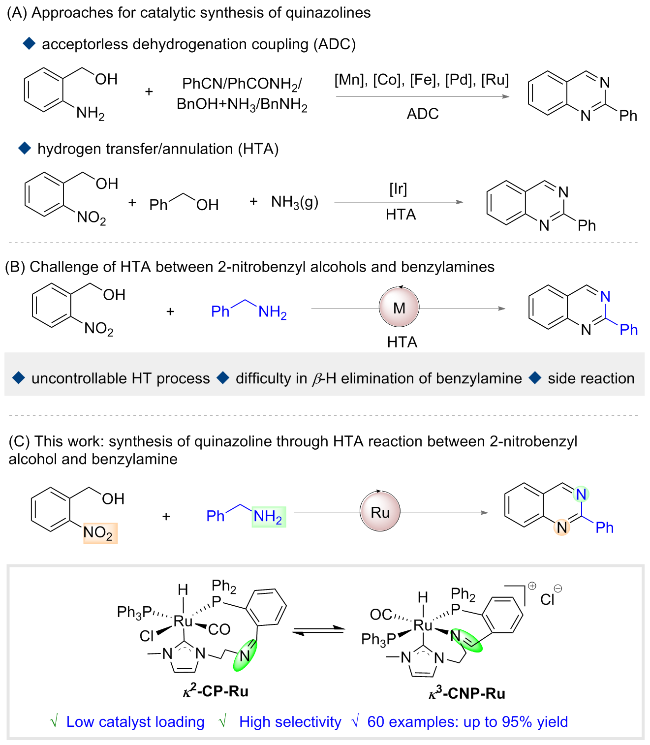
Generally, amino compounds are typically synthesized via the reduction of nitro compounds.[11] The direct synthesis of quinazolines from nitro compounds is advantageous as it minimizes the necessity for substantial quantities of reducing agents. In 2020, Tan’s group[12] reported only an example of synthesizing quinazoline through hydrogen transfer/annulation (HTA) of 2-nitrobenzyl alcohol and benzyl alcohol using naphthyridine-based iridium as a catalyst and ammonia gas as a nitrogen source (Scheme 1, A). However, the direct use of benzylamine is deemed to be more experimentally convenient and safe. The key challenges are the formation of multiple dehydrogenation and hydrolysis products from benzylamine, such as benzaldehyde, benzamide, N-benzylbenzylideneimine, phenylmeth- nimine, and benzonitrile (Scheme 1, B), complicating the control of dehydrogenation selectivity to yield the desired intermediate.[13] According to the literature, the transition metal-catalyzed dehydrogenation of benzylamine faces significant challenges due to the strong nucleophilicity of benzylamine and the difficulty of β-H elimination,[14] rendering benzylamine a particularly problematic substrate.
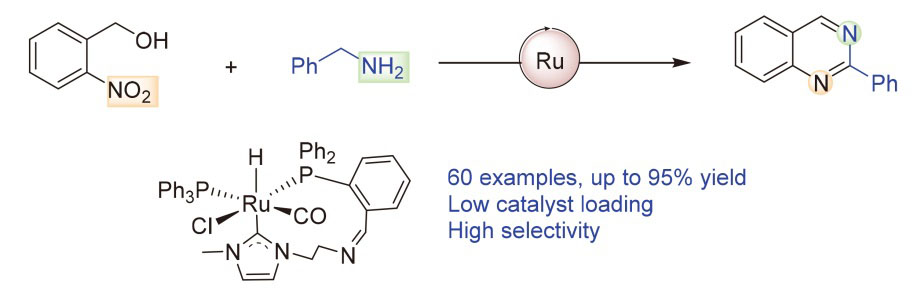
We previously synthesized the N-heterocyclic carbene nitrogen phosphine (CNP) ruthenium complex RuHCl- (CO)(PPh3)(κ2-CP), denoted as κ2-CP-Ru (Scheme 1, C). This complex demonstrated effective catalytic activity in various acceptorless dehydrogenation reactions.[13,15] And the complex brings several advantages to the reaction system. Firstly, the facial configuration of the κ2-CP-Ru complex provides a spacious coordination environment around the Ru center, facilitating the accommodation of substrates as geometrically required.[13,15] Secondly, the anchoring effect of the carbene moiety stabilizes the catalytically active species.[15-16] Notably, the presence of an imine moiety within the structure leads us to hypothesize that it can facilitate the in-situ transformation of the κ2-CP-Ru complex into the cationic ruthenium complex, namely [fac-RuH(CO)(PPh3)(κ3-CNP)]Cl (κ3-CNP-Ru).[15b] Herein, we show that this catalytic system effectively addresses the challenges associated with quinazoline synthesis from 2-nitrobenzyl alcohol and benzylamine. To the best of our knowledge, this represents the first example of quinazoline synthesis from 2-nitrobenzyl alcohol and benzylamine via a catalytic hydrogen transfer/annulation reaction.
2 Results and discussion
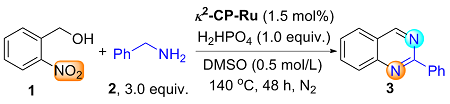
Initially, the optimization of reaction conditions was conducted by utilizing 2-nitrobenzyl alcohol (1) and benzylamine (2) as representative substrates (Table 1). A high yield (77%) of 2-phenylquinoline (3) was obtained in dimethyl sulfoxide (DMSO) with 1.5 mol% κ2-CP-Ru as the catalyst precursor at 140 ℃ for 48 h in the presence of K2HPO4 (Table 1, Entry 1). A gram-scale experiment between 1 and 2 led to product 3 with 65% yield (Table 1, Entry 1), thereby demonstrating the practicality of the hydrogen transfer/annulation reactions. Only 38% product was formed without a base (Table 1, Entry 2). Replacing K2HPO4 with K3PO4 or Na2HPO4 resulted in the low yields (Table 1, Entries 3 and 4). Solvent testing revealed that DMSO was the most effective (Table 1, Entries 5~7), whereas weak polar solvents like chlorobenzene or o-xylene resulted in product yields of only 48% or 50%, respectively (Table 1, Entries 6 and 7). Lowering the reaction temperature to 120 ℃ led to the decrease of yield (Table 1, Entry 8). Replacing complex κ2-CP-Ru with complex κ3-CNP-Ru did not cause the obvious change in yield (Table 1, Entry 9). However, using RuHCl(CO)(PPh3)3 as a catalyst led to a significant decreased product yield (Table 1, Entry 10). These results clearly demonstrated the efficient co-catalytic role of the CNP ligand in the catalytic process.
Table 1 Optimization of the reaction conditionsa,b |
| Entry | Deviation from the standard conditions | Yield/% |
|---|---|---|
| 1 | None | 77 (65)c |
| 2 | No base | 38 |
| 3 | K3PO4 instead of K2HPO4 | 47 |
| 4 | Na2HPO4 instead of K2HPO4 | 51 |
| 5 | DMF instead of DMSO | 67 |
| 6 | o-Xylene instead of DMSO | 50 |
| 7 | PhCl instead of DMSO | 48 |
| 8 | 120 ℃ | 54 |
| 9 | κ3-CNP-Ru instead of κ2-CP-Ru | 75 |
| 10 | [RuH(CO)(PPh3)3Cl instead of κ2-CP-Ru | 49 |
a Yield was determined by GC-MS using tridecane as the internal standard. b Reaction conditions: κ2-CP-Ru (1.5 mol%), 1 (0.5 mmol), 2 (3.0 equiv.) and K2HPO4 (1.0 equiv.) in DMSO (0.5 mol/L) at 140 ℃ for 48 h under the nitrogen atmosphere. c Gram-scale experiments: κ2-CP-Ru (0.1 mmol, 86.7 mg), 1 (7.0 mmol, 1.07 g), 2 (21.0 mmol, 2.3 mL) and K2HPO4 (7.0 mmol, 1.2 g) in DMSO (14 mL) at 140 ℃ for 48 h under the nitrogen atmosphere. |
With the optimized condition in hand, the generality of this reaction was investigated. The scope of benzylamine was initially assessed (Table 2). Various substituted benzylamine substrates reacted well with 2-nitrobenzyl alcohol to produce the corresponding quinazolines in yields ranging from 50%~93%, regardless of whether the substituents were on the para- (4~12), meta- (13~18), or ortho-positions (19~25), irrespective of whether they were electron-donating (CH3, OCH3) or electron-withdrawing (F, CF3) groups. The general trend observed was that ortho-substituted benzylamines yielded lower products than their para- or meta-substituted analogeous (8 vs 21, 18 vs 25), possibly due to steric hindrance. Additionally, benzylamines bearing electron-withdrawing groups exhibited lower reactivity compared to those with electron-donating groups (4 vs 12, 14 vs 18). Remarkably, multi-substituted benzylamines smoothly delivered the corresponding quinazolines in good yields (26~31). Naphthalen-1-yl- methanamine also gave its corresponding product 32 in a high yield of 90%. Methylamines containing heterocyclic moieties, such as pyridine, furan, and thiophene were also proven to be compatible with this system (33~40). Subsequently, the scope of the 2-nitrobenzyl alcohols was also examined. The conversion of 3-substituted 2-nitrobenzyl alcohols to the target product resulted in the yields ranging from 56% to 74% (41~44), and the compounds bearing electron-donating group had higher reactivity than those bearing electron-withdrawing group (41 vs 42). Gratifyingly, various substituted 2-nitrobenzyl alcohols, including C(4), C(5), and C(6) substitutions, produced quinazolines (45~60) in yields ranging from 49% to 93%. C(4) and C(5) substitutions with small steric hindrance had higher reactivity than C(3) and C(6) substitutions with large steric hindrance (41 vs 46, 52 vs 57). The conversion of multi- substituted 2-nitrobenzyl alcohols gave quinazolines in yields of 95% and 77% (61, 62). (6-Nitrobenzo[d][1,3]di- oxol-5-yl)methanol was also amenable, affording quinazoline 63 in 66% yield. It is worth noting that both substrates demonstrate a high tolerance for a wide range of functional groups.
Table 2 Substrate scope |

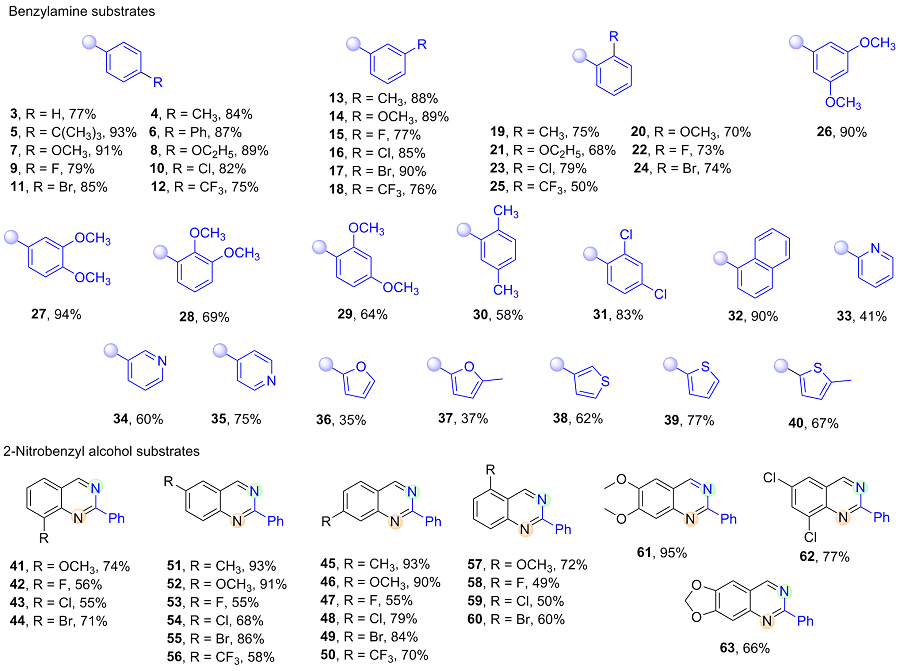 |
a Yields were isolated yields. b Reaction conditions: κ2-CP-Ru (1.5 mol%), 2-nitrobenzyl alcohol (0.5 mmol), benzylamine (3.0 equiv.) and K2HPO4 (1.0 equiv.) in DMSO (0.5 mol/L) at 140 ℃ for 48 h under the nitrogen atmosphere. |
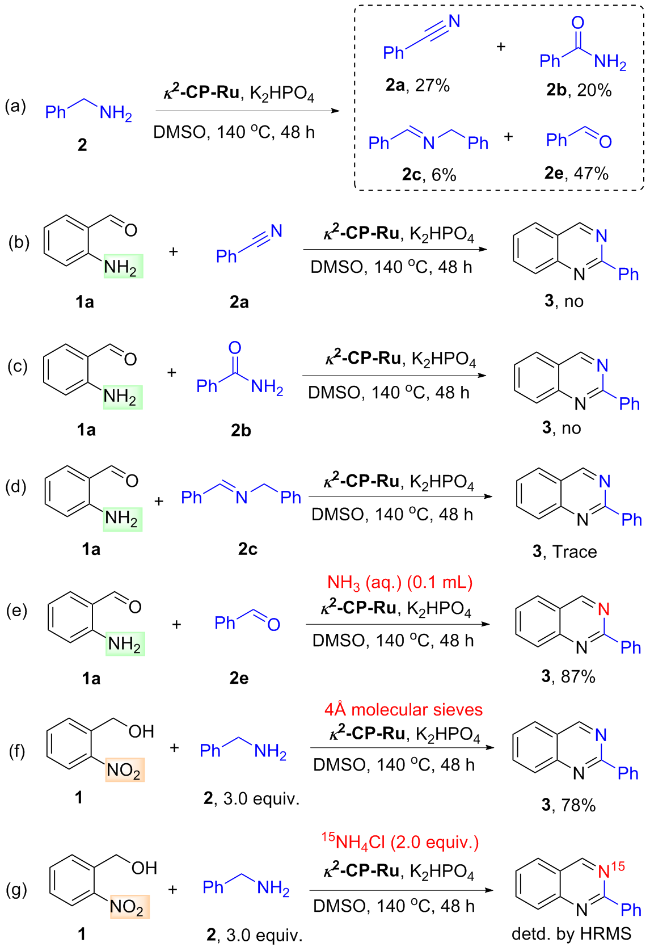
On the basis of transition metal-catalyzed acceptorless dehydrogenation of solely benzylamine as a substrate under standard conditions (Scheme 2, a), it is hypothesized that the reaction may involve the following intermediates, ben- zonitrile (2a),[7e,7f] benzamide (2b),[7a,7d] N-benzylbenzyli- deneimine (2c), or benzaldehyde (2e).[17] To identify the actual intermediates participating in the reaction, a series of control experiments were conducted (Scheme 2). Initially, these possible intermediates were employed as substrates and their reactivity with 2-aminobenzaldehyde (1a), which was detected in the reaction related to 2-nitrobenzyl alcohol, was assessed under standard conditions (Scheme 2, b~e). Notably, when benzonitrile (2a), benzamide (2b), and N- benzyl-1-phenylmethanimine (2c), were subjected to standard reaction conditions, they either failed to produce or generated trace amounts of the desired product, thus ruling them out as potential reaction intermediates (Scheme 2, b~d). Conversely, the reaction of benzaldehyde (2e) in the presence of ammonia gave the product in a high yield of 87% (Scheme 2, e). The benzaldehyde may be produced from the hydrolysis of the phenylmethanimine, which is generated through the dehydrogenation of benzylamine. Since phenylmethanimine has a reactive dynamic covalent C=N bond, the interconversion between benzaldehyde and phenylmethanimine during the reaction would establish a reversible process mediated by the presence of water and amine sources. Therefore, the water and amine sources were regulated in order to identify the true reaction intermediates (Scheme 2, f and g). Under the standard conditions, the addition of dried molecular sieves resulted in a product yield of 78% (Scheme 2, f), suggesting that phenylmethanimine remained reactive without undergoing hydrolysis to benzaldehyde. Intriguingly, the addition of 15NH4Cl to the reaction system resulted in the formation of a 15N- labeled quinazoline (Scheme 2, g), as confirmed by high- resolution mass spectrometry (HRMS), where N(1) was the nitrogen atom of 2-nitrobenzyl alcohol and N(2) was the externally introduced nitrogen atom. This finding indicated that the reaction proceeded through the hydrolysis of phenylmethanimine to benzaldehyde, with the external nitrogen source (15NH4Cl) being incorporated into the product. These control experiments provided strong evidence that both benzaldehyde and phenylmethanimine acted as intermediates in the reaction.
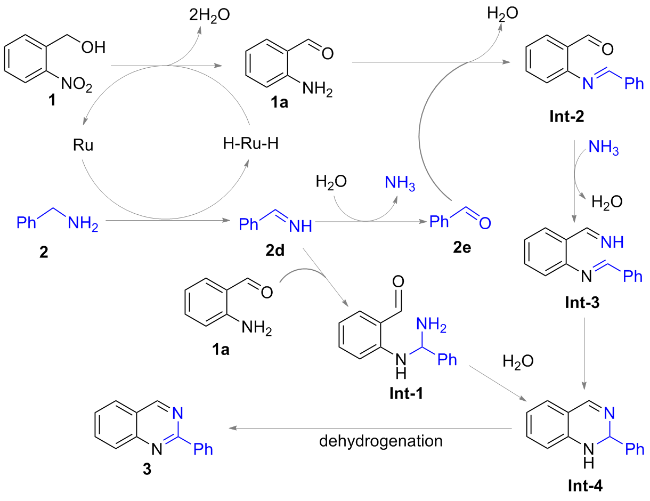
Based on these experimental results, a plausible reaction mechanism is proposed (Scheme 3). Under the catalysis of the κ2-CP-Ru complex, transfer hydrogenation occurs between benzylamine (2) and 2-nitrobenzyl alcohol (1), leading to the formation of benzylamine (2d) and 2-amino- benzaldehyde (1a). Subsequently, two parallel pathways are operative: on one hand, 2d undergoes nucleophilic addition with 1a, leading to formation of the intermediate Int-1, which undergoes dehydration condensation to form Int-4. Alternatively, 2d can be hydrolyzed to benzaldehyde (2e), which then condenses with 1a to form Int-2. The condensation of Int-2 with ammonia results in the formation of Int-3, followed by cyclization to generate Int-4. Ultimately, the final product 3 is obtained from Int-4 through a subsequent dehydrogenative process.


3 Conclusions
In summary, the Ru-catalyzed (κ2-CP-Ru) synthesis of quinazoline from 2-nitrobenzyl alcohol and benzylamine through hydrogen transfer/annulation has been developed. This reaction system is an efficient, selective and sustainable protocol for synthesis of quinazolines with 60 examples and a yield of up to 95%. The high efficiency of the catalytic system can be attributed to the use of an auxiliary N-hetero- cyclic carbene nitrogen phosphine (CNP) ligand, which plays a key role in enhancing catalytic performance.
4 Experimental section
4.1 General Information
All procedures sensitive to air and moisture were conducted either in a nitrogen atmosphere utilizing standard Schlenk techniques or within a glovebox environment. Solvents were dried according to established protocols. Reagents were obtained from commercial vendors, specifically Tansoole and Innochem, and were utilized as received. The synthesis of RuH(CO)(PPh3)3Cl and N-hetero- cyclic carbene nitrogen phosphine ligand (CNP) was performed following previously published methodologies.
All reactions were conducted under heating using an IKA magnetic stirring apparatus or an oil bath. NMR spectra were recorded on a Bruker AVANCE III HD-400 MHz spectrometer, with 31P NMR spectra obtained under nitrogen using Teflon valve plugs. Gas chromatography-mass spectrometry (GC-MS) analysis was performed using a SHIMADZU GCMS-QP2020 system, while high-resolu- tion mass spectrometry (HRMS) was conducted on a SHIMADZU LCMS-IT-TOF mass spectrometer.
4.2 Synthesis of RuHCl(CO)(PPh3)(κ2-CP) (κ2-CP- Ru)
The ligand CNP (2.0 mmol, 866 mg) was reacted with Ag2O (1.1 mmol, 256 mg) in dichloromethane (10 mL) at room temperature for 2 h. The solution was then filtered, and the filtrate was treated with anhydrous ether to precipitate the silver complex, [Ag]-CNP (72%, 826 mg). This [Ag]-CNP (0.2 mmol, 115 mg) was subsequently reacted with RuHCl(CO)(PPh3)3 (0.2 mmol, 190 mg) in toluene at 60 ℃, resulting in a brown solution. The resultant yellow solid was isolated via filtration and washed with anhydrous ether, ultimately producing a yellow powder identified as κ2-CP-Ru with a yield of 40% (66 mg). 1H NMR (CD2Cl2, 400.1 MHz) δ: 8.63 (s, 1H), 7.51~7.47 (m, 2H), 6.80~7.40 (m, 26H), 6.58 (s, 1H), 6.20 (t, J=8.0 Hz, 2H), 4.39~4.52 (m, 2H), 4.02 (d, J=12.0 Hz, 1H), 3.89 (s, 3H), 2.59 (t, J=8.0 Hz, 1H), -11.97 (dd, J=24.3, 15.1 Hz, 1H); 31P NMR (CD2Cl2, 162.0 MHz) δ: 40.7 (d, J=30.4 Hz), 36.8 (d, J=30.4 Hz); HRMS (ESI-TOF) calcd for C44H40N3- OP2Ru [M-Cl]+ 790.1690, found 790.1687; C26H25N3- OPRu [M-Cl-PPh3]+ 528.0779, found 528.0784.
4.3 Synthesis of RuHCl(CO)(PPh3)(κ3-CNP) (κ3- CNP-Ru)
The [Ag]-CNP (0.2 mmol, 115 mg) underwent a reaction with RuHCl(CO)(PPh3)3 (0.2 mmol, 190 mg) in tetrahydrofuran at a temperature of 90 ℃, which resulted in the formation of a brown solution. The yellow solid obtained from this reaction was separated through filtration and rinsed with anhydrous ether, leading to the acquisition of a yellow powder designated as κ3-CNP-Ru with a yield of 42% (70 mg). 1H NMR (CD2Cl2, 400.1 MHz) δ: 8.64 (s, 1H), 7.85~7.82 (m, 1H), 6.77~7.64 (m, 28H), 6.45 (t, J=8.0 Hz, 2H), 3.99 (d, J=16.0 Hz, 1H), 3.61 (d, J=12.0 Hz, 1H), 3.47 (t, J=12.0 Hz, 1H), 2.96 (s, 3H), 2.31 (t, J=12.0 Hz, 1H), -7.55 (dd, J=24.8, 22.0 Hz); 31P NMR (CD2Cl2, 162.0 MHz) δ: 47.0 (d, J=254.3 Hz, 42.7 (d, J=254.3 Hz); HRMS (ESI-TOF) calcd for C44H40N3OP2Ru [M-Cl]+ 790.1690, found 790.1691; C26H25N3OPRu [M-Cl- PPh3]+ 528.0779, found 528.0773.
4.4 Synthesis of quinazoline through hydrogen transfer/annulation reaction
2-Nitrobenzyl alcohol (0.5 mmol), κ2-CP-Ru (1.5 mmol%, 6.3 mg) and K2HPO4 (0.5 mmol, 87 mg) were added into an oven-dried Schlenk tube equipped with a N2 balloon, and it was subject to three cycles of vacuum and refilled with nitrogen. Then another alcohol (1.5 mmol) and 1 mL of PhCl were sequentially injected and the mixture was stirred at 140 ℃. After reacting 48 h, the mixture was filtered, and the sample was washed with dichloromethane. The crude residue was purified by flash column chromatography [unless mentioned otherwise, the mixture of petroleum (PE)/ethyl acetate (EA) with V∶V=30∶1 was used as eluent) to obtain the pure product.
2-Phenylquinazoline (3): Light yellow solid, 79 mg, 77% yield. m.p. 103~105 ℃; 1H NMR (400 MHz, CDCl3) δ: 9.50 (s, 1H), 8.69~8.60 (m, 2H), 8.18~8.07 (m, 1H), 8.01~7.87 (m, 2H), 7.71~7.61 (m, 1H), 7.60~7.49 (m, 3H); 13C NMR (101 MHz, CDCl3) δ: 161.0, 160.5, 150.7, 138.0, 134.1, 130.6, 128.6, 128.6, 127.2, 127.1, 123.6; HRMS (ESI+) calcd for C14H11N2 [M+H]+ 207.1917, found 207.1922.
2-(p-Tolyl)quinazoline (4): Light yellow solid, 88 mg, 84% yield. m.p. 97~99 ℃; 1H NMR (400 MHz, CDCl3) δ: 9.46 (s, 1H), 8.64~8.46 (m, 2H), 8.20~7.99 (m, 1H), 8.00~7.83 (m, 2H), 7.65~7.52 (m, 1H), 7.37 (d, J=8.0 Hz, 2H), 2.47 (s, 3H); 13C NMR (101 MHz, CDCl3) δ: 161.1, 160.4, 150.8, 140.8, 135.3, 134.0, 129.4, 128.5, 127.1, 127.0, 123.5, 21.5; HRMS (ESI+) calcd for C15H13N2 [M+H]+ 211.1073, found 211.1068.
2-(4-(tert-Butyl)phenyl)quinazoline (5): Light yellow solid, 122 mg, 93% yield. m.p. 82~84 ℃; 1H NMR (400 MHz, CDCl3) δ: 9.47 (s, 1H), 8.66~8.52 (m, 2H), 8.10 (dd, J=8.4, 0.8 Hz, 1H), 7.97~7.85 (m, 2H), 7.67~7.53 (m, 3H), 1.42 (s, 9H); 13C NMR (101 MHz, CDCl3) δ: 161.1, 160.4, 153.9, 150.8, 135.3, 134.0, 128.6, 128.3, 127.1, 127.0, 125.6, 123.5, 34.8, 31.3; HRMS (ESI+) calcd for C18H19N2 [M+H]+ 263.1543, found 263.1543.
2-([1'-Viphenyl]-4-yl)quinazoline (6): Light yellow solid, 123 mg, 87% yield. m.p. 117~119 ℃; 1H NMR (400 MHz, CDCl3) δ: 9.50 (s, 1H), 8.73 (d, J=8.4 Hz, 2H), 8.13 (d, J=8.4 Hz, 1H), 8.00~7.90 (m, 2H), 7.86~7.78 (m, 2H), 7.74 (dd, J=5.2, 3.3 Hz, 2H), 7.68~7.58 (m, 1H), 7.51 (dd, J=10.3, 4.8 Hz, 2H), 7.47~7.38 (m, 1H); 13C NMR (101 MHz, CDCl3) δ: 160.8, 160.5, 150.8, 143.2, 140.6, 137.0, 134.1, 129.0, 128.8, 128.6, 127.6, 127.3, 127.2, 127.2, 127.1, 123.6; HRMS (ESI+) calcd for C20H15N2 [M+H]+ 283.1230, found 283.1231.
2-(4-Methoxyphenyl)quinazoline (7): Light yellow solid, 107 mg, 91% yield. m.p. 91~93 ℃; 1H NMR (400 MHz, CDCl3) δ: 9.42 (s, 1H), 8.74~8.50 (m, 2H), 8.05 (d, J=9.0 Hz, 1H), 8.00~7.83 (m, 2H), 7.65~7.48 (m, 1H), 7.16~6.98 (m, 2H), 3.91 (s, 3H); 13C NMR (101 MHz, CDCl3) δ: 161.8, 160.8, 160.3, 150.8, 134.0, 130.7, 130.2, 128.3, 127.1, 126.7, 123.3, 113.9, 55.3; HRMS (ESI+) calcd for C15H13N2O [M+H]+ 237.1022, found 237.1015.
2-(4-Ethoxyphenyl)quinazoline (8): Light yellow solid, 111 mg, 89% yield. m.p. 123~125 ℃; 1H NMR (400 MHz, CDCl3) δ: 9.42 (s, 1H), 8.78~8.48 (m, 2H), 8.05 (d, J=9.0 Hz, 1H), 7.93~7.80 (m, 2H), 7.70~7.43 (m, 1H), 7.24~6.85 (m, 2H), 4.14 (q, J=7.0 Hz, 2H), 1.48 (t, J=7.0 Hz, 3H); 13C NMR (101 MHz, CDCl3) δ: 161.2, 160.8, 160.3, 150.8, 134.0, 130.5, 130.2, 128.3, 127.1, 126.7, 123.2, 114.4, 63.5, 14.8; HRMS (ESI+) calcd for C16H15N2O [M+H]+ 251.1179, found 251.1173.
2-(4-Fluorophenyl)quinazoline (9): Yellow solid, 88 mg, 79% yield. m.p. 136~138 ℃; 1H NMR (400 MHz, CDCl3) δ: 9.46 (s, 1H), 8.82~8.53 (m, 2H), 8.09 (d, J=8.3 Hz, 1H), 8.02~7.84 (m, 2H), 7.71~7.51 (m, 1H), 7.27~7.15 (m, 2H); 13C NMR (101 MHz, CDCl3) δ: 164.7 (d, J=250.4 Hz), 160.5, 160.0, 150.6, 134.2, 134.1, 134.1, 130.7 (d, J=8.7 Hz), 128.5, 127.2 (d, J=15.9 Hz), 123.4, 115.5 (d, J=21.6 Hz); HRMS (ESI+) calcd for C14H17FN2 [M+H]+ 225.0823, found 225.0824.
2-(4-Chlorophenyl)quinazoline (10): Yellow solid, 98 mg, 82% yield. m.p. 137~139 ℃; 1H NMR (400 MHz, CDCl3) δ: 9.46 (s, 1H), 8.68~8.52 (m, 2H), 8.16~8.02 (m, 1H), 8.00~7.89 (m, 2H), 7.72~7.58 (m, 1H), 7.58~7.45 (m, 2H); 13C NMR (101 MHz, CDCl3) δ: 160.5, 159.9, 150.6, 136.8, 136.4, 134.3, 129.9, 128.8, 128.5, 127.4, 127.1, 123.6; HRMS (ESI+) calcd for C14H17ClN2 [M+ H]+ 241.0527, found 241.0531.
2-(4-Bromophenyl)quinazoline (11): yellow solid, 121 mg, 85% yield. m.p. 122~124 ℃; 1H NMR (400 MHz, CDCl3) δ: 9.45 (s, 1H), 8.55~8.45 (m, 2H), 8.23~8.03 (m, 1H), 7.99~7.86 (m, 2H), 7.73~7.58 (m, 3H); 13C NMR (101 MHz, CDCl3) δ: 160.5, 160.0, 150.6, 136.9, 134.3, 131.7, 130.1, 128.5, 127.5, 127.1, 125.4, 123.6; HRMS (ESI+) calcd for C14H10BrN2 [M+H]+ 285.0022, found 285.0017.
2-(4-(Trifluoromethyl)phenyl)quinazoline (12): Brown solid, 103 mg, 75% yield. m.p. 144~146 ℃; 1H NMR (400 MHz, CDCl3) δ: 9.50 (s, 1H), 8.76 (d, J=8.1 Hz, 2H), 8.13 (dd, J=8.3, 0.8 Hz, 1H), 7.95 (dd, J=12.2, 4.5 Hz, 2H), 7.80 (d, J=8.2 Hz, 2H), 7.70~7.59 (m, 1H); 13C NMR (101 MHz, CDCl3) δ: 160.6, 159.6, 150.6, 141.2, 134.3, 132.1 (q, J=32.3 Hz), 128.8, 128.7, 127.8, 127.1, 125.5 (q, J=3.8 Hz), 125.5(q, J=272.4 Hz), 123.8; HRMS (ESI+) calcd for C15H10F3N2 [M+H]+ 275.0791, found 275.0785.
2-(m-Tolyl)quinazoline (13): Light yellow solid, 92 mg, 88% yield. m.p. 101~103 ℃; 1H NMR (400 MHz, CDCl3) δ: 9.48 (s, 1H), 8.45 (dd, J=6.4, 5.3 Hz, 2H), 8.16~8.07 (m, 1H), 8.03~7.83 (m, 2H), 7.68~7.54 (m, 1H), 7.50~7.42 (m, 1H), 7.35 (d, J=7.5 Hz, 1H), 2.52 (s, 3H); 13C NMR (101 MHz, CDCl3) δ: 161.2, 160.4, 150.7, 138.2, 137.9, 134.1, 131.4, 129.1, 128.6, 128.6, 127.2, 127.1, 125.8, 123.5, 21.5; HRMS (ESI+) calcd for C15H13N2 [M+H]+ 211.1073, found 211.1080.
2-(3-Methoxyphenyl)quinazoline (14): Light yellow solid, 105 mg, 89% yield. m.p. 82~84 ℃; 1H NMR (400 MHz, CDCl3) δ: 9.48 (s, 1H), 8.29~8.23 (m, 1H), 8.21 (dd, J=2.5, 1.5 Hz, 1H), 8.11 (dd, J=8.4, 0.8 Hz, 1H), 7.99~7.88 (m, 2H), 7.68~7.58 (m, 1H), 7.51~7.43 (m, 1H), 7.17~7.04 (m, 1H), 3.98 (s, 3H); 13C NMR (101 MHz, CDCl3) δ: 160.8, 160.4, 160.0, 150.7, 139.5, 134.1, 129.6, 128.6, 127.3, 127.1, 123.6, 121.1, 117.2, 113.0, 55.4; HRMS (ESI+) calcd for C15H13N2O [M+H]+ 237.1022, found 237.1027.
2-(3-Fluorophenyl)quinazoline (15): Light yellow solid, 86 mg, 77% yield. m.p. 95~97 ℃; 1H NMR (400 MHz, CDCl3) δ: 9.49 (s, 1H), 8.44 (d, J=7.8 Hz, 1H), 8.39~8.28 (m, 1H), 8.18~8.06 (m, 1H), 8.02~7.88 (m, 2H), 7.74~7.61 (m, 1H), 7.60~7.46 (m, 1H), 7.26~7.18 (m, 1H); 13C NMR (101 MHz, CDCl3) δ: 163.2 (d, J=244.8 Hz), 160.5, 159.8 (d, J=3.4 Hz), 150.6, 140.4 (d, J=7.9 Hz), 134.3, 130.0 (d, J=8.0 Hz), 128.7, 127.6, 127.1, 124.1 (d, J=2.8 Hz), 123.7, 117.4 (d, J=21.5 Hz), 115.4 (d, J=23.3 Hz); HRMS (ESI+) calcd for C14H17FN2 [M+H]+ 225.0823, found 225.0821.
2-(3-Chlorophenyl)quinazoline (16): Yellow solid, 102 mg, 85% yield. m.p. 148~150 ℃; 1H NMR (400 MHz, CDCl3) δ: 9.49 (s, 1H), 8.66 (dd, J=2.2, 1.3 Hz, 1H), 8.61~8.48 (m, 1H), 8.12 (dd, J=8.3, 0.8 Hz, 1H), 8.02~7.90 (m, 2H), 7.73~7.60 (m, 1H), 7.54~7.44 (m, 2H); 13C NMR (101 MHz, CDCl3) δ: 160.5, 159.7, 150.6, 139.8, 134.7, 134.3, 130.5, 129.8, 128.6, 128.6, 127.6, 127.1, 126.6, 123.7; HRMS (ESI+) calcd for C14H17ClN2 [M+ H]+ 241.0527, found 241.0529.
2-(3-Bromophenyl)quinazoline (17): Yellow solid, 128 mg, 90% yield. m.p. 149~151 ℃; 1H NMR (400 MHz, CDCl3) δ: 9.47 (s, 1H), 8.81 (t, J=1.8 Hz, 1H), 8.65~8.50 (m, 1H), 8.10 (d, J=9.0 Hz, 1H), 8.65~8.50 (m, 1H), 8.10 (d, J=9.0 Hz, 1H), 8.00~7.87 (m, 2H), 7.71~7.60 (m, 2H), 7.46~7.32 (m, 1H); 13C NMR (101 MHz, CDCl3) δ: 160.5, 159.6, 150.6, 140.0, 134.3, 133.4, 131.5, 130.1, 128.7, 127.6, 127.1, 127.1, 123.7, 122.9; HRMS (ESI+) calcd for C14H10BrN2 [M+H]+ 285.0022, found 285.0029.
2-(3-(Trifluoromethyl)phenyl)quinazoline (18): Brown solid, 104 mg, 76% yield. m.p. 146~148 ℃; 1H NMR (400 MHz, CDCl3) δ: 9.50 (s, 1H), 8.96 (s, 1H), 8.85 (d, J=7.8 Hz, 1H), 8.20~8.10 (m, 1H), 8.02~7.92 (m, 2H), 7.78 (d, J=7.7 Hz, 1H), 7.67 (dd, J=11.6, 4.2 Hz, 2H); 13C NMR (101 MHz, CDCl3) δ: 160.6, 159.5, 150.6, 138.8, 134.3, 131.6, 131.1 (q, J=32.4 Hz), 129.0, 128.7, 127.7, 127.1, 127.0 (q, J=3.7 Hz), 125.5 (q, 3.9 Hz), 124.0 (q, J=274.1 Hz), 123.8; HRMS (ESI+) calcd for C15H10F3N2 [M+H]+ 275.0791, found 275.0797.
2-(o-Tolyl)quinazoline (19): Light yellow solid, 79 mg, 75% yield. m.p. 44~46 ℃; 1H NMR (400 MHz, CDCl3) δ: 9.52 (s, 1H), 8.12 (dd, J=8.5, 0.7 Hz, 1H), 8.00~7.90 (m, 3H), 7.73~7.61 (m, 1H), 7.44~7.31 (m, 3H), 2.64 (s, 3H); 13C NMR (101 MHz, CDCl3) δ: 164.0, 160.0, 150.4, 138.6, 137.3, 134.1, 131.3, 130.6, 129.3, 128.5, 127.5, 127.0, 125.9, 122.9, 21.0; HRMS (ESI+) calcd for C15H13N2 [M+H]+ 211.1073, found 211.1068.
2-(2-Methoxyphenyl)quinazoline (20): Light yellow solid, 83 mg, 70% yield. m.p. 118~120 ℃; 1H NMR (400 MHz, CDCl3) δ: 9.52 (s, 1H), 8.13 (dd, J=8.5, 0.7 Hz, 1H), 8.03~7.88 (m, 2H), 7.80 (dd, J=7.6, 1.8 Hz, 1H), 7.70~7.61 (m, 1H), 7.53~7.41 (m, 1H), 7.15~7.10 (m, 1H), 7.08 (d, J=8.4 Hz, 1H), 3.89 (s, 3H); 13C NMR (101 MHz, CDCl3) δ: 162.4, 160.0, 157.6, 150.6, 134.0, 131.7, 130.8, 128.9, 128.5, 127.5, 127.0, 123.1, 120.8, 111.9, 56.0; HRMS (ESI+) calcd for C15H13N2O [M+H]+ 237.1022, found 237.1015.
2-(2-Ethoxyphenyl)quinazoline (21): Light yellow solid, 85 mg, 68% yield. m.p. 127~129 ℃; 1H NMR (400 MHz, CDCl3) δ: 9.50 (s, 1H), 8.19~8.08 (m, 1H), 8.01~7.87 (m, 2H), 7.79 (dd, J=7.6, 1.8 Hz, 1H), 7.70~7.60 (m, 1H), 7.50~7.37 (m, 1H), 7.20~7.00 (m, 2H), 4.14 (q, J=7.0 Hz, 2H), 1.34 (t, J=7.0 Hz, 3H); 13C NMR (101 MHz, CDCl3) δ: 162.5, 159.8, 157.2, 150.5, 133.9, 131.6, 130.7, 129.3, 128.5, 127.4, 127.0, 123.0, 120.7, 113.5, 64.6, 14.7; HRMS (ESI+) calcd for C16H15N2O [M+H]+ 251.1179, found 251.1173.
2-(2-Fluorophenyl)quinazoline (22): Light yellow solid, 81 mg, 73% yield. m.p. 88~90 ℃; 1H NMR (400 MHz, Chloroform-d) δ: 9.52 (s, 1H), 8.22~8.15 (m, 1H), 8.15~8.10 (m, 1H), 7.98~7.89 (m, 2H), 7.70~7.63 (m, 1H), 7.53~7.44 (m, 1H), 7.35~7.29 (m, 1H), 7.29~7.20 (m, 1H); 13C NMR (101 MHz, CDCl3) δ: 161.2 (d, J=254.6 Hz), 160.4, 159.8 (d, J=4.4 Hz), 150.5, 134.3, 132.1 (d, J=1.9 Hz), 131.6 (d, J=8.6 Hz), 128.6, 127.9, 127.1,127.0 (d, J=9.8 Hz), 124.2 (d, J=3.8 Hz), 123.2, 116.8 (d, J=22.4 Hz); HRMS (ESI+) calcd for C14H17FN2 [M+H]+ 225.0823, found 225.0824.
2-(2-Chlorophenyl)quinazoline (23): Light yellow solid, 95 mg, 79% yield. m.p. 66~68 ℃; 1H NMR (400 MHz, CDCl3) δ: 9.55 (s, 1H), 8.15 (dd, J=8.5, 0.7 Hz, 1H), 8.05~7.92 (m, 2H), 7.90~7.79 (m, 1H), 7.79~7.64 (m, 1H), 7.63~7.50 (m, 1H), 7.50~7.36 (m, 2H); 13C NMR (101 MHz, CDCl3) δ: 161.9, 160.2, 150.3, 138.2, 134.4, 132.9, 131.8, 130.5, 130.3, 128.6, 128.0, 127.1, 126.9, 123.2; HRMS (ESI+) calcd for C14H17ClN2 [M+H]+ 241.0527, found 241.0531.
2-(2-Bromophenyl)quinazoline (24): Yellow solid, 105 mg, 74% yield. m.p. 71~73 ℃; 1H NMR (400 MHz, CDCl3) δ: 9.54 (s, 1H), 8.15 (dd, J=8.5, 0.6 Hz, 1H), 8.07~7.92 (m, 2H), 7.81 (dd, J=7.6, 1.7 Hz, 1H), 7.78~7.66 (m, 2H), 7.50~7.44 (m, 1H), 7.38~7.30 (m, 1H); 13C NMR (101 MHz, CDCl3) δ: 162.7, 160.2, 150.2, 140.1, 134.4, 133.7, 131.6, 130.4, 128.6, 128.1, 127.4, 127.1, 123.3, 121.9; HRMS (ESI+) calcd for C14H10BrN2 [M+ H]+ 285.0022, found 285.0017.
2-(2-(Trifluoromethyl)phenyl)quinazoline (25): Brown solid, 69 mg, 50% yield. Purified by flash column chromatography using PE/EA (V∶V=20∶1) as eluent. m.p. 97~99 ℃; 1H NMR (400 MHz, CDCl3) δ: 9.53 (s, 1H), 8.14 (d, J=8.4 Hz, 1H), 8.07~7.95 (m, 2H), 7.86 (dd, J=7.6, 3.4 Hz, 2H), 7.79~7.66 (m, 2H), 7.66~7.58 (m, 1H); 13C NMR (101 MHz, CDCl3) δ: 162.4, 160.1, 150.1, 138.7 (q, J=4.0 Hz), 134.5, 131.6, 131.5, 129.1, 128.8 (q, J=31.3 Hz), 128.6, 128.1, 127.1, 126.8 (q, J=5.2 Hz), 124.0 (q, J=273.7 Hz), 123.2; HRMS (ESI+) calcd for C15H10F3N2 [M+H]+ 275.0791, found 275.0785.
2-(3,5-Dimethoxyphenyl)quinazoline (26): Light yellow solid, 120 mg, 90% yield. m.p. 106~108 ℃; 1H NMR (400 MHz, CDCl3) δ: 9.47 (s, 1H), 8.12 (dd, J=8.4, 0.8 Hz, 1H), 7.98~7.89 (m, 2H), 7.86 (d, J=2.4 Hz, 2H), 7.69~7.59 (m, 1H), 6.69~6.63 (m, 1H), 3.95 (s, 6H); 13C NMR (101 MHz, CDCl3) δ: 161.0, 160.6, 160.3, 150.6, 140.0, 134.1, 128.6, 127.3, 127.1, 123.7, 106.2, 103.8, 55.6; HRMS (ESI+) calcd for C16H15N2O2 [M+H]+ 267.1128, found 267.1123.
2-(3,4-Dimethoxyphenyl)quinazoline (27): Light yellow solid, 125 mg, 94% yield. m.p. 110~112 ℃; 1H NMR (400 MHz, CDCl3) δ: 9.41 (s, 1H), 8.27 (dd, J=8.4, 2.0 Hz, 1H), 8.21 (d, J=1.9 Hz, 1H), 8.06 (d, J=9.0 Hz, 1H), 7.96~7.82 (m, 2H), 7.63~7.50 (m, 1H), 7.02 (d, J=8.5 Hz, 1H), 4.07 (s, 3H), 3.98 (s, 3H); 13C NMR (101 MHz, CDCl3) δ: 160.6, 160.3, 151.3, 150.7, 149.0, 134.0, 130.8, 128.3, 127.1, 126.8, 123.3, 122.0, 111.1, 110.8, 56.0, 55.9; HRMS (ESI+) calcd for C16H15N2O2 [M+H]+ 267.1128, found 267.1127.
2-(2,3-Dimethoxyphenyl)quinazoline (28): Light yellow solid, 92 mg, 69% yield. m.p. 113~115 ℃; 1H NMR (400 MHz, CDCl3) δ: 9.53 (s, 1H), 8.13 (d, J=8.5 Hz, 1H), 8.02~7.87 (m, 2H), 7.68 (dd, J=11.1, 3.9 Hz, 1H), 7.44 (dd, J=7.8, 1.5 Hz, 1H), 7.25~7.13 (m, 1H), 7.08 (dd, J=8.2, 1.4 Hz, 1H), 3.96 (s, 3H), 3.95 (s, 3H); 13C NMR (101 MHz, CDCl3) δ: 162.0, 160.1, 153.4, 150.5, 148.0, 134.3, 134.0, 128.6, 127.5, 127.0, 124.0, 123.2, 123.1, 113.9, 61.6, 56.1; HRMS (ESI+) calcd for C16H15N2O2 [M+H]+ 267.1128, found 267.1123.
2-(2,4-Dimethoxyphenyl)quinazoline (29): Light yellow solid, 85 mg, 64% yield. m.p. 90~92 ℃; 1H NMR (400 MHz, CDCl3) δ: 9.50 (s, 1H), 8.11 (dd, J=8.5, 0.6 Hz, 1H), 7.99~7.79 (m, 3H), 7.71~7.58 (m, 1H), 6.72~6.58 (m, 2H), 3.91 (s, 3H), 3.90 (s, 3H); 13C NMR (101 MHz, CDCl3) δ: 162.2, 162.0, 159.9, 159.2, 150.6, 133.9, 133.2, 128.4, 127.2, 127.0, 122.8, 121.7, 105.0, 99.4, 56.1, 55.5; HRMS (ESI+) calcd for C16H15N2O2 [M+H]+ 267.1128, found 267.1130.
2-(2,5-Dimethylphenyl)quinazoline (30): Light yellow solid, 68 mg, 58% yield. m.p. 93~95 ℃; 1H NMR (400 MHz, CDCl3) δ: 9.52 (s, 1H), 8.13 (d, J=8.4 Hz, 1H), 8.04~7.91 (m, 2H), 7.74 (s, 1H), 7.71~7.65 (m, 1H), 7.27~7.16 (m, 2H), 2.58 (s, 3H), 2.43 (s, 3H); 13C NMR (101 MHz, CDCl3) δ: 164.1, 160.0, 150.3, 138.2, 135.4, 134.2, 134.1, 131.2, 131.1, 130.1, 128.5, 127.4, 127.0, 122.8, 20.9, 20.5; HRMS (ESI+) calcd for C16H15N2 [M+H]+ 235.1210, found 235.1216.
2-(2,4-Dichlorophenyl)quinazoline (31): Light yellow solid, 114 mg, 83% yield. m.p. 109~111 ℃; 1H NMR (400 MHz, CDCl3) δ: 9.54 (s, 1H), 8.14 (d, J=9.5 Hz, 1H), 8.10~7.94 (m, 2H), 7.84 (d, J=8.3 Hz, 1H), 7.77~7.69 (m, 1H), 7.69~7.29 (m, 2H); 13C NMR (101 MHz, CDCl3) δ: 160.9, 160.3, 150.3, 136.6, 135.7, 134.5, 133.8, 132.8, 130.4, 128.6, 128.2, 127.2, 127.1, 123.3; HRMS (ESI+) calcd for C14H9Cl2N2 [M+H]+ 275.0137, found 275.0141.
2-(Naphthalen-1-yl)quinazoline (32): Light yellow solid, 115 mg, 90% yield. m.p. 124~126 ℃; 1H NMR (400 MHz, CDCl3) δ: 9.63 (s, 1H), 8.74 (dd, J=8.0, 6.3 Hz, 1H), 8.21 (dd, J=5.1, 4.0 Hz, 2H), 8.08~7.89 (m, 4H), 7.79~7.70 (m, 1H), 7.69~7.62 (m, 1H), 7.62~7.53 (m, 2H); 13C NMR (101 MHz, CDCl3) δ: 163.4, 160.4, 150.5, 136.3, 134.3, 134.2, 131.2, 130.4, 129.6, 128.6, 128.5, 127.7, 127.1, 126.8, 125.9, 125.3, 123.1; HRMS (ESI+) calcd for C18H13N2 [M+H]+ 257.1073, found 257.1073.
2-(Pyridin-2-yl)quinazoline (33): Light brown oil, 42 mg, 41% yield. Purified by flash column chromatography using PE/EA (V∶V=5∶1) as eluent. 1H NMR (400 MHz, CDCl3) δ: 9.56~9.48 (m, 1H), 8.87 (s, 1H), 8.69~8.62 (m, 1H), 8.23~8.16 (m, 1H), 8.01~7.78 (m, 3H), 7.62 (q, J=7.4 Hz, 1H), 7.43~7.34 (m, 1H); 13C NMR (101 MHz, CDCl3) δ: 160.9, 159.8, 155.0, 150.7, 150.1, 136.9, 134.3, 129.1, 128.0, 127.1, 124.7, 124.0, 124.0; HRMS (ESI+) calcd for C13H10N3 [M+H]+ 208.0869, found 208.0865.
2-(Pyridin-3-yl)quinazoline (34): Light brown oil, 62 mg, 60% yield. Purified by flash column chromatography using PE/EA (V∶V=10∶1) as eluent. 1H NMR (400 MHz, CDCl3) δ: 9.83 (s, 1H), 9.51~9.47 (m, 1H), 8.92~8.84 (m, 1H), 8.75 (dd, J=4.8, 1.7 Hz, 1H), 8.15~8.08 (m, 1H), 7.99~7.90 (m, 2H), 7.71~7.62 (m, 1H), 7.51~7.43 (m, 1H); 13C NMR (101 MHz, CDCl3) δ: 160.6, 159.1, 151.1, 150.6, 150.2, 135.8, 134.4, 133.5, 128.6, 127.8, 127.2, 123.8, 123.4; HRMS (ESI+) calcd for C13H10N3 [M+H]+ 208.0869, found 208.0863.
2-(Pyridin-4-yl)quinazoline (35): Light brown solid, 78 mg, 75% yield. Purified by flash column chromatography using PE/EA (V∶V=10∶1) as eluent. m.p. 104~106 ℃; 1H NMR (400 MHz, CDCl3) δ: 9.53 (s, 1H), 8.86~8.82 (m, 2H), 8.49 (d, J=5.7 Hz, 2H), 8.16 (d, J=8.4 Hz, 1H), 8.04~7.95 (m, 2H), 7.76~7.68 (m, 1H); 13C NMR (101 MHz, CDCl3) δ: 160.7, 158.9, 150.5, 150.3, 145.4, 134.5, 128.9, 128.3, 127.2, 124.1, 122.4; HRMS (ESI+) calcd for C13H10N3 [M+H]+ 208.0869, found 208.0866.
2-(Furan-2-yl)quinazoline (36): Light yellow oil, 34 mg, 35% yield. Purified by flash column chromatography using PE/EA (V∶V=20∶1) as eluent. 1H NMR (400 MHz, CDCl3) δ: 9.39 (s, 1H), 8.19~8.05 (m, 1H), 7.95~7.85 (m, 2H), 7.70 (dd, J=1.7, 0.8 Hz, 1H), 7.67~7.53 (m, 1H), 7.47 (dd, J=3.4, 0.8 Hz, 1H), 6.63 (dd, J=3.4, 1.7 Hz, 1H); 13C NMR (101 MHz, CDCl3) δ: 160.7, 154.0, 152.5, 150.4, 145.3, 134.5, 128.3, 127.2, 127.2, 123.3, 114.1, 112.3; HRMS (ESI+) calcd for C12H9N2O [M+H]+ 197.0709, found 197.0714.
2-(5-Methylfuran-2-yl)quinazoline (37): Light yellow solid, 39 mg, 37% yield. Purified by flash column chromatography using PE/EA (V∶V=20∶1) as eluent. m.p. 114~116 ℃; 1H NMR (400 MHz, CDCl3) δ: 9.34 (s, 1H), 8.11~8.04 (m, 1H), 7.92~7.83 (m, 2H), 7.60~7.52 (m, 1H), 7.39 (d, J=3.3 Hz, 1H), 6.26~6.21 (m, 1H), 2.51 (s, 3H); 13C NMR (101 MHz, CDCl3) δ: 160.7, 156.1, 154.2, 151.1, 150.5, 134.4, 128.3, 127.3, 126.9, 123.2, 115.7, 108.9, 14.3; HRMS (ESI+) calcd for C13H11N2O [M+H]+ 211.0866, found 211.0869.
2-(Thiophen-3-yl)quinazoline (38): Light yellow oil, 66 mg, 62% yield. Purified by flash column chromatography using PE/EA (V∶V=20∶1) as eluent. 1H NMR (400 MHz, CDCl3) δ: 9.41 (s, 1H), 8.47 (dd, J=3.1, 1.1 Hz, 1H), 8.26~8.00 (m, 2H), 8.00~7.84 (m, 2H), 7.71~7.55 (m, 1H), 7.44 (dd, J=5.1, 3.1 Hz, 1H); 13C NMR (101 MHz, CDCl3) δ: 160.5, 158.2, 150.6, 141.9, 134.1, 128.3, 128.3, 127.7, 127.1, 127.0, 126.1, 123.3; HRMS (ESI+) calcd for C12H9N2S [M+H]+ 213.0481, found 213.0489.
2-(Thiophen-2-yl)quinazoline (39): Light yellow oil, 82 mg, 77% yield. Purified by flash column chromatography using PE/EA (V∶V=20∶1) as eluent. 1H NMR (400 MHz, CDCl3) δ: 9.36 (s, 1H), 8.18 (dd, J=3.7, 1.1 Hz, 1H), 8.09~7.96 (m, 1H), 7.92~7.83 (m, 2H), 7.65~7.46 (m, 2H), 7.21 (dd, J=4.9, 3.8 Hz, 1H); 13C NMR (101 MHz, CDCl3) δ: 160.5, 157.8, 150.6, 143.8, 134.3, 129.8, 129.2, 128.4, 128.1, 127.2, 127.0, 123.3; HRMS (ESI+) calcd for C12H9N2S [M+H]+ 213.0481, found 213.0479.
2-(5-Methylthiophen-2-yl)quinazoline (40): Light yellow solid, 76 mg, 67% yield. Purified by flash column chromatography using PE/EA (V∶V=20∶1) as eluent. m.p. 137~139 ℃; 1H NMR (400 MHz, CDCl3) δ: 9.32 (s, 1H), 8.02~7.94 (m, 2H), 7.90~7.82 (m, 2H), 7.58~7.50 (m, 1H), 6.90~6.84 (m, 1H), 2.58 (s, 3H); 13C NMR (101 MHz, CDCl3) δ: 160.5, 157.9, 150.6, 145.2, 141.2, 134.2, 129.6, 128.0, 127.2, 126.9, 126.7, 123.2, 15.8; HRMS (ESI+) calcd for C13H10N2S [M+H]+ 227.0637, found 227.0639.
8-Methoxy-2-phenylquinazoline (41): Light yellow solid, 87 mg, 74% yield. m.p. 99~101 ℃; 1H NMR (400 MHz, CDCl3) δ: 9.46 (s, 1H), 8.91~8.33 (m, 2H), 7.62~7.33 (m, 5H), 7.25 (dd, J=7.3, 1.7 Hz, 1H), 4.14 (s, 3H); 13C NMR (101 MHz, CDCl3) δ: 160.4, 160.3, 154.9, 142.9, 138.0, 130.5, 128.6, 128.5, 127.5, 124.4, 118.6, 112.0, 56.3; HRMS (ESI+) calcd for C15H13N2O [M+H]+ 237.1022, found 237.1028.
8-Fluoro-2-phenylquinazoline (42): Light yellow solid, 63 mg, 56% yield. m.p. 137~139 ℃; 1H NMR (400 MHz, CDCl3) δ: 9.53 (s, 1H), 8.74~8.62 (m, 2H), 7.82~7.72 (m, 1H), 7.68~7.51 (m, 5H); 13C NMR (101 MHz, CDCl3) δ: 160.2, 160.2, 159.9 (d, J=259.0 Hz), 156.0, 141.2 (d, J=12.7 Hz), 137.5, 131.0, 128.7, 128.6, 127.0 (d, J=7.3 Hz), 122.7 (d, J=4.9 Hz), 118.1 (d, J=18.3 Hz); HRMS (ESI+) calcd for C14H17FN2 [M+H]+ 225.0823, found 225.0823.
8-Chloro-2-phenylquinazoline (43): Light yellow solid, 66 mg, 55% yield. m.p. 111~113 ℃; 1H NMR (400 MHz, CDCl3) δ: 9.50 (s, 1H), 8.89~8.55 (m, 2H), 8.03 (dd, J=7.5, 1.3 Hz, 1H), 7.88 (dd, J=8.1, 1.3 Hz, 1H), 7.72~7.39 (m, 4H); 13C NMR (101 MHz, CDCl3) δ: 161.5, 160.7, 147.3, 137.6, 133.9, 133.2, 131.0, 128.8, 128.7, 127.1, 125.9, 124.6; HRMS (ESI+) calcd for C14H17ClN2 [M+ H]+ 241.0527, found 241.0529.
8-Bromo-2-phenylquinazoline (44): Light yellow solid, 101 mg, 71% yield. m.p. 107~109 ℃; 1H NMR (400 MHz, CDCl3) δ: 9.46 (s, 1H), 8.79~8.70 (m, 2H), 8.24 (dd, J=7.5, 1.2 Hz, 1H), 7.92 (dd, J=8.1, 1.2 Hz, 1H), 7.64~7.53 (m, 3H), 7.50~7.45 (m, 1H); 13C NMR (101 MHz, CDCl3) δ: 161.7, 160.9, 148.1, 137.5, 137.4, 131.0, 128.9, 128.7, 127.6, 126.7, 124.7, 124.3; HRMS (ESI+) calcd for C14H10BrN2 [M+H]+ 285.0022, found 285.0015.
7-Methyl-2-phenylquinazoline (45): Light yellow solid, 98 mg, 93% yield. m.p. 130~132 ℃; 1H NMR (400 MHz, CDCl3) δ: 9.40 (s, 1H), 8.82~8.32 (m, 2H), 7.88 (d, J=0.7 Hz, 1H), 7.81 (d, J=8.3 Hz, 1H), 7.61~7.50 (m, 3H), 7.44 (dd, J=8.3, 1.4 Hz, 1H), 2.62 (s, 3H); 13C NMR (101 MHz, CDCl3) δ: 161.1, 159.8, 151.0, 145.1, 138.2, 130.4, 129.5, 128.6, 128.5, 127.5, 126.7, 121.8, 22.3; HRMS (ESI+) calcd for C15H13N2 [M+H]+ 211.1073, found 211.1077.
7-Methoxy-2-phenylquinazoline (46): Light yellow solid, 106 mg, 90% yield. m.p. 119~121 ℃; 1H NMR (400 MHz, CDCl3) δ: 9.31 (s, 1H), 8.71~8.43 (m, 2H), 7.80 (d, J=8.9 Hz, 1H), 7.58~7.48 (m, 3H), 7.38 (d, J=2.4 Hz, 1H), 7.24 (dd, J=8.9, 2.4 Hz, 1H), 4.02 (s, 3H); 13C NMR (101 MHz, CDCl3) δ: 164.3, 161.5, 158.9, 153.1, 138.2, 130.5, 128.6, 128.5, 128.3, 120.7, 119.2, 106.2, 55.8; HRMS (ESI+) calcd for C15H13N2O [M+H]+ 237.1022, found 237.1024.
7-Fluoro-2-phenylquinazoline (47): Light yellow solid, 62 mg, 55% yield. m.p. 137~139 ℃; 1H NMR (400 MHz, CDCl3) δ: 9.45 (s, 1H), 8.71~8.55 (m, 2H), 7.97 (dd, J=8.9, 5.9 Hz, 1H), 7.73 (dd, J=9.8, 2.4 Hz, 1H), 7.65~7.48 (m, 3H), 7.46~7.33 (m, 1H); 13C NMR (101 MHz, CDCl3) δ: 165.9 (d, J=255.9 Hz), 161.8, 159.9, 152.4 (d, J=14.0 Hz), 137.6, 130.9, 129.7 (d, J=10.8 Hz), 128.7, 128.67, 120.8, 117.9 (d, J=25.7 Hz), 112.4 (d, J=20.6 Hz); HRMS (ESI+) calcd for C14H17FN2 [M+H]+ 225.0823, found 225.0818.
7-Chloro-2-phenylquinazoline (48): Light yellow solid, 95 mg, 79% yield. m.p. 200~202 ℃; 1H NMR (400 MHz, CDCl3) δ: 9.43 (s, 1H), 8.67~8.43 (m, 2H), 8.09 (d, J=1.9 Hz, 1H), 7.85 (d, J=8.6 Hz, 1H), 7.68~7.49 (m, 4H); 13C NMR (101 MHz, CDCl3) δ: 161.8, 160.1, 151.2, 140.3, 137.5, 130.9, 128.7, 128.6, 128.4, 128.3, 127.7, 121.9; HRMS (ESI+) calcd for C14H17ClN2 [M+H]+ 241.0527, found 241.0526.
7-Bromo-2-phenylquinazoline (49): Light yellow solid, 119 mg, 84% yield. m.p. 167~169 ℃; 1H NMR (400 MHz, CDCl3) δ: 9.43 (s, 1H), 8.70~8.51 (m, 2H), 8.29 (d, J=1.7 Hz, 1H), 7.78 (d, J=8.6 Hz, 1H), 7.70 (dd, J=8.6, 1.8 Hz, 1H), 7.62~7.49 (m, 3H); 13C NMR (101 MHz, CDCl3) δ: 161.7, 160.3, 151.3, 137.5, 131.1, 130.9, 130.9, 128.9, 128.7, 128.6, 128.2, 122.1; HRMS (ESI+) calcd for C14H10- BrN2 [M+H]+ 285.0022, found 285.0026.
2-Phenyl-7-(trifluoromethyl)quinazoline (50): Yellow solid, 96 mg, 70% yield. m.p. 149~151 ℃; 1H NMR (400 MHz, CDCl3) δ: 9.56 (s, 1H), 8.76~8.55 (m, 2H), 8.42 (d, J=0.7 Hz, 1H), 8.07 (d, J=8.5 Hz, 1H), 7.81 (d, J=1.5 Hz, 1H), 7.68~7.53 (m, 3H); 13C NMR (101 MHz, CDCl3) δ: 162.1, 160.6, 150.1, 137.2, 135.5 (q, J=32.9 Hz), 131.2, 128.7, 128.7, 128.3, 126.6 (q, J=4.4 Hz), 124.5, 123.4 (q, J=273.0 Hz), 122.9 (q, J=3.1 Hz); HRMS (ESI+) calcd for C15H10F3N2 [M+H]+ 275.0791, found 275.0794.
6-Methyl-2-phenylquinazoline (51): Light yellow solid, 98 mg, 93% yield. m.p. 106~108 ℃; 1H NMR (400 MHz, CDCl3) δ: 9.39 (s, 1H), 8.70~8.54 (m, 2H), 8.00 (d, J=8.6 Hz, 1H), 7.79~7.70 (m, 1H), 7.71~7.64 (m, 1H), 7.62~7.45 (m, 3H), 2.58 (s, 3H); 13C NMR (101 MHz, CDCl3) δ: 160.4, 159.7, 149.3, 138.1, 137.4, 136.4, 130.4, 128.6, 128.4, 128.2, 125.8, 123.6, 21.6; HRMS (ESI+) calcd for C15H13N2 [M+H]+ 211.1073, found 211.1080.
6-Methoxy-2-phenylquinazoline (52): Light yellow solid, 107 mg, 91% yield. m.p. 84~86 ℃; 1H NMR (400 MHz, CDCl3) δ: 9.37 (s, 1H), 8.73~8.50 (m, 2H), 8.01 (d, J=9.2 Hz, 1H), 7.59~7.44 (m, 4H), 7.15 (d, J=2.8 Hz, 1H), 3.97 (s, 3H); 13C NMR (101 MHz, CDCl3) δ: 159.4, 158.8, 158.2, 147.0, 138.1, 130.1, 130.1, 128.6, 128.2, 127.1, 124.4, 103.9, 55.7; HRMS (ESI+) calcd for C15H13- N2O [M+H]+ 237.1022, found 237.1027.
6-Fluoro-2-phenylquinazoline (53): Light yellow solid, 62 mg, 55% yield. m.p. 149~151 ℃; 1H NMR (400 MHz, CDCl3) δ: 9.47 (s, 1H), 8.69~8.59 (m, 2H), 8.15 (dd, J=9.2, 5.0 Hz, 1H), 7.78~7.63 (m, 1H), 7.62~7.46 (m, 4H); 13C NMR (101 MHz, CDCl3) δ: 160.4 (d, J=251.1 Hz), 159.8, 159.7, 147.9, 137.7, 131.3 (d, J=8.5 Hz), 130.7, 128.6, 128.4, 124.5 (d, J=25.9 Hz), 123.9 (d, J=9.3 Hz), 110.1 (d, J=21.9 Hz); HRMS (ESI+) calcd for C14H17FN2 [M+H]+ 225.0823, found 225.0820.
6-Chloro-2-phenylquinazoline (54): Light yellow solid, 82 mg, 68% yield. m.p. 135~137 ℃; 1H NMR (400 MHz, CDCl3) δ: 9.42 (s, 1H), 8.62 (dd, J=7.6, 2.2 Hz, 2H), 8.05 (d, J=9.0 Hz, 1H), 7.92 (d, J=2.1 Hz, 1H), 7.85 (dd, J=9.0, 2.3 Hz, 1H), 7.61~7.49 (m, 3H); 13C NMR (101 MHz, CDCl3) δ: 161.3, 159.5, 149.2, 137.6, 135.0, 132.7, 130.8, 130.4, 128.7, 128.5, 125.8, 123.9; HRMS (ESI+) calcd for C14H17ClN2 [M+H]+ 241.0527, found 241.0528.
6-Bromo-2-phenylquinazoline (55): Yellow solid, 122 mg, 86% yield. m.p. 133~135 ℃; 1H NMR (400 MHz, CDCl3) δ: 9.41 (s, 1H), 8.74~8.54 (m, 2H), 8.12~8.07 (m, 1H), 7.98 (d, J=1.2 Hz, 2H), 7.69~7.43 (m, 3H); 13C NMR (101 MHz, CDCl3) δ: 161.3, 159.4, 149.4, 137.6, 137.5, 130.9, 130.4, 129.2, 128.7, 128.6, 124.4, 120.7; HRMS (ESI+) calcd for C14H10BrN2 [M+H]+ 285.0022, found 285.0029.
2-Phenyl-6-(trifluoromethyl)quinazoline (56): Light yellow solid, 79 mg, 58% yield. m.p. 154~156 ℃; 1H NMR (400 MHz, CDCl3) δ: 9.58 (s, 1H), 8.67 (dd, J=6.8, 3.0 Hz, 2H), 8.34~8.18 (m, 2H), 8.09 (dd, J=8.9, 1.9 Hz, 1H), 7.63~7.52 (m, 3H); 13C NMR (101 MHz, CDCl3) δ: 162.8, 161.2, 151.9, 137.2, 131.3, 129.9, 129.7 (q, J=2.9 Hz), 129.6~129.1 (m), 128.9, 128.7, 125.2 (q, J=4.3 Hz), 123.7 (q, J=272.5 Hz), 122.4; HRMS (ESI+) calcd for C15H10F3N2 [M+H]+ 275.0791, found 275.0797.
5-Methoxy-2-phenylquinazoline (57): Light yellow solid, 85 mg, 72% yield. m.p. 151~153 ℃; 1H NMR (400 MHz, CDCl3) δ: 9.82 (s, 1H), 8.63 (dd, J=7.9, 1.6 Hz, 2H), 7.84~7.76 (m, 1H), 7.65 (d, J=8.5 Hz, 1H), 7.61~7.47 (m, 3H), 6.89 (d, J=7.8 Hz, 1H), 4.06 (s, 3H); 13C NMR (101 MHz, CDCl3) δ: 161.4, 156.1, 156.1, 151.6, 138.1, 134.6, 130.5, 128.6, 120.4, 115.9, 105.1, 55.8; HRMS (ESI+) calcd for C15H13N2O [M+H]+ 237.1022, found 237.1024.
5-Fluoro-2-phenylquinazoline (58): Light yellow solid, 55 mg, 49% yield. m.p. 101~103 ℃; 1H NMR (400 MHz, CDCl3) δ: 9.78 (s, 1H), 8.70~8.58 (m, 2H), 7.95 (d, J=8.5 Hz, 1H), 7.92~7.82 (m, 1H), 7.63~7.53 (m, 3H), 7.36~7.27 (m, 1H); 13C NMR (101 MHz, CDCl3) δ: 161.6, 158.3 (d, J=254.5 Hz), 154.9 (d, J=3.6 Hz), 151.3, 137.3, 134.3 (d, J=9.1 Hz), 131.1, 128.8, 128.7, 124.5 (d, J=4.5 Hz), 116.6 (d, J=33.0 Hz), 111.1 (d, J=18.6 Hz); HRMS (ESI+) calcd for C14H17FN2 [M+H]+ 225.0823, found 225.0819.
5-Chloro-2-phenylquinazoline (59): Light yellow solid, 60 mg, 50% yield. m.p. 99~101 ℃; 1H NMR (400 MHz, CDCl3) δ: 9.86 (s, 1H), 8.73~8.57 (m, 2H), 8.08~7.99 (m, 1H), 7.82 (dd, J=8.5, 7.6 Hz, 1H), 7.64 (dd, J=7.5, 0.9 Hz, 1H), 7.61~7.52 (m, 3H); 13C NMR (101 MHz, CDCl3) δ: 161.6, 157.8, 151.8, 137.4, 133.9, 131.9, 131.0, 128.7, 128.7, 127.8, 127.2, 121.4; HRMS (ESI+) calcd for C14H17ClN2 [M+H]+ 241.0527, found 241.0526.
5-Bromo-2-phenylquinazoline (60): Light yellow solid, 85 mg, 60% yield. m.p. 105~107 ℃; 1H NMR (400 MHz, Chloroform-d) δ: 9.79 (s, 1H), 8.69~8.62 (m, 2H), 8.07 (dd, J=8.5, 1.2 Hz, 1H), 7.84 (dd, J=7.5, 1.1 Hz, 1H), 7.80~7.71 (m, 1H), 7.62~7.44 (m, 3H); 13C NMR (101 MHz, CDCl3) δ: 161.6, 160.2, 152.0, 137.3, 134.3, 131.0, 130.8, 128.7, 128.7, 128.5, 122.6, 121.7; HRMS (ESI+) calcd for C14H10BrN2 [M+H]+ 285.0022, found 285.0026.
6,7-Dimethoxy-2-phenylquinazoline (61): Light yellow solid, 126 mg, 95% yield. m.p. 176~178 ℃; 1H NMR (400 MHz, CDCl3) δ: 9.23 (s, 1H), 8.65~8.45 (m, 2H), 7.61~7.45 (m, 3H), 7.39 (s, 1H), 7.11 (s, 1H), 4.09 (s, 3H), 4.05 (s, 3H); 13C NMR (101 MHz, CDCl3) δ: 159.9, 157.1, 156.2, 150.3, 148.6, 138.3, 130.1, 128.5, 128.1, 119.4, 106.8, 103.9, 56.4, 56.2; HRMS (ESI+) calcd for C16H15N2O2 [M+H]+ 267.1128, found 267.1129.
6,8-Dichloro-2-phenylquinazoline (62): Light yellow solid, 105 mg, 77% yield. m.p. 132~134 ℃; 1H NMR (400 MHz, CDCl3) δ: 9.40 (s, 1H), 8.78~8.59 (m, 2H), 7.97 (d, J=2.2 Hz, 1H), 7.83 (d, J=2.2 Hz, 1H), 7.66~7.48 (m, 3H); 13C NMR (101 MHz, CDCl3) δ: 161.6, 159.8, 146.0, 137.1, 134.6, 134.4, 132.2, 131.3, 128.8, 128.7, 124.7, 124.5; HRMS (ESI+) calcd for C14H9Cl2N2 [M+H]+ 275.0137, found 275.0134.
6-Phenyl-[1,3]dioxolo[5-g]quinazoline (63): Light yellow solid, 83 mg, 66% yield. m.p. 174~176 ℃; 1H NMR (400 MHz, CDCl3) δ: 9.17 (s, 1H), 8.66~8.37 (m, 2H), 7.72~7.39 (m, 3H), 7.35 (s, 1H), 7.11 (s, 1H), 6.15 (s, 2H); 13C NMR (101 MHz, CDCl3) δ: 160.0, 157.4, 154.1, 150.2, 148.2, 138.1, 130.2, 128.5, 128.1, 120.7, 104.9, 102.1, 101.8; HRMS (ESI+) calcd for C15H11N2O2 [M+H]+ 251.0815, found 251.0811.
Supporting Information Detailed experimental procedures, characterization data, and NMR spectra of products. The Supporting Information is available free of charge via the Internet at http://sioc-journal.cn.
(Zhao, C.)