



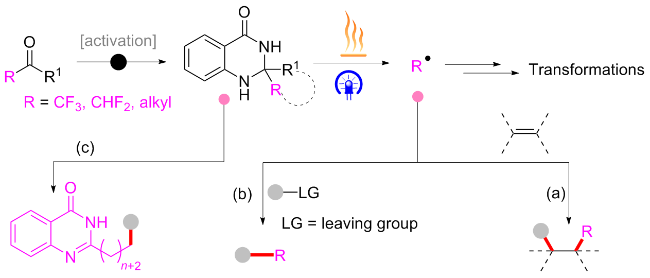
喹唑啉由一个苯环与一个嘧啶环稠合而成, 是一类重要的含氮杂环化合物[1]. 它广泛存在于各种生物碱和具有生物药理活性的有机分子中, 其活性包括抗肿瘤、抗疟疾、抗炎、抗菌、抗惊厥、抗结核及抗高血压等[2]. 作为喹唑啉的衍生物, 二氢喹唑啉酮同样表现出诸如此类的生物活性, 然而除了二氢喹唑啉酮本身具有的特殊活性外, 其可控且多变的化学性质同样吸引有机合成化学工作者的关注. 近年来, 自由基介导不饱和烃的串联官能化已成为快速获得高附加值且复杂的有机分子的有力工具[3,4]. 自由基被认为反应活性高、不稳定、难以控制, 因此对于一些复杂的反应体系, 自由基反应往往不是第一选择, 副产物可能较多. 然而, 随着合成手段的革新及合成工作者对自由基反应的深入研究, “活泼”的自由基中间体已经可以被驯服且有效地进行反应[4]. 酮官能团是有机化学中最通用和基础的基团之一, 这主要归因于它们在各种化学键的形成与转化过程中的能力[5]. 近年来, 由商品化的大宗化学品“酮”作为原料而合成出来的二氢喹唑啉酮化合物被证实是一类非常好的有机官能化试剂, 相关研究被陆续报道, 然而目前并未有文献对于这一主题的系统性总结, 因此在这篇综述中作者详细总结了二氢喹唑啉酮衍生物参与的有机转化(Scheme 1), 期望可以为相关合成工作者提供参考. 全文根据反应底物类别以及反应类型主要分为三部分: (a)基于烯烃官能化策略的二氢喹啉的转化反应, (b)基于偶联策略的二氢喹唑啉酮的转化反应, (c)螺环二氢喹唑啉酮的转化反应.
1 基于烯烃官能化策略的二氢喹唑啉酮的转化反应
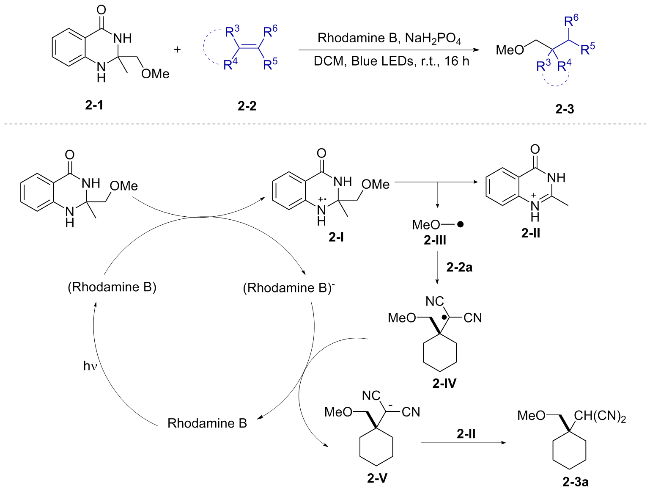
烯烃是有机合成中一类廉价且应用非常广泛的合成砌块之一. 由于烯烃具有独特的反应活性, 人们发展了许多烯烃的官能化反应用于合成高附加值的化学品[6]. 串联反应是一种简洁、高效构建多样性骨架的方法. 近年来, 自由基环化反应吸引合成工作者的极大关注, 利用不饱和烃的易于转化性质实现复杂多环结构的构建已经成为合成与药物化学的一个重要研究分支[7]. 2020年, 朱进课题组[8]报道了一例可见光介导的分子间自由基共轭加成反应. 作者使用荧光染料罗丹明B (Rhodamine B)作为光催化剂, 在蓝光照射16 h后可以获得全取代的季碳中心(Scheme 2). 反应展现了较好底物耐受性, 但是自由基受体局限在迈克受体, 富电子的烯烃无法兼容该反应体系. 此外, 该反应对于2,2-二取代二氢喹唑啉酮具有良好的容忍性, 不同以酮为前体的2,2-二取代二氢喹唑啉酮, 均能以较好的收率得到目标产物.
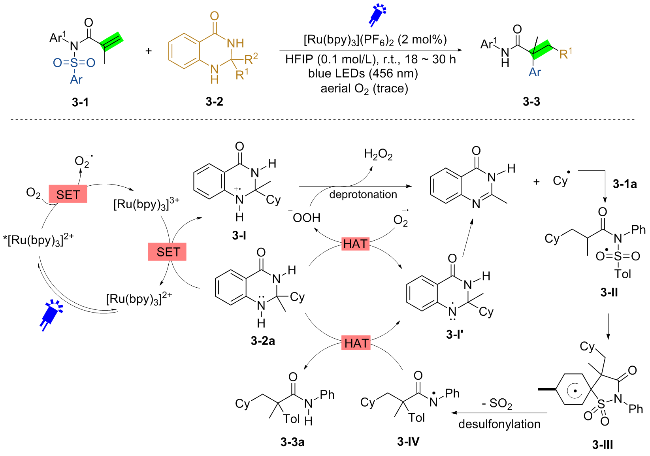
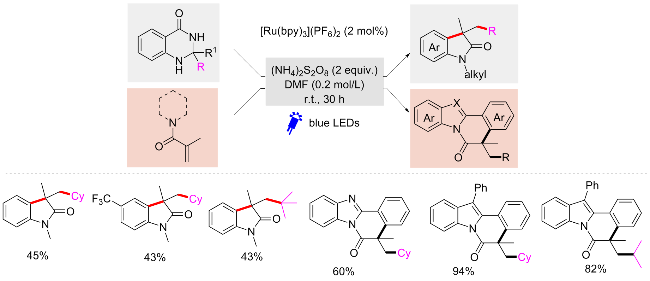
随后, Sahoo及合作者[10]报道了另外一例可见光催化N-丙烯酰胺与酮衍生的二氢喹啉酮的串联烷基化/芳基化反应(Scheme 4), 通过这个反应可以获得吲哚和苯并咪唑并[2,1-a]异喹啉或2-吲哚酮衍生物. 作者通过条件的筛选发现光催化剂[Ru(bpy)3](PF6)2的催化性能最佳, 在波长为456 nm的蓝光照射下, 以六氟异丙醇为溶剂可获得串联产物, 产物的收率为72%. 同时, 该反应可以放大到1 mmol, 相应的吲哚并[2,1-a]异喹啉收率为82%. 机理研究表明, 激发态的[Ru(bpy)3](PF6)2与过硫酸盐发生单电子转移(SET)得到[Ru(bpy)3]3+、$\text{SO}_{\text{4}}^{2}$与$\text{SO}{{_{\text{4}}^{}}^{-\ \bullet }}$, $\text{SO}{{_{\text{4}}^{}}^{-\bullet }}$物种随后从酮衍生的二氢喹啉酮攫取氢原子并发生C—C断裂, 分别产生环己基自由基与喹唑啉酮中间体. 环己基自由基随后相继发生自由基加成、环化、单电子转移、去质子化得到最终产物.
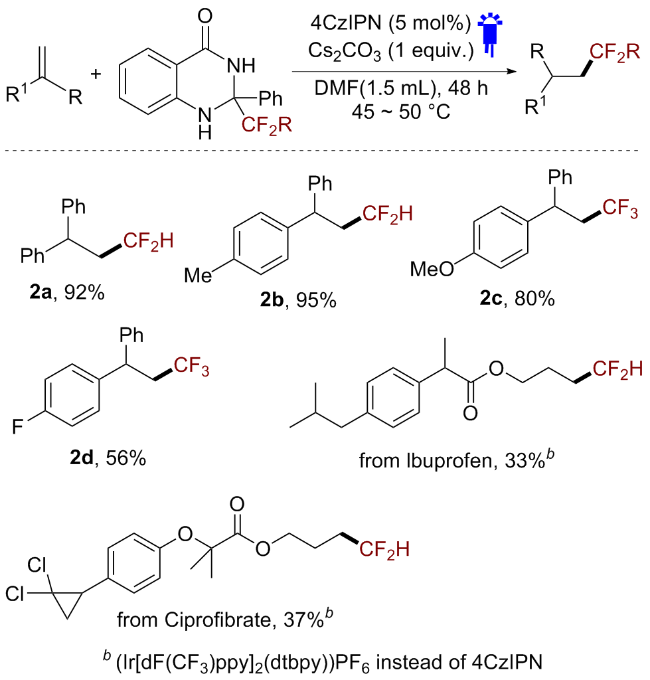
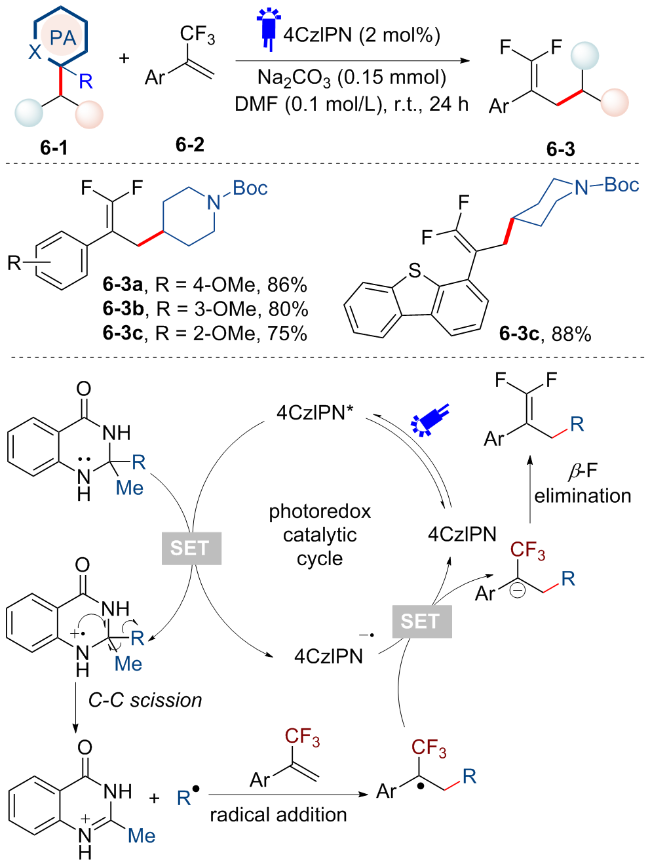
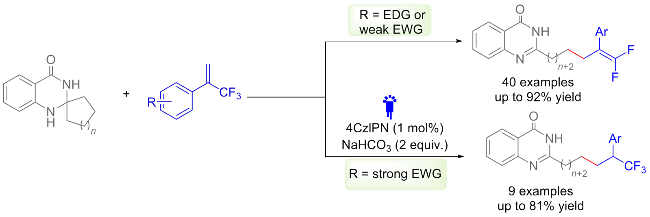
二氟甲基作为醇羟基和硫羟基的生物电子等排体, 可提高生物活性分子代谢稳定性和生物利用度, 发展合成含二氟甲基化合物的新方法或新试剂对于药物的发现和发展有重要意义[11] (Scheme 5). 在朱进课题组的基础上, Kuniyil与Yatham课题组[12]发展了可以长期存储的三氟甲基/二氟甲基试剂的合成与表征. 作者选用2,2,2-三氟苯乙酮、2,2-二氟苯乙酮与邻氨基苯甲酰胺衍生物反应制备三氟甲基取代的二氢喹唑啉酮化合物, 并将产物应用于烯烃的氢三氟甲基化或氢二氟甲基化反应中. 各种取代的苯乙烯衍生物在该体系下都可以兼容, 带有活性骨架的末端烯烃也能顺利地参与此反应. 值得指出的是依据烯烃活性的差异, 光催化剂分别使用4CzIPN与(Ir[dF(CF3)ppy]2(dtbpy))PF6.
2 基于偶联策略的二氢喹唑啉酮的转化反应
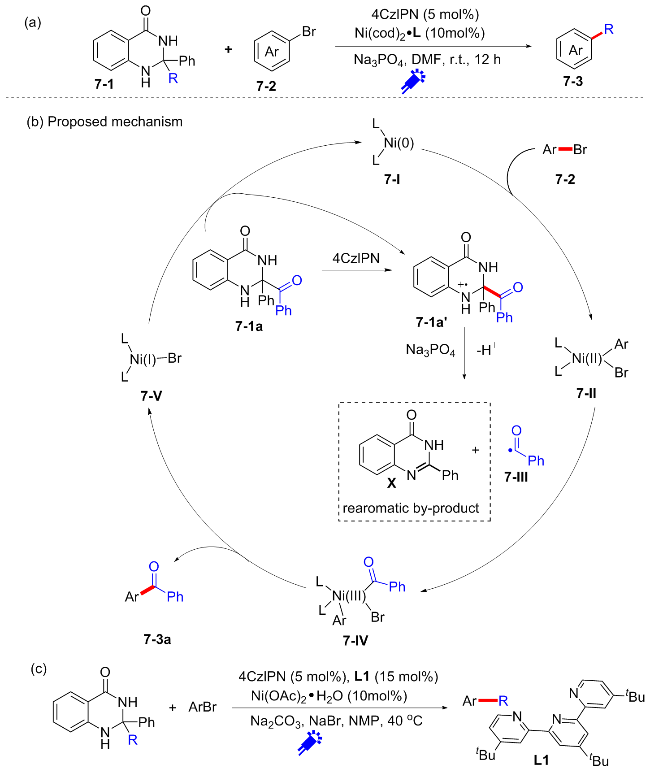
作为有机化学中研究最多的化学反应之一, 过渡金属介导的偶联反应不仅能够高效地构建各种化学键, 而且可以极大简化复杂分子的合成路线. 在过去的半个世纪里, 合成工作者对铑、钯、钌、铜、镍和其它金属介导的偶联反应展开了一系列研究[14]. 尽管涌现出一些新的合成方法, 例如过渡金属与光化学、电化学的结合, 但该策略仍需要对各种配体、预催化剂、碱、添加剂、反应条件以及偶联试剂的电性/结构多样性进行优化以获得最佳反应条件. 因此, 发展新的官能化试剂, 突破上述壁垒亦非常重要. 2022年, 廖軒宏等[15a]选用联苯甲酰与邻氨基苯甲酰胺衍生物反应制备苯甲酰基取代的二氢喹唑啉酮化合物, 并将产物应用于镍催化溴代苯衍生物的偶联反应中(Scheme 7a). 首先, 有机光催化剂4CzIPN经光照、单电子转移、脱质子生成酰基自由基, 与此同时镍催化剂与溴苯发生氧化加成得到芳基镍(II)中间体7-II (Scheme 7b). 随后, 芳基镍(II)中间体捕获游离的酰基自由基物种7-III得到高不稳定性的镍(III)中间体7-IV, 镍(III)物种随即发生还原消除生成最终偶联产物并释放镍(I)物种7-V. 镍(I)物种发生单电子还原回到镍(0)完成催化循环. 与此同时, Martin课题组[15b]报道了相同的偶联反应(Scheme 7c), 但催化剂与廖軒宏的工作略有不同(NiBr2•diglyme催化剂).
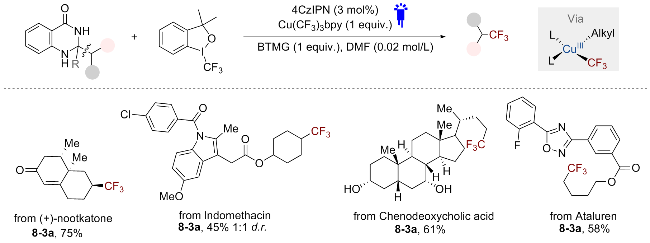
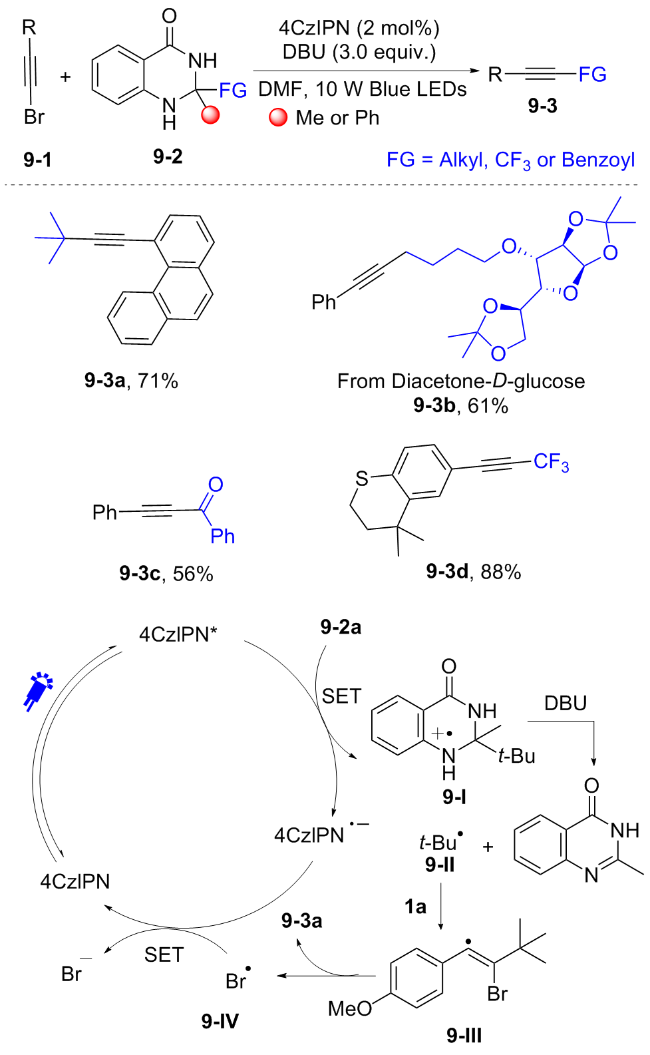
同年, 陈曙光与商永嘉[17]报道了可见光诱导的烷基/三氟甲基/酰基取代的二氢喹唑啉酮与炔基溴的自由基交叉偶联反应(Scheme 9). 在此反应中, 4CzIPN被用作光催化剂, 1,5-二氮杂二环[5.4.0]十一烯-5 (DBU)被用作碱, DMF作为反应溶剂, 在蓝光的辐射下, 一系列官能化内炔以中等到良好的收率获得. 该反应具有广泛的底物范围, 多达63个实例, 优异的官能团耐受性和克级反应证明了这种新型炔基化方法的实用性. 机理研究表明, 有机光催化剂4CzIPN经光照形成激发态的4CzIPN, 激发态的4CzIPN与官能化二氢喹唑啉酮发生单电子转移获得中间体9-I, 9-I随后被碱攫质子得到烷基自由基中间体9-II. 9-II随后加成到炔烃得到物种9-III, 9-III脱溴自由基获得最终产物. 此外溴自由基被4CzIPN自由基负离子还原为溴负离子.
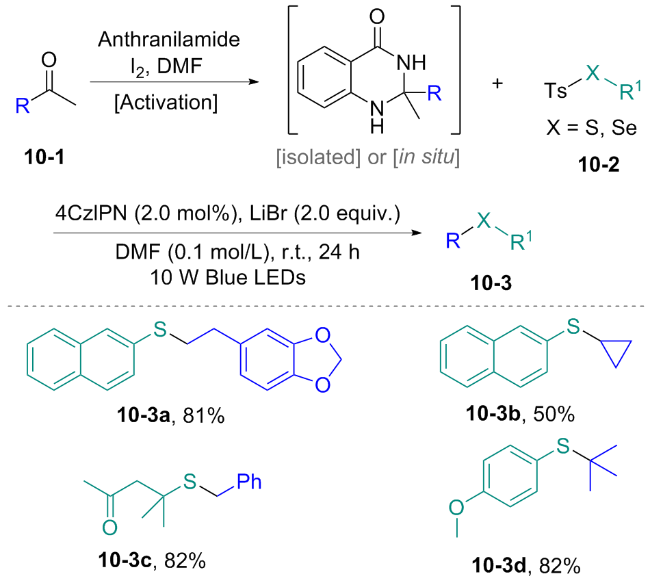
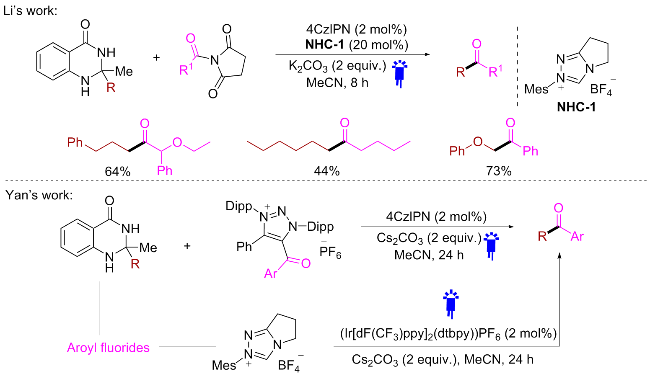
还是烷酰基自由基均可获得相应的不对称酮产物. 在闫晓宇的工作中, 使用4CzIPN或(Ir[dF(CF3)ppy]2(dtbpy))-PF6作为光催化剂, 与此同时碱在反应中依然是必需的. 当选择芳基酰氟作为酰基化试剂, 此时反应体系需要额外加入氮杂卡宾催化剂以及使用4CzIPN作为光催化剂在455~460 nm波长照射; 当选用4-芳酰基-1,2,3-三唑鎓作为酰基化试剂, 此时反应体系需要使用(Ir[dF(CF3)-ppy]2(dtbpy))PF6作为光催化剂, 并在410~415 nm波长照射下可顺利完成反应.
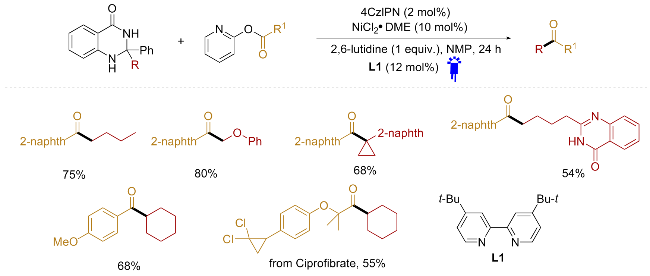
3 螺环二氢喹唑啉酮的转化反应
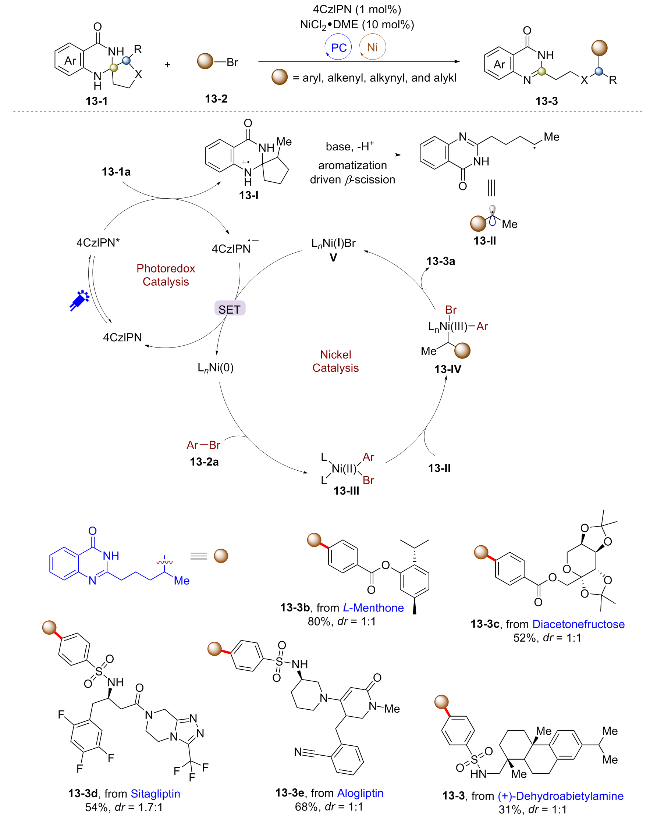
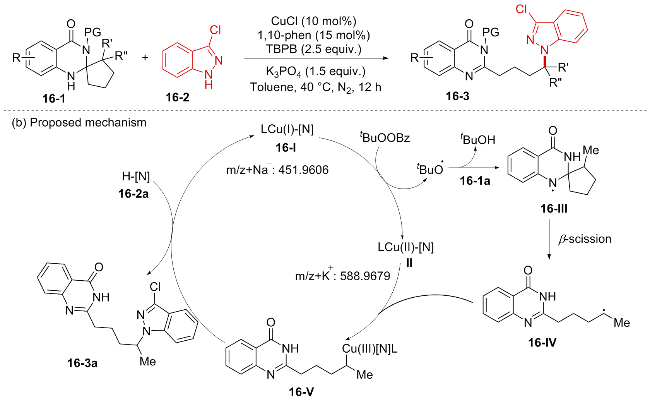
如何才能突破专利, 设计出具有自主知识产权的全新结构一直是困扰从事创新药物研发人员的难题[22]. 如今, 专利保护范围越来越全面, 已经不再仅仅局限于结构, 诸如晶型、异构体等都在保护范围内. 当下, 基于螺环化合物及其衍生化获得的活性分子已经成为新药创制的一种重要途径. 2024年, 郭丽娜等[23]通过底物设计, 在二氢喹唑啉酮骨架中引入一个螺环, 通过C—C键断裂可以转完成螺环二氢喹唑啉酮骨架的远程官能化反应(Scheme 13), 这项工作为现有的自由基介导的未应变碳环的C—C键断裂提供了一种补充策略. 该反应克服了氮中心自由基诱导的碳环解构的环尺寸限制, 碳环可以从常见的三元与四元扩展至七元环. 与此同时, 开环后的自由基物种在金属镍催化剂的作用下可以实现与芳基溴代物的偶联反应. 针对反应机理, 作者也做了一系列实验, 例如开光实验、自由基中间体捕捉和自由基时钟等, 反应的历程与Martin以及廖軒宏的有相似之处, 均涉及到Ni(0)的氧化加成与还原消除反应.
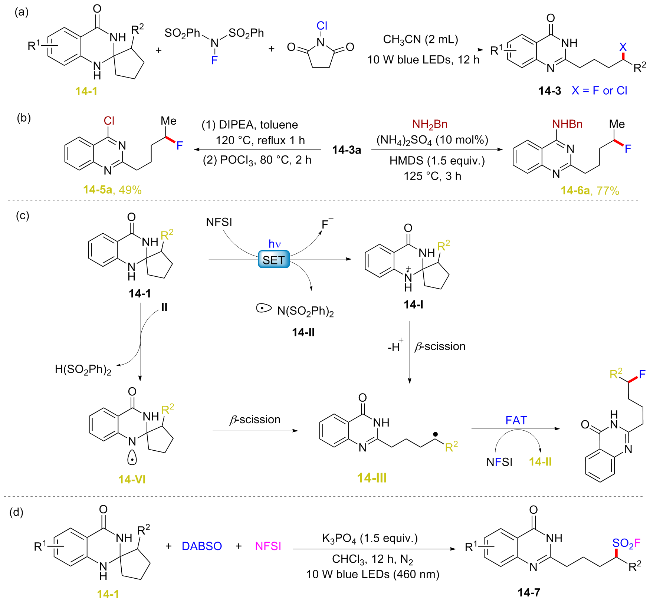
同年, 基于该机理, 郭丽娜等[24]报道了以N-氟代双苯磺酰胺作为氟源, 通过开环氟化合成氟代的喹唑啉酮骨架的策略(Scheme 14a), 为药物分子的修饰与构建提供一种新途径. 机理研究表明该反应先后经过β-断裂, 氟原子转移. 当把氟源N-氯代丁二酰亚胺换成N-氯代丁二酰亚胺, 此时可以顺利地完成氯化反应. 产物的放大反应可以达到克级, 产物的转化也是多样性的, 可以获得4-氯-喹唑啉以及4-氨基喹唑啉. 最近, 该课题组[24b]报道了一例类似的开环反应, 在反应体系中加入双(二氧化硫)-1,4-二氮杂双环[2.2.2]辛烷加合物(DABSO)即可实现螺环二氢喹唑啉酮骨架的开环、二氧化硫插入、氟化反应, 最终获得各种磺酰氟产物, 磺酰氯再与亲核试剂反应又可获得磺酸酯、磺酰胺、磺基叠氮等衍生化产物(Scheme 14d). 需要特别指出的是, 该策略不需要光催化剂的参与.


4 总结与展望
综上所述, 本综述介绍了二氢喹唑啉酮衍生物参与的有机反应, 近期的一些重要进展已经说明以二氢喹唑啉酮衍生物作为可靠的自由基前体的有机转化已经成为一类具有实用价值的有机反应. 本文根据二氢喹唑啉酮衍生物参与自由基反应的方式将全文分为三个部分:基于烯烃双官能化策略的二氢喹唑啉酮的转化反应、基于偶联策略的二氢喹唑啉酮的转化反应、螺环二氢喹唑啉酮的转化反应. 总体而言, 目前已报道的反应类型以可见光介导的转化为主, 催化体系越来越简单, 官能化试剂前体越来越丰富. 但需要指出的是, 目前二氢喹唑啉酮衍生物参与的有机反应依旧存在一些缺点, 仍然具有探索和拓展的意义. 例如: (1)目前的光催化体系比较单一, 绝大部分反应依然需要光催化剂的参与, 因此挖掘1,2-乙二胺(EDA)策略在该类反应中的应用是非常具有吸引力的; (2)涉及二氢喹唑啉酮衍生物参与的自由基不对称反应也尚属空白, 考虑到手性分子在药物化学中的重要性, 因此该类不对称反应也亟需探索.
(Lu, Y.)