



1 Introduction
1,4-Thiazines and isoquinolines are prevalent in various natural and synthetic pharmaceutical molecules.[1-4] The strategic combination of these two privileged frameworks into a novel heterocyclic framework holds great promise for the development of new therapeutic agents[5-6] (Figure 1). This new hybrid structure may exhibit synergistic effects, broadening the spectrum of biological activity while minimizing toxicity. As a result, efficient construction of such hybrid skeletons from readily available starting materials in a minimum number of steps is a highly desired but challenging topic in organic synthesis. To address these synthetic challenges, the application of domino reactions emerges as a promising solution.[7-8] These methodologies allow for the simultaneous formation of multiple bonds in a single reaction sequence, significantly reducing the number of synthetic steps required.
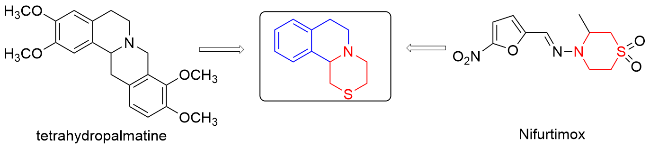
Pyridinium zwitterions represent versatile building blocks for the synthesis of natural products and biological compounds. Among them, the most common and stable types are 1,2-zwitterions that feature an electron-with- drawing group.[9-11] The pyridine ring not only provides reactive functional groups for integration into the product but also serves as an effective leaving group. To expand the application of pyridinium zwitterions in the synthesis of nitrogen-containing heterocycles, the development of other pyridinium zwitterion types has been pursued.[12-14] For instance, novel isoquinoline 1,4-zwitterionic thiolates have been shown to efficiently synthesize polycyclic com- pounds harboring a quinoline framework, garnering significant interest from chemists.
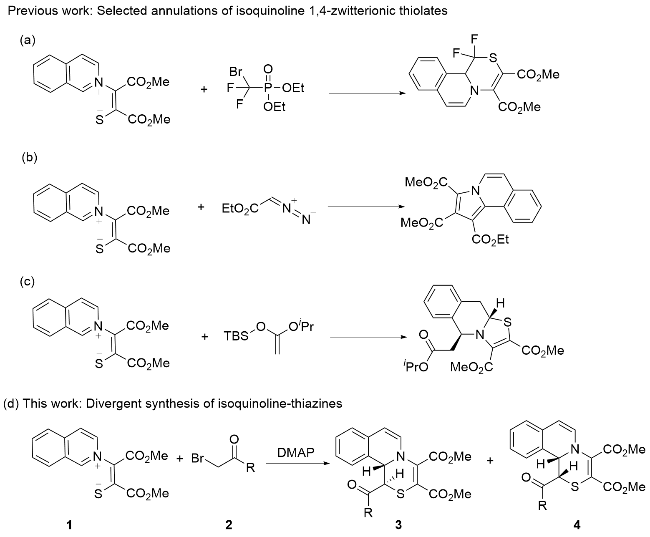
Independently, Xu and Song et al.[15] have reported a rapid and efficient method for constructing 1,4-thiazines with difluoro groups via [5+1] cyclization reactions based on isoquinoline 1,4-zwitterionic thiolates (Scheme 1, a). Liu’s group[16] described a copper-catalyzed [4+1] cyclo- addition reaction that swiftly generated isoquinoline-fused pyrrole derivatives using these thiolates in conjunction with diazo compounds (Scheme 1, b). Mancheño’s group[17] developed a reaction between isoquinoline 1,4-zwitterionic thiolates and tert-butyldimethylsilyl (TBS) ketene acetal, leading to the formation of two distinct isoquinoline-fused thiazoline derivatives depending on the solvent used (Scheme 1, c). During the preparation of this manuscript, Zuo’s group[18] disclosed a novel [5+1] cycloaddition reaction involving isoquinoline 1,4-zwitterionic thiolates, which reacted with bromoacetophenone to produce a series of fused isoquinoline 1,4-thiazole derivatives. However, this reaction yielded two isomers as a mixture without separation. From the perspectives of organic synthesis and medicinal chemistry, the preparation of two pure isomers would facilitate more convenient drug activity screening. Herein, we describe a DMAP-promoted [5+1] cyclization reaction between isoquinoline 1,4-zwitterionic thiolates and α-bromoketone, which effectively yields fused isoquinoline thiazole derivatives. Notably, the two isomers can be separated by column chromatography (Scheme 1, d).
2 Results and discussion
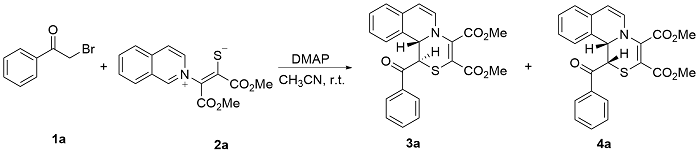
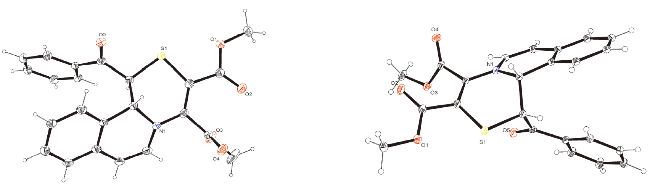
We conducted our study by treating α-bromoketone 1a (1.0 equiv.) with isoquinoline 1,4-zwitterionic thiolates 2 (2.5 equiv.) in CH3CN in the presence of K2CO3 (2.0 equiv.) as a base at room temperature (Table 1, Entry 1). Satisfactorily, the reaction proceeded efficiently, yielding 3a (CCDC: 2422118) with 29% yield and 4a (CCDC: 2422119) with 44% yield. Both isomers could be separated effectively using silica gel column chromatography, and their conformations were confirmed through X-ray diffraction analysis. Encouraged by these promising results, we proceeded to optimize the reaction conditions to enhance the yield. Firstly, a series of bases were screened, including inorganic bases (NaOH, NaH) and organic bases [DMAP, 1,4-diazabicyclo[2.2.2]octane (DABCO), N,N-diisopropyl- ethylamine (DIPEA), and sodium methoxide] (Entries 2~7). The results showed that both inorganic and organic bases could facilitate the reaction, with DMAP having the highest yield and excellent stereoselectivity. After determining the optimal base, the solvent for the reaction was explored. Surprisingly, when the reaction solvent was changed to acetonitrile, the yield of product 4a significantly increased, reaching 81%, and the stereoselectivity was also significantly improved (Entry 8). The single- crystal structural analysis of products 3a and 4a revealed that product 4a predominated due to the longer distance between the carbonyl group and the isoquinoline moiety, resulting in reduced steric hindrance compared to product 3a. When the solvents were replaced with toluene, methanol, chloroform, chlorobenzene, tetrahydrofuran (THF), and dioxane, the yields were not as good as acetonitrile (Entries 9~14). Subsequently, lowering the temperature to 0 ℃ and raising the temperature to the reflux temperature of acetonitrile did not increase the reaction yield (Entries 15, 16). Considering the use of minimal raw materials to achieve the most efficient reaction, the equivalent of 2a was reduced (Entries 17~19), but unfortunately, the yield significantly decreased, which is not conducive to the production of compounds 3a and 4a.
Table 1 Optimization of reaction conditionsa |
| Entry | Base | Solvent | Yieldb/% | |
|---|---|---|---|---|
| 3a | 4a | |||
| 1 | K2CO3 | DCM | 29 | 44 |
| 2 | NaOH | DCM | 21 | 66 |
| 3 | NaH | DCM | 25 | 58 |
| 4 | DMAP | DCM | 20 | 66 |
| 5 | DABCO | DCM | 11 | 49 |
| 6 | DIPEA | DCM | 41 | 55 |
| 7 | CH3ONa | DCM | 23 | 66 |
| 8 | DMAP | CH3CN | 11 | 81 |
| 9 | DMAP | Toluene | 9 | 28 |
| 10 | DMAP | CH3OH | 11 | 49 |
| 11 | DMAP | CH3Cl | 9 | 25 |
| 12 | DMAP | C6H5Cl | 4 | 53 |
| 13 | DMAP | THF | 17 | 49 |
| 14 | DMAP | Dioxane | 10 | 53 |
| 15c | DMAP | CH3CN | 14 | 60 |
| 16d | DMAP | CH3CN | 10 | 57 |
| 17e | DMAP | CH3CN | 14 | 47 |
| 18f | DMAP | CH3CN | 11 | 54 |
| 19g | DMAP | CH3CN | 8 | 40 |
a Unless otherwise noted, reactions were carried out with compound 1a (0.25 mmol), compound 2a (0.75 mmol), and base (0.50 mmol) in 2.0 mL of solvent at room temperature. b Isolated yields. c The reaction temperature is 0 ℃. d The reaction temperature is 80 ℃. e A total of 2.5 equiv. of compound 2a was used. f A total of 2.0 equiv. of compound 2a was used. g A total of 1.5 equiv. of compound 2a was used. |
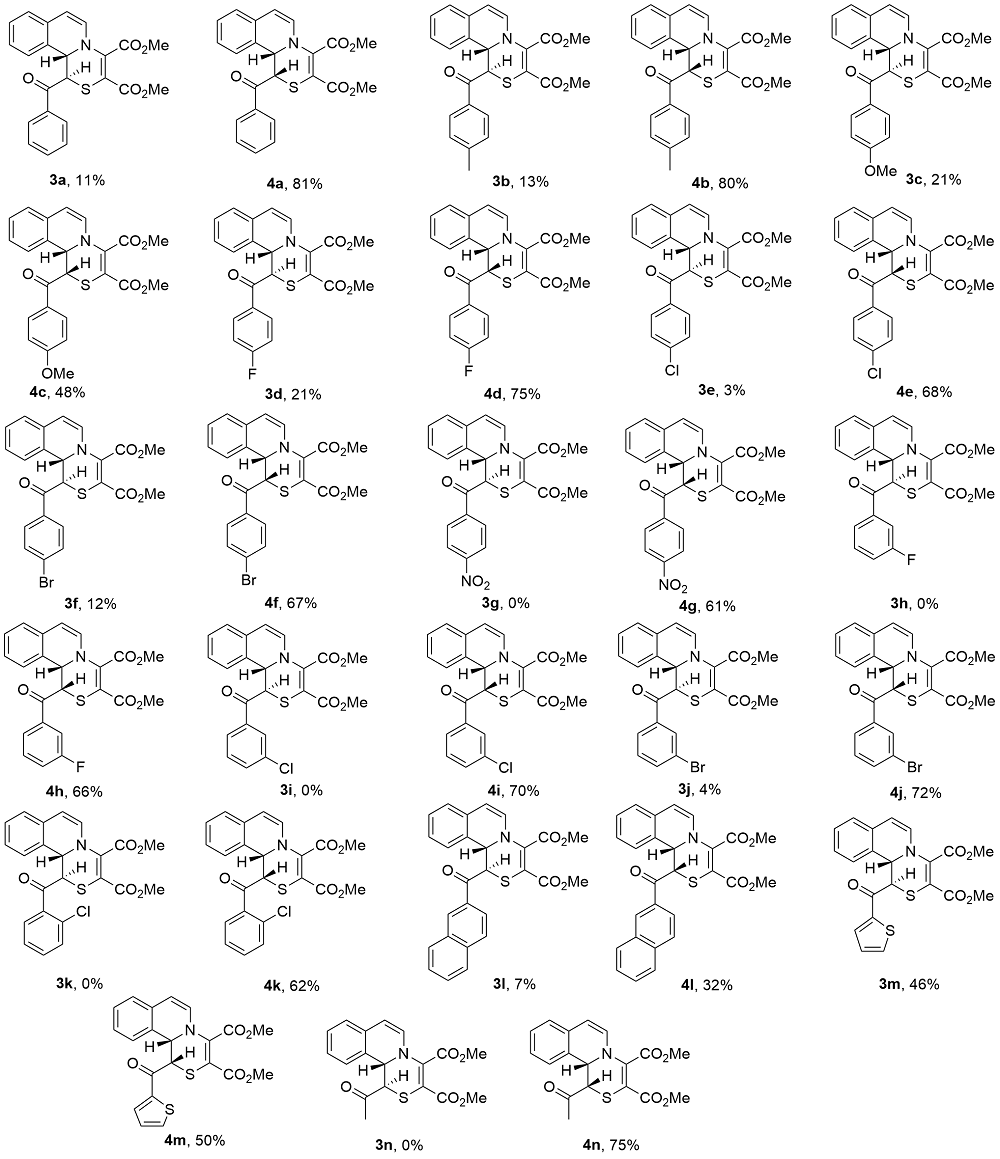
Subsequently, utilizing the established optimal conditions, various substituted α-bromoketones were reacted with isoquinoline 1,4-zwitterionic thiolates in acetonitrile to yield the corresponding six-membered ring compounds 3 and 4 (Table 2). As shown in Figure 2, the electron donating groups (CH3, OCH3) at position 4 of α-bromoketone exhibit good tolerance, resulting in the formation of corresponding products 3b, 3c (13%, 21%) and 4b, 4c (80%, 48%). Meanwhile, the electron withdrawing groups (F, Cl, Br) at the 4-position of α-bromoketone can also yield corresponding products 3d~3f (21%, 3%, 12%) and 4d~4f (75%, 68%, 67%). Unfortunately, due to the strong electron withdrawing effect of nitro, only product 4g was obtained with a yield of 61%, and product 3g was not obtained. Subsequently, the substituent at position 3 of α-bromo- ketone was investigated. When R1=3-F and 3-Cl, almost no products 3h and 3i were obtained, and only products 4h and 4i were obtained with 66% and 70% yields, respectively. Fortunately, when R1=3-Br, although the yield of product 3j was only 4%, the corresponding product was successfully obtained. Subsequently, the steric hindrance effect was also investigated, and when R1=2-Cl, product 4k could still be obtained with moderate yield. In order to investigate the adaptability of substrates more extensively, the substitution of the aryl group of α-bromoketone with naphthyl and thienyl groups resulted in excellent yields of products 3l~3m (7%, 46%) and 4l~4m (32%, 50%). Surprisingly, when using bromoacetone instead of α-bro- moketone, the reaction still occurred and the product 4n was obtained with a yield of 75%.

Next, the substrate scope of isoquinoline 1,4-zwitterionic thiolates (Table 3) was explored. When R2=4-Br, no corresponding product was detected. When R2=5-Br, the product 4p was obtained with a yield of 51%, and only a trace amount of 3p was generated. Similarly, When R2=7-Br, the product 4q was obtained with a yield of 23%, and only a trace amount of 3q was generated. Unfortunately, the reaction did not occur when R2=8-Br. When R2=6-OCH3, the product 4s was obtained with a yield of 52%, and only a trace amount of 3s was generated. It indicates that the reaction can also proceed normally for electron substituted isoquinoline 1,4-zwitterions. When replacing the ester group of isoquinoline zwitterion from methyl to ethyl, it did not hinder this conversion process, and the product 4t was obtained with a yield of 43%, only a trace amount of 3t was generated.
Table 3 Substrate scope of isoquinoline 1,4-zwitteriona |

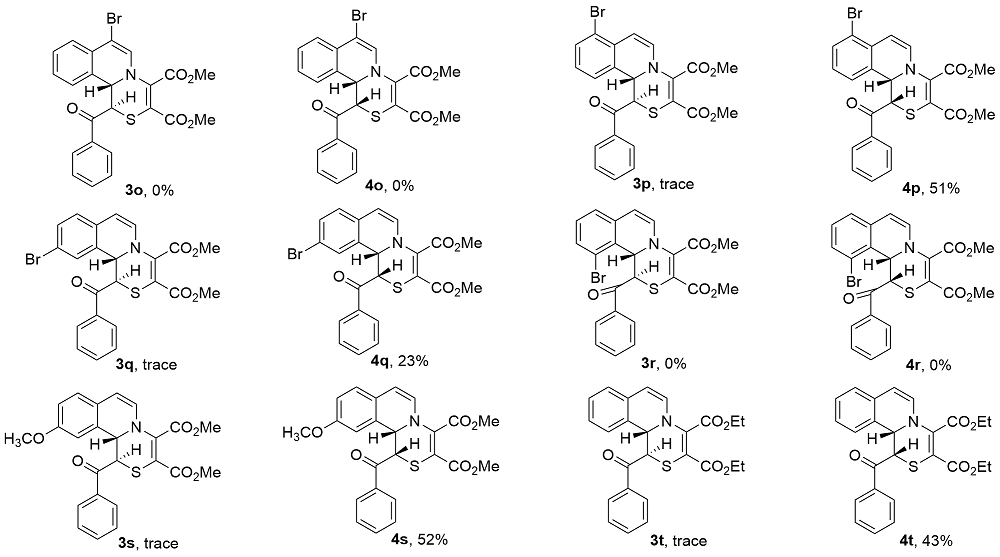 |
a Reaction conditions: compound 1a (0.25 mmol), compound 2 (0.75 mmol) and DMAP (0.50 mmol) in CH3CN (2.0 mL) at room temperature with isolated yields. |
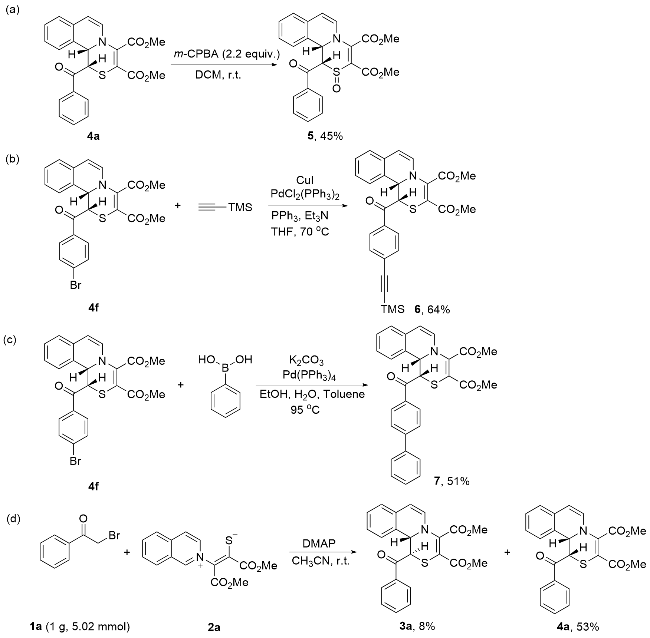
Furthermore, considering that 1,4-thiazine scaffolds are commonly found in many biologically active molecules, their varying oxidation states can exhibit diverse bioactivities,[19-20] The transformation of 4a into corresponding sulfoxide and sulfone analogues was investigated (Scheme 2, a). To our delight, using 2.2 equiv. of m-CPBA as the oxidizing agent, compound 5 (CCDC: 2422120) was obtained in a 45% isolated yield. In addition, using 4f as a raw material, Sonogashira coupling reactions and Suzuki coupling reactions occurred (Scheme 2, b, c). Treatment of 4f with ethynyltrimethylsilane, CuI, palladium catalyst, PPh3, and Et3N in THF at reflux temperature produced 6 (CCDC: 2422121) in 64% yield. Similarly, treating 4f with phenylboronic acid, palladium catalyst, and K2CO3 in EtOH, H2O, and toluene at 95 ℃ produced 7 (CCDC: 2422122) in 51% yield. In addition, a large-scale reaction at the gram level was conducted to obtain the corresponding products 3a and 4a with yields of 8% and 53%, respectively (Scheme 2, d).
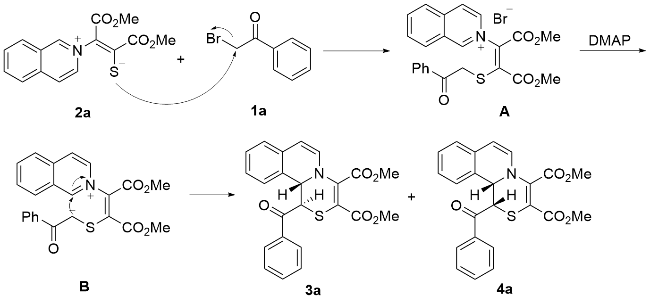
Based on our experimental results and some related reports, a possible mechanism was proposed (Scheme 3). The sulfur atom in isoquinolinium 1,4-zwitterionic thiolate 2a initiated a nucleophilic attack on the electrophilic carbon in 1a, leading to the formation of intermediate A. This intermediate A then underwent dehydrobromination in the presence of a base, resulting in the generation of intermediate B. Finally, an intramolecular ring closing process of B yielded the desired products 3a and 4a.


3 Conclusions
In conclusion, a DMAP promoted [5+1] cyclization reaction between isoquinoline 1,4-zwitterionic thiolates and α-bromoacetophenone was developed, and two diastereomers were successfully separated with moderate to good yields. We are currently studying the further application of this domino reaction in the synthesis of complex molecules.
4 Experimental section
4.1 Experimental details
All reactions were performed under Ar atmospheres in oven-dried glassware with magnetic stirring. The heat source of all reactions that require heating is an oil bath. Unless otherwise stated, all reagents were purchased from commercial suppliers (Aldrich, TCI, or Alfa Aesar) and used without further purification. All solvents were purified and dried according to standard methods prior to use. Thin-layer chromatography (TLC) monitored all reactions with silica gel-coated plates. Flash column chromatography was performed using 200~300 mesh silica gel. 1H NMR and 13C NMR spectra were recorded at an ambient temperature on Bruker 400 instruments. All spectra were referenced to DMSO-d6 (1H NMR δ 2.50; 13C NMR δ 39.52). High resolution mass spectra (HRMS) were obtained on a Waters Xevo Q-TOF MS instrument with ESI resource. Melting points were measured on an RY-I apparatus and uncorrected. Compounds 1 and 2 were synthesized according to the known procedure.[21]
4.2 General procedure for the synthesis of products 3 and 4
Under Ar atmosphere, substrates 1 (0.25 mmol) and 2 (0.75 mmol) were added to an oven-dried round bottle flask with a magnetic stirring bar, followed by the addition of CH3CN (2 mL) and DMAP (0.50 mmol). The stirring was maintained at room temperature until completion of the reaction (the reaction was monitored by TLC plate). The residue was purified by a flash column chromatography on silica gel (ethyl acetate/petroleum ether, V:V=1:2) to yield 3 and 4.
Dimethyl-1-benzoyl-1,11b-dihydro[1,4]thiazino[3,4-a]- isoquinoline-3,4-dicarboxylate (3a): Yellow solid, 11 mg, 11% yield. m.p. 189~190 ℃; 1H NMR (400 MHz, DMSO- d6) δ: 8.02 (d, J=7.6 Hz, 2H), 7.59 (t, J=7.2 Hz, 1H), 7.53 (d, J=7.6 Hz, 1H), 7.45 (t, J=8.0 Hz, 2H), 7.23~7.14 (m, 3H), 6.65 (d, J=7.2 Hz, 1H), 6.24 (d, J=7.6 Hz, 1H), 5.59 (d, J=3.2 Hz, 1H), 4.71 (d, J=3.2 Hz, 1H), 3.83 (s, 3H), 3.59 (s, 3H); 13C NMR (100 MHz, DMSO-d6) δ: 191.9, 163.1, 140.5, 134.9, 133.4, 131.9, 129.8, 129.2, 128.9, 128.5, 128.1, 126.8, 125.1, 124.5, 110.5, 58.4, 53.3, 52.5, 42.4; IR (KBr) ν: 2951, 1741, 1703, 1663, 1593, 1553, 1432, 1358, 1303, 1240, 1204, 1074, 1002, 928, 840, 777, 689 cm-1; HRMS (ESI-TOF) calcd for C23H20NO5S [M+H]+ 422.1057, found 422.1065.
Dimethyl-1-benzoyl-1,11b-dihydro[1,4]thiazino[3,4-a]- isoquinoline-3,4-dicarboxylate (4a): Yellow solid, 85 mg, 81% yield. m.p. 192~193 ℃; 1H NMR (400 MHz, DMSO- d6) δ: 7.78 (d, J=7.6 Hz, 2H), 7.52 (t, J=7.2 Hz, 2H), 7.37 (t, J=8.0 Hz, 2H), 7.11 (t, J=7.2 Hz, 1H), 7.05 (t, J=7.2 Hz, 1H), 6.82 (d, J=7.2 Hz, 1H), 6.27 (d, J=8.0 Hz, 1H), 6.01 (s, 1H), 5.45 (d, J=7.6 Hz, 1H), 5.33 (s, 1H), 3.83 (s, 3H), 3.67 (s, 3H); 13C NMR (100 MHz, DMSO-d6) δ: 193.9, 164.6, 164.3, 139.0, 136.5, 133.7, 130.0, 129.3, 129.0, 128.9, 128.8, 128.8, 127.2, 127.0, 125.2, 103.9, 102.4, 59.2, 53.7, 53.0, 44.7; IR (KBr) ν: 2951, 1733, 1698, 1665, 1638, 1555, 1432, 1420, 1339, 1239, 1202, 1137, 1072, 1002, 839, 778, 699 cm-1; HRMS (ESI-TOF) calcd for C23H20NO5S [M+H]+ 422.1057, found 422.1075.
Dimethyl-1-(4-methylbenzoyl)-1,11b-dihydro[1,4]thia-zino[3,4-a]isoquinoline-3,4-dicarboxylate (3b): Purified by flash chromatography on silica gel (ethyl acetate/petroleum ether, V:V=1:2). Yellow solid, 13 mg, 13% yield. m.p. 135~136 ℃; 1H NMR (400 MHz, DMSO-d6) δ: 7.91 (d, J=8.0 Hz, 2H), 7.49 (d, J=7.6 Hz, 1H), 7.25 (d, J=8.0 Hz, 2H), 7.19~7.12 (m, 3H), 6.63 (d, J=7.6 Hz, 1H), 6.21 (d, J=7.6 Hz, 1H), 5.53 (d, J=3.6 Hz, 1H), 4.69 (d, J=3.2 Hz, 1H), 3.82 (s, 3H), 3.59 (s, 3H), 2.34 (s, 3H); 13C NMR (100 MHz, DMSO-d6) δ: 191.6, 164.3, 163.1, 144.0, 140.1, 132.5, 131.8, 129.8, 129.1, 129.1, 128.1, 126.8, 125.3, 124.5, 110.1, 58.5, 53.3, 52.5, 42.5, 21.2; IR (KBr) ν: 2950, 1739, 1699, 1663, 1640, 1551, 1433, 1420, 1304, 1228, 1203, 1075, 1003, 929, 846, 774, 696 cm-1; HRMS (ESI- TOF) calcd for C24H22NO5S [M+H]+ 436.1213, found 436.1233.
Dimethyl-1-(4-methylbenzoyl)-1,11b-dihydro[1,4]thia-zino[3,4-a]isoquinoline-3,4-dicarboxylate (4b): Yellow solid, 82 mg, 80% yield. m.p. 152~153 ℃; 1H NMR (400 MHz, DMSO-d6) δ: 7.69 (d, J=8.4 Hz, 2H), 7.52 (d, J=7.2 Hz, 1H), 7.19 (d, J=8.0 Hz, 2H), 7.13~7.04 (m, 2H), 6.84 (dd, J=7.2, 1.2 Hz, 1H), 6.27 (d, J=7.6 Hz, 1H), 5.96 (d, J=2.0 Hz, 1H), 5.45 (d, J=8.0 Hz, 1H), 5.32 (d, J=1.6 Hz, 1H), 3.82 (s, 3H), 3.67 (s, 3H), 2.30 (s, 3H); 13C NMR (100 MHz, DMSO-d6) δ: 192.9, 164.2, 163.9, 143.8, 138.6, 133.6, 129.5, 129.1, 129.0, 128.6, 128.5, 128.3, 126.7, 126.6, 124.8, 103.4, 101.6, 58.7, 53.3, 52.6, 43.7, 21.1; IR (KBr) ν: 2950, 1733, 1703, 1668, 1579, 1561, 1436, 1339, 1266, 1243, 1209, 1071, 1004, 843, 779, 700, 529 cm-1; HRMS (ESI-TOF) calcd for C24H22NO5S [M+H]+ 436.1213, found 436.1208.
Dimethyl-1-(4-methoxybenzoyl)-1,11b-dihydro[1,4]thia-zino[3,4-a]isoquinoline-3,4-dicarboxylate (3c): Yellow solid, 21 mg, 21% yield. m.p. 151~152 ℃; 1H NMR (400 MHz, DMSO-d6) δ: 7.97 (d, J=8.8 Hz, 2H), 7.40 (d, J=8.0 Hz, 1H), 7.21~7.08 (m, 3H), 6.95 (d, J=8.8 Hz, 2H), 6.59 (d, J=7.6 Hz, 1H), 6.16 (d, J=7.6 Hz, 1H), 5.47 (d, J=4.0 Hz, 1H), 4.66 (d, J=4.0 Hz, 1H), 3.82 (d, J=2.4 Hz, 6H), 3.62 (s, 3H); 13C NMR (100 MHz, DMSO-d6) δ: 190.7, 164.4, 163.3, 163.1, 139.4, 131.5, 131.4, 129.9, 128.7, 128.2, 128.0, 126.6, 125.7, 124.5, 113.8, 109.3, 58.8, 55.6, 53.2, 52.5, 42.9; IR (KBr) ν: 2954, 1740, 1700, 1660, 1598, 1550, 1421, 1327, 1308, 1250, 1206, 1179, 1144, 1703, 994, 852, 771, 692 cm-1; HRMS (ESI-TOF) calcd for C24H22- NO6S [M+H]+ 452.1162, found 452.1167.
Dimethyl-1-(4-methoxybenzoyl)-1,11b-dihydro[1,4]-thiazino[3,4-a]isoquinoline-3,4-dicarboxylate (4c): Yellow solid, 47 mg, 48% yield. m.p. 211~212 ℃; 1H NMR (400 MHz, DMSO-d6) δ: 7.77 (d, J=8.8 Hz, 2H), 7.51 (d, J=7.6 Hz, 1H), 7.13~7.04 (m, 2H), 6.89 (d, J=8.8 Hz, 2H), 6.84 (d, J=7.2 Hz, 1H), 6.26 (d, J=7.6 Hz, 1H), 5.93 (d, J=2.0 Hz, 1H), 5.44 (d, J=8.0 Hz, 1H), 5.30 (s, 1H), 3.80 (d, J=15.6 Hz, 6H), 3.67 (s, 3H); 13C NMR (100 MHz, DMSO-d6) δ: 191.8, 164.2, 163.9, 163.1, 130.8, 138.5, 129.6, 129.1, 129.0, 128.6, 128.3, 126.7, 126.6, 124.8, 113.7, 103.3, 101.9, 58.8, 55.6, 53.2, 52.6, 43.7; IR (KBr) ν: 2950, 1735, 1742, 1663, 1600, 1560, 1513, 1417, 1340, 1244, 1206, 1171, 1142, 996, 833, 779, 694 cm-1; HRMS (ESI-TOF) calcd for C24H22NO6S [M+H]+ 452.1162, found 452.1165.
Dimethyl-1-(4-fluorobenzoyl)-1,11b-dihydro[1,4]thia-zino[3,4-a]isoquinoline-3,4-dicarboxylate (3d): Yellow solid, 21 mg, 21% yield. m.p. 158~159 ℃; 1H NMR (400 MHz, DMSO-d6) δ: 8.13 (dd, J=8.4, 5.6 Hz, 2H), 7.54 (d, J=7.6 Hz, 1H), 7.29 (t, J=8.8 Hz, 2H), 7.23~7.14 (m, 3H), 6.65 (d, J=7.6 Hz, 1H), 6.24 (d, J=7.2 Hz, 1H), 5.61 (d, J=3.2 Hz, 1H), 4.70 (d, J=3.2 Hz, 1H), 3.83 (s, 3H), 3.59 (s, 3H); 13C NMR (100 MHz, DMSO-d6) δ: 190.5, 164.4, 163.8, 163.1, 132.1, 132.0, 131.9, 131.7, 131.7, 129.8, 129.2, 128.2, 126.8, 125.1, 124.6, 115.7, 115.5, 110.6, 58.4, 53.3, 52.5, 42.4; 19F NMR (471 MHz, DMSO- d6) δ: -105.36; IR (KBr) ν: 2950, 1719, 1700, 1667, 1594, 1556, 1435, 1354, 1248, 1206, 1142, 1008, 929, 837, 771, 723, 610 cm-1; HRMS (ESI-TOF) calcd for C23H19FNO5S [M+H]+ 440.0962, found 440.0977.
Dimethyl-1-(4-fluorobenzoyl)-1,11b-dihydro[1,4]thia-zino[3,4-a]isoquinoline-3,4-dicarboxylate(4d): Yellow solid, 76 mg, 75% yield. m.p. 150~151 ℃; 1H NMR (400 MHz, DMSO-d6) δ: 7.84 (dd, J=9.2, 5.6 Hz, 2H), 7.50 (d, J=7.6 Hz, 1H), 7.18 (t, J=8.8 Hz, 2H), 7.11 (td, J=7.6, 1.2 Hz, 1H), 7.08 - 7.04 (m, 1H), 6.81~6.79 (m, 1H), 6.26 (d, J=8.0 Hz, 1H), 6.00 (d, J=2.0 Hz, 1H), 5.42 (d, J=8.0 Hz, 1H), 5.32 (d, J=1.6 Hz, 1H), 3.82 (s, 3H), 3.68 (s, 3H); 13C NMR (100 MHz, DMSO-d6) δ: 192.3, 164.2, 163.8, 163.6, 138.4, 133.0, 131.5, 131.4, 128.8, 128.7, 128.4, 126.8, 126.7, 124.7, 115.6, 115.4, 103.4, 102.8, 58.9, 53.3, 52.6, 45.1; 19F NMR (471 MHz, DMSO-d6) δ: -105.26; IR (KBr) ν: 2950, 1727, 1710, 1675, 1556, 1431, 1339, 1246, 1208, 1162, 1070, 1006, 952, 841, 775, 702, 608 cm-1; HRMS (ESI-TOF) calcd for C23H19FNO5S [M+H]+ 440.0962, found 440.0987.
Dimethyl-1-(4-chlorobenzoyl)-1,11b-dihydro[1,4]thia-zino[3,4-a]isoquinoline-3,4-dicarboxylate (3e): Yellow solid, 3 mg, 3% yield. m.p. 166~167 ℃; 1H NMR (400 MHz, DMSO-d6) δ: 8.08 (d, J=8.8 Hz, 2H), 7.60 (d, J=7.6 Hz, 1H), 7.54 (d, J=8.4 Hz, 2H), 7.24~7.20 (m, 3H), 6.67 (d, J=7.6 Hz, 1H), 6.28 (d, J=7.2 Hz, 1H), 5.63 (d, J=2.8 Hz, 1H), 4.72 (d, J=2.8 Hz, 1H), 3.83 (s, 3H), 3.57 (s, 3H); 13C NMR (100 MHz, DMSO-d6) δ: 190.6, 164.3, 163.0, 141.1, 138.3, 133.6, 132.1, 130.9, 129.7, 129.4, 128.6, 128.1, 126.9, 124.8, 124.6, 111.1, 58.2, 53.3, 52.4, 42.1; IR (KBr) ν:2945, 1722, 1704, 1666, 1556, 1435, 1354, 1243, 1206, 1139, 1092, 1006, 929, 831, 779, 716, 542 cm-1; HRMS (ESI-TOF) calcd for C23H19ClNO5S [M+H]+ 456.0667, found 456.0694.
Dimethyl-1-(4-chlorobenzoyl)-1,11b-dihydro[1,4]thia-zino[3,4-a]isoquinoline-3,4-dicarboxylate (4e): Yellow solid, 66 mg, 68% yield. m.p. 183~184 ℃; 1H NMR (400 MHz, DMSO-d6) δ: 7.76 (d, J=8.4 Hz, 2H), 7.50 (d, J=7.2 Hz, 1H), 7.42 (d, J=8.4 Hz, 2H), 7.09 (dt, J=23.2, 7.2 Hz, 2H), 6.80 (d, J=7.2 Hz, 1H), 6.26 (d, J=7.6 Hz, 1H), 5.99 (s, 1H), 5.42 (d, J=7.6 Hz, 1H), 5.32 (s, 1H), 3.82 (s, 3H), 3.68 (s, 3H); 13C NMR (100 MHz, DMSO-d6) δ: 192.7, 164.2, 163.8, 138.4, 138.2, 134.8, 130.2, 129.5, 128.7, 128.6, 128.5, 128.4, 126.8, 126.7, 124.7, 103.4, 102.8, 58.8, 53.3, 52.6, 45.2; IR (KBr) ν: 2948, 1742, 1704, 1664, 1562, 1435, 1333, 1244, 1204, 1139, 1092, 1073, 998, 835, 779, 523 cm-1; HRMS (ESI-TOF) calcd for C23H19ClNO5S [M+H]+ 456.0667, found 456.0676.
Dimethyl-1-(4-bromobenzoyl)-1,11b-dihydro[1,4]thia-zino[3,4-a]isoquinoline-3,4-dicarboxylate (3f): Yellow solid, 11 mg, 12% yield. m.p. 173~174 ℃; 1H NMR (400 MHz, DMSO-d6) δ: 8.00 (d, J=8.4 Hz, 2H), 7.68 (d, J=8.8 Hz, 2H), 7.61 (d, J=7.2 Hz, 1H), 7.25~7.20 (m, 3H), 6.67 (d, J=7.2 Hz, 1H), 6.28 (d, J=7.2 Hz, 1H), 5.63 (d, J=2.8 Hz, 1H), 4.72 (d, J=2.8 Hz, 1H), 3.83 (s, 3H), 3.57 (s, 3H); 13C NMR (100 MHz, DMSO-d6) δ: 190.8, 164.3, 163.0, 141.2, 133.9, 132.1, 131.6, 131.0, 129.7, 129.4, 128.1, 127.5, 126.9, 124.8, 124.6, 111.2, 58.1, 53.3, 52.4, 42.0; IR (KBr) ν: 2945, 1723, 1706, 1662, 1585, 1558, 1437, 1354, 1242, 1200, 1142, 1068, 1004, 929, 831, 777, 523 cm-1; HRMS (ESI-TOF) calcd for C23H19BrNO5S [M+H]+ 500.0162, found 500.0148.
Dimethyl-1-(4-bromobenzoyl)-1,11b-dihydro[1,4]thia-zino[3,4-a]isoquinoline-3,4-dicarboxylate (4f): Yellow solid, 60 mg, 67% yield. m.p. 188~189 ℃; 1H NMR (400 MHz, DMSO-d6) δ: 7.68 (d, J=8.4 Hz, 2H), 7.57 (d, J=8.8 Hz, 2H), 7.49 (d, J=7.2 Hz, 1H), 7.14~7.04 (m, 2H), 6.82~6.79 (m, 1H), 6.26 (d, J=8.0 Hz, 1H), 5.99 (d, J=2.0 Hz, 1H), 5.42 (d, J=7.6 Hz, 1H), 5.32 (d, J=1.6 Hz, 1H), 3.82 (s, 3H), 3.68 (s, 3H); 13C NMR (100 MHz, DMSO-d6) δ: 190.5, 164.4, 163.1, 140.6, 132.1, 132.0, 131.9, 131.7, 129.8, 129.2, 128.2, 126.8, 125.1, 124.6, 115.7, 115.5, 110.6, 58.4, 53.3, 52.5, 42.40; IR (KBr) ν: 2952, 1742, 1706, 1662, 1641, 1560, 1433, 1335, 1242, 1202, 1142, 1073, 998, 821, 779, 702, 581 cm-1; HRMS (ESI-TOF) calcd for C23H19BrNO5S [M+H]+ 500.0162, found 500.0175.
Dimethyl-1-(4-nitrobenzoyl)-1,11b-dihydro[1,4]thia-zino[3,4-a]isoquinoline-3,4-dicarboxylate (4g): Yellow solid, 58 mg, 61% yield. m.p. 182~183 ℃; 1H NMR (400 MHz, DMSO-d6) δ: 8.14 (d, J=8.8 Hz, 2H), 7.96 (d, J=8.8 Hz, 2H), 7.51 (d, J=7.6 Hz, 1H), 7.12 (td, J=7.6, 1.2 Hz, 1H), 7.03 (t, J=7.2 Hz, 1H), 6.76~6.74 (m, 1H), 6.27 (d, J=8.0 Hz, 1H), 6.10 (d, J=2.0 Hz, 1H), 5.42 (d, J=8.0 Hz, 1H), 5.37 (d, J=1.6 Hz, 1H), 3.83 (s, 3H), 3.69 (s, 3H); 13C NMR (100 MHz, DMSO-d6) δ: 192.9, 164.1, 163.7, 149.6, 140.8, 138.3, 129.8, 129.4, 128.6, 128.5, 128.5, 126.9, 126.7, 124.7, 123.4 103.6, 103.2, 58.9, 53.3, 52.7, 46.6; IR (KBr) ν: 2954, 1710, 1641, 1560, 1514, 1433, 1356, 1262, 1202, 1131, 1068, 993, 825, 766, 739, 698 cm-1; HRMS (ESI-TOF) calcd for C23H19N2O7S [M+H]+ 467.0907, found 467.0918.
Dimethyl-1-(3-fluorobenzoyl)-1,11b-dihydro[1,4]thia-zino[3,4-a]isoquinoline-3,4-dicarboxylate (4h): Yellow solid, 67 mg, 66% yield. m.p. 181~182 ℃; 1H NMR (400 MHz, DMSO-d6) δ: 7.60 (d, J=6.8 Hz, 1H), 7.55~7.50 (m, 2H), 7.44~7.36 (m, 2H), 7.13 (t, J=6.8 Hz, 1H), 7.05 (t, J=7.2 Hz, 1H), 6.80 (d, J=7.2 Hz, 1H), 6.27 (d, J=8.0 Hz, 1H), 6.01 (d, J=2.0 Hz, 1H), 5.43 (d, J=8.0 Hz, 1H), 5.34 (d, J=0.8 Hz, 1H), 3.83 (s, 3H), 3.69 (s, 3H); 13C NMR (100 MHz, DMSO-d6) δ: 192.6, 164.1, 163.8, 138.4, 138.3, 130.7, 129.5, 128.6, 128.4, 126.7, 126.7, 124.7, 124.6, 120.3, 120.1, 115.1, 114.9, 103.4, 102.8, 58.9, 53.3, 52.6, 45.3; 19F NMR (471 MHz, DMSO-d6) δ: -112.313; IR (KBr) ν: 2952, 1742, 1698, 1673, 1639, 1562, 1437, 1242, 1210, 1142, 1079, 1000, 929, 829, 779, 687 cm-1; HRMS (ESI-TOF) calcd for C23H19FNO5S [M+H]+ 440.0962, found 440.0975.
Dimethyl-1-(3-chlorobenzoyl)-1,11b-dihydro[1,4]thia-zino[3,4-a]isoquinoline-3,4-dicarboxylate (4i): Yellow solid, 68 mg, 70% yield. m.p. 179~180 ℃; 1H NMR (400 MHz, DMSO-d6) δ: 7.74 (s, 1H), 7.68 (d, J=8.0 Hz, 1H), 7.58 (d, J=8.0 Hz, 1H), 7.51 (d, J=7.6 Hz, 1H), 7.38 (t, J=8.0 Hz, 1H), 7.14 (t, J=7.6 Hz, 1H), 7.05 (t, J=7.6 Hz, 1H), 6.78 (d, J=7.6 Hz, 1H), 6.25 (d, J=8.0 Hz, 1H), 6.02 (d, J=2.0 Hz, 1H), 5.41 (d, J=8.0 Hz, 1H), 5.32 (s, 1H), 3.82 (s, 3H), 3.69 (s, 3H); 13C NMR (100 MHz, DMSO-d6) δ: 192.7, 164.1, 163.7, 138.3, 137.9, 133.4, 132.9, 130.3, 129.4, 128.6, 128.6, 128.5, 128.2, 126.9, 126.7, 126.7, 124.7, 103.4, 103.3, 58.9, 53.3, 52.6, 45.8; IR (KBr) ν: 2952, 1742, 1696, 1668, 1641, 1565, 1435, 1333, 1204, 1142, 1079, 1002, 956, 845, 779, 689 cm-1; HRMS (ESI- TOF) calcd for C23H19ClNO5S [M+H]+ 456.0667, found 456.0683.
Dimethyl-1-(3-bromobenzoyl)-1,11b-dihydro[1,4]thia-zino[3,4-a]isoquinoline-3,4-dicarboxylate (3j): Yellow solid, 4 mg, 4% yield. m.p. 150~151 ℃; 1H NMR (400 MHz, DMSO-d6) δ: 8.28 (t, J=1.6 Hz, 1H), 8.02 (d, J=8.0 Hz, 1H), 7.68 (dd, J=8.0, 0.8 Hz, 1H), 7.68 (d, J=7.6 Hz, 1H), 7.43 (t, J=8.0 Hz, 1H), 7.25~7.20 (m, 3H), 6.69 (d, J=7.6 Hz, 1H), 6.31 (d, J=7.6 Hz, 1H), 5.66 (d, J=2.8 Hz, 1H), 4.72 (d, J=2.4 Hz, 1H), 3.83 (s, 3H), 3.57 (s, 3H); 13C NMR (100 MHz, DMSO-d6) δ: 190.1, 164.3, 163.0, 141.4, 136.8, 135.8, 132.2, 131.5, 130.7, 129.7, 129.6, 128.1, 127.8, 126.9, 124.6, 124.5, 121.9, 111.5, 58.1, 53.3, 52.4, 42.0; IR (KBr) ν: 2946, 1714, 1675, 1558, 1433, 1339, 1264, 1206, 1135, 1066, 927, 820, 775, 720, 664 cm-1; HRMS (ESI-TOF) calcd for C23H19BrNO5S [M+ H]+ 500.0162, found 500.0172.
Dimethyl-1-(3-bromobenzoyl)-1,11b-dihydro[1,4]thia-zino[3,4-a]isoquinoline-3,4-dicarboxylate (4j): Yellow solid, 4 mg, 72% yield. m.p. 174~175 ℃; 1H NMR (400 MHz, DMSO-d6) δ: 7.86 (s, 1H), 7.71 (t, J=7.6 Hz, 2H), 7.51 (d, J=7.2 Hz, 1H), 7.30 (t, J=7.6 Hz, 1H), 7.14 (t, J=7.2 Hz, 1H), 7.05 (t, J=7.6 Hz, 1H), 6.78 (d, J=7.2 Hz, 1H), 6.25 (d, J=8.0 Hz, 1H), 6.01 (s, 1H), 5.41 (d, J=7.6 Hz, 1H), 5.31 (s, 1H), 3.82 (s, 3H), 3.69 (s, 3H); 13C NMR (100 MHz, DMSO-d6) δ: 192.6, 164.1, 163.7, 138.2, 138.1, 135.8, 131.1, 130.5, 129.4, 128.6, 128.5, 128.5, 127.2, 126.7, 126.7, 124.7, 121.8, 103.4, 58.9, 53.2, 52.6, 45.8; IR (KBr) ν: 2950, 1739, 1695, 1668, 1639, 1562, 1437, 1333, 1202, 1139, 1075, 1000, 954, 845, 781, 685 cm-1; HRMS (ESI-TOF) calcd for C23H19BrNO5S [M+H]+ 500.0162, found 500.0162.
Dimethyl-1-(2-chlorobenzoyl)-1,11b-dihydro[1,4]thia-zino[3,4-a]isoquinoline-3,4-dicarboxylate(4k): Yellow so- lid, 61 mg, 62% yield. m.p. 124~125 ℃; 1H NMR (400 MHz, DMSO-d6) δ: 7.46 (d, J=7.2 Hz, 1H), 7.41~7.39 (m, 2H), 7.22 (dd, J=4.8, 2.4 Hz, 2H), 7.10~7.01 (m, 2H), 6.92 (dd, J=7.2, 1.2 Hz, 1H), 6.30 (d, J=8.0 Hz, 1H), 5.68 (d, J=2.4 Hz, 1H), 5.54 (d, J=8.0 Hz, 1H), 5.31 (d, J=1.6 Hz, 1H), 3.84 (s, 3H), 3.71 (s, 3H); 13C NMR (100 MHz, DMSO-d6) δ: 196.1, 164.1, 163.8, 138.6, 137.9, 132.5, 130.3, 130.2, 129.5, 129.1, 128.5, 128.5, 128.4, 127.1, 126.8, 126.8, 124.9, 103.3, 102.5, 58.7, 53.4, 52.7, 49.4; IR (KBr) ν: 2954, 1722, 1700, 1645, 1556, 1433, 1258, 1210, 1145, 1070, 998, 895, 843, 775,743, 704 cm-1; HRMS (ESI-TOF) calcd for C23H19ClNO5S [M+H]+ 456.0667, found 456.0678.
Dimethyl-1-(2-naphthoyl)-1,11b-dihydro[1,4]thiazino-[3,4-a]isoquinoline-3,4-dicarboxylate (3l): Yellow solid, 7 mg, 7% yield. m.p. 197~198 ℃; 1H NMR (400 MHz, DMSO-d6) δ: 8.80 (s, 1H), 8.06 (d, J=8.0 Hz, 1H), 8.02~7.95 (m, 3H), 7.69~7.58 (m, 3H), 7.17 (s, 3H), 6.69 (d, J=7.6 Hz, 1H), 6.27 (d, J=7.2 Hz, 1H), 5.76 (s, 1H), 4.78 (s, 1H), 3.85 (s, 3H), 3.57 (s, 3H); 13C NMR (100 MHz, DMSO-d6) δ: 191.7, 164.4, 163.1, 140.5, 135.0, 132.3, 132.0, 131.9, 131.1, 129.8, 129.6, 129.2, 129.0, 128.1, 127.7, 127.0, 126.8, 125.1, 124.6, 124.2, 110.4, 58.5, 53.3, 52.5, 42.6; IR (KBr) ν: 2952, 1729, 1698, 1662, 1556, 1435, 1245, 1210, 1139, 1068, 1004, 927, 864, 777, 752, 689 cm-1; HRMS (ESI-TOF) calcd for C27H22NO5S [M+H]+ 472.1213, found 472.1225.
Dimethyl-1-(2-naphthoyl)-1,11b-dihydro[1,4]thiazino-[3,4-a]isoquinoline-3,4-dicarboxylate (4l): Yellow solid, 30 mg, 32% yield. m.p. 207~208 ℃; 1H NMR (400 MHz, DMSO-d6) δ: 8.44 (s, 1H), 7.93~7.90 (m, 2H), 7.87 (d, J=8.8 Hz, 1H), 7.78 (dd, J=8.4, 1.6 Hz, 1H), 7.66~7.57 (m, 3H), 7.11 (td, J=7.6, 0.8 Hz, 1H), 6.94 (t, J=7.6 Hz, 1H), 6.73 (d, J=6.8 Hz, 1H), 6.29 (d, J=7.6 Hz, 1H), 6.15 (d, J=2.0 Hz, 1H), 5.43 (d, J=8.0 Hz, 1H), 5.39 (d, J=1.6 Hz, 1H), 3.84 (s, 3H), 3.68 (s, 3H); 13C NMR (100 MHz, DMSO-d6) δ: 193.4, 164.2, 163.9, 138.5, 134.8, 133.3, 131.8, 130.9, 129.6, 129.5, 128.9, 128.9, 128.7, 128.3, 128.2, 127.6, 127.0, 126.8, 126.7, 124.7, 123.6, 103.4, 102.7, 59.0, 53.3, 52.6, 44.9; IR (KBr) ν: 2948, 1735, 1697, 1664, 1554, 1437, 1370, 1243, 1204, 1131, 1072, 1004, 929, 812, 781, 697 cm-1; HRMS (ESI-TOF) calcd for C27H22N- O5S [M+H]+ 472.1213, found 472.1224.
Dimethyl-1-(thiophene-2-carbonyl)-1,11b-dihydro[1,4]-thiazino[3,4-a]isoquinoline-3,4-dicarboxylate (3m): Yellow solid, 48 mg, 46% yield. m.p. 160~161 ℃; 1H NMR (500 MHz, DMSO-d6) δ: 7.96 (d, J=12.5 Hz, 2H), 7.23 (d, J=7.0 Hz, 2H), 7.13~7.11 (m, 3H), 7.04 (d, J=5.0 Hz, 2H), 6.52 (d, J=7.0 Hz, 1H), 6.07 (d, J=7.0 Hz, 1H), 5.30 (s, 1H), 4.64 (s, 1H), 3.82 (s, 3H), 3.67 (s, 3H); 13C NMR (100 MHz, DMSO-d6) δ: 185.5, 164.3, 163.0, 142.6, 138.2, 136.4, 135.0, 130.9, 129.8, 128.8, 128.3, 127.9, 126.5, 126.2, 124.5, 108.0, 59.1, 53.2, 52.7, 45.4; IR (KBr) ν: 2948, 1737, 1698, 1645, 1562, 1412, 1244, 1206, 1139, 1072, 1000, 845, 779, 739, 687 cm-1; HRMS (ESI-TOF) calcd for C21H18NO5S2 [M+H]+ 428.0621, found 428.0637.
Dimethyl-1-(thiophene-2-carbonyl)-1,11b-dihydro-[1,4]thiazino[3,4-a]isoquinoline-3,4-dicarboxylate (4m): Yellow solid, 52 mg, 50% yield. m.p. 174~175 ℃; 1H NMR (500 MHz, DMSO-d6) δ: 7.91 (d, J=4.0 Hz, 1H), 7.70 (s, 1H), 7.54 (d, J=7.5 Hz, 1H), 7.14 (t, J=7.0 Hz, 1H), 7.08 (t, J=7.0 Hz, 1H), 7.04 (s, 1H), 6.84 (d, J=7.0 Hz, 1H), 6.24 (d, J=7.5 Hz, 1H), 5.79 (s, 1H), 5.42 (d, J=7.5 Hz, 1H), 5.29 (s, 1H), 3.83 (s, 3H), 3.70 (s, 3H); 13C NMR (100 MHz, DMSO-d6) δ: 186.8, 164.2, 163.8, 143.6, 138.5, 136.0, 134.4, 129.5, 128.8, 128.6, 128.6, 128.5, 127.0, 126.7, 124.8, 103.3, 103.1, 59.0, 53.3, 52.7, 45.7; IR (KBr) ν: 2945, 1735, 1695, 1641, 1556, 1410, 1354, 1239, 1204, 1141, 1070, 1000, 833, 779, 737, 689 cm-1; HRMS (ESI-TOF) calcd for C21H18NO5S2 [M+H]+ 428.0621, found 428.0635.
Dimethyl-1-acetyl-1,11b-dihydro[1,4]thiazino[3,4-a]iso- quinoline-3,4-dicarboxylate (4n): Yellow solid, 98 mg, 75% yield. m.p. 178~179 ℃; 1H NMR (400 MHz, DMSO- d6) δ: 7.44~7.42 (m, 1H), 7.22 (t, J=4.0 Hz, 2H), 7.05~7.03 (m, 1H), 6.22 (d, J=8.0 Hz, 1H), 5.54(d, J=7.6 Hz, 1H), 5.16 (d, J=2.0 Hz, 1H), 4.96 (d, J=2.0 Hz, 1H), 3.80 (s, 3H), 3.71 (s, 3H), 1.87 (s, 3H); 13C NMR (100 MHz, DMSO-d6) δ: 201.9, 164.2, 163.7, 138.1, 129.4, 128.8, 128.5, 128.5, 127.0, 126.8, 124.9, 103.6, 103.1, 58.2, 53.2, 52.6, 51.5, 30.4; IR (KBr) ν: 2950, 1729, 1706, 1639, 1558, 1433, 1243, 1212, 1143, 1072, 1010, 841, 783, 708 cm-1; HRMS (ESI-TOF) calcd for C18H18NO5S [M+H]+ 360.0900, found 360.0915.
Dimethyl-1-benzoyl-8-bromo-1,11b-dihydro[1,4]thia-zino[3,4-a]isoquinoline-3,4-dicarboxylate(4p): Yellow so- lid, 64 mg, 51% yield. m.p. 194~195 ℃; 1H NMR (500 MHz, DMSO-d6) δ: 7.73 (d, J=8.0 Hz, 2H), 7.52 (d, J=7.5 Hz, 2H), 7.35 (t, J=7.5 Hz, 2H), 7.30 (d, J=8.0 Hz, 1H), 7.02 (t, J=7.5 Hz, 1H), 6.43 (d, J=8.0 Hz, 1H), 5.98 (s, 1H), 5.55 (d, J=8.0 Hz, 1H), 5.33 (s, 1H), 3.83 (s, 3H), 3.70 (s, 3H); 13C NMR (100 MHz, DMSO-d6) δ: 193.7, 164.0, 163.4, 137.2, 136.2, 133.3, 132.0, 131.4, 130.9, 129.1, 128.3, 127.7, 126.4, 119.0, 105.5, 100.7, 58.5, 53.2, 52.7, 46.1; IR (KBr) ν: 2948, 1731, 1706, 1554, 1435, 1262, 1208, 1133, 1072, 1002, 958, 847, 762, 704, 648 cm-1; HRMS (ESI-TOF) calcd for C23H19BrNO5S [M+H]+ 500.0162, found 500.0155.
Dimethyl-1-benzoyl-10-bromo-1,11b-dihydro[1,4]thia-zino[3,4-a]isoquinoline-3,4-dicarboxylate (4q): Yellow solid, 29 mg, 23% yield. m.p. 195~196 ℃; 1H NMR (400 MHz, DMSO-d6) δ: 7.80 (d, J=7.2 Hz, 3H), 7.55 (t, J=7.6 Hz, 1H), 7.39 (t, J=7.6 Hz, 2H), 7.21 (dd, J=8.0, 1.6 Hz, 1H), 6.75 (d, J=8.0 Hz, 1H), 6.31 (d, J=8.0 Hz, 1H), 6.06 (d, J=2.0 Hz, 1H), 5.42 (d, J=8.0 Hz, 1H), 5.34 (s, 1H), 3.82 (s, 3H), 3.68 (s, 3H); 13C NMR (100 MHz, DMSO-d6) δ: 193.6, 164.1, 163.7, 138.0, 136.1, 133.4, 131.1, 129.5, 129.3, 128.9, 128.5, 128.5, 126.5, 118.9, 102.2, 58.0, 53.3, 52.7, 45.1; IR (KBr) ν: 2952, 1737, 1702, 1668, 1575, 1558, 1431, 1245, 1210, 1141, 1072, 997, 829, 762, 700, 650 cm-1; HRMS (ESI-TOF) calcd for C23H19BrNO5S [M+H]+ 500.0162, found 500.0210.
Dimethyl-1-benzoyl-9-methoxy-1,11b-dihydro[1,4]thia-zino[3,4-a]isoquinoline-3,4-dicarboxylate (4s): Yellow solid, 59 mg, 52% yield. m.p. 180~181 ℃; 1H NMR (400 MHz, DMSO-d6) δ: 7.78 (d, J=7.2 Hz, 2H), 7.54 (t, J=7.2 Hz, 1H), 7.45 (d, J=8.8 Hz, 1H), 7.39 (t, J=8.0 Hz, 2H), 6.68 (dd, J=8.4, 2.8 Hz, 1H), 6.41 (d, J=2.4 Hz, 1H), 6.28 (d, J=8.0 Hz, 1H), 5.95 (d, J=2.4 Hz, 1H), 5.42 (d, J=8.0 Hz, 1H), 5.26 (d, J=2.0 Hz, 1H), 3.83 (s, 3H), 3.65 (d, J=14.4 Hz, 6H); 13C NMR (100 MHz, DMSO-d6) δ: 193.5, 164.2, 163.9, 159.0, 138.5, 136.1, 133.2, 130.8, 128.9, 128.5, 128.4, 127.8, 121.0, 112.4, 109.6, 103.4, 101.9, 58.5, 55.0, 53.2, 52.6, 44.0; IR (KBr) ν: 2949, 1735, 1701, 1666, 1554, 1500, 1440, 1350, 1242, 1207, 1033, 1001, 852, 761, 719, 684 cm-1; HRMS (ESI-TOF) calcd for C24H22NO6S [M+H]+ 452.1162, found 452.1203.
Diethyl-1-benzoyl-1,11b-dihydro[1,4]thiazino[3,4-a]iso-quinoline-3,4-dicarboxylate (4t): Yellow solid, 49 mg, 43% yield. m.p. 150~151 ℃; 1H NMR (400 MHz, DMSO-d6) δ: 7.76 (d, J=7.2 Hz, 2H), 7.52 (t, J=6.4 Hz, 2H), 7.36 (t, J=8.0 Hz, 2H), 7.11 (td, J=7.2, 1.2 Hz, 1H), 7.06~7.02 (m, 1H), 6.08 (dd, J=7.6, 0.8 Hz, 1H), 6.26 (d, J=8.0 Hz, 1H), 5.97 (d, J=2.0 Hz, 1H), 5.43 (d, J=7.6 Hz, 1H), 5.29 (d, J=1.6 Hz, 1H), 4.36~4.22 (m, 2H), 4.17~4.11 (m, 2H), 1.29 (t, J=7.2 Hz, 3H), 1.19 (t, J=6.8 Hz, 3H); 13C NMR (100 MHz, DMSO-d6) δ: 193.78, 163.8, 163.3, 138.3, 136.1, 133.3, 129.6, 128.9, 128.6, 128.5, 128.4, 128.4, 126.8, 126.7, 124.7, 103.3, 103.1, 62.3, 61.4, 58.7, 45.0, 14.1, 13.7; IR (KBr) ν: 2979, 1720, 1695, 1675, 1554, 1448, 1350, 1243, 1202, 1141, 1075, 994, 954, 847, 766, 689 cm-1; HRMS (ESI-TOF) calcd for C25H24NO5S [M+H]+ 450.1370, found 450.1385.
4.3 Procedure for gram-scale reaction of 3a and 4a
Under Ar atmosphere, substrate 1a (1 g, 5.02 mmol) and 2 (4.99 g, 15.07 mmol) were added to an oven-dried round bottle flask with a magnetic stirring bar, followed by the addition of CH3CN (40 mL) and DMAP (1.23 g, 10.05 mmol). The stirring was maintained at room temperature until completion of the reaction (the reaction was monitored by TLC plate). The residue was purified by a flash column chromatography to yield 3a (0.18 g, 8% yield and 4a (1.20 g, 53% yield.
4.4 Synthetic procedure for 5
Under Ar atmosphere, to a dry dichloromethane (DCM, 4 mL) solution of 4a (100 mg, 0.24 mmol) was added m-CPBA (91 mg, 0.52 mmol). The resulting mixture was stirred at room temperature. After the reaction was completed (monitored by TLC), the residue was dissolved by 10 mL of DCM and then washed with saturated sodium bicarbonate solution. The combined organic layers were dried over MgSO4 and concentrated. The reside was purified by column chromatography (ethyl acetate/petroleum ether, V:V=1:2) to give dimethyl-1-benzoyl-1,11b-dihydro- [1,4]thiazino[3,4-a]isoquinoline-3,4-dicarboxylate 2-oxide (5), yellow solid, 47 mg, 45% yield. m.p. 147~148 ℃; 1H NMR (500 MHz, DMSO-d6) δ: 7.52 (t, J=8.5 Hz, 3H), 7.48 (t, J=7.5 Hz, 1H), 7.36 (t, J=7.0 Hz, 1H), 7.22 (t, J=7.0 Hz, 3H), 6.90 (d, J=7.5 Hz, 1H), 6.48 (d, J=8.0 Hz, 1H), 5.73 (d, J=8.0 Hz, 1H), 5.59 (s, 1H), 5.32 (s, 1H), 3.91 (s, 3H), 3.78 (s, 3H); 13C NMR (100 MHz, DMSO-d6) δ: 193.1, 164.2, 162.8, 146.2, 135.1, 133.8, 128.6, 128.6, 128.4, 128.1, 128.1, 126.7, 125.7, 125.6, 110.1, 108.9, 70.2, 53.9, 53.3, 52.5; IR (KBr) ν: 2948, 1741, 1695, 1664, 1529, 1435, 1366, 1266, 1214, 1143, 1075, 1054, 929, 841, 773, 685 cm-1; HRMS (ESI-TOF) calcd for C23H20NO6S [M+H]+ 438.1006, found 438.1003.
4.5 Synthetic procedure for 6
Under Ar atmosphere, to a dry THF (3 mL) solution of 4f (100 mg, 0.20 mmol) were added PPh3 (5.24 mg, 0.02 mmol), PdCl2(PPh3)2 (7 mg, 0.01 mmol), CuI (3.81 mg, 0.02 mmol). Then ethynyltrimethylsilane (20 mg, 0.20 mmol) and Et3N (0.11 mL, 0.80 mmol) were added. The resulting mixture was stirred at 70 ℃. After the reaction completed (monitored by TLC), saturated NH4Cl was added and the mixture was extracted with dichloromethane (10 mL×2). The combined organic layers were washed with water and dried over MgSO4. The mixture was filtered, the solvent was removed, and the reside was purified by column chromatography (ethyl acetate/petroleum ether, V:V=1:5) to give dimethyl-1-(4-((trimethylsilyl)ethynyl)benzoyl)- 1,1b-dihydro[1,4]thiazino[3,4-a]isoquinoline-3,4-dicarbox-ylate (6), yellow solid, 66 mg, 64% yield. m.p. 224~225 ℃; 1H NMR (400 MHz, DMSO-d6) δ: 7.73 (d, J=8.4 Hz, 2H), 7.50 (d, J=7.6 Hz, 1H), 7.41 (d, J=8.8 Hz, 2H), 7.11 (td, J=7.6, 1.2 Hz, 1H), 7.05 (t, J=7.6 Hz, 1H), 6.80 (d, J=8.4 Hz, 1H), 6.25 (d, J=8.0 Hz, 1H), 5.99 (d, J=2.4 Hz, 1H), 5.42 (d, J=8.0 Hz, 1H), 5.31 (s, 1H), 3.82 (s, 3H), 3.68 (s, 3H), 0.23 (s, 9H); 13C NMR (100 MHz, DMSO-d6) δ: 193.0, 164.1, 163.8, 138.3, 135.7, 131.5, 129.5, 128.7, 128.6, 128.4, 126.7, 126.7, 126.6, 124.7, 104.1, 103.3, 103.0, 98.2, 58.9, 53.2, 52.6, 45.2, -0.3; IR (KBr) ν: 2950, 2166, 1739, 1700, 1679, 1600, 1560, 1435, 1339, 1256, 1206, 1141, 1072, 1004, 841, 783, 764, 700, 658, 545 cm-1; HRMS (ESI-TOF) calcd for C28H28NO5SSi [M+H]+ 518.1452, found 518.1385.
4.6 Synthetic procedure for 7
Under Ar atmosphere, to EtOH (0.3 mL), H2O (0.6 mL) and toluene (1.2 mL) solution of 4f (100 mg, 0.20 mmol) were added phenylboronic acid (36.55 mg, 0.30 mmol), K2CO3 (110 mg, 0.8 mmol) and Pd(PPh3)4 (11.55 mg, 0.10 mmol). The resulting mixture was stirred at 95 ℃. After the reaction completed (monitored by TLC), the residue was dissolved by 10 mL of ethyl acetate and then washed with saturated sodium bicarbonate solution. The combined organic layers were dried over MgSO4 and concentrated. The reside was purified by column chromatography (ethyl acetate/petroleum ether, V:V=1:3) to give dimethyl-1-([1'-biphenyl]-4-carbonyl)-1,11b-dihydro[1,4]thiazino[3,4-a]isoquinoline-3,4-dicarboxylate (7), yellow solid, 51 mg, 51% yield. m.p. 159~160 ℃; 1H NMR (400 MHz, DMSO-d6) δ: 7.88 (d, J=8.4 Hz, 2H), 7.69 (t, J=6.8 Hz, 4H), 7.55 (d, J=7.6 Hz, 1H), 7.49 (t, J=7.2 Hz, 2H), 7.42 (t, J=7.2 Hz, 1H), 7.13 (td, J=7.6, 1.2 Hz, 1H), 7.06 (t, J=7.2 Hz, 1H), 6.83 (dd, J=7.6, 0.8 Hz, 1H), 6.29 (d, J=7.6 Hz, 1H), 6.05 (d, J=2.4 Hz, 1H), 5.47 (d, J=8.0 Hz, 1H), 5.36 (d, J=1.6 Hz, 1H), 3.84 (s, 3H), 3.68 (s, 3H); 13C NMR (100 MHz, DMSO-d6) δ: 192.8, 164.1, 163.9, 144.5, 138.7, 138.6, 134.8, 129.1, 129.1, 129.5, 129.0, 128.5, 128.5, 128.3, 127.0, 126.8, 126.6, 126.5, 124.8, 103.5, 101.7, 58.8, 53.3, 52.6, 44.2; IR (KBr) ν: 2954, 1733, 1693, 1668, 1597, 1556, 1435, 1247, 1214, 1064, 1000, 897, 843, 770, 714 cm-1; HRMS (ESI-TOF) calcd for C29H24NO5S [M+H]+ 498.1370, found 498.1418.
Supporting Information NMR spectra of all compounds 3~7 and X-ray crystal structures of compounds 5~7. The Supporting Information is available free of charge via the Internet at http://sioc-journal.cn.
(Zhao, C.)