As shown in
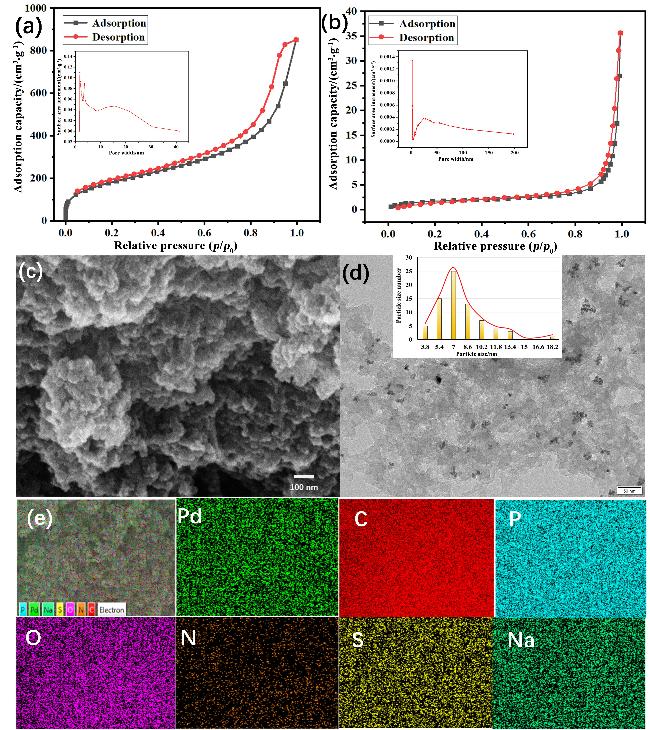
Figure 3a, the N
2 adsorption-desorption isotherm gave a type-IV isotherm for Pd/POP-Nixantphos- PPh
3-PhSO
3Na. A high Brunauer-Emmett-Teller (BET) specific surface area (662.8 m
3/g) and pore volume (1.32 cm
3/g) were detected. Based on the calculations of nonlocal density functional theory (NLDFT), the pore sizes are dis-tributed in 1.4~2.0 and 2.0~41.4 nm, respectively. The pore-size distribution demonstrated the dominant presence of microporous and mesoporous in the catalyst. For Pd/ POP-Nixantphos-PhSO
3Na, a type-III isotherm was observed (
Figure 3b) along with low BET surface area (6.4 m
3/g) and pore volume (0.06 cm
3/g). The above results indicated that the PPh
3 ligand moieties could effectively construct porous structures of catalyst. The hierarchical porosities of Pd/POP-Nixantphos-PPh
3-PhSO
3Na are also confirmed by scanning electron microscopy (SEM,
Figure 3c) and transmission electron microscopy (TEM,
Figure 3d) images. The energy-dispersive spectroscopy (EDS,
Figure 3e) mapping shows that the Pd, P, C, S, O, N and Na elements are uniformly distributed in the catalyst of Pd/POP- Nixantphos-PPh
3-PhSO
3Na. In addition, TEM image reveals that the Pd nanoparticles have an average particle diameter of 7.68 nm. The high specific surface area and porous structure can effectively disperse Pd nanoparticles.