



1 席夫碱型荧光探针对氨基酸的化学选择性识别
1.1 精氨酸的识别
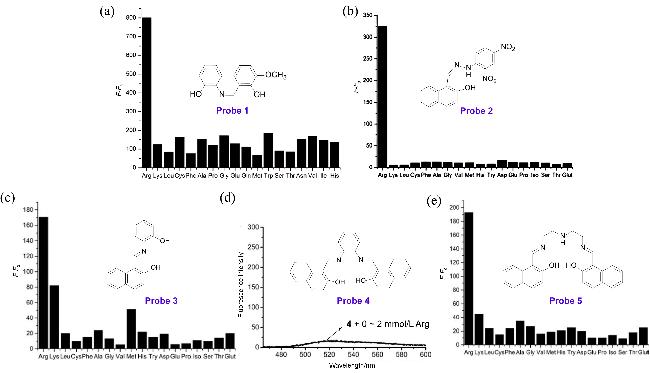
图1 荧光探针1~5的分子结构及对氨基酸的荧光响应[31-33]Figure 1 Molecular structures of probes 1~5, and the fluorescence response toward amino acids[31-33] Among (a), (b), (c), and (e), F-F0 represents the increment in the fluorescence response intensity of the probe to the amino acids, where F0 and F are the fluorescence intensity of probe before and after interaction with the amino acids. (d) shows the fluorescence spectra of probe 4 for 0~2 mmol/L Arg. |
1.2 半光氨酸的识别
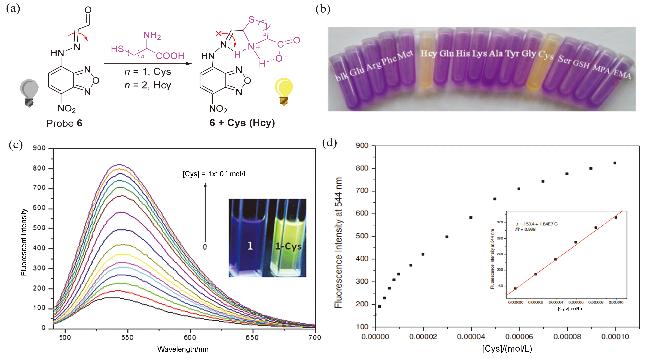
图2 (a)探针6的分子结构; (b)探针6与各种氨基酸作用后在自然光下的照片; (c)探针6对半胱氨酸(0~100 μmol/L)的荧光光谱; (d)探针6的荧光响应强度对低浓度半胱氨酸的(0到10 μmol/L)线性相关性[35]Figure 2 (a) Molecular structure of probe 6; (b) Photographs of probe 6 treated by several amino acids and irradiated under natural light; (c) Fluorescence spectra of probe 6 after its interaction with Cys (0~100 μmol/L); (d) The linear relationship between the fluorescence intensity of probe 6 and low concentrations of Cys (0~10 μmol/L)[35] |
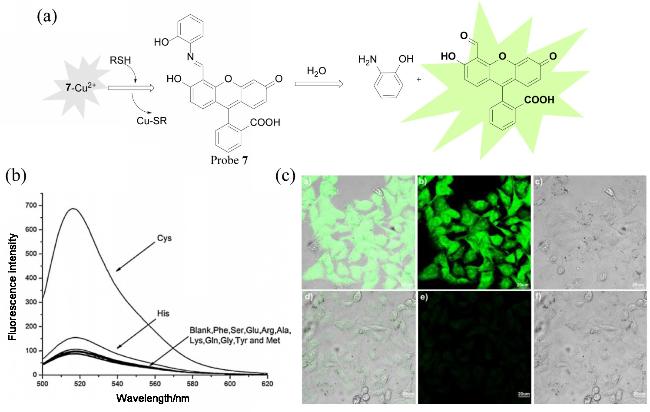
图3 (a)探针7-Cu2+与Cys的作用机理; (b)探针7-Cu2+对氨基酸的荧光响应; (c)探针7-Cu2+对MCF-7细胞成像[孵育7-Cu2+ 30 min(上); 经过硫醇封闭试剂NEM孵育后再孵育7-Cu2+ 30 min(下)[36]Figure 3 (a) Interaction mechanism of probe 7-Cu2+with Cys; (b) Fluorescence response of probe 7-Cu2+to amino acids; (c) Imaging of MCF-7 cells with probe 7-Cu2+ (incubation with 7-Cu2+for 30 minutes (top); incubation with thiol-blocking reagent NEM followed by incubation with 7-Cu2+for 30 min (bottom)[36] |
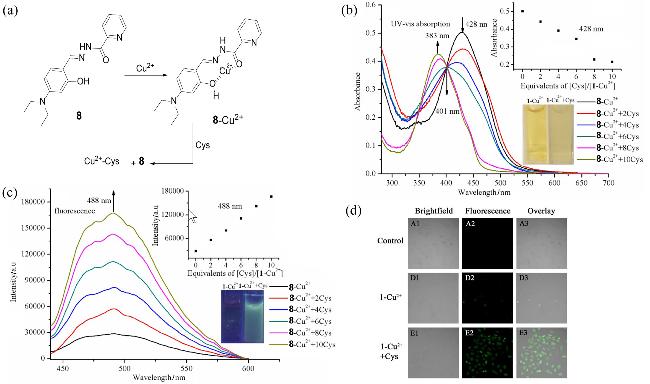
图4 (a)探针8的分子结构及与Cys的作用机理; (b) 8+Cu2+对不同量Cys的UV-Vis吸收光谱; (c) 8+Cu2+对不同量Cys的荧光光谱; (d) HeLa细胞中8+Cu2+对Cys的荧光成像[(A1)~(A3) 0.5 mmol/L NEM预孵育30 min的HeLa细胞共聚焦荧光图像; (D1)~(D3) HeLa细胞用0.5 mmol/L NEM预孵育, 然后用8-Cu2+(20 μmol/L)处理30 min; (E1)~(E3) HeLa细胞用0.5 mmol/L NEM预孵育30 min, 然后用8-Cu2+(20 μmol/L)和Cys(0.1 mmol/L)处理15 min[37]]Figure 4 (a) Molecular structure of probe 8 and its interaction mechanism with Cys; (b) UV-Vis absorption spectra of 8+Cu2+with different equivalents of Cys; (c) Fluorescence spectra of 8+Cu2+with different equivalents of Cys; (d) Fluorescence imaging of Cys in HeLa cells using 8+Cu2+ ((A1)~(A3) Confocal fluorescence images of HeLa cells pre-incubated with 0.5 mmol/L NEM for 30 min; (D1)~(D3) HeLa cells pre-incubated with 0.5 mmol/L NEM and then treated with 8-Cu2+(20 μmol/L) for 30 min; (E1)~(E3) HeLa cells pre-incubated with 0.5 mmol/L NEM for 30 min and then treated with 8-Cu2+(20 µmol/L) and Cys (0.1 mmol/L) for 15 min[37]) |
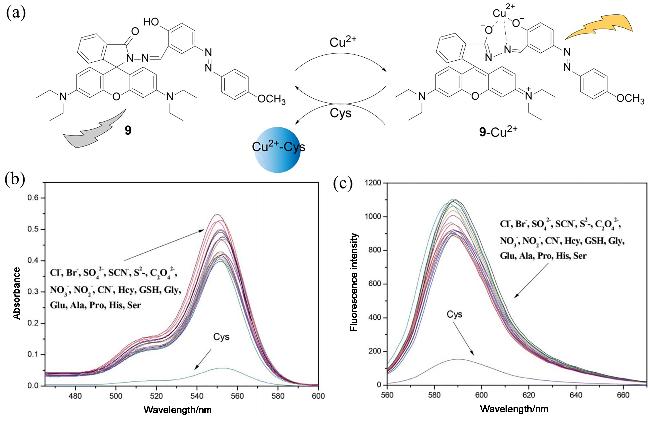
图5 (a)探针9的分子结构及在Cu2+参与条件下对Cys的识别机制; (b)~(c)探针9-Cu2+分别与Cys及其它8种氨基酸和9种不同阴离子作用后的UV-Vis吸收光谱和荧光光谱[38]Figure 5 (a) Molecular structure of probe 9 and its recognition mechanism for Cys in the presence of Cu2+; (b)~(c) UV-Vis absorption spectra and fluorescence spectra of probe 9-Cu2+upon interaction with Cys, eight other amino acids, and nine different anions[38] |
1.3 赖氨酸的识别
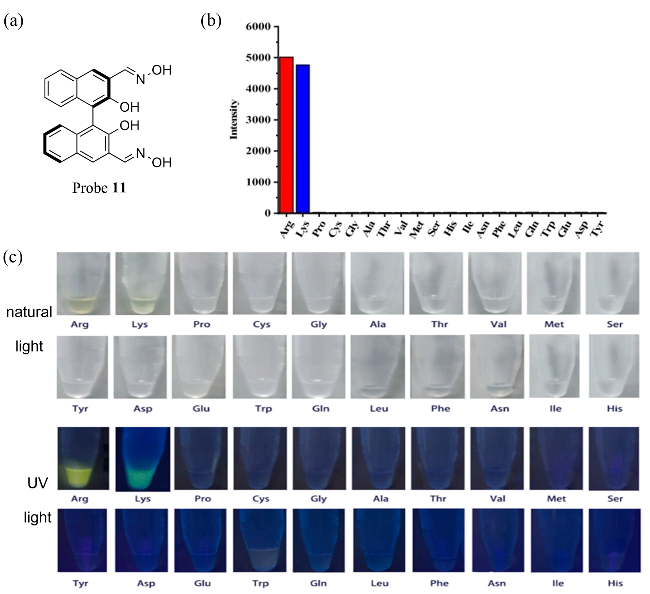
图7 (a)探针11的分子结构; (b)在Zn2+存在条件下探针11对20种氨基酸(包括Lys)的荧光响应; (c)探针11+Zn2+与20种氨基酸作用后分别在自然光下和紫外灯照射下的照片[41]Figure 7 (a) Molecular structure of probe 11; (b) Fluorescence response of probe 11 to 20 amino acids (including Lys) in the presence of Zn2+; (c) Photographs of probe 11+Zn2+respectively treated by 20 amino acids then irradiated under natural light and UV light[41] |
1.4 苯丙氨酸的识别
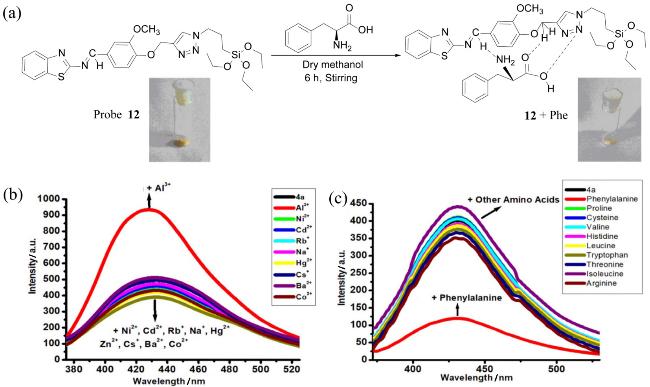
Figure 8 (a)探针12与Phe的作用模式; (b)探针12对Al3+离子的选择性荧光增强; (c)探针12对Phe的选择性荧光淬灭[43] |
1.5 色氨酸的识别
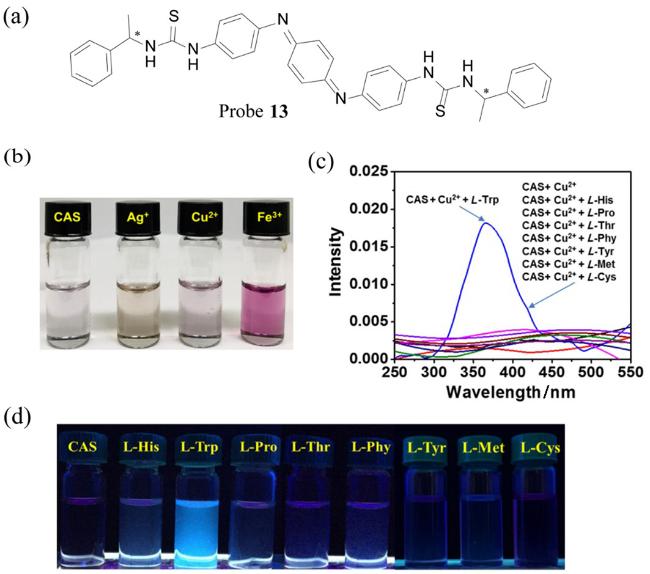
图9 (a)探针13的分子结构; (b)探针13与金属离子作用后溶液颜色的变化; (c) 13-Cu2+复合物对8种不同结构氨基酸的荧光响应; (d) 13-Cu2+复合物与8种不同结构氨基酸作用后的溶液照片[45]Figure 9 (a) Molecular structure of probe 13; (b) Color changes of probe 13 after interaction with metal ions; (c) Fluorescence response of the 13-Cu2+complex to 8 amino acids; (d) Photographs of the 13-Cu2+complex solution after interaction with 8 amino acids[45] |
1.6 丝氨酸的识别
1.7 谷氨酸的识别
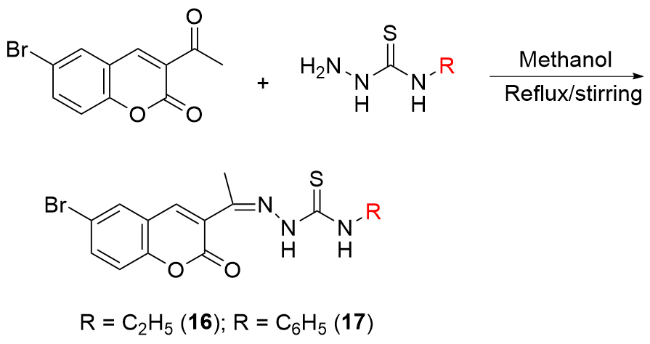
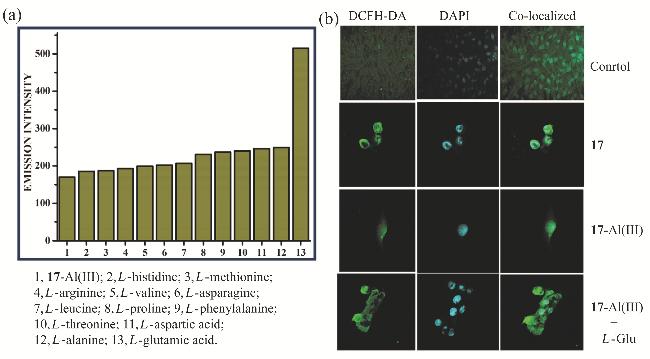
图13 (a)探针17-Al3+对13种氨基酸(包括Glu)的荧光响应; (b)探针17、17-Al3+和17-Al3+-Glu在MDA-MB-231乳腺癌细胞中的共聚焦荧光成像(从左至右依次是10 µmol/L的DCFH-DA、DAPI及DAPI+DCFH-DA染色定位)[51]Figure 13 (a) Fluorescence response of probe 17-Al3+to 13 amino acids (including Glu); (b) Confocal fluorescence imaging of probe 17, 17-Al3+, and 17-Al3+-Glu in MDA-MB-231 breast cancer cells, showing staining localization with 10 µmol/L DCFH-DA, DAPI, and DAPI+DCFH-DA from left to right[51] |
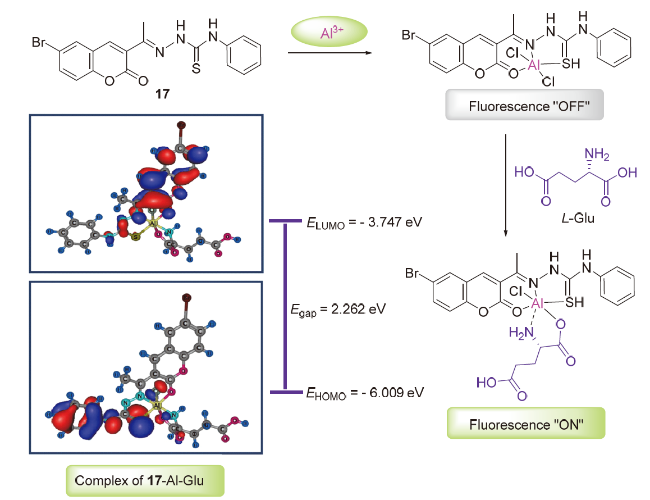


图14 化合物17与Al3+、复合物17-Al3+与L-Glu的作用机制; 17-Al3+与L-Glu复合物的分子模型及HOMO和LUMO轨道电荷分布及能级值(Hartree理论水平)[51]Figure 14 Interaction mechanism of compound 17 with Al3+ and the complex 17-Al3+ with L-Glu; molecular model of the 17-Al3+- L-Glu complex along with the charge distribution of HOMO and LUMO orbitals and their energy level values (Hartree level of theory)[51] |
2 总结与展望
表1 化学选择性识别氨基酸的席夫碱型荧光探针汇总Table 1 Summary of Schiff-base fluorescence probes for chemoselective recogniton on amino acids |
| 氨基酸 | 探针 | 荧光响应 | 检测限 | 溶剂 | pH | 金属离子 | 识别机理 | |
|---|---|---|---|---|---|---|---|---|
| 酸性 | Glu | 17[51] | 增强 | 185.0 nmol/L | EtOH/H2O (V/V=1/4) | 7.0 | Al3+ | C=N、氨基酸的氨基和羰基与Al3+的共配位作用 |
| 碱性 | Arg | 1[31] | 增强 | DMSO/H2O (V/V=1/1) | 7.0 | No | 与Arg的作用改变了C=N与OH之间氢键上电子转移 | |
| 2[32] | 增强 | DMSO/H2O (V/V=1/1) | 7.0 | No | 与Arg作用后C=N与NO2之间氢键变化 | |||
| 3[33] | 增强 | DMSO/H2O (V/V=1/1) | 7.0 | No | 与Arg的作用改变了C=N与OH之间氢键上电子转移 | |||
| 4[33] | 无响应 | DMSO/H2O (V/V=1/1) | 7.0 | No | ||||
| 5[33] | 增强 | DMSO/H2O (V/V=1/1) | 7.0 | No | 与Arg的作用改变了C=N与OH之间氢键上电子转移 | |||
| 11[41] | 增强 | 13.07 nmol/L | THF/H2O | 7.0 | Zn2+ | C=N、Arg的氨基和羧基与Zn2+的共配位作用, C=N与Arg胍基质子氢键作用 | ||
| 16[51] | 增强 | 148.0 nmol/L | EtOH/H2O (V/V=1/4) | 7.0 | Cu2+ | C=N、Arg的氨基和羧基与Cu2+的共配位作用 | ||
| Lys | 11[41] | 增强 | 12.53 nmol/L | H2O/1.25% THF | 7.0 | Zn2+ | C=N、Lys的氨基、羧基与Zn2+的共配位作用, C=N与Lys氨基质子氢键作用 | |
| 非极性 | Phe | 12[43] | 淬灭 | 18.45 μmol/L | MeOH/H2O (V/V=6/4) | 7.0 | No | C=N、三唑环、OCH2与Phe的氨基、羧基之间的氢键作用 |
| Trp | 13[45] | 增强 | DMSO/H2O (V/V=9/1) | 7~11 | Cu2+ | 竞争配位与共配位形成三元复合物 | ||
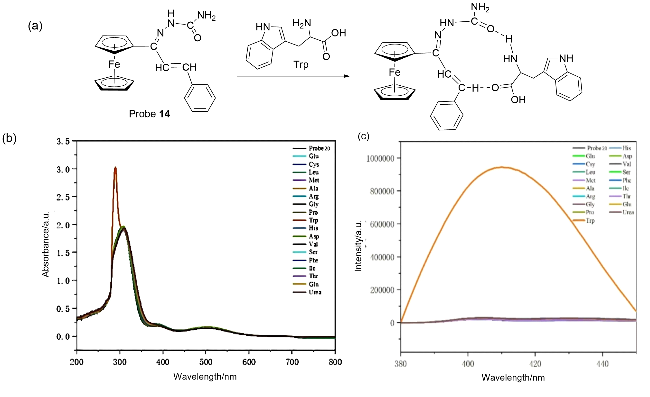
| 14[46] | 增强 | 130.7 μmol/L | MeOH | 2~12 | No | C=O、C=C与Trp的氨基、羧基之间通过氢键作用, 形成包含C=N的大环 | ||
| 极性 | Cys | 6[35] | 增强 | 3.6 nmol/L | CH3CN-PBS (V/V=1/2) | 7.2 | No | 探针醛基与Cys巯基发生环化反应后通过分子内氢键形成五元环, 抑制C=N异构化诱导的荧光淬灭 |
| 7[36] | 增强 | 9 μmol/L | HEPES buffer/1% MeCN | 7.4 | Cu2+ | Cys对Cu2+的竞争配位, C=N水解释放荧光素 | ||
| 8[37] | 增强 | 0.64 nmol/L | PBS buffer | 7.4 | Cu2+ | 探针的C=N, C=O, OH与Cu2的配位作用淬灭荧光, Cys对Cu2+的竞争配位, 释放探针分子, 荧光恢复 | ||
| 9[38] | 淬灭 | 1.2 μmol/L | MeOH/H2O (V/V=3/7) | 7.0 | Cu2+ | Cys对Cu2+的竞争配位, 释放罗丹明分子且使其内酰胺环重新形成, 荧光淬灭 | ||
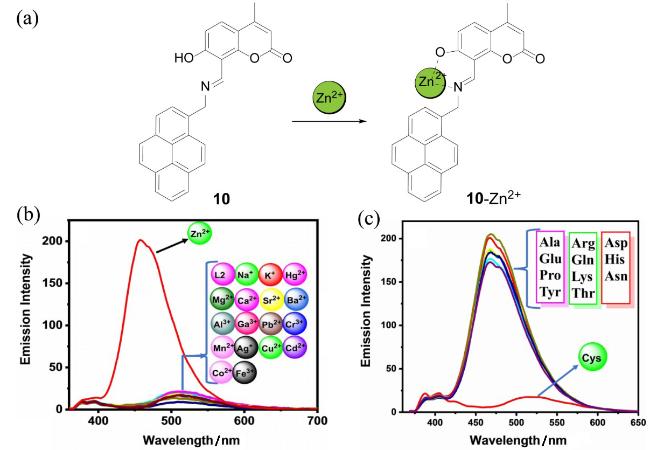
| 10[39] | 淬灭 | 1.23 μmol/L | MeCN/H2O (V/V=8/2) | 7.0 | Zn2+ | Cys对Zn2+的竞争配位, 释放探针分子 | ||
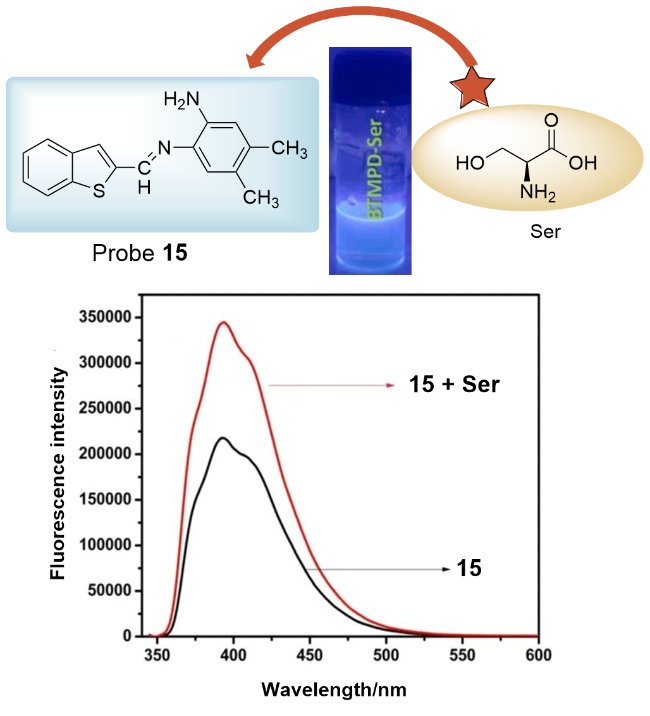
| Ser | 15[48] | 增强 | 1.74 nmol/L | DMF | 7.0 | No | Ser与探针分子之间的电荷转移 | |