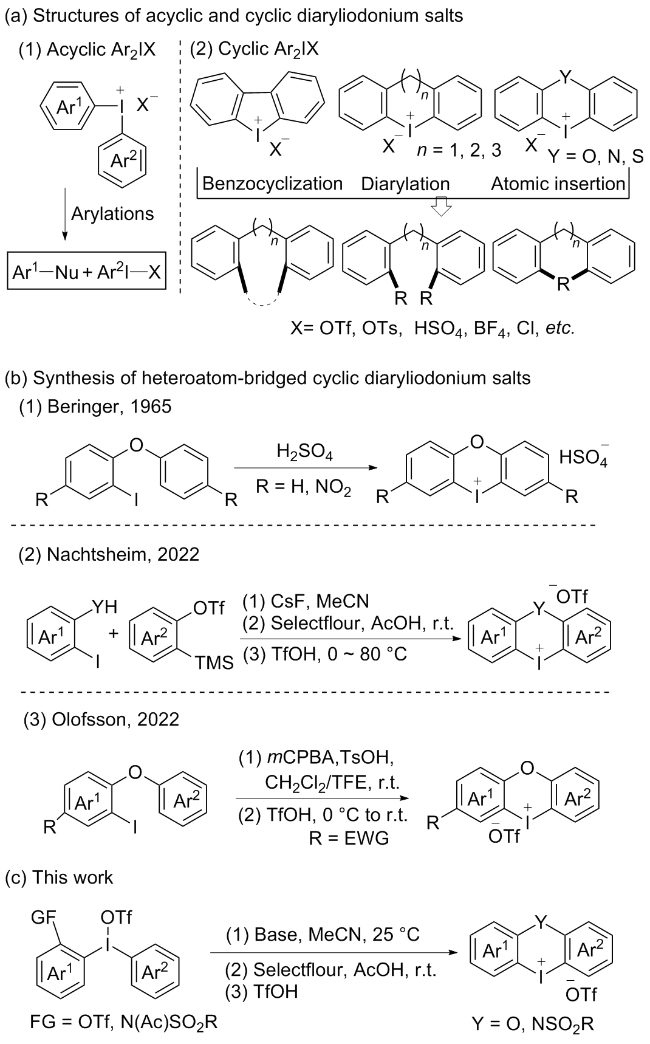
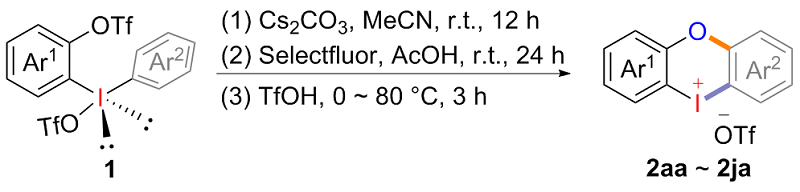
To an oven-dried Schlenk tube was added iodonium salts (0.5 mmol, 1 equiv.) and Cs2CO3 (0.55 mmol, 1.1 equiv.). The tube was degassed with argon for three times. Acetonitrile (5 mL) was added via syringe, and the mixture was stirred at room temperature for 12 h. After TLC indicated that the diaryliodonium salts were completely consumed, Selectfluor (2.0 mmol, 4 equiv.) was subsequently added, followed by the addition of 0.5 mL of acetic acid. This mixture was stirred at room temperature for 24 h. After the reaction was detected by TLC, the reaction mixture was treated with trifluoromethanesulfonic acid (2.0 mmol, 4 equiv.) under ice-bath cooling and stirred for 10 minutes. The reaction temperature was adjusted to 80 ℃ and maintained for 2 h. The mixture was washed with water (30 mL) and extracted with DCM (15 mL) for three times. Then the solvent was evaporated under vacuum. The crude products were purified using flash column chromatography [eluent: V(di- chloromethane)∶V(methanol)=20∶1] on silica gel to afford the desired product.
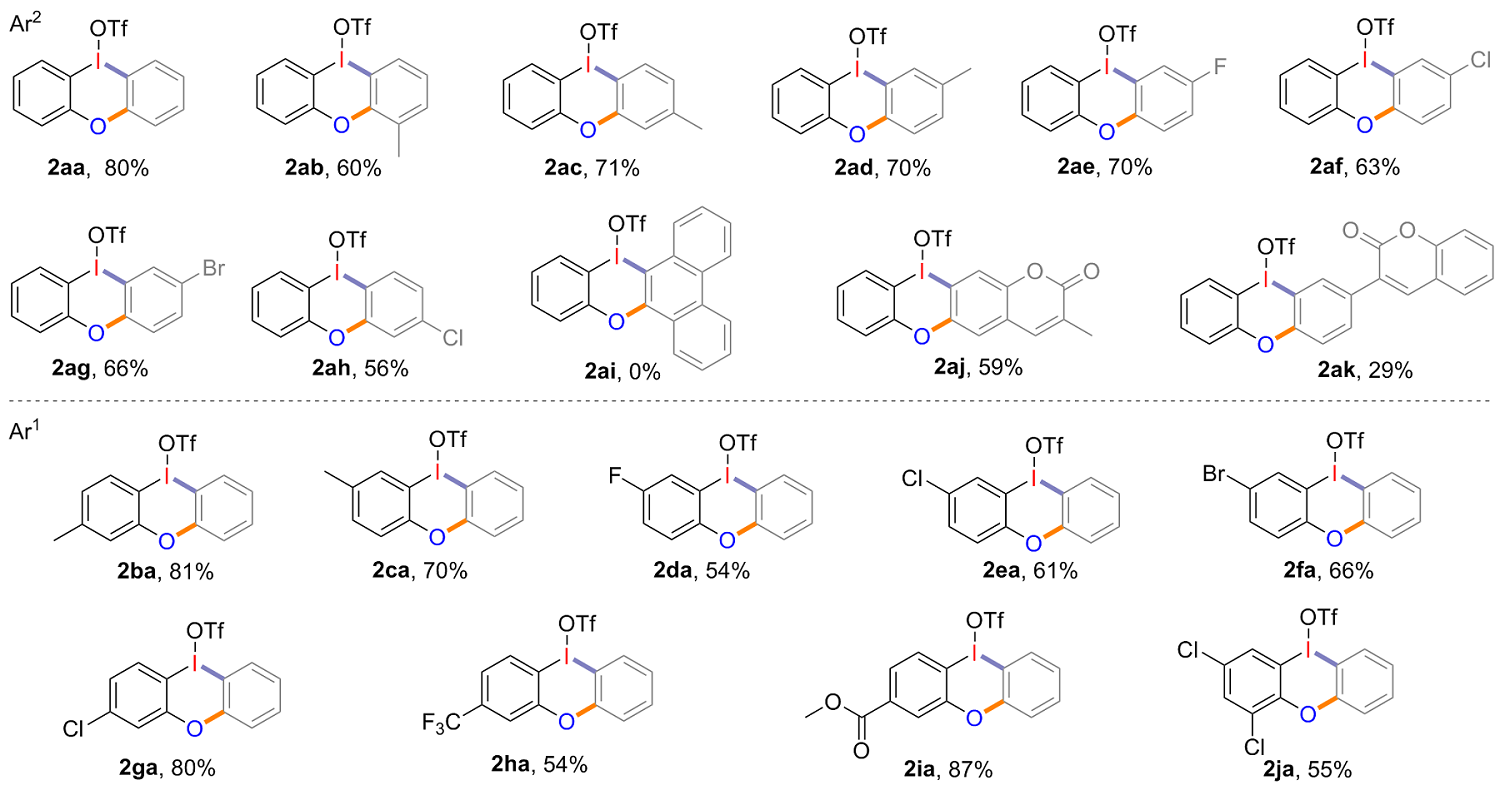
5H-5λ3-Dibenzo[b,e][1,4]iodaoxin-5-yl trifluorometha- nesulfonate (2aa): 80% yield (178 mg), white solid, column chromatography [V(dichloromethane)∶V(metha- nol)=20∶1]. m.p. 181~183 ℃; 1H NMR (400 MHz, DMSO-d6) δ: 8.07 (d, J=8.1 Hz, 2H), 7.76~7.63 (m, 4H), 7.55~7.37 (m, 2H); 13C NMR (101 MHz, DMSO-d6) δ: 153.5, 133.5, 133.5, 128.2, 121.6, 120.7 (q, JC-F=324.2 Hz), 102.4; 19F NMR (376 MHz, DMSO-d6) δ: 77.75; HRMS (ESI) calcd for C12H8IO [MOTf]+ 294.9614, found 294.9611.
1-Methyl-5H-5λ3-dibenzo[b,e][1,4]iodaoxin-5-yl trifluoromethanesulfonate (2ab): 60% yield (136 mg), yellow solid, column chromatography [V(dichloromethane)∶V(methanol)=20∶1]. m.p. 177~179 ℃; 1H NMR (400 MHz, DMSO-d6) δ: 8.04 (dd, J=8.2, 1.5 Hz, 1H), 7.84 (d, J=8.3 Hz, 1H), 7.78 (dd, J=8.2, 1.5 Hz, 1H), 7.67 (td, J=7.7, 1.5 Hz, 1H), 7.54 (d, J=8.5 Hz, 1H), 7.49~7.40 (m, 1H), 7.32 (t, J=7.8 Hz, 1H), 2.51 (s, 3H); 13C NMR (101 MHz, DMSO-d6) δ: 153.6, 151.7, 134.4, 133.6, 133.5, 131.5, 131.0, 128.2, 127.6, 122.0, 120.7 (q, JC-F=320.1 Hz), 103.5, 103.3, 16.0; 19F NMR (376 MHz, DMSO-d6) δ: 77.77; HRMS (ESI) calcd for C13H10IO [MOTf]+ 308.9771, found 308.9766.
2-Methyl-5H-5λ3-dibenzo[b,e][1,4]iodaoxin-5-yl trifluo- romethanesulfonate (2ac): 71% yield (162 mg), light yellow solid, column chromatography [V(dichloromethane)∶V(methanol)=20∶1]. m.p. 180~182 ℃; 1H NMR (400 MHz, DMSO-d6) δ: 8.02 (d, J=8.1 Hz, 1H), 7.88 (d, J=8.2 Hz, 1H), 7.66 (d, J=3.9 Hz, 2H), 7.53 (d, J=1.2 Hz, 1H), 7.46~7.40 (m, 1H), 7.26 (dd, J=8.3, 1.3 Hz, 1H), 2.39 (s, 3H); 13C NMR (101 MHz, DMSO-d6) δ: 153.6, 153.4, 144.3, 133.5, 133.4, 132.9, 128.9, 128.0, 121.9, 121.6, 119.6 (q, JC-F=317.1 Hz), 102.6, 98.6, 20.6; 19F NMR (376 MHz, DMSO-d6) δ: 77.76; HRMS (ESI) calcd for C13H10IO [MOTf]+ 308.9771, found 308.9765.
3-Methyl-5H-5λ3-dibenzo[b,e][1,4]iodaoxin-5-yl trifluo- romethanesulfonate (2ad): 70% yield (159 mg), yellow solid, column chromatography [V(dichloromethane)∶V(methanol)=20∶1]. m.p. 175~177 ℃; 1H NMR (400 MHz, DMSO-d6) δ: 8.03 (dd, J=8.1, 1.3 Hz, 1H), 7.82 (dd, J=2.1, 0.8 Hz, 1H), 7.72~7.64 (m, 2H), 7.59 (d, J=8.3 Hz, 1H), 7.51~7.39 (m, 2H), 2.37 (s, 3H); 13C NMR (101 MHz, DMSO-d6) δ: 153.7, 151.4, 138.0, 133.9, 133.5, 133.5, 133.1, 128.0, 121.6, 121.1, 120.7 (q, JC-F=320.1 Hz), 102.7, 102.3, 20.2; 19F NMR (376 MHz, DMSO-d6) δ: 77.75; HRMS (ESI) calcd for C13H10IO [MOTf]+ 308.9771, found 308.9766.
3-Fluoro-5H-5λ3-dibenzo[b,e][1,4]iodaoxin-5-yl trifluo- romethanesulfonate (2ae): 70% yield (162 mg), white solid, column chromatography [V(dichloromethane)∶V(me- thanol)=20∶1]. m.p. 170~172 ℃; 1H NMR (400 MHz, DMSO-d6) δ: 8.04 (dd, J=8.2, 1.3 Hz, 1H), 7.88 (dd, J=7.5, 3.0 Hz, 1H), 7.78 (dd, J=9.0, 4.6 Hz, 1H), 7.74~7.66 (m, 2H), 7.63~7.56 (m, 1H), 7.50~7.43 (m, 1H); 13C NMR (101 MHz, DMSO-d6) δ: 159.3 (d, JC-F=249.5 Hz), 153.6, 150.5 (d, JC-F=2.0 Hz), 133.7, 133.5, 128.3, 122.7 (d, JC-F=9.1 Hz), 121.7, 120.5 (d, JC-F=23.2 Hz), 120.1 (d, JC-F=27.3 Hz), 118.2 (q, JC-F=186.9 Hz), 103.1 (d, JC-F=9.1 Hz), 102.9; 19F NMR (376 MHz, DMSO-d6) δ: 77.76(s), 113.58 (s); HRMS (ESI) calcd for C12H7- FIO [MOTf]+ 312.9520, found 312.9512.
3-Chloro-5H-5λ3-dibenzo[b,e][1,4]iodaoxin-5-yl trifluo- romethanesulfonate (2af): 63% yield (150 mg), white solid, Column chromatography [V(dichloromethane)∶V(me- thanol)=20∶1]. m.p. 188~190 ℃; 1H NMR (400 MHz, DMSO-d6) δ: 8.08~8.01 (m, 2H), 7.80~7.67 (m, 4H), 7.47 (td, J=7.6, 6.8, 2.1 Hz, 1H); 13C NMR (101 MHz, DMSO-d6) δ: 153.3, 152.7, 133.6, 133.5, 133.3, 132.5, 131.0, 128.4, 122.8, 121.7, 120.7 (q, JC-F=324.2 Hz), 103.3, 102.4; 19F NMR (376 MHz, DMSO-d6) δ: 77.75; HRMS (ESI) calcd for C12H7ClIO [MOTf]+ 328.9225, found 328.9218.
3-Bromo-5H-5λ3-dibenzo[b,e][1,4]iodaoxin-5-yl trifluo- romethanesulfonate (2ag): 66% yield (172 mg), white solid, column chromatography [V(dichloromethane)∶V(me- thanol)=20∶1]. m.p. 193~195 ℃; 1H NMR (400 MHz, DMSO-d6) δ: 8.06 (d, J=7.9 Hz, 1H), 7.90 (dd, J=7.5, 3.0 Hz, 1H), 7.78 (dd, J=9.0, 4.6 Hz, 1H), 7.74~7.67 (m, 2H), 7.60 (td, J=8.6, 3.0 Hz, 1H), 7.48 (td, J=6.4, 3.4 Hz, 1H); 13C NMR (101 MHz, DMSO-d6) δ: 158.0, 153.7, 150.5, 150.4, 133.6, 133.5, 128.3, 122.6, 121.7, 121.3, (q, JC-F=275.3 Hz)120.6, 103.4, 103.1; 19F NMR (376 MHz, DMSO-d6) δ: 77.77; HRMS (ESI) calcd for C12H7BrIO [MOTf]+ 372.8719, found 372.8714.
2-Chloro-5H-5λ3-dibenzo[b,e][1,4]iodaoxin-5-yl trifluo- romethanesulfonate (2ah): 56% yield (134 mg), yellow solid, column chromatography [V(dichloromethane)∶V(methanol)=20∶1]. m.p. 170~172 ℃; 1H NMR (400 MHz, DMSO-d6) δ: 8.07~8.00 (m, 2H), 7.90 (d, J=2.3 Hz, 1H), 7.69 (d, J=3.9 Hz, 2H), 7.56 (dd, J=8.7, 2.3 Hz, 1H), 7.46 (dt, J=8.8, 4.6 Hz, 1H); 13C NMR (101 MHz, DMSO-d6) δ: 154.4, 153.2, 137.7, 134.6, 133.6, 133.5, 128.5, 128.1, 121.8, 121.8, 120.7 (q, JC-F=323.2 Hz), 102.4, 101.1; 19F NMR (376 MHz, DMSO-d6) δ: 77.77; HRMS (ESI) calcd for C12H7ClIO [MOTf]+ 328.9225, found 328.9221.
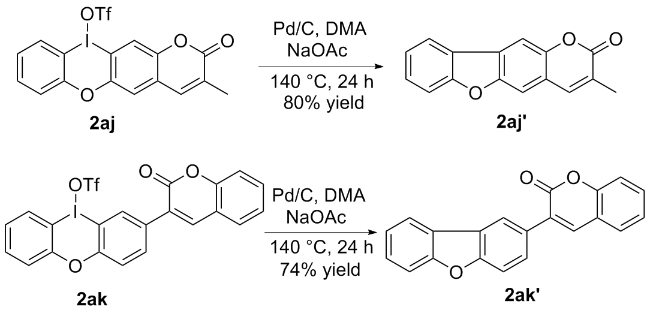
3-Methyl-2-oxo-11λ3-benzo[b]chromeno[6,7-e][1,4]io-daoxin-11(2H)-yl trifluoromethanesulfonate (2aj): 59% yield (59 mg), white solid, column chromatography [V(dichloromethane)∶V(methanol)=20∶1]. m.p. 168~170 ℃; 1H NMR (400 MHz, DMSO-d6) δ: 8.06 (d, J=6.8 Hz, 1H), 7.96~7.86 (m, 2H), 7.78 (dd, J=8.1, 1.5 Hz, 1H), 7.76~7.67 (m, 2H), 7.48 (ddd, J=8.5, 7.3, 1.6 Hz, 1H), 2.21 (s, 2H); 13C NMR (101 MHz, DMSO-d6) δ: 160.4, 154.1, 151.7, 150.6, 139.1, 136.3, 135.7, 133.6, 128.4, 127.4, 122.6, 121.6, 121.7 (q, JC-F=324.2 Hz), 121.1, 119.8, 105.3, 16.8; 19F NMR (376 MHz, DMSO-d6) δ: 77.73; HRMS (ESI) calcd for C16H10IO3 [MOTf]+376.9669, found 376.9656.
3-(2-Oxo-2H-chromen-3-yl)-5H-5λ3-dibenzo[b,e][1,4]-iodaoxin-5-yl trifluoromethanesulfonate (2ak): 29% yield (84 mg), yellow solid, column chromatography [V(dich- loromethane)∶V(methanol)=20∶1]. m.p. 196~198 ℃; 1H NMR (400 MHz, DMSO-d6) δ: 8.50 (d, J=2.1 Hz, 1H), 8.32 (s, 1H), 8.14 (dd, J=8.1, 1.4 Hz, 1H), 7.98 (dd, J=8.6, 2.2 Hz, 1H), 7.83~7.74 (m, 2H), 7.73~7.62 (m, 2H), 7.51~7.37 (m, 4H); 13C NMR (101 MHz, DMSO-d6) δ: 171.7, 159.6, 153.5, 153.4, 153.2, 141.7, 134.3, 133.6, 133.4, 133.2, 132.5, 129.0, 128.3, 124.9, 124.4, 121.7, 121.3, 120.7 (q, JC-F=324.2 Hz) 119.3, 116.1, 102.4, 102.3; 19F NMR (376 MHz, DMSO-d6) δ: 77.73; HRMS (ESI) calcd for C21H12IO3 [MOTf]+ 438.9826, found 438.9808.
2-Methyl-5H-5λ3-dibenzo[b,e][1,4]iodaoxin-5-yl trifluo- romethanesulfonate (2ba): 81% yield (185 mg), light yellow solid, column chromatography [V(dichloromethane)∶V(methanol)=20∶1]. m.p. 181~183 ℃; 1H NMR (400 MHz, DMSO-d6) δ: 8.04 (d, J=8.0 Hz, 1H), 7.90 (d, J=8.3 Hz, 1H), 7.71~7.66 (m, 2H), 7.59~7.55 (m, 1H), 7.45 (ddd, J=8.5, 5.6, 3.2 Hz, 1H), 7.29 (dd, J=8.3, 1.9 Hz, 1H), 2.41 (s, 3H); 13C NMR (151 MHz, DMSO-d6) δ: 153.6, 153.4, 144.3, 133.5, 133.4, 132.9, 128.9, 128.0, 121.9, 121.6, 119.6 (q, JC-F=317.1 Hz), 102.6, 98.6, 20.6; 19F NMR (376 MHz, DMSO-d6) δ: 77.76; HRMS (ESI) calcd for C13H10IO [MOTf]+ 308.9771, found 308.9765.
3-Methyl-5H-5λ3-dibenzo[b,e][1,4]iodaoxin-5-yl trifluo- romethanesulfonate (2ca): 70% yield (161 mg), light yellow solid, column chromatography [V(dichloromethane)∶V(methanol)=20∶1]. m.p. 173~175 ℃; 1H NMR (400 MHz, DMSO-d6) δ: 8.03 (dd, J=8.1, 1.3 Hz, 1H), 7.82 (dd, J=2.1, 0.8 Hz, 1H), 7.72~7.64 (m, 2H), 7.59 (d, J=8.3 Hz, 1H), 7.51~7.39 (m, 2H), 2.37 (s, 3H); 19F NMR (376 MHz, DMSO-d6) δ: 77.77; HRMS (ESI) calcd for C13H10IO [MOTf]+ 308.9771, found 308.9764.
3-Fluoro-5H-5λ3-dibenzo[b,e][1,4]iodaoxin-5-yl trifluo- romethanesulfonate (2da): 54% yield (121 mg), light yellow solid, column chromatography [V(dichloromethane)∶V(methanol)=20∶1]. m.p. 171~173 ℃; 1H NMR (400 MHz, DMSO-d6) δ: 8.04 (dd, J=8.1, 1.3 Hz, 1H), 7.88 (dd, J=7.4, 3.0 Hz, 1H), 7.77 (dd, J=9.0, 4.5 Hz, 1H), 7.70 (qd, J=8.2, 1.8 Hz, 2H), 7.59 (td, J=8.5, 3.0 Hz, 1H), 7.47 (ddd, J=8.5, 6.7, 2.2 Hz, 1H); 13C NMR (101 MHz, DMSO-d6) δ: 159.3 (d, JC-F=249.5 Hz), 153.6, 150.5 (d, JC-F=2.0 Hz), 133.7, 133.5, 128.3, 122.7 (d, JC-F=9.1 Hz), 121.7, 120.5 (d, JC-F=23.2 Hz), 120.1 (d, JC-F=27.3 Hz), 118.2 (q, JC-F=186.9 Hz), 103.1 (d, JC-F=9.1 Hz), 102.9; 19F NMR (376 MHz, DMSO-d6) δ: 77.76 (s), 113.57 (s); HRMS (ESI) calcd for C12H7FIO [MOTf]+ 312.9520, found 312.9512.
3-Chloro-5H-5λ3-dibenzo[b,e][1,4]iodaoxin-5-yl trifluo- romethanesulfonate (2ea): 61% yield (145 mg), white solid, column chromatography [V(dichloromethane)∶V(me- thanol)=20∶1]. m.p. 188~190 ℃; 1H NMR (400 MHz, DMSO-d6) δ: 8.07~8.02 (m, 2H), 7.80~7.74 (m, 2H), 7.72~7.69 (m, 2H), 7.47 (ddd, J=8.5, 6.8, 2.1 Hz, 1H); 19F NMR (376 MHz, DMSO-d6) δ: 77.74; 13C NMR (101 MHz, DMSO-d6) δ: 153.3, 152.7, 133.6, 133.5, 133.3, 132.5, 131.0, 128.4, 122.8, 121.7, 120.7 (q, JC-F=324.2 Hz), 103.3, 102.4; HRMS (ESI) calcd for C12H7ClIO [MOTf]+ 328.9225, found 328.9218.
3-Bromo-5H-5λ3-dibenzo[b,e][1,4]iodaoxin-5-yl trifluo- romethanesulfonate (2fa): 66% yield (171 mg), white solid, column chromatography [V(dichloromethane)∶V(me- thanol)=20∶1]. m.p. 195~197 ℃; 1H NMR (400 MHz, DMSO-d6) δ: 8.17 (d, J=2.3 Hz, 1H), 8.03 (dd, J=8.1, 1.3 Hz, 1H), 7.88 (dd, J=8.7, 2.3 Hz, 1H), 7.74~7.64 (m, 3H), 7.47 (ddd, J=8.6, 6.7, 2.1 Hz, 1H); 13C NMR (101 MHz, DMSO-d6) δ: 153.3, 153.1, 136.2, 135.2, 133.6, 133.5, 128.4, 123.2, 121.7, 120.7 (q, JC-F=323.2 Hz), 118.8, 103.8, 102.4; 19F NMR (376 MHz, DMSO-d6) δ: 77.75; HRMS (ESI) calcd for C12H7BrIO [MOTf]+ 372.8719, found 372.8714.
2-Chloro-5H-5λ3-dibenzo[b,e][1,4]iodaoxin-5-yl trifluo- romethanesulfonate (2ga): 80% yield (191 mg), white solid, column chromatography [V(dichloromethane)∶V(me- thanol)=20∶1]. m.p. 170~172 ℃; 1H NMR (400 MHz, DMSO-d6) δ: 8.08~8.02 (m, 2H), 7.89 (d, J=2.3 Hz, 1H), 7.69 (d, J=3.8 Hz, 2H), 7.55 (dd, J=8.7, 2.3 Hz, 1H), 7.48~7.43 (m, 1H); 13C NMR (101 MHz, DMSO-d6) δ: 154.4, 153.2, 137.7, 134.6, 133.6, 133.5, 128.5, 128.1, 121.8, 121.8, 120.7 (q, JC-F=323.2 Hz), 102.4, 101.1; 19F NMR (376 MHz, DMSO-d6) δ: 77.76; HRMS (ESI) calcd for C12H7ClIO [MOTf]+ 328.9225, found 328.9215.
2-(Trifluoromethyl)-5H-5λ3-dibenzo[b,e][1,4]iodaoxin-5-yl trifluoromethanesulfonate (2ha): 54% yield (138 mg), white solid, column chromatography [V(dichlorome- thane)∶V(methanol)=20∶1]. m.p. 204~210 ℃; 1H NMR (400 MHz, DMSO-d6) δ: 8.28~8.24 (m, 1H), 8.15 (d, J=2.1 Hz, 1H), 8.05 (dd, J=8.1, 1.4 Hz, 1H), 7.85 (dd, J=8.6, 2.1 Hz, 1H), 7.77~7.68 (m, 2H), 7.49 (ddd, J=8.6, 7.1, 1.9 Hz, 1H); 13C NMR (101 MHz, DMSO-d6) δ: 154.0, 153.1, 135.0, 133.6, 133.5, 133.4 (q, JC-F=32.3 Hz), 128.6, 124.5 (q, JC-F=4.0 Hz), 124.3, 121.7 (q, JC-F=21.2 Hz), 120.7 (q, JC-F=323.2 Hz), 118.7 (q, JC-F=4.0 Hz), 107.6, 102.2; 19F NMR (376 MHz, DMSO-d6) δ: 61.48 (s), 77.76 (s); HRMS (ESI) calcd for C13H7F3IO [MOTf]+ 362.9488, found 362.9478.
Methyl 5-(((trifluoromethyl)sulfonyl)oxy)-5H-5λ3-di- benzo[b,e][1,4]iodaoxine-2-carboxylate (2ia): 87% yield (217 mg), white solid, column chromatography [V(dich- loromethane)∶V(methanol)=20∶1]. m.p. 170~172 ℃; 1H NMR (400 MHz, DMSO-d6) δ: 8.12~8.07 (m, 2H), 8.00 (dd, J=8.1, 1.4 Hz, 1H), 7.85 (t, J=7.9 Hz, 1H), 7.77~7.67 (m, 2H), 7.52~7.45 (m, 1H), 4.04 (s, 3H); 13C NMR (101 MHz, DMSO-d6) δ: 164.6, 153.8, 153.3, 134.4, 134.3, 133.6, 133.6, 128.5, 128.1, 121.9, 121.6, 120.7 (q, JC-F=323.2 Hz), 108.2, 102.5, 53.0; 19F NMR (376 MHz, DMSO-d6) δ: 77.77; HRMS (ESI) calcd for C14H10IO3 [MOTf]+ 352.9669, found 352.9662.
1,3-Dichloro-5H-5λ3-dibenzo[b,e][1,4]iodaoxin-5-yl trifluoromethanesulfonate (2ja): 55% yield (141 mg), white solid, column chromatography [V(dichloromethane)∶V(methanol)=20∶1]. m.p. 215~217 ℃; 1H NMR (400 MHz, DMSO-d6) δ: 8.12~8.10 (m, 1H), 8.09~8.04 (m, 1H), 8.02 (d, J=2.4 Hz, 1H), 7.73~7.70 (m, 2H), 7.54~7.49 (m, 1H); 13C NMR (101 MHz, DMSO-d6) δ: 153.0, 148.7, 133.8, 133.7, 133.0, 131.6, 131.1, 128.9, 126.3, 121.9, 120.7 (q, JC-F=323.2 Hz), 105.6, 103.6; 19F NMR (376 MHz, DMSO-d6) δ: 77.76; HRMS (ESI) calcd for C12H6Cl2IO [MOTf]+ 362.8835, found 362.8828.
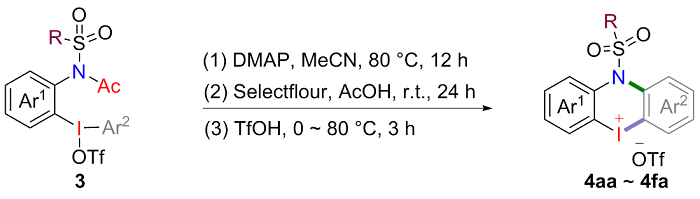
An oven-dried Schlenk tube equipped with a Teflon cap and a magnetic stir bar, was charged with diaryliodonium salts (0.5 mmol, 1.0 equiv.) and DMAP (1.0 equiv.). The tube was filled with nitrogen for three times, then MeCN (3 mL) was added. The mixture was allowed to be stirred at 80 ℃ for 12 h. After cooling to room temperature, and TLC indicated that the iodonium salts were completely consumed. Then selective fluorine reagent (2.0 mmol, 4 equiv.) was added, followed by the addition of 0.5 mL of acetic acid as ligand, continued the reaction at room temperature for 24 h. After the reaction was detected by TLC, trifluoromethanesulfonic acid (2.0 mmol, 4 equiv.) was added under an ice bath, stirred for 10 min, and transferred the reaction to 80 ℃ to continue the reaction for 2 h, and the product was obtained.
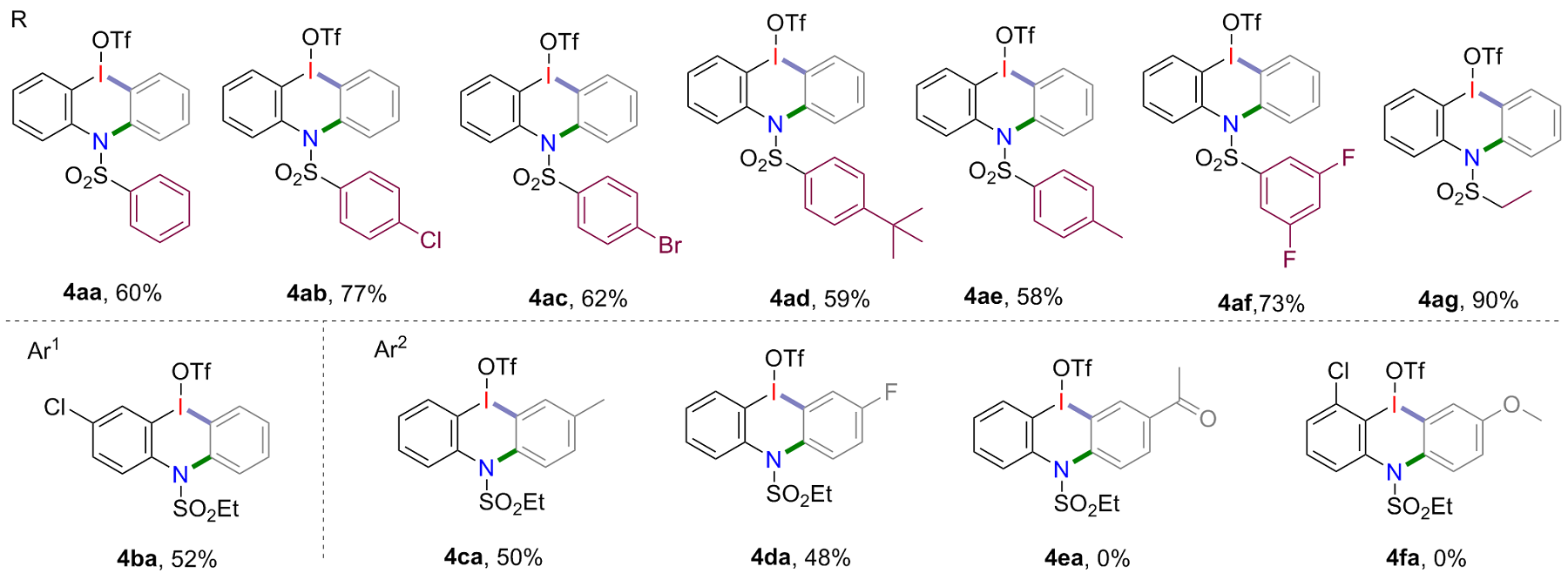
10-(Phenylsulfonyl)-5λ3-dibenzo[b,e][1,4]iodazin-5(10H)-yl trifluoromethanesulfonate (4aa): 60% yield (135 mg), light yellow solid, column chromatography [V(di- chloromethane)∶V(methanol)=20∶1]. m.p. 202~204 ℃; 1H NMR (400 MHz, DMSO-d6) δ: 7.99 (ddd, J=8.0, 4.3, 1.5 Hz, 4H), 7.86 (t, J=7.5 Hz, 1H), 7.80~7.74 (m, 2H), 7.67~7.61 (m, 2H), 7.58 (t, J=7.8 Hz, 2H), 7.47 (d, J=7.3 Hz, 2H); 13C NMR (101 MHz, DMSO-d6) δ: 137.9, 136.7, 134.5, 133.9, 132.3, 131.6, 130.4, 130.2, 126.8, 120.4 (q, JC-F=325.2 Hz), 113.9; 19F NMR (376 MHz, DMSO-d6) δ: 77.75; HRMS (ESI) calcd for C18H13INO2S [MOTf]+ 433.9706, found 433.9697.
10-((4-Chlorophenyl)sulfonyl)-5λ3-dibenzo[b,e][1,4]-iodazin-5(10H)-yl trifluoromethanesulfonate (4ab): 77% yield (238 mg), white solid, column chromatography [V(dichloromethane)∶V(methanol)=20∶1]. m.p. 204~206 ℃; 1H NMR (400 MHz, DMSO-d6) δ: 8.00 (dd, J=8.1, 1.5 Hz, 4H), 7.79 (td, J=7.7, 1.4 Hz, 2H), 7.74~7.68 (m, 2H), 7.60 (td, J=7.8, 1.5 Hz, 2H), 7.47~7.43 (m, 2H); 13C NMR (101 MHz, DMSO-d6) δ: 139.9, 137.0, 136.7, 134.3, 132.7, 132.1, 130.9, 130.8, 128.9, 120.7 (q, JC-F=324.2 Hz), 114.0; 19F NMR (376 MHz, DMSO-d6) δ: 77.75; HRMS (ESI) calcd for C18H12NClISO2 [M OTf]+ 467.9316, found 467.9300.
10-((4-Bromophenyl)sulfonyl)-5λ3-dibenzo[b,e][1,4]io-dazin-5(10H)-yl trifluoromethanesulfonate (4ac): 62% yield (206 mg), light yellow solid, column chromatography [V(dichloromethane)∶V(methanol)=20∶1]. m.p. 206~208 ℃; 1H NMR (400 MHz, DMSO-d6) δ: 8.00 (dd, J=8.1, 1.5 Hz, 4H), 7.87~7.83 (m, 2H), 7.79 (td, J=7.7, 1.4 Hz, 2H), 7.60 (td, J=7.8, 1.5 Hz, 2H), 7.38~7.33 (m, 2H); 13C NMR (101 MHz, DMSO-d6) δ: 137.4, 136.7, 134.3, 133.7, 132.7, 132.1, 130.9, 129.0, 128.9, 121.0 (q, JC-F=324.2 Hz), 114.0; 19F NMR (376 MHz, DMSO-d6) δ: 77.74; HRMS (ESI) calcd for C18H12NBrISO2 [MOTf]+ 511.8811, found 511.8796.
10-((4-(tert-Butyl)phenyl)sulfonyl)-5λ3-dibenzo[b,e]-[1,4]iodazin-5(10H)-yl trifluoromethanesulfonate (4ad): 59% yield (113 mg), light yellow solid, column chromatography [V(dichloromethane)∶V(methanol)=20∶1]. m.p. 204~206 ℃; 1H NMR (400 MHz, DMSO-d6) δ: 8.02 (dd, J=8.3, 1.3 Hz, 2H), 7.98 (dd, J=8.1, 1.5 Hz, 2H), 7.78 (td, J=7.7, 1.4 Hz, 2H), 7.64~7.55 (m, 4H), 7.40 (d, J=8.4 Hz, 2H), 1.32 (s, 9H); 13C NMR (101 MHz, DMSO-d6) δ: 158.1, 137.1, 135.5, 134.3, 132.6, 131.9, 130.7, 127.3, 126.9, 120.6 (q, JC-F=323.4 Hz), 114.0, 35.2, 30.8; 19F NMR (376 MHz, DMSO-d6) δ: 77.75; HRMS (ESI) calcd for C22H21NISO2 [MOTf]+ 490.0332, found 490.0314.
10-Tosyl-5λ
3-dibenzo[
b,
e][1,4]iodazin-5(10
H)-yl trifluoromethanesulfonate (
4ae): 58% yield (172 mg), light yellow solid, column chromatography [
V(dichlorome- thane)∶
V(methanol)=20∶1]. m.p. 190~192 ℃;
1H NMR (400 MHz, DMSO-
d6)
δ: 7.98 (dt,
J=7.8, 3.9 Hz, 4H), 7.77 (td,
J=8.1, 7.7, 3.7 Hz, 2H), 7.57 (td,
J=8.0, 3.4 Hz, 2H), 7.43 (dd,
J=8.6, 3.5 Hz, 2H), 7.35 (dd,
J=8.6, 3.1 Hz, 2H), 2.43 (s, 3H);
13C NMR (101 MHz, DMSO-
d6)
δ: 145.5, 137.0, 135.4, 134.2, 132.6, 131.9, 131.0, 130.7, 127.2, 121.0 (q,
JC-F=324.0 Hz), 114.0, 21.3;
19F NMR (376 MHz, DMSO-
d6)
δ: 77.76; HRMS (ESI) calcd for C
14H
13NISO
2 [MOTf]
+ 385.9706, found 385.9690. Analytical data are in agreement with the reported ones.
[8]10-((3,5-Difluorophenyl)sulfonyl)-5λ3-dibenzo[b,e][1,4]iodazin-5(10H)-yl trifluoromethanesulfonate (4af): 73% yield (226 mg), light yellow solid, column chromatography [V(dichloromethane)∶V(methanol)=20∶1]. m.p. 214~216 ℃; 1H NMR (400 MHz, DMSO-d6) δ: 8.02 (ddd, J=13.9, 8.1, 1.4 Hz, 4H), 7.93 (tt, J=9.1, 2.3 Hz, 1H), 7.79 (td, J=7.7, 1.4 Hz, 2H), 7.61 (td, J=7.8, 1.5 Hz, 2H), 7.20~7.14 (m, 2H); 13C NMR (101 MHz, DMSO-d6) δ: 162.9 (dd, JC-F=252.2, 13.1 Hz), 141.0 (t, JC-F=8.1 Hz), 136.6, 134.4, 132.7, 131.9, 131.0, 120.7 (q, JC-F=323.2 Hz), 114.8, 110.8 (dd, JC-F=8.1, 4.0 Hz), 109.7 (t, JC-F=26.8 Hz); 19F NMR (376 MHz, DMSO-d6) δ: 77.76 (s), 103.50 (s); HRMS (ESI) calcd for C18H11NF2ISO2 [MOTf]+ 469.9518, found 469.9496.
10-(Ethylsulfonyl)-5λ3-dibenzo[b,e][1,4]iodazin-5(10-H)-yl trifluoromethanesulfonate (4ag): 90% yield (145 mg), light yellow solid, column chromatography [V(dichlo- romethane)∶V(methanol)=20∶1]. m.p. 150~152 ℃; 1H NMR (400 MHz, DMSO-d6) δ: 8.14 (dd, J=8.2, 1.4 Hz, 2H), 7.98 (dd, J=8.1, 1.5 Hz, 2H), 7.75 (td, J=7.7, 1.4 Hz, 2H), 7.58 (td, J=7.8, 1.5 Hz, 2H), 3.75 (q, J=7.3 Hz, 2H), 1.42 (t, J=7.3 Hz, 3H); 13C NMR (101 MHz, DMSO-d6) δ: 138.5, 134.5, 132.9, 130.5, 130.1, 120.5 (q, JC-F=323.0 Hz), 117.2, 49.5, 22.6; 19F NMR (376 MHz, DMSO-d6) δ: 77.76; HRMS (ESI) calcd for C14H13N- ISO2 [MOTf]+ 385.9706, found 385.9690.
3-Chloro-10-(ethylsulfonyl)-5λ3-dibenzo[b,e][1,4]ioda-zin-5(10H)-yl trifluoromethanesulfonate (4ba): 58% yield (148 mg), oily liquid in tan, column chromatography [V(dichloromethane)∶V(methanol)=20∶1]. 1H NMR (400 MHz, DMSO-d6) δ: 8.2 (d, J=2.4 Hz, 1H), 8.2 (dd, J=8.2, 1.4 Hz, 1H), 8.0 (d, J=8.6 Hz, 2H), 7.8 (dd, J=8.6, 2.4 Hz, 1H), 7.8 (td, J=7.7, 1.4 Hz, 1H), 7.6 (td, J=7.8, 1.5 Hz, 1H), 3.8 (q, J=7.3 Hz, 2H), 1.4 (t, J=7.3 Hz, 3H); 13C NMR (101 MHz, DMSO-d6) δ: 138.3, 137.8, 134.5, 133.8, 133.7, 132.9, 132.7, 131.1, 130.6, 130.2, 120.7 (q, JC-F=324.2 Hz), 118.1, 117.3, 49.4, 8.2; 19F NMR (376 MHz, DMSO-d6) δ: 77.8; HRMS (ESI) calcd for C14H12NClISO2 [MOTf]+ 419.9316, found 419.9300.
10-(Ethylsulfonyl)-3-methyl-5λ3-dibenzo[b,e][1,4]ioda-zin-5(10H)-yl trifluoromethanesulfonate (4ca): 50% yield (136 mg), brown solid, column chromatography [V(di- chloro-methane)∶V(methanol)=20∶1]. m.p. 130~132 ℃; 1H NMR (400 MHz, DMSO-d6) δ: 8.14 (dd, J=8.1, 1.4 Hz, 1H), 7.97~7.93 (m, 2H), 7.85 (d, J=8.2 Hz, 2H), 7.74 (td, J=7.7, 1.4 Hz, 1H), 7.61~7.51 (m, 2H), 3.72 (q, J=7.3 Hz, 2H), 2.41 (s, 3H), 1.41 (t, J=7.3 Hz, 3H); 13C NMR (101 MHz, DMSO-d6) δ: 140.7, 138.7, 135.9, 134.5, 134.3, 133.3, 132.8, 130.3, 130.1, 129.6, 120.7 (q, JC-F=324.2 Hz), 117.1, 117.0, 49.3, 20.4, 8.3; 19F NMR (376 MHz, DMSO-d6) δ: 77.76; HRMS (ESI) calcd for C15H15NISO2 [MOTf]+ 399.9863, found 399.9848.
10-(Ethylsulfonyl)-3-fluoro-5λ3-dibenzo[b,e][1,4]ioda-zin-5(10H)-yl trifluoromethanesulfonate (4da): 48% yield (132 mg), brown oily liquid solid, column chromatography [V(dichloromethane)∶V(methanol)=20∶1]. 1H NMR (400 MHz, DMSO-d6) δ: 8.2 (dd, J=8.2, 1.4 Hz, 1H), 8.0~8.0 (m, 2H), 8.0 (dd, J=8.0, 1.5 Hz, 1H), 7.8 (td, J=7.7, 1.4 Hz, 1H), 7.6 (td, J=8.5, 2.9 Hz, 1H), 7.6~7.5 (m, 1H), 3.7 (q, J=7.3 Hz, 2H), 1.4 (t, J=7.3 Hz, 3H); 13C NMR (101 MHz, DMSO-d6) δ: 160.6 (d, JC-F=253.5 Hz), 138.5, 135.4 (d, JC-F=3.0 Hz), 134.5, 132.9, 131.5 (d, JC-F=9.1 Hz), 130.5, 130.3, 121.5 (d, JC-F=27.3 Hz), 120.7 (q, JC-F=323.2 Hz), 120.0 (d, JC-F=22.2 Hz), 118.1 (d, JC-F=9.1 Hz), 117.7, 49.4, 8.2; 19F NMR (376 MHz, DMSO-d6) δ: 77.7, 109.5 (td, J=8.5, 5.3 Hz); HRMS (ESI) calcd for C14H12NFISO2 [MOTf]+ 403.9612, found 403.9594.