



1 Introduction
Axially chiral phosphorus compounds are of great significance in asymmetric synthesis, medicinal chemistry, and materials science due to their unique stereochemical properties and versatile applications.[1] Their rigid chiral frameworks make them highly effective as ligands and catalysts in enantioselective reactions, enabling the precise construction of complex molecules. [2] Given their importance, the enantioselective synthesis of axially chiral phosphorus compounds has attracted considerable attention in recent years. De novo construction via aryl-aryl cross-coupling represents one of the most important app- roaches to axially chiral phosphorus compounds (Scheme 1a). The former strategy was pioneered by Buchwald in 2000 through Pd-catalyzed Suzuki-Miyaura cross-coupling for synthesizing axially chiral phosphine oxides (Scheme 1a, left),[3] with subsequent methodological develop- ments.[4] Cramer and coworkers later expanded this approach using Ir(III)-catalyzed enantioselective C—H arylation of phosphine oxides with o-quinone diazides, achieving excellent stereoselectivity (Scheme 1a, right).[5] In addition to the de novo construction of axially chiral phosphines, the desymmetrization reaction of prochiral biaryl phosphines has also gradually evolved into a commonly used method for the synthesis of axially chiral phosphines (Scheme 1b). Recently, the Shi groupʼs efficient Rh-catalyzed atroposelective C—H activation (Sche- me 1b, left)[6] and Li/Yuʼs novel Pd-catalyzed C—P bond cleavage approach (Scheme 1b, right) provide complementary, robust strategies for the synthesis of valuable axially chiral phosphines.[7] Despite significant progress, the development of novel and efficient synthetic methods for axially chiral phosphine compounds remains crucial.
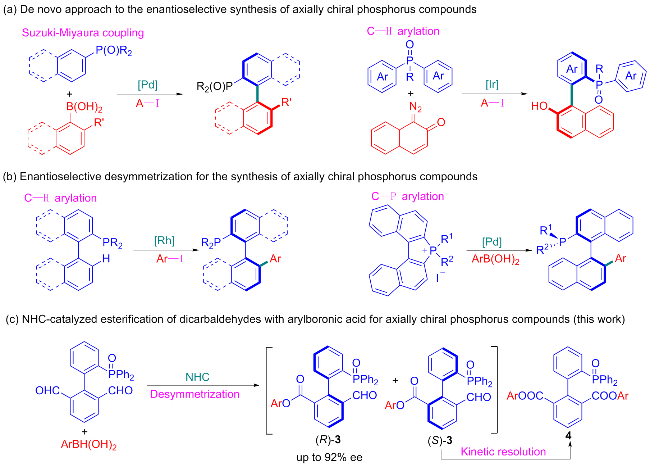
As efficient organocatalysts, N-heterocyclic carbenes (NHCs) have been widely used in the transformation of various carbonyl compounds.[8] In recent years, NHC catalysis has emerged as a powerful platform in asymmetric synthesis, proving particularly effective for the stereoselective synthesis of biaryl atropisomers,[9] C—N axially chiral compounds,[10] C—O axially chiral compounds[11] and olefinic axially chiral systems. Ye, Wang, and Zhangʼ groups[12] recently reported an NHC-catalyzed asymmetric desymmetrization of prochiral 2-aryloxyisophthalalde- hydes with aliphatic alcohols, enabling the synthesis of axially chiral diaryl ethers. Moreover, the desymmetrization of dicarbaldehydes represents a pivotal strategy for constructing diverse non-carbon-stereogenic compou- nds.[13] Herein, we report a catalytic method for the asymmetric NHC-catalyzed desymmetrization-esterification of dicarbaldehydes with arylboronic acids to access axially chiral phosphorus compounds (Scheme 1c). We propose that in the reaction the NHC-catalyzed desymmetrization of prochiral dicarbaldehydes with arylboronic acid gene-rates axially chiral phosphorus compounds 3.[14] Subsequently, the (S)-3 selectively undergoes further esterification to yield byproduct 4, while the (R)-3 is obtained with high enantioselectivity through the kinetic resolution process.
2 Results and discussion
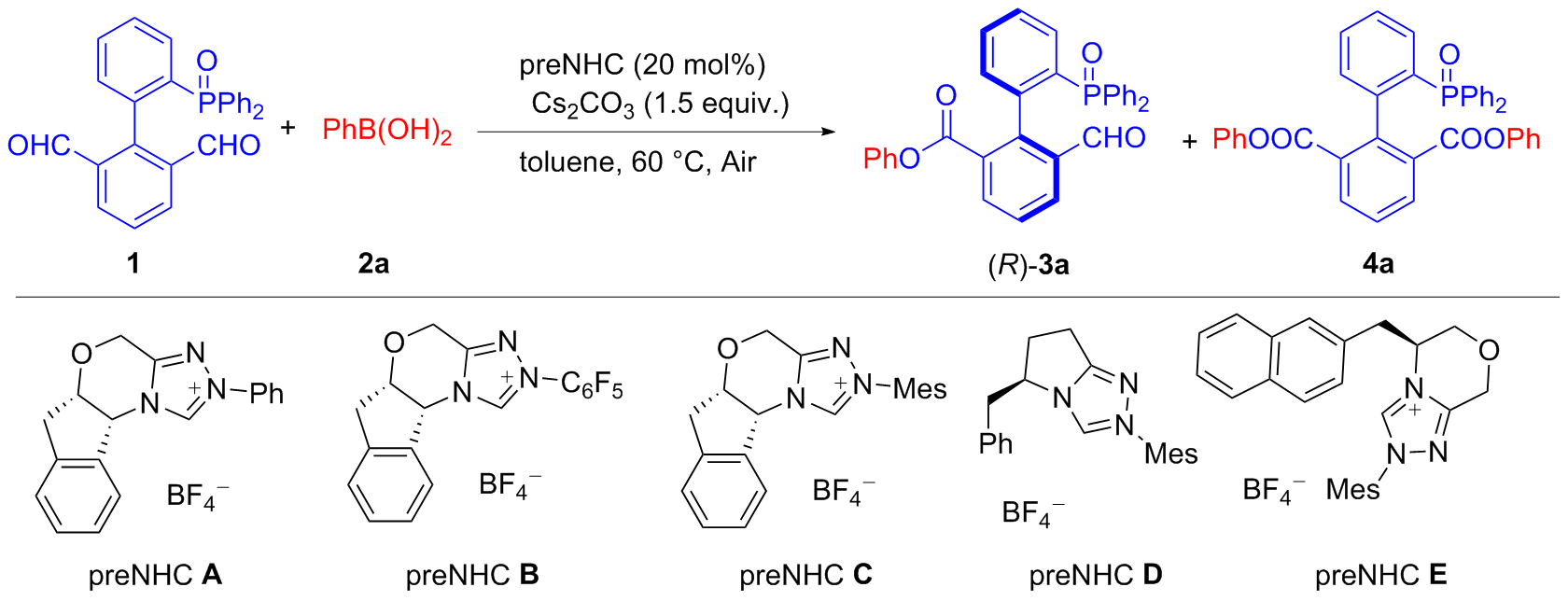
We initiated our studies on the construction of axially chiral phosphorus compounds using dicarbaldehydes 1 and phenylboronic acid 2a as model substrates to search for suitable conditions (Table 1). In the presence of 20 mol% preNHC A bearing an N-Ph group, using Cs2CO3 as a base in toluene at 60 °C under air for 9 h, the reaction afforded the corresponding product 3a in 9% yield with 86% ee (Table 1, Entry 1). NHC precatalyst B bearing NC6F5 groups was not efficient for the reactions (Table 1, Entry 2). To our delight, when NHC precatalyst C bearing NMes group was employed, the yield of product 3a was further improved to 15% yield with 92% ee, while byproduct 4a was obtained in 14% yield (Table 1, Entry 3). Different catalyst scaffolds were explored, however, when testing preNHCs D and E, no improved results were achieved (Table 1, Entry 4~5). Consequently, we proceeded with preNHC C for further condition optimization. When the reaction temperature was decreased to 45 °C, the yield of the desired product 3a improved to 26%, while the enan- tioselectivity remained excellent. Under these conditions, the byproduct 4a was obtained in 17% yield (Table 1, Entry 6). When the temperature was further reduced to 30 °C, the reaction proceeded more slowly, affording compound 3a in 21% yield with 57% ee after 17 h (Table 1, Entry 7). To further improve the yield, the loading of phenylboronic acid was next optimized (Table 1, Entries 8~9). When 1.5 equivalents were used, the desired product 3a was obtained in 26% yield with 95% ee, while the byproduct 4a was generated in 19% yield (Table 1, Entries 9). Screening of the solvents revealed that the reaction worked better in toluene than in tetrahydrofuran (THF) and dichloromethane (DCM) (Entries 10~11). When we attempted to improve the reaction yield by diluting the concentration of the reaction system, no better results were obtained (Entries 12~13).
Table 1 Optimization of reaction conditionsa |
| Entry | preNHC | n(1)∶n(2a) | T/°C | Solvent | Time/h | Yieldb/% of 3a | eec/% of 3a | Yieldb/% of 4a | |
|---|---|---|---|---|---|---|---|---|---|
| 1 | A | 1∶1 | 60 | Toluene | 9 | 6 | 86 | Trace | |
| 2 | B | 1∶1 | 60 | Toluene | 9 | N.D. | — | — | |
| 3 | C | 1∶1 | 60 | Toluene | 9 | 15 | 92 | 14 | |
| 4 | D | 1∶1 | 60 | Toluene | 9 | 13 | 67 | 5 | |
| 5 | E | 1∶1 | 60 | Toluene | 9 | 12 | 85 | 6 | |
| 6 | C | 1∶1 | 45 | Toluene | 9 | 24 | 91 | 17 | |
| 7 | C | 1∶1 | 30 | Toluene | 17 | 21 | 57 | 13 | |
| 8 | C | 1∶0.8 | 45 | Toluene | 7 | 41 | 43 | 27 | |
| 9 | C | 1∶1.5 | 45 | Toluene | 6 | 26 | 92 | 19 | |
| 10 | C | 1∶1.5 | 45 | THF | 6 | 21 | 46 | 27 | |
| 11 | C | 1∶1.5 | 45 | DCM | 6 | 14 | 61 | 23 | |
| 12d | C | 1∶1.5 | 45 | Toluene | 8 | 23 | 91 | 19 | |
| 13e | C | 1∶1.5 | 45 | Toluene | 10 | 21 | 87 | 20 |
a Reaction conditions: 1 (0.1 mmol), 2a (x mmol), preNHC (20 mol%), solvent (1.0 mL), air. b Isolated yields. c Determined by HPLC analysis. d Toluene (2.0 mL). e Toluene (3.0 mL). |
With the optimized reaction conditions in hand (Table 1, Entry 9), the scope of arylboronic acid 2 with different substitution patterns was examined (Table 2). The reactions of 4-methoxyphenylboronic acid (2b) proceeded well to give product 3b in excellent enantioselectivity, the byproduct 4b was obtained in 20% yield. The absolute (R)-configuration of product 3b (CCDC 2431534) was assigned via single-crystal X-ray analysis. The structure of 3b was confirmed through a single-crystal X-ray diffraction study (CCDC 2431534). The reactions of 4-methyl- phenylboronic acid (2c) also reacted efficiently and furnished corresponding products 3c in good enantioselectivity. Arylboronic acids containing electron-withdrawing groups (Ar=4-ClC6H4, 4-BrC6H4) at the 4-position of the phenyl ring were also tested for this reaction. Compared to the electron-donating substituted arylboronic acids, these substrates gave the desired products (3d and 3e) in slightly lower enantioselectivity. Substitution at the meta-position benzene ring of 2 resulted in the smooth conversion to the product (3f~3i) in reasonable yields. Compared with electron-deficient arylboronic acids (2h and 2i), electron-rich arylboronic acids (2f and 2g) still exhibited better enantioselectivity. ortho-Substituted arylboronic acids (Ar=2- MeC6H4, 2-ClC6H4, and 2-BrC6H4) were evaluated under the standard reaction conditions. The results showed that both the yield and enantioselectivity of the products (3j~3l) were significantly diminished, indicating that steric hindrance has a substantial impact on the esterification reaction. 2-Naphthaleneboronic acid (2m) furnished the corresponding product 3m in 26% yield with 51% ee. Unfortunately, cyclohexaneboronic acid did not work for the reaction under current conditions.
Table 2 Scope of arylboronic acida |

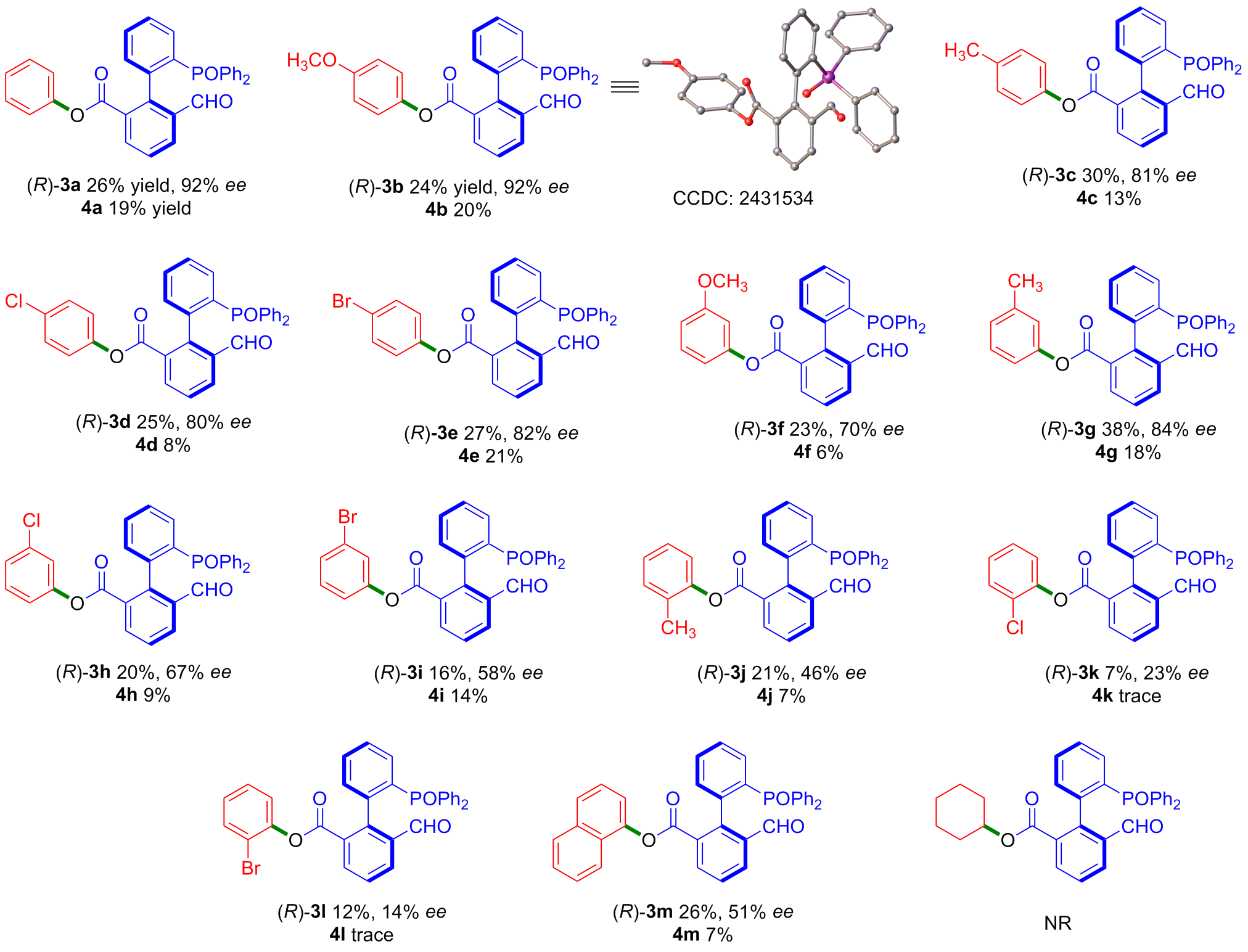 |
a Reaction conditions: 1 (0.1 mmol), 2 (0.15 mmol), preNHC (20 mol%), Cs2CO3 (0.15 mmol), toluene (1.0 mL), 45 ℃, air, isolated yields, ee determined by HPLC analysis. |
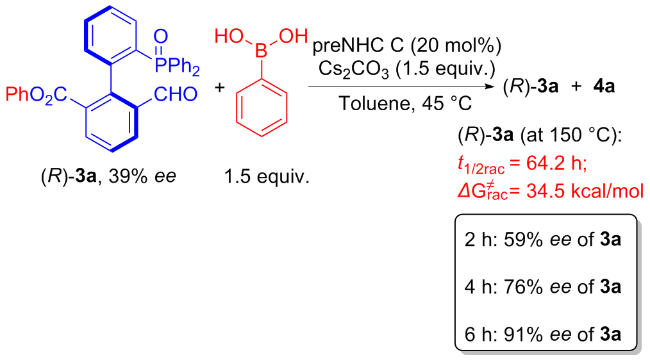
To gain a better understanding of the reaction mechanism, an experiment was conducted using 3a (with an initial ee of 39%) and phenylboronic acid (2a) under the current conditions (Scheme 2). It was observed that as the formation of byproduct 4a progressed, the ee value of 3a gradually increased. The ee of 3a could reach 91% after 6 h reaction. This indicates that the initial desymmetrization reaction has relatively poor enantioselectivity. The high ee value is actually a result of subsequent reactions occurring during the formation of the byproduct, which also helps to explain the low yield of this desymmetrization-esterifica- tion reaction. Product 3a exhibited excellent configurational stability with a racemization barrier of 34.5 kcal/mol and a racemization half-life of 64.2 h at 150 °C.
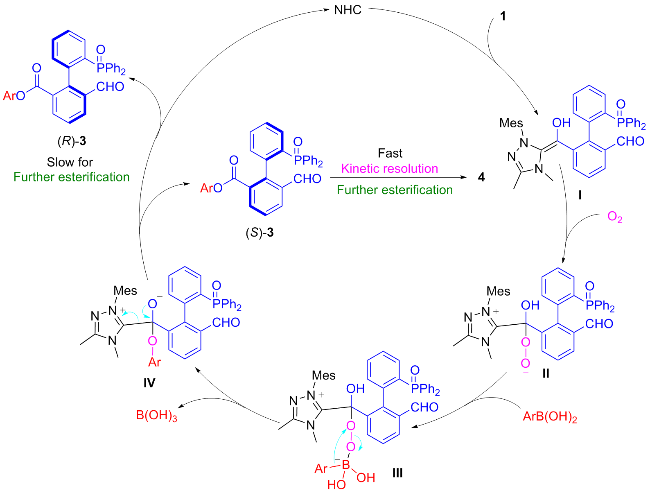
Based on our experimental results and previous literature, a plausible catalytic cycle is proposed in Scheme 3[14-15] Initially, the NHC catalyst undergoes nucleophilic addition to dicarbaldehyde 1, generating the Breslow intermediate I. Subsequently, molecular oxygen reacts with I to form the zwitterionic peroxide intermediate II. III is formed by the reaction of II with boronic acid, which un dergoes transfer of the phenyl group to the peroxy linkage, forming a borate anion and rapidly decomposing to IV. Finally, intermediate IV furnishes ester 3 and releases the NHC catalyst for the next catalytic cycle. Control experiments demonstrated that compound 3 could react with the carbene to form byproduct 4 in the presence of oxygen and arylboronic acid. During this kinetic resolution process, (S)-3 was preferentially converted to byproduct 4, thereby enhancing the ee of the target product 3.


3 Conclusions
In summary, we have developed an NHC-catalyzed de- symmetrization and subsequent kinetic resolution strategy for the synthesis of axially chiral phosphorus compounds. This approach involves the esterification of dialdehydes with arylboronic acids, efficiently constructing axially chiral phosphorus frameworks with high enantioselectivity (up to 92% ee) and moderate yields. Further studies on the synthesis of axially chiral phosphorus are currently underway in our laboratory.
4 Experimental section
1H NMR and 13C NMR spectrometers were recorded on Bruker-400 MHz instruments internally referenced to tetramethylsilane (δ 0.0) or residue of CDCl3 (δ 7.26) signal. Melting points were measured using a XT4A microscopic apparatus. Unless otherwise stated. Solvents and chemicals were bought from commercial sources and used directly unless otherwise stated. Column chromatography was performed on 300~400 mesh silica gel. The substrates 3a~ 3n were synthesized according to published procedures. Analytical thin-layer chromatography (TLC) was performed on pre-coated, glass-backed silica gel plates.
4.1 General procedure for the synthesis of products 3
1 (0.1 mmol, 1.0 equiv.) and 2 (0.15 mmol, 1.5 equiv.) were combined in an oven-dried Schlenk tube with a magnetic stir bar. Subsequently, 8.2 mg (20 mol%) of preNHC C in toluene (1 mL) was added dropwise to the reaction mixture, and the resulting solution was stirred at 45 °C. After the reaction was complete (monitored by TLC), the reaction mixture was cooled to room temperature and concentrated under vacuum. The residue was purified by flash column chromatography with dichloromethane/ethyl acetate to afford the desired product 3.
Phenyl (R)-2'-(diphenylphosphoryl)-6-formyl-[1'-bi- phenyl]-2-carboxylate (3a): White solid, 12.1 mg, 24% yield. V(dichloromethane)∶V(ethyl acetate)=5∶1, Rf=0.5; [α]3/26/143125 D0.021 (c 0.1 in CHCl3), 92% ee, determined by HPLC analysis [Daicel CHIRALPAK AD-H column, V(n- hexane)/V(i-PrOH)=70/30, 1.0 mL/min, λ=254 nm, t(mi- nor)=8.576 min, t(major)=11.470 min]. m.p. 173~ 174 °C; 1H NMR (400 MHz, CDCl3) δ: 9.36 (s, 1H), 8.34 (dd, J=7.8, 1.3 Hz, 1H), 7.97 (dd, J=7.8, 1.3 Hz, 1H), 7.58~7.43 (m, 9H), 7.36~7.26 (m, 8H), 7.19 (t, J=7.4 Hz, 1H), 7.05 (d, J=7.6 Hz, 2H); 31P NMR (162 MHz, CDCl3) δ: 26.58; 13C NMR (101 MHz, CDCl3) δ: 190.1, 164.1, 150.9, 144.2, 141.8, 135. 4, 135.4, 133.2, 133.1, 132.8, 132.7, 132.1, 132.0, 132.0, 131.9, 131.9, 131.7, 131.7, 131.7, 131.6, 131.4, 131.3, 131.2, 131.2, 130.6, 129.4, 128.7, 128.6, 128.6, 128.5, 128.4, 127.7, 127.6, 125.8, 121.8 (Due to C—P coupling and the complexity of the spectrum, doublets in the aromatic region cannot be assigned and they are listed as singlets). HRMS (ESI) calcd for C32H24O4P [M+H]+ 503.1412, found 503.1418.
4-Methoxyphenyl (R)-2'-(diphenylphosphoryl)-6-form- yl-[1'-biphenyl]-2-carboxylate (3b): White solid, 12.8 mg, 24% yield. V(petroleum ether)∶V(ethyl acetate)=1∶1, Rf=0.5; [α]3/26/143125 D20.079 (c 0.1 in CHCl3), 92% ee, determined by HPLC analysis [Daicel CHIRALPAK IF column, V(n-hexane)/V(i-PrOH)=50/50, 1.0 mL/min, λ=254 nm, t(minor)=20.132 min, t(major)=23.248 min]. m.p. 154~155 °C; 1H NMR (400 MHz, CDCl3) δ: 9.36 (s, 1H), 8.32 (d, J=7.7 Hz, 1H), 7.97 (d, J=7.7 Hz, 1H), 7.60~7.43 (m, 8H), 7.40~7.31 (m, 7H), 6.96 (d, J=9.0 Hz, 2H), 6.85 (d, J=9.0 Hz, 2H), 3.79 (s, 3H); 31P NMR (162 MHz, CDCl3) δ: 26.68; 13C NMR (101 MHz, CDCl3) δ: 190.1, 164.5, 157.3, 144.4, 144.1, 144.1, 141.8, 141.8, 135.4, 135.4, 133.2, 133.1, 132.8, 132.7, 132.2, 132.1, 132.0, 132.0, 131.9, 131.9, 131.8, 131.7, 131.7, 131.7, 131.6, 131.4, 131.3, 130.6, 128.7, 128.6, 128.5, 128.5, 128.4, 127.7, 127.6, 122.5, 114.5, 55.8 (Due to C—P coupling and the complexity of the spectrum, doublets in the aromatic region cannot be assigned and they are listed as singlets). HRMS (ESI) calcd for C33H26O5P 533.1518, found 533.1519.
p-Tolyl (R)-2'-(diphenylphosphoryl)-6-formyl-[1'-bi- phenyl]-2-carboxylate (3c): White solid, 15.5 mg, 30% yield. V(dichloromethane)∶V(ethyl acetate)=5∶1, Rf=0.6; [α]3/26/143125 D69.190 (c 0.1 in CHCl3), 81% ee, determined by HPLC analysis [Daicel CHIRALPAK IF column, V(n-he- xane)/V(i-PrOH)=65/35, 1.0 mL/min, λ=254 nm, t(minor)=22.723 min, t(major)=26.559 min]. m.p. 157~158 °C; 1H NMR (400 MHz, CDCl3) δ: 9.37 (s, 1H), 8.32 (d, J=7.1 Hz, 1H), 7.98 (d, J=7.6 Hz, 1H), 7.59~7.5 (m, 8H), 7.39~7.31 (m, 7H), 7.13 (d, J=8.2 Hz, 2H), 6.92 (d, J=8.3 Hz, 2H), 2.33 (s, 3H); 31P NMR (162 MHz, CDCl3) δ: 26.55; 13C NMR (101 MHz, CDCl3) δ: 190.0, 164.2, 148.5, 144.0, 144.0, 141.7, 141.6, 135.3, 135.3, 133.1, 132.9, 132.7, 132.6, 132.1, 131.9, 131.9, 131.8, 131.8, 131.6, 131.6, 131.5, 131.2, 131.2, 131.1, 131.0, 130.5, 129.8, 129.7, 128.6, 128.4, 128.4, 128.3, 128.2, 128.1, 127.9, 127.6, 127.5, 127.4, 121.5, 121.3, 20.9 (Due to C—P coupling and the complexity of the spectrum, doublets in the aromatic region cannot be assigned and they are listed as singlets). HRMS (ESI) calcd for C33H26O4P [M+H]+ 517.1569, found 517.1588.
4-Chlorophenyl (R)-2'-(diphenylphosphoryl)-6-formyl- [1'-biphenyl]-2-carboxylate (3d): White solid, 13.4 mg, 25% yield. V(dichloromethane)∶V(ethyl acetate)=5∶1, Rf=0.6; [α]3/26/143125 D50.177 (c 0.1 in CHCl3), 80% ee, determined by HPLC analysis [Daicel CHIRALPAK IF column, V(n-hexane)/V(i-PrOH)=65/35, 1.0 mL/min, λ=254 nm, t(minor)=23.845 min, t(major)=27.381 min]. m.p. 147~148 °C; 1H NMR (400 MHz, CDCl3) δ: 9.31 (s, 1H), 8.36 (dd, J=7.8, 1.3 Hz, 1H), 7.92 (dd, J=7.8, 1.3 Hz, 1H), 7.62~7.55 (m, 4H), 7.53~7.36 (m, 7H), 7.34~7.28 (m, 6H), 7.04 (d, J=8.8 Hz, 2H); 31P NMR (162 MHz, CDCl3) δ: 26.68; 13C NMR (101 MHz, CDCl3) δ: 190.0, 164.0, 149.5, 144.1, 144.1, 141.7, 141.6, 135.3, 135.2, 133.2, 133.1, 132.6, 132.2, 132.1, 132.1, 132.0, 132.0, 131.9, 131.9, 131.9, 131.5, 131.4, 131.4, 131.3, 131.2, 131.2, 131.2, 130.7, 129.4, 128.7, 128.6, 128.6, 128.4, 127.8, 127.6, 123.3 (Due to C—P coupling and the complexity of the spectrum, doublets in the aromatic region cannot be assigned and they are listed as singlets). HRMS (ESI) calcd for C32H23ClO4P [M+H]+ 537.1022, found 537.1032.
4-Bromophenyl (R)-2'-(diphenylphosphoryl)-6-formyl- [1'-biphenyl]-2-carboxylate (3e): White solid, 15.7 mg, 27% yield. V(dichloromethane)∶V(ethyl acetate)=5∶1, Rf=0.6; [α]3/26/143125 D21.919 (c 0.1 in CHCl3), 82% ee, determined by HPLC analysis [Daicel CHIRALPAK IF column, V(n-hexane)/V(i-PrOH)=70/30, 1.0 mL/min, λ=254 nm, t(minor)=29.567 min, t(major)=34.061 min]. m.p. 175~176 °C; 1H NMR (400 MHz, CDCl3) δ: 9.30 (s, 1H), 8.36 (d, J=7.7 Hz, 1H), 7.91 (d, J=7.5 Hz, 1H), 7.62~7.50 (m, 5H), 7.46~7.37 (m, 8H), 7.34~7.28(m, 4H), 7.00 (d, J=8.1 Hz, 2H); 31P NMR (162 MHz, CDCl3) δ: 26.69; 13C NMR (101 MHz, CDCl3) δ: 190.0, 163.8, 149.9, 144.0, 141.5, 135.2, 135.1, 133.1, 133.0, 132.4, 132.3, 131.9, 131.8, 131.4, 131.3, 131.1, 130.6, 128.6, 128.5, 128.3, 127.7, 127.5, 123.6, 118.8 (Due to C—P coupling and the complexity of the spectrum, doublets in the aromatic region cannot be assigned and they are listed as singlets). HRMS (ESI) calcd for C32H23BrO4P [M+H]+ 581.0517, found 581.0496.
3-Methoxyphenyl (R)-2'-(diphenylphosphoryl)-6-form- yl-[1'-biphenyl]-2-carboxylate (3f): White solid, 12.3 mg, 23% yield. V(petroleum ether)∶V(ethyl acetate)=1∶1, Rf=0.5; [α]3/26/143125 D8.333 (c 0.1 in CHCl3), 70% ee, determined by HPLC analysis [Daicel CHIRALPAK IF column, V(n-hexane)/V(i-PrOH)=70/30, 1.0 mL/min, λ=254 nm, t(minor)=38.738 min, t(major)=46.404 min]. m.p. 170~171 °C; 1H NMR (400 MHz, CDCl3) δ: 9.34 (s, 1H), 8.33 (d, J=7.7 Hz, 1H), 7.97 (d, J=7.8 Hz, 1H), 7.60~7.54 (m, 4H), 7.53~7.43 (m, 5H), 7.39~7.30 (m, 7H), 7.22 (t, J=8.2 Hz, 1H), 6.77~6.73 (m, 1H), 6.66~6.63 (m, 2H), 3.76 (s, 3H); 31P NMR (162 MHz, CDCl3) δ: 26.71; 13C NMR (101 MHz, CDCl3) δ: 190.0, 164.1, 160.5, 151.9, 144.1, 141.8, 141.7, 135.4, 135.3, 133.2, 133.1, 132.8, 132.6, 132.2, 132.1, 132.0, 131.9, 131.8, 131.8, 131.7, 131.6, 131.3, 131.2, 130.6, 129.7, 128.7, 128.6, 128.6, 128.5, 128.4, 127.7, 127.6, 114.0, 111.9, 107.8, 55.5 (Due to C—P coupling and the complexity of the spectrum, doublets in the aromatic region cannot be assigned and they are listed as singlets). HRMS (ESI) calcd for C33H26- O5P [M+H]+ 533.1518, found 533.1533.
m-Tolyl (R)-2'-(diphenylphosphoryl)-6-formyl-[1'-bi- phenyl]-2-carboxylate (3g): White solid, 19.6 mg, 38% yield. V(dichloromethane)∶V(ethyl acetate)=5∶1, Rf=0.6; [α]3/26/143125 D78.566 (c 0.1 in CHCl3), 82% ee, determined by HPLC analysis [Daicel CHIRALPAK IF column, V(n- hexane)/V(i-PrOH)=70/30, 1.0 mL/min, λ=254 nm, t(minor)=32.563 min, t(major)=37.638 min]. m.p. 169~170 °C; 1H NMR (400 MHz, CDCl3) δ: 9.35 (s, 1H), 8.33 (dd, J=7.8, 1.1 Hz, 1H), 7.97 (dd, J=7.8, 1.1 Hz, 1H), 7.61~7.43 (m, 11H), 7.39~7.30 (m, 7H), 7.21(t, J=8.6, 2H), 7.00 (d, J=7.6 Hz, 1H), 6.90 (s, 1H), 6.83 (d, J=8.6 Hz, 1H); 31P NMR (162 MHz, CDCl3) δ: 26.67; 13C NMR (101 MHz, CDCl3) δ: 190.0, 164.1, 150.8, 144.1, 144.1, 141.7, 141.6, 139.4, 139.2, 135.3, 135.2, 133.8, 133.1, 132.9, 132.7, 132.5, 132.0, 131.9, 131.9, 131.8, 131.8, 131.7, 131.6, 131.5, 131.2, 131.0, 130.5, 129.0, 128.9, 128.6, 128.4, 128.4, 128.3, 128.2, 128.1, 127.9, 127.6, 127.6, 127.4, 126.5, 126.2, 122.5, 122.3, 118.7, 118.6 (Due to C—P coupling and the complexity of the spectrum, doublets in the aromatic region cannot be assigned and they are listed as singlets). HRMS (ESI) calcd for C33H26- O4P [M+H]+ 517.1569, found 517.1561.
3-Chlorophenyl (R)-2'-(diphenylphosphoryl)-6-formyl- [1'-biphenyl]-2-carboxylate (3h): White solid, 10.7 mg, 20% yield. V(dichloromethane)∶V(ethyl acetate)=5∶1, Rf=0.7; [α]3/26/143125 D91.321 (c 0.1 in CHCl3), 67% ee, determined by HPLC analysis [Daicel CHIRALPAK IF column, V(n-hexane)/V(i-PrOH)=70/30, 1.0 mL/min, λ=254 nm, t(minor)=22.168 min, t(major)=26.751 min]. m.p. 189~190 °C; 1H NMR (400 MHz, CDCl3) δ: 9.33 (s, 1H), 8.39 (dd, J=7.8, 1.3 Hz, 1H), 7.95 (dd, J=7.8, 1.3 Hz, 1H), 7.67~7.58 (m, 4H), 7.51~7.39 (m, 7H), 7.37~7.31 (m, 5H), 7.22~7.20 (m, 2H), 7.04~7.02 (m, 1H); 31P NMR (162 MHz, CDCl3) δ: 26.88; 13C NMR (101 MHz, CDCl3) δ: 190.0, 163.9, 151.5, 144.2, 141.7, 135.3, 135.2, 134.6, 133.2, 133.1, 132.6, 132.5, 132.4, 132.2, 132.2, 132.1, 132.1, 132.0, 132.0, 132.0, 132.0, 131.5, 131.4, 131.4, 131.2, 130.8, 130.1, 128.7, 128.6, 128.5, 127.8, 127.7, 126.1, 122.7, 120.2 (Due to C—P coupling and the complexity of the spectrum, doublets in the aromatic region cannot be assigned and they are listed as singlets). HRMS (ESI) calcd for C32H23ClO4P [M+H]+ 537.1022, found 537.1025.
3-Bromophenyl (R)-2'-(diphenylphosphoryl)-6-formyl- [1'-biphenyl]-2-carboxylate (3i): White solid, 9.3 mg, 16% yield. V(dichloromethane)∶V(ethyl acetate)=5∶1, Rf=0.6; [α]3/26/143125 D28.705 (c 0.1 in CHCl3), 58% ee, determined by HPLC analysis [Daicel CHIRALPAK IF column, V(n-hexane)/V(i-PrOH)=65/35, 1.0 mL/min, λ=254 nm, t(minor)=22.537 min, t(major)=27.553 min]. m.p. 183~184 °C; 1H NMR (400 MHz, CDCl3) δ: 9.31 (s, 1H), 8.36 (dd, J=7.8, 1.1 Hz, 1H), 7.92 (dd, J=7.8, 1.1 Hz, 1H), 7.65~7.47 (m, 7H), 7.45~7.36 (m, 7H), 7.34~7.30 (m, 3H), 7.20 (t, J=8.0 Hz, 1H), 7.04 (dd, J=8.1, 1.1 Hz, 1H); 31P NMR (162 MHz, CDCl3) δ: 26.87; 13C NMR (101 MHz, CDCl3) δ: 190.0, 163.7, 151.4, 144.0, 141.5, 141.4, 135.1, 135.1, 133.1, 133.0, 132.5, 132.4, 132.0, 132.0, 131.9, 131.9, 131.8, 131.8, 131.4, 131.4, 131.3, 131.3, 131.2, 131.1, 130.6, 130.3, 128.9, 128.6, 128.5, 128.5, 128.4, 127.7, 127.6, 125.5, 122.2, 120.6 (Due to C—P coupling and the complexity of the spectrum, doublets in the aromatic region cannot be assigned and they are listed as singlets). HRMS (ESI) calcd for C32H23BrO4P [M+H]+ 581.0517, found 581.0518.
o-Tolyl (R)-2'-(diphenylphosphoryl)-6-formyl-[1'-bi- phenyl]-2-carboxylate (3j): White solid, 9.3 mg, 21% yield. V(dichloromethane)∶V(ethyl acetate)=5∶1, Rf=0.6; [α]3/26/143125 D42.377 (c 0.1 in CHCl3), 46% ee, determined by HPLC analysis [Daicel CHIRALPAK IF column, V(n- hexane)/V(i-PrOH)=50/50, 1.0 mL/min, λ=254 nm, t(minor)=18.737 min, t(major)=26.310 min]. m.p. 160~161 °C; 1H NMR (400 MHz, CDCl3) δ: 9.32 (s, 1H), 8.39 (dd, J=7.8, 1.4 Hz, 1H), 7.98 (dd, J=7.8, 1.4 Hz, 1H), 7.61~7.44 (m, 8H), 7.39~7.27 (m, 7H), 7.18 (t, J=7.0 Hz, 2H), 7.13~7.05 (m, 2H), 2.14 (s, 3H); 31P NMR (162 MHz, CDCl3) δ: 34.52~12.94; 13C NMR (101 MHz, CDCl3) δ: 190.0, 163.7, 149.4, 144.3, 144.3, 141.6, 141.5, 135.1, 133.1, 133.0, 132.7, 132.5, 132.1, 131.9, 131.8, 131.8, 131.8, 131.7, 131.6, 131.6, 131.5, 131.2, 131.2, 131.1, 131.1, 130.9, 130.4, 130.2, 128.6, 128.4, 128.3, 128.2, 127.6, 127.4, 126.8, 125.9, 122.2, 16.3 (Due to C—P coupling and the complexity of the spectrum, doublets in the aromatic region cannot be assigned and they are listed as singlets). HRMS (ESI) calcd for C33H26O4P [M+H]+ 517.1569, found 517.1572.
2-Chlorophenyl (R)-2'-(diphenylphosphoryl)-6-formyl- [1'-biphenyl]-2-carboxylate (3k): White solid, 3.8 mg, 7% yield. V(dichloromethane)∶V(ethyl acetate)=5∶1, Rf=0.7; [α]3/26/143125 D14.659 (c 0.1 in CHCl3), 23% ee, determined by HPLC analysis [Daicel CHIRALPAK IF column, V(n-hexane)/V(i-PrOH)=60/40, 1.0 mL/min, λ=254 nm, t(minor)=19.022 min, t(major)=22.593 min]. m.p. 186~187 °C; 1H NMR (400 MHz, CDCl3) δ: 9.34 (s, 1H), 8.44 (d, J=7.6 Hz, 1H), 7.95 (d, J=7.5 Hz, 1H), 7.64~7.47 (m, 8H), 7.42~7.33 (m, 9H), 7.18~7.14 (m, 1H); 31P NMR (162 MHz, CDCl3) δ: 26.59; 13C NMR (101 MHz, CDCl3) δ: 190.0, 163.0, 147.1, 144.3, 141.2, 135.3, 135.1, 133.1, 133.0, 132.5, 132.1, 132.0, 131.9, 131.8, 131.8, 131.8, 131.7, 131.7, 131.5, 131.5, 131.4, 131.3, 131.3, 131.0, 130.7, 130.6, 130.0, 128.6, 128.5, 128.5, 128.4, 128.3, 127.7, 127.7, 127.6, 126.8, 126.8, 124.4 (Due to C—P coupling and the complexity of the spectrum, doublets in the aromatic region cannot be assigned and they are listed as singlets). HRMS (ESI) calcd for C32H23ClO4P [M+H]+ 537.1022, found 537.1020.
2-Bromophenyl (R)-2'-(diphenylphosphoryl)-6-formyl- [1'-biphenyl]-2-carboxylate (3l): White solid, 3.8 mg, 12% yield. V(dichloromethane)∶V(ethyl acetate)=5∶1, Rf=0.6; [α]3/26/143125 D65.940 (c 0.1 in CHCl3), 14% ee, determined by HPLC analysis [Daicel CHIRALPAK IF column, V(n-hexane)/V(i-PrOH)=60/40, 1.0 mL/min, λ=254 nm, t(minor)=22.413 min, t(major)=28.353 min]. m.p. 190~191 °C; 1H NMR (400 MHz, CDCl3) δ: 9.33 (s, 1H), 8.47 (d, J=7.5 Hz, 1H), 7.94 (d, J=7.5 Hz, 1H), 7.66~7.54 (m, 6H), 7.52~7.42 (m, 5H), 7.39~7.30 (m, 5H), 7.09 (m, 1H); 31P NMR (162 MHz, CDCl3) δ: 26.61; 13C NMR (101 MHz, CDCl3) δ: 190.0, 163.0, 148.3, 144.3, 141.2, 135.31, 135.1, 133.1, 133.0, 133.0, 132.6, 132.6, 132.5, 132.2, 132.1, 132.0, 132.0, 131.9, 131.8, 131.4, 131.3, 130.9, 130.6, 128.6, 128.5, 128.5, 128.4, 128.4, 128.3, 127.7, 127.6, 127.2, 124.5, 116.0 (Due to C—P coupling and the complexity of the spectrum, doublets in the aromatic region cannot be assigned and they are listed as singlets). HRMS (ESI) calcd for C32H23BrO4P [M+H]+ 581.0517, found 581.0527.
Naphthalen-1-yl (R)-2'-(diphenylphosphoryl)-6-formyl- [1'-biphenyl]-2-carboxylate (3m): White solid, 14.4 mg, 26% yield. V(dichloromethane)∶V(ethyl acetate)=5∶1, Rf=0.7; [α]3/26/143125 D8.720 (c 0.1 in CHCl3), 51% ee, determined by HPLC analysis [Daicel CHIRALPAK IF column, V(n-hexane)/V(i-PrOH)=50/50, 1.0 mL/min, λ=254 nm, t(minor)=20.675 min, t(major)=28.058 min]. m.p. 173~174 °C; 1H NMR (400 MHz, CDCl3) δ: 9.28 (s, 1H), 8.58 (d, J=7.4 Hz, 1H), 8.09~8.00 (m, 2H), 7.82~7.70 (m, 4H), 7.62~7.55 (m, 8H), 7.52~7.22 (m, 9H); 31P NMR (162 MHz, CDCl3) δ: 27.09; 13C NMR (101 MHz, CDCl3) δ: 190.0, 164.1, 147.0, 144.6,144.5, 141.6, 141.5, 138.1, 135.3, 135.1, 134.6, 134.0, 133.6, 133.1, 132.9, 132.8, 132.4, 132.0, 131.9, 131.9, 131.9, 131.8, 131.8, 131.7, 131.6, 131.6, 131.5, 131.4, 131.3, 131.2, 131.2, 131.0, 130.6, 128.6, 128.5, 128.3, 128.2, 128.2, 128.1, 128.0, 127.8, 127.7, 127.6, 127.5, 127.3, 127.12 126.4, 126.3, 126.2, 125.9, 125.6, 125.4, 122.2, 122.0, 118.4, 118.3 (Due to C—P coupling and the complexity of the spectrum, doublets in the aromatic region cannot be assigned and they are listed as singlets). HRMS (ESI) calcd for C36H26O4P [M+H]+ 553.1569, found 553.1563.
Supporting Information X-ray structure of compound 3b; 1H NMR and 13C NMR spectra of products 3~4. The Supporting Information is available free of charge via the Internet at http://sioc-journal.cn/.
(Li, L.)