



1 Introduction
Pyrazole and their derivatives play crucial roles in the pharmaceutical industry and agrochemicals because of the diversity of biological and pharmaceutical activities,[1] such as antiinflammatory, anticancer, antiarrhythmia, antispasticity, antidiabetes and antibacterial.[2] Many molecules containing pyrazole rings have become commercially available drugs, such as celecoxib,[3] mavacoxib[4] and razaxaban (Figure 1).[5] In the field of pesticides, pyrazole pesticides are widely used and demonstrate insecticidal, acaricidal, fungicidal and herbicidal activities.[6] Pyrazole pesticides have become a popular category in the pesticide industry due to their high efficiency, low toxicity and broad spectrum of biological activities, such as fipronil and pyraclostrobin (Figure 1).[7]
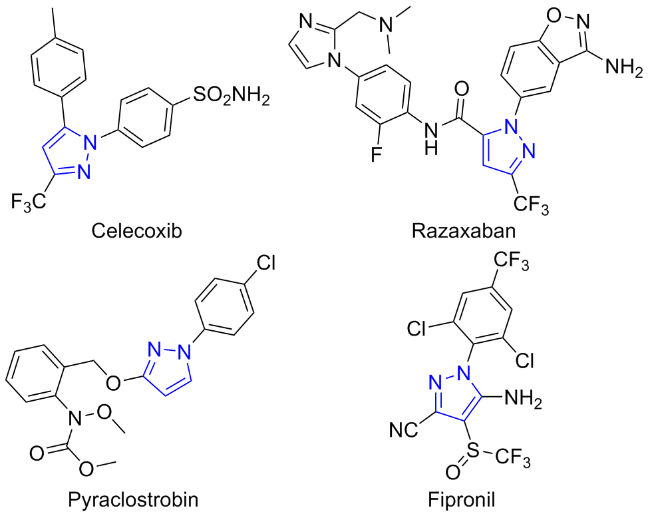
Selenium (Se) is one of the essential trace elements for the human body and holds significant importance for human health.[8] Organic selenium compounds are commonly found in natural products and pharmaceuticals due to their high biological activity and broad pharmacological properties, such as anticancer, antibacterial and antioxidant.[9] Among organic selenium compounds, those containing nitrogen heterocycles especially pyrazoles in their structure have shown a range of pharmacology properties.[10-11]
In view of the importance of pyrazoles and organic selenium compounds, the development of green and efficient method for the preparation of pyrazole derivatives containing selenium has attracted significant attention. In 2015, Alves group[10] obtained 4-selenylbenzoylpyrazoles from phenylhydrazine, 1,3-diketones and diselenides with CuBr as catalysis in dimethyl sulfoxide (DMSO) at 100 ℃ (Scheme 1, a). In 2018, Yan and coworkers[11] described an iodine-mediated synthesis of 4-selenylbenzoylpyrazoles from pyrazoles and diselenides (Scheme 1, b. Although the synthetic routes for 4-selenylpyrazoles have been well developed, most of these methods require catalysts or chemical oxidants, which raise safety and environmental concerns.
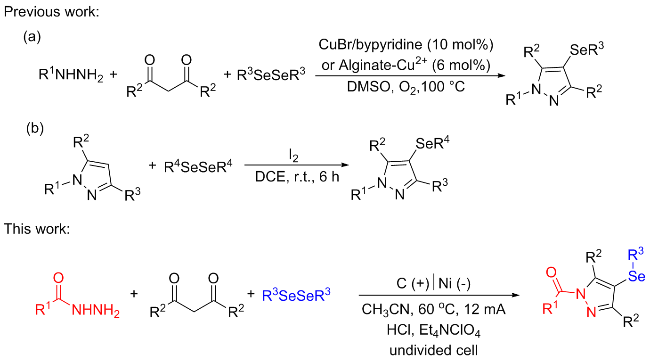
Organic electrochemical synthesis is a “green synthetic tool” which utilizes electrons as a clean reagent to replace traditional oxidants and reductants. Reactants gain or lose electrons at the electrode/solution interface, undergoing redox reactions, which eliminates the need for exogenous transition metals, chemical oxidants or reductants.[12] It can reduce material consumption and decreases environmental pollution from the source of chemical conversion. To our knowledge, the electrochemical multi-component reaction for the synthesis of 4-selenylbenzoylpyrazoles through radical pathway has not been reported before. Herein, we described an electrochemical multicomponent one-pot cascade synthesis of 4-selenylacylpyrazoles.
2 Results and discussion
To verify the feasibility of the strategy, the electroche- mical multicomponent reaction of benzohydrazide (1a), pentane-2,4-dione (2a) and 1,2-diphenyldiselane (3a) was used as the model reaction to optimize the reaction conditions (Table 1). To our delight, when we conducted the electrochemical reaction in an undivided cell equipped with carbon (C) rod anode and a nickel (Ni) flake cathode under 12 mA constant current electrolysis with Et4NClO4 using HCl as catalyst at 60 ℃ in acetonitrile, the desired product (3,5-dimethyl-4-(phenylselanyl)-1H-pyrazol-1-yl)(phenyl)methanone (4aaa) was obtained in 62% yield (Table 1, Entry 1). It was found that HCl was more suitable for this reaction after screening of catalysts (Table 1, Entries 1, 2). To investigate the effect of temperature on the reaction yield, various reaction temperatures (60, 80, 25 ℃) were screened, and the results showed that 80 ℃ was favorable for the formation of 4aaa (Table 1, Entries 1, 3, 4). In term of current, the reaction was carried out under 8 and 16 mA and the results showed that the yield of 4aaa decreased (Table 1, Entries 6, 7). In addition, the desired product was not detected in the absence of electric current (Table 1, Entry 5). Subsequently, different electrolytes were then screened and the highest yield was obtained when Et4NClO4 was used as the supporting electrolyte (Table 1, Entries 3, 8~15). Furthermore, other electrode materials such as Pt cathode, Ag cathode, C cathode or Zn cathode were found
Table 1 Optimization of the reaction conditionsa |

| Entry | Solvent | Catalyst (Dosage/equiv.) | Temp./℃ | Electrolyte | Electrode | Yieldb/% |
|---|---|---|---|---|---|---|
| 1 | CH3CN | HCl (1.0) | 60 | Et4NClO4 | C(+)/Ni() | 62 |
| 2 | CH3CN | Citric acid (1.0) | 60 | Et4NClO4 | C(+)/Ni() | 43 |
| 3 | CH3CN | HCl (1.0) | 80 | Et4NClO4 | C(+)/Ni() | 80 |
| 4 | CH3CN | HCl (1.0) | 25 | Et4NClO4 | C(+)/Ni() | 21 |
| 5c | CH3CN | HCl (1.0) | 80 | Et4NClO4 | C(+)/Ni() | No |
| 6d | CH3CN | HCl (1.0) | 80 | Et4NClO4 | C(+)/Ni() | 29 |
| 7e | CH3CN | HCl (1.0) | 80 | Et4NClO4 | C(+)/Ni() | 61 |
| 8 | CH3CN | HCl (1.0) | 80 | n-Bu4NBr | C(+)/Ni() | 63 |
| 9 | CH3CN | HCl (1.0) | 80 | NH4I | C(+)/Ni() | 50 |
| 10 | CH3CN | HCl (1.0) | 80 | No | C(+)/Ni() | 48 |
| 11 | CH3CN | HCl (1.0) | 80 | n-Bu4NI | C(+)/Ni() | Trace |
| 12 | CH3CN | HCl (1.0) | 80 | LiBF4 | C(+)/Ni() | 63 |
| 13 | CH3CN | HCl (1.0) | 80 | NaClO4 | C(+)/Ni() | 57 |
| 14 | CH3CN | HCl (1.0) | 80 | n-Bu4NF | C(+)/Ni() | 16 |
| 15 | CH3CN | HCl (1.0) | 80 | NaBF4 | C(+)/Ni() | No |
| 16 | CH3CN | HCl (1.0) | 80 | Et4NClO4 | C(+)/Pt() | 58 |
| 17 | CH3CN | HCl (1.0) | 80 | Et4NClO4 | C(+)/Ag() | 44 |
| 18 | CH3CN | HCl (1.0) | 80 | Et4NClO4 | C(+)/C() | 17 |
| 19 | CH3CN | HCl (1.0) | 80 | Et4NClO4 | C(+)/Zn() | 32 |
| 20 | DCE | HCl (1.0) | 80 | Et4NClO4 | C(+)/Ni() | 22 |
| 21 | DMSO | HCl (1.0) | 80 | Et4NClO4 | C(+)/Ni() | No |
| 22 | DMF | HCl (1.0) | 80 | Et4NClO4 | C(+)/Ni() | No |
| 23 | CH3NO2 | HCl (1.0) | 80 | Et4NClO4 | C(+)/Ni() | 42 |
| 24 | CH3CN | HCl (0.5) | 80 | Et4NClO4 | C(+)/Ni() | 66 |
| 25 | CH3CN | HCl (1.5) | 80 | Et4NClO4 | C(+)/Ni() | 59 |
a Reaction conditions: C (Φ 6 mm×60 mm) as the anode, Ni (10 mm×10 mm×0.1 mm) as the cathode, constant current=12 mA, 1a (0.2 mmol), 2a (0.3 mmol), 3a (0.3 mmol), HCl (0.2 mmol), Et4NClO4 (0.2 mmol), CH3CN (12 mL), 80 ℃, in air, 13 h, undivided cell. b Isolated yields. c Constant current=0 mA. d Constant current=8 mA. e Constant current=16 mA. |
to be less efficient than Ni cathode (Table 1, Entries 3, 16~19). Then, the exploration of the reaction medium showed that acetonitrile was more favorable for this transformation (Table 1, Entries 3, 20~23). Both decreasing or increasing the amount of HCl led to a decrease in the reaction yield (Table 1, Entries 3, 24, 25). Finally, the optimal conditions are as follows: benzohydrazide (0.2 mmol), pentane-2,4- dione (0.3 mmol) and 1,2-diphenyldiselane (0.3 mmol) using a carbon (C) anode and a nickel (Ni) cathode with Et4NClO4 under HCl catalyst at 12 mA constant current electrolysis in acetonitrile solvent at 80 ℃.
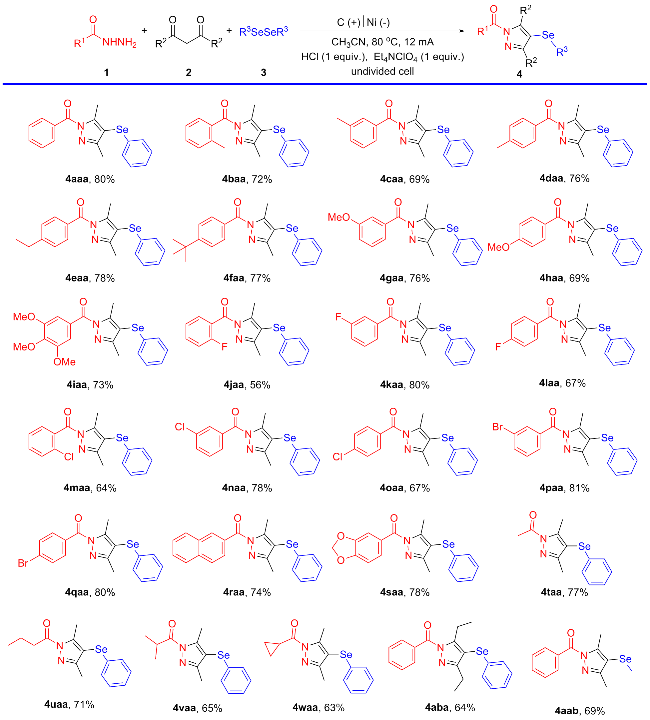
The suitability of the substrate for this electrochemical three-component reaction was evaluated after determining the optimal reaction conditions (Scheme 2). Firstly, under standard conditions, reactions were conducted on phenylhydrazines with different substituents on the benzene ring. The results indicated that substrates with electron-donating or electron-withdrawing substituents reacted smoothly, and the desired products were obtained in good to excellent yields (4aaa~4qaa). In addition, the desired products 4iaa was received in moderate yields under the optimal conditions, which indicated that steric factors did not significantly affect the reaction yields (4iaa). Moreover, 2-naph- thohydrazide (1r) and 1,3-dihydroisobenzofuran-5-carbo- hydrazide (1s) could also tolerate the reaction conditions well, giving isolated yields of 74% and 78% for the corresponding products, respectively (4raa~4saa). Our attention was then turned to investigate the substrate range of the aliphatic hydrazides under optimal reaction conditions. Aliphatic hydrazides, such as isobutyrohydrazide (1t), propionohydrazide (1u), cyclopropanecarbohydrazide (1v) and butyrohydrazide (1w) underwent the standard reaction efficiently, giving the corresponding products in good yields (4taa~4waa). Satisfactorily, the ideal products 4aba and 4aab were obtained with yields of 64% and 69% under standard conditions (4aba~4aab).
In order to evaluate the scalability of this developed protocol, gram-scale electrochemical multi-component rea- ction was performed. The reaction of benzohydrazide (5 mmol), pentane-2,4-dione (7.5 mmol) and 1,2-diphenyl- diselane (7.5 mmol) was carried out under the standard conditions. The desired product 4aaa could be given in 76% yield without significant loss, demonstrating the scalability and versatility of our strategy (Scheme 3).

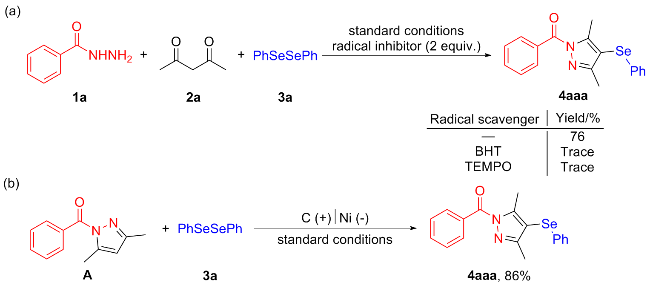
To gain preliminary insight into this electrochemical reaction mechanism, several control experiments were conducted (Scheme 4). When the radical scavenger such as 2,2,6,6-tetramethylpiperidinooxy (TEMPO) or butylated hydroxytoluene (BHT) was added into the template reaction, the production of 4aaa was totally inhibited (Scheme 4, a). The above experimental results indicate that the reaction may be carried out through the radical pathway. More- over, when the proposed intermediate (3,5-dimethyl-1H- pyrazol-1-yl)(phenyl)methanone (A) was reacted with 1,2- diphenyldiselane under standard conditions, the product 4aaa was received in 86% yield, which indicated that A was the key intermediate of this three-component reaction (Scheme 4, b.
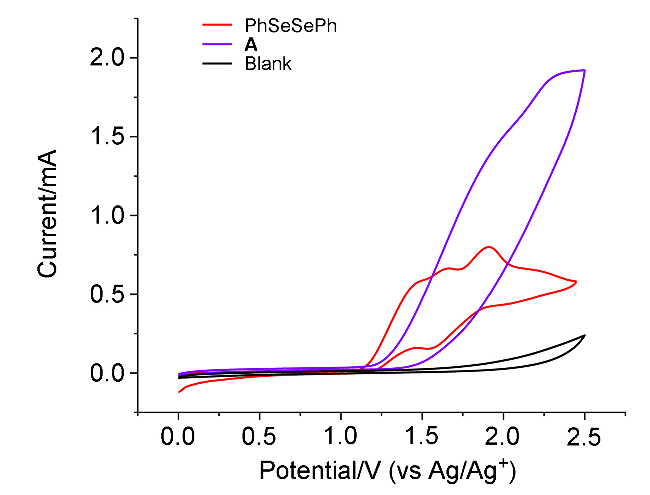
In order to study the redox potential of the intermediates and substrate, cyclic voltammetry (CV) experiment was performed. The working electrode was a 3-millimeter diameter glassy carbon electrode, the counter electrode was a platinum electrode, and the reference electrode was a silver electrode. The scan rate was 0.050 V/s, and the voltage range was 0~2.50 V. The initial oxidation potential of diphenyl diselenide (3a) is lower than that of (3,5-dimethyl- 1H-pyrazol-1-yl)(phenyl)methanone (A). The oxidation peak of diphenyl diselenide (3a) appears at 1.94 V, while that of (3,5-dimethyl-1H-pyrazol-1-yl)(phenyl)methanone (A) appears at 2.47 V, showing that diphenyl diselenide (3a) is preferentially oxidized at carbon (C) anode (Figure 2).
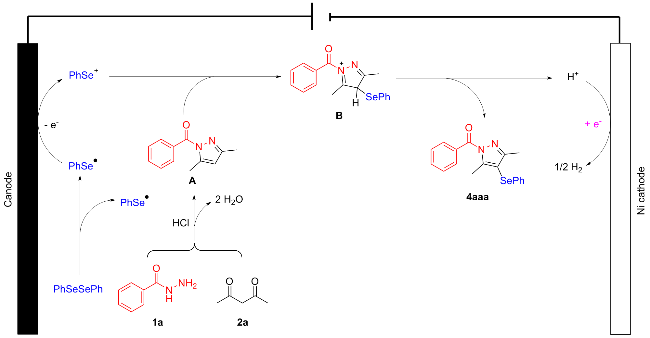
On the basis of the control experiments results, a possible reaction mechanism for this strategy was proposed (Scheme 5). Initially, 1,2-diphenyldiselane 3a decomposes to phenyl-selenium radicals, which is oxidized to phenyl-selenium cations at carbon (C) anode. Then, the phenyl-selenium cations reacts with (3,5-dimethyl-1H-pyrazol-1-yl)(phen- yl)methanone (A), which is received from benzhydrazide 1a and pentane-2,4-dione 2a, to form intermediate B. Subsequently, the final product 4aaa is produced by deprotonation of the intermediate B. At the surface of Ni cathode, the protons are reduced to H2 to complete the reaction cycle, which is confirmed by the bubble of hydrogen on the cathode surface.


3 Conclusions
In summary, an electrochemical procedure for the synthesis of 4-selenylacylpyrazoles from hydrazides, pentane-2,4-diones and diselenides was developed. The merit of this green strategy has also been demonstrated by its high yields, environmental friendliness, mild reaction conditions, step economy, ease of scale up and external oxidant-free. We believe that this strategy will provide an alternative method in the synthesis of 4-selenylacylpyrazoles pharmaceuticals and bioactive molecules.
4 Experimental section
4.1 General experimental details
The instruments used in this experiment are all from commercial suppliers. The power supply is programmed DC power supply (made in China), the anode electrode is carbon (Φ 6 mm×60 mm), and the cathode electrode is nickel electrode (10 mm×10 mm×0.1 mm). Electrochemical workstation for testing cyclic voltammetry curve was purchased from domestic instrument merchants. 1H NMR spectra were recorded on a JNM-ECZ400S (JEOL, Japan) instrument at 400 MHz. Chemical shifts were referenced to tetramethylsilane (δ 0.00) in CDCl3 as an internal standard. 13C NMR spectra were obtained at 100 MHz and were calibrated with CDCl3 (δ 77.00). The high resolution mass spectra (HRMS) were recorded on an Q-TOF mass spectrometer (Waters G2-S qtof) using electrospray ionization (ESI). Products were purified by flash chromatography on 200~300 mesh silica gels. Unless otherwise noted, commercially available reagents and solvents were used without further purification. Melting points were determined with a X-5 (Beijing Tech Instrument Co., Ltd).
4.2 Typical procedure for the preparation 4aaa~4aab
An undivided electrolytic tank (25 mL) was charged with benzohydrazide (1a, 0.2 mmol), pentane-2,4-dione (2a, 0.3 mmol), 1,2-diphenyldiselane (3a, 0.3 mmol), HCl (0.2 mmol), Et4NClO4 (0.2 mmol) and MeCN (12 mL). The electrolytic tank was equipped with carbon (C) (Φ 6 mm× 60 mm) as anode and nickel (Ni) (10 mm×10 mm×0.1 mm) as cathode. Then the reaction mixture was stirred and electrolyzed at a constant current of 12 mA under 80 ℃ for 13 h. After cooling to room temperature, the solvent was evaporated in vacuo. The residues were purified by column chromatography, eluting with petroleum ether/ethyl acetate (V∶V=50∶1) to afford pure 4aaa. Compounds 4baa~4aab were prepared using the same procedure.
(3,5-Dimethyl-4-(phenylselanyl)-1H-pyrazol-1-yl)(phen-yl)methanone (4aaa): Yellow solid. m.p. 87~89 ℃; 1H NMR (400 MHz, Chloroform-d) δ: 8.04~7.98 (m, 2H), 7.63~7.56 (m, 1H), 7.49 (t, J=7.6 Hz, 2H), 7.24~7.18 (m, 5H), 2.76 (s, 3H), 2.25 (s, 3H); 13C NMR (100 MHz, Chloroform-d) δ: 168.08, 155.45, 149.24, 132.79, 132.71, 131.53, 131.45, 129.32, 129.07, 127.96, 126.31, 108.57, 14.38, 13.35; HRMS calcd for C18H17N2OSe [M+H]+ 357.0501, found 357.0504.
(3,5-Dimethyl-4-(phenylselanyl)-1H-pyrazol-1-yl)(o-tolyl)methanone (4baa): Yellow oil. 1H NMR (400 MHz, Chloroform-d) δ: 7.47 (dd, J=7.9, 1.5 Hz, 1H), 7.44~7.39 (m, 1H), 7.28 (d, J=5.2 Hz, 2H), 7.24~7.15 (m, 5H), 2.78 (s, 3H), 2.34 (s, 3H), 2.18 (s, 3H); 13C NMR (100 MHz, Chloroform-d) δ: 169.67, 155.84, 148.62, 137.16, 133.86, 131.45, 130.91, 130.69, 129.32, 129.26, 129.08, 126.33, 125.17, 108.86, 19.92, 14.37, 13.35; HRMS calcd for C19H19N2OSe [M+H]+ 371.0657, found 371.0659.
(3,5-Dimethyl-4-(phenylselanyl)-1H-pyrazol-1-yl)(m-tolyl)methanone (4caa): Yellow oil. 1H NMR (400 MHz, Chloroform-d) δ: 7.86 (s, 2H), 7.45 (q, J=8.6, 7.7 Hz, 2H), 7.33~7.24 (m, 5H), 2.82 (s, 3H), 2.50 (s, 3H), 2.32 (s, 3H); 13C NMR (100 MHz, Chloroform-d) δ: 168.34, 155.34, 149.16, 137.78, 133.59, 132.69, 131.69, 131.55, 129.30, 129.07, 128.61, 127.81, 126.29, 108.48, 21.36, 14.32, 13.35; HRMS calcd for C19H19N2OSe [M+H]+ 371.0657, found 371.0660.
(3,5-Dimethyl-4-(phenylselanyl)-1H-pyrazol-1-yl)(p-tolyl)methanone (4daa): Yellow oil. 1H NMR (400 MHz, Chloroform-d) δ: 7.92 (d, J=8.3 Hz, 2H), 7.29 (d, J=7.8 Hz, 2H), 7.24~7.17 (m, 5H), 2.75 (s, 3H), 2.44 (s, 3H), 2.25 (s, 3H); 13C NMR (100 MHz, Chloroform-d) δ: 167.98, 155.20, 149.15, 143.71, 131.64, 131.61, 129.79, 129.30, 129.02, 128.69, 126.26, 108.29, 21.73, 14.29, 13.33; HRMS calcd for C19H19N2OSe [M+H]+ 371.0657, found 371.0661.
(3,5-Dimethyl-4-(phenylselanyl)-1H-pyrazol-1-yl)(4-ethylphenyl)methanone (4eaa): Yellow oil. 1H NMR (400 MHz, Chloroform-d) δ: 7.95 (d, J=8.3 Hz, 2H), 7.31 (d, J=8.6 Hz, 2H), 7.23~7.17 (m, 5H), 2.75 (s, 3H), 2.73~2.67 (m, 2H), 2.25 (s, 3H), 1.28 (t, J=7.6 Hz, 3H); 13C NMR (100 MHz, Chloroform-d) δ: 167.96, 155.20, 149.84, 149.16, 131.77, 131.61, 129.96, 129.29, 129.01, 127.56, 126.25, 108.27, 28.98, 15.14, 14.31, 13.33; HRMS calcd for C20H21N2OSe [M+H]+ 385.0814, found 385.0819.
(4-(tert-Butyl)phenyl)(3,5-dimethyl-4-(phenylselanyl)-1H-pyrazol-1-yl)methanone (4faa): Yellow oil. 1H NMR (400 MHz, Chloroform-d) δ: 7.98 (d, J=8.7 Hz, 2H), 7.50 (d, J=8.8 Hz, 2H), 7.25~7.16 (m, 5H), 2.75 (s, 3H), 2.26 (s, 3H), 1.36 (s, 9H); 13C NMR (100 MHz, Chloroform-d) δ: 167.87, 156.59, 155.21, 149.17, 131.63, 131.57, 129.68, 129.30, 129.04, 126.27, 125.08, 108.28, 35.12, 31.07, 14.32, 13.35; HRMS calcd for C22H25N2OSe [M+H]+ 413.1127, found 413.1130.
(3,5-Dimethyl-4-(phenylselanyl)-1H-pyrazol-1-yl)(3-methoxyphenyl)methanone (4gaa): Yellow solid. m.p. 80~82 ℃; 1H NMR (400 MHz, Chloroform-d) δ: 7.59 (d, J=7.7 Hz, 1H), 7.55~7.50 (m, 1H), 7.39 (t, J=8.0 Hz, 1H), 7.25~7.16 (m, 5H), 7.16~7.11 (m, 1H), 3.86 (s, 3H), 2.76 (s, 3H), 2.25 (s, 3H); 13C NMR (100 MHz, Chloroform-d) δ: 167.88, 159.07, 155.48, 149.25, 133.90, 131.50, 129.32, 129.12, 128.97, 126.33, 123.99, 119.03, 116.19, 108.65, 55.47, 14.37, 13.35; HRMS calcd for C19H19N2O2Se [M+H]+ 387.0606, found 387.0610.
(3,5-Dimethyl-4-(phenylselanyl)-1H-pyrazol-1-yl)(4-methoxyphenyl)methanone (4haa): Colourless oil. 1H NMR (400 MHz, Chloroform-d) δ: 8.08 (d, J=9.0 Hz, 2H), 7.24~7.17 (m, 5H), 6.98 (d, J=9.0 Hz, 2H), 3.89 (s, 3H), 2.74 (s, 3H), 2.27 (s, 3H); 13C NMR (100 MHz, Chloroform-d) δ: 167.13, 163.43, 154.98, 149.13, 134.10, 131.66, 129.27, 128.96, 126.21, 124.62, 113.36, 107.98, 55.46, 14.23, 13.29; HRMS calcd for C19H19N2O2Se [M+H]+ 387.0606, found 387.0609.
(3,5-Dimethyl-4-(phenylselanyl)-1H-pyrazol-1-yl)(3,4,5-trimethoxyphenyl)methanone (4iaa): Yellow oil. 1H NMR (400 MHz, Chloroform-d) δ: 7.35 (s, 2H), 7.25~7.17 (m, 5H), 3.94 (s, 3H), 3.91 (s, 6H), 2.76 (s, 3H), 2.27 (s, 3H); 13C NMR (100 MHz, Chloroform-d) δ: 167.12, 155.35, 152.44, 149.36, 142.26, 131.37, 129.26, 129.18, 127.16, 126.33, 109.32, 108.52, 60.85, 56.20, 14.33, 13.30; HRMS calcd for C21H23N2O4Se [M+H]+ 447.0818, found 447.0819.
(3,5-Dimethyl-4-(phenylselanyl)-1H-pyrazol-1-yl)(2-fluorophenyl)methanone (4jaa): Yellow oil. 1H NMR (400 MHz, Chloroform-d) δ: 7.66~7.59 (m, 1H), 7.58~7.50 (m, 1H), 7.29~7.21 (m, 2H), 7.21~7.13 (m, 5H), 2.78 (s, 3H), 2.18 (s, 3H); 13C NMR (100 MHz, Chloroform-d) δ: 165.55, 159.94 (d, J=254 Hz), 156.12, 148.54, 136.98, 133.33 (d, J=9 Hz), 131.35, 130.76, 129.21 (d, J=24 Hz), 126.34, 123.87 (d, J=4 Hz), 122.86 (d, J=14 Hz), 116.05 (d, J=21 Hz), 109.26, 14.24, 13.34; HRMS calcd for C18H16FN2OSe [M+H]+ 375.0407, found 375.0410.
(3,5-Dimethyl-4-(phenylselanyl)-1H-pyrazol-1-yl)(3-fluorophenyl)methanone (4kaa): Yellow solid. m.p. 101~103 ℃; 1H NMR (400 MHz, Chloroform-d) δ: 7.84~7.79 (m, 1H), 7.77~7.71 (m, 1H), 7.50~7.42 (m, 1H), 7.32~7.26 (m, 1H), 7.24~7.17 (m, 5H), 2.76 (s, 3H), 2.25 (s, 3H); 13C NMR (100 MHz, Chloroform-d) δ: 166.66, 161.94 (d, J=247 Hz), 155.87, 149.37, 131.49, 131.34, 129.59 (d, J=8 Hz), 129.29 (d, J=14 Hz), 127.71, 127.20 (d, J=3 Hz), 126.43, 119.76 (d, J=21 Hz), 118.52 (d, J=24 Hz), 109.11, 14.43, 13.35; HRMS calcd for C18H16FN2OSe [M+H]+ 375.0407, found 375.0412.
(3,5-Dimethyl-4-(phenylselanyl)-1H-pyrazol-1-yl)(4-fluorophenyl)methanone (4laa): Yellow solid. m.p. 94~96 ℃; 1H NMR (400 MHz, Chloroform-d) δ: 8.09 (dd, J=8.9, 5.4 Hz, 2H), 7.23~7.18 (m, 5H), 7.18~7.13 (m, 2H), 2.76 (s, 3H), 2.25 (s, 3H); 13C NMR (100 MHz, Chloroform-d) δ: 165.49 (d, J=254 Hz), 155.60, 149.36, 134.31 (d, J=9 Hz), 131.44, 129.34, 129.15, 128.78, 127.61, 126.38, 115.20 (d, J=22 Hz), 108.77, 14.39, 13.34; HRMS calcd for C18H16FN2OSe [M+H]+ 375.0407, found 375.0409.
(2-Chlorophenyl)(3,5-dimethyl-4-(phenylselanyl)-1H-pyrazol-1-yl)methanone (4maa): Yellow oil. 1H NMR (400 MHz, Chloroform-d) δ: 7.55~7.50 (m, 1H), 7.47~7.42 (m, 2H), 7.38 (ddd, J=7.5, 5.2, 3.5 Hz, 1H), 7.20 (h, J=3.7, 3.3 Hz, 5H), 2.79 (s, 3H), 2.16 (s, 3H); 13C NMR (100 MHz, Chloroform-d) δ: 167.08, 156.40, 148.52, 134.47, 131.83, 131.53, 131.32, 129.75, 129.50, 129.33, 129.08, 126.44, 126.36, 109.36, 14.24, 13.36; HRMS calcd for C18H16ClN2OSe [M+H]+ 391.0111, found 391.0116.
(3-Chlorophenyl)(3,5-dimethyl-4-(phenylselanyl)-1H-pyrazol-1-yl)methanone (4naa): Yellow oil. 1H NMR (400 MHz, Chloroform-d) δ: 7.99 (t, J=1.9 Hz, 1H), 7.91~7.87 (m, 1H), 7.58~7.54 (m, 1H), 7.43 (t, J=7.9 Hz, 1H), 7.24~7.19 (m, 5H), 2.76 (s, 3H), 2.25 (s, 3H); 13C NMR (100 MHz, Chloroform-d) δ: 166.67, 155.93, 149.34, 134.45, 134.00, 132.65, 131.31, 129.60, 129.49, 129.36, 129.24, 129.21, 126.43, 109.16, 14.42, 13.37; HRMS calcd for C18H16ClN2OSe [M+H]+ 391.0111, found 391.0112.
(4-Chlorophenyl)(3,5-dimethyl-4-(phenylselanyl)-1H-pyrazol-1-yl)methanone (4oaa): Yellow oil. 1H NMR (400 MHz, Chloroform-d) δ: 7.98 (d, J=8.7 Hz, 2H), 7.46 (d, J=8.6 Hz, 2H), 7.24~7.18 (m, 5H), 2.76 (s, 3H), 2.24 (s, 3H); 13C NMR (101 MHz, Chloroform-d) δ: 167.10, 155.76, 149.32, 133.00, 131.55, 131.36, 131.27, 129.34, 129.20, 127.91, 126.41, 108.99, 14.41, 13.35; HRMS calcd for C18H16ClN2OSe [M+H]+ 391.0111, found 391.0115.
(3-Bromophenyl)(3,5-dimethyl-4-(phenylselanyl)-1H-pyrazol-1-yl)methanone (4paa): Yellow oil. 1H NMR (400 MHz, Chloroform-d) δ: 8.14 (s, 1H), 7.94 (d, J=7.8 Hz, 1H), 7.71 (d, J=8.1 Hz, 1H), 7.37 (t, J=7.9 Hz, 1H), 7.22 (d, J=1.5 Hz, 5H), 2.76 (s, 3H), 2.25 (s, 3H); 13C NMR (100 MHz, Chloroform-d) δ: 166.54, 155.95, 149.33, 135.54, 134.69, 134.13, 131.30, 129.93, 129.46, 129.36, 129.23, 126.44, 121.95, 109.18, 14.41, 13.38; HRMS calcd for C18H16BrN2OSe [M+H]+ 434.9606, found 434.9607.
(4-Bromophenyl)(3,5-dimethyl-4-(phenylselanyl)-1H-pyrazol-1-yl)methanone (4qaa): Yellow oil. 1H NMR (400 MHz, Chloroform-d) δ: 7.90 (d, J=8.7 Hz, 2H), 7.63 (d, J=8.6 Hz, 2H), 7.24~7.18 (m, 5H), 2.76 (s, 3H), 2.24 (s, 3H); 13C NMR (101 MHz, Chloroform-d) δ: 167.10, 155.76, 149.32, 133.00, 131.55, 131.36, 131.27, 129.34, 129.20, 127.91, 126.41, 108.99, 14.41, 13.35; HRMS calcd for C18H16BrN2OSe [M+H]+ 434.9606, found 434.9609.
(3,5-Dimethyl-4-(phenylselanyl)-1H-pyrazol-1-yl)(naph-thalen-2-yl)methanone (4raa): Colourless oil. 1H NMR (400 MHz, Chloroform-d) δ: 8.59 (s, 1H), 8.03 (d, J=8.6 Hz, 1H), 7.97 (d, J=8.0 Hz, 1H), 7.93~7.86 (m, 2H), 7.63~7.53 (m, 2H), 7.26~7.20 (m, 5H), 2.80 (s, 3H), 2.27 (s, 3H); 13C NMR (100 MHz, Chloroform-d) δ: 168.10, 155.48, 149.28, 135.30, 133.28, 132.13, 131.52, 129.94, 129.53, 129.32, 129.13, 128.47, 127.68, 127.57, 126.84, 126.64, 126.32, 108.59, 14.38, 13.37; HRMS calcd for C22H19N2OSe [M+H]+ 407.0657, found 407.0659.
Benzo[d][1,3]dioxol-5-yl(3,5-dimethyl-4-(phenylsel-anyl)-1H-pyrazol-1-yl)methanone (4saa): Yellow oil. 1H NMR (400 MHz, Chloroform-d) δ: 7.69 (dd, J=8.3, 1.8 Hz, 1H), 7.53 (d, J=1.7 Hz, 1H), 7.25~7.16 (m, 5H), 6.90 (d, J=8.2 Hz, 1H), 6.07 (s, 2H), 2.72 (s, 3H), 2.26 (s, 3H); 13C NMR (100 MHz, Chloroform-d) δ: 166.77, 155.15, 151.74, 149.22, 147.27, 131.57, 129.29, 129.02, 128.15, 126.27, 126.15, 111.76, 108.22, 107.86, 101.88, 14.23, 13.29; HRMS calcd for C19H17N2O3Se [M+H]+ 401.0399, found 401.0403.
1-(3,5-Dimethyl-4-(phenylselanyl)-1H-pyrazol-1-yl)-ethan-1-one (4taa): Colourless oil. 1H NMR (400 MHz, Chloroform-d) δ: 7.23~7.12 (m, 5H), 2.71 (s, 3H), 2.67 (s, 3H), 2.24 (s, 3H); 13C NMR (100 MHz, Chloroform-d) δ: 171.10, 155.32, 148.03, 131.54, 129.27, 128.95, 126.25, 108.56, 23.40, 14.54, 13.25; HRMS calcd for C13H15N2OSe [M+H]+ 295.0344, found 295.0348.
1-(3,5-Dimethyl-4-(phenylselanyl)-1H-pyrazol-1-yl)-butan-1-one (4uaa): Yellow oil. 1H NMR (400 MHz, Chloroform-d) δ: 7.23~7.13 (m, 5H), 3.13 (t, J=7.4 Hz, 2H), 2.68 (s, 3H), 2.24 (s, 3H), 1.79 (q, J=7.4 Hz, 2H), 1.04 (t, J=7.4 Hz, 3H); 13C NMR (100 MHz, Chloroform-d) δ: 173.66, 155.06, 148.02, 131.61, 129.24, 128.91, 126.19, 108.25, 36.93, 17.69, 14.55, 13.69, 13.26; HRMS calcd for C15H19N2OSe [M+H]+ 323.0657, found 323.0660.
1-(3,5-Dimethyl-4-(phenylselanyl)-1H-pyrazol-1-yl)-2-methylpropan-1-one (4vaa): Yellow oil. 1H NMR (400 MHz, Chloroform-d) δ: 7.25~7.12 (m, 5H), 3.95 (p, J=6.9 Hz, 1H), 2.67 (s, 3H), 2.24 (s, 3H), 1.29 (d, J=6.9 Hz, 6H); 13C NMR (100 MHz, Chloroform-d) δ: 177.90, 155.04, 148.24, 131.63, 129.26, 128.99, 126.22, 108.37, 32.84, 19.16, 14.64, 13.31; HRMS calcd for C15H19N2OSe [M+ H]+ 323.0657, found 323.0658.
Cyclopropyl(3,5-dimethyl-4-(phenylselanyl)-1H-pyrazol- 1-yl)methanone (4waa): Yellow oil. 1H NMR (400 MHz, Chloroform-d) δ: 7.23~7.13 (m, 5H), 3.22 (tt, J=8.0, 4.6 Hz, 1H), 2.66 (s, 3H), 2.27 (s, 3H), 1.29~1.22 (m, 2H), 1.16~1.09 (m, 2H); 13C NMR (100 MHz, Chloroform-d) δ: 174.37, 155.42, 147.97, 131.66, 129.27, 128.89, 126.20, 108.45, 14.56, 13.34, 12.82, 11.31; HRMS calcd for C15H17N2OSe [M+H]+ 321.0501, found 321.0505.
(3,5-Diethyl-4-(phenylselanyl)-1H-pyrazol-1-yl)(phen-yl)methanone (4aba): Colourless oil. 1H NMR (400 MHz, Chloroform-d) δ: 8.03 (d, J=7.2 Hz, 2H), 7.60 (t, J=7.4 Hz, 1H), 7.49 (t, J=7.7 Hz, 2H), 7.23~7.17 (m, 5H), 3.22 (q, J=7.4 Hz, 2H), 2.63 (q, J=7.5 Hz, 2H), 1.20 (t, J=7.4 Hz, 3H), 1.16 (t, J=7.5 Hz, 3H); 13C NMR (100 MHz, Chloroform-d) δ: 167.82, 159.95, 154.90, 132.93, 132.72, 132.15, 131.65, 129.26, 128.86, 127.88, 126.19, 106.85, 21.03, 20.96, 13.86, 12.78; HRMS calcd for C20H21N2OSe [M+H]+ 385.0814, found 385.0816.
(3,5-Dimethyl-4-(methylselanyl)-1H-pyrazol-1-yl)(phen-yl)methanone (4aab): Colourless oil. 1H NMR (400 MHz, Chloroform-d) δ: 7.96 (dd, J=8.6, 1.3 Hz, 2H), 7.60~7.54 (m, 1H), 7.47 (t, J=7.6 Hz, 2H), 2.76 (s, 3H), 2.35 (s, 3H), 2.08 (s, 3H); 13C NMR (100 MHz, Chloroform-d) δ: 167.99, 155.02, 147.84, 132.84, 132.61, 131.34, 127.88, 109.85, 14.30, 13.41, 8.48; HRMS calcd for C13H15N2OSe [M+ H]+ 295.0344, found 295.0347.
Supporting Information 1H NMR and 13C NMR spectra of all products. The Supporting Information is available free of charge via the Internet at http://sioc-journal.cn.
(Zhao, C.)