


细菌感染已经成为全球主要的公共卫生问题[1-2]. 尽管抗生素的发现和使用对治疗细菌感染性疾病具有显著意义[3-4], 但由于近年来抗生素的滥用, 细菌耐药已成为一个全球性日益的严重问题, 严重威胁着人类健康[5-6]. 大多数的抗生素都是针对细菌的内过程, 而细菌的生物膜是天然的屏障, 能够有效阻止和延缓许多抗生素渗入细菌内部, 因此, 可用于临床治疗的药物较少, 且导致细菌易产生耐药性[7-8]. 因此, 研究新型的抗菌疗法以解决细菌耐药性问题至关重要.
荧光成像介导的光动力疗法(Photodynamic therapy, PDT)作为一种非侵入性、时空选择性强及光敏药物荧光可视化的诊疗技术, 近年来在抗感染领域展现出重要应用潜力[9-12]. 其核心机制依赖于光敏剂(Photosensitizer, PS)在特定波长光激发下产生活性氧(Reactive oxygen species, ROS), 通过氧化应激破坏细菌细胞膜、蛋白质及核酸, 最终实现病原体灭活. 然而, 传统商用化光敏剂在抗菌应用中面临诸多挑战[13], 例如聚集导致的荧光猝灭和低效的ROS产生, 以及依赖高浓度光敏剂药物或强辐照剂量带来的潜在毒性和副作用等问题. 因此, 优化光敏剂的荧光量子效率和ROS效率对于提高光动力诊疗效果至关重要. 传统提高ROS效率的方法主要包含两种: 其一为在光敏剂分子中引入重原子(如碘、溴)以增强单线态和三线态之间的自旋轨道耦合效应(Spin-orbit coupling, SOC)[14]; 其二为构筑强电子给体-受体(Donor-Acceptor, D-A)结构以促进分子内电荷转移(Intramolecular charge transfer, ICT), 降低单线态和三线态之间能垒. 以上两种策略均通过促进单线态和三线态之间的系间窜越(Intersystem crossing, ISC)过程, 从而提高光敏剂产生ROS的效率[15]. 然而, 重原子效应虽能促进ISC过程, 但可能引发材料的荧光聚集淬灭(Aggregation caused quenching, ACQ). D-A结构导致分子构象扭曲, 不利于提高光敏剂的摩尔吸光系数. 这些问题在耐药菌治疗中尤为突出, 因为细菌生物膜的存在可能进一步削弱光穿透性和药物渗透, 迫使临床需采用高浓度光敏剂或长时间高辐照剂量, 增加了治疗副作用风险.
具有聚集诱导发光(Aggregation-induced emission, AIE)特性的光敏剂因其在聚集状态下分子运动受限(Restriction of intramolecular motions, RIM), 导致非辐射跃迁通道受阻, 致使更多的单线态能量可以通过辐射跃迁实现良好的荧光量子效率; 或者通过ISC过程产生更多的三线态能量, 进而大大提高ROS效率[16-17]. 因此, AIE型光敏剂具有越聚越亮和越聚ROS越高的独特优势, 在癌细胞和细菌的荧光可视化和可控光动力治疗方面应用广泛[18-21]. 因此, 如何提高AIE光敏剂的聚集态荧光量子效率和ROS效率是决定光诊疗效率的关键所在. Zhu等[22]以三苯胺为电子给体、噻吩为π桥、吡啶盐为电子受体, 制备了一款高效AIE自由基光敏剂(Pys-QM-TT). 该分子具有显著的分子内电荷转移效应, 降低了单线态与三线态之间的能级差, 促进了分子内ISC, 最终提升了自由基型ROS效率[22]. 我们团队前期以强电子给体5,10-二氢还原吩嗪为核心, 进而引入不同类型的电子受体制备AIE自由基光敏剂. 实验结果发现, 随着电子受体的吸电子能力增强, 光敏剂产生的自由基型ROS效率越高[23]. Zhang等[24]联合I型光敏剂和H2S气体疗法, 实现了良好的肿瘤协同治疗效果. 尽管通过强化分子内ICT效应可以有效提高AIE光敏剂的ROS效率, 但其荧光量子效率大大降低. 因此, 同时提高AIE光敏剂的荧光量子效率和ROS效率面临较大挑战.
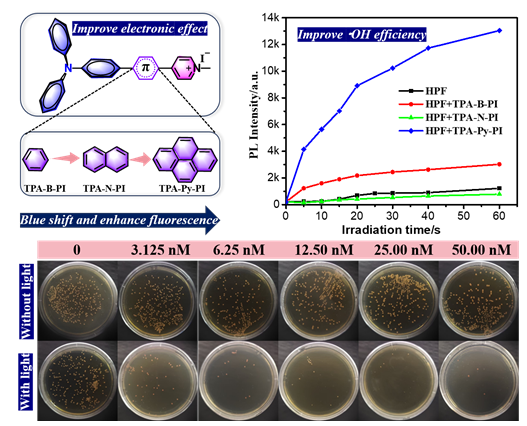
离子型光敏剂具有良好的细胞线粒体靶向性, 强的自由基型ROS产生效率等优点, 在肿瘤治疗和促伤口愈合等领域具有广泛的应用前景[25-27]. 因此, 为解决上述问题, 本研究以离子型AIE分子设计为指导, 系统调控分子内电荷转移激发态, 成功制备三种离子型AIE光敏剂, 分别命名为TPA-B-PI, TPA-N-PI和TPA-Py-PI. 光敏剂的分子结构及合成路线如Scheme 1所示, 选用三苯胺(TPA)为电子给体, 赋予分子AIE特性, 从而抑制分子在聚集态的非辐射跃迁速率, 降低单线态能量的无效损耗; 以电荷型吡啶杂环为电子受体, 一方面构筑分子内ICT效应, 促进单线态与三线态之间的ISC过程, 提高光敏剂产生ROS效率, 另一方面, 强化光敏剂与革兰氏阳性菌的作用力, 促进光敏剂进入细菌菌体内部而充分发挥光动力灭菌功效. 通过在D-A单元间引入不同电子共轭程度的苯、萘和芘基元, 从而调控分子内局域激发和电荷转移激发态. 实验结果显示, 由于芘基元具有较大的共轭结构, 导致TPA-Py-PI分子的摩尔吸光系数显著优于TPA-B-PI和TPA-N-PI, 从而显著优化了TPA-Py-PI产生ROS的效率. 不仅如此, 芘基元的引入也弱化了分子内ICT效应, 强化了分子辐射跃迁效率, 显著提高了TPA-Py-PI的荧光量子效率. 选用TPA-Py-PI对革兰氏阳性菌(金黄色葡萄球菌和耐甲氧西林金黄色葡萄球菌)和阴性菌(大肠杆菌)进行光动力灭菌效果评估, 结果显示, TPA-Py-PI可以对革兰氏阳性和阴性菌均具有良好的光动力疗效. 更为重要的是, 在低白光辐照剂量(20 mW/cm2)和低光敏剂浓度(25 nmol/L)条件下, 实现了对MRSA超过99.99%的灭菌效果. 该工作为高效率光敏剂的设计提供重要参考依据.
1 结果与讨论
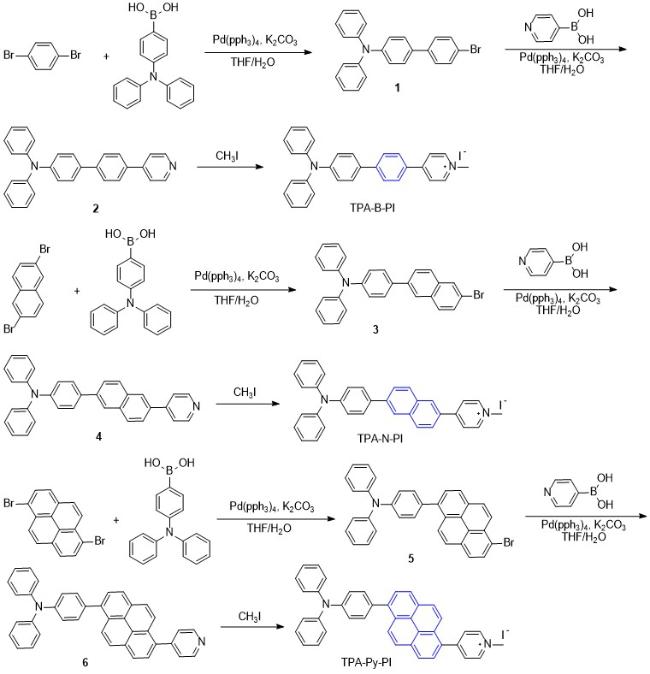
1.1 TPA-B-PI, TPA-N-PI和TPA-Py-PI的制备
TPA-B-PI, TPA-N-PI和TPA-Py-PI均可以通过简单且成熟的制备方法所合成, 合成的步骤如Scheme 1所示. 首先, 原料1,4-二溴苯或2,6-二溴萘或1,6-二溴芘和4-硼酸三苯胺进行Suzuki偶联, 得到中间体产物1, 3和5. 然后, 以上中间体继续与吡啶-4-硼酸进行Suzuki偶联得到中间体产物2, 4, 6. 最后, 中间体产物2, 4, 6与碘甲烷反应得到最终产物TPA-B-PI, TPA-N-PI和TPA- Py-PI. 系统表征了中间体产物和最终产物核磁共振氢谱、碳谱和质谱, 并测定其熔点, 结果显示, 所设计的中间体和产物均被成功合成.
1.2 理论计算
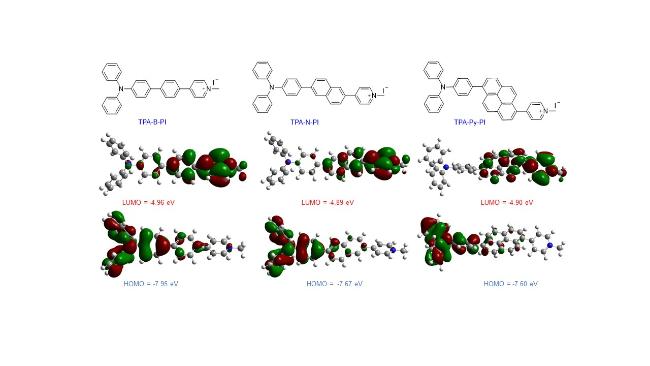
对TPA-B-PI, TPA-N-PI和TPA-Py-PI的结构进行充分表征后, 为了预测这三种化合物的光学性质, 首先对分子最高占据分子轨道(HOMO)和最低未占据分子轨道(LUMO)电子云分布进行理论计算. 利用高斯09在MX-062/6-31G(d,p)水平上对这三个化合物进行了密度泛函理论(DFT)和含时密度泛函理论(TD-DFT)计算模拟. 首先对其基态和激发态电子云分布进行了计算(图1). 结果显示, TPA-B-PI, TPA-N-PI和TPA-Py-PI的HOMO的电子云主要分布在三苯胺基团上, 还有少量位于中间的苯、萘和芘上; 而LUMO的电子云主要分布在电荷型吡啶杂环上, 还有少量位于中间的苯、萘和芘上. 研究初步表明三类光敏剂均具有ICT效应. 激发态能级分布理论模拟结果显示, TPA-B-PI, TPA-N-PI和TPA-Py-PI的T1-S0能量差分别为1.67, 1.66和1.61 eV, 均高于3O2激发到单线态产生1O2所需的能量[28-30], 表明三类光敏剂可能产生1O2. 此外, 模拟了三类光敏剂的单线态-三线态能级差, 分别为TPA-B-PI (0.43 eV), TPA-N-PI (0.28 eV)和TPA-Py-PI (0.33 eV), 均小于发生ISC所需的能量(0.35 eV), 预示三类光敏剂均可以有效产生ROS.
1.3 紫外吸收和荧光光谱及AIE性质表征
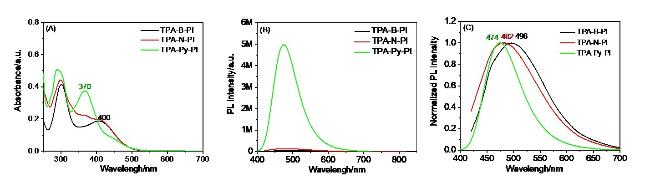
首先测试了三类光敏剂在四氢呋喃(THF)溶液中的紫外-可见吸收光谱(图2A). 从图中可知: TPA-B-PI, TPA-N-PI和TPA-Py-PI的最大吸收峰分别位于400, 400 和370 nm处. 相较于TPA-B-PI和TPA-N-PI的最大吸收峰, TPA-Py-PI的最大吸收峰蓝移30 nm. 表明芘基团的引入弱化了分子内ICT效应. 此外, 在相同浓度条件下, TPA-Py-PI具有最大的摩尔吸光系数, 表明引入平面刚性结构的芘基团, 增大了分子内吸光截面, 有利于提高分子吸光效率而产生更多的单线态能量. 荧光光谱显示(图2C), TPA-B-PI, TPA-N-PI和TPA-Py-PI在THF溶液中的最大发射波长为496, 482, 474 nm, 与吸收光谱相似, TPA-Py-PI表现明显荧光蓝移, 且荧光明显强于TPA-B-PI和TPA-N-PI(图2B), 表明TPA-Py-PI的分子内ICT效应明显减弱. 以上结果初步证实了分子设计的可行性, 即在分子D-A结构中引入稠环基团, 增强局域激发态效应, 弱化分子内ICT效应, 提高光敏剂分子发光效率.
1.4 活性氧效率和种类分析
使用9',10'-蒽二烷基双(亚甲基)二丙二酸(ABDA)、羟基荧光素(HPF)、二氢罗丹明123 (DHR123)等ROS特异性探针对所合成光敏剂产生的ROS效率和种类进行检测与分析(图3). 首先使用ABDA探针检测1O2的生成(图3A). 结果显示, 在白光(30 mW/cm2)照射条件下, 纯ABDA探针的特征吸收强度并没有下降, 表明没有1O2产生. 当加入光敏剂并光照后, ABDA探针的特征吸收强度明显下降, 表明三种光敏剂均可以有效产生1O2. 此外, 加入TPA-B-PI和TPA-N-PI光敏剂且光照后, ABDA 探针的吸收峰在15 s内消失; 而TPA-Py-PI仅需光照5 s致使探针吸收强度完全消失, 表明TPA-Py-PI具有更优秀的1O2产生效率.
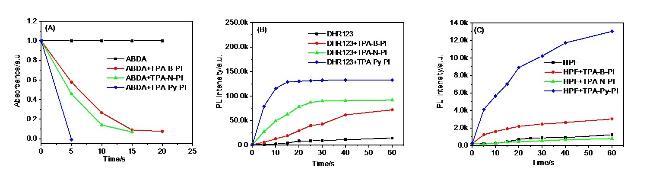
图3 (A) ABDA探针在含有PS的DMSO/H2O混合液中吸收强度的变化、(B) DHR123探针和(C) HPF探针在含有PS的DMSO/ H2O混合液中荧光强度的变化Figure 3 (A) Change of absorption intensity of ABDA probe in PSs-contained DMSO/H2O mixture; (B) Change of fluorescence intensity of DHR123 probe and (C) HPF probe in PSs-contained DMSO/H2O mixture Concentration of PS: 10 μmol/L, concentration of ABDA: 20 μmol/L, concentration of DHR123: 5 μmol/L, concentration of HPF: 5 μmol/L, DMSO/H2O (V/V=1/99), white light power: 30 mW/cm2 |
之后, 使用DHR123检测$O_{2}^{-·}$的生成(图3B). DHR123探针在光照条件下荧光强度只有微弱增强, 加入光敏剂后荧光迅速增强, 初步可以证明TPA-B-PI, TPA-N-PI和TPA-Py-PI均可产生$O_{2}^{-·}$, 且TPA-Py-PI在同等光照条件下产生的$O_{2}^{-·}$最强. 此外, 选用自由基猝灭剂维生素C (Vc), 进一步表征光敏剂产生$O_{2}^{-·}$[34]. 在光照条件下, 加入光敏剂和Vc后, DHR123探针的荧光强度并没有提高, 主要归因于光照产生的$O_{2}^{-·}$被Vc猝灭, 再次证明TPA-B-PI, TPA-N-PI和TPA-Py-PI在光照后均可产生$O_{2}^{-·}$[35].
最后, 使用HPF探针检测•OH的生成(图3C). 结果显示, TPA-B-PI和TPA-Py-PI在光照之后能够产生•OH, 而TPA-N-PI几乎不产生•OH. 因此, 可以说明, TPA- B-PI和TPA-Py-PI既产生1O2, 也产生$O_{2}^{-·}$和•OH; 而TPA-N-PI产生1O2以及自由基型活性氧$O_{2}^{-·}$. 以上结果表明, 在分子D-A结构中引入稠环结构的电子π桥, 可以有效增强光敏剂产生ROS效率. 进一步对以上三种光敏剂产生I型ROS效率差异进行分析, 首先对三种光敏剂的光电流进行测试, 白光激发光敏剂后出现明显的电流信号, 表明激子的有效分离, 从而产生电子, 为实现三线态能量的电子转移提供条件. 此外, 由于分子中存在较强的ICT效应, 致使单线态能量可以通过ISC通道转化为三线态能量, 而由于TPA-Py-PI具有最佳的摩尔吸光系数, 故该分子的三线态能量最多, 在激发态电子环境中, 三线态与电子发生转移产生I型ROS的效率也就越高.
1.5 抑菌实验分析
由于TPA-Py-PI的活性氧效率最高, 且产生速度最快, 本研究选取TPA-Py-PI作为光敏剂开展后续抗菌应用研究. 首先, 验证了TPA-Py-PI是否可以进入革兰氏阳性和阴性菌. 荧光共聚焦成像结果显示,TPA-Py-PI可以很好地进入革兰氏阳性菌(S. aureus 和MRSA)及革兰氏阴性菌(E. coli)菌体内, 并表现出明亮的荧光. 进一步采用琼脂稀释法系统评估了该化合物对S. aureus, MRSA及E. coli的光动力抗菌性能. 在实验设计中, 将菌悬液分别与PBS缓冲液(对照组)及梯度浓度的TPA-Py-PI溶液(实验组)在37 ℃恒温条件下共孵育60 min后, 采用白光光源(光密度20 mW/cm²)进行20 min辐照处理, 通过涂布平板并统计平板菌落数确定光敏剂抑菌活性. 实验数据(图4A)显示: 在光动力条件下, TPA-Py-PI对革兰氏阳性菌S. aureus和多重耐药菌株MRSA都展现出浓度依赖性光动力抗菌效应. 当TPA- Py-PI在12.5 nmol/L的低浓度条件下即可使菌体存活率降低至10%以下, 浓度达到25 nmol/L时即可实现99.9%以上的菌落抑制率(P<0.01). 而对于革兰氏阴性菌E. coli, 其光动力效应阈值显著提高, 需在20 μmol/L浓度条件下方可实现完全灭菌. 上述结果表明, TPA-Py-PI对不同类型细菌的杀伤性具有明显差异. 即在保持对革兰氏阳性菌(包括耐药菌株)高效光动力抗菌效应的同时, 对革兰氏阴性菌也具有一定的抗菌效果.
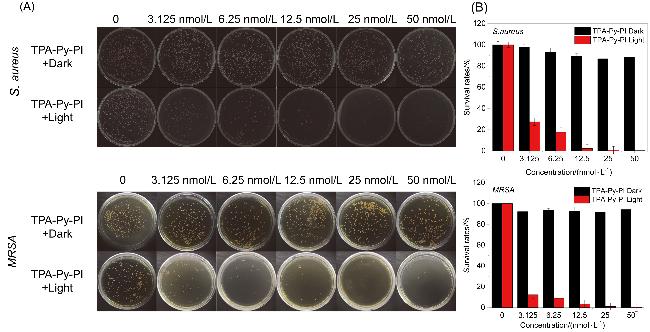


图4 通过平板稀释法在有或无白光照射条件下作用后光敏剂对S. aureus和MRSA的(A)抑菌平板图和(B)菌落计数统计(白光20 mW/cm2, 20 min)Figure 4 After the action with or without white light irradiation by the plate dilution method, the photosensitizer (A) bacteriostatic plate image and (B) colony count statistics for S. aureus and MRSA (20 mW/cm2, 20 min under white light) |
2 结论
本工作重点探究了分子内电荷转移激发态和局域激发态的调控对光敏剂的光致荧光量子效率和ROS效率的影响. 以TPA为电子给体, 电荷型吡啶为电子受体, 所构筑的D-A型分子结构中引入苯、萘、芘等不同稠环, 从而探究分子结构改性对激发态性能影响. 实验结果显示, 大稠环芘的引入导致TPA-Py-PI吸收和发射蓝移, 主要归因于分子内局域激发态占比提高而电荷转移激发态效应减弱. 由于TPA-Py-PI摩尔吸光系数的提高, 单线态能量的产生效率增强, 在限制分子运动和促进ISC的作用下, TPA-Py-PI具有最佳的荧光量子效率和ROS效率. 平板稀释法抑菌实验发现, 用光密度为20 mW/cm2、白光照射时间为20 min的条件下, 低浓度TPA-Py-PI (25 nmol/L)可对 S. aureus和MRSA达到完全抑菌的效果. 本项研究为设计开发高效率AIE自由基光敏剂提供重要的理论指导依据.
3 实验部分
3.1 仪器与试剂
紫外-可见吸收光谱在UV-1900i分光光度计上测得; 荧光发射光谱在岛津RF-6000上测得; 核磁共振氢谱和碳谱在Bruker AV 400核磁共振谱仪上测得, 以氘代二甲基亚砜(DMSO-d6)为溶剂; 细菌吸光度在722N型可见分光光度计上测得.
所有溶剂和分子合成试剂均为分析级. 单线态氧探针9',10'-蒽二烷基双(亚甲基)二丙二酸(ABDA)在上海毕得科技有限公司购买; 羟基自由基探针羟基荧光素(HPF)和超氧阴离子自由基探针二氢罗丹明123 (DHR123)在上海懋康生物技术有限公司购买; 磷酸盐(PBS)缓冲液在武汉赛维尔生物科技有限公司购买; 1,4-二溴苯、2,6-二溴萘、1,6-二溴芘、碘甲烷和吡啶-4-硼酸在安耐吉购买; 4-硼酸三苯胺在苏凯路化学科技有限公司购买.
金黄色葡萄球菌(S. aureus) ATCC 6538来自中国微生物综合培养采集中心. 大肠杆菌(escherichia coli, E. coli) TOP 10购自北京生物医学科技发展有限公司. MRSA购自北京百欧博伟生物技术有限公司, 样本号: bio-107352.
3.2 探针TPA-B-PI的合成
3.2.1 4-溴-N,N-二苯基联苯胺(1)的合成
在100 mL双口烧瓶中, 加入1,4-二溴苯(1 g, 4.24 mmol), 4-硼酸三苯胺(1.34 g, 4.66 mmol), Pd(PPh3)4 (147 mg, 0.127 mmol), K2CO3 (2.4 g, 17.37 mmol), THF (20 mL), 水 (8 mL), 然后在氮气环境下回流12 h. 反应液冷却后, 用二氯甲烷(DCM)萃取, 蒸发有机溶剂, 用硅胶色谱柱(石油醚作为洗脱剂)分离提纯, 干燥后得到白色产物1 1.22 g, 产率72.3%. 1H NMR (400 MHz, DMSO-d6) δ: 7.60~7.53 (m, 6H), 7.30 (t, J=16.0 Hz, 4H), 7.03~6.99 (m, 8H); 13C NMR (151 MHz, DMSO-d6) δ: 147.5, 147.4, 139.2, 133.7, 132.9, 132.2, 130.1, 128.6, 128.0, 124.7, 123.8, 123.5, 120.7.
3.2.2 N,N-二苯基-4'-(吡啶-4-基)-[1'-联苯]-4-胺(2)的合成
在100 mL双口烧瓶中, 加入化合物1 (500 mg, 1.25 mmol), 吡啶-4-硼酸(307 mg, 2.5 mmol), Pd(PPh3)4 (43 mg, 0.0375 mmol), K2CO3 (1.2 g, 8.69 mmol), THF (10 mL), 水(4 mL), 然后在氮气环境下回流12 h. 反应液冷却后, 用DCM萃取, 蒸发有机溶剂, 用硅胶色谱柱[石油醚/二氯甲烷(V∶V=40∶1)作为洗脱剂]分离提纯, 干燥后得到淡黄色产物2 342 mg, 产率 68.7%. 1H NMR (400 MHz, DMSO-d6) δ: 8.62 (d, J=4.0 Hz, 2H), 7.87~7.72 (m, 4H), 7.69~7.48 (m, 6H), 7.30 (t, J=8.0 Hz, 4H), 7.04 (t, J=16.0 Hz, 6H).
3.2.3 碘化-4-(4'-(二苯氨基)-[1'-联苯]-4-基)-1-甲基吡啶盐(TPA-B-PI)的合成
在50 mL烧瓶中, 加入化合物2 (100 mg, 0.25 mmol), 碘甲烷(76 mg, 0.5 mmol), 乙腈(20 mL), 然后回流8 h. 反应液冷却后, 蒸发有机溶剂, 加二氯甲烷刚好溶解, 再加石油醚, 产物析出, 抽滤, 干燥后得到红色产物TPA-B-PI 108 mg, 产率80%. m.p. 160~161 ℃; 1H NMR (400 MHz, DMSO-d6) δ: 8.95 (d, J=8.0 Hz, 2H), 8.53 (d, J=8.0 Hz, 2H), 8.14 (d, J=8.0 Hz, 2H), 7.90 (d, J=12 Hz, 2H), 7.72 (d, J=8.0 Hz, 2H), 7.33 (t, J=16 Hz, 4H), 7.11~7.01 (m, 8H), 4.30 (s, 3H); 13C NMR (101 MHz, DMSO-d6) δ: 154.0, 148.1, 147.1, 145.9, 143.4, 132.0, 130.1, 129.1, 128.3, 127.4, 125.0, 124.0, 122.9. HRMS (ESI) calcd for C30H25N2 413.2012, found 413.2011.
3.3 探针TPA-N-PI的合成
3.3.1 4-(6-溴萘-2-基)-N,N-二苯基苯胺(3)的合成
在100 mL双口烧瓶中, 加入2,6-二溴萘(500 mg, 1.75 mmol), 4-硼酸三苯胺(500 mg, 1.75 mmol), Pd(PPh3)4 (100 mg, 0.087 mmol), K2CO3 (2.4 g, 17.37 mmol), THF (20 mL), 水(8 mL), 然后在氮气环境下回流12 h. 反应液冷却后用DCM萃取, 蒸发有机溶剂, 用硅胶色谱柱(石油醚作为洗脱剂)分离提纯, 干燥后得到浅黄色产物3 500 mg, 产率63.5%. 1H NMR (400 MHz, DMSO-d6) δ: 8.24~8.16 (m, 2H), 7.96~7.84 (m, 3H), 7.73~7.59 (m, 3H), 7.33~7.24 (m, 4H), 7.11~6.92 (m, 8H); 13C NMR (151 MHz, DMSO-d6) δ: 147.4, 138.0, 133.7, 133.5, 132.4, 130.6, 130.2, 130.1, 130.0~129.4, 128.4, 128.1, 126.4, 124.9, 124.7, 123.8, 123.6, 119.3.
3.3.2 N,N-二苯基-4-(6-(吡啶-4-基)萘-2-基)苯胺(4)的合成
在100 mL双口烧瓶中, 加入化合物3 (350 mg, 0.78 mmol), 吡啶-4-硼酸(185 mg, 1.5 mmol), Pd(PPh3)4 (45 mg, 0.038 mmol), K2CO3 (1.2 g, 8.69 mmol), THF (10 mL), 水(4 mL), 然后在氮气环境下回流12 h. 反应液冷却后用DCM萃取, 蒸发有机溶剂, 用硅胶色谱柱[石油醚/二氯甲烷(V∶V=30∶1)作为洗脱剂]分离提纯, 干燥后得到淡黄色产物4 180 mg, 产率51.7%. 1H NMR (400 MHz, DMSO-d6) δ: 8.66 (d, J=8.0 Hz, 2H), 8.40 (s, 1H), 8.22 (s, 1H), 8.06 (d, J=8.0 Hz, 2H), 7.94 (d, J=8.6 Hz, 1H), 7.85~7.84 (m, 3H), 7.75 (d, J=8.0 Hz, 2H), 7.36~7.30 (m, 4H), 7.06 (t, J=8.0 Hz, 8H).
3.3.3 碘化-4-(6-(4-(二苯氨基)苯基)萘-2-基)-1-甲基吡啶盐(TPA-N-PI)的合成
在50 mL烧瓶中, 加入化合物4 (100 mg, 0.22 mmol), 碘甲烷(76 mg, 0.5 mmol), 乙腈 (20 mL), 然后回流8 h. 反应液冷却后, 蒸发有机溶剂, 加二氯甲烷刚好溶解, 再加石油醚, 产物析出, 抽滤, 干燥后得到黄色产物TPA-N-PI 69 mg, 产率68%. m.p. 58~59 ℃; 1H NMR (400 MHz, DMSO-d6) δ: 9.03 (d, J=8.0 Hz, 2H), 8.78 (s, 1H), 8.64 (d, J=4.0 Hz, 2H), 8.29 (s, 1H), 8.15 (d, J=16.0 Hz, 3H), 7.97 (d, J=8.6 Hz, 1H), 7.79 (d, J=8.0 Hz, 2H), 7.33 (t, J=16.0 Hz, 4H), 7.07 (d, J=8.0 Hz, 8H), 4.33 (s, 3H); 13C NMR (101 MHz, DMSO-d6) δ: 147.8, 147.2, 146.9, 133.2, 130.9, 129.3, 127.7, 125.6, 125.2, 124.7, 124.1, 123.5, 123.1, 122.5. HRMS (ESI) calcd for C34H27N2 463.2169, found 463.2171.
3.4 探针TPA-Py-PI的合成
3.4.1 4-(7-溴芘-2-基)-N,N-二苯基苯胺(5)的合成
在100 mL双口烧瓶中, 加入1,6-二溴芘(1 g, 2.8 mmol), 4-硼酸三苯胺(0.81 g, 2.8 mmol), Pd(PPh3)4 (97 mg, 0.084 mmol), K2CO3 (2.4 g, 17.37 mmol), THF (20 mL), 水(8 mL), 然后在氮气环境下回流12 h. 反应液冷却后, 用DCM萃取, 蒸发有机溶剂, 用硅胶色谱柱[石油醚/二氯甲烷(V∶V=500∶1)作为洗脱剂]分离提纯, 干燥后得到淡黄色产物5 660 mg, 产率43.8%. 1H NMR (400 MHz, DMSO-d6) δ: 8.40 (s, 1H), 8.39~8.31 (m, 3H), 8.25~8.16 (m, 3H), 8.07 (d, J=8.0 Hz, 1H), 7.53 (d, J=8.0 Hz, 2H), 7.36 (t, J=16.0 Hz, 4H), 7.15~7.09 (m, 8H); 13C NMR (151 MHz, DMSO-d6) δ: 147.5, 147.3, 138.3, 131.9, 130.8, 130.6, 130.1, 130.0, 128.9, 128.1, 127.8, 126.4, 126.2, 125.5, 124.9, 123.9, 122.9.
3.4.2 N,N-二苯基-4-(7-(吡啶-4-基)芘-2-基)苯胺(6)的合成
在100 mL双口烧瓶中, 加入化合物5 (400 mg, 0.668 mmol), 吡啶-4-硼酸(164 mg, 1.3 mmol), Pd(PPh3)4 (23 mg, 0.02 mmol), K2CO3 (1.2 g, 8.69 mmol), THF (10 mL), 水(4 mL), 然后在氮气环境下回流12 h. 反应液冷却后, 用DCM萃取, 蒸发有机溶剂, 用硅胶色谱柱[石油醚/二氯甲烷(V∶V=40∶1)作为洗脱剂]分离提纯, 干燥后得到淡黄色产物6 200 mg, 产率 50.2%. 1H NMR (400 MHz, DMSO-d6) δ: 8.78 (d, J=4.0 Hz, 2H), 8.35 (t, J=12.0 Hz, 2H), 8.27~8.19 (m, 3H), 8.08~8.02 (m, 3H), 7.66 (d, J=4.0 Hz, 2H), 7.54 (d, J=8.0 Hz, 2H), 7.36 (t, J=16.0 Hz, 4H), 7.17~7.09 (m, 8H).
3.4.3 碘化-4-(7-(4-(二苯氨基)苯基)芘-2-基)-1-甲基吡啶盐(TPA-Py-PI)的合成
在50 mL烧瓶中, 加入化合物6 (100 mg, 0.19 mmol), 碘甲烷(60 mg, 0.4 mmol), 乙腈(20 mL), 然后回流8 h. 反应液冷却后, 蒸发有机溶剂, 加二氯甲烷刚好溶解, 再加石油醚, 产物析出, 抽滤, 干燥后得到黄色产物TPA-Py-PI 73.7 mg, 产率58%. m.p. 56~57 ℃; 1H NMR (400 MHz, DMSO-d6) δ: 9.15 (d, J=8.0 Hz, 2H), 8.46 (t, J=8.0 Hz, 4H), 8.36~8.27 (m, 3H), 8.19~8.08 (m, 3H), 7.576 (d, J=12.0 Hz, 2H), 7.37 (t, J=16.0 Hz, 4H), 7.18~7.08 (m, 8H), 4.45 (s, 3H); 13C NMR (101 MHz, DMSO-d6) δ: 156.5, 147.3, 145.8, 138.5, 133.9, 132.5, 131.9, 131.2, 130.1, 129.8, 129.2, 128.4, 128.1, 126.4, 124.9, 124.6, 123.9, 122.9. HRMS (ESI) calcd for C40H29N2 537.2325, found 537.2328.
3.5 测试方法
溶液的紫外-可见光吸收光谱、发射光谱以及活性氧测试, 均采用 μmol/浓度的溶液进行.
微生物菌液的制备: 将液体菌液取10 μL转移到10 mL的液体培养基中. 在37 ℃下培养12 h(液体培养基: S. aureus, MRSA(革兰氏阳性)为NB (Nutrient Broth)培养基, E. coli(革兰氏阴性)为LB (Luria-Bertani)培养基. 通过离心(7200 r/min, 1 min)收集细菌, 并用PBS冲洗3次. 除去上清液, 将细菌重悬于PBS中, 调节吸收值在600 nm处为1.0 (OD600=1.0, Abs=0.2). 采用平板稀释法进行抑菌分析: TPA-Py-PI对S. aureus, MRSA和E. coli的抑制率按如下步骤进行. 将包含不同浓度的光敏剂TPA-Py-PI的NB培养基(S. aureus, MRSA)或LB培养液(E. coli) 500 μL 加入离心(EP)管中, 然后加入细菌浊液(500 μL, 1×10⁶ CFU/mL). 在37 ℃下孵育1 h后, 白光照射组将细菌浊液置于白光(20 mW•cm-2)下光照20 min. 用PBS将细菌浊液稀释100倍, 取100 μL滴入琼脂平板, 用涂布棒将细菌均匀分散. 将涂有细菌的琼脂平板置于37 ℃的培养箱中孵育16 h. 统计细菌菌落.
辅助材料(Supporting Information) TPA-B-PI, TPA-N-PI和TPA-Py-PI的1H NMR、13C NMR谱图、溶剂化效应图、AIE测试图、DHR123加Vc验证图、含时密度泛函计算图和平板稀释抑菌平板照片. 这些材料可以免费从本刊网站(http://sioc-journal.cn/)上下载.
(Lu, Y.)