



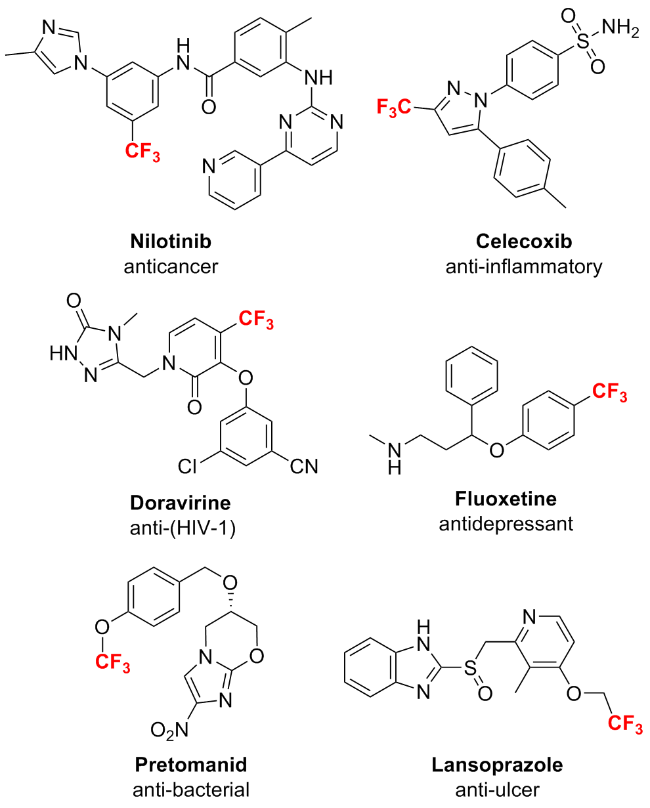
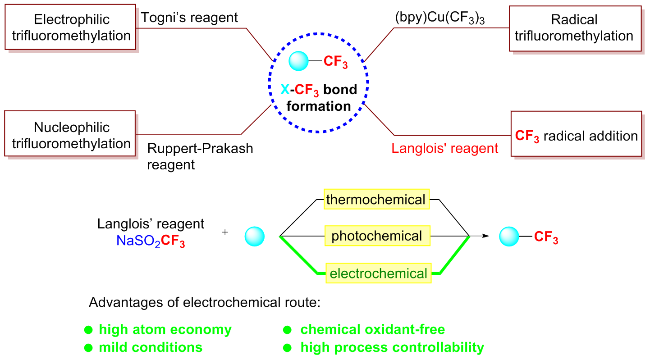
在有机合成领域, 将含氟基团引入小分子结构是一项非常重要的转化策略[1]. 通过将含氟基团引入生物活性分子, 可显著提升化合物的亲脂性和代谢稳定性, 从而优化先导化合物的药理特性, 在过去几十年时间始终是科研攻关的重点方向[2]. 以三氟甲基化分子为例, 这类结构在医药、农药以及新材料开发等领域展现出广阔的应用前景(Scheme 1)[3]. 近年来, 研究人员开发了一系列使用有机金属催化、光催化氧化偶联等通过CF3+、CF3-或CF3基团的三氟甲基化方法. 目前已有多种三氟甲基化试剂被广泛应用于有机合成领域, 包括Langlois试剂、Togni试剂、Baran试剂、Ruppert-Prakash试剂、Umemoto试剂、CF3I以及CF3SO2Cl等[4]. 这些试剂主要通过两种主要途径实现三氟甲基化反应: 一是通过过渡金属催化的氧化或还原过程, 二是通过光催化引发的亲核、亲电或自由基反应机制. 在这些试剂中, Langlois试剂(即CF3SO2Na)因其具有显著的成本优势、操作简便性以及优异的储存稳定性等特点, 已成为科研工作者的首选试剂[5]. 以光电技术为代表的自由基化学在绿色合成领域取得重要突破[6]. 这些技术利用清洁的光能或电能驱动反应, 成功开发出环境友好的自由基中间体制备新方法. 在这些方法中, 电化学合成具有原子经济性高、反应条件温和、无需添加化学氧化剂和过程可控等的独特优势(图1), 这一技术突破不仅体现了绿色化学理念, 更为医药、材料等领域的分子合成与结构修饰开辟了新思路. 现有相关综述文献包括通过后期官能化直接获得三氟甲基化天然产物(2023)[3b]、氟烷基取代反应合成氟烷基化烯烃和炔烃(2023)[7]、Langlois试剂在烯烃双官能化中的应用进展(2022)[8]、电化学实现的二氟甲基化(2025)[2a]、电化学实现的氟烷基化反应(2021)[2b]等. 本文将从不同于以往的角度系统综述2021~2025年间Langlois试剂在电化学诱导的有机分子三氟甲基化领域的应用进展, 为本领域研究人员提供最新的参考信息.
1 C—H键的三氟甲基化
1.1 C—H键直接三氟甲基化
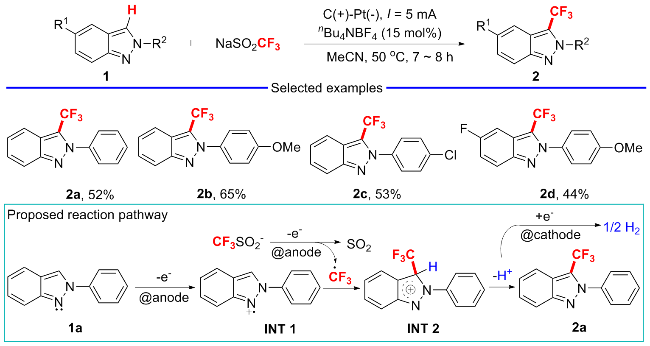
近年来, C—H键的直接三氟甲基化已成为有机合成化学领域的研究热点之一. 国内外研究团队基于电化学合成利用Langlois试剂实现C—H键的直接三氟甲基化领域研究取得了显著进展[9]. 此类反应主要包括C(sp2)—H和C(sp)—H两种碳氢键的官能化反应, 从反应机理来看, 此类反应均通过自由基加成和去质子化过程实现三氟甲基官能化. 其中C(sp2)—H的三氟甲基化反应往往因为存在多个反应位点而面临选择性问题, 从相关报道来看, 基于Langlois试剂的C(sp2)—H电化学三氟甲基化反应表现出了良好的区域选择性. 2021年, 谢媛媛课题组[10]开发了一种绿色高效的电化学合成策略, 成功实现了2H-吲唑C-3位的选择性三氟甲基化反应(Scheme 2). 该方法以环境友好的CF3SO2Na作为三氟甲基源, 在温和的电化学条件下, 无需过渡金属催化剂和额外氧化剂即可高效进行. 实验结果表明, 该反应体系具有良好的官能团兼容性, 能够以中等至优良的收率获得目标产物. 通过详细的机理研究, 作者提出了可能的自由基反应途径, CF3SO2Na在阳极被氧化得到CF3•自由基并释放出SO2, 另一方面, 1a在阳极被氧化得到氮正离子自由基中间体INT 1, 其与CF3•自由基结合并脱去H+得到目标产物2a, 而H+则在阴极被还原为H2. 该方法的开发不仅拓展了三氟甲基化反应的应用范围, 也为绿色有机合成提供了新思路.
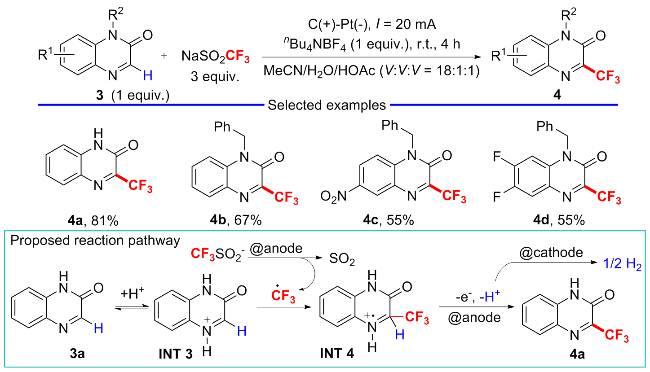
2022年, 王陆瑶课题组[11]开发了一种简便高效的电化学合成方法, 成功实现了喹喔啉-2(1H)-酮C-3位C—H键的选择性直接三氟甲基化(Scheme 3). 该方法采用廉价易得、操作简便的CF3SO2Na作为三氟甲基源, 在无催化剂和氧化剂的温和条件下进行, 充分体现了绿色化学的理念. 通过一系列机理实验, 作者提出了可能的反应路径, 当电流通过时, CF3SO2Na在阳极失去一个电子产生CF3•自由基, 同时喹啉酮3a被质子化形成中间体INT 3, 然后CF3•自由基选择性地攻击INT 3的C-3位, 形成中间体INT 4. 最后, 中间体INT 4在阳极失去电子、脱质子化得到产物4a. 同时, 质子在阴极获得电子而生成氢气. 值得一提的是, 该课题组创新性地引入电描述符图分析方法, 通过可视化手段清晰地展示了底物反应活性与产物收率之间的定量关系, 为反应条件的优化和底物适用范围预测提供了重要依据. 该研究不仅为含氟化合物的合成提供了新策略, 也为电化学有机合成方法学的发展做出了贡献.
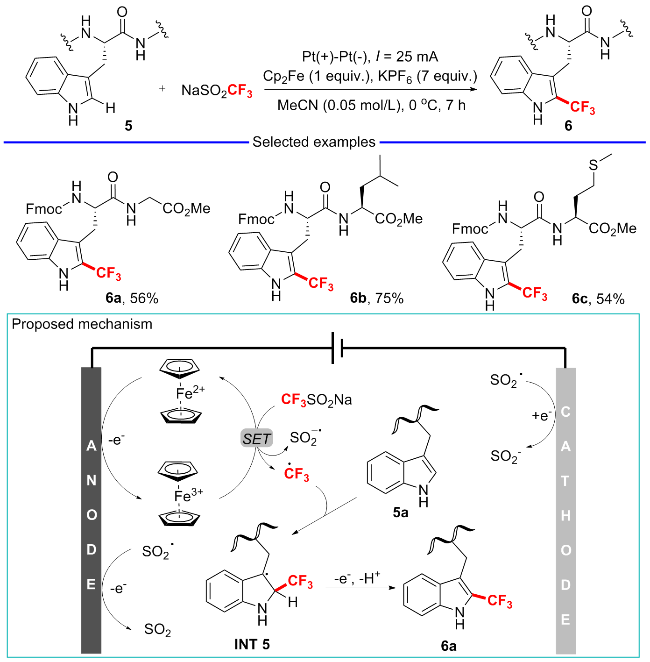
2023年, Chiang课题组[12]开发了一种创新的电化学策略, 成功实现了色氨酸残基上吲哚环C-2位的选择性三氟甲基化修饰(Scheme 4). 该策略通过二茂铁介导的间接电合成途径, 以良好的分离收率高效地制备了三氟甲基化肽类化合物. 值得注意的是, 在直接电解条件下未能观察到色氨酸的三氟甲基化反应, 而引入二茂铁作为电子介体后, 反应得以顺利进行. 实验证明, 该方法对多种寡肽体系均表现出优异的色氨酸残基选择性. 结合循环伏安法(CV)和密度泛函理论(DFT)计算, 作者揭示了可能的反应机理: 首先, 二茂铁(II)在阳极被氧化为二茂铁(III), 二茂铁(III)随后通过单电子转移(SET)过程氧化CF3SO2Na, 产生CF3•自由基和SO2•—, 生成的CF3•自由基随后选择性加成至色氨酸残基, 生成中间体INT 5, 而SO2•—既可以在阳极被氧化为SO2, 亦可以在阴极被还原为SO2—. 中间体INT 5经过去质子化和阳极氧化得到最终产物6a. 该工作建立的电化学三氟甲基化方法为含色氨酸肽类的选择性修饰提供了新的研究工具.
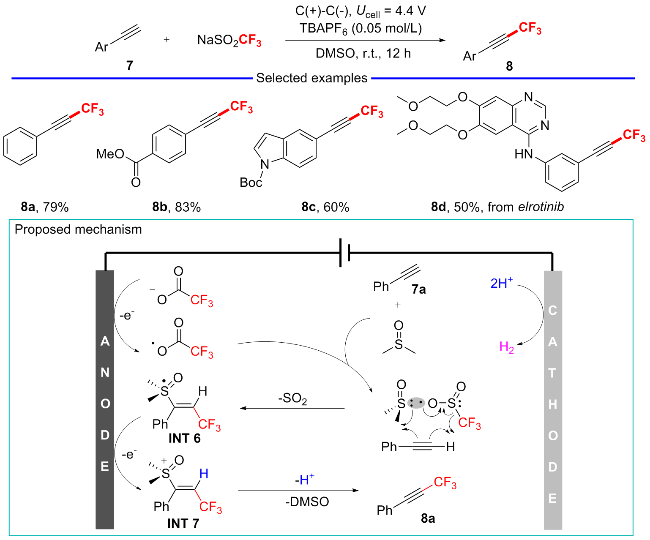
2024年, Cho等[13]开发了一种用于末端炔烃C(sp)—H键电化学三氟甲基化方法, 促进了含CF3炔烃的有效合成(Scheme 5). 这种方法的成功之处在于使用DMSO作为“掩蔽助剂”, 有效地稳定了烯基中间体, 使反应在温和条件下顺利进行, 得到了广泛的实验和计算研究的支持. 这些研究阐明了自由基三氟甲基化在化学合成中的独特机制, 并扩展了其潜在应用. 基于一系列实验和计算结果, 作者提出了以下可能的反应机理: 首先, SO2CF3发生单电子氧化生成•SO2CF3自由基. 特别值得注意的是, 在DMSO存在的情况下•SO2CF3自由基分解为CF3•自由基和SO2的速度明显慢于无DMSO存在的情况, 说明DMSO能够有效稳定该自由基, 通过DFT计算证实两者之间存在较强的相互作用(结合能为67.15 kJ·mol1, O—S键距为0.229 nm). 此外, 通过动力学同位素效应(KIE)实验进一步验证了DMSO在反应中的关键参与作用. 在反应体系中加入苯乙炔7a后, CF3•自由基优先加成至炔烃位点, 随后与DMSO发生反应, 释放一分子SO2而得到中间体INT 6, 然后在阳极氧化得到中间体INT 7, 最后经过去质子化和脱去一分子DMSO得到最终产物8a.
1.2 三氟甲基化级联环化反应
1.2.1 三氟甲基化/C—C键构建级联环化反应
2022年, 钟为慧课题组[16]以石墨毡为阳极、泡沫镍为阴极, 以KPF6为电解质, TsOH·H2O为添加剂, 50 ℃条件下在DMSO和H2O(体积比为3∶1)混合溶剂中以6 mA的恒定电流持续反应12 h, 实现了未活化烯烃的三氟甲基化级联环化反应, 该反应以原子经济性方式实现了多种多环喹唑啉酮的高效合成(28个产物, 收率52%~81%). 2023年, 臧中林课题组[17]以Langlois试剂作为三氟甲基化试剂, 通过调控底物氮原子上保护基团的电子效应, 成功开发了一种高效的三氟甲基化/ C(sp2)—H键级联环化策略, 该方法分别以石墨为阳极, 铂为阴极, LiClO4为电解质, 在乙腈溶剂中以10 mA恒定电流持续反应2 h, 实现了高效构建官能团化的四氢喹啉和二氢喹啉酮骨架. 陈志卫课题组[15d]开发了一种新颖的电化学策略, 实现了苯并咪唑骨架中未活化烯烃与C(2)—H键的三氟甲基化/级联环化反应. 该反应采用廉价易得的Langlois试剂作为三氟甲基自由基源, 以石墨毡为阳极, 铂为阴极, n-Bu4NBr为电解质, 在DMSO和H2O(体积比为3∶1)混合溶剂中以4 mA恒定电流持续反应10 h, 高效构建了一系列结构多样的多环苯并咪唑衍生物(30个产物, 产率34%~78%).
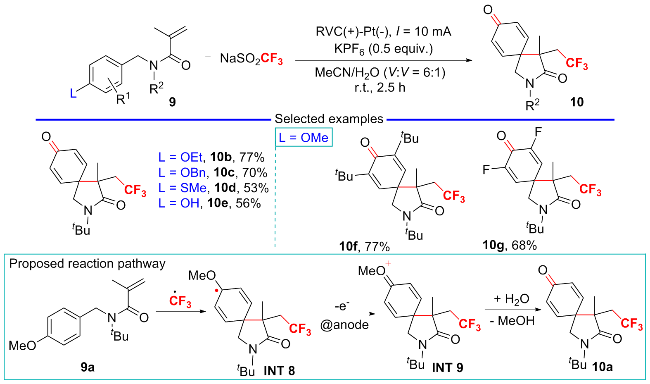
2023年, 唐海涛课题组[18]开发了一种电化学促进的N-(芳基磺酰基)丙烯酰胺、CF3SO2Na和H2O的三组分三氟甲基化/级联螺环化反应策略. 受此启发, 2024年, 王磊课题组[19]开发了一种以Langlois试剂为三氟甲基来源的N-苄基丙烯酰胺的电化学级联三氟甲基化/级联螺环化反应, 该策略以网状玻璃碳(RVC)为阳极, 铂为阴极, KPF6 为电解质, 室温条件下在MeCN/H2O(体积比为6∶1)混合溶剂中以10 mA恒定电流持续反应2.5 h, 构建了一系列含CF3的2-氮杂螺[4.5]癸烷骨架(Scheme 6). 作者通过一系列控制实验提出了该反应可能的机理, NaSO2CF3在阳极氧化得到CF3•自由基, 其与底物9a反应后得到碳自由基中间体INT 8, 该中间体在阳极被氧化得到正离子中间体INT 9. 最后, 通过水解作用以甲醇方式脱去甲氧基得到最终产物10a. 在阴极, 水得到电子被还原为氢气和氢氧根离子. 值得一提的是, 该方法除了得到不同取代基的三氟甲基化产物外, 还以良好的收率得到了二氟甲基化以及磺酰基化产物, 表现出了良好的底物适用性.
1.2.2 三氟甲基化/C—O键构建级联环化反应
2022年朱庭顺课题组[20]开发了一种电化学驱动的吲哚非对映选择性氧三氟甲基化策略, 成功实现了环境友好型的含三氟甲基螺环吲哚啉的高效构建, 该反应通过阳极氧化原位产生CF3•自由基, 经自由基加成/分子内螺环化的级联过程, 一步完成C—CF3键形成与螺环骨架构建, 展现出优异的原子经济性和立体选择性. 2023年黄精美课题组[21]开发了一种电化学介导的N-烯丙基酰胺与三氟甲磺酸钠/磺酰肼的自由基级联环化反应, 高效构建了三氟甲基化及磺酰化噁唑啉衍生物, 该绿色合成策略在温和条件下展现出优异的官能团兼容性和广泛的底物适用范围, 为含氟杂环化合物的制备提供了新思路. 同年, De Sarkar课题组[15a] 提出了一种环境友好的电化学氧化策略, 通过阳极氧化原位生成CF3•自由基, 并成功应用于β,γ-不饱和肟的级联环化反应, 高效构建了异噁唑啉骨架. 该反应通过连续的C—C和C—O键形成过程, 在温和、稳定且可放大的条件下展现出优异的底物普适性. 机理研究表明阳极氧化在级联过程中起着关键作用, 而所得异噁唑啉产物可进一步衍生化为多种高价值化合物.
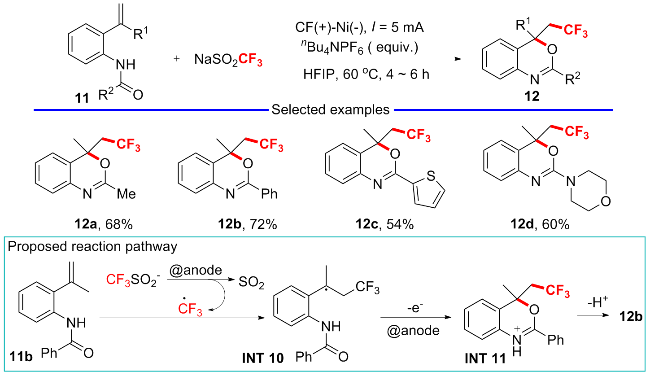
2024年周宇课题组[22]均以NaSO2CF3为三氟甲基源, 通过阳极氧化产生CF3•自由基, 进攻碳碳双键引发级联环化反应构建含氧杂环化合物. 通过N-(2-乙烯基苯基)酰胺的电化学氧化诱导自由基级联环化反应, 高效地构建了含三氟甲基的苯并噁嗪及噁唑啉骨架(Scheme 7). 通过一系列机理研究, 作者提出了可能的反应路径: 在阳极, CF3SO2Na首先被氧化生成CF3SO2•自由基, 该自由基随后分解形成高活性的CF3•自由基. 这些CF3•自由基选择性地进攻与烯烃底物11b的C=C形成关键的烷基中间体INT 10. 随后, 中间体INT 10经历分子内自由基环化反应, 并在阳极进一步氧化生成环化产物INT 11. 最终, 中间体INT 11通过去质子化过程, 转化为目标产物12b.
1.2.3 三氟甲基化/C—N键构建级联环化反应
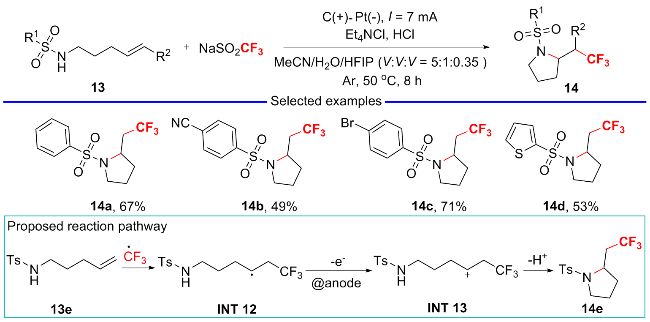
在过去的十几年间, 研究者们通过系统性地开发和应用各类亲核型与亲电型三氟甲基化试剂, 成功建立了一系列高效可靠的合成策略, 实现了对胺类化合物及含氮杂环体系的选择性三氟甲基化修饰. 近几年, 利用电化学策略对含氮化合物进行三氟甲基化修饰, 为开发环境友好的新型有机转化提供了创新性解决方案[23]. 2024年, 尹志平课题组[24]开发了一种高效、可持续的电化学合成策略, 成功实现了多种三氟甲基吡咯烷类化合物的绿色制备(Scheme 8). 该方法以廉价易得的Langlois试剂作为三氟甲基源, 通过电化学驱动的三氟甲基化/ C—N键构建级联环化反应, 将一系列未活化烯烃高效转化为目标杂环化合物, 收率可达43%~80%. 详细的机理研究表明, 该转化过程起始于阳极单电子转移氧化产生的CF3•自由基, 该自由基进攻烯烃底物13e的C=C发生选择性自由基加成, 形成关键的碳自由基中间体INT 12. 随后, 该自由基中间体在阳极被进一步氧化, 生成高活性的碳阳离子中间体INT 13. 这一碳阳离子中间体随即经历分子内亲核环化反应和去质子化, 生成三氟甲基化的N-杂环骨架结构14e. 与此同时, 在阴极区域, 溶液中的质子通过还原反应生成氢气作为副产物. 值得关注的是, 该方法已成功应用于抗炎药物塞来昔布的结构修饰和克级规模合成, 充分展现了其在药物化学和工业化生产中的重要应用价值.
1.3 脱羧三氟甲基化
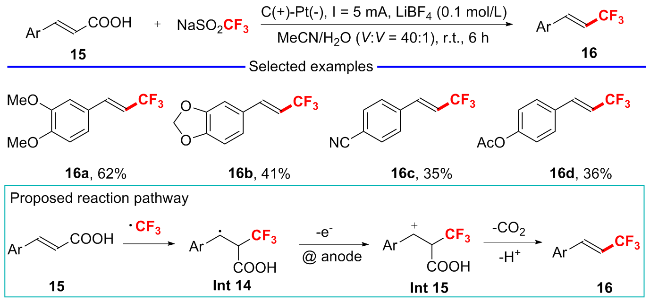
β-(三氟甲基)苯乙烯的缺电子烯烃结构赋予其独特的反应活性, 因此其合成方法备受关注. β-(三氟甲基)苯乙烯的传统合成主要依赖于过渡金属催化的偶联反应[25]. 近年来, 以肉桂酸衍生物为原料的脱羧三氟甲基化反应, 因其原料易得而受到广泛关注, 研究人员以Togni试剂为三氟甲基自由基源, 采用不同的催化剂实现了对肉桂酸衍生物的脱羧三氟甲基化[7,26]. 考虑到Togni试剂的高成本限制, 研究者们将目光转向了更为经济的Langlois试剂(NaSO2CF3), 将其作为三氟甲基自由基源[8,27]. 虽然传统方法需要过量氧化剂, 但近期电化学方法的引入带来了突破性进展. 两个独立研究团队分别采用电化学策略, 利用Langlois试剂实现了肉桂酸衍生物的脱羧三氟甲基化, 这一创新使得三氟甲基自由基的生成不再依赖化学计量氧化剂[28]. 在具体实验条件方面, 黄精美团队采用石墨阳极/铂阴极的未分割电解池体系, 在DME/H2O(体积比为4∶1)混合溶剂中, 以LiClO4为持电解质, 添加三氟乙醇(TFE), 5 mA恒电流条件下进行反应[28a]. 黄玉冰课题组则选用DMSO/ CH2Cl2(体积比为1.5∶1)为溶剂体系, nBu4NPF6为电解质, 在7 mA恒电流条件下实现了高效转化[28b]. 这些研究为绿色合成β-(三氟甲基)苯乙烯提供了重要参考.
2025年, Yamamoto等[29]创新性地采用电化学驱动策略, 以廉价易得的肉桂酸衍生物为原料, 在无外加添加剂条件下实现了Langlois试剂(NaSO2CF3)介导的高效脱羧三氟甲基化反应(Scheme 9). 并通过深入的机理计算研究, 揭示了芳基取代基电子效应对反应选择性的调控规律. 作者还提出了可能的反应机理: Langlois试剂在阳极氧化过程中产生CF3•自由基, 同时释放SO2. 生成的CF3•自由基与肉桂酸15反应形成苄基中间体Int 14. Int 14在阳极氧化下生成中间体Int 15, 随后脱羧释放出CO2和H+得到β-(三氟甲基)苯乙烯16. 值得关注的是, 所得β-(三氟甲基)苯乙烯可高效转化为4-芳基- 3-(三氟甲基)吡咯烷等含氟杂环化合物, 充分展现了其在复杂含氟分子构建中的合成潜力. 该工作不仅为含氟砌块的绿色合成提供了新思路, 也为后续功能化应用奠定了坚实基础.
1.4 脱磺酰基三氟甲基化
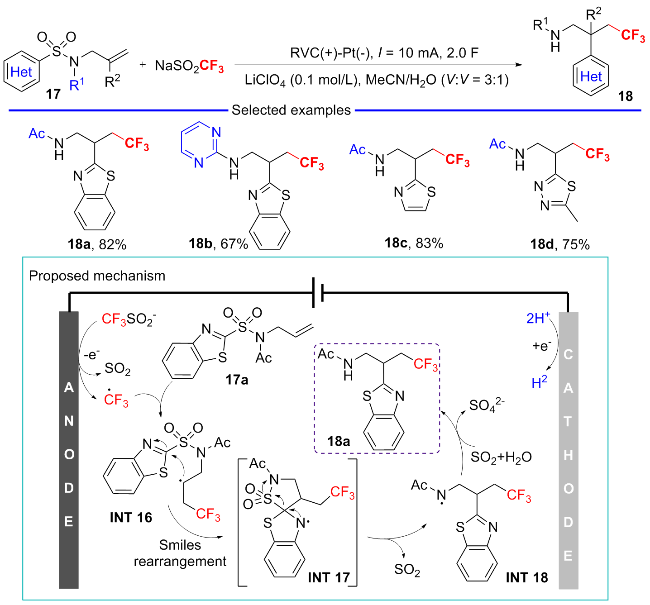
烯丙基胺异芳基三氟甲基化反应为γ-三氟甲基异芳基乙胺衍生物的合成提供了一条高效直接的路径. 虽然芳基三氟甲基化反应已有多种成熟方法, 但针对烯丙基胺体系的异芳基三氟甲基化反应研究仍较为匮乏. 受Nevado课题组[30]开创性工作的启发, 朱庭顺团队[31]在2022年设计了自由基介导的N→C迁移策略, 成功实现了该转化(Scheme 10). 该反应机理涉及三个关键步骤: 首先通过阳极氧化CF3SO2Na产生CF3•自由基; 该自由基对未活化烯烃17a的C=C进行加成得到碳自由基中间体INT 16, 随后经过本位加成得到螺环中间体INT 17; 然后经SO2消除得到氮自由基中间体INT 18. 中间体INT 18可能被溶解的SO2还原而得到最终产物18a. 值得关注的是, 与传统氧化反应机制不同, 该体系中Langlois试剂的SO2组分与Smiles重排过程可能协同发挥了化学还原剂的作用.
2 O—H键三氟甲基化反应
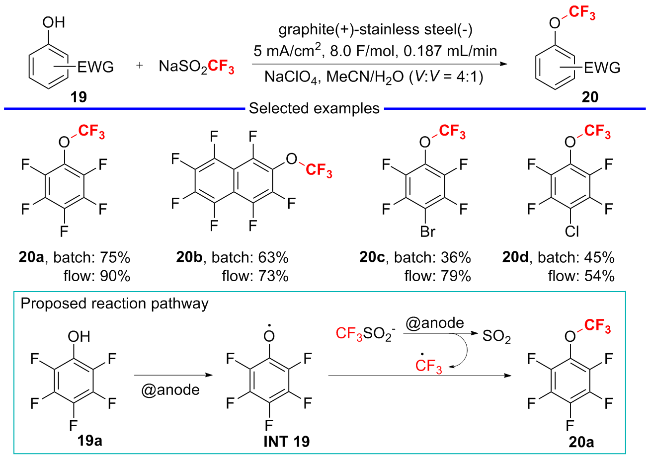
目前, 电化学三氟甲基化反应以C—H键的三氟甲基化为主, 其他形式的三氟甲基化反应报道很少. Terfort团队[32]在电化学构建O—CF3领域取得了不错的进展. 2021年, 他们[32a]开发了一种高效、可持续的电化学合成方法, 通过一步反应实现了缺电子酚类化合物向芳基三氟甲基醚(ArOCF3)的转化. 该方法采用Langlois试剂作为三氟甲基原料, 在阳极氧化条件下成功实现了含氟、氯、溴及腈基等吸电子基团的苯酚衍生物的直接O-三氟甲基化反应. 实验结果表明, 该反应条件温和(室温、常压), 产率可达75%, 且可扩展至克级规模生产. 2023年该课题组[32b]又创新性地将电化学合成与流动化学技术相结合, 成功建立了可在微流池中实施的流动电化学合成方案(Scheme 11). 在该方法中, Langlois试剂与酚类底物在微流反应器中同步进行阳极氧化, 一步即可高效地转化为目标三氟甲基醚产物, 最高产率达90%. 作者提出了可能的反应机理: 苯酚19a在阳极被氧化为氧自由基中间体INT 19, 同时CF3SO2Na也在阳极被氧化产生CF3•自由基, 二者结合即可得到三氟甲基化产物20a. 值得注意的是, 该策略结合了电化学合成和流动技术的优点, 与间歇工艺相比, 流动工艺的产率更高(从75%提高到90%), 所需电流密度更低(仅为间歇工艺的一半), 反应时间更短(从19 h缩短到4 h), 反应的选择性更高, 副产物更少. 这种电化学流动合成策略可以克服间歇电池工艺的主要挑战(起始原料转化缓慢、产率不高和区域选择性不高), 为三氟甲基醚类化合物的制备提供了一条高效、环保的新途径.
3 S—H键三氟甲基化反应
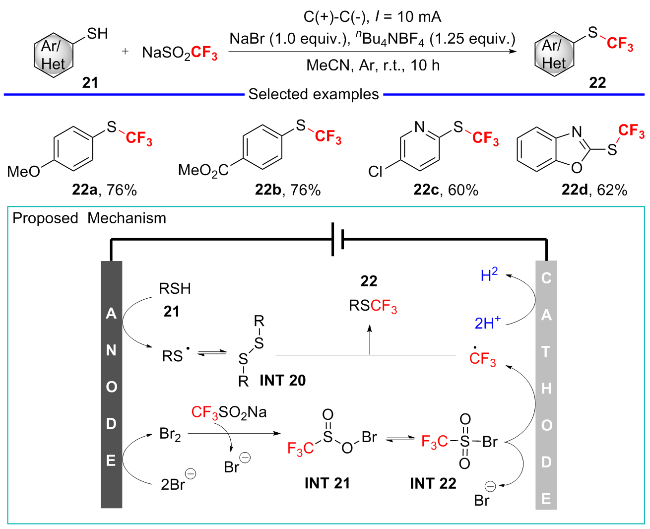
在药物化学领域, 将三氟甲硫基(SCF3)引入药物分子结构是一种重要的修饰策略, 这种修饰能显著增强化合物的亲脂性, 同时改善其跨膜渗透性, 从而提高生物利用度. 这一特性使得三氟甲硫基化成为现代药物设计中极具价值的分子改造手段. 近二十年来, 三氟甲基芳基硫醚(ArSCF3)的合成研究取得了突破性进展, 研究者们相继开发出多种高效、温和的合成策略, 包括过渡金属催化、光催化、电化学合成等创新方法[33]. 2021年, 许华建课题组[34]开发了一种无需金属催化剂和氧化剂参与的S—H键电化学三氟甲基化方法(Scheme 12). 该反应以石墨板为电极, 四氟硼酸四丁基铵为电解质, 溴化钠为辅助剂, 乙腈为溶剂, 恒电流为10.0 mA, 在氩气保护下室温反应10 h, 以中等至良好产率得到了一系列三氟甲基芳基硫醚. 值得一提的是, 该策略除了适用于各种取代苯硫酚底物之外, 还适用于吡啶、嘧啶和苯并噁唑等杂环取代的硫醇, 表现出良好的底物适用性. 作者通过一系列控制实验提出了可能的反应机理: 首先, 硫酚在阳极发生氧化反应, 通过析氢过程生成硫自由基中间体; 随后, 这些硫自由基通过二聚作用在原位转化为二硫化物中间体INT 20. 与此同时, 来源于电解液中的溴化钠的溴离子在阳极被氧化生成溴分子(Br2), 该溴分子随即与CF3SO2Na发生反应, 形成关键的磺酰基次溴化物中间体INT 21, 该中间体与另一种活性中间体INT 22保持着动态平衡. 在阴极区域, 中间体INT 21或INT 22通过还原或均裂过程, 分解释放出SO2气体, 同时再生溴离子并产生CF3•自由基, 产生的CF3•自由基与二硫化物中间体INT 20发生高效偶联, 最终形成目标产物22. 整个电化学循环的完成伴随着阴极区氢离子的还原, 并以氢气的形式释放. 此外, 作者还尝试对该方法进行克级放大实验研究, 表现出良好的效果, 表明该方法具备一定的应用前景.


4 结论与展望
综上所述, 近年来, Langlois试剂在电化学三氟甲基化反应中获得了广泛的应用. 国内外研究人员通过对电极、电解质、溶剂、添加剂、温度、电流强度等条件的探索, 开发了众多利用Langlois试剂进行三氟甲基化反应的电化学合成策略. 其中, 研究最热门的领域当属C—H键的三氟甲基化, 而在C—H键的三氟甲基化反应中, 又包括C—H键的直接三氟甲基化、C—H键三氟甲基化级联环化反应、脱羧三氟甲基化、脱磺酰基三氟甲基化等多个细分领域, 其中C—H键的直接三氟甲基化和C—H键三氟甲基化级联环化反应两个方向的相关报道很多, 已成为构建含三氟甲基分子结构的主要策略. 除C—H键的三氟甲基化之外, 仅有少量关于酚类化合物O—H键的三氟甲基化和硫酚类化合物S—H键的三氟甲基化的报道, 可能是由于其他类型的三氟甲基化反应难度更大且应用偏少. 此外, 目前报道的电化学三氟甲基化策略尚存在不足之处, 如(1)电极间的电子转移过程存在热力学不稳定性, 容易引发非目标位点的氧化还原反应, 生成副产物, 降低反应选择性和产率; (2)在碳氢键活化等反应中, 电化学方法常面临区域选择性不佳的问题, 因而需要引入相应的添加剂, 增加了体系复杂性和成本; (3)反应高度依赖电极材料或电解质, 限制了底物适用范围和操作便捷性. 这些也是今后研究者们需要重点关注和解决的问题.
电化学合成作为绿色有机合成的核心技术, 将继续在药物分子合成中扮演重要角色. 展望未来, 基于电化学合成三氟甲基化反应的未来发展将聚焦于以下三大维度: (1)精准控制与选择性提升, 如结合手性催化剂或电极修饰技术, 开发不对称电合成新体系, 实现高立体选择性转化, 满足药物合成需求, 又如通过程序化交流电精准调控电流波形、频率等参数, 实现反应路径的动态切换; (2)工艺创新与规模化应用, 如开发光电化学流通池与连续流反应器, 实现百克级放大生产; (3)前沿交叉与可持续发展, 如开发新型材料电极, 增强电极稳定性并降低贵金属依赖, 提高催化效率与经济性. 随着研究的不断深入, 在有机小分子的三氟甲基化反应中必然会涌现出一些新的三氟甲基化试剂和新的策略, 可能拓宽三氟甲基化的反应类型, 而Langlois试剂仍然是电化学三氟甲基化反应的一个重要选项.
(Li, L.)