


苯并异色烷醌类化合物(benzoisochromanequinones, BIQs)是一类具有显著生物活性的醌类化合物, 因其结构复杂性和生物活性备受关注. 这类化合物结构多样, 其骨架的生物合成主要通过II型聚酮合酶(PKS-II)系统完成, 该类化合物的生物合成基因簇异源表达研究表明, BIQs与蒽醌(anthraquinones)和二蒽酮(dianthrones)类化合物共享部分生物合成路径, 且PKS组件对底物具有较高的宽容性和混杂性[1]. BIQs类化合物具有显著的抗菌、抗肿瘤、抗白血病、抗自由基和神经保护等广泛的生物学活性[2-4]. 因此, 发现更多的该类化合物进行开发利用具有重要的意义.
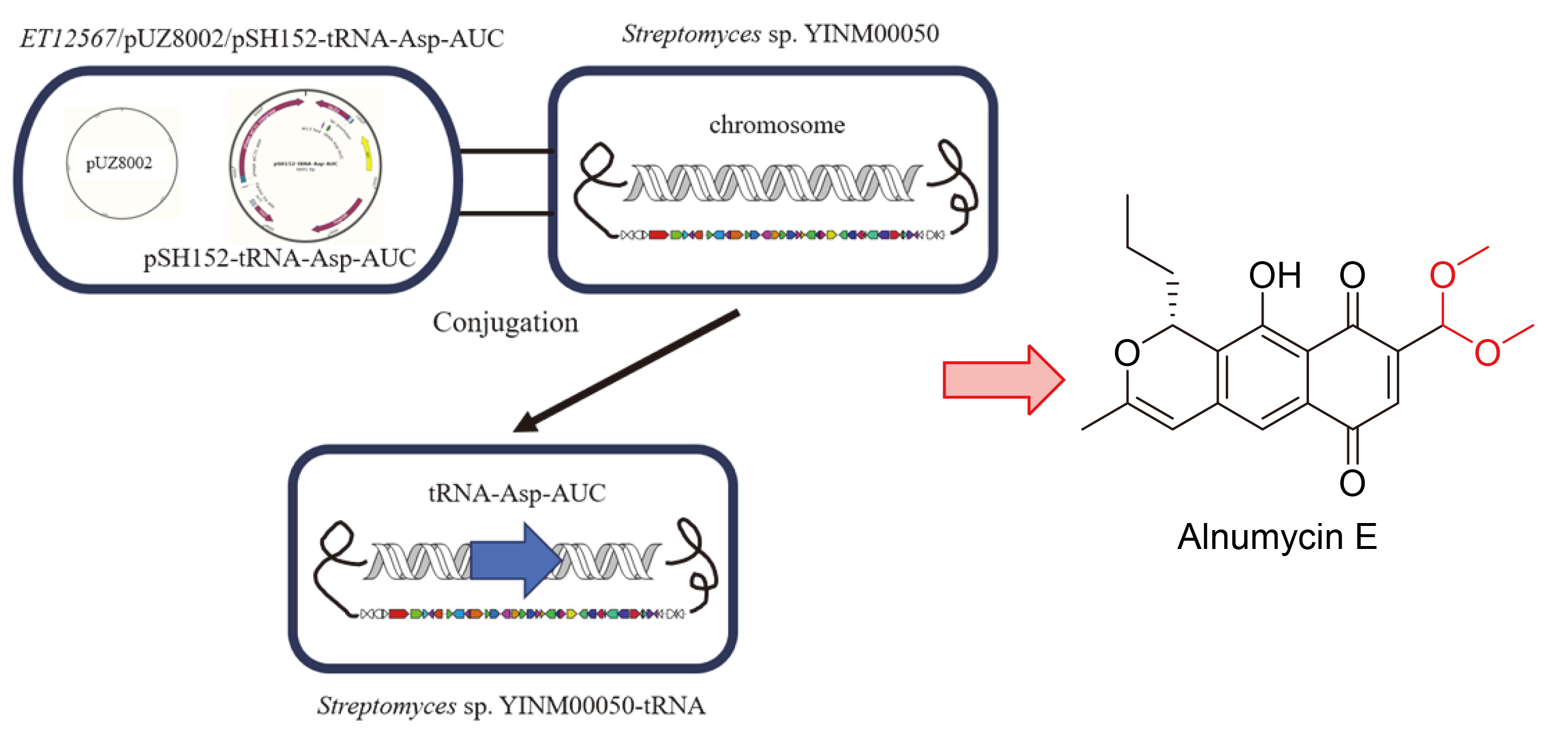
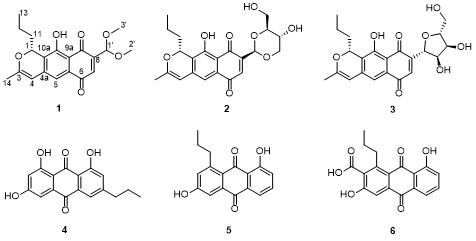
在微生物类群中, 放线菌是开发活性天然产物的宝库. 据统计, 约70%的临床和农用抗生素来源于放线菌, 同时, 放线菌还产生大量抗肿瘤药物、免疫抑制剂等活性药物[5]. 为了从放线菌中发现更多活性天然产物, 基因组挖掘技术已经被广泛应用. 通过分析基因组中生物合成基因簇的结构特征, 结合调控基因的敲除或过表达、关键结构基因的合理改造, 为高效地发现新化合物提供了新的途径[6]. 在我们对先前建立的药用植物内生放线菌库进行基因组挖掘时, 发现Streptomyces sp. YINM00050的基因组中有一个可能的芳香聚酮类化合物的生物合成基因簇. 本研究旨在通过基因组挖掘策略定向获取更多类型的苯并异色烷醌类化合物. 我们首先对YINM00050野生型菌株进行系统的遗传改造, 构建了突变株YINM00050-tRNA. 通过对比分析突变株与野生型的发酵代谢产物, 成功分离鉴定了6个次级代谢产物, 其中包括1个结构新颖的苯并异色烷醌类化合物Alnumycin E以及2个已知苯并异色烷醌类和3个已知蒽醌类化合物(图1). 新化合物Alnumycin E展现出显著的广谱抗肿瘤细胞毒活性, 且对人正常肺上皮细胞BEAS-2B无明显毒性. 该研究成果不仅丰富了苯并异色烷醌类化合物的结构多样性, 更重要的是, 验证了基于基因组挖掘结合遗传改造的策略在定向发现活性天然产物方面的有效性和靶向性, 为后续天然药物开发提供了新的研究思路和技术路径.
1 结果与讨论
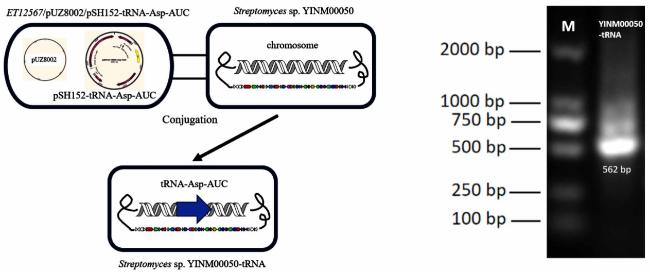
本课题组从云南高黎贡山区药用植物唐松草(Thalictrum aquilegiifolium var. sibiricum Regel & Tiling)中分离到一株内生链霉菌Streptomyces sp. YINM00050, 该菌株的16S rRNA基因序列(Genbank登录号: PV759741)与链霉菌Streptomyces umbrinus NBRC 13091(T)的相似性为100%. 基因组挖掘显示, 菌株YINM00050中包含了一个II型聚酮类基因簇, 与Alnumycin的生物合成基因簇有较高的相似性, 推测其可能产生苯并异色烷醌类化合物. 我们采用了实验室常用的5种链霉菌发酵培养基, 对野生型菌株YINM00050进行了发酵研究. 遗憾的是, 虽然HPLC检测到蒽醌类化合物的特征峰, 但由于产量太低, 没有分离到目标化合物. 究其原因可能是基因簇中某些关键基因表达量太低, 导致产物的产量过低, 难以分离鉴定. 因此, 采用了本实验室常用的链霉菌基因簇激活质粒pSH152- tRNA-Asp-AUC[7], 该质粒不仅能通过有效识别链霉菌中天冬氨酸的稀有密码子鸟嘌呤-腺嘌呤-胸腺嘧啶(GAT)来促进链霉菌次级代谢产物基因簇的表达, 还能通过调控抗生素合成关键因素维生素B12相关化合物的合成来提升次级代谢产物的产率. 例如, 将质粒pSH152-tRNA-Asp-AUC转入天蓝色链霉菌后, 能够显著提高Undecylprodigiosin、Actinorhodin和Methyleno- mycin的产量; 此外, 将其转入不同抗生素(Natamycin、Daptomycin、Daptomycin、β-Lactam clavulanic acid和daunorubicin)的生产菌株后, 也显著提高了这些次级代谢产物的产量[7]. 因此, 我们通过接合转移将质粒pSH152-tRNA-Asp-AUC导入野生型菌株YINM00050中, 构建了突变株YINM00050- tRNA(图2).
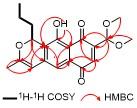
HPLC检测发现突变株YINM00050-tRNA中可能的芳香聚酮类化合物的产量显著提高. 最终, 从13 L发酵液中共获得了6个芳香聚酮类化合物, 其中化合物1为新化合物. 该化合物为红色固体, 通过高分辨质谱(HR-ESI-MS)提供的准分子离子峰m/z 359.1488 (M+ H)+, 推测该化合物分子式为C20H22O6, 不饱和度为10. 600 MHz核磁共振1H NMR数据(表1)和HSQC相关信号显示, 化合物1存在2个甲基质子信号[δH: 0.96 (t, J=7.1 Hz, 3H, H-13), 1.96 (s, 3H, H-14)]; 2个甲氧基质子信号[δH: 3.43 (s, 3H, H-3'), 3.44 (s, 3H, H-2')]; 2个亚甲基质子信号[δH: 1.45~1.52 (m, 1H, H-12a), 1.48~1.55 (m, 1H, H-11a), 1.53~1.60 (m, 1H, H-12b), 1.96~2.02 (m, 1H, H-11b)]; 5个次甲基质子, 包括2个氧取代的sp3次甲基质子[δH: 5.52 (s, 1H, H-1'), 5.58 (dd, J=9.3, 3.5 Hz, 1H, H-1)]和3个sp2次甲基质子信号[δH: 5.60 (s, 1H, H-4), 6.99 (s, 1H, H-7), 7.13 (s, 1H, H-5)]; 1个羟基质子[δH 12.25 (s, 1H, OH-10)]. 13C NMR数据(表1)和HSQC相关信号显示, 该化合物中含有4个甲基信号[δC: 13.8 (C-13), 20.4 (C-14), 54.2 (C-2'), 54.3 (C-3')]; 2个亚甲基信号[δC: 18.1 (C-12), 24.9 (C-11)]; 5个次甲基信号[δC: 73.0 (C-1), 97.3 (C-1'), 100.0 (C-4), 114.3 (C-5), 135.2 (C-7)]; 以及9个季碳, 其中包括7个烯烃碳[δC: 113.0 (C-9a), 122.4 (C-10a), 131.4 (C-5a), 139.6 (C-4a), 144.8 (C-8), 157.1 (C-10), 158.5 (C-3)]和两个羰基碳[δC: 184.8 (C-6), 187.8 (C-9)]. 通过比较发现化合物1与已知化合物Alnumycin A (2)的核磁数据[8]极其相似, 表明1与Alnumycin A的结构类似, 不同之处在于C-1'位的取代差异. 结合化合物1中H-1'与C-7, C-8, C-9相关, H-2'和H-3'与C-1'的HMBC相关(图3), 可确定C-1'与两个甲氧基相连. 其余二维核磁波谱数据也进一步证实了上述推论. 根据已报道的Alnumycin A的立体构型[9], 结合化合物1与Alnumycin A高度一致的核磁数据, 以及相似的比旋光度值($[\alpha]_{\mathrm{D}}^{25}$+51.8 vs Alnumycin A+170.0)确定化合物1具有相同的1R绝对构型, 其结构如图1所示, 命名为Alnumycin E.
表1 化合物1的1H NMR (600 MHz)和13C NMR (151 MHz)核磁数据(CD3OD)Table 1 1H NMR (600 MHz) and 13C NMR (151 MHz) data of compound 1 in CD3OD |
| Position | δC, type | δH, mult (J in Hz) |
|---|---|---|
| 1 | 73.0, CH | 5.58, dd (9.3, 3.5) |
| 3 | 158.5, C | — |
| 4 | 100.0, CH | 5.60, s |
| 4a | 139.6, C | — |
| 5 | 114.3, CH | 7.13, s |
| 5a | 131.4, C | — |
| 6 | 184.8, C | — |
| 7 | 135.2, CH | 6.99, s |
| 8 | 144.8, C | — |
| 9 | 187.8, C | — |
| 9a | 113.0, C | — |
| 10 | 157.1, C | — |
| 10a | 122.4, C | — |
| 11 | 34.9, CH2 | 1.96~2.02, m, overlapped 1.48~1.55, m, overlapped |
| 12 | 18.1, CH2 | 1.53~1.60, m, overlapped 1.45~1.52, m, overlapped |
| 13 | 13.8, CH3 | 0.96, t (7.1) |
| 14 | 20.4, CH3 | 1.96, s |
| 1' | 97.3, CH | 5.52, s |
| 2' | 54.2, CH3 | 3.44, s |
| 3' | 54.3, CH3 | 3.43, s |
| OH-10 | — | 12.25, s |


体外细胞毒活性测试结果显示, 化合物1表现出广谱的抗肿瘤活性, 其对5种人源肿瘤细胞株白血病HL-60、肺癌A-549、肝癌SMMC-7721、乳腺癌MCF-7和结肠癌SW480的IC50值介于(0.264±0.012)与 (4.609±0.039) μmol/L之间, 细胞毒活性显著优于临床化疗药物顺铂(DDP), 且对人正常肺上皮细胞BEAS-2B无明显活性(表2).
表2 化合物1的抗肿瘤活性(IC50±SD, μmol/L)Table 2 Anti-tumor activity of compound 1 (IC50±SD, μmol/L) |
| Compound | HL-60 | A549 | SMMC-7721 | MCF-7 | SW480 | BEAS-2B |
|---|---|---|---|---|---|---|
| 1 | 0.26±0.01 | 4.61±0.04 | 0.53±0.02 | 1.94±0.11 | 1.72±0.11 | >40 |
| DDP | 2.97±0.14 | 12.55±0.60 | 9.60±0.67 | 21.03±0.71 | 35.63±1.16 | >40 |
| Taxol | <0.008 | <0.008 | 0.28±0.02 | <0.008 | <0.008 | 0.46±0.01 |
2 结论
本研究通过导入质粒pSH152-tRNA-Asp-AUC, 获得了二型聚酮基因簇激活突变株YINM00050-tRNA, 并从发酵产物中分离到6个芳香聚酮类化合物, 包括一个新化合物, 命名为Alnumycin E. 该化合物具有广谱且强效的抗肿瘤活性. 文献表明, 在多株链霉菌中导入质粒pSH152-tRNA-Asp-AUC能显著提高多种次级代谢产物的产量, 并能缩短部分抗生素的产生时间. 研究结果表明, 新型tRNA的应用在微生物天然产物发现中具有较大的应用潜力.
3 实验部分
3.1 仪器与试剂
PCR扩增仪(赛默飞世尔SimpliAmpTM); 水平电泳仪(北京六一DYCP-32B); 凝胶成像系统(BioRad Syngene); 紫外分光光度计(岛津UV-2550 PC型); 高分辨电喷雾质谱仪(HR-ESI-MS, 安捷伦1260 Q-TOF); 分析兼半制备高效液相色谱仪(Agilent 1260); 分析色谱柱(Agilent C18 5 μm, 250 mm×4.6 mm), 半制备柱(Venusil XBP C18, 5 μm, 250 mm×10 mm); 高分辨质谱仪(Agilent 1100 HPLC/TOF), 核磁共振仪(布鲁克Avance-600 MHz).
生物试剂购自宝日医生物技术(北京)有限公司, 进口化学试剂购自Sigma-Aldrich公司, 国产化学试剂购自云南利研科技有限公司, 引物合成和DNA测序由北京擎科生物科技股份有限公司完成, 链霉菌Streptomyces sp. YINM00050由本实验室分离鉴定, 突变株YINM00050-tRNA由本实验室构建, 质粒pSH152- tRNA-Asp-AUC由西北生态环境资源研究院陈熙明教授惠赠[7], 其它细胞株、大肠杆菌菌株和质粒由本实验室保存.
3.2 实验方法
3.2.1 突变株的构建
大肠杆菌采用LB (Luria-Bertani)固体和液体培养基于37 ℃进行培养. 链霉菌采用MS、ISP-2、ISP-4、TSA、R2A、IWL-4等固体培养基于28 ℃进行培养, 从中挑选出生长迅速且产孢较好的培养基进行进一步实验. 采用标准电击转化方法将质粒pSH152-tRNA-Asp-AUC转入供体菌ET12567/pUZ8002. 大肠杆菌和链霉菌中DNA相关操作、PCR扩增、接合转移及突变株筛选方法如文献[13]所述, 使用引物pSH 152-tRNA-F(5'-CGC- GTGACGCTCGTCTCCAGG-3')和pSH 152-tRNA-R(5'- CGATCGCCGGGCAGCGTACG-3'), PCR产物大小为562 bp.
3.2.2 突变株的发酵及分离
将突变株YINM00050/pSH152-tRNA-Asp-AUC于ISP-2固体培养基中划线培养2~3 d, 收集新鲜孢子接种于50 mL TSB液体培养基中, 于28 ℃, 250 r/min摇瓶培养24 h以获得种子液. 然后将种子液按体积分数为5%的量接入13 L的20#发酵培养基(甘油50 g、玉米粉25 g、酵母浸膏5 g、蒸馏水1000 mL, pH值7.0, 100 mL/瓶)于28 ℃、250 r/min培养15 d. 发酵产物用等体积的乙酸乙酯对发酵液萃取3遍, 并利用旋转蒸发仪对发酵混合物进行浓缩富集获得发酵粗提物(18 g).
3.2.3 化合物的分离及鉴定
粗提物采用中压液相色谱(MPLC), 以甲醇-水梯度 (0→100%甲醇, 20%梯度差)洗脱, 得到5个馏分(Fr.1~Fr.15). Fr.3经反相柱色谱(LiChroprep RP-18, 甲醇-水, 40%→80%甲醇)梯度洗脱, 得到Fr.3.1~Fr.3.5, 其中Fr.3.2和Fr.3.5经HPLC制备(ZORBAX SB-C18, 250 mm×9.4 mm, 5 μm; 溶剂A, 水; 溶剂B, 甲醇; 35%~70% B, 0~25 min; 流速3.0 mL/min)分别得到化合物6 (3.0 mg)和化合物3 (4.2 mg). Fr.4经反相柱色谱(Li Chroprep RP-18, 甲醇-水, 50%→100%甲醇)梯度洗脱, 得到Fr.4.1~Fr.4.5, 其中Fr.4.4以甲醇为洗脱溶液经凝胶色谱Sephadex LH-20纯化, 并通过HPLC制备(ZORBAXSB-C18, 250 mm×9.4 mm, 5 μm; 溶剂A, 水; 溶剂B, 甲醇; 60% B到80% B, 0~25 min; 流速3.0 mL/min)得到化合物5 (5.8 mg). Fr.4.5经反相柱色谱(LiChroprep RP-18, 甲醇-水, 50%→100%甲醇)梯度洗脱分离得到Fr.4.5.1~Fr.4.5.3, Fr.4.5.1经甲醇凝胶色谱Sephadex LH-20分离, 进一步通过HPLC制备(ZORBAX SB-C18, 250 mm×9.4 mm, 5 μm; 溶剂A, 水; 溶剂B, 甲醇; 50% B到75% B, 0~20 min; 流速3.0 mL/min))得到化合物1 (4.6 mg). Fr.5经反相色谱柱(LiChroprep RP-18, 甲醇-水, 20%→100%甲醇)梯度洗脱, 得到Fr.5.1~Fr.5.3. Fr.5.3进一步经反相色谱(LiChroprep RP-18, 甲醇-水, 50%→90%甲醇)分离得Fr.5.3.1~Fr.5.3.3, 其中Fr.5.3.2经HPLC制备(ZORBAX SB-C18, 250 mm×9.4 mm, 5 μm; 溶剂A, 水; 溶剂B, 甲醇; 65% B到85% B, 0~20 min; 流速3.0 mL/min)得到化合物2 (6.5 mg), Fr.5.3.3经甲醇凝胶色谱Sephadex LH-20纯化后, 再通过HPLC制备(ZORBAX SB-C18, 250 mm×9.4 mm, 5 μm; 溶剂A, 水; 溶剂B, 甲醇; 70% B到85% B, 0~15 min; 流速3.0 mL/min)得到化合物4 (3.9 mg).
Alnumycin E (1): 红色固体, m.p. 131.5~133.2 ℃; $[\alpha]_{\mathrm{D}}^{25}$+51.8 (c 0.10, MeOH); UV (MeOH) λmax [log ε/(L•mol-1•cm-1)]: 246 (3.18), 288 (2.64), 334 (1.05) nm; IR (KBr) νmax: 3415, 1679, 1205 cm-1; 1H和13C NMR数据见表1. HR-ESI-MS calcd for C20H23O6 [M+H]+ 359.1489, found 359.1488.
3.2.4 细胞毒活性实验
采用甲基噻唑基四氮唑法(MTS)[14]评价了化合物对五种人源肿瘤细胞株(白血病HL-60、肺癌A-549、肝癌SMMC-7721、乳腺癌MCF-7和结肠癌SW480)及人正常肺上皮细胞(BEAS-2B)的体外抑制活性. 参照美国典型培养物保藏中心(ATCC)操作规范, 将细胞接种于96孔板(每孔3×10²个细胞), 加入100 μL罗斯维尔公园纪念研究所(RPMI)培养基, 在37 ℃、体积分数为5%的 CO2的条件下培养24 h. 孵育结束后, 加入MTS试剂(Promega公司, 美国麦迪逊), 使用酶标仪测定490 nm处的吸光度. IC50值通过Reed和Muench法计算[15], 并以顺铂和紫杉醇作为阳性对照. 实验结果以三次独立测定的平均值±标准差(mean±SD)表示.
辅助材料(Supporting Information) 突变株次级代谢产物HPLC分析结果, 化合物1的HR-ESIMS和NMR图谱等. 这些材料可以免费从本刊网站(http://sioc- journal.cn/)上下载.
(Cheng, F.)