


1 Introduction
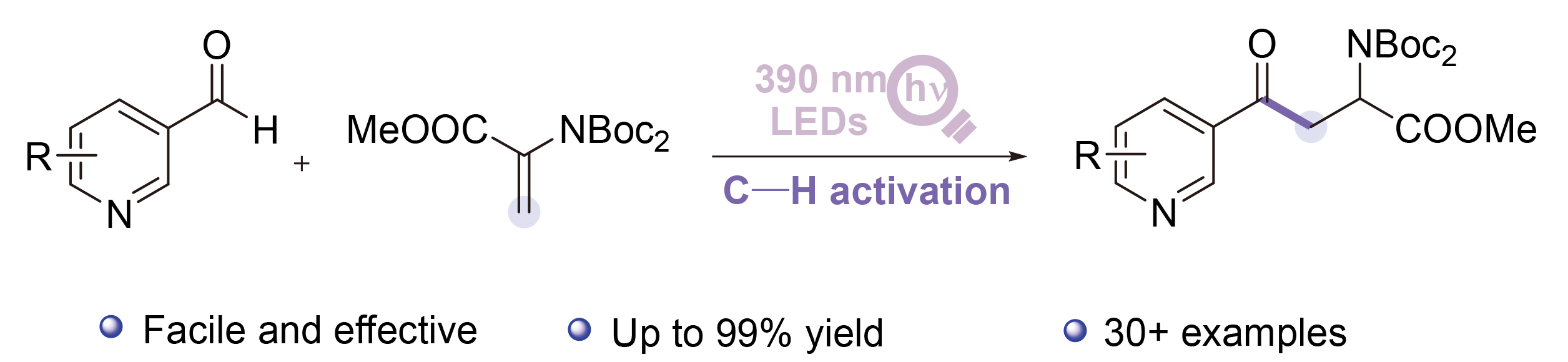
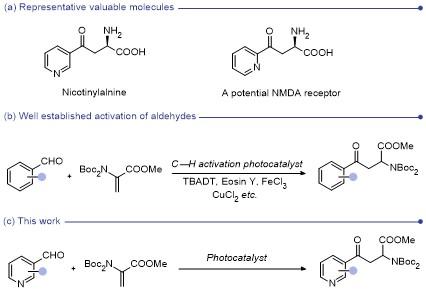
Non-natural α-amino acids (α-AAs) are indispensable tools in modern chemistry, serving as protease-resistant pharmacophores and chiral ligands.[1] However, existing methods for their synthesis often lack modularity, particularly for N-heteroaryl variants, which are underrepresented despite their pharmaceutical relevance.[2-3] An illustrative instance of this approach involves incorporating a side chain carbonyl group, a synthetically significant functional moiety that can effectively enhance molecular complexity through diverse transformations. The presence of a carbonyl group in the side chain of amino acids, which is naturally produced through metabolic pathways, holds crucial significance in biological processes.[4-7] Various methodologies for synthesizing γ-carbonyl amino acids have been documented in the literature.[8-13] Nitrogen-containing heteroaromatic compounds are prevalent in pharmaceuticals due to their direct influence on solubility, metabolic stability, and binding affinity of the molecules.[14-15] Incorporation of nitrogen-containing heteroaromatic rings like pyridine and quinine significantly alters the properties of amino acids and peptides. For instance, nicotinylalnine, a neuroprotective agent, acts as a potent inhibitor of two enzymes, kynurenine hydroxylase and kynurenine enzyme, whereas 2-amino-4-oxo-4-(pyridin-2- yl)butanoic acid, a pyridine derivative of aspartate, shows potential as an antagonist of NMDA receptors (Scheme 1a).[16-18] However, limited research has been conducted on the synthesis of analogous compounds.[16-17,19] Aryl formaldehyde is a commonly used class of reagents in chemical reactions. Recent advancements have been achieved in the activation of aldehyde C-H bonds using photocatalysts,[203420-34] leading to the synthesis of unnatural α-amino acids (Scheme 1b).[38-39] Despite this progress, the photoinduced activation of aryl formaldehyde containing nitrogen-containing heterocyclic rings such as pyridine and quinoline has not been documented. In this study, we present a novel photocatalytic method for the synthesis of nitrogenous heterocyclic aromatic α-amino acids from nitrogen-containing heterocyclic aromatic formaldehydes (Scheme 1c). In this protocol, heteroaryl aldehydes bearing diverse functionalities can be incorporated. The reaction of peptides and the late-stage reduction of non-natural α-AAs demonstrate the practical application potential of this approach.
2 Results and discussion
Our study commenced with an examination of the two model substrates involving nicotinaldehyde (1a) and methyl-2-(bis[(tert-butoxy)carbonyl]amino)-prop-2-enoate (2) (Table 1). When a mixture of 1a (0.2 mmol), 2a (1.5 equiv) and NaDT (3 mol%) in 1.0 mL of CH3CN was irradiated by 390 nm LED for 24 h at room temperature, nonnatural α-AAs 3a was yielded in 96.5% yield (Table 1, Entry 1). Careful screening of solvents proved the irre- placeability of CH3CN, all other solvents led to diminished yields (from trace to 58.3%, Table 1, Entry 2). Reducing the ratio of the feeding amounts of 1a:2a would not benefit the reaction, as well as increasing the ratio did (63.0%~ 80.1%, Table 1, Entry 3). Replacing NaDT with other photocatalysts also resulted in unsatisfactory yields (Table 1, Entry 4). The best NaDT dosages was confirmed to be 3% (Table 1, Entries 5~6). Changing the reaction times to other durations was found to be unsuitable for the transformation (41.9%~63.0%, Table 1, Entry 6).
Table 1 Optimization of the reactiona |

| Entry | Deviation from standard conditions | Yieldb/% |
|---|---|---|
| | ||

a Standard conditions: 0.2 mmol of 1a, 3.0 equiv of 2a, 0.03 equiv. of NaDT, 1.0 mL of CH3CN, room temperature, 24 W 390 nm LED, 24 h. PC1= [Ir(dFCF3ppy)2dtbbpy]PF6, PC2=[Ir(dtbbpy)(ppy)2]PF6, PC3=4-CzIPN, PC4=Eosin-Y; b Isolated yield. |
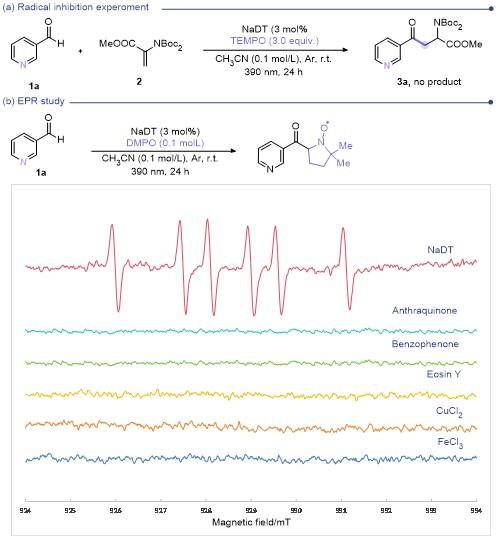
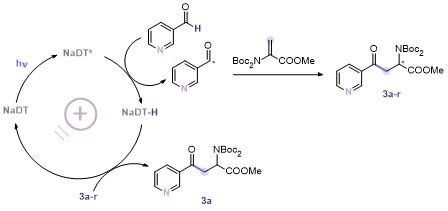
With optimal reaction conditions, a study in the substrate scope of aryl aldehydes was commenced (Table 2). Aryl aldehydes bearing various alkyl or alkoxyl groups at different sites are tolerated by this method, delivering 3b~3l in a moderate to excellent yield of 41.5%~92.7%. When the halogen atoms of aryl aldehydes were introduced at different sites at the pyridine rings, the reactions still worked smoothly, affording unnatural α-AAs 3 in moderate to excellent yields of 42.6%~76.0% (3m~3x). The yields for ortho-halogen-substituted aldehydes are lower than those of para-halogen-substituted aryl aldehydes, likely due to electron density effects and steric effects of the halogen atoms, hindering the capture of H atoms on aldehyde groups by NaDT. Similarly, stronger electron- withdrawing para-halogen groups increase the electron density at the para-aryl carbon atoms and stabilized the aldehyde radicals, thus leading to higher yields in this reaction (3n, 3q and 3u). Electron-withdrawing substituents like trifluoromethyl and ester groups were also compatible in this approach, yielding in lower yield (28.5%~47.0%, 3y~3z), this disparity may be attributed to the electronic effect of the electron-withdrawing groups, rendering the substrate challenging to activate. Additionally, a substantial amount of unreacted raw material residue was observed after reactions were finished. Altering the pyridine group in 1a with various N-containing heteroaryl groups, for example, pyrimidinyl (3aa~3ab), quinolinyl (3ac~3ae) and isoquinolinyl (3ag~3ah), did not impede the reaction, yielding products 3 with 27.5%~85.1% efficiency. When exploring the practical potential of this protocol, it was found that peptides 4a and 4b were also contained in the appropriate substrates, yielding the target products 5a and 5b successfully (Scheme 2a), presenting a fresh concept for peptides modification. The late-stage reduction of the unnatural α-AAs 3a was also conducted, converting the carbonyl group to valuable hydroxyl group in 6a, which proved the more possibilities for derivatization of this method. To gain further insight of the reaction mechanism, a series of mechanistic experiments were conducted. Firstly, when 3.0 equiv. TEMPO (2,2,6,6- tetramethylpiperidin-1-oxyl) radical scavenger was added to the model reaction, the formation of 5a was completely suppressed (Scheme 3a). This indicates a radical reaction pathway of this transformation. Secondly, under 390 nm illumination (5 min), various photocatalysts underwent C—H activation through a reaction with 1a.[37] The results depicted in Scheme 2b indicate that only NaDT was able to activate 1a into acarbonyl radical under illumination, which was abducted with DMPO and detected by electron paramagnetic resonance spectrum (EPR) with g=2.0042, AN=1.43 mT, AH=2.06 mT. In contrast, photocatalysts like FeCl3, CuCl2, anthraquinone, and others did not exhibit the signal of the respective carbon centered free radical under the same illumination conditions. Based on the above mechanistic experiments, the following reaction mechanism is proposed (Scheme 4). Under the light irradiation, NaDT is excited to NaDT*, which then reacts with 1a to abstract a hydrogen atom from the carbonyl group, generating acyl radical 1a-r and NaDT-H. Subsequently, 1a-r is captured by the alkene 2 to form a Giese-type carbon radical 3a-r. Finally, 3a-r undergoes a reverse hydrogen abstraction with NaDT-H to afford 3a and regenerate NaDT.
Table 2 Scope of aryl aldehydesa |

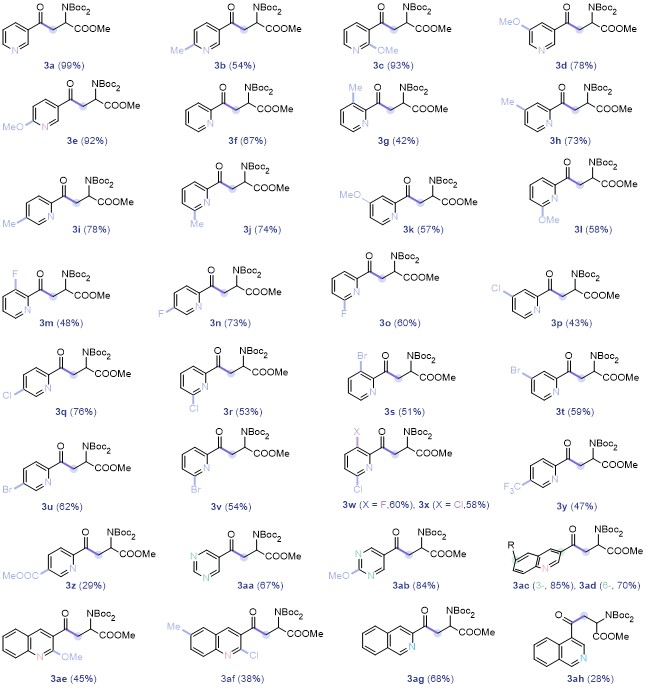 |
a Reaction condition: 0.1 mmol of 1, 3.0 equiv. of 2, 3 mol% NaDT, 1.0 mL of CH3CN, room temperature, 24 W 390 nm LED, 24 h. Isolated yields. |
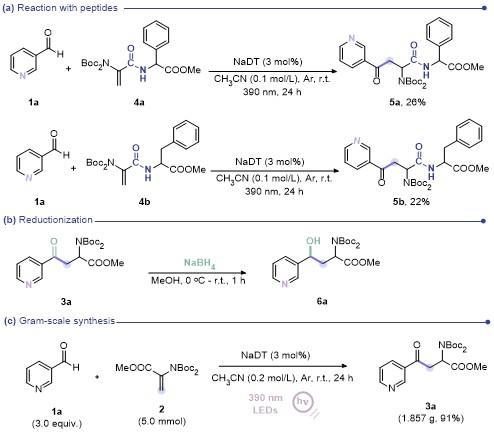
Scheme 2 (a) Synthetic applications; (b) Late-stage reduction; (c) Gram-scale synthesis |


3 Conclusions
In conclusion, we merged photocatalysis with radical chemistry to establish a versatile platform for α-AAs synthesis, overcoming long-standing challenges in N-hete- roaryl aldehyde activation. This method leverages the generation of acyl radicals from heteroaryl aldehydes, combined with the Giese addition of alkenes. The reaction exhibits fabulous functional group tolerance and offers an access for the precise installation of a wide range of aryl carbonyl group to α-AAs precursors. Besides these, the resulted unnatural α-AAs bearing various functional groups, such as methoxy, halogen atom and ester groups, can be further derivatized to valuable molecule based on α-AAs skeletons. Together with the compatible reaction with peptides, all these experiments illustrated the practical potential of this method. Mechanistic studies included EPR study revealed the proposed pathway to the synthesis of unnatural α-AAs. In short, this approach provides a powerful and facile pathway for constructing unnatural α-AAs with carbonyl and N-heteroaryl groups.
4 Experimental section
4.1 Instruments and reagents
Unless otherwise noted, materials were obtained from commercial suppliers and used without further purification. ESR spectra were recorded by using a JEOL JES X320 spectrometer (X-band, 10.0 GHz). Thin layer chromatography (TLC) employed glass 0.25 mm silica gel plates. Flash chromatography columns were packed with 200~300 mesh silica gel. 1H NMR spectra were recorded at 500 MHz, 13C NMR spectra were recorded at 125 MHz and 19F NMR spectra were recorded at 471 MHz by using a Bruker AMX 500 spectrophotometer. Chemical shifts were calibrated using residual undeuterated solvent as an internal reference (1H NMR: CDCl3 δ 7.26; 13C NMR: CDCl3 δ 77.16).
4.2 Experimental method
4.2.1 General experimental procedure for compounds
Aldehydes 1 (0.3 mmol, 3.0 equiv.), 2 (0.1 mmol, 1.0 equiv.) and NaDT (0.003 mmol, 3%) were added into a 3 mL vial. Subsequently, CH3CN (1 mL) was added, degassed three times by bubbling method to replace air. The reaction mixture was then stirred at room temperature under irradiation of 24 W 390 nm Purple LED for 24 h, as the time indicated. The mixture was evaporated in vacuo, then it was purified by silica gel column chromatography to afford the desired product 3.
4.2.2 General experimental procedure for ESR
In a glovebox, 3-pyridinecarboxaldehyde (18.8 µL, 0.2 mmol), photocatalyst (3%) and DMPO (11.3 µL, 0.1 mmol) were added to a 5 mL round bottomed bottle with a stir bar, then CH3CN (1 mL) was added. After the mixture was stirred for 2 min under dark, 20 µL of the mixture was transferred to a capillary. The capillary was transferred to a ESR tube, the ESR tube was then adapted to the ESR instrument measure capacity, and measured in-situ.
Methyl 2-(bis(tert-butoxycarbonyl)amino)-4-oxo-4-(py-ridin-3-yl)-butanoate (3a): 99% yield, faint yellow solid, m.p. 93.0~93.8 °C; 1H NMR (500 MHz, Chloroform-d) δ: 9.22~9.17 (m, 1H), 8.82~8.78 (m, 1H), 8.27 (dt, J=7.9, 2.0 Hz, 1H), 7.45 (dd, J=7.9, 4.7 Hz, 1H), 5.74 (dd, J=7.2, 5.3 Hz, 1H), 4.07 (dd, J=17.4, 7.2 Hz, 1H), 3.73 (s, 3H), 3.24 (dd, J=17.4, 5.4 Hz, 1H), 1.52 (s, 18H); 13C NMR (126 MHz, Chloroform-d) δ: 195.48, 170.58, 153.45, 151.86, 149.51, 135.68, 132.01, 123.71, 83.63, 54.41, 52.59, 40.06, 27.99. HRMS (ESI+) calcd for C20H28- N2O7Na (M+Na)+ 431.1789, found 431.1792.
Methyl 2-(bis(tert-butoxycarbonyl)amino)-4-(6-meth-yl- pyridin-3-yl)-4-oxobutanoate (3b): 54% yield, faint yellow oil. 1H NMR (500 MHz, Chloroform-d) δ: 9.08 (s, 1H), 8.16 (dd, J=8.1, 2.3 Hz, 1H), 7.28 (d, J=8.3 Hz, 1H), 5.74 (dd, J=7.2, 5.4 Hz, 1H), 4.04 (dd, J=17.4, 7.2 Hz, 1H), 3.72 (s, 3H), 3.22 (dd, J=17.4, 5.5 Hz, 1H), 2.65 (s, 3H), 1.52 (s, 18H); 13C NMR (126 MHz, Chloroform-d) δ: 195.19, 170.66, 163.33, 151.85, 149.10, 136.10, 129.63, 123.41, 83.60, 54.42, 52.58, 39.95, 28.01, 24.68. HRMS (ESI+) calcd for C21H30N2O7Na (M+Na)+ 445.1945, found 445.1949.
Methyl 2-(bis(tert-butoxycarbonyl)amino)-4-(2-metho-xypyridin-3-yl)-4-oxobutanoate (3c): 93% yield, faint yellow oil. 1H NMR (500 MHz, Chloroform-d) δ: 8.32 (dd, J=4.9, 2.0 Hz, 1H), 8.14 (dd, J=7.5, 2.1 Hz, 1H), 6.99 (dd, J=7.5, 4.8 Hz, 1H), 5.74 (dd, J=7.1, 5.4 Hz, 1H), 4.08~4.03 (m, 4H), 3.72 (s, 3H), 3.32 (dd, J=18.1, 5.3 Hz, 1H), 1.51 (s, 18H); 13C NMR (126 MHz, Chloroform-d) δ: 196.65, 170.89, 161.99, 151.73, 150.93, 140.23, 121.07, 117.19, 83.30, 54.32, 53.81, 52.43, 44.76, 27.98. HRMS (ESI+) calcd for C21H30N2O8Na (M+Na)+ 461.1894, found 461.1889.
Methyl 2-(bis(tert-butoxycarbonyl)amino)-4-(5-metho-xypyridin-3-yl)-4-oxobutanoate (3d): 78% yield, faint yellow oil. 1H NMR (500 MHz, Chloroform-d) δ: 8.82-8.77 (m, 1H), 8.50 (d, J=2.9 Hz, 1H), 7.73 (dd, J=2.9, 1.7 Hz, 1H), 5.74 (dd, J=7.2, 5.4 Hz, 1H), 4.06 (dd, J=17.5, 7.2 Hz, 1H), 3.91 (s, 3H), 3.73 (s, 3H), 3.25 (dd, J=17.5, 5.4 Hz, 1H), 1.52 (s, 18H); 13C NMR (126 MHz, Chloroform-d) δ: 195.44, 170.60, 155.98, 151.84, 142.95, 141.77, 132.61, 118.07, 83.64, 55.78, 54.39, 52.61, 40.35, 28.01. HRMS (ESI+) calcd for C21H31N2O8 (M+H)+ 439.2075, found 439.2077.
Methyl 2-(bis(tert-butoxycarbonyl)amino)-4-(6-metho-xypyridin-3-yl)-4-oxobutanoate (3e): 92% yield, faint yellow oil. 1H NMR (500 MHz, Chloroform-d) δ: 8.81 (d, J=2.4 Hz, 1H), 8.16 (dd, J=8.8, 2.5 Hz, 1H), 6.79 (d, J=8.7 Hz, 1H), 5.74 (dd, J=7.0, 5.5 Hz, 1H), 4.01 (s, 3H), 4.00~3.95 (m, 1H), 3.72 (s, 3H), 3.19 (dd, J=17.2, 5.5 Hz, 1H), 1.52 (s, 18H); 13C NMR (126 MHz, Chloroform- d) δ: 194.23, 170.72, 166.86, 151.83, 149.07, 138.25, 126.47, 111.17, 83.48, 54.43, 54.08, 52.52, 39.62, 27.99. HRMS (ESI+) calcd for C21H30N2O8Na (M+Na)+ 461.1894, found 461.1892.
Methyl 2-(bis(tert-butoxycarbonyl)amino)-4-(2-brom-opyridin-3-yl)-4-oxobutanoate (3f): 53% yield, faint yellow oil. 1H NMR (500 MHz, Chloroform-d) δ: 8.45 (dd, J=4.8, 2.0 Hz, 1H), 7.84 (dd, J=7.6, 2.0 Hz, 1H), 7.37 (dd, J=7.6, 4.8 Hz, 1H), 5.70 (dd, J=8.0, 5.0 Hz, 1H), 3.93 (dd, J=17.3, 8.1 Hz, 1H), 3.73 (s, 3H), 3.29 (dd, J=17.3, 5.1 Hz, 1H), 1.51 (s, 18H); 13C NMR (126 MHz, Chloroform-d) δ: 199.08, 170.61, 151.71, 151.37, 138.52, 137.76, 137.54, 122.77, 83.74, 54.90, 52.64, 43.73, 28.00. HRMS (ESI+) calcd for C20H27BrN2O7Na (M+Na)+ 509.0894, found 509.0899.
Methyl 2-(bis(tert-butoxycarbonyl)amino)-4-oxo-4-(py-ridin-2-yl)butanoate (3g): 67% yield, faint yellow solid, m.p. 82.6~83.1 °C; 1H NMR (500 MHz, Chloroform-d) δ: 8.68 (dd, J=4.7, 1.6 Hz, 1H), 8.05 (d, J=7.5 Hz, 1H), 7.83 (td, J=7.7, 1.8 Hz, 1H), 7.47 (ddd, J=7.6, 4.7, 1.2 Hz, 1H), 5.72 (dd, J=7.4, 5.7 Hz, 1H), 4.34 (dd, J=17.5, 7.3 Hz, 1H), 3.72 (s, 3H), 3.44 (dd, J=17.6, 5.7 Hz, 1H), 1.50 (s, 18H); 13C NMR (126 MHz, Chloroform-d) δ: 198.32, 170.74, 153.03, 151.65, 148.99, 136.83, 127.21, 121.93, 83.32, 54.74, 52.41, 39.19, 27.98. HRMS (ESI+) calcd for C20H28N2O7Na (M+Na)+ 431.1789, found 431.1794.
Methyl 2-(bis(tert-butoxycarbonyl)amino)-4-(3-methyl-pyridin-2-yl)-4-oxobutanoate (3h): 42% yield, faint yellow oil. 1H NMR (500 MHz, Chloroform-d) δ: 8.50 (dd, J=4.8, 1.6 Hz, 1H), 7.59~7.57 (m, 1H), 7.33 (dd, J=7.8, 4.6 Hz, 1H), 5.69 (dd, J=7.6, 5.6 Hz, 1H), 4.21 (dd, J=17.4, 7.5 Hz, 1H), 3.72 (s, 3H), 3.46 (dd, J=17.4, 5.6 Hz, 1H), 2.58 (s, 3H), 1.49 (s, 18H); 13C NMR (126 MHz, CDCl3) δ: 200.25, 170.86, 151.69, 151.49, 146.18, 140.04, 134.76, 126.12, 83.26, 54.88, 52.37, 41.19, 27.97, 20.17. HRMS (ESI+) calcd for C21H30N2O7Na (M+Na)+ 445.1945, found 445.1938.
Methyl 2-(bis(tert-butoxycarbonyl)amino)-4-(4-methyl-pyridin-2-yl)-4-oxobutanoate (3i): 73% yield, yellow oil. 1H NMR (500 MHz, Chloroform-d) δ: 8.54 (d, J=4.9 Hz, 1H), 7.89~7.86 (m, 1H), 7.29 (d, J=3.6 Hz, 1H), 5.71 (dd, J=7.4, 5.6 Hz, 1H), 4.31 (dd, J=17.6, 7.4 Hz, 1H), 3.71 (s, 3H), 3.42 (dd, J=17.6, 5.6 Hz, 1H), 2.42 (s, 3H), 1.50 (s, 18H); 13C NMR (126 MHz, Chloroform-d) δ: 198.56, 170.74, 152.82, 151.64, 148.85, 148.23, 128.08, 122.82, 83.29, 54.76, 52.39, 39.29, 27.97, 21.07. HRMS (ESI+) calcd for C21H31N2O7 (M+H)+ 423.2126, found 423.2131.
Methyl 2-(bis(tert-butoxycarbonyl)amino)-4-(5-methyl-pyridin-2-yl)-4-oxobutanoate (3j): 78% yield, yellow oil. 1H NMR (500 MHz, Chloroform-d) δ: 8.50 (d, J=2.1 Hz, 1H), 7.96 (d, J=8.0 Hz, 1H), 7.62 (dd, J=8.3, 2.0 Hz, 1H), 5.71 (dd, J=7.3, 5.7 Hz, 1H), 4.30 (dd, J=17.5, 7.3 Hz, 1H), 3.71 (s, 3H), 3.42 (dd, J=17.5, 5.7 Hz, 1H), 2.41 (s, 3H), 1.50 (s, 18H); 13C NMR (126 MHz, Chloroform-d) δ: 198.08, 170.75, 151.63, 150.73, 149.48, 137.70, 137.19, 121.70, 83.26, 54.77, 52.37, 39.11, 27.96, 18.73. HRMS (ESI+) calcd for C21H31N2O7 (M+H)+ 423.2126, found 423.2123.
Methyl 2-(bis(tert-butoxycarbonyl)amino)-4-(6-methyl-pyridin-2-yl)-4-oxobutanoate (3k): 73% yield, faint yellow oil. 1H NMR (500 MHz, Chloroform-d) δ: 7.85 (d, J=7.7 Hz, 1H), 7.70 (t, J=7.7 Hz, 1H), 7.32 (d, J=7.6 Hz, 1H), 5.73 (dd, J=7.2, 5.7 Hz, 1H), 4.35 (dd, J=17.6, 7.2 Hz, 1H), 3.72 (s, 3H), 3.44 (dd, J=17.6, 5.7 Hz, 1H), 2.60 (s, 3H), 1.51 (s, 18H); 13C NMR (126 MHz, Chloroform-d) δ: 198.60, 170.87, 157.98, 152.48, 151.65, 136.89, 126.84, 118.99, 83.27, 54.80, 52.39, 39.07, 27.96, 24.38. HRMS (ESI+) calcd for C21H30N2O7 (M H)+ 423.2126, found 423.2123.
Methyl 2-(bis(tert-butoxycarbonyl)amino)-4-(4-methox-ypyridin-2-yl)-4-oxobutanoate (3l): 57% yield, yellow oil. 1H NMR (500 MHz, Chloroform-d) δ: 8.48 (d, J=5.6 Hz, 1H), 7.58 (d, J=2.6 Hz, 1H), 6.98 (dd, J=5.6, 2.6 Hz, 1H), 5.71 (dd, J=7.5, 5.6 Hz, 1H), 4.32 (dd, J=17.6, 7.5 Hz, 1H), 3.90 (s, 3H), 3.72 (s, 3H), 3.41 (dd, J=17.7, 5.6 Hz, 1H), 1.50 (s, 18H); 13C NMR (126 MHz, Chloroform-d) δ: 198.26, 170.71, 166.51, 154.82, 151.64, 150.15, 114.04, 107.07, 83.32, 55.48, 54.74, 52.40, 39.34, 27.97. HRMS (ESI+) calcd for C21H31N2O8 (M+H)+ 439.2075, found 439.2080.
Methyl 2-(bis(tert-butoxycarbonyl)amino)-4-(6-methox- ypyridin-2-yl)-4-oxobutanoate (3m): 58% yield, faint yellow oil. 1H NMR (500 MHz, Chloroform-d) δ: 7.72~7.65 (m, 2H), 6.94 (dd, J=8.1, 1.1 Hz, 1H), 5.76 (dd, J=6.9, 5.8 Hz, 1H), 4.31 (dd, J=17.9, 6.9 Hz, 1H), 3.99 (s, 3H), 3.73 (s, 3H), 3.40 (dd, J=17.9, 5.8 Hz, 1H), 1.50 (s, 18H); 13C NMR (126 MHz, CDCl3) δ: 197.77, 170.90, 163.29, 151.66, 150.33, 139.13, 115.56, 115.24, 83.28, 54.46, 53.40, 52.44, 39.56, 27.97. HRMS (ESI+) calcd for C21- H30- N2O8Na (M+Na)+ 461.1894, found 461.1895.
Methyl 2-(bis(tert-butoxycarbonyl)amino)-4-(3-fluoro-pyridin-2-yl)-4-oxobutanoate (3n): 48% yield, white solid, m.p. 98.8~99.3 °C; 1H NMR (500 MHz, Chloroform-d) δ: 8.50 (d, J=4.1 Hz, 1H), 7.55~7.50 (m, 2H), 5.70 (dd, J=7.4, 5.7 Hz, 1H), 4.26 (dd, J=17.4, 7.4 Hz, 1H), 3.72 (s, 3H), 3.38 (dd, J=17.4, 5.7 Hz, 1H), 1.50 (s, 18H); 13C NMR (126 MHz, CDCl3) δ: 196.02, 170.63, 159.69, 157.51, 151.61, 144.67, 144.63, 141.39, 128.67, 128.64, 125.67, 125.51, 83.40, 54.62, 52.47, 40.88, 27.97; 19F NMR (471 MHz, CDCl3) δ: -130.60. HRMS (ESI+) calcd for C20H27FN2O7Na (M+Na)+ 449.1695, found 449.1692.
Methyl 2-(bis(tert-butoxycarbonyl)amino)-4-(5-fluoro- pyridin-2-yl)-4-oxobutanoate (3o): 73% yield, faint yellow oil. 1H NMR (500 MHz, Chloroform-d) δ: 8.50 (d, J=2.7 Hz, 1H), 8.12 (dd, J=8.7, 4.6 Hz, 1H), 7.51 (td, J=8.3, 2.8 Hz, 1H), 5.72~5.68 (m, 1H), 4.32 (dd, J=17.5, 7.4 Hz, 1H), 3.72 (s, 3H), 3.38 (dd, J=17.5, 5.7 Hz, 1H), 1.50 (s, 18H); 13C NMR (126 MHz, CDCl3) δ: 196.68, 170.69, 162.58, 160.48, 151.65, 149.59, 149.56, 137.50, 137.30, 123.98, 123.94, 123.51, 123.36, 83.37, 54.70, 52.43, 39.08, 27.97; 19F NMR (471 MHz, CDCl3) δ: -119.76. HRMS (ESI+) calcd for C20H28FN2O7 (M+H)+ 427.1875, found 427.1880.
Methyl 2-(bis(tert-butoxycarbonyl)amino)-4-(6-fluoro- pyridin-2-yl)-4-oxobutanoate (3p): 60% yield, faint yellow oil. 1H NMR (500 MHz, Chloroform-d) δ: 7.96~7.93 (m, 2H), 7.17~7.13 (m, 1H), 5.69 (dd, J=7.6, 5.4 Hz, 1H), 4.28 (dd, J=17.8, 7.6 Hz, 1H), 3.72 (s, 3H), 3.33 (dd, J=17.8, 5.5 Hz, 1H), 1.51 (s, 18H); 13C NMR (126 MHz, CDCl3) δ: 196.74, 170.61, 163.48, 161.56, 151.61, 151.23, 151.14, 141.96, 141.90, 119.45, 119.42, 114.12, 113.83, 83.47, 54.59, 52.45, 39.07, 27.97; 19F NMR (471 MHz, CDCl3) δ: -66.40. HRMS (ESI+) calcd for C20H27- FN2O7Na (M+Na)+ 449.1695, found 449.1693.
Methyl 2-(bis(tert-butoxycarbonyl)amino)-4-(4-chloro-pyridin-2-yl)-4-oxobutanoate (3q): 43% yield, faint yellow oil. 1H NMR (500 MHz, Chloroform-d) δ: 8.57 (d, J=5.2 Hz, 1H), 8.04 (d, J=2.0 Hz, 1H), 7.47 (dd, J=5.2, 2.1 Hz, 1H), 5.70 (dd, J=7.4, 5.7 Hz, 1H), 4.33 (dd, J=17.6, 7.4 Hz, 1H), 3.72 (s, 3H), 3.38 (dd, J=17.6, 5.7 Hz, 1H), 1.50 (s, 18H); 13C NMR (126 MHz, CDCl3) δ: 197.24, 170.63, 154.19, 151.65, 149.95, 145.43, 127.26, 122.44, 83.44, 54.71, 52.47, 39.23, 27.98; HRMS (ESI+) calcd for C20H27ClN2O7Na (M+Na)+ 465.1399, found 465.1401.
Methyl 2-(bis(tert-butoxycarbonyl)amino)-4-(5-chloro-pyridin-2-yl)-4-oxobutanoate (3r): 76% yield, yellow oil. 1H NMR (500 MHz, Chloroform-d) δ: 8.62 (d, J=2.4 Hz, 1H), 8.01 (d, J=8.4 Hz, 1H), 7.80 (dd, J=8.4, 2.4 Hz, 1H), 5.70 (dd, J=7.4, 5.7 Hz, 1H), 4.31 (dd, J=17.5, 7.3 Hz, 1H), 3.72 (s, 3H), 3.37 (dd, J=17.5, 5.7 Hz, 1H), 1.50 (s, 18H); 13C NMR (126 MHz, CDCl3) δ: 197.21, 170.66, 151.65, 150.95, 147.98, 136.64, 136.16, 122.90, 83.41, 54.70, 52.45, 39.06, 27.97. HRMS (ESI+) calcd for C20H27ClN2O7Na (M+Na)+ 465.1399, found 465.1394.
Methyl 2-(bis(tert-butoxycarbonyl)amino)-4-(6-chloro-pyridin-2-yl)-4-oxobutanoate (3s): 53% yield, faint yellow oil. 1H NMR (500 MHz, Chloroform-d) δ: 7.97 (dd, J=7.6, 0.9 Hz, 1H), 7.80 (t, J=7.7 Hz, 1H), 7.51 (dd, J=7.9, 0.9 Hz, 1H), 5.70 (dd, J=7.7, 5.4 Hz, 1H), 4.34 (dd, J=17.8, 7.7 Hz, 1H), 3.72 (s, 3H), 3.35 (dd, J=17.8, 5.4 Hz, 1H), 1.51 (s, 18H); 13C NMR (126 MHz, CDCl3) δ: 196.87, 170.64, 153.16, 151.61, 150.84, 139.50, 128.20, 120.44, 83.48, 54.64, 52.45, 38.98, 27.98. HRMS (ESI+) calcd for C20H27ClN2O7Na (M+Na)+ 465.1399, found 465.1401.
Methyl 2-(bis(tert-butoxycarbonyl)amino)-4-(3-bromo-pyridin-2-yl)-4-oxobutanoate (3t): 51% yield, faint yellow oil. 1H NMR (500 MHz, Chloroform-d) δ: 8.58 (dd, J=4.5, 1.4 Hz, 1H), 8.00 (dd, J=8.2, 1.4 Hz, 1H), 7.29 (dd, J=8.1, 4.6 Hz, 1H), 5.69 (dd, J=7.3, 5.7 Hz, 1H), 4.16 (dd, J=17.6, 7.4 Hz, 1H), 3.73 (s, 3H), 3.42 (dd, J=17.6, 5.7 Hz, 1H), 1.50 (s, 18H); 13C NMR (126 MHz, CDCl3) δ: 197.46, 170.59, 151.75, 151.65, 147.20, 142.67, 126.77, 118.11, 83.38, 54.67, 52.51, 41.20, 27.99. HRMS (ESI+) calcd for C20H27BrN2O7Na (M+Na)+ 509.0894, found 509.0888.
Methyl 2-(bis(tert-butoxycarbonyl)amino)-4-(4-bromo-pyridin-2-yl)-4-oxobutanoate (3u): 59% yield, faint yellow oil. 1H NMR (500 MHz, Chloroform-d) δ: 8.49 (d, J=5.2 Hz, 1H), 8.20 (d, J=1.9 Hz, 1H), 7.64 (dd, J=5.2, 2.0 Hz, 1H), 5.69 (dd, J=7.4, 5.7 Hz, 1H), 4.32 (dd, J=17.6, 7.4 Hz, 1H), 3.72 (s, 3H), 3.38 (dd, J=17.6, 5.8 Hz, 1H), 1.50 (s, 18H); 13C NMR (126 MHz, CDCl3) δ: 197.17, 170.61, 153.83, 151.64, 149.78, 133.99, 130.30, 125.49, 83.43, 54.69, 52.46, 39.19, 27.97. HRMS (ESI+) calcd for C20H27BrN2O7Na (M+Na)+ 509.0894, found 509.0890.
Methyl 2-(bis(tert-butoxycarbonyl)amino)-4-(5-bromo-pyridin-2-yl)-4-oxobutanoate (3v): 62% yield, yellow oil. 1H NMR (500 MHz, Chloroform-d) δ: 8.73 (dd, J=2.2, 0.8 Hz, 1H), 7.97 (dd, J=8.4, 2.2 Hz, 1H), 7.93 (dd, J=8.4, 0.8 Hz, 1H), 5.69 (dd, J=7.4, 5.7 Hz, 1H), 4.31 (dd, J=17.5, 7.3 Hz, 1H), 3.72 (s, 3H), 3.36 (dd, J=17.5, 5.7 Hz, 1H), 1.50 (s, 18H); 13C NMR (126 MHz, CDCl3) δ: 197.44, 170.66, 151.64, 151.28, 150.18, 139.58, 125.42, 123.21, 83.42, 54.70, 52.45, 39.03, 27.97. HRMS (ESI+) calcd for C20H27BrN2O7Na (M+Na)+ 509.0894, found 509.0890.
Methyl 2-(bis(tert-butoxycarbonyl)amino)-4-(6-bromo-pyridin-2-yl)-4-oxobutanoate (3w): 54% yield, faint yellow oil. 1H NMR (500 MHz, Chloroform-d) δ: 8.00 (dd, J=7.3, 1.2 Hz, 1H), 7.72~7.68 (m, 1H), 7.66 (dd, J=7.9, 1.2 Hz, 1H), 5.70 (dd, J=7.7, 5.4 Hz, 1H), 4.35 (dd, J=17.8, 7.7 Hz, 1H), 3.71 (s, 3H), 3.34 (dd, J=17.8, 5.4 Hz, 1H), 1.52 (s, 18H); 13C NMR (126 MHz, CDCl3) δ: 196.78, 170.67, 153.68, 151.60, 141.37, 139.18, 131.94, 120.78, 83.49, 54.64, 52.46, 38.96, 27.99. HRMS (ESI+) calcd for C20H27BrN2O7Na (M+Na)+ 509.0894, found 509.0893.
Methyl 2-(bis(tert-butoxycarbonyl)amino)-4-(6-chloro-3-fluoropyridin-2-yl)-4-oxobutanoate (3x): 60% yield, faint yellow oil. 1H NMR (500 MHz, Chloroform-d) δ: 7.55~7.50 (m, 2H), 5.67 (dd, J=7.8, 5.4 Hz, 1H), 4.25 (dd, J=17.5, 7.8 Hz, 1H), 3.72 (s, 3H), 3.29 (dd, J=17.5, 5.4 Hz, 1H), 1.51 (s, 18H); 13C NMR (126 MHz, CDCl3) δ: 194.69, 194.66, 170.56, 158.65, 156.47, 151.57, 144.83, 144.80, 140.66, 140.61, 129.76, 129.71, 128.98, 128.81, 83.56, 54.56, 52.52, 40.49, 27.97; 19F NMR (471 MHz, CDCl3) δ: -122.91. HRMS (ESI+) calcd for C20H26ClF- N2O7 (M+K)+ 499.1044, found 499.1047.
Methyl 2-(bis(tert-butoxycarbonyl)amino)-4-(6-chloro-3-fluoropyridin-2-yl)-4-oxobutanoate (3y): 58% yield, faint yellow solid, m.p. 118.9~119.2 °C; 1H NMR (500 MHz, Chloroform-d) δ: 7.75 (d, J=8.4 Hz, 1H), 7.40 (d, J=8.4 Hz, 1H), 5.67 (dd, J=7.8, 5.5 Hz, 1H), 4.17 (dd, J=17.7, 7.8 Hz, 1H), 3.72 (s, 3H), 3.35 (dd, J=17.7, 5.5 Hz, 1H), 1.51 (s, 18H); 13C NMR (126 MHz, CDCl3) δ: 195.57, 170.53, 151.61, 149.86, 148.26, 142.04, 129.44, 127.83, 83.53, 54.59, 52.54, 41.05, 27.99. HRMS (ESI+) calcd for C20H26Cl2N2O7Na (M+Na)+ 499.1009, found 499.1012.
Methyl 2-(bis(tert-butoxycarbonyl)amino)-4-oxo-4-(5-(trifluoromethyl)pyridin-2yl)butanoate (3z): 47% yield, faint yellow oil. 1H NMR (500 MHz, Chloroform-d) δ: 8.95 (d, J=2.1 Hz, 1H), 8.17 (d, J=8.2 Hz, 1H), 8.08 (dd, J=8.3, 2.3 Hz, 1H), 5.72 (dd, J=7.5, 5.6 Hz, 1H), 4.39 (dd, J=17.6, 7.5 Hz, 1H), 3.72 (s, 3H), 3.38 (dd, J=17.6, 5.6 Hz, 1H), 1.51 (s, 18H); 13C NMR (126 MHz, CDCl3) δ: 197.26, 170.61, 155.33, 151.66, 150.67, 146.09, 134.27, 124.70, 121.63, 83.52, 54.70, 52.50, 39.22, 27.97; 19F NMR (471 MHz, CDCl3) δ: -62.67. HRMS (ESI+) calcd for C21H27F3N2O7 (M+K)+ 499.1663, found 499.1661.
Methyl 6-(3-(bis(tert-butoxycarbonyl)amino)-4-metho-xy-4-oxobutanoyl)nicotinate (3aa): 29% yield, faint yellow oil. 1H NMR (500 MHz, Chloroform-d) δ: 9.27~9.25 (m, 1H), 8.42 (dd, J=8.2, 2.1 Hz, 1H), 8.11 (dd, J=8.1, 0.9 Hz, 1H), 5.71 (dd, J=7.4, 5.7 Hz, 1H), 4.37 (dd, J=17.6, 7.4 Hz, 1H), 3.99 (s, 3H), 3.72 (s, 3H), 3.42 (dd, J=17.6, 5.7 Hz, 1H), 1.51 (s, 18H); 13C NMR (126 MHz, CDCl3) δ: 197.73, 170.64, 165.11, 155.38, 151.65, 150.25, 138.06, 128.66, 121.46, 83.46, 54.71, 52.72, 52.47, 39.36, 27.98. HRMS (ESI+) calcd for C22H30N2O9Na (M+Na)+ 489.1844, found 489.1842.
Methyl 2-(bis(tert-butoxycarbonyl)amino)-4-oxo-4-(py-rimidin-5-yl)butanoate (3ab): 67% yield, faint yellow solid, m.p. 116.4~116.8 °C; H NMR (500 MHz, Chloroform-d) δ: 9.39 (s, 1H), 9.26 (s, 2H), 5.72 (dd, J=7.5, 5.2 Hz, 1H), 4.07 (dd, J=17.2, 7.5 Hz, 1H), 3.73 (s, 3H), 3.20 (dd, J=17.2, 5.3 Hz, 1H), 1.53 (s, 18H); 13C NMR (126 MHz, CDCl3) δ: 194.30, 170.42, 161.41, 156.70, 151.86, 129.47, 83.84, 54.40, 52.70, 40.11, 27.99. HRMS (ESI+) calcd for C19H28N3O7 (M+H)+ 410.1922, found 410.1925.
Methyl 2-(bis(tert-butoxycarbonyl)amino)-4-(2-methox-ypyrimidin-5-yl)-4-oxobutanoate (3ac): 84% yield, faint yellow solid, m.p. 112.1~112.3 °C; 1H NMR (500 MHz, Chloroform-d) δ: 9.09 (s, 2H), 5.71 (dd, J=7.3, 5.4 Hz, 1H), 4.11 (s, 3H), 3.98 (dd, J=17.2, 7.3 Hz, 1H), 3.73 (s, 3H), 3.15 (dd, J=17.2, 5.3 Hz, 1H), 1.52 (s, 18H); 13C NMR (126 MHz, CDCl3) δ: 193.08, 170.53, 167.18, 160.31, 151.85, 124.50, 83.71, 55.78, 54.34, 52.63, 39.75, 27.99. HRMS (ESI+) calcd for C20H30N3O8 (M+H)+ 440.2027, found 440.2021.
Methyl 2-(bis(tert-butoxycarbonyl)amino)-4-oxo-4-(qu-inolin-3-yl)butanoate (3ad): 85% yield, yellow oil; 1H NMR (500 MHz, Chloroform-d) δ: 9.45 (d, J=2.1 Hz, 1H), 8.77 (d, J=2.1 Hz, 1H), 8.19 (d, J=8.5 Hz, 1H), 7.97 (dd, J=8.3, 1.5 Hz, 1H), 7.86 (ddd, J=8.5, 6.9, 1.4 Hz, 1H), 7.65 (ddd, J=8.1, 6.9, 1.1 Hz, 1H), 5.79 (dd, J=7.0, 5.5 Hz, 1H), 4.20 (dd, J=17.3, 7.1 Hz, 1H), 3.74 (s, 3H), 3.38 (dd, J=17.3, 5.6 Hz, 1H), 1.53 (s, 18H)l 13C NMR (126 MHz, CDCl3) δ: 195.48, 170.67, 151.99, 149.68, 148.96, 137.46, 132.19, 129.43, 129.36, 128.95, 127.68, 126.87, 83.65, 54.59, 52.63, 40.07, 28.03; HRMS (ESI+) calcd for C24H30N2O7Na (M+Na)+ 481.1945, found 481.1942.
Methyl 2-(bis(tert-butoxycarbonyl)amino)-4-oxo-4-(qu-inolin-6-yl)butanoate (3ae): 70% yield, faint yellow oil. 1H NMR (500 MHz, Chloroform-d) δ: 9.04 (d, J=4.3 Hz, 1H), 8.50 (d, J=2.6 Hz, 1H), 8.31~8.27 (m, 2H), 8.19 (d, J=8.8 Hz, 1H), 7.50 (ddd, J=8.3, 4.2, 1.0 Hz, 1H), 5.78 (t, J=6.3 Hz, 1H), 4.20 (dd, J=17.3, 6.9 Hz, 1H), 3.74 (s, 3H), 3.41 (dd, J=17.4, 5.7 Hz, 1H), 1.53 (s, 18H); 13C NMR (126 MHz, CDCl3) δ: 195.99, 170.76, 152.70, 152.03, 150.10, 137.75, 134.51, 130.04, 129.70, 127.75, 127.52, 122.00, 83.52, 54.75, 52.57, 39.98, 28.02. HRMS (ESI+) calcd for C24H31N2O7 (M+H)+ 459.2126, found 459.2129.
Methyl 2-(bis(tert-butoxycarbonyl)amino)-4-(2-meth-oxyquinolin-3-yl)-4-oxobutanoate (3af): 45% yield, yellow solid, m.p. 114.2~114.5 °C; 1H NMR (500 MHz, Chloroform-d) δ: 8.55 (s, 1H), 7.84 (dd, J=21.7, 8.0 Hz, 2H), 7.70 (ddd, J=8.5, 7.0, 1.5 Hz, 1H), 7.42 (ddd, J=8.0, 6.9, 1.1 Hz, 1H), 5.78 (dd, J=7.2, 5.4 Hz, 1H), 4.17 (s, 3H), 4.11 (dd, J=18.0, 7.2 Hz, 1H), 3.73 (s, 3H), 3.40 (dd, J=18.0, 5.4 Hz, 1H), 1.51 (s, 18H); 13C NMR (126 MHz, CDCl3) δ: 197.01, 170.88, 159.25, 151.73, 147.84, 141.66, 131.80, 129.13, 126.94, 124.83, 124.48, 123.08, 83.37, 54.46, 53.86, 52.46, 44.65, 27.99. HRMS (ESI+) calcd for C25H32N2O7Na (M+Na)+ 511.2051, found 511.2052.
Methyl 2-(bis(tert-butoxycarbonyl)amino)-4-(2-chloro-6-methylquinolin-3-yl)-4oxobutanoate (3ag): 38% yield, faint yellow oil. 1H NMR (500 MHz, Chloroform-d) δ: 8.34 (s, 1H), 7.94 (d, J=8.8 Hz, 1H), 7.65 (d, J=7.8 Hz, 2H), 5.76 (dd, J=7.9, 5.0 Hz, 1H), 4.05 (dd, J=17.4, 8.0 Hz, 1H), 3.74 (s, 3H), 3.36 (dd, J=17.4, 5.0 Hz, 1H), 2.55 (s, 3H), 1.52 (s, 18H); 13C NMR (126 MHz, CDCl3) δ: 198.08, 170.63, 151.75, 146.74, 144.70, 138.85, 138.05, 134.58, 132.91, 128.08, 127.30, 126.29, 83.69, 54.92, 52.62, 43.99, 28.00, 21.61. HRMS (ESI+) calcd for C25H31ClN2O7Na (M+Na)+ 529.1712, found 529.1717.
Methyl 2-(bis(tert-butoxycarbonyl)amino)-4-(isoqu-inolin-3-yl)-4-oxobutanoate (3ah): 68% yield, yellow solid, m.p. 112.5C~112.8 °C; 1H NMR (500 MHz, Chloroform-d) δ: 9.29 (s, 1H), 8.49 (s, 1H), 8.02 (dd, J=30.8, 7.6 Hz, 2H), 7.79~7.72 (m, 2H), 5.80 (dd, J=7.3, 5.6 Hz, 1H), 4.45 (dd, J=17.6, 7.3 Hz, 1H), 3.73 (s, 3H), 3.55 (dd, J=17.6, 5.7 Hz, 1H), 1.51 (s, 18H); 13C NMR (126 MHz, CDCl3) δ: 198.42, 170.82, 151.95, 151.71, 147.08, 135.51, 130.98, 130.26, 129.47, 128.63, 127.60, 120.57, 83.28, 54.84, 52.40, 39.89, 27.98. HRMS (ESI+) calcd for C24H31N2O7 (M+H)+ 459.2126, found 459.2120.
Methyl 2-(bis(tert-butoxycarbonyl)amino)-4-(isoquino-lin-4-yl)-4-oxobutanoate (3ai): 28% yield, yellow oil. 1H NMR (500 MHz, Chloroform-d) δ: 10.32 (s, 1H), 9.26 (d, J=8.5 Hz, 1H), 8.84 (s, 1H), 8.28 (d, J=8.4 Hz, 1H), 7.89 (ddd, J=8.4, 6.9, 1.2 Hz, 1H), 7.71 (ddd, J=8.4, 6.9, 1.3 Hz, 1H), 5.87 (dd, J=8.3, 5.3 Hz, 1H), 4.29 (dd, J=15.5, 5.3 Hz, 1H), 3.97 (dd, J=15.5, 8.3 Hz, 1H), 3.77 (s, 3H), 1.39 (s, 18H); 13C NMR (126 MHz, CDCl3) δ: 192.78, 170.85, 165.26, 152.17, 151.90, 132.98, 132.78, 128.30, 127.15, 125.49, 125.12, 123.81, 83.23, 57.58, 52.56, 35.90, 27.86. HRMS (ESI+) calcd for C24H31N2O7 (M+H)+ 459.2126, found 459.2131.
Methyl 2-(2-(bis(tert-butoxycarbonyl)amino)-4-oxo-4-(pyridin-3-yl)butanamido)-2-phenylacetate (5a): 26% yield, faint yellow oil. 1H NMR (500 MHz, Chloroform-d) δ: 9.19 (s, 1H), 8.79 (s, 1H), 8.26 (td, J=6.6, 1.7 Hz, 1H), 7.42 (dt, J=8.3, 4.2 Hz, 1H), 7.36~7.29 (m, 5H), 7.17~7.13 (m, 1H), 5.60~5.46 (m, 2H), 4.12 (ddd, J=17.9, 15.1, 6.5 Hz, 1H), 3.72 (d, J=11.6 Hz, 3H), 3.34 (ddd, J=55.0, 17.9, 6.1 Hz, 1H), 1.54 (s, 9H), 1.44 (s, 9H); 13C NMR (126 MHz, CDCl3) δ: 196.06, 195.98, 171.12, 170.88, 168.78, 153.48, 152.29, 151.96, 149.63, 136.50, 136.37, 135.82, 128.97, 128.93, 128.56, 128.50, 127.34, 127.09, 123.71, 84.18, 84.10, 56.51, 55.65, 55.47, 52.90, 52.78, 39.30, 39.15, 27.95, 27.86. HRMS (ESI+) calcd for C28H36N3O8 (M+H)+ 542.2497, found 542.2502.
Methyl (2-(bis(tert-butoxycarbonyl)amino)-4-oxo-4-(py-ridin-3-yl)butanoyl)phenylalaninate (5b): 22% yield, faint yellow oil. 1H NMR (500 MHz, Chloroform-d) δ: 9.23~9.18 (m, 1H), 8.80 (d, J=4.9 Hz, 1H), 8.27 (dd, J=8.0, 2.0 Hz, 1H), 7.43 (dd, J=8.0, 4.8 Hz, 1H), 7.29 (ddt, J=5.4, 3.7, 1.9 Hz, 2H), 7.25~7.22 (m, 1H), 7.11 (ddd, J=7.8, 6.3, 1.5 Hz, 2H), 6.55 (dd, J=13.0, 7.8 Hz, 1H), 5.46 (dt, J=12.7, 6.3 Hz, 1H), 4.86~4.81 (m, 1H), 4.11 (dd, J=17.8, 6.6 Hz, 1H), 3.67 (d, J=11.9 Hz, 3H), 3.35 (ddd, J=23.7, 17.9, 6.1 Hz, 1H), 3.19~2.95 (m, 3H), 1.50 (d, J=14.3 Hz, 17H); 13C NMR (126 MHz, CDCl3) δ: 196.12, 196.00, 171.58, 171.43, 169.19, 168.90, 153.51, 152.18, 152.10, 149.64, 135.80, 135.71, 135.61, 129.31, 129.19, 128.70, 128.61, 128.45, 127.20, 127.13, 123.71, 84.07, 83.95, 55.58, 55.37, 53.47, 53.40, 52.24, 52.22, 39.30, 39.04, 38.31, 38.05, 27.96, 27.90. HRMS (ESI+) calcd for C29H38N3O8 (M+H)+ 578.2473, found 578.2470.
Methyl (4S)-2-(bis(tert-butoxycarbonyl)amino)-4-hydr- oxy-4-(pyridin-3-yl)butanoate (6a): 33% yield, faint yellow oil. 1H NMR (500 MHz, Chloroform-d) δ: 8.71~8.58 (m, 2H), 7.87 (tt, J=8.0, 1.9 Hz, 1H), 7.39 (dd, J=7.7, 5.1 Hz, 1H), 5.14~4.69 (m, 2H), 3.74 (s, 3H), 3.14 (s, 1H), 2.78-2.40 (m, 1H), 2.29~2.04 (m, 1H), 1.51 (d, J=22.9 Hz, 18H); 13C NMR (126 MHz, CDCl3) δ: 1971.48, 171.03, 152.66, 152.05, 148.13, 146.98, 135.22, 124.15, 84.26, 83.71, 69.64, 67.98, 55.80, 55.32, 52.57, 52.50, 40.44, 39.81, 28.00, 27.98.
Supporting Information 1H NMR and 13C NMR spectra of compounds 3a~6a. The Supporting Information is available free of charge via the Internet at http://sioc- journal.cn.
(Li, L.)