



1 Introduction
Imidazopyridine is a well-known fused N-heterocyclic compound.[1] The structural framework of this compound has a variety of biological activities, including antitumor, antibacterial, anti-inflammatory, antifungal, analgesic, and antipyretic, etc.[2] For example, the marketed sedative- hypnotic and anxiolytic drugs zolpidem and alpidem are imidazopyridine based compounds.[3] The imidazole ring can participate in intramolecular proton transfer in the excited state, making it useful in material science.[4-5] Since the biological properties of imidazopyridine derivatives to a large extent depend on the functionality at the C3 position, the C3 functionalization of imidazo[1,2-a]pyridines has received special attention in the past few decades. A variety of efficient approaches have been established for the direct derivatization of imidazopyridines at C3 position.[6-11] Among them, the C3 thiolation became the focus for medicinal and synthetic organic chemists due to the fact that the introduction of C—S bond into the imidazopyridine skeleton can change the molecular properties and thus confer them more biological activities. Up to date, a wide range of reagents have been used to thiolate C-3 position of imidazopyridines involving thiols, elemental sulfur, sodium sulfinate, sulfinic acid, sulfonothioates, etc.[12-17] However, these methods still suffer from some shortcomings, such as unpleasant odor and the use of metal reagents. Furthermore, in some protocols, the difficulty in obtaining sulfur source resulted in the limited substrate scope.
Recently, several three-component reactions involving imidazopyridines have been described. In 2017, Tang and co-authors[18] released a three-component thiolation of imidazopyridines with elemental sulfur and ethers (Scheme 1a). In 2020, Sun and co-authors[19] reported a three-com- ponent heteroarylation-nitration of alkenes with imidazo- [1,2-a]pyridines and tert-butylnitrite (Scheme 1b). In 2021, Hajra's group[20] published a three-component carbosilylation reaction of alkenes with imidazopyridines and silanes promoted by FeCl2 and visible-light photocatalysis (Sche- me 1c). These novel strategies enabled the synthesis of imidazopyridines carrying diversified functional groups at C3 position.
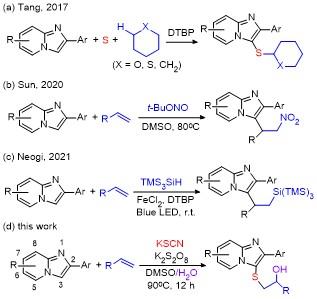
Potassium thiocyanate (KSCN) is an odorless, stable and inexpensive inorganic salt. KSCN has been widely applied in the synthesis of sulfur-containing compounds.[21-25] In 2024, Ji and co-authors[26] reported the use of readily avai- lable and easy-to-handle NH4SCN as a sulfur source in the C3 thiolation of imidazopyridines. Herein, we want to report our results of four-component difunctionalization of styrenes with KSCN and imidazo[1,2-a]pyridines (Scheme 1d). Our strategy used KSCN as the sulfur source and inexpensive K2S2O8 as the free radical initiator and a series of C3 thiolated imidazo[1,2-a]pyridines with hydroxyl and aryl groups at C-3 side chain were smoothly synthesized.
2 Results and discussion
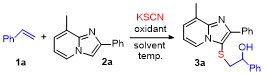
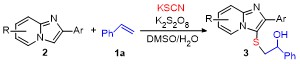
Initially, the difunctionalization of 8-methyl-2-phenyl- imidazo[1,2-a]pyridine (2a) with styrene (1a) and KSCN was selected as the model reaction, employing di-tert-butyl peroxide (DTBP) as the oxidant and 1,2-dichloroethane (DCE) as the solvent (Table 1). The corresponding product 3a was obtained in 42% yield at 80 ℃ for 12 h under N2 atmosphere (Table 1, Entry 1). Motivated by this preliminary result, the effect of various oxidants such as tert- butylhydroperoxide (TBHP), H2O2, dicumyl peroxide (DCP), cumyl hydroperoxide (CHP), K2S2O8, and Na2S2O8, was examined (Table 1, Entries 2~7). It was observed that K2S2O8 was the most efficient oxidant to provide the desired product in 63% yield (Table 1, Entry 7). Notably, the reaction was impeded in the absence of K2S2O8 (Table 1, Entry 8). These results showed that oxidants have significant effects on the reaction. Thus, K2S2O8 was used as an oxidant for further optimizations. Next, a diverse range of solvents were assessed, such as CH3CN, PhCl, EtOH, CH3CN/H2O, ultra-dry dimethyl sulfoxide (DMSO), DMSO/H2O (Table 1, Entries 9~14). It is worth noting that the reaction is more favorable in DMSO/H2O (Table 1, Entry 14), indicating that the solubility of KSCN in solvent also plays an important role. When ultra-dry DMSO was used as the solvent, no reaction occurred, indicating that the OH group in 3a obviously originated from water in the solvent (Table 1, Entry 13). The formation of 3a in Entries 1, 7, 9, 10 and 11 in Table 1 thus should be due to the presence of residual moisture in the solvents. When H218O was used instead of H2O, 18O-labeled 3a was obtained, which further confirmed that hydroxy group in 3a originated from H2O. Further screening of the ratio of DMSO to H2O, the amount of oxidant K2S2O8 and reaction temperature revealed that the most satisfactory outcome was achieved using DMSO/H2O (V∶V=2∶1), 3.0 equiv. of K2S2O8 and 90 ℃ (Table 1, Entries 15~21). Thus, the optimum reaction conditions are as follows: 1a (2.0 equiv.), 2a (1.0 equiv.), KSCN (2.0 equiv.), and K2S2O8 (3.0 equiv.) in DMSO/H2O (V∶V=2∶1) at 90 ℃ for 12 h under N2 atmosphere.
Table 1 Optimization of reaction conditionsa |
| Entry | Oxidant (equiv.) | Solvent (mL) | Temp./℃ | Yieldb/% |
|---|---|---|---|---|
| 1 | DTBP (1.5) | DCE (2) | 80 | 42 |
| 2 | TBHP (1.5) | DCE (2) | 80 | 0 |
| 3 | H2O2 (1.5) | DCE (2) | 80 | 0 |
| 4 | DCP (1.5) | DCE (2) | 80 | 0 |
| 5 | CHP (1.5) | DCE (2) | 80 | 0 |
| 6 | Na2S2O8 (1.5) | DCE (2) | 80 | 51 |
| 7 | K2S2O8 (1.5) | DCE (2) | 80 | 63 |
| 8 | None | DCE (2) | 80 | Trace |
| 9 | K2S2O8 (1.5) | MeCN (2) | 80 | 66 |
| 10 | K2S2O8 (1.5) | PhCl (2) | 80 | 31 |
| 11 | K2S2O8 (1.5) | EtOH (2) | 80 | 22 |
| 12 | K2S2O8 (1.5) | MeCNH2O (2/1) | 80 | 53 |
| 13 | K2S2O8 (1.5) | DMSO (2) | 80 | 0 |
| 14 | K2S2O8 (1.5) | DMSO/H2O (1/1) | 80 | 70 |
| 15 | K2S2O8 (1.5) | DMSO/H2O (2/1) | 80 | 72 |
| 16 | K2S2O8 (2.0) | DMSO/H2O (2/1) | 80 | 76 |
| 17 | K2S2O8 (3.0) | DMSO/H2O (2/1) | 80 | 85 |
| 18 | K2S2O8 (4.0) | DMSO/H2O (2/1) | 80 | 80 |
| 19 | K2S2O8 (3.0) | DMSO/H2O (2/1) | 70 | 69 |
| 20c | K2S2O8 (3.0) | DMSO/H2O (2/1) | 90 | 90 |
| 21 | K2S2O8 (3.0) | DMSO/H2O (2/1) | 100 | 84 |
a Reaction conditions: 1a (0.4 mmol, 2 equiv.), 2a (0.2 mmol), KSCN (0.4 mmol, 2 equiv.) and solvent in a sealed tube, stirred at 80~100 ℃ under nitrogen for 12 h. b Isolated yields. c DMSO (2 mL), H2O (1 mL). |
With the optimal conditions in hand, a series of 2-phen- ylimidazo[1,2-a]pyridines were investigated to evaluate the generality of this transformation (Table 2). In general, the substituents (Cl, Br, I, Me) at different positions of the pyridine ring of 2-phenylimidazo[1,2-a]pyridine does not affect the effectiveness of the reaction, and the corresponding products (3a~3e) can be obtained in good yields (64%~90%). However, when the substituent was located at the C5 position of the pyridine ring, the corresponding product (3f) could not be obtained probably due to the steric hindrance effect. In addition, the expected products (3g, 3h and 3i) could also be obtained in excellent yields (79%~82%) when the substituents were located at the para position of the benzene ring of 2-phenylimidazo- [1,2-a]pyridines. The yields (72% and 68%) slightly decreased when the substituents were at the meta and ortho positions of the phenyl ring of 2-phenylimidazo[1,2-a]- pyridines (3j and 3k). Moreover, when the phenyl group of 2-phenylimidazo[1,2-a]pyridine was substituted by tert- butyl group, 2-(tert-butyl)imidazo[1,2-a]pyridine was also compatible with the reaction conditions giving the desired product (3l) in 72% yield. Unfortunately, imidazo[1,2-a]- pyridine did not undergo this reaction (3m).
Table 2 Substrate scope of thiolation reactiona |
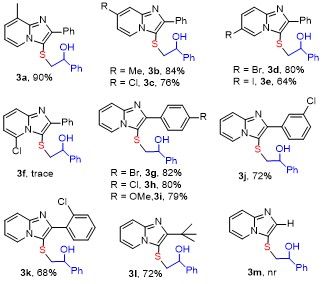 |
a Reaction conditions: 1a (0.4 mmol), 2 (0.2 mmol), KSCN (0.4 mmol) and K2S2O8 (0.6 mmol) in DMSO (2 mL) and H2O (1 mL) at 90 ℃ under N2 for 12 h. Isolated yields. |
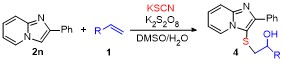
Next, styrenes and other kinds of alkenes were further tested by reacting with 2-phenylimidazo[1,2-a]pyridine and KSCN under the optimized reaction conditions (Table 3). Styrenes with electron-withdrawing or electron-donat- ing groups on the benzene ring are all suitable substrates. It is worth noting that the electron-donating and weak electron-withdrawing groups (4a~4c) located at the para position of the benzene ring, such as tert-butyl, Cl, and Br, were more conducive to the reaction than the strong electron-withdrawing group (4d). Substituents at ortho and meta positions of the benzene ring provided the corresponding β-hydroxy sulfides in good yields (4e~4i). 2-Phenyl-1-propene also worked well (4j). Finally, the aliphatic alkene (4k) were also suitable substrate for this transformation but the corresponding β-hydroxy sulfide were formed in relatively lower yield. The reaction of α,β-unsaturated ketone did not occur (4l).
Table 3 Substrate scope of thiolation reactiona |
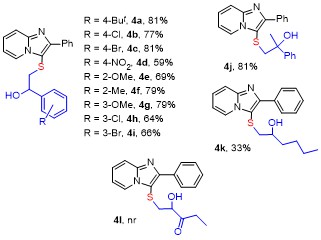 |
a Reaction conditions: 1 (0.4 mmol), 2o (0.2 mmol), KSCN (0.4 mmol) and K2S2O8 (0.6 mmol) in DMSO (2 mL) and H2O (1 mL) at 90 ℃ under N2 for 12 h. Isolated yields. |
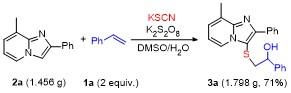
To demonstrate the practicality of this method, a gram- scale experiment was performed using substrates 1a, 2a and KSCN (Scheme 2). As shown in Scheme 2, the treatment of 1.456 g (7 mmol) of 2a with 2 equiv. of styrene (1a) and 2 equiv. of KSCN under the optimized reaction conditions afforded the desired 3a in 71% yield. Thus, this protocol can be applied as an efficient and straightforward method in organic synthesis.
Eventually, in order to gain insights into the reaction mechanism, a few of control experiments were carried out (Scheme 3). It was observed that the reaction failed to proceed in the presence of a radical scavenger like 2,2,6,6- tetramethylpiperidine-1-oxyl (TEMPO) or 2,6-di-tert- butyl-p-cresol (BHT) (Schemes 3a and 3b). This indicates that the reaction possibly proceeds through a radical pathway and radical intermediates were involved in the reaction. When ultra-dry DMSO was used as the solvent, no reaction was observed (Scheme 3c). When 1a was absent, 2a reacted with KSCN to produce 8-methyl-2-phenyl-3- thiocyanatoimidazo[1,2-a]pyridine (5) in 88% yield (Sche- me 3d). It should be noted that 5 was not detected in Schemes 3a~3c. Furthermore, the reaction of 5 with 1a in the absence of K2S2O8 resulted in the formation of the desired product 3a in 72% yield and the detection of a certain amount of 8-methyl-2-phenylimidazo[1,2-a]pyridine-3- thiol (6, 12% yield. Probably resulted from the hydrolysis of 5) (Scheme 3e). This result indicates that 5 is likely to be an intermediate in the reaction.
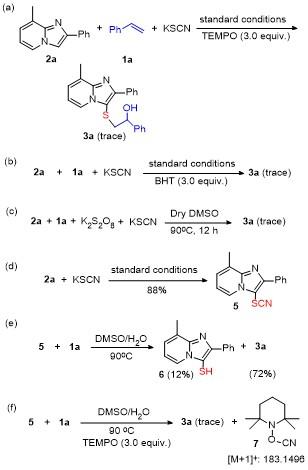
Furthermore, in the presence of free radical scavenger TEMPO, the reaction of 5 with 1a was also inhibited with the formation of trace of 3a and the detection of 7 by GC-MS (Scheme 3f).
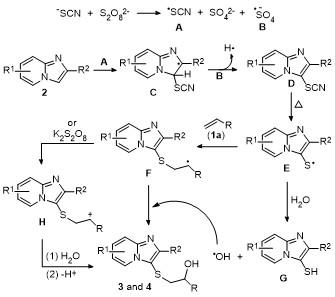
A reasonable mechanism is proposed on the basis of the above experimental results and literature reports (Scheme 4).[26-27] First, K2S2O8 oxidizes thiocyanate anion to SCN• radical A, which selectively attacks the C3 position of imidazo[1,2-a]pyridine (2). The resulting species C loses a H• radical to form intermediate D. Intermediate D decomposes to form species E and CN• radical under heating conditions. The detection of adduct 7 demonstrates the generation of CN• radical. Then the species E attacks the double bond of styrene to form a radical F. Meanwhile E can take H• radical from H2O to form HO• radical and byproduct G. The HO• radical combines with F to form the desired product imidazo[1,2-a]pyridine derivative (3 and 4). In another way F can also be oxidized to give cation H. The attack of H by water also results in the formation of 3 and 4.


3 Conclusion
A new, concise and green method to extend the carbon chain length and increase the diversity of functional groups at the C3 position of imidazo[1,2-a]pyridines has been developed. A series of 2-phenyl-3-alkylthioimidazo[1,2-a]pyridine derivatives carrying hydroxyl and phenyl (or alkyl) groups at C3 site were efficiently and smoothly synthesized, thus providing a wider range of screening objects for the further study of imidazopyridine drugs. The reaction was carried out through a four-component difunctionalization of styrenes with 2-phenylimidazo[1,2-a]pyridines and KSCN in the absence of metal catalyst. The cheap and easily available K2S2O8 was used as a free radical initiator and low toxic DMSO was used as the solvent. The method has good functional group tolerance, and the products were formed in moderate to good yields.
4 Experimental section
4.1 General information
Unless otherwise stated, all reagents were commercially available and used without further purification. All reactions were performed in a double-necked flask. The melting points were determined using an X-4 melting point apparatus purchased from Shanghai Yidian Optics. 1H NMR (400 MHz) and 13C NMR (101 MHz) spectra were measured on an Agilent spectrometer, using CDCl3, DMSO-d6 as the solvent with tetramethylsilane (TMS) as the internal standard at room temperature. HRMS spectra were recorded on an Agilent 6545. Flash column chromatographic purification of products was accomplished by forced-flow chromatography on silica gel (300~400 mesh) using petroleum ether/ethyl acetate as eluent.
4.2 General procedure for the synthesis of imidazo- [1,2-a]pyridine substrates and its four-component reaction with styrenes and KSCN
All the imidazo[1,2-a]pyridine substrates were synthesized according to the following procedure.[28] The mixture of 2-phenylimidazo[1,2-a]pyridine 1 (0.2 mmol, 1.0 equiv.), styrene 2 (0.4 mmol, 2.0 equiv.), KSCN (0.4 mmol, 2.0 equiv.), and K2S2O8 (0.6 mmol, 3.0 equiv.) in a mixed solvent of DMSO/H2O (V∶V=2∶1, 3 mL) was stirred in an atmosphere of N2 at 90 ℃ for 12 h. After the reaction was completed, the reaction mixture was cooled to room temperature, and then water was added followed by extraction with dichloromethane. The organic phase was collected. It was then dried with anhydrous Na2SO4 and rotary evaporated to give a crude product. The crude product was further purified through flash column chromatography using a mixture of petroleum ether and ethyl acetate as eluent [V(PE)∶V(EA)=100∶1~2∶1].
2-((8-Methyl-2-phenylimidazo[1,2-a]pyridin-3-yl)thio)-1-phenylethan-1-ol (3a): Yellow oil, 65 mg, 90% yield. 1H NMR (DMSO-d6, 400 MHz) δ: 8.34 (d, J=8.0 Hz, 1H), 8.25 (d, J=8.0 Hz, 2H), 7.44 (dd, J=8.3, 6.8 Hz, 2H), 7.37~7.34 (m, 1H), 7.24~7.17 (m, 5H), 7.14 (d, J=8.0 Hz, 1H), 6.89 (dd, J=6.8, 6.8 Hz, 1H), 5.68 (d, J=4.6 Hz, 1H), 4.66~4.62 (m, 1H), 3.04~2.94 (m, 2H), 2.52 (s, 3H); 13C NMR (DMSO-d6, 101 MHz) δ: 147.91, 146.35, 144.15, 134.41, 128.69, 128.42, 128.38, 127.60, 126.87, 126.47, 125.38, 123.19, 113.23, 110.60, 71.96, 44.69, 16.70; HRMS (ESI-TOF) calcd for C22H21N2OS [M+H]+361.1375, found 361.1357.
2-((7-Methyl-2-phenylimidazo[1,2-a]pyridin-3-yl)thio)-1-phenylethan-1-ol (3b): Yellow solid, 62 mg, 84% yield. m.p. 170.6~170.8 ℃; 1H NMR (CDCl3, 400 MHz) δ: 8.32 (d, J=6.9 Hz, 1H), 8.18 (d, J=7.6 Hz, 2H), 7.45 (d, J=7.5 Hz, 1H), 7.43 (d, J=7.5 Hz, 1H), 7.39~7.35 (m, 2H), 7.26~7.17 (m, 3H), 7.11~7.09 (m, 2H), 6.71 (d, J=7.0 Hz, 1H), 4.42 (dd, J=8.9, 4.0 Hz, 1H), 3.01 (br s, 1H), 2.92 (dd, J=13.4, 4.0 Hz, 1H), 2.80 (dd, J=13.4, 8.8 Hz, 1H), 2.41 (s, 3H); 13C NMR (CDCl3, 101 MHz) δ: 149.96, 146.92, 141.96, 137.41, 133.67, 128.51, 128.44, 128.41, 128.39, 127.87, 125.81, 123.68, 116.02, 115.47, 72.17, 44.47, 21.37; HRMS (ESI-TOF) calcd for C22H21N2OS [M+H]+ 361.1375, found 361.1374.
2-((7-Chloro-2-phenylimidazo[1,2-a]pyridin-3-yl)thio)-1-phenylethan-1-ol (3c): Yellow solid, 58 mg, 76% yield. m.p. 152.4~152.6 ℃; 1H NMR (DMSO-d6, 400 MHz) δ: 8.47 (d, J=8.0 Hz, 1H), 8.25~8.20 (m, 2H), 7.78~7.77 (m, 1H), 7.45~7.35 (m, 3H), 7.25~7.15 (m, 5H), 7.06~7.03 (m, 1H), 5.71 (d, J=4.0 Hz, 1H), 4.66~4.62 (m, 1H), 3.04 (dd, J=12.0, 8.0 Hz, 1H), 2.97 (dd, J=12.0, 8.0 Hz, 1H); 13C NMR (DMSO-d6, 101 MHz) δ: 148.96, 145.73, 144.05, 133.81, 132.00, 128.82, 128.76, 128.42, 128.27, 127.62, 126.64, 126.41, 115.99, 114.27, 111.10, 71.86, 44.64; HRMS (ESI-TOF) calcd for C21H18ClN2OS [M+H]+ 381.0828, found 381.0824.
2-((6-Bromo-2-phenylimidazo[1,2-a]pyridin-3-yl)thio)-1-phenylethan-1-ol (3d): Yellow solid, 69 mg, 80% yield. m.p. 165.2~165.4 ℃; 1H NMR (DMSO-d6, 400 MHz) δ: 8.48 (d, J=6.9, Hz, 1H), 8.18~8.15 (m, 2H), 7.62~7.59 (m, 3H), 7.39~7.35 (m, 1H), 7.24~7.15 (m, 5H), 7.03~6.99 (m, 1H), 5.68 (d, J=4.5 Hz, 1H), 4.62~4.58 (m, 1H), 3.02 (dd, J=12.0, 4.0 Hz, 1H), 2.95 (dd, J=12.0, 8.0 Hz, 1H); 13C NMR (DMSO-d6, 101 MHz) δ: 147.01, 146.10, 144.04, 133.40, 131.73, 130.21, 128.43, 127.64, 127.20, 126.43, 125.56, 121.92, 117.35, 113.54, 110.55, 71.80, 44.41; HRMS (ESI-TOF) calcd for C21H18BrN2OS [M+H]+ 425.0323, found 425.0358.
2-((6-iodo-2-phenylimidazo[1,2-a]pyridin-3-yl)thio)-1-phenylethan-1-ol (3e): Yellow solid, 60 mg, 64% yield. m.p. 103.8~104.1 ℃; 1H NMR (DMSO-d6, 400 MHz) δ: 8.64 (s, 1H), 8.19 (d, J=7.6 Hz, 2H), 7.52~7.49 (m, 1H), 7.43~7.39 (m, 3H), 7.35~7.31 (m, 1H), 7.22~7.13 (m, 5H), 5.65 (d, J=4.5 Hz, 1H), 4.62~4.60 (m, 1H), 3.05~2.99 (m, 2H); 13C NMR (DMSO-d6, 101 MHz) δ: 148.17, 144.63, 143.83, 134.41, 133.77, 130.20, 128.83, 128.72, 128.38, 128.22, 127.62, 126.39, 118.52, 110.59, 77.48, 71.68, 44.66; HRMS (ESI-TOF) calcd for C21H18IN2OS [M+H]+ 473.0185, found 473.0199.
2-((2-(4-Bromophenyl)imidazo[1,2-a]pyridin-3-yl)thio)-1-phenylethan-1-ol (3g): Yellow solid, 71 mg, 82% yield. m.p. 159.4~159.6 ℃; 1H NMR (DMSO-d6, 400 MHz) δ: 8.49 (d, J=6.8 Hz, 1H), 8.18 (d, J=8.0 Hz, 2H), 7.63~7.59 (m, 3H), 7.40~7.36 (m, 1H), 7.26~7.16 (m, 5H), 7.02 (t, J=6.8 Hz, 1H), 5.70 (d, J=4.5 Hz, 1H), 4.64~4.59 (m, 1H), 3.03 (dd, J=12.0, 8.0 Hz, 1H), 2.95 (dd, J=12.0, 8.0 Hz, 1H); 13C NMR (DMSO-d6, 101 MHz) δ: 147.01, 146.10, 144.08, 133.42, 131.74, 130.22, 128.43, 127.65, 127.19, 126.45, 125.58, 121.93, 117.37, 113.53, 110.56, 71.82, 44.44; HRMS (ESI-TOF) calcd for C21H18BrN2OS [M+H]+ 425.0323, found 425.0257.
2-((2-(4-Chlorophenyl)imidazo[1,2-a]pyridin-3-yl)thio)-1-phenylethan-1-ol (3h): Yellow solid, 61 mg, 80% yield. m.p. 140.1~140.6 ℃; 1H NMR (DMSO-d6, 400 MHz) δ: 8.46 (d, J=6.8 Hz, 1H), 8.24 (d, J=8.0, 2H), 7.59 (d, J=8.0 Hz, 1H), 7.44 (d, J=8.0 Hz, 2H), 7.34 (dd, J=8.0, 8.0 Hz, 1H), 7.21~7.16 (m, 5H), 6.98 (t, J=6.8 Hz, 1H), 5.71 (d, J=4.5 Hz, 1H), 4.65~4.60 (m, 1H), 3.02 (dd, J=12.0, 8.0 Hz, 1H), 2.95 (dd, J=12.0, 8.0 Hz, 1H); 13C NMR (DMSO-d6, 101 MHz) δ: 146.99, 146.10, 144.06, 133.21, 133.05, 129.90, 128.75, 128.41, 127.62, 127.07, 126.42, 125.50, 117.33, 113.44, 110.55, 71.86, 44.47; HRMS (ESI-TOF) calcd for C21H18ClN2OS [M+H]+ 381.0828, found 381.0832.
2-((2-(4-Methoxyphenyl)imidazo[1,2-a]pyridin-3-yl)-thio)-1-phenylethan-1-ol (3i): White solid, 61 mg, 79% yield. m.p. 165.5~165.9 ℃; 1H NMR (CDCl3, 400 MHz) δ: 8.43 (d, J=7.1 Hz, 1H), 8.18 (d, J=8.8 Hz, 2H), 7.60 (d, J=9.0 Hz, 1H), 7.31~7.15 (m, 4H), 7.12~7.10 (m, 2H), 6.98 (d, J=8.0 Hz, 2H), 6.87 (t, J=6.8 Hz, 1H), 4.45 (dd, J=8.8, 4.0 Hz, 1H), 3.84 (s, 3H), 2.94 (dd, J=13.4, 4.0 Hz, 1H), 2.82 (dd, J=13.5, 8.8 Hz, 1H); 13C NMR (CDCl3, 101 MHz) δ: 159.84, 149.91, 146.46, 141.89, 129.76, 128.42, 127.90, 126.10, 126.03, 125.77, 124.44, 117.27, 113.96, 112.70, 108.28, 72.24, 55.28, 44.24; HRMS (ESI-TOF) calcd for C22H21N2O2S [M+H]+377.1324, found 377.1304.
2-((2-(3-Chlorophenyl)imidazo[1,2-a]pyridin-3-yl)thio)-1-phenylethan-1-ol (3j): Yellow oil, 55 mg, 72% yield. 1H NMR (DMSO-d6, 400 MHz) δ: 8.46 (d, J=6.8 Hz, 1H), 8.27~8.26 (m, 1H), 8.21 (d, J=8.0 Hz, 1H), 7.60 (d, J=9.0 Hz, 1H), 7.47~7.29 (m, 3H), 7.24~7.11 (m, 5H), 6.99 (t, J=6.8 Hz, 1H), 5.70 (d, J=4.5 Hz, 1H), 4.66~4.57 (m, 1H), 3.04~2.94 (m, 2H); 13C NMR (DMSO-d6, 101 MHz) δ: 146.50, 146.08, 143.96, 136.26, 133.59, 130.62, 128.41, 128.25, 127.78, 127.62, 127.20, 126.68, 126.39, 125.52, 117.40, 113.56, 110.91, 71.89, 44.36; HRMS (ESI-TOF) calcd for C21H18ClN2OS [M+H]+ 381.0828, found 381.0830.
2-((2-(2-Chlorophenyl)imidazo[1,2-a]pyridin-3-yl)thio)-1-phenylethan-1-ol (3k): Yellow oil, 51 mg, 68% yield. 1H NMR (DMSO-d6, 400 MHz) δ: 8.47~8.44 (m, 1H), 7.62~7.60 (m, 1H), 7.54~7.51 (m, 1H), 7.47~7.33 (m, 4H), 7.18~7.01 (m, 6H), 5.54 (m, 1H), 4.46~4.42 (m, 1H), 2.87~2.74 (m, 2H); 13C NMR (DMSO-d6, 101 MHz) δ: 146.99, 146.10, 144.06, 133.21, 133.05, 129.90, 128.75, 128.41, 127.62, 127.07, 126.42, 125.50, 117.33, 113.44, 110.55, 71.86, 44.47; HRMS (ESI-TOF) calcd for C21H18- ClN2OS [M+H]+ 381.0828, found 381.0830.
2-((2-(tert-Butyl)imidazo[1,2-a]pyridin-3-yl)thio)-1-phenylethan-1-ol (3l): Yellow solid, 48 mg, 72% yield. m.p. 115.6~115.8; 1H NMR (DMSO-d6, 400 MHz) δ: 8.40 (d, J=6.8 Hz, 1H), 7.54 (dd, J=8.8, 1.3 Hz, 1H), 7.34~7.27 (m, 5H), 7.24~7.21 (m, 1H), 6.95 (t, J=6.8 Hz, 1H), 5.73 (d, J=4.6 Hz, 1H), 4.77~4.73 (m, 1H), 2.95~2.86 (m, 2H), 1.43 (s, 9H); 13C NMR (DMSO-d6, 101 MHz) δ: 144.43, 128.56, 128.53, 127.71, 127.68, 126.40, 126.37, 126.17, 124.82, 116.87, 113.06, 71.69, 45.81, 34.05, 30.91; HRMS (ESI-TOF) calcd for C19H23- N2OS [M+H]+ 327.1531, found 327.1535.
1-(4-(tert-Butyl)phenyl)-2-((2-phenylimidazo[1,2-a]-pyridin-3-yl)thio)ethan-1-ol (4a): White solid, 66 mg, 81% yield. m.p. 142.7~142.9 ℃; 1H NMR (CDCl3, 400 MHz) δ: 8.47 (d, J=8.0 Hz, 1H), 8.23 (d, J=8.0 Hz, 2H), 7.64 (d, J=9.0 Hz, 1H), 7.47 (t, J=8.0 Hz, 2H), 7.41~7.37 (m, 1H), 7.31~7.21 (m, 3H), 7.04 (d, J=8.3 Hz, 2H), 6.91~6.88 (m, 1H), 4.42 (dd, J=8.8, 4.0 Hz, 1H), 2.96 (dd, J=13.4, 4.0 Hz, 1H), 2.85 (dd, J=13.5, 8.9 Hz, 1H), 1.25 (s, 9H); 13C NMR (CDCl3, 101 MHz) δ: 150.99, 150.12, 146.54, 138.78, 133.62, 128.54, 128.49, 128.48, 126.13, 125.50, 125.36, 124.54, 117.58, 112.79, 109.28, 72.11, 44.16, 34.50, 31.27; HRMS (ESI-TOF) calcd for C25H27N2OS [M+H]+403.1844, found 403.1794.
1-(4-Chlorophenyl)-2-((2-phenylimidazo[1,2-a]pyridin-3-yl)thio)ethan-1-ol (4b): Yellow solid, 90 mg, 77% yield. m.p. 156.2~156.4 ℃; 1H NMR (CDCl3, 400 MHz) δ: 8.37 (d, J=6.8 Hz, 1H), 8.12~8.10 (m, 2H), 7.55 (d, J=9.0 Hz, 1H), 7.44~7.35 (m, 3H), 7.25 (t, J=8.0 Hz, 1H), 7.11 (d, J=8.2 Hz, 2H), 6.96 (d, J=8.2 Hz, 2H), 6.86 (t, J=6.8 Hz, 1H), 4.39 (dd, J=8.0, 4.7 Hz, 1H), 2.87 (dd, J=13.4, 4.7 Hz, 1H), 2.78 (dd, J=13.4, 8.0 Hz, 1H); 13C NMR (CDCl3, 101 MHz) δ: 149.84, 146.39, 140.45, 133.40, 133.34, 128.56, 128.54, 128.49, 128.41, 127.21, 126.33, 124.48, 117.36, 112.92, 109.29, 71.54, 44.01; HRMS (ESI-TOF) calcd for C21H18ClN2OS [M+H]+381.0828, found 381.0820.
1-(4-Bromophenyl)-2-((2-phenylimidazo[1,2-a]pyridin-3-yl)thio)ethan-1-ol (4c): Yellow solid, 105 mg, 81% yield. m.p. 154.3~154.6 ℃; 1H NMR (DMSO-d6, 400 MHz) δ: 8.47 (d, J=6.8 Hz, 1H), 8.24~8.21 (m, 2H), 7.61 (d, J=9.0 Hz, 1H), 7.43 (t, J=7.5 Hz, 2H), 7.40~7.31 (m, 4H), 7.16 (d, J=8.2 Hz, 2H), 6.99 (d, J=8.0 Hz, 1H), 5.79 (br s, 1H), 4.67~4.63 (m 1H), 3.04 (dd, J=12.0, 4.0 Hz, 1H), 2.97 (qd, J=12.9, 6.0 Hz, 1H); 13C NMR (DMSO-d6, 101 MHz) δ: 148.32, 146.07, 143.36, 134.19, 131.22, 128.72, 128.68, 128.51, 128.37, 126.85, 125.46, 120.67, 117.29, 113.26, 110.15, 71.27, 44.26; HRMS (ESI-TOF) calcd for C21H18BrN2OS [M+H]+425.0323, found 425.0337.
1-(4-Nitrophenyl)-2-((2-phenylimidazo[1,2-a]pyridin-3-yl)thio)ethan-1-ol (4d): Yellow solid, 71 mg, 59% yield. m.p. 181.9~182.1 ℃; 1H NMR (DMSO-d6, 400 MHz) δ: 8.47 (d, J=6.9 Hz, 1H), 8.20 (d, J=8.3 Hz, 2H), 7.62~7.54 (m, 3H), 7.45~7.41 (m, 4H), 7.39~7.33 (m, 2H), 7.00 (t, J=6.8 Hz, 1H), 5.87 (d, J=4.6 Hz, 1H), 4.75 (m, 1H), 3.11 (dd, J=13.0, 5.1 Hz, 1H), 3.01 (dd, J=13.0, 6.7 Hz, 1H); 13C NMR (DMSO-d6, 101 MHz) δ: 148.61, 148.32, 146.05, 134.17, 128.72, 128.51, 128.32, 127.21, 126.88, 125.47, 125.20, 125.16, 117.30, 113.28, 109.98, 71.26, 44.10; HRMS (ESI-TOF) calcd for C21H18N3O3S [M+H]+ 392.1069, found 392.1061.
1-(2-Methoxyphenyl)-2-((2-phenylimidazo[1,2-a]-pyridin-3-yl)thio)ethan-1-ol (4e): White solid, 53 mg, 69% yield. m.p. 77.9~78.1 ℃; 1H NMR (DMSO-d6, 400 MHz) δ: 8.52 (d, J=6.8 Hz, 1H), 8.31~8.28 (m, 2H), 7.64 (d, J=8.9 Hz, 1H), 7.46~7.34 (m, 5H), 7.15 (td, J=8.0 Hz, 1.7 Hz, 1H), 7.03 (td, J=6.8 Hz, 1.0 Hz, 1H), 6.88 (t, J=7.1 Hz, 1H), 6.79 (d, J=8.1 Hz, 1H), 5.51 (d, J=7.4 Hz, 1H), 4.90~4.88 (m, 1H), 3.42 (s, 3H, mixed with peak of water), 3.05 (dd, J=12.8, 3.1 Hz, 1H), 2.81 (dd, J=12.8, 8.0 Hz, 1H); 13C NMR (DMSO-d6, 101 MHz) δ: 155.61, 148.20, 146.05, 134.23, 132.07, 128.72, 128.57, 128.48, 128.22, 126.90, 126.41, 125.48, 120.55, 117.26, 113.27, 110.72, 110.27, 66.54, 55.36, 42.99; HRMS (ESI-TOF) calcd for C22H21N2O2S [M+H]+ 377.1324, found 377.1349.
2-((2-Phenylimidazo[1,2-a]pyridin-3-yl)thio)-1-(o-tolyl)ethan-1-ol (4f): White solid, 58 mg, 79% yield. m.p. 104.8~105.1 ℃; 1H NMR (DMSO-d6, 400 MHz) δ: 8.58~8.54 (m, 1H), 8.31~8.29 (m, 2H), 7.66~7.61 (m, 1H), 7.46~7.33 (m, 5H), 7.14~6.96 (m, 4H), 5.62~5.57 (m, 1H), 4.74~4.71 (m, 1H), 2.96~2.81 (m, 2H), 1.83 (s, 3H); 13C NMR (DMSO-d6, 101 MHz) δ: 148.36, 146.14, 142.15, 134.18 (d, J=1.5 Hz), 130.45, 128.77, 128.56, 128.23, 127.38, 126.99, 126.21, 125.87, 125.46, 117.34, 113.41, 110.18, 68.60, 43.33, 18.32; HRMS (ESI-TOF) calcd for C22H21N2OS [M+H]+ 361.1375, found 361.1377.
1-(3-Methoxyphenyl)-2-((2-phenylimidazo[1,2-a]-pyridin-3-yl)thio)ethan-1-ol (4g): White solid, 91 mg, 79% yield. m.p. 160.0~161.2 ℃; 1H NMR (CDCl3, 400 MHz) δ: 8.43 (d, J=6.8 Hz, 1H), 8.20 (d, J=8.0 Hz, 2H), 7.59 (d, J=9.0 Hz, 1H), 7.44 (d, J=7.4 Hz, 3H), 7.38~7.34 (m, 1H), 7.25 (t, J=7.9 Hz, 1H), 7.09 (t, J=7.8 Hz, 1H), 6.86 (t, J=6.8 Hz, 1H), 6.72~6.63 (m, 3H), 4.43 (dd, J=8.7, 4.1 Hz, 1H), 3.69 (s, 3H), 3.26 (br s, 1H), 2.93 (dd, J=13.4, 4.1 Hz, 1H), 2.83 (dd, J=13.4, 8.6 Hz, 1H); 13C NMR (CDCl3, 101 MHz) δ: 159.59, 149.80, 146.43, 143.67, 133.49, 129.41, 128.52, 128.49, 128.44, 126.20, 124.59, 118.06, 117.40, 113.38, 112.81, 111.12, 109.44, 72.17, 55.17, 44.31; HRMS (ESI-TOF) calcd for C22H21- N2O2S [M+H]+ 377.1324, found 377.1328.
1-(3-Chlorophenyl)-2-((2-phenylimidazo[1,2-a]pyridin-3-yl)thio)ethan-1-ol (4h): Yellow solid, 49 mg, 64% yield. m.p. 160.6~160.8 ℃; 1H NMR (DMSO-d6, 400 MHz) δ: 8.47 (d, J=6.8 Hz, 1H), 8.21~8.19 (m, 2H), 7.60 (d, J=9.0 Hz, 1H), 7.42 (t, J=8.0 Hz, 2H), 7.36~7.33 (m, 2H), 7.28 (s, 1H), 7.21~7.20 (m, 2H), 7.16~7.13 (m, 1H), 6.99 (t, J=6.8 Hz, 1H), 5.82~5.81 (m, 1H), 4.68~4.65 (m, 1H), 3.08~2.95 (m, 2H); 13C NMR (DMSO-d6, 101 MHz) δ: 148.30, 146.55, 146.06, 134.14, 133.27, 130.21, 128.74, 128.53, 128.35, 127.49, 126.92, 126.34, 125.47, 125.12, 117.26, 113.32, 110.07, 71.24, 44.11; HRMS (ESI-TOF) calcd for C21H18ClN2OS [M+H]+ 381.0828, found 381.0823.
1-(3-Bromophenyl)-2-((2-phenylimidazo[1,2-a]pyridin-3-yl)thio)ethan-1-ol (4i): Yellow solid, 56 mg, 66% yield. m.p. 154.6~155.0 ℃; 1H NMR (DMSO-d6, 400 MHz) δ: 8.46 (d, J=6.8 Hz, 1H), 8.19 (d, J=7.6 Hz, 2H), 7.60 (d, J=9.0 Hz, 1H), 7.47~7.31 (m, 6H), 7.19~7.13 (m, 2H), 7.00 (t, J=6.8 Hz, 1H), 5.79 (d, J=4.7 Hz, 1H), 4.65~4.62 (m, 1H), 3.05 (dd, J=14.0, 8.0 Hz, 1H), 2.96 (dd, J=12.0, 8.0 Hz, 1H); 13C NMR (DMSO-d6, 101 MHz) δ: 148.31, 146.80, 146.08, 134.16, 130.56, 130.41, 129.21, 128.76, 128.55, 128.33, 126.93, 125.54, 125.48, 121.91, 117.29, 113.34, 110.04, 71.19, 44.12; HRMS (ESI-TOF) calcd for C21H18BrN2OS [M+H]+425.0323, found 425.0331.
2-Phenyl-1-((2-phenylimidazo[1,2-a]pyridin-3-yl)thio)-propan-2-ol (4j): White solid, 58 mg, 81% yield. m.p. 144.1~144.4 ℃; 1H NMR (CDCl3, 400 MHz) δ: 8.27~8.24 (m, 3H), 7.64 (d, J=8.0 Hz, 1H), 7.52~7.45 (m, 4H), 7.41~7.39 (m, 2H), 7.35~7.31 (m, 2H), 7.27~7.24 (m, 1H), 6.99 (t, J=6.8 Hz, 1H), 5.52 (br s, 1H), 3.25 (d, J=12.3 Hz, 1H), 3.17 (d, J=12.3 Hz, 1H), 1.55 (s, 3H); 13C NMR (CDCl3, 101 MHz) δ: 149.19, 146.18, 145.46 133.58, 128.44, 128.35, 128.08, 126.93, 125.79, 124.46, 124.44, 117.37, 112.53, 109.88, 73.91, 49.59, 29.64; HRMS (ESI-TOF) calcd for C22H21N2OS [M+H]+361.1375, found 361.1386.
1-((2-Phenylimidazo[1,2-a]pyridin-3-yl)thio)hexan-2-ol (4k): Yellow solid, 31 mg, 33% yield. m.p. 105.7~105.9; 1H NMR (DMSO-d6, 400 MHz) δ: 8.65 (d, J=6.8 Hz, 1H), 8.27 (d, J=8.0 Hz, 2H), 7.65 (d, J=9.0 Hz, 1H), 7.46 (t, J=8.0 Hz, 2H), 7.41~7.35 (m, 2H), 7.07 (t, J=6.8 Hz, 1H), 4.78 (d, J=5.5 Hz, 1H), 2.71~2.68 (m, 2H), 1.47~1.39 (m, 1H), 1.29~0.90 (m, 5H), 0.73 (t, J=7.1 Hz, 3H); 13C NMR (DMSO-d6, 101 MHz) δ: 148.45, 146.12, 134.25, 128.72, 128.52, 128.35, 126.93, 125.48, 117.41, 113.45, 110.34, 69.64, 42.83, 35.81, 27.84, 22.53, 14.36; HRMS (ESI-TOF) calcd for C19H23N2OS [M+H]+327.1531, found 327.1522.
8-Methyl-3-(thiocyanato)imidazo[1,2-a]pyridine (5): White solid, m.p. 131.8~132.2 ℃ (lit.[27a] 131~132 ℃); 1H NMR (CDCl3, 400 MHz) δ: 8.01~7.99 (m, 2H), 7.51 (t, J=8.0 Hz, 2H), 7.46~7.42 (m, 1H), 7.32 (d, J=4.0 Hz, 1H), 6.77 (d, J=8.0 Hz, 1H), 6.16 (t, J=8.0 Hz, 1H), 2.42 (s, 3H); 13C NMR (CDCl3, 101 MHz) δ: 150.44, 146.74, 134.14, 129.74, 128.69, 128.52, 127.30, 125.04, 123.20, 112.46, 107.91, 16.69.
Supporting Information 1H NMR and 13C NMR spectra of the products 3~5. The supporting information is available free of charge via the Internet at http://sioc-journal.cn.
(Cheng, F.)