研究论文

铜催化的3-羟基-2-萘甲酸酯的不对称氧化偶联反应:氨基酸类配体的设计与优化

  • 王文龙 ,
  • 温家旭 ,
  • 陈飞 ,
  • 薄春博 ,
  • 李敏 ,
  • 刘宁 , * ,
  • 杜智宏 , *
展开
  • 石河子大学化学化工学院 化工绿色过程省部共建国家重点实验室培育基地 新疆石河子 832003

收稿日期: 2025-05-10

  修回日期: 2025-07-07

  网络出版日期: 2025-09-18

基金资助

国家自然科学基金(22201186)

石河子大学高层次人才启动基金(2022ZK005)

及新疆维吾尔自治区天池英才计划资助项目

Copper-Catalyzed Asymmetric Oxidative Homocoupling Reaction of 3-Hydroxy-2-naphthoates: Design and Optimization of Amino Acid-Based Ligands

  • Wen-Long Wang ,
  • Jia-Xu Wen ,
  • Fei Chen ,
  • Chunbo Bo ,
  • Min Li ,
  • Ning Liu , * ,
  • Zhi-Hong Du , *
Expand
  • State Key Laboratory Incubation Base for Green Processing of Chemical Engineering, School of Chemistry and Chemical Engineering, Shihezi University, Shihezi, Xinjiang 832003

Received date: 2025-05-10

  Revised date: 2025-07-07

  Online published: 2025-09-18

Supported by

National Natural Science Foundation of China(22201186)

Start-Up Foundation for High-Level Professionals of Shihezi University(2022ZK005)

Tianchi Talent Project of Xinjiang Uygur Autonomous Region

摘要

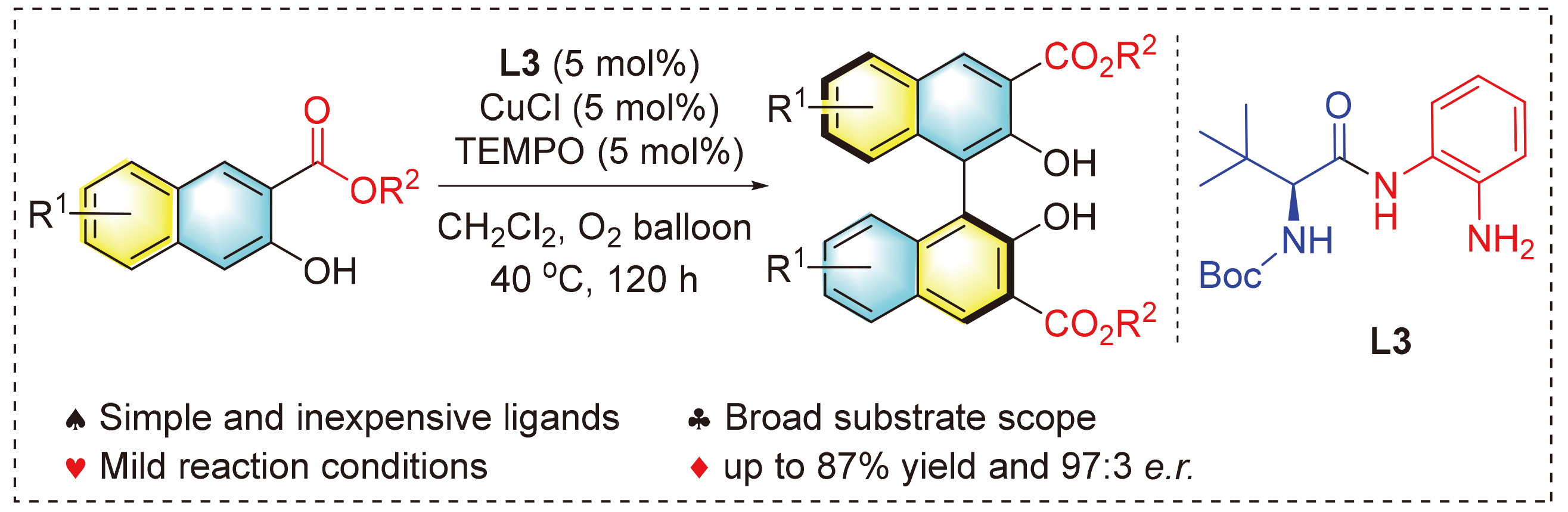
以天然氨基酸为原料, 制备了一系列新型手性酰胺类配体, 并将其与铜盐原位配位, 用于催化3-羟基-2-萘酸酯的不对称氧化自偶联反应. 通过对反应条件的系统优化, 发现在以L3 (5 mol%)为配体, CuCl (5 mol%)为催化剂, 二氯甲烷为溶剂, 2,2,6,6-四甲基哌啶氧化物(TEMPO)/O₂为氧化剂, 40 ℃的反应条件下, 该方法表现出良好的底物耐受性, 以45%~90%的产率和50∶50~97∶3的对映选择性合成了一系列手性1,1'-联二萘酚(BINOL)衍生物.

本文引用格式

王文龙 , 温家旭 , 陈飞 , 薄春博 , 李敏 , 刘宁 , 杜智宏 . 铜催化的3-羟基-2-萘甲酸酯的不对称氧化偶联反应:氨基酸类配体的设计与优化[J]. 有机化学, 2026 , 46(1) : 167 -180 . DOI: 10.6023/cjoc202505013

Abstract

A series of new chiral amide ligands were prepared from natural amino acids and applied to the copper-catalyzed asymmetric oxidative homocoupling reaction of 3-hydroxy-2-naphthoates. By optimizing the reaction conditions, it was found that when using L3 (5 mol%) as the ligand, CuCl (5 mol%) as the catalyst, dichloromethane as the solvent, 2,2,6,6-tetra- methylpiperidine 1-oxyl (TEMPO)/O₂ as the oxidant, and under the reaction condition of 40 ℃, this method exhibited good substrate tolerance. Under these conditions, a series of chiral 1,1'-bi-2-naphthol (BINOL) derivatives were synthesized with yields of 45%~90% and enantioselectivities ranging from 50∶50 to 97∶3.

1 Introduction

Chiral 1,1'-bi-2-naphthol (BINOL) and its derivatives (BINOLs) are a class of very important axially chiral compounds, which exist in many natural products[1-3] and pharmaceutically active molecules[4], and are also used as chiral ligands[5-11] and catalysts[12-13] in asymmetric catalysis. In recent years, due to the diversity of BINOLs structures, they have also demonstrated important application in materials science.[14-15] Given their wide application in various fields, the preparation of optically pure BINOLs compounds has received intense attention over the past 20 years. Compared with the traditional methods of obtaining optically pure BINOLs through enzymatic or chemical resolution, the direct enantioselective oxidative coupling reaction of 2-naphthol and its derivatives is the most direct and effective method for synthesizing this type of compound.[16]
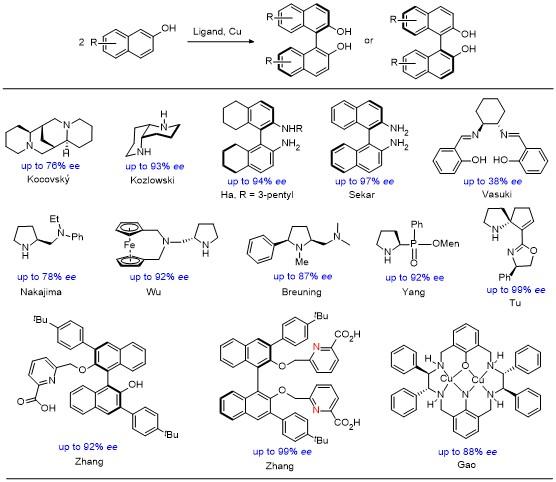
In the past 20 years, researchers have developed a series of methods for synthesizing chiral BINOLs compounds through the direct enantioselective oxidative coupling reaction of 2-naphthol and its derivatives catalyzed by transition metals, such as iron,[17-20] vanadium,[21-24] ruthenium,[25-26] copper.[27-40] Among these studies, the copper catalyzed system has always been a research hotspot. In 1978, Wynberg and co-workers[27] were the first to discover that the combination of stoichiometric copper nitrate and (S)-phenethylamine could catalyse the direct asymmetric homocoupling reaction of 2-naphthol in methanol at room temperature to synthesize chiral BINOL. Since then, several chiral ligands have been identified as effective in this reaction, such as sparteine ligand developed by the Kočov- ský group,[32] amino acid-derived diamine ligand developed by the Nakajima[33] and Breuning groups,[34] 1,5-dia- za-cis-decahydrona-phthalene ligand developed by the Kozlowski group,[35] (R)-H8-BINAM ligand developed by Ha group,[36] Salen-type mononuclear and binuclear copper catalysts developed by the Vasuki,[37] and Gao groups,[38] chiral ferrocenylamine developed by Wu group,[39] and (R)-BINAM-CuCl catalytic system developed by the Sekar group.[40] Recently, some novel chiral ligands has been developed, such as chiral spirocyclic 1,5-N,N-bidentate ligand developed by the Tu group,[28] BINOL-based chiral binuclear copper catalyst developed by the Zhang group,[29,41] and chiral α-amino phosphonate ligand developed by the Yang group (Scheme 1).[30] These research achievements provide diverse paths and strategies for the synthesis of chiral BINOLs compounds from different perspectives, and promote the continuous development of this field.
Scheme 1 Chiral ligand for the copper-catalyzed oxidative coupling of 2-naphthols
Although remarkable progress has been achieved in the research of catalytic systems for the synthesis of chiral BINOLs through the asymmetric coupling reaction of 2- naphthol and its derivatives, the systems have become increasingly mature. However, there is still a pressing need for the development of new chiral ligands that are easily accessible from common sources and can be used in conjunction with inexpensive and abundant copper catalysts to obtain a broader range of chiral BINOL products. Therefore, developing chiral ligands with novel structures, low- cost raw materials, and simple synthesis steps, and enabling them to work in synergy with affordable copper catalysts to obtain a more diverse range of chiral BINOL products remains a crucial research topic in this field. Our group has long been deeply engaged in the research field of chiral catalysts and ligands based on chiral amino acid frameworks[42]. Based on previous research, natural amino acids were used as chiral sources to design and synthesize a series of amide-based ligands, aiming to catalyse the direct asymmetric oxidative homocoupling of 2-naphthol derivatives. Herein, we report a chiral amine ligand- copper-based catalytic system that catalyses the direct asymmetric oxidative homocoupling of 3-hydroxy-2- naphthoates. The method operates under mild reaction conditions and employs inexpensive and readily available raw materials. A series of 3,3'-disubstituted BINOLs can be obtained with good yields and moderate to high enantioselectivities, thus providing an efficient, economical, and green approach for the synthesis of chiral BINOLs.

2 Results and discussion

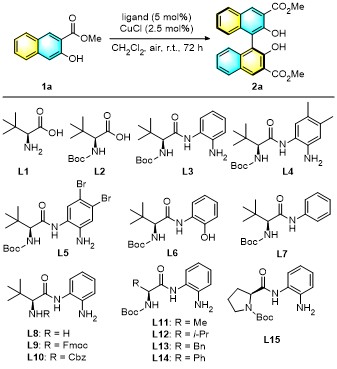
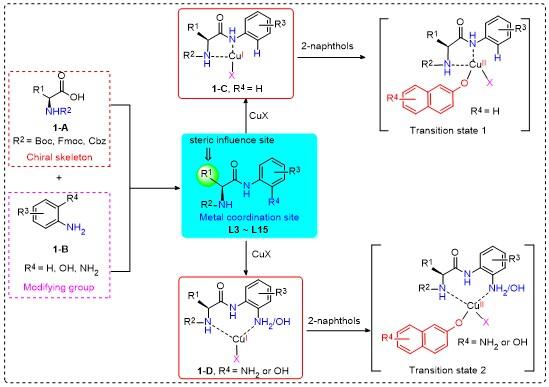
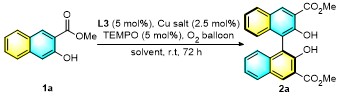
α-Amino acids are a common source of chirality and have great potential for use in the synthesis of chiral catalysts or ligands. To commence our studies, methyl 3-hydr- oxy-2-naphthoate (1a) was selected as a model substrate in the presence of 5 mol% L1 (L-Tle-OH) and 2.5 mol% CuCl in CH2Cl2 at room temperature under air. After 3 d of reaction, the target product 2a was successfully obtained in 20% yield and 58∶42 enantioselectivity ratio (e.r.) (Table 1, Entry 1). Next, an attempt was made to replace L-Tle-OH with Boc-L-Tle-OH (L2), and 2a could be obtained in 32% yield and 54∶46 e.r. (Entry 2). Inspired by this promising result, it is speculated that amino acids can serve as chiral ligands for this type of reaction. Subsequently, a series of amino acid-based ligands were designed and synthesized for the copper-catalyzed asymmetric oxidative coupling of 2-naphthols. Compared with previously reported ligands, these ligands can be prepared in high yields via a single synthetic step, offering distinct advantages of simple synthesis, low cost, and suitability for large-scale production. Furthermore, these ligands, containing 2~3 nitrogen atoms, which can coordinate with copper salts to form complexe 1-C or 1-D with copper salts. The 1-C or 1-D can be used to catalyze the oxidative coupling reaction of 2-naphthols with transition state 1 or 2 (Scheme 2).
Table 1 Optimization of ligands, oxidant and additivea

Entry Ligand Additive Yieldb/% e.r.c
1 L1 20 58∶42
2 L2 32 54∶46
3 L3 15 97∶3
4 L4 10 64∶36
5 L5 11 94∶6
6 L6 Trace
7 L7 23 51∶49
8 L8 20 51∶49
9 L9 25 78∶22
10 L10 9 95∶5
11 L11 42 54∶46
12 L12 41 52∶48
13 L13 40 53∶47
14 L14 37 57∶43
15 L15 36 52∶48
16 L3 TEMPO 18 96∶4
17 L3 O2 20 96∶4
18 L3 TEMPO/O2 28 97∶3
19 L3 m-CPBA NR
20 L3 DDQ NR
21 L3 t-BuOOH NR
22 L3 Ag2CO3 NR
23 L3 4Å MS 16 96∶4
24 L3 MgSO4 47 87∶13
25 L3 Na2SO4 14 91∶9

a Reaction conditions: ligand L (5 mol%) and Cu salt (2.5 mol%) were mixed in 4 mL of CH2Cl2 and stirred at room temperature for 30 min. Then the TEMPO (5 mol%) and 1a (1 mmol, 202 mg) was added to the reaction system, and the reaction is carried out at room temperature for 72 h under the O2 balloon. b Isolated yield. c Determined by HPLC.

Scheme 2 Design of amino acid-based ligands for the copper-catalyzed asymmetric oxidative coupling of 2-naphthols
Next, the activity of these ligands in the model reaction was evaluated. When ligand L3, which was prepared from L2 and 1,2-phenylenediamine, was applied to the reaction, although the yield was only 15%, the e.r. was up to 96.5∶3.5. This indicates that the modification of the carboxyl-terminal of amino acids can effectively enhance the stereoselectivity of the reaction. To further optimize the reaction yield, phenylenediamine was respectively replaced with 4,5-dimethyl-1,2-phenylenediamine, 4,5-dibromo-1,2- phenylenediamine, 2-aminophenol, and aniline to synthesize ligands L4~L7. Unfortunately, no breakthroughs were achieved in either the reaction yield or enantioselectivity. Among them, L4 and L5 showed similar yield with 10% and 11% respectively, and e.r. values of 64∶36 and 94∶6 in sequence; particularly, L6 caused the reaction to stagnate, and L7 produced an almost racemic product, which fully highlights the crucial role of the free amino group on the benzene ring of the amide moiety in maintaining the stereoselectivity of the reaction. Then, the Boc of L3 was removed to obtain L8. However, compared with L3, although the yield slightly increased, only a racemic product was obtained, which means that the protection of the amino group in the amino acid part is indispensable. Thereafter, Fmoc-Tle-OH and Cbz-Tle-OH were selected to prepare ligands L9 and L10, respectively. Compared with L3, the yield of ligand L9 increased to 25%, but the e.r. value was only 78∶22. L10 was basically the same as that of L3, but the yield did not increase further (Entries 9~10). Finally, to improve the reaction yield, an attempt was made to enhance the ligand activity by changing the type of amino acid skeleton. Five natural Boc-amino acids were selected to synthesize new ligands L11~L15. After using these ligands, the reaction yield could be increased to 42%, but the enantioselectivity generally decreased significantly (Table 1, Entries 11~15). Based on the above results, it can be concluded that in this reaction system, only ligands with large steric hindrance can induce ideal enantioselectivity. Therefore, ligand L3 was selected as the optimal ligand.
In order to further increase the reaction yield, we attempted to add oxidants or additives to the reaction system. Firstly, a catalytic amount of 2,2,6,6-tetramethylpiperidine 1-oxyl (TEMPO) was added to the reaction system, but there was no significant increase in the reaction yield (Entry 16, 18% yield). Subsequently, an oxygen balloon was introduced into the reaction system, but the reaction yield did not show a significant improvement either (Entry 17, 20% yield). Next, an attempt was made to use TEMPO and oxygen in combination, and the reaction enantioselectivity was almost unaffected while the yield increased to 28% (Entry 18). Although the yield has increased, it was still far from the ideal result. Therefore, some oxidants, such as meta-chloroperoxybenzoic acid (m-CPBA), 2,3-dichloro- 5,6-dicyano-1,4-benzoquinone (DDQ), t-BuOOH, and Ag2CO3, were screened. However, these oxidants directly caused no reaction (Entries 19~22). Considering that trace amounts of water in the reaction system might affect the reaction yield, an attempt was made to add 4Å MS, MgSO4, and Na2SO4 as desiccants to the reaction system. The addition of 4Å MS and Na2SO4 did not increase the reaction yield (Entries 23, 25), while the addition of anhydrous MgSO4 increased the reaction yield to 47%, but the e.r. decreased to 87∶13 (Entry 24). Based on the above results, we decided not to introduce additional additives into the reaction system. Given that the TEMPO/O2 system can effectively enhance the reaction yield, it was ultimately selected as the oxidant.
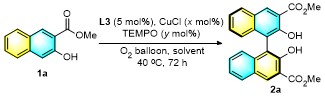
To improve the yield, various copper salts in the reaction were subsequently screened (Table 2). The results show that CuBr, CuI, Cu2O, Cu(OAc)2, and CuSO4 failed to initiate the reaction (Table 2, Entries 1~5). Both CuCl2 and CuBr2 could increase the reaction yield. However, the enantioselectivity of the reaction decreased significantly, with e.r. values of 58∶42 and 53∶47, respectively (Entries 6~7). Although Cu(OTf)2 and CuOAc provided moderate enantioselectivity, the yield was only 6% (Entries 8~9). Therefore, only CuCl is a relatively ideal catalyst (Table 1, Entry 3). Next, to improve the yield, a series of solvents were carefully screened (Table 2). From the reaction results, CHCl3 gave a yield of 18% and 96∶4 e.r. (Entry 10), and this result was almost the same as CH2Cl2. CCl4 gave a yield of 16% and an e.r. value of 63∶37 (Entry 11), and 1,2-dichloroethane (DCE) gave a yield of 21% and an e.r. value of 83∶17 (Entry 12). When the toluene was used as the solvent, the reaction did not proceed. After that, the protic solvents was investigated. It was found that protic solvents can greatly increase the yield of the reaction, but they also led to a significant decrease in the stereoselectivity of the reaction (Entries 14~16). Then, ether solvents were optimized and it was found that when dioxane was used as the solvent, the reaction gave a yield of 65% and 92∶8 e.r. (Entry 17). When tetrahydrofuran was used as the solvent, the reaction gave a yield of 45% and 89∶11 e.r. (Entry 18). When MeCN and dimethyl sulfoxide (DMSO) were used as solvents, the reaction did not proceed (Entries 19~20). Considering the enantioselectivity of the reaction, CH2Cl2 was more suitable as the solvent.
Table 2 Optimization of copper salts and solventsa

Entry [Cu] Solvent Yieldb/% e.r.c
1 CuBr CH2Cl2 NR
2 CuI CH2Cl2 Trace
3 Cu2O CH2Cl2 Trace
4 Cu(OAc)2 CH2Cl2 Trace
5 CuSO4 CH2Cl2 NR
6 CuCl2 CH2Cl2 37 58∶42
7 CuBr2 CH2Cl2 25 53∶47
8 Cu(OTf)2 CH2Cl2 6 79∶21
9 CuOAc CH2Cl2 6 68∶32
10 CuCl CHCl3 18 96∶4
11 CuCl CCl4 16 63∶37
12 CuCl DCE 21 83∶17
13 CuCl PhMe Trace
14 CuCl MeOH 90 56∶44
15 CuCl i-PrOH 76 58∶42
16 CuCl HFIP 74 66∶34
17 CuCl Dioxane 65 92∶8
18 CuCl THF 45 89∶11
19 CuCl MeCN NR
20 CuCl DMSO NR

a Reaction conditions: ligand L3 (5 mol%) and Cu salt (2.5 mol%) were mixed in 4 mL of solvent and stirred at room temperature for 30 min. Then the TEMPO (5 mol%) and 1a (1 mmol, 202 mg) were added to the reaction system, and the reaction was carried out at room temperature for 72 h under the O₂ balloon. b Isolated yield. c Determined by HPLC.

Given that none of the additives, copper salts, and solvents could effectively improve the reaction yield, we hypothesized whether the low yield was due to the relatively large reaction scale. Therefore, the reaction scale was carried out to 0.2 mmol, and it was found that the yield increased from the original 28% to 35% (Table 3, Entry 1). Taking into account the influence of temperature on the reaction, the temperature was increased to 40 ℃ (the boiling point of CH2Cl2). Under this condition, the reaction yield further increased to 46%, and the enantioselectivity was still unaffected (Table 3, Entry 2). After that, the amount of CuCl was increased to 5 mol%, the yield could be further improved, reaching 60% after three days (Table 3, Entry 3). When the amount of CuCl was continuously increased to 10 mol%, the yield and the enantioselectivity also decreased (Table 3, Entry 4). Then, the amount of TEMPO was increased to 10 mol%, the yield almost unchanged, but the enantioselectivity decreased. Finally, the reaction time was extended to 120 h and it was found that the yield could be increased to 87%, and the enantioselectivity still remained (Table 3, Entry 6). Based on the above results, the optimal reaction conditions for the asymmetric oxidative homo-coupling reaction of 3-hydroxy-2-naphth- oates are as follows: the reaction was carried out at 40 ℃, using 5 mol% L3 as the ligand, 5 mol% CuCl as the catalyst, CH2Cl2 as the solvent, and TEMPO/O₂ as the oxidant.
Table 3 Optimization of reaction scale, catalyst and ligand ratio, temperature, and reaction timea

Entry CuCl/mol% TEMPO/mol% Yieldb/% e.r.c
1d 2.5 5 35 96∶4
2 2.5 5 46 96∶4
3 5 5 60 97∶3
4 10 5 42 95∶5
5 5 10 58 89∶11
6e 5 5 87 97∶3

a Reaction conditions: ligand L3 (5 mol%) and Cu salt (as shown in the table.) were mixed in 1 mL of CH2Cl2 and stirred at room temperature for 30 min. Then the TEMPO (as shown in the table) and 1a (0.2 mmol, 40 mg) was added to the reaction system, and the reaction is carried out at 40 ℃ for 72 h under the O₂ balloon. b Isolated yield. c Determined by HPLC. d Under the room temperature. e 120 h.

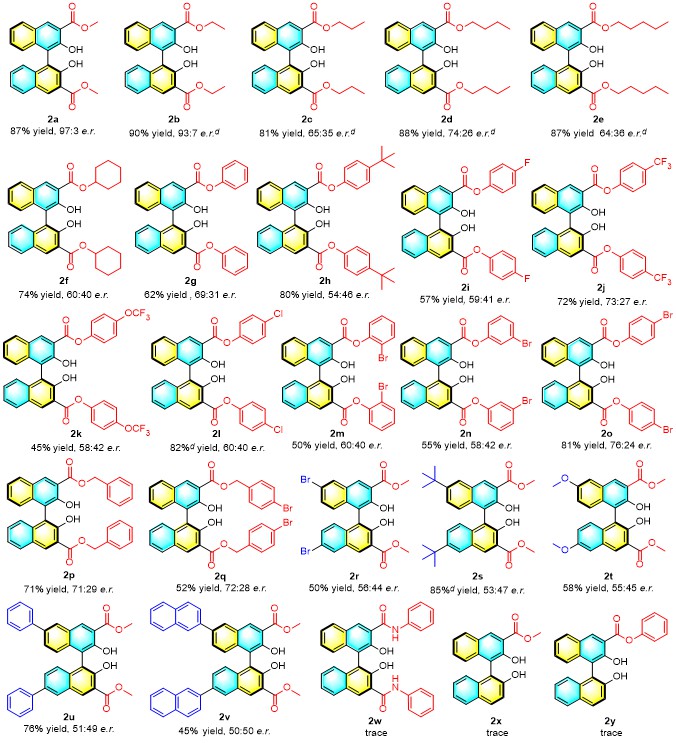
After obtaining the optimal reaction conditions, the range of reactants was screened (Table 4). First, the ester group of 3-hydroxy-2-naphthoates was investigated. When the methyl ester (1a) was replaced by the ethyl ester (1b), the product 2b was obtained in 90% yield and 93∶7 e.r. When the carbon chain of the ester group was further elongated, the reaction yield was almost unaffected, but the enantioselectivity decreased significantly. For example, for the propyl ester 1c, the product 2c was obtained with a yield of 81% and a 65∶35 e.r.; for the butyl ester 1d, the product 2d was obtained with a yield of 88% and 73.5∶ 26.5 e.r.; for the pentyl ester 1e with a longer carbon chain, the product 2e was obtained with a yield of 87% and a lower e.r. value of 63.5∶36.5; the cyclohexyl ester 1f also gave the target product 2f with a similar yield and enantioselectivity (74% yield and 60∶40 e.r.). We speculate that the decrease in enantioselectivity caused by the long chain may be due to the increased steric hindrance, which is not conducive to the catalyst control over the product configuration. Subsequently, the aromatic esters were investigated as substrates. When the phenyl ester 1g was used in the reaction, the product 2g was obtained in 62% yield and 69∶31 e.r. The tert-butylphenyl ester 1h also reacted smoothly and obtained the product 2h with 80% yield and 54∶46 e.r. As substrates, 4-fluorophenyl ester 1i, 4-trifluoromethoxyphenyl ester 1k, 4-chlorophenyl ester 1l, 2-bromophenyl ester 1m, and 3-bromophenyl ester 1n all showed low enantioselectivity (about 60∶40 e.r.). The 4-trifluoromethylphenyl ester 1j and 4-bromophenyl ester 1o could obtain the target products 2j (73∶27 e.r.) and 2o (76∶24 e.r.) with moderate enantioselectivity. After that, benzyl ester 1p was also applied to the reaction system, and the product 2p was obtained in 71% yield and 71∶29 e.r. 4-Bromobenzyl ester 1q also gave the product 2q in 52% yield and 72∶28 e.r. At last, the influence of substituents at the C-6 position of the naphthol skeleton on the reaction was investigated. The experimental results showed that both electron-deficient (2r) and electron-donating (2s and 2t) substituents exhibited low enantioselectivity. When the substituent at the C-6 position of the naphthol skeleton was an aromatic group, the product was almost racemic (2u and 2v). In addition, benzamide 1w was also evaluated as the substrate, yet no reaction occurred. Finally, the cross-coupling reaction between the 3-hydroxy-2-naph- thoates and 2-naphthol was investigated, and only trace amounts of products were obtained (2x and 2y).
Table 4 Enantioselective homocoupling reaction of 3-hydroxy-2-naphthoatesa

a Reaction conditions: Ligand L3 (5 mol%) and CuCl (5 mol%) were mixed in 1 mL of CH2Cl2 and stirred at room temperature for 30 min. TEMPO (5 mol%) and 1 (0.2 mmol) were added to the reaction system, and the reaction proceeded at 40 ℃ for 120 h under the O2 balloon. b Isolated yield. c Determined by HPLC. d The reaction time is 72 h.

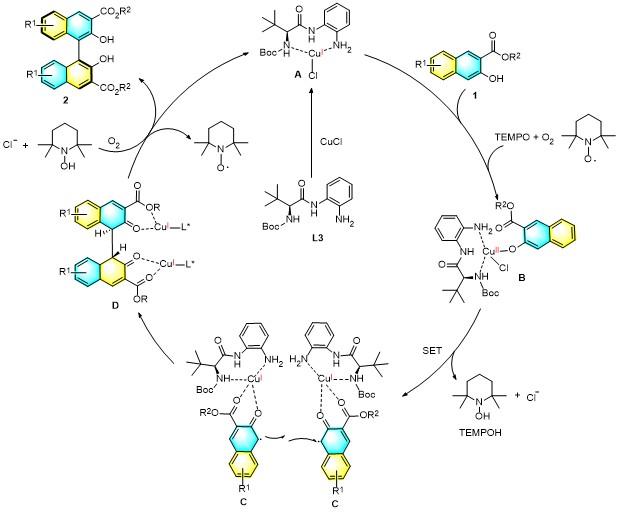
Based on previous studies on the homocoupling reaction of 3-hydroxy-2-naphthoates,[43-44] the reaction was proposed to proceed via a radical mechanism. To verify this hypothesis, 5,5-dimethyl-1-pyrroline N-oxide (DMPO, a radical scavenger) was added to the reaction system. The result showed almost no product formation, thereby confirming that the reaction follows a radical pathway. According to this result, a proposed mechanism is shown in Scheme 3. Firstly, the complex A is formed in situ by the combination of CuCl and the ligand L3. Then, under the action of oxygen and TEMPO, A coordinates with 3-hydr- oxy-2-naphthoate to form the intermediate B. B forms the radical intermediate C through a single-electron transfer process. Subsequently, two molecules of the intermediate C undergo radical coupling to form the intermediate D. Then, the intermediate D undergoes isomerization to yield product 2 and the complex A. A continues to participate in the next catalytic cycle, thus forming a catalytic cycle process.
Scheme 3 Proposed mechanism

3 Conclusions

In summary, a chiral amine ligand-copper catalytic system based on the amino acid skeleton has been developed and successfully applied it to catalyze the asymmetric oxidative coupling reaction of 3-hydroxy-2-naphthoate. This system features mild reaction conditions and requires low amounts of catalysts and ligands. Through the reaction, a series of BINOLs can be obtained with moderate to high yields (up to 87%) and enantioselectivity (up to 97∶3 e.r.). This work demonstrates that the bulky tert-leucine amide ligand holds significant research potential in this type of reaction, and moving forward, we will continue to conduct in-depth investigations into the catalytic system.

4 Experimental section

4.1 General information

Unless otherwise specified, all reagents and solvents were purchased from commercial suppliers and used without further purification. All reactions were carried out in 25 mL Schlenk reaction tubes. Column chromatography was performed on silica gel (200~300 meshes) with petroleum ether (PE) and ethyl acetate (EtOAc) mixture as eluent. Thin-layer chromatography (TLC, 0.2~0.25 mm) and silica gel were purchased from commercial suppliers.
NMR spectra were recorded on a Bruker Avance III HD 400 spectrometer using TMS as an internal standard (400 MHz for 1H NMR and 100 MHz for 13C NMR). Mass spectra (MS) were collected on a Bruker ultrafle Xtreme mass spectrometer.

4.2 General method of ligand synthesis

1-Hydroxybenzotriazole (HOBT, 11 mmol) and amino acid derivative (10 mmol) were added to a 100 mL round bottom flask. The flask was sealed and evacuated. Then, 20 mL of dry tetrahydrofuran was added under nitrogen protection to dissolve the mixture. After stirring at 0 ℃, N,N'-diisopropylcarbodiimide (DIC, 11 mmol) was slowly added. Subsequently, aniline derivatives (10 mmol) dissolved in THF were added. After stirring for 48 h at room temperature, the insoluble matter was removed by filtration. The filter cake was washed with ethyl acetate, and then the filtrate was concentrated under reduced pressure. The residue was then dissolved with ethyl acetate. The organic layer was extracted with saturated brine three times. The organic phase was dried over anhydrous magnesium sulfate and concentrated under reduced pressure. The crude residue was purified by column chromatography using CH2Cl2/MeOH (VV=80∶1) to obtain the target products (L3~L7, L9~L15).
tert-Butyl (S)-(1-((2-aminophenyl)amino)-3,3-dimethyl- 1-oxobutan-2yl)carbamate (L3): White solid (2.82 g, 88% yield), m.p. 169~171 ℃; 1H NMR (400 MHz, DMSO-d6) δ: 9.27 (s, 1H), 7.09 (d, J=7.6 Hz, 1H), 6.95~6.89 (m, 1H), 6.72 (d, J=7.6 Hz, 1H), 6.62 (d, J=8.4 Hz, 1H), 6.54 (t, J=7.6 Hz, 1H), 4.82 (s, 2H), 4.03 (d, J=8.8 Hz, 1H), 1.41 (s, 9H), 0.99 (s, 9H); 13C NMR (100 MHz, DMSO-d6) δ: 170.0, 156.1, 142.9, 126.7, 126.1, 123.4, 116.6, 116.4, 78.7, 62.9, 34.2, 28.7, 27.2; HRMS (ESI) calcd for C17H27- N3O3Na [M+Na]344.1951, found 344.1950.
tert-Butyl (S)-(1-((2-amino-4,5-dimethylphenyl)amino)- 3,3-dimethyl-1-oxobu-tan-2-yl)carbamate (L4): White solid (2.61 g, 75% yield), m.p. 157~159 ℃; 1H NMR (400 MHz, DMSO-d6) δ: 9.18 (s, 1H), 6.82 (s, 1H), 6.56 (d, J=8.4 Hz, 1H), 6.52 (s, 1H), 4.52 (s, 2H), 4.00 (d, J=8.8 Hz, 1H), 2.07 (s, 3H), 2.05 (s, 3H), 1.40 (s, 9H), 0.98 (s, 9H); 13C NMR (100 MHz, DMSO-d6) δ: 169.7, 156.1, 140.5, 134.2, 127.0, 124.0, 121.2, 117.9, 78.7, 62.8, 34.3, 28.7, 27.2, 19.6, 18.8; HRMS (ESI) calcd for C19H32N3O3 [M+H]350.2449, found 350.2444.
tert-Butyl (S)-(1-((2-amino-4,5-dibromophenyl)amino)- 3,3-dimethyl-1-oxobu-tan-2-yl)carbamate (L5): White solid (3.57 g, 75% yield), m.p. 157~159 ℃; 1H NMR (400 MHz, DMSO-d6) δ: 9.32 (s, 1H), 7.54 (s, 1H), 7.08 (s, 1H), 6.76 (d, J=8 Hz, 1H), 5.34 (s, 2H), 3.99 (d, J=8 Hz, 1H), 1.40 (s, 9H), 0.98 (s, 9H); 13C NMR (100 MHz, DMSO-d6) δ: 170.5, 156.3, 143.4, 129.4, 124.1, 120.4, 119.4, 107.7, 78.8, 63.1, 34.1, 28.7, 27.1; HRMS (ESI) calcd for C17H25Br2N3O3Na [M+Na]500.0151, found 500.0160.
tert-Butyl (S)-(1-((2-hydroxyphenyl)amino)-3,3-dime- thyl-1-oxobutan-2-yl)carbamate (L6):[45] White solid (2.61 g, 81% yield); 1H NMR (400 MHz, DMSO-d6) δ: 9.75 (s, 1H), 9.18 (s, 1H), 7.72 (d, J=7.6 Hz, 1H), 6,97~6.92 (m, 1H), 6.91~6.83 (m, 3H), 6.80~6.74 (m, 3H), 4.10 (d, J=8.80 Hz, 1H), 1.40 (s, 9H), 0.98 (s, 9H).
tert-Butyl (S)-(3,3-dimethyl-1-oxo-1-(phenylamino)-bu- tan-2-yl)carbamate (L7): White solid (2.36 g, 77% yield), m.p. 139~141 ℃; 1H NMR (400 MHz, DMSO-d6) δ: 9.98 (s, 1H), 7.61 (d, J=7.6 Hz, 2H), 7.30 (t, J=7.2 Hz, 2H), 7.05 (t, J=7.2 Hz, 1H), 6.62 (d, J=9.2 Hz, 1H), 4.07 (d, J=9.2 Hz, 1H), 1.40 (s, 9H), 0.96 (s, 9H); 13C NMR (100 MHz, DMSO-d6) δ: 170.1, 155.9, 139.1, 129.2, 123.8, 119.8, 78.6, 62.9, 34.7, 28.6, 27.0; HRMS (ESI) calcd for C17H26N2O3Na [M+Na] 329.1843, found 329.1841.
(9H-Fluoren-9-yl)methyl (S)-(1-((2-aminophenyl)ami- no)-3,3-dimethyl-1-oxobutan-2-yl)carbamate (L9): White solid (3.59 g, 81% yield), m.p. 100~102 ℃; 1H NMR (400 MHz, DMSO-d6) δ: 9.37 (s, 1H), 7.89 (d, J=7.2 Hz, 2H), 7.79 (t, J=7.2 Hz, 2H), 7.48 (d, J=9.2 Hz, 1H), 7.42 (t, J=7.6 Hz, 2H), 7.32 (t, J=7.2 Hz, 2H), 7.13 (d, J=7.6 Hz, 1H), 6.94~6.89 (m, 1H), 6.72 (dd, J=0.8, 6.8 Hz, 1H), 6.58~6.53 (m, 1H), 4.81 (s, 2H), 4.31~4.22 (m, 3H), 4.16 (d, J=8.8 Hz, 1H), 1.03 (s, 9H); 13C NMR (100 MHz, DMSO-d6) δ: 169.7, 156.8, 144.4, 144.3, 142.6, 141.2, 128.1, 127.5, 126.6, 126.0, 125.9, 125.9, 123.5, 120.6, 116.7, 116.5, 66.4, 63.2, 47.1, 34.5, 27.2; HRMS (ESI) calcd for C27H30N3O3 [M+H]444.2283, found 444.2287.
Benzyl (S)-(1-((2-aminophenyl)amino)-3,3-dimethyl-1- oxobutan-2-yl)carbamate (L10): White solid (2.77 g, 78% yield), m.p. 131~133 ℃; 1H NMR (400 MHz, DMSO-d6) δ: 9.35 (s, 1H), 7.42~7.26 (m, 5H), 7.11 (d, J=7.6 Hz, 1H), 6.92 (t, J=8 Hz, 1H), 6.73 (d, J=7.6 Hz, 1H), 6.55 (t, J=8 Hz, 1H), 5.07 (s, 2H), 4.81 (s, 2H), 4.12 (d, J=8.8 Hz, 1H), 1.01 (s, 9H); 13C NMR (100 MHz, DMSO-d6) δ: 169.7, 156.8, 142.7, 137.5, 128.8, 128.3, 128.1, 126.6, 126.0, 123.5, 116.7, 116.4, 66.0, 63.4, 34.3, 27.2, 23.8; HRMS (ESI) calcd for C20H26N3O3 [M+H] 356.1979, found 356.1974.
tert-Butyl (S)-(1-((2-aminophenyl)amino)-1-oxo-3- phenyl-propan-2-yl)carbamate (L11): White solid (2.372 g, 85% yield), m.p. 221~223 ℃; 1H NMR (400 MHz, DMSO-d6) δ: 12.13 (s, 1H), 7.54 (d, J=7.2 Hz, 1H), 7.44 (d, J=6.80 Hz, 1H), 7.34 (d, J=7.6 Hz, 1H), 7.15~7.10 (m, 2H), 4.86 (t, J=7.2 Hz, 1H), 1.48 (d, J=7.2 Hz, 3H), 1.40 (s, 9H); 13C NMR (100 MHz, DMSO-d6) δ: 156.9, 155.6, 143.4, 134.7, 122.2, 121.4, 118.9, 111.7, 78.6, 45.5, 28.7, 20.6; HRMS (ESI) calcd for C14H22N3O3 [M+H]280.1661, found 280.1661.
tert-Butyl (S)-(1-((2-aminophenyl)amino)-3-methyl-1- oxobutan-2-yl)carbamate (L12): White solid (2.52 g, 82% yield), m.p. 141~143 ℃; 1H NMR (400 MHz, DMSO-d6) δ: 9.20 (s, 1H), 7.08 (d, J=7.6 Hz, 1H), 6.91 (t, J=8.4 Hz, 2H), 6.71 (d, J=7.6 Hz, 1H), 6.53 (t, J=7.2 Hz, 1H), 4.84 (s, 2H), 3.90 (t, J=7.6 Hz, 1H), 2.05~1.95 (m, 1H), 1.40 (s, 9H), 0.93 (dd, J=9.2, 6.8 Hz, 6H); 13C NMR (100 MHz, DMSO-d6) δ: 171.1, 156.3, 143.0, 126.7, 126.3, 123.3, 116.5, 116.1, 78.6, 61.0, 30.4, 28.7, 19.8, 19.1; HRMS (ESI) calcd for C16H25N3O3Na [M+Na]330.1792, found 330.1794.
tert-Butyl (S)-(1-((2-aminophenyl)amino)-1-oxo-3-phen- ylpropan-2-yl)carbamate (L13): White solid (3.09 g, 87% yield), m.p. 142~144 ℃; 1H NMR (400 MHz, DMSO-d6) δ: 9.21 (s, 1H), 7.36~7.25 (m, 4H), 7.24~7.19 (m, 1H), 7.10 (d, J=8 Hz, 1H), 6.99 (d, J=7.6 Hz, 1H), 6.94~6.88 (m, 1H), 6.69 (d, J=7.6 Hz, 1H), 6.52 (t, J=7.2 Hz, 1H), 4.79 (s, 2H), 4.37~4.27 (m, 1H), 3.02 (dd, J=13.6, 5.6 Hz, 1H), 2.87 (dd, J=4, 9.6 Hz, 1H), 1.34 (s, 9H); 13C NMR (100 MHz, DMSO-d6) δ: 171.2, 156.0, 143.2, 138.5, 129.8, 128.5, 126.8, 126.4, 123.1, 116.4, 116.0, 78.6, 56.7, 28.6; HRMS (ESI) calcd for C20H25N3O3Na [M+Na] 378.1793, found 378.1794.
tert-Butyl (S)-(1-((2-aminophenyl)amino)-1-oxo-3-phen- ylpropan-2-yl)carbamate (L14): White solid (2.76 g, 81% yield), m.p. 130~132 ℃; 1H NMR (400 MHz, DMSO-d6) δ: 9.43 (s, 1H), 7.51 (d, J=7.2 Hz, 2H), 7.43 (d, J=7.6 Hz, 1H), 7.37 (t, J=7.6 Hz, 2H), 7.31 (d, J=7.2 Hz, 1H), 7.07 (d, J=7.6 Hz, 1H), 6.94~6.88 (m, 1H), 6.69 (d, J=7.6 Hz, 1H), 6.52 (t, J=7.6 Hz, 1H), 5.37 (d, J=7.6 Hz, 1H), 4.79 (s, 2H), 1.40 (s, 9H); 13C NMR (100 MHz, DMSO-d6) δ: 169.6, 155.7, 142.7, 139.0, 128.8, 128.2, 127.8, 126.8, 125.9, 123.0, 116.6, 116.2, 79.0, 58.7, 28.7; HRMS (ESI) calcd for C19H23N3O3Na [M+Na] 364.1637, found 364.1637.
tert-Butyl (S)-2-((2-aminophenyl)carbamoyl)pyrroli- dine-1-carboxylate (L15): White solid (1.86 g, 61% yield), m.p. 170~172 ℃; 1H NMR (400 MHz, DMSO-d6) δ: 9.25 (d, J=30 Hz, 1H), 7.09 (dd, J=30, 7.6 Hz, 1H), 6.91 (t, J=8 Hz, 1H), 6.77~6.66 (m, 1H), 6.62~6.47 (m, 1H), 4.82 (d, J=33.6 Hz, 2H), 4.29~4.20 (m, 1H), 3.48~3,34 (m, 2H), 2.28~2.10 (m, 1H), 1.99~1.72 (m, 3H), 1.38 (d, J=23.2 Hz, 9H); 13C NMR (100 MHz, DMSO-d6) δ: 171.9, 171.6, 153.7, 143.5, 142.5, 126.8, 126.7, 126.4, 125.6, 123.7, 123.1, 116.8, 116.6, 116.3, 115.9, 79.3, 79.0, 60.4, 47.2, 47.1, 30.5, 28.6, 28.5, 24.6, 23.8; HRMS (ESI) calcd for C16H23N3O3Na [M+Na]328.1629, found 328.1637.

4.3 Synthesis of L8

The L3 (10 mmol) was placed into a 100 mL round bottom flask and dissolved in 10 mL of dry dichloromethane. Then, 10 mL of trifluoroacetic acid (TFA) was slowly added at 0 ℃ over half an hour. After stirring at room temperature for 12 h, the reaction was complete. Subsequently, the mixture was neutralized with 1 mol/L NaOH solution at 0 ℃ to approximately pH=9.0. The organic phase was separated, and the aqueous phase was extracted with CH2Cl2 (10 mL×3). The combined organic phases were washed once with saturated brine, dried over anhydrous MgSO4, and concentrated under reduced pressure to obtain (S)-2-amino-N-(2-aminophenyl)-3,3-dimethylbutan-amide (L8). White solid (1.61 g, 73% yield), m.p. 97~98 ℃; 1H NMR (400 MHz, DMSO-d6) δ: 9.10 (s, 1H), 7.15 (dd, J=6.4, 1.6 Hz, 1H), 6.93~6.87 (m, 1H), 6.73 (dd, J=6.4, 1.6 Hz, 1H), 6.58~6.53 (m, 1H), 4.79 (s, 2H), 3.08 (s, 1H), 1.91 (s, 2H), 0.97 (s, 9H); 13C NMR (101 MHz, DMSO-d6) δ: 173.4, 142.5, 126.2, 125.6, 123.9, 116.8, 116.5, 63.7, 34.5, 27.1; HRMS (ESI) calcd for C12H19N3ONa [M+Na] 244.1419, found 244.1426.

4.4 General procedure for the synthesis of substrates 1

HOBT (11 mmol) and 3-hydroxy-2-naphthoic acid (10 mmol) were added to a 100 mL round bottom flask and dissolved in 20 mL of THF. Then 11 mmol of N,N'-DIC was added. After stirring for 30 min, the alcohol (10 mmol) was added. After stirring at 50 ℃ for 48 h, the solvent was removed under reduced pressure. The filter cake was washed with EtOAc, concentrated under reduced pressure, and then dissolved in EtOAc. After that, it was extracted with saturated brine three times. The organic phase was dried over anhydrous MgSO4, and concentrated under reduced pressure. The crude residue was purified by column chromatography using petroleum ether/EtOAc (VV=98∶2) to obtain target compounds 1.
Propyl 3-hydroxy-2-naphthoate (1c):[40] Yellow liquid (1.34 g, 55% yield); 1H NMR (400 MHz, CDCl3) δ: 10.53 (s, 1H), 8.48 (s, 1H), 7.81 (d, J=8.4 Hz, 1H), 7.68 (d, J=8.4 Hz, 1H), 7.52~7.45 (m, 1H), 7.35~7.29 (m, 2H), 4.38 (t, J=6.4 Hz, 2H), 1.92~1.82 (m, 2H), 1.09 (t, J=7.6 Hz, 3H).
Butyl 3-hydroxy-2-naphthoate (1d):[46] Yellow liquid (1.34 g, 55% yield); 1H NMR (400 MHz, DMSO-d6) δ: 10.34 (s, 1H), 8.45 (s, 1H), 7.96 (d, J=8.4 Hz, 1H), 7.75 (d, J=8.4 Hz, 1H), 7.55~7.50 (m, 1H), 7.38~7.32 (m, 2H), 4.36 (t, J=6.8 Hz, 2H), 1.79~1.68 (m, 2H), 1.51~1.39 (m, 2H), 0.94 (t, J=7.6 Hz, 3H).
Pentyl 3-hydroxy-2-naphthoate (1e):[40] Yellow liquid (1.34 g, 55% yield); 1H NMR (400 MHz, CDCl3) δ: 10.53 (s, 1H), 8.47 (s, 1H), 7.81 (d, J=8 Hz, 1H), 7.68 (d, J=8.4 Hz, 1H), 7.52~7.45 (m, 1H), 7.34~7.28 (m, 2H), 4.41 (t, J=6.8 Hz, 2H), 1.90~1.81 (m, 2H), 1.51~1.37(m, 4H), 0.96 (t, J=7.2 Hz, 3H).
Cyclohexyl 3-hydroxy-2-naphthoate (1f):[30] Yellow solid (1.35 g, 50% yield); 1H NMR (400 MHz, DMSO-d6) δ: 10.39 (s, 1H), 8.48 (s, 1H), 7.99 (d, J=8.4 Hz, 1H), 7.77 (d, J=8.4 Hz 1H), 7.57~7.52 (m, 2H), 7.39~7.33 (m, 2H), 5.10~5.02 (m, 1H), 2,0~1.92 (m, 2H), 1.83~1.75 (m, 2H), 1.69~1.60 (m, 2H), 1.58~1.51 (m, 1H), 1.50~1.41 (m, 2H), 1.39~1.31 (m, 1H).
Phenyl 3-hydroxy-2-naphthoate (1g):[47] Yellow solid (1.58 g, 60% yield); 1H NMR (400 MHz, CDCl3) δ: 10.14 (s, 1H), 8.75 (s, 1H), 7.87 (d, J=8 Hz, 1H), 7.72 (d, J=8.4 Hz, 1H), 7.57~7.45 (m, 3H), 7.39~7.32 (m, 3H), 7.30~7.26 (m, 2H).
4-(tert-Butyl)phenyl 3-hydroxy-2-naphthoate (1h): Yellow solid (1.92 g, 60% yield), m.p. 85~87 ℃; 1H NMR (400 MHz, CDCl3) δ: 10.19 (s, 1H), 8.74 (s, 1H), 7.87 (d, J=8.4 Hz, 1H), 7.72 (d, J=8.4 Hz, 1H), 7.56~7.47 (m, 3H), 7.38~7.33 (m, 2H), 7.21~7.16 (m, 2H), 1.36 (s, 9H); 13C NMR (100 MHz, CDCl3) δ: 168.9, 156.5, 149.5, 147.8, 138.3, 133.2, 129.6, 129.4, 127.2, 126.6, 126.4, 124.2, 121.0, 113.8, 112.0, 34.6, 31.5; HRMS (ESI) calcd for C21H21O3 [M+H] 321.14852, found 321.14856.
4-fluorophenyl 3-hydroxy-2-naphthoate (1i):[28] Yellow solid (1.39 g, 60% yield); 1H NMR (400 MHz, CDCl3) δ: 10.05 (s, 1H), 8.71 (s, 1H), 7.85 (d, J=8 Hz, 1H), 7.71 (d, J=8.4 Hz, 1H), 7.56~7.51 (m, 1H), 7.38~7.33 (m, 2H), 7.25~7.21 (m, 2H), 7.18~7.13 (m, 2H).
4-(Trifluoromethyl)phenyl 3-hydroxy-2-naphthoate (1j):[48] Yellow solid (1.76g, 53% yield); 1H NMR (400 MHz, CDCl3) δ: 9.94 (s, 1H), 8.74 (s, 1H), 7.87 (d, J=8.4 Hz, 1H), 7.79~7.71 (m, 3H), 7.59~7.53 (m, 1H), 7.44~7.35 (m, 4H).
4-(trifluoromethoxy)phenyl 3-hydroxy-2-naphthoate (1k): Yellow solid (1.39 g, 60% yield), m.p. 126~128 ℃; 1H NMR (400 MHz, CDCl3) δ: 9.99 (s, 1H), 8.73 (s, 1H), 7.87 (d, J=8 Hz, 1H), 7.73 (d, J=8.4 Hz, 1H), 7.59~7.53 (m, 1H), 7.40~7.29 (m, 6H); 13C NMR (100 MHz, CDCl3) δ: 168.4, 156.4, 148.3, 138.4, 133.2, 129.8, 129.4, 127.1, 126.5, 124.4, 123.1, 122.4, 113.3, 112.2; HRMS (ESI) calcd for C18H12F3O4 [M+H]349.0688, found 349.0683.
4-Chlorophenyl 3-hydroxy-2-naphthoate (1l):[40] Yellow solid (1.76 g, 53% yield); 1H NMR (400 MHz, CDCl3) δ: 10.05 (s, 1H), 8.71 (s, 1H), 7.85 (d, J=8 Hz, 1H), 7.71 (d, J=8.4 Hz, 1H), 7.56~7.51 (m, 1H), 7.38~7.32 (m, 2H), 7.26~7.20 (m, 2H), 7.19~7.12 (m, 2H).
2-Bromophenyl 3-hydroxy-2-naphthoate (1m): Yellow solid (1.76 g, 53% yield), m.p. 134~136 ℃; 1H NMR (400 MHz, CDCl3) δ: 9.94 (s, 1H), 8.81 (s, 1H), 7.87 (d, J=8.4 Hz, 1H), 7.73~7.67 (m, 2H), 7.57~7.51 (m, 1H), 7.44~7.39 (m, 1H), 7.37 (s, 1H), 7.36~7.30 (m, 2H), 7.24~7.19 (m, 1H); 13C NMR (100 MHz, CDCl3) δ: 167.8, 156.4, 147.7, 138.5, 133.7, 133.6, 129.8, 129.6, 128.7, 128.0, 127.2, 126.5, 124.3, 123.9, 116.3, 113.2, 112.1; HRMS (ESI) calcd for C17H11BrO3Na [M+Na]364.9789, found 364.9786.
3-Bromophenyl 3-hydroxy-2-naphthoate (1n): Yellow solid (1.76 g, 53% yield), m.p. 135~137 ℃; 1H NMR (400 MHz, CDCl3) δ: 9.98 (s, 1H), 8.69 (s, 1H), 7.85 (d, J=8 Hz, 1H), 7.71 (d, J=8 Hz, 1H), 7.56~7.51 (m, 2H), 7.49~7.45 (m, 2H), 7.39~7.31 (m, 3H), 7.26~7.21 (m, 1H); 13C NMR (100 MHz, CDCl3) δ: 168.2, 156.4, 150.6, 138.4, 133.2, 130.8, 129.8, 129.7, 129.4, 127.1, 126.5, 125.3, 124.3, 122.7, 120.6, 113.2, 112.2, 76.8; HRMS (ESI) calcd for C17H11BrO3Na [M+Na]364.9789, found 364.9784.
4-Bromophenyl 3-hydroxy-2-naphthoate (1o): Yellow solid (1.88 g, 55% yield), m.p. 132~134 ℃; 1H NMR (400 MHz, CDCl3) δ: 10.01 (s, 1H), 8.72 (s, 1H), 7.86 (d, J=8.4 Hz, 1H), 7.72 (d, J=8.4 Hz, 1H), 7.63~7.52 (m, 3H), 7.40~7.34 (m, 2H), 7.21~7.12 (m, 2H); 13C NMR (100 MHz, CDCl3) δ: 168.3, 156.4, 149.2, 138.4, 133.2, 132.8, 129.8, 129.4, 127.1, 126.5, 124.3, 123.5, 119.7, 113.3, 112.1; HRMS (ESI) calcd for C17H12BrO3 [M+H]342.99643, found 342.99646.
Benzyl 3-hydroxy-2-naphthoate1 (1p):[49] Yellow solid (1.58 g, 60% yield); 1H NMR (400 MHz, CDCl3) δ: 10.43 (s, 1H), 8.53 (s, 1H), 7.79 (d, J=8.4 Hz, 1H), 7.69 (d, J=8.4 Hz 1H), 7.54~7.37 (m, 6H), 7.34~7.29 (m, 2H), 5.47 (s, 2H).
4-Bromobenzyl 3-hydroxy-2-naphthoate (1q): Yellow solid (1.76 g, 53% yield), m.p. 122~124 ℃; 1H NMR (400 MHz, CDCl3) δ: 10.34 (s, 1H), 8.47 (s, 1H), 7.76 (d, J=8 Hz, 1H), 7.66 (d, J=8 Hz, 1H), 7.57~7.52 (m, 2H), 7.48~7.45 (m, 2H), 7.35 (d, J=8.4 Hz, 2H), 7.32~7.27 (m, 2H), 5.37 (s, 2H); 13C NMR (100 MHz, CDCl3) δ: 169.6, 156.4, 138.0, 134.2, 132.5, 132.0, 130.2, 129.3, 129.3, 127.0, 126.4, 124.1, 122.8, 114.0, 111.8, 66.6; HRMS (ESI) calcd for C18H13BrO3Na [M+Na]378.9946, found 378.9945.
Methyl 3-hydroxy-7-methoxy-2-naphthoate (1t):[50] Yellow solid (2.08 g, 90% yield); 1H NMR (400 MHz, CDCl3) δ: 10.27 (s, 1H), 8.35 (s, 1H), 7.58 (d, J=9.2 Hz, 1H), 7.26 (s, 1H), 7.19 (dd, J=6.8, 2.4 Hz, 1H), 7.06 (d, J=2.4 Hz, 1H), 4.01 (s, 3H), 3.88 (s, 3H); 13C NMR (100 MHz, CDCl3) δ: 170.4, 156.2, 155.0, 133.6, 130.6, 127.8, 122.7, 114.3, 111.9, 106.3, 55.3, 52.5.

4.5 General procedure for the synthesis of 1u and 1v

A 250 mL round-bottom flask was charged with 6-bromonaphthalen-2-ol (5 mmol), boric acid (5 mmol), K2CO3 (4.14 g, 30 mmol) and Pd(PPh3)4 (0.1 g, 0.09 mmol), then evacuated and charged with argon three times. 1,4-Dioxane (20 mL) and water (5 mL) were added and the reaction was heated at 80 ℃ for 3 d under an argon atmosphere. After cooling to room temperature, the mixture was poured into water and extracted with CH₂Cl₂ three times. The organic layer was washed with brine, and dried using anhydrous MgSO4. The solvent was removed under reduced pressure. The residue was purified by silica gel column chromatography [using a gradient of V(EA)∶V(PE)=1∶20~1∶10]. The obtained product was then washed with ethanol to give compounds 1u and 1v.
Methyl 3-hydroxy-7-phenyl-2-naphthoate (1u):[51] Yellow solid (1.112 g, 80% yield). 1H NMR (400 MHz, CDCl3) δ: 10.47 (s, 1H), 8.56 (s, 1H), 8.0 (s, 1H), 7.80~7.76 (m, 2H), 7.70~7.67 (m, 2H), 7.51~7.46 (m, 2H), 7.41~7.36 (m, 1H), 7.34 (s, 1H), 4.04 (s, 3H).
Methyl 6-hydroxy-[2'-binaphthalene]-7-carboxylate (1v): Yellow solid (1.41 g, 86% yield). m.p. 180~182 ℃; 1H NMR (400 MHz, CDCl3) δ: 10.49 (s, 1H), 8.60 (s, 1H), 8.13 (s, 2H), 7.98~7.87 (m, 4H), 7.85~7.79 (m, 2H), 7.56~7.48 (m, 2H), 7.37 (s, 1H), 4.05 (s, 3H); 13C NMR (100 MHz, CDCl3) δ: 170.3, 156.6, 137.9, 137.1, 136.6, 133.8, 132.8, 129.1, 128.6, 128.2, 127.7, 127.2, 127.0, 126.5, 126.1, 125.8, 125.4, 114.6, 111.6, 52.7; HRMS (ESI) calcd for C22H17O3 [M+H]329.11720, found 329.11722.

4.6 Synthesis of substrate 1s

To a stirred solution of 1a (404 mg, 2 mmol) in t-BuCl (8.7 mL, 80 mmol), a solution of MsOH (0.65 mL, 10 mmol) was added slowly. The reaction was stirred at room temperature for 48 h and then was slowly poured into cold water. The mixture was adjusted to pH=7 by adding NaHCO₃ and then extracted with ethyl acetate (20 mL×3). The combined organic phase was washed with brine, dried over Na2SO4, and evaporated under reduced pressure. The crude residue was purified by column chromatography [V(PE)∶V(EA)=10∶1] to afford methyl 7-(tert-butyl)-3- hydroxy-2-naphthoate (1s)[20] (413 mg, 80% yield) as a yellow solid. 1H NMR (400 MHz, CDCl3) δ: 10.38 (s, 1H), 8.48 (s, 1H), 7.72 (s, 1H), 7.66~7.59 (m, 2H), 7.28 (s, 1H), 4.02 (s, 3H), 1.40 (s, 9H).

4.7 General method of homocoupling reaction

The ligand L3 (5 mol%) and CuCl (5 mol%) were mixed in 1 mL of CH₂Cl₂ and stirred at room temperature for 30 min. TEMPO (5 mol%) and 1 (0.2 mmol) were added to the reaction system, and the reaction proceeded at 40 ℃ for 120 h under the O2 balloon. The reaction was monitored by TLC, the reaction mixture was concentrated and the resulting residue was directly purified on silica gelcolumn chromatography using PE/EA as eluent to obtain products 2.
(S)-Dimethyl 2,2'-dihydroxy-[1'-binaphthalene]-3,3'- dicarboxylate (2a):[40] 35 mg, 87% yield, yellow solid. 1H NMR (400 MHz, CDCl3) δ: 10.70 (s, 2H), 8.69 (s, 2H), 7.97~7.84 (m, 2H), 7.37~7.31 (m, 4H), 7.19~7.12 (m, 2H), 4.05 (s, 6H). HPLC: Chiralpak AD-H column, 254 nm, V(hexane)∶V(isopropanol)=90∶10, flow rate 1 mL/ min, tR(major)=9.840 min, tR(minor)=17.076 min.
(S)-Diethyl 2,2'-dihydroxy-[1'-binaphthalene]-3,3'- dicarboxylate (2b):[40] 39 mg, 90% yield, yellow solid. 1H NMR (400 MHz, CDCl3) δ: 10.81 (s, 2H), 8.69 (s, 2H), 8.00~7.85 (m, 2H), 7.38~7.30 (m, 4H), 7.19~7.13 (m, 2H), 4.58~4.44 (m, 2H), 1.51 (t, J=7.2 Hz, 6H). HPLC: Chiralpak AD-H column, 254 nm, V(hexane)∶V(isopro- panol)=70∶30, flow rate 1 mL/min, tR(major)=5.033 min, tR(minor)=7.068 min.
(S)-Dipropyl 2,2'-dihydroxy-[1'-binaphthalene]-3,3'- dicarboxylate (2c):[40] 37 mg, 81% yield, yellow solid. 1H NMR (400 MHz, CDCl3) δ: 10.81 (s, 2H), 8.68 (s, 2H), 7.95~7.90 (m, 2H), 7.36~7.31 (m, 4H), 7.18~7.13 (m, 2H), 4.46~4.37 (m, 4H), 1.95~1.85 (m, 4H), 1.10 (t, J=7.6 Hz, 6H). HPLC: Chiralpak AD-H column, 254 nm, V(hexane)∶V(isopropanol)=99∶1, flow rate 1 mL/min, tR(major)=6.549 min, tR(minor)=10.352 min.
(S)-Dibutyl 2,2'-dihydroxy-[1'-binaphthalene]-3,3'-di- carboxylate (2d):[40] 43 mg, 88% yield, yellow solid. 1H NMR (400 MHz, CDCl3) δ: 10.81 (s, 2H), 8.67 (s, 2H), 7.95~7.90 (m, 2H), 7.35~7.31 (m, 4H), 7.17~7.13 (m, 2H), 4.50~4.42 (m, 4H), 1.90~1.82 (m, 4H), 1.58~1.51 (m, 4H), 1.03 (t, J=7.6 Hz, 6H). HPLC: Chiralpak AD-H column, 254 nm, V(hexane)∶V(isopropanol)=95∶5, flow rate 1 mL/min, tR(major)=6.429 min, tR(minor)=12.288 min.
(S)-Dipentyl 2,2'-dihydroxy-[1'-binaphthalene]-3,3'-di- carboxylate (2e):[40] 45 mg, 87% yield, yellow solid. 1H NMR (400 MHz, CDCl3) δ: 10.82 (s, 2H), 8.67 (s, 2H), 7.96~7.90 (m, 2H), 7.36~7.30 (m, 4H), 7.19~7.13 (m, 2H), 4.49~4.39 (m, 4H), 1.92~1.83 (m, 4H), 1.53~1.41 (m, 8H), 0.97 (t, J=7.6 Hz, 6H). HPLC: Chiralpak AD-H column, 254 nm, V(hexane)∶V(isopropanol)=99∶1, flow rate 1 mL/min, tR(major)=4.778 min, tR(minor)=8.289 min.
(S)-Dicyclohexyl 2,2'-dihydroxy-[1'-binaphthalene]- 3,3'-dicarboxylate (2f):[30] 40 mg, 74% yield, yellow solid. 1H NMR (400 MHz, CDCl3) δ: 10.91 (s, 2H), 8.67 (s, 2H), 7.95~7.90 (m, 2H), 7.35~7.30 (m, 4H), 7.18~7.12 (m, 2H), 5.19~5.11 (m, 2H), 2.10~1.98 (m, 4H), 1.92~1.82 (m, 4H), 1.80~1.58 (m, 6H), 1.55~1.47 (m, 4H), 1.46~1.38 (m, 2H). HPLC: Chiralpak AD-H column, 254 nm, V(hexane)∶V(isopropanol)=95∶5, flow rate 1 mL/min, tR(major)=7.154 min, tR(minor)=11.129 min.
(S)-Diphenyl 2,2'-dihydroxy-[1'-binaphthalene]-3,3'- dicarboxylate (2g):[40] 33 mg, 62% yield, yellow solid. 1H NMR (400 MHz, CDCl3) δ: 10.44 (s, 2H), 8.95 (s, 2H), 8.01~7.97 (m, 2H), 7.52~7.46 (m, 4H), 7.44~7.38 (m, 4H), 7.37~7.32 (m, 2H), 7.32~7.27 (m, 4H), 7.25~7.20 (m, 2H). HPLC: Chiralpak AD-H column, 254 nm, V(he- xane)∶V(isopropanol)=80∶20, flow rate 1 mL/min, tR(major)=9.037 min, tR(minor)=16.511 min.
(S)-Bis(4-(tert-butyl)phenyl)2,2'-dihydroxy-[1'-bina-phthalene]-3,3'-dicarboxylate (2h): 51 mg, 80% yield. Yellow solid, m.p. 205~207 ℃; 1H NMR (400 MHz, CDCl3) δ: 10.47 (s, 2H), 8.94 (s, 2H), 8.02~7.96 (m, 2H), 7.52~7.47 (m, 4H), 7.42~7.37 (m, 4H), 7.25~7.18 (m, 6H), 1.36 (s, 18H); 13C NMR (100 MHz, CDCl3) δ: 169.2, 154.2, 149.5, 147.8, 137.6, 133.7, 130.0, 129.9, 127.3, 126.7, 124.8, 124.3, 121.0, 117.2, 113.8, 76.7, 34.6, 31.4. HPLC: Chiralpak AD-H column, 254 nm, V(hexane)∶V(isopropanol)=80∶20, flow rate 1 mL/min, tR(major)=5.221 min, tR(minor)=7.258 min.
(S)-Bis(4-fluorophenyl) 2,2'-dihydroxy-[1'-binaphth- alene]-3,3'-dicarboxylate (2i): 32 mg, 57% yield. Yellow solid, m.p. 108~110 ℃; 1H NMR (400 MHz, CDCl3) δ: 10.36 (s, 2H), 8.93 (s, 2H), 8.01~7.95 (m, 2H), 7.42~7.36 (m, 4H), 7.27~7.21 (m, 6H), 7.19~7.12 (m, 4H); 13C NMR (100 MHz, CDCl3) δ: 169.0, 161.9, 154.2, 146.0, 146.0, 137.7, 133.8, 130.1, 130.1, 127.3, 124.8, 124.4, 123.3, 123.2, 117.2, 116.6, 116.4, 113.4; 19F NMR (377 MHz, CDCl3) δ: -115.81; HRMS (ESI) calcd for C34H20- F2O6Na [M+Na]585.1126, found 585.1119. HPLC: Chiralpak AD-H column, 254 nm, V(hexane)∶V(isopro- panol)=70∶30, flow rate 1 mL/min, tR(major)=10.590 min, tR(minor)=34.988 min.
(S)-Bis(4-(trifluoromethyl)phenyl) 2,2'-dihydroxy-2,3- dihydro-[1'-binaphthalene]-3,3'-dicarboxylate (2j): 48 mg, 72% yield. Yellow solid, m.p. 127~129 ℃; 1H NMR (400 MHz, CDCl3) δ: 10.26 (s, 2H), 8.95 (s, 2H), 8.02~7.98 (m, 2H), 7.77 (d, J=8.8 Hz, 4H), 7.46~7.40 (m, 8H), 7.24~7.21 (m, 2H); 13C NMR (100 MHz, CDCl3) δ: 168.5, 154.1, 152.7, 152.7, 137.8, 133.9, 130.3, 130.1, 127.3, 127.2, 127.2, 124.8, 124.5, 122.4, 117.3, 113.2; HRMS (ESI) calcd for C36H19F6O6 [M+H] 661.1091, found 661.1098. HPLC: Chiralpak AD-H column, 254 nm, V(hexane)∶V(isopropanol)=65∶35, flow rate 1 mL/min, tR(major)=9.357 min, tR(minor)=23.775 min.
(S)-Bis(4-(trifluoromethoxy)phenyl) 2,2'-dihydroxy-2,3- dihydro-[1'-binaphthal-ene]-3,3'-dicarboxylate (2k): 31 mg, 45% yield. Yellow solid, m.p. 132~135 ℃; 1H NMR (400 MHz, CDCl3) δ: 10.30 (s, 2H), 8.93 (s, 2H), 8.01~7.97 (m, 2H), 7.43~7.39 (m, 4H), 7.34 (s, 8H), 7.24~7.20 (m, 2H); 13C NMR (100 MHz, CDCl3) δ: 168.7, 154.1, 148.3, 147.2, 137.7, 133.8, 130.2, 130.1, 127.3, 124.7, 124.5, 123.2, 122.4, 117.3, 113.3, 76.7; 19F NMR (377 MHz, Chloroform-d) δ: -58.1; HRMS (ESI) calcd for C36H20F6O8Na [M+Na] 717.0960, found 717.0955. HPLC: Chiralpak AD-H column, 254 nm, V(hexane)∶V(isopropanol)=70∶30, flow rate 1 mL/min, tR(major)=7.011 min, tR(minor)=12.885 min.
(S)-Bis(4-chlorophenyl) 2,2'-dihydroxy-2,3-dihydro- [1'-binaphthalene]-3,3'-dicarboxylate (2l):[40] 49 mg, 82% yield, yellow solid. 1H NMR (400 MHz, CDCl3) δ: 10.32 (s, 2H), 8.92 (s, 2H), 8.02~7.92 (m, 2H), 7.44 (d, J=8.4 Hz, 4H), 7.40 (t, J=4 Hz, 4H), 7.23 (d, J=7.6 Hz, 6H). (HPLC: Chiralpak AD-H column, 254 nm, V(hexane)∶V(isopropanol)=70∶30, flow rate 1 mL/min, tR(major)=12.077 min, tR(minor)=38.621 min).
(S)-Bis(2-bromophenyl)2,2'-dihydroxy-2,3-dihydro-[1'-binaphthalene]-3,3'-dicarboxylate (2m): 34 mg, 50% yield. Yellow solid, m.p. 105~107 ℃; 1H NMR (400 MHz, CDCl3) δ: 10.25 (s, 2H), 9.03 (s, 2H), 8.03~7.98 (m, 2H), 7.69 (dd, J=7.2, 0.8 Hz, 2H), 7.44~7.37 (m, 6H), 7.33 (dd, J=6.8, 1.2 Hz, 2H), 7.27~7.23 (m, 2H), 7.23~7.18 (m, 2H); 13C NMR (100 MHz, CDCl3) δ: 168.0, 154.2, 147.7, 137.8, 134.2, 133.7, 130.2, 130.2, 128.8, 128.0, 127.4, 124.8, 124.4, 123.9, 117.2, 116.3, 113.2, 76.8; HRMS (ESI) calcd for C34H20Br2O6Na [M+Na]704.9524, found 704.9510. HPLC: Chiralpak AD-H column, 254 nm, V(hexane)∶V(isopropanol)=70∶30, flow rate 1 mL/min, tR(major)=7.038 min, tR(minor)=9.165 min.
(S)-Bis(3-bromophenyl) 2,2'-dihydroxy-2,3-dihydro- [1'-binaphthalene]-3,3'-dicarboxylate (2n): 37.5 mg, 55% yield. Yellow solid, m.p. 107~110 ℃; 1H NMR (400 MHz, CDCl3) δ: 10.29 (s, 2H), 8.91 (s, 2H), 8.00~7.95 (m, 2H), 7.51~7.45 (m, 4H), 7.42~7.38 (m, 4H), 7.35 (t, J=8 Hz, 2H), 7.27~7.24 (m, 1H), 7.25~7.19 (m, 3H); 13C NMR (100 MHz, CDCl3) δ: 168.6, 154.1, 150.6, 137.7, 133.8, 130.8, 130.2, 130.1, 129.8, 127.3, 125.3, 124.8, 124.5, 122.7, 120.7, 117.3, 113.3, 76.7; HRMS (ESI) calcd for C34H20Br2O6Na [M+Na]704.9524, found 704.9511. HPLC: Chiralpak AD-H column, 254 nm, V(hexane)∶V(isopropanol)=70∶30, flow rate 1 mL/min, tR(major)=8.139 min, tR(minor)=22.337 min.
(S)-Bis(4-bromophenyl) 2,2'-dihydroxy-2,3-dihydro- [1'-binaphthalene]-3,3'-dicarboxylate (2o): 55 mg, 81% yield. Yellow solid, m.p. 128~130 ℃; 1H NMR (400 MHz, CDCl3) δ: 10.32 (s, 2H), 8.93 (s, 2H), 8.02~7.97 (m, 2H), 7.61 (d, J=8.8 Hz, 4H), 7.44~7.38 (m, 4H), 7.24~7.16 (m, 6H); 13C NMR (100 MHz, CDCl3) δ: 168.7, 154.1, 149.2, 137.7, 133.8, 132.9, 130.2, 130.1, 127.3, 124.7, 124.4, 123.6, 119.8, 117.2, 113.3, 76.7; HRMS (ESI) calcd for C34H20Br2O6Na [M+Na]704.9524, found 704.9511. HPLC: Chiralpak AD-H column, 254 nm, V(hexane)∶V(isopropanol)=65∶35, flow rate 1 mL/min, tR(major)=12.223 min, tR(minor)=34.608 min.
(S)-Dibenzyl 2,2'-dihydroxy-2,3-dihydro-[1'-binaph- thalene]-3,3'-dicarboxylate (2p):[30] 39 mg, 71% yield, Yellow solid; 1H NMR (400 MHz, CDCl3) δ: 10.69 (s, 2H), 8.71 (s, 2H), 7.93~7.88 (m, 2H), 7.55~7.50 (m, 4H), 7.48~7.39 (m, 6H), 7.35~7.30 (m, 4H), 7.16~7.11 (m, 2H), 5.48 (s, 4H). HPLC: Chiralpak AD-H column, 254 nm, V(hexane)∶V(isopropanol)=80∶20, flow rate 1 mL/min, tR(major)=7.607 min, tR(minor)=10.422 min.
(S)-Bis(4-bromobenzyl) 2,2'-dihydroxy-2,3-dihydro- [1'-binaphthalene]-3,3'-dicarboxylate (2q): 37 mg, 52% yield. Yellow solid, m.p. 106~108 ℃; 1H NMR (400 MHz, CDCl3) δ: 10.63 (s, 2H), 8.69 (s, 2H), 7.93~7.88 (m, 2H), 7.57 (d, J=8.4 Hz, 4H), 7.39 (d, J=8.4 Hz, 4H), 7.35~7.31 (m, 4H), 7.18~7.12 (m, 2H), 5.42 (s, 4H); 13C NMR (100 MHz, CDCl3) δ: 169.8, 154.1, 137.3, 134.2, 133.0, 132.0, 130.3, 129.8, 129.6, 127.2, 124.7, 124.1, 122.9, 117.1, 114.0, 66.7; HRMS (ESI) calcd for C36H24- Br2O6Na [M+Na]732.9837, found 732.9836. HPLC: Chiralpak AD-H column, 254 nm, V(hexane)∶V(isopro- panol)=70∶30, flow rate 1 mL/min, tR(major)=10.686 min, tR(minor)=13.703 min.
(S)-Dimethyl 6,6'-dibromo-2,2'-dihydroxy-2,3-dihydro- [1'-binaphthalene]-3,3'-dicarboxylate (2r): 28 mg, 50% yield. Yellow solid, m.p. 102~105 ℃; 1H NMR (400 MHz, CDCl3) δ: 10.75 (s, 2H), 8.59 (s, 2H), 8.07 (d, J=2. Hz, 2H), 7.39 (dd, J=7.2, 2 Hz, 2H), 6.99 (d, J=9.2 Hz, 2H), 4.06 (s, 6H); 13C NMR (100 MHz, CDCl3) δ: 170.2, 154.4, 135.5, 132.7, 132.0, 131.5, 128.2, 126.4, 117.8, 116.8, 115.1, 53.0; HRMS (ESI) calcd for C24H17Br2O6 [M+H] 560.9366, found 560.9365. HPLC: Chiralpak AD-H column, 254 nm, V(hexane)∶V(isopropanol)=70∶30, flow rate 1 mL/min, tR(minor)=19.008 min, tR(major)=33.708 min.
(S)-Dimethyl 6,6'-di-tert-butyl-2,2'-dihydroxy-2,3-di-hydro-[1'-binaphthalene]-3,3'-dicarboxylate (2s): 48 mg, 85% yield. Yellow solid, m.p. 189~191 ℃; 1H NMR (400 MHz, CDCl3) δ: 10.63 (s, 2H), 8.66 (s, 2H), 7.82 (d, J=1.6 Hz, 2H), 7.43 (dd, J=7.2, 2 Hz, 2H), 7.12 (d, J=9.2 Hz, 2H), 4.04 (s, 6H), 1.36 (s, 18H). HPLC: Chiralpak AD-H column, 254 nm, V(hexane)∶V(isopropanol)=90∶10, flow rate 1 mL/min, tR(major)=4.836 min, tR(minor)=6.458 min.
(S)-Dimethyl 2,2'-dihydroxy-6,6'-dimethoxy-2,3-di- hydro-[1'-binaphthalene]-3,3'-dicarboxylate (2t): 27 mg, 58% yield. Yellow solid, m.p. 241~244 ℃; 1H NMR (400 MHz, CDCl3) δ: 10.53 (s, 2H), 8.57 (s, 2H), 7.20 (d, J=2 Hz, 2H), 7.07 (d, J=9.2 Hz, 2H), 7.03 (dd, J=6.8, 2.4 Hz, 2H), 4.04 (s, 6H), 3.90 (s, 6H); 13C NMR (100 MHz, CDCl3) δ: 170.6, 156.2, 152.6, 132.9, 131.1, 128.0, 126.3, 122.7, 117.4, 114.4, 107.0, 55.4, 52.7; HRMS (ESI) calcd for C26H21O8 [M-H] 461.1241, found 461.1245. HPLC: Chiralpak AD-H column, 254 nm, V(hexane)∶V(isopropanol)=70∶30, flow rate 1 mL/min, tR(major)=17.744 min, tR(minor)=20.155 min.
(S)-Dimethyl 2,2'-dihydroxy-6,6'-diphenyl-2,3-dihydro- [1'-binaphthalene]-3,3'-dicarboxylate (2u): 42 mg, 76% yield. Yellow solid, m.p. 237~239 ℃; 1H NMR (400 MHz, CDCl3) δ: 10.77 (s, 2H), 8.77 (s, 2H), 8.13 (d, J=0.8 Hz, 2H), 7.72~7.60 (m, 6H), 7.46 (t, J=7.60 Hz, 4H), 7.36 (t, J=6.8 Hz, 2H), 7.28 (d, J=8.8 Hz, 2H), 4.08 (s, 6H); 13C NMR (100 MHz, CDCl3) δ: 170.6, 154.2, 140.6, 136.8, 136.3, 133.2, 129.4, 128.9, 127.5, 127.5, 127.4, 127.2, 125.3, 116.9, 114.6, 52.8; HRMS (ESI) calcd for C36H27O6 [M+H]555.18022, found 555.180223. (HPLC: Chiralpak AD-H column, 254 nm, V(hexane)∶V(isopropanol)=65∶35, flow rate 1 mL/min, tR(major)=20.949 min, tR(minor)=37.218 min).
(S)-Dimethyl 2'',6'-dihydroxy-2'',3''-dihydro-[2'''-quaternaphthalene]-3'',7'-dicarboxylate (2v): 28 mg, 45% yield. Yellow solid, m.p. 251~254 ℃; 1H NMR (400 MHz, CDCl3) δ: 10.82 (s, 2H), 8.82 (s, 2H), 8.27 (d, J=1.2 Hz, 2H), 8.14~8.10 (m, 2H), 7.97~7.92 (m, 3H), 7.91~7.86 (m, 3H), 7.83 (dd, J=6.8, 1.6 Hz, 2H), 7.78 (dd, J=7.2, 2 Hz, 2H), 7.55~7.47 (m, 4H), 7.36 (d, J=9.2 Hz, 2H), 4.09 (s, 6H); 13C NMR (100 MHz, CDCl3) δ: 170.6, 154.3, 137.9, 136.7, 136.4, 133.7, 133.3, 132.7, 129.5, 128.6, 128.2, 127.9, 127.7, 127.6, 126.4, 126.1, 125.9, 125.5, 125.4, 117.0, 114.7, 52.8; HRMS (ESI) calcd for C44H31O6 [M+H]655.2115, found 655.2112. HPLC: Chiralpak AD-H column, 254 nm, V(hexane)∶V(isopro- panol)=65∶35, flow rate 1 mL/min, tR(major)=40.068 min, tR(minor)=48.010 min.
Supporting Information 1H NMR and 13C NMR spectra for compounds L3~L15, 1c~1q, 1s~1v, and 2a~2v, along with HPLC spectra for 2a~2v. The Supporting Information is available free of charge via the Internet at http://sioc-journal.cn/.
(Cheng, F.)
[1]
Kozlowski M. C.; Morgan B. J.; Linton E. C. Chem. Soc. Rev. 2009, 38, 3193.

DOI PMID

[2]
Bringmann G.; Gulder T.; Gulder T. A. M.; Breuning M. Chem. Rev. 2011, 111, 563.

DOI PMID

[3]
Moore M. J.; Qu S.; Tan C.; Cai Y.; Mogi Y.; Keith D. J.; Boger D. L. J. Am. Chem. Soc. 2020, 142, 16039.

DOI

[4]
Wang Z.; Meng L.; Liu X.; Zhang L.; Yu Z.; Wu G. Eur. J. Med. Chem. 2022, 243, 114700.

DOI

[5]
Brunel J. M. Chem. Rev. 2005, 105, 857.

DOI

[6]
Wencel-Delord J.; Panossian A.; Leroux F. R.; Colobert F. Chem. Soc. Rev. 2015, 44, 3418.

DOI PMID

[7]
Chen Y.; Yekta S.; Yudin A. K. Chem. Rev. 2003, 103, 3155.

PMID

[8]
Cheng J. K.; Xiang S.-H.; Li S.; Ye L.; Tan B. Chem. Rev. 2021, 121, 4805.

DOI

[9]
Cheng J. K.; Xiang S.-H.; Tan B. Acc. Chem. Res. 2022, 55, 2920.

DOI

[10]
Wang Y.-B.; Tan B. Acc. Chem. Res. 2018, 51, 534.

DOI

[11]
Wu J.; Kozlowski M. C. ACS Catal. 2022, 12, 6532.

DOI

[12]
Cheng A.; Zhang L.; Zhou Q.; Liu T.; Cao J.; Zhao G.; Zhang K.; Song G.; Zhao B. Angew. Chem., Int. Ed. 2021, 60, 20166.

DOI

[13]
Xu B.; Shi L.-L.; Zhang Y.-Z.; Wu Z.-J.; Fu L.-N.; Luo C.-Q.; Zhang L.-X.; Peng Y.-G.; Guo Q.-X. Chem. Sci. 2014, 5, 1988.

DOI

[14]
Takaishi K.; Yasui M.; Ema T. J. Am. Chem. Soc. 2018, 140, 5334.

DOI PMID

[15]
Wen K.; Yu S.; Huang Z.; Chen L.; Xiao M.; Yu X.; Pu L. J. Am. Chem. Soc. 2015, 137, 4517.

DOI

[16]
Brunel J. M. Chem. Res. 2007, 107, PR1.

[17]
Egami H.; Katsuki T. J. Am. Chem. Soc. 2009, 131, 6082.

DOI

[18]
Egami H.; Matsumoto K.; Oguma T.; Kunisu T.; Katsuki T. J. Am. Chem. Soc. 2010, 132, 13633.

DOI

[19]
Narute S.; Parnes R.; Toste F. D.; Pappo D. J. Am. Chem. Soc. 2016, 138, 16553.

DOI

[20]
Dyadyuk A.; Vershinin V.; Shalit H.; Shalev H.; More N. Y.; Pappo D. J. Am. Chem. Soc. 2022, 144, 3676.

DOI PMID

[21]
Guo Q.-X.; Wu Z.-J.; Luo Z.-B.; Liu Q.-Z.; Ye J.-L.; Luo S.-W.; Cun L.-F.; Gong L.-Z. J. Am. Chem. Soc. 2007, 129, 13927.

DOI

[22]
Takizawa S.; Katayama T.; Kameyama C.; Onitsuka K.; Suzuki T.; Yanagida T.; Kawai T.; Sasai H. Chem. Commun. 2008, 15, 1810.

[23]
Kumar A.; Sasai H.; Takizawa S. Acc. Chem. Res. 2022, 55, 2949.

DOI

[24]
Barhate N. B.; Chen C. T. Org. Lett. 2002, 4, 2529.

DOI

[25]
Irie R.; Masutani K.; Katsuki T. Synlett 2000, 10, 1433.

[26]
Tanaka H.; Nishikawa H.; Uchida T.; Katsuki T. J. Am. Chem. Soc. 2010, 132, 12034.

DOI

[27]
Feringa B.; Wynberg H. Bioorg. Chem. 1978, 7, 397.

DOI

[28]
Tian J.-M.; Wang A.-F.; Yang J.-S.; Zhao X.-J.; Tu Y.-Q.; Zhang S.-Y.; Chen Z.-M. Angew. Chem., Int. Ed. 2019, 58, 11023.

DOI

[29]
Wang P.; Cen S.; Gao J.; Shen A.; Zhang Z. Org. Lett. 2022, 24, 2321.

DOI

[30]
Zuo Q.-M.; Wu M.-Y.; Han L.-B.; Yang S.-D. Org. Lett. 2024, 26, 5274.

DOI

[31]
Brussee J.; Groenendijk J. L. G.; te Koppele J. M.; Jansen A. C. A. Tetrahedron 1985, 41, 3313.

DOI

[32]
Smrcina M.; Polakova J.; Vyskocil S.; Kocovsky P. J. Org. Chem. 1993, 58, 4534.

DOI

[33]
Nakajima M.; Miyoshi I.; Kanayama K.; Hashimoto S.; Noji M.; Koga K. J. Org. Chem. 1999, 64, 2264.

DOI

[34]
Prause F.; Arensmeyer B.; Fröhlich B.; Breuning M. Catal. Sci. Technol. 2015, 5, 2215.

DOI

[35]
Li X. L.; Yang J.; Kozlowski M. C. Org. Lett. 2001, 3, 1137.

PMID

[36]
Kim K. H.; Lee D. W.; Lee Y. S.; Ko D. H.; Ha D. C. Tetrahedron 2004, 60, 9037.

DOI

[37]
Sabarinathan S.; Vasuki G.; Rao P. S. Eur. J. Chem. 2010, 1, 360.

[38]
Gao J.; Reibenspies J. H.; Martell A. E. Angew. Chem., Int. Ed. 2003, 42, 6008.

DOI

[39]
Zhang Q.; Cui X.; Chen L.; Liu H.; Wu Y. Eur. J. Org. Chem. 2014, 35, 7823.

[40]
Alamsetti S. K.; Poonguzhali E.; Ganapathy D.; Sekar G. Adv. Synth. Catal. 2013, 355, 2803.

DOI

[41]
Shen A.; Xu J.; Gao J.; Cen S.; Zhang Z. J. Org. Chem. 2024, 89, 12842.

DOI

[42]
Wang W.-L.; Lv X.-X.; Chen F.; Liu N.; Du Z.-H. Tetrahedron 2025, 174, 134495.

DOI

[43]
Li X. L.; Hewgley J. B.; Mulrooney C. A.; Yang J. M.; Kozlowski M. C. J. Org. Chem. 2003, 68, 5500.

DOI

[44]
Roithova J.; Milko P. J. Am. Chem. Soc. 2010, 132, 281.

DOI

[45]
Lv X.-X.; Liu N.; Chen F.; Zhang H.; Du Z.-H.; Wang P.; Yuan M.; Da C. S. Org. Biomol. Chem. 2023, 21, 8695.

DOI

[46]
Mamidi N.; Manna D. J. Org. Chem. 2013, 78, 2386.

DOI

[47]
Shen D.; Li L.; Ren T.; Chen K.; Zhang X.; Zhang H.; Zhang S.; Gong P.; Zhang F.; Chao M. J. Org. Chem. 2024, 89, 2691.

DOI

[48]
Zhao X.-J.; Li Z.-H.; Ding T.-M.; Tian J.-M.; Tu Y.-Q.; Wang A.-F.; Xie Y.-Y. Angew. Chem., Int. Ed. 2021, 60, 7061.

DOI

[49]
Corti V.; Thaegersen M. K.; Enemaerke V. J.; Rezayee N. M.; Barlose C. L.; Jorgensen K. A. Chem.-Eur. J. 2022, 28, e202202395.

[50]
Rong M.-G.; Qin T.-Z.; Liu X.-R.; Wang H.-F.; Zi W. Org. Lett. 2018, 20, 6289.

DOI

[51]
Niu C.; Zhou Y.; Chen Q.; Zhu Y.; Tang S.; Yu Z.-X.; Sun J. Org. Lett. 2022, 24, 7428.

DOI

文章导航

/